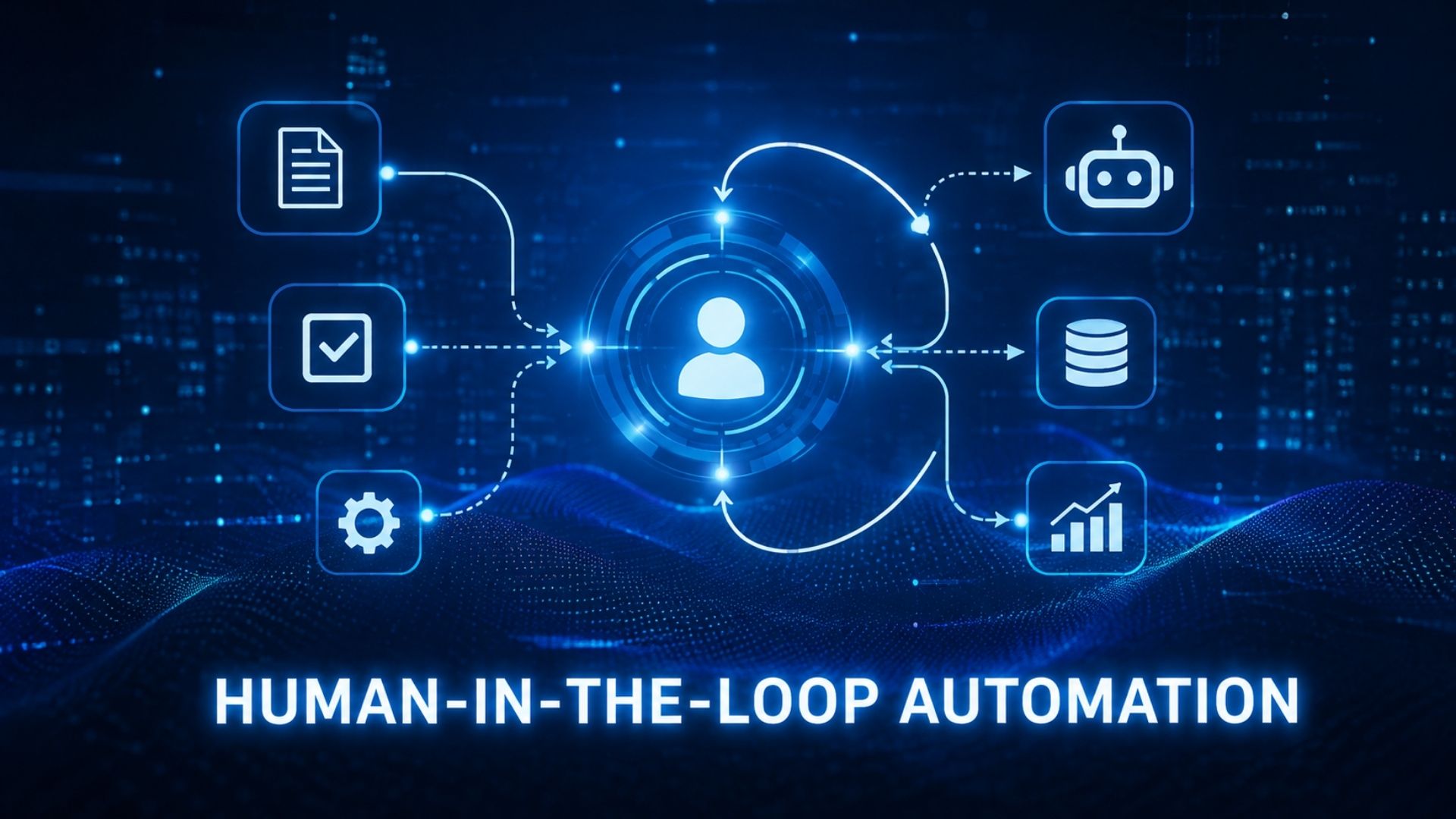

Human in the loop automation combines automated execution with human oversight at critical decision points, allowing people to intervene before high-risk actions take effect. It works best when reviewers have enough context, time, and authority to reject or override an AI decision rather than simply approve it.
For businesses, the challenge is designing the right intervention points without turning automation into a manual bottleneck. This guide explains how human-in-the-loop automation works, when to use it, how it compares with other automation models, and why poorly designed review processes can fail. DIGI-TEXX applies similar human-in-the-loop principles across intelligent document processing and AI training data services to combine automation with human review and quality control.
>>> See more:
- OCR vs Manual Data Entry: Why Automation is the Future
- AI-Powered Data Annotation Technologies Efficiency Accuracy Guide For AI Projects
- AI Document Processing: How It Works, Tools & Use Cases 2026
What Is Human-In-The-Loop Automation?
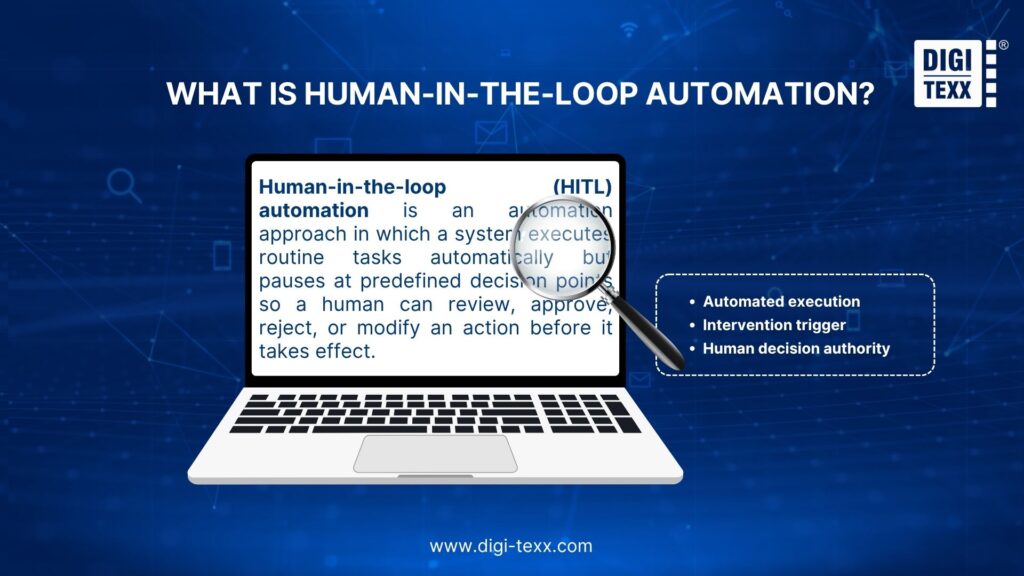
Human-in-the-loop (HITL) automation is a workflow design approach that combines automated processing with human judgment at selected points in the process. The system handles routine or predictable tasks, while people review, guide, correct, approve, reject, or override outputs when human context or judgment is needed.
The model has three essential components: automated execution, which handles the workflow; an intervention trigger, which determines when human review is required; and human decision authority, which gives the reviewer the actual power to change or stop the automated action. This distinction is consistent with HITL systems in which a person can intervene in an individual automated decision before it is implemented.
The four-step HITL automation cycle
- Automated execution: The system processes the task according to predefined rules, models, or workflow logic.
- Intervention trigger: A predefined condition, such as low confidence, an exception, or a high-risk action, activates human review.
- State preservation and review: The workflow pauses while preserving its current state and presents the relevant context to the reviewer.
- Human decision and continuation: The reviewer approves, rejects, or modifies the proposed action, and the workflow resumes accordingly.
The critical point is when human intervention occurs. In an operational HITL workflow, human input should occur at a point where it can meaningfully influence the outcome. Depending on the system design, that may happen before an action is executed, during an iterative process, or when an exception requires human judgment.
For example, in intelligent document processing, AI can extract and validate data automatically, while flagged or low-confidence fields can be routed to human operators for correction before downstream processing.
How Does Human-In-The-Loop Automation Work?
Human-in-the-loop (HITL) automation works by running a workflow until a predefined checkpoint, preserving its current state, routing the case to a human reviewer, waiting for a decision, and then resuming the workflow based on that decision. This checkpoint can be triggered by uncertainty, abnormal values, an irreversible action, or an exception that falls outside the system’s expected operating conditions. In a well-designed workflow, the human review step is enforced before the consequential action executes, rather than being added as a post-execution inspection.
Types Of Intervention Triggers
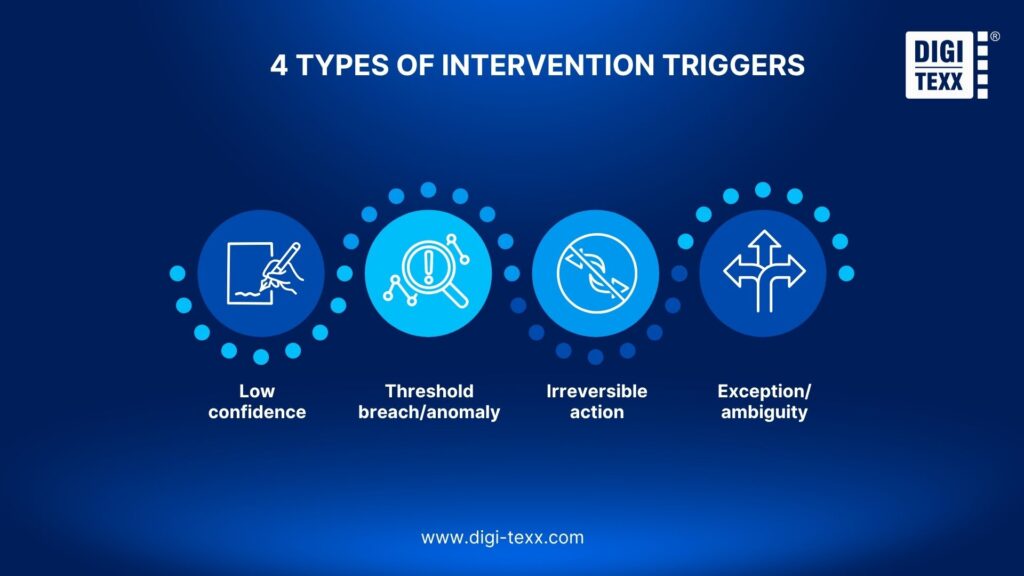
The intervention trigger determines when an automated workflow should stop and request human input. Four common triggers for human intervention include:
| Intervention trigger | Triggered when | Example |
| Low confidence | The model’s confidence score falls below a predefined threshold | An AI extracts an invoice amount with 72% confidence when the review threshold is 85% |
| Threshold breach/anomaly | A value, frequency, or behavioral pattern exceeds an established limit or deviates from the expected range | A payment exceeds $10,000 or a transaction pattern suddenly changes |
| Irreversible action | The next action could create a consequential change that is difficult or impossible to undo | Transferring funds, sending an external email, deleting records, or overwriting data |
| Exception/ambiguity | The input is out of distribution, incomplete, conflicting, or has no established precedent | An identity document contains an unfamiliar format or conflicting information |
Confidence thresholds can be used to route uncertain decisions to reviewers, while high-impact actions can require approval regardless of model confidence.
3 Checkpoint Models
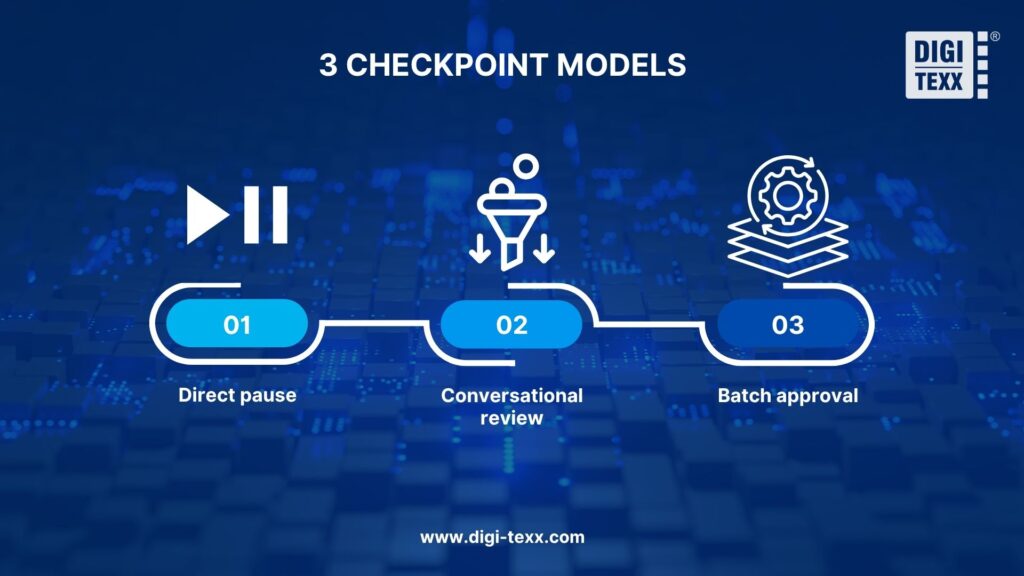
The checkpoint does not have to look the same in every workflow:
- Direct pause: The workflow presents a structured form with the relevant data, proposed action, and approve/reject or edit controls. This works well for discrete operational decisions.
- Conversational review: The system routes the case to a chat interface where the reviewer can inspect the context, ask for clarification, and provide instructions. This is useful for AI agents and complex cases.
- Batch approval: Multiple cases are collected into a review queue, spreadsheet, or worklist so reviewers can process them together. This is more efficient for high-volume, relatively standardized decisions.
Regardless of the interface, state preservation is critical. When a workflow pauses, it should persist the execution state, inputs, intermediate results, and pending decision so that the process can resume from the checkpoint. Without state preservation, the system may have to reconstruct or rerun the entire pipeline after the reviewer responds, increasing latency, compute costs, and the risk of inconsistent results. Modern HITL workflow systems explicitly pause execution and resume subsequent steps after the review is completed.
>>> See more:
- Machine Learning Algorithms for Intelligent Document Classification
- What Is Intelligent Document Recognition (IDR)? Definition & Benefits
- How AI Streamlines PDF Data Extraction from Documents
When Should You Put A Human In The Loop?
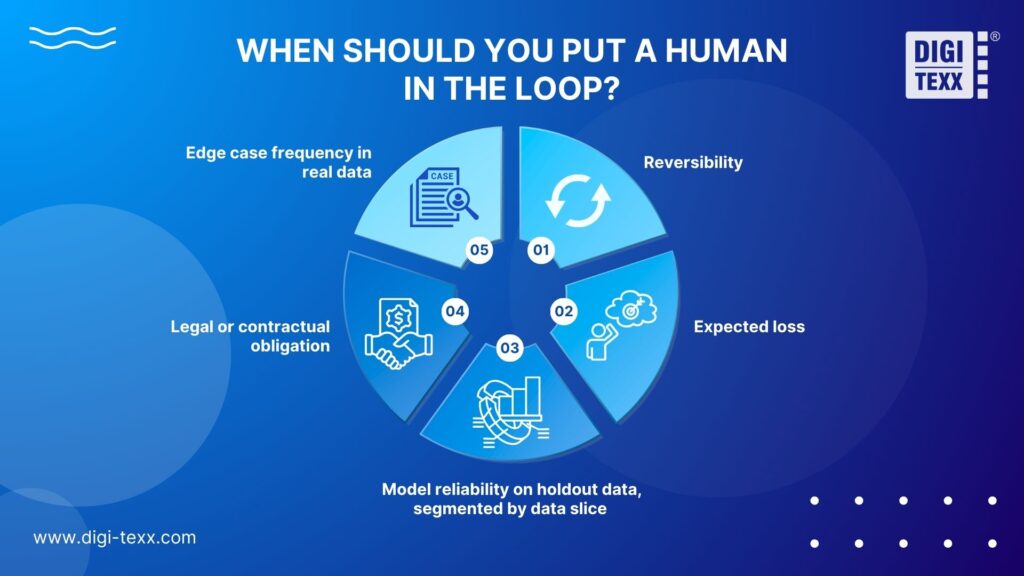
Put a human in the loop when the cost of a missed error is higher than the cost of reviewing the queue. Below that line, human-in-the-loop automation adds latency without adding safety. Above it, skipping review is the more expensive choice, even if it looks cheaper on paper.
5 Decision Criteria
- Reversibility
Ask how long it takes to undo the action if it turns out to be wrong. An action that can be reversed within minutes, such as re-queuing a support ticket, carries a different risk profile than one that cannot be reversed at all, such as an outbound wire transfer or a deleted record. Actions that are difficult, costly, or impossible to reverse generally warrant stronger human oversight. The appropriate threshold should be defined according to the organization’s risk tolerance and business context.
- Expected loss
Estimate expected loss as the probability of failure multiplied by the impact of failure. A low-probability event with catastrophic impact, such as approving a fraudulent high-value transaction, can carry the same expected loss as a high-probability event with minor impact, such as a mistyped shipping address. Route the workflow to a human whenever this calculation crosses a threshold the business defines as unacceptable.
- Model reliability on holdout data, segmented by data slice
Aggregate accuracy hides weak spots. A model can perform well overall while failing on a specific document type, language, or customer segment. Break down holdout performance by segment before deciding which cases can run unattended and which need review.
- Legal or contractual obligation
Some review requirements are not optional. Regulated industries, government contracts, and specific clauses in customer agreements can mandate human sign-off regardless of model confidence. Treat this criterion as a floor, not a starting point for negotiation.
- Edge case frequency in real data
Check how often the workflow encounters inputs the model was not trained to handle. A process with a low edge case rate can run with lighter oversight; a process where 10% or more of cases fall outside the model’s training distribution needs a review layer built in from the start, not bolted on later.
When Not To Use Human-In-The-Loop Automation?
Human-in-the-loop automation is the wrong choice when volume is very high, risk is low, and the action is easily reversible. Forcing review at this intersection does not add safety; it adds fatigue.
Reviewers who spend their day approving low-stakes, reversible actions become conditioned to click approve by default, and that habit follows them into the high-stakes cases where their judgment actually matters. The better design routes low-risk, high-volume, reversible work through full automation, and reserves human review for the cases these five criteria flag as consequential.
Human-in-the-Loop vs. Human-on-the-Loop: What’s the Difference?
These three models differ by when the human acts relative to the automated decision:
- In-the-loop means before the action takes effect
- On-the-loop means monitoring the system with the ability to intervene as needed
- Out-of-the-loop means reviewing outcomes only after the fact, with no ability to change them.
| Model | Position | When intervention happens | Impact on throughput | Suitable risk level |
| Human-in-the-loop | Inside the decision path | Before the action executes | Slower; every flagged case waits for a decision | High risk, low reversibility |
| Human-on-the-loop | Alongside the decision path | During execution, only when the reviewer chooses to step in | Faster; most actions proceed unattended | Medium risk, action is monitored and interruptible |
| Human-out-of-the-loop | Outside the decision path | After execution, via reports or logs | Fastest; no runtime delay | Low risk, fully reversible or low-impact |
In the human-out-of-the-loop model, human involvement occurs outside the operational decision loop, with no direct ability to influence the automated action at the point of execution. Review, if it happens at all, is retrospective rather than preventive.
The principle for choosing between the three models is the reversibility of the action, not the complexity of the underlying AI model. A highly sophisticated model making an irreversible decision, such as authorizing a large payment, still belongs in the human-in-the-loop category.
A simple model making a fully reversible decision, such as sorting a support ticket into a queue, can run human-out-of-the-loop even though the logic behind it is trivial. Model complexity tells you how likely a system is to be right; reversibility tells you how much it costs when it is wrong. Human placement should follow the second question, not the first.
Human-In-The-Loop vs. RPA vs. Full Automation
RPA automates tasks according to fixed, rule-based logic, while human-in-the-loop automation automates the same tasks but keeps decision authority with a person at the points where risk is highest. RPA excels at structured, repetitive work where the rules rarely change; HITL automation adds a layer of judgment for the subset of cases where a fixed rule cannot safely make the call alone.
| Dimension | Full automation | HITL automation | Manual |
| Speed | Fastest; no wait for human input | Moderate; flagged cases wait for review | Slowest; every case depends on human throughput |
| Unit cost | Lowest at scale | Moderate; cost concentrated on flagged cases only | Highest; every case carries full labor cost |
| Edge case handling | Weak; no mechanism to catch unfamiliar inputs | Strong; edge cases route to a person by design | Strong, but inconsistent across reviewers |
| Auditability | Limited to system logs | Strong; decision plus reviewer rationale is captured | Depends entirely on documentation discipline |
| Acceptable risk level | Low-risk, reversible actions only | Medium to high risk, including irreversible actions | Any risk level, constrained by headcount |
Full automation wins on speed and unit cost but has no built-in way to catch the inputs it was not designed to handle.
Manual processing catches almost everything a trained reviewer would catch, but it does not scale and produces inconsistent judgment across reviewers.
Document and data processing workflows that combine automated extraction with human validation on flagged fields typically land in this middle category, capturing most of the speed of full automation while keeping a review layer for the cases that need one.
HITL automation is not a transitional stage on the way to full automation. For many processes, particularly those involving financial transactions, regulated data, or irreversible actions, it is the permanent, correct end state. The goal is not to eventually remove the human; it is to keep automating the parts of the process that do not need judgment while keeping a person at the points that do.
How Does Human-In-The-Loop Work With AI Agents?
For AI agents, organizations should consider placing human approval or authorization checkpoints before consequential external actions, such as sending messages, modifying production data, making payments, or changing access permissions. Reviewing an agent’s output only after it has finished running is entirely too late.
Traditional automation executes linear steps, making end-of-process reviews feasible. Agentic AI, however, chains multiple autonomous reasoning steps and actions together. If an agent hallucinates or makes an incorrect assumption at step two, it treats that error as a verified fact for steps three, four, and five, amplifying the mistake exponentially. By the time the agent completes its chain of thought, the operational damage is already done.
For agents that can perform consequential external actions, tool-call authorization can provide an effective checkpoint for human oversight. The loop pauses the workflow just before the agent attempts to execute a consequential action, ensuring state preservation while a human grants or denies permission to interact with the external system.
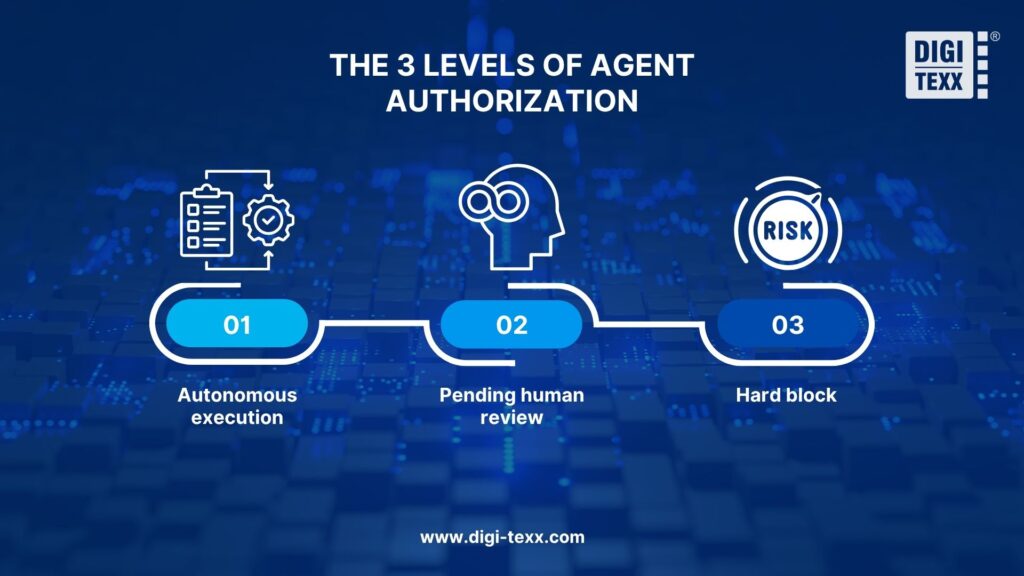
The 3 Levels Of Agent Authorization
To prevent operational bottlenecks while maintaining security, agent permissions must be categorized strictly by action reversibility. A robust agentic workflow uses a three-tier authorization model:
- Autonomous execution: The agent has full permission to read internal data, draft summaries, or perform strictly reversible operations. No human oversight is required, allowing the agent to operate at maximum speed.
- Pending human review: The agent can prepare an action, such as staging an outbound client email, generating a proposed refund, or formatting a CRM database update, but must wait for an explicit human approval trigger before the API call actually fires.
- Hard block: High-risk, highly irreversible actions (e.g., executing financial wire transfers, deleting production data, or granting system access) are entirely restricted from the agent’s toolset. The agent can escalate the case, but the action requires a human to execute it manually.
However, forcing human oversight on every agent-driven micro-decision introduces a dangerous new vulnerability: because agents operate at machine speed, they generate authorization prompts faster than humans can process, inevitably triggering severe approval fatigue that causes the entire human-in-the-loop system to fail.
“More than 40% of agentic AI projects will be canceled before the end of 2027 due to escalating costs, unclear business value, or inadequate risk controls” – Gartner
Real Examples Of Human-In-The-Loop Automation
Real examples of human in the loop automation span across AI agents, intelligent document processing, risk compliance, and content moderation. While software approval gates have existed for decades, modern human-in-the-loop systems require humans to review probabilistic AI outputs rather than deterministic rules.
Because AI models fail unpredictably, reviewers now actively intercept unknown edge cases instead of simply rubber-stamping expected outcomes.
To make these applications easier to evaluate, enterprise automation use cases generally fall into four core categories:
- AI and Automation: Agentic workflows, automated customer support, and DevOps deployment pipelines.
- Document and Data: Invoice processing, intelligent document processing (IDP), and data annotation.
- Risk and Compliance: KYC onboarding, insurance claims processing, and fraud detection.
- Trust and Safety: Policy enforcement and user-generated content moderation.
The table below breaks down exactly how automated execution and human intervention interact across these different operational environments.
| Use Case | What Automation Does | Where Human Steps In | Trigger Type |
| AI Agents & LLM Workflows | Plans multi-step reasoning and queues external tool calls. | Authorizes action before writing to a database or transferring funds. | Irreversible action |
| Invoice & AP Processing | OCR extracts financial data and matches with Purchase Orders. | Validates data when the total amount or vendor ID does not match. | Threshold breach |
| Data Annotation | Pre-labels large datasets using zero-shot or fine-tuned models. | Corrects or adjusts labels exclusively on samples with low prediction scores. | Low confidence |
| Intelligent Document Processing | Extracts structured fields from unstructured scanned files. | Transcribes blurred scans, complex handwriting, and marginal notes. | Low confidence |
| Insurance Claims | Classifies claims and extracts standard policy data. | Reviews cases that exceed automated payout limits or exhibit unusual patterns. | Threshold breach |
| KYC & Onboarding | Cross-references uploaded identity documents with user declarations. | Intervenes when documents do not match, appear forged, or feature unfamiliar formats. | Exception |
| Content Moderation | Flags user-generated text, images, or video for policy violations. | Adjudicates borderline cases that fall into policy gray areas. | Exception |
| Fraud & Security Alerts | Monitors network traffic or transactions and flags anomalies. | Investigates alerts to differentiate between genuine threats and false positives. | Threshold breach |
| Customer Support | Generates contextual, drafted email or chat responses. | Edits the tone, brand voice, or factual accuracy before the message is sent. | Irreversible action |
| DevOps & Access Management | Runs deployment pipelines up to the final staging phase. | Grants admin approval before deploying code to production or elevating user access. | Irreversible action |
Relying entirely on full automation for complex data entry often results in high downstream error costs. When processing degraded physical scans and unstructured handwritten inputs, forcing an AI model to guess creates significant operational risks.
A proven approach to solving this bottleneck is implementing a strict confidence threshold workflow. For example, a recent enterprise intelligent document scanning solution successfully separated standard processing from exception handling to eliminate AI guesswork. The automation layer instantly processed clear, structured data fields at maximum speed. Simultaneously, the system automatically routed low-confidence extractions, such as faded stamps or cursive handwriting, to specialized human operators.
By explicitly designing the workflow around human intervention at the point of failure, the operation maintained optimal processing speed while securing a high rate of data accuracy rate. This outcome proves that selective human review operates as a strategic asset for quality control rather than an operational bottleneck.

>>> See more:
- Outsourced Content Moderation Services: Top Providers & How To Choose 2026
- Fast & Accurate Claims Processing Services
- Top Outsourced Data Annotation Services & Companies 2026
Benefits And Trade-Offs Of HITL Automation
Human-in-the-loop automation balances AI speed with operational safety by reducing error risks, ensuring compliance, handling edge cases, and generating valuable training data. However, this oversight introduces inevitable trade-offs, specifically increased process latency, higher labor costs, and complex queue management requirements.
The 4 Core Benefits Of Human Intervention
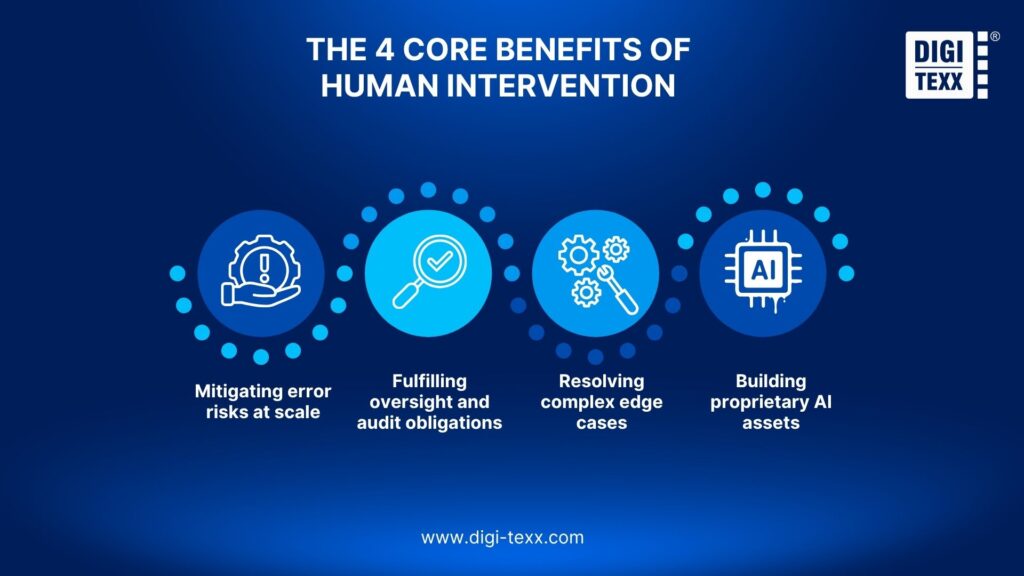
Implementing a human-in-the-loop framework delivers four core advantages: mitigating error risks at scale, fulfilling compliance obligations, resolving unforeseen edge cases, and converting human corrections into model training data.
- Mitigating error risks at scale: Fully autonomous systems often fail silently when processing ambiguous inputs. Adding a human checkpoint prevents these anomalies from corrupting downstream databases. In one DIGI-TEXX intelligent document scanning deployment for a life insurance carrier with 87 branches and 1.5 million customers, adding structured validation rules on top of automated scanning cut the error rate by 90%, from 30% (70% accuracy) to 3% (97% accuracy).
- Fulfilling oversight and audit obligations: Regulated industries require strict documentation for automated decisions. A structured review process captures exactly who approved an action and why, creating a definitive audit trail for compliance and risk management.
- Resolving complex edge cases: Machine learning models inevitably encounter out-of-distribution inputs they were not explicitly trained to handle. Human reviewers possess the contextual awareness to accurately process these rare exceptions without requiring immediate model retraining.
- Building proprietary AI assets: Every time a human corrects an AI output, the system captures that interaction. This continuous feedback loop generates high-quality AI training data that fine-tunes the underlying algorithm. Consequently, the operational cost of human review transforms into a long-term strategic asset that gradually lowers future exception rates.
The Real Costs: Latency, Scalability, And Labor
To build an effective system, organizations must acknowledge the inherent costs of human oversight. Every human checkpoint adds latency to the workflow, increases human resource expenses, and introduces a new potential failure point if the workflow queue is mismanaged.
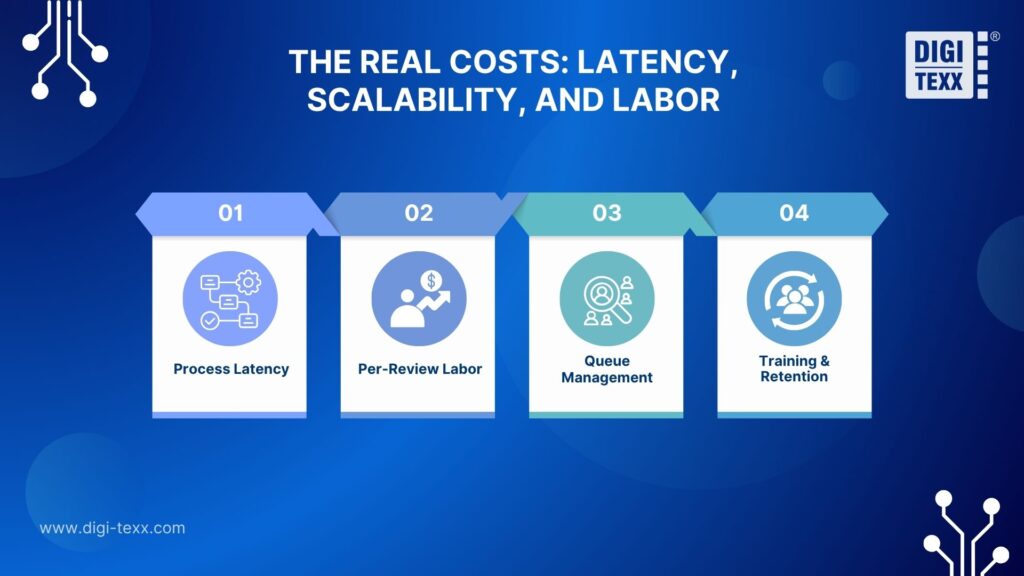
Evaluating these trade-offs requires analyzing four specific cost categories.
| Cost Category | Operational Impact | Scalability Challenge |
| Process Latency | AI generates outputs in milliseconds, but human review takes minutes or hours. | High volumes create severe bottlenecks if reviewer availability fluctuates. |
| Per-Review Labor | Every routed case requires paying a human operator for their time and expertise. | Operating costs scale linearly with exception volume, limiting automation ROI. |
| Queue Management | Preserving the system state requires routing software, UI design, and database storage. | Requires continuous IT maintenance to ensure seamless hand-offs. |
| Training & Retention | Reviewers must deeply understand the business domain to catch subtle AI hallucinations. | High staff turnover degrades review quality and increases onboarding expenses. |
To project the true financial impact of adding a review layer, operations leaders should apply the following baseline estimation formula:
Estimated Daily Review Cost = Total Daily Volume × Human Routing Rate (%) × Average Review Time × Hourly Reviewer Cost
Being transparent about these limitations is crucial for a successful deployment. Organizations cannot scale human-in-the-loop automation infinitely. Operations teams must carefully calculate whether the financial cost of maintaining the review queue is genuinely lower than the expected loss of allowing an automated error to reach production.
Why Does Human-In-The-Loop Automation Fail?
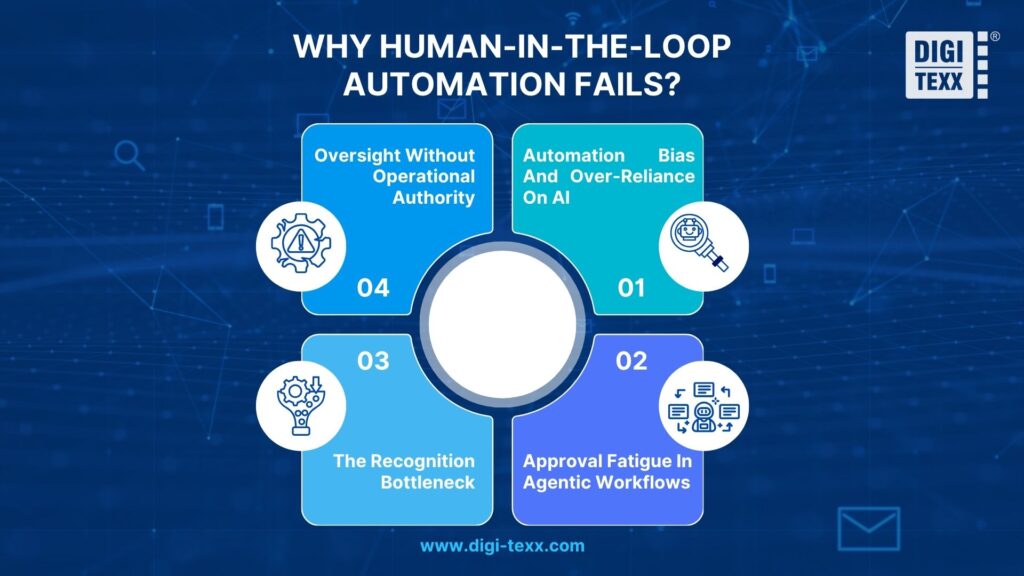
Human-in-the-loop automation fails when reviewers default to approving machine decisions without active cognitive engagement. This systemic failure occurs due to automation bias, severe approval fatigue, lack of domain expertise, or conflicting throughput metrics. Consequently, the review layer devolves into a rubber stamp, offering a dangerous illusion of operational safety.
When a catastrophic error breaches a human-in-the-loop workflow, enterprise leaders often blame the underlying machine learning model. However, the root cause is almost always a failure in the human-computer interaction design. Designing a system with an “Approve” button is easy; designing a system where the human actually evaluates the data before clicking that button requires navigating complex psychological and operational traps.
Automation Bias And Over-Reliance On AI
Automation bias is the deeply ingrained human tendency to over-trust machine-generated recommendations, even when there is clear, contradictory evidence available on the screen. When an AI model is consistently accurate 95% of the time, human operators subconsciously lower their cognitive guard for the remaining 5%.
This phenomenon has been extensively documented across high-stakes environments, including aviation, clinical radiology, criminal justice, and corporate hiring. Foundational human factors research, such as Lisanne Bainbridge’s Ironies of Automation (1983) and Clinical workflow studies by Goddard et al. (2012), demonstrates a consistent and dangerous pattern. The more reliable an automated system appears during initial testing, the less critically humans evaluate its outputs in production.
For example, if an intelligent document processing system extracts invoice data flawlessly for 99 consecutive documents, the human reviewer will likely glance at the 100th document and click approve without truly reading it. The machine’s high accuracy paradoxically creates human negligence, blinding operators to obvious algorithmic errors because they assume the AI is always right.
Approval Fatigue In Agentic Workflows
As WorkOS’s 2026 research on agent governance puts it, approval fatigue is becoming ‘agent governance’s next attack surface’. When AI agents operate at machine speed, they can generate far more authorization requests than a human can meaningfully evaluate.
Reviewers processing massive queues mentally anchor to the first few accurate AI suggestions they see at the start of their workday. As cognitive load increases throughout the shift, their brain seeks energy-saving shortcuts.
They gradually lower their level of scrutiny, stop verifying source documents, and eventually treat the AI’s proposed output as the default correct answer. Instead of actively evaluating the context of each individual case, operators succumb to repetitive motion. This psychological depletion turns a critical safety checkpoint into a mindless administrative chore.
The Recognition Bottleneck
Providing a human with the opportunity to intervene does not guarantee they will actually recognize the need to do so. Across multiple tested oversight strategies in enterprise automation, the actual rate at which reviewers catch a genuinely wrong AI action is inconsistent and, in high-volume settings, low; automation bias research (below) explains why.
This low catch rate highlights the recognition bottleneck. The failure point is not a lack of attention; it is a fundamental inability to comprehend that a perfectly formatted, highly confident AI output is actually a hallucination. Generative AI models and large language models (LLMs) are exceptionally articulate, even when they are entirely wrong. If the reviewer lacks deep domain expertise, they will not spot the subtle logical flaws, fabricated legal citations, or incorrect financial codes buried within a well-written AI response. You cannot intercept an error you do not recognize.
Oversight Without Operational Authority
A system cannot be considered human-in-the-loop if the operator lacks the actual time, specialized knowledge, or operational authority to reject the machine’s decision. In many fast-paced enterprise workflows, reviewers face aggressive throughput Key Performance Indicators (KPIs) and strict Service Level Agreements (SLAs).
These volume-driven metrics implicitly punish workers for slowing down to investigate complex edge cases. If a reviewer is expected to process 60 exceptions per hour, they physically do not have the time to cross-reference ambiguous data. When volume metrics override quality metrics, human oversight exists purely on the organizational chart but vanishes in practice. The human operator is stripped of genuine decision-making power and simply becomes a liability shield to absorb the blame when the automation eventually fails.
5 Signs Your Review Layer Is A Rubber Stamp
To determine if your human-in-the-loop architecture has failed, operations leaders must audit their workflow data for these five critical warning signs:
- Near-zero override rates: Reviewers modify, reject, or escalate less than 1% of the AI’s proposed outputs. A healthy system processing complex edge cases should see a much higher rate of human intervention.
- Declining time-per-review: The average time spent evaluating a case drops significantly toward the end of a shift or workday. This metric is a direct indicator of severe cognitive fatigue and automated clicking.
- Throughput-driven KPIs: Reviewers are penalized for missing volume targets but receive no financial or performance incentives for catching critical AI errors.
- Lack of source context in the UI: The user interface displays the AI’s final answer but hides the original raw data, forcing the reviewer to navigate away to independently verify the facts. Friction prevents verification.
- Batch approval reliance: The software platform allows operators to select multiple flagged exceptions and bulk-approve them simultaneously without requiring individual inspection.
How To Implement Human-In-The-Loop Automation?
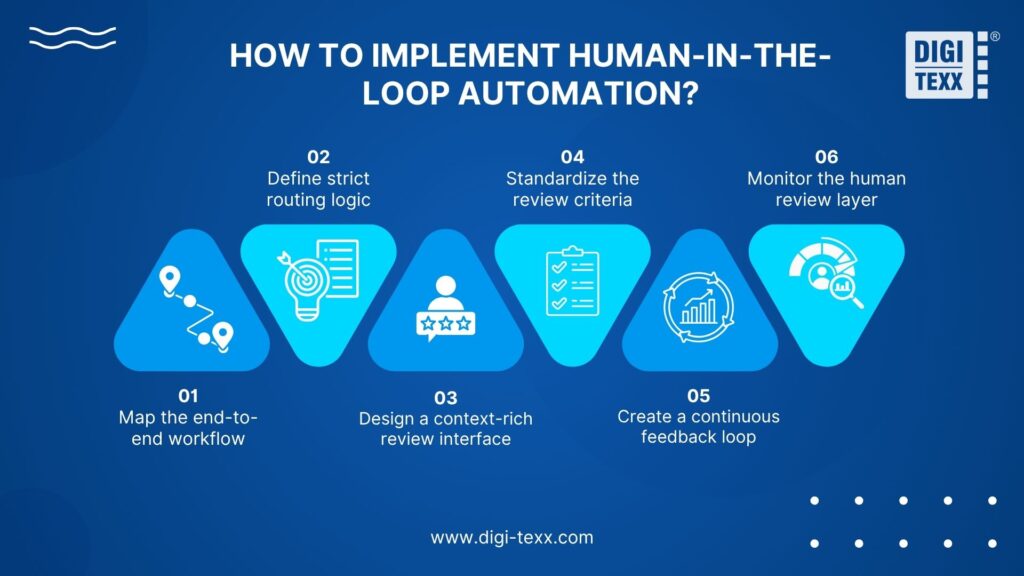
Implementing human-in-the-loop automation starts by mapping your end-to-end workflow to identify irreversible actions, not by selecting a software tool. A successful deployment requires defining clear routing logic, designing a context-rich interface that empowers reviewers to reject AI outputs, and continuously monitoring human performance to prevent approval fatigue.
To build an effective oversight mechanism, operations leaders must approach human review as a distinct operational capability. Following this six-step implementation framework ensures humans remain actively engaged rather than becoming passive observers.
- Map the end-to-end workflow: Document the entire process flow and identify every touchpoint where the AI model makes a decision. Crucially, highlight any action that cannot be easily reversed, such as sending an external email, initiating a financial transfer, or updating a core production database.
- Define strict routing logic: Establish explicit rules based on risk and reversibility. Determine exactly which tasks execute autonomously, which trigger a pending human review based on predefined confidence thresholds, and which require a hard block for entirely manual processing.
- Design a context-rich review interface: This step is where most deployments fail. The user interface must display the original source data alongside the AI’s proposed action on a single screen. If reviewers must switch tabs or dig through secondary systems to verify facts, friction will force them to blindly approve the AI’s output. The UI must provide enough immediate context for the operator to confidently say “no.”
- Standardize the review criteria: Develop a comprehensive grading rubric that includes concrete examples of historical edge cases. Establish explicit operational rules for handling highly ambiguous inputs so reviewers never have to guess company policy on the fly.
- Create a continuous feedback loop: Human corrections should be treated as high-value assets. Automatically pipe every modified output, rejected AI decision, or escalated case back into your database as labeled training data. This mechanism continuously fine-tunes the underlying model and systematically reduces future exception rates.
- Monitor the human review layer: Organizations frequently assume that simply having a human in the loop guarantees safety. You must audit the human reviewers just as strictly as the AI system. Measure individual override rates, enforce strict shift rotations to combat cognitive fatigue, and conduct periodic workflow audits to ensure the oversight layer has not devolved into a rubber stamp.
How To Measure Whether Your Human-In-The-Loop Is Working?
If you cannot measure how many AI decisions your human reviewers actually change, you do not know if you have real oversight or just compliance paperwork. To measure human-in-the-loop effectiveness, organizations must track override rates, error catch rates, and review times to ensure operators are actively evaluating data rather than rubber-stamping it.
Monitoring the AI model is only half of the operational equation; enterprises must monitor their human reviewers with equal rigor. Relying solely on downstream error reports is a reactive strategy. A proactive governance framework uses specific, real-time performance metrics to detect approval fatigue and reviewer disengagement before critical failures reach production.
To maintain a secure review layer, track these six critical operational metrics:
| Metric | What It Measures | Warning Sign |
| Override Rate | The percentage of AI-proposed decisions modified, rejected, or escalated by a human. | Approaching 0% strongly indicates a rubber-stamp review layer. |
| Catch Rate | The percentage of actual AI errors successfully detected and blocked by the reviewer. | A low rate proves the oversight mechanism is ineffective. |
| Time Per Review | The average time an operator spends evaluating a single case. | Decreasing times as a shift progresses indicate severe cognitive fatigue. |
| Inter-Reviewer Agreement | How often two independent reviewers make the exact same decision on the same case. | Low agreement means your review rubric or policy is too ambiguous. |
| Escalation-to-Resolution | The time required to process, investigate, and close highly complex edge cases. | Increasing times signal a lack of available Subject Matter Experts (SMEs). |
| Downstream Error Rate | The volume of AI errors that bypass the human layer and reach production. | This is the ultimate lagging indicator of system-wide failure. |
Who Should Be The Human In The Loop?
The human in the loop must possess deep domain expertise to recognize subtle AI hallucinations and logic failures. Reviewers without a strong business background cannot accurately evaluate complex edge cases, inevitably turning the oversight layer into a dangerous rubber stamp within a matter of weeks.
Assigning the review task to the wrong personnel guarantees system failure. Organizations generally choose between three staffing models for their review layer, depending on their transaction volume, security requirements, and need for operational scalability.
| Staffing Model | Best Suited For | Key Weakness |
| Existing Business Staff | Low volume, highly specialized internal domain knowledge. | Cannot scale. Reviewing is a secondary task and often neglected under pressure. |
| Dedicated In-House Team | Stable, predictable volume involving highly sensitive, air-gapped data. | High fixed overhead costs. Extremely difficult to scale up or down quickly. |
| Outsourced Managed Team | High volume, fluctuating demand, multi-language processing, 24/7 coverage. | Requires strict Service Level Agreements (SLAs), initial domain training, and security vetting. |
Criteria For Selecting A Managed Review Team
When transaction volumes exceed internal capacity, scaling through an outsourced managed team becomes the most viable strategy. However, selecting an enterprise-grade data labeling service provider requires evaluating specific operational capabilities rather than just raw headcount. A capable vendor must demonstrate:
- Information security certifications: Documented compliance with frameworks like ISO 27001, GDPR, or HIPAA to protect sensitive corporate data.
- Multi-layer quality assurance: Independent QA layers that continuously audit the reviewers themselves to catch cognitive fatigue.
- Domain and language proficiency: The ability to provide specialized operators who understand the specific business context, not just generic gig workers.
- Elastic scalability: The infrastructure to absorb massive volume spikes without compromising average review times or SLA commitments.
- Transparent performance reporting: The capability to track and report on critical operational metrics like override rates, catch rates, and inter-reviewer agreement.
Structuring Human Oversight For Long-Term Success
Managing a large-scale oversight team requires strict protocols to combat psychological traps like automation bias. Leading enterprise data annotation services and managed review operations, such as those implemented by DIGI-TEXX, solve this through rigorous workforce management.
Instead of relying on isolated operators, DIGI-TEXX utilizes a structured multi-layer QA process where senior reviewers spot-check baseline annotations. To actively prevent approval fatigue and the recognition bottleneck, they enforce strict shift rotations, breaking up long periods of repetitive cognitive work.
Furthermore, annotators undergo intensive, domain-specific training to master the specific business rules of the dataset they evaluate. By treating human review as a highly specialized, managed discipline, organizations can confidently scale their automation initiatives while maintaining the rigorous cognitive engagement required to keep AI systems safe.

>>> See more:
- Best Data Entry Outsourcing Companies Reviewed For 2026
- Top Data Labeling Service Providers & Annotation Firms
- Professional Digital Transformation Services
Human-In-The-Loop Automation Tools And Platforms
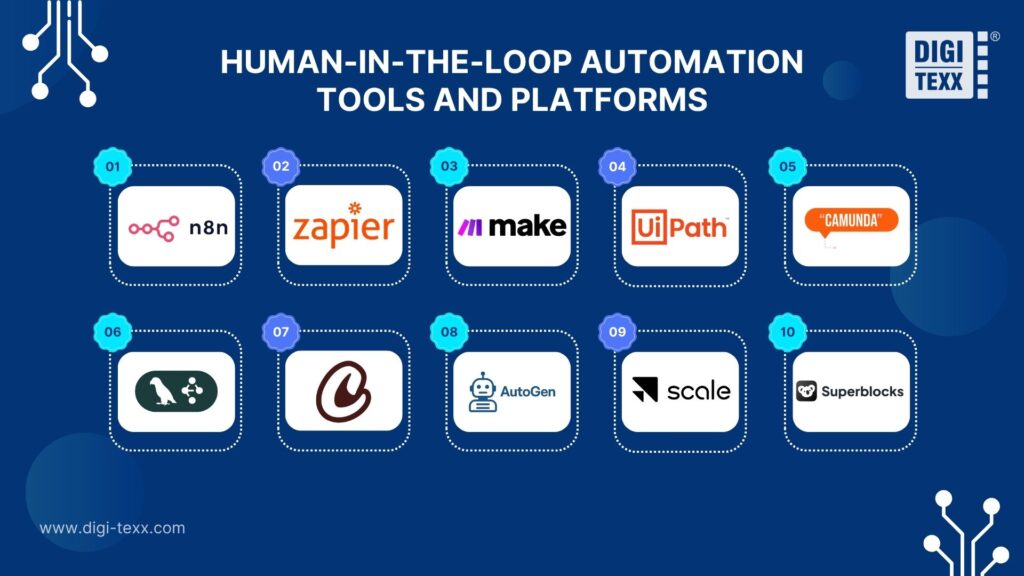
Human-in-the-loop automation tools provide the infrastructure to pause workflows, route exceptions, and securely capture human decisions. Rather than a single software category, HITL capabilities are embedded across workflow automation platforms, RPA solutions, agent orchestration frameworks, and specialized data labeling systems depending on the specific enterprise use case.
Organizations rarely purchase a standalone “human-in-the-loop tool.” Instead, operations leaders implement review checkpoints within their existing automation or AI technology stacks. The correct platform choice depends entirely on whether the enterprise is orchestrating autonomous large language models (LLMs), routing financial documents, or training proprietary machine learning models.
To support commercial investigation, the table below categorizes the leading platforms that facilitate human oversight, organized by their core operational focus.
| Category | Example Platforms | Best For |
| Workflow Automation | n8n, Zapier, Make | Routine business workflows, API integrations, and simple multi-step approval routing. |
| RPA & BPM | UiPath Action Center, Camunda | Complex enterprise processes, legacy system integration, and rule-based exception handling. |
| Agent Orchestration | LangGraph, CrewAI, Microsoft AutoGen | Building autonomous AI workflows and implementing strict tool call interception. |
| Data Labeling & ML | Amazon SageMaker Ground Truth, Scale AI, Labelbox | Managing massive dataset annotation, model fine-tuning, and confidence-based routing. |
| Internal Operations | Retool, Superblocks | Building custom human approval interfaces, dashboards, and exception resolution portals. |
Does The Law Require Human Oversight For AI?
Yes, human oversight is a strict legal requirement for high-risk AI systems deployed in the European Union. However, the compliance timeline recently changed. Following the July 2026 adoption of the Digital Omnibus on AI, the enforcement deadline for standalone high-risk systems shifted to December 2027. Consequently, most existing regulatory guidance is now outdated.
The Legal Requirements: Article 14 And Article 26
Under Article 14 of the EU AI Act, high-risk systems must be designed to allow natural persons to monitor operations, interpret outputs, and prevent over-reliance on algorithmic decisions. Human supervisors must have the technical capability to override the AI, disregard its recommendations, or completely stop the system to prevent operational harm.
Article 14’s design rule connects directly to Article 26, which governs enterprise deployers’ obligations. Under EU law, human oversight only counts as meaningful when it comes from a structured, well-trained review layer, not an administrative rubber stamp.
The Updated 2026 Compliance Timeline
In July 2026, the European Union enacted Regulation (EU) 2026/1744, widely known as the Digital Omnibus on AI. Entering into force on July 27, 2026, this legislation significantly altered the original AI Act enforcement schedule to ease administrative burdens on enterprises and resolve implementation delays.
The revised regulatory deadlines require immediate updates to corporate compliance roadmaps:
- Standalone High-Risk AI (Annex III): The compliance deadline for AI systems used in employment, critical infrastructure, education, and credit scoring is officially deferred to December 2, 2027.
- Embedded AI (Annex I): High-risk AI systems functioning as safety components within larger regulated physical products, such as machinery or aviation technology, are deferred to August 2, 2028.
- Transparency Obligations (Article 50): The requirement to explicitly notify users that they are interacting with an AI system was completely excluded from the delay. This rule remains fully enforceable as of August 2, 2026.
Strategic Recommendation
Enterprise leaders must realign their compliance strategies around the December 2027 enforcement date. However, this extension should not be treated as a pause in operations. Organizations must utilize this critical window to conduct conformity assessments, finalize technical documentation, and build the physical user interfaces required to support legally compliant human intervention.
Disclaimer: The regulatory information provided above is current as of August 2026. This content is intended for technical and operational planning purposes only and does not constitute formal legal advice. For complete statutory definitions, please consult Article 14 of the EU AI Act and your organization’s legal counsel.

>>> See more:
- Why Should Financial Sectors Adopt Digital Onboarding?
- Insurance Outsourcing Services & Tech Solutions
- Document Processing Company: Fast & Professional Services
FAQs About Human-in-the-loop Automation
What Is Human-In-The-Loop Automation?
Human-in-the-loop automation is a workflow framework where artificial intelligence systems process routine tasks while routing exceptions, low-confidence predictions, or critical decisions to human operators for review and validation. This model combines computational speed with human judgment to maintain high accuracy and safety standards.
What Is The Difference Between Human-In-The-Loop And Human-On-The-Loop?
Human-in-the-loop requires direct human intervention to approve or reject specific automated decisions before execution can proceed. In contrast, human-on-the-loop allows the automated system to operate independently while humans monitor performance and retain the authority to intervene or override actions in real time.
Does Agentic AI Need A Human In The Loop?
Yes, autonomous agentic AI systems require a human in the loop to establish operational guardrails, authorize high-stakes transactions, and course-correct when multi-step workflows encounter ambiguous scenarios. Human oversight prevents autonomous agents from compounding errors or drifting from intended business objectives.
Does Human-In-The-Loop Automation Slow Down Automation?
Human-in-the-loop automation can introduce temporary delays when routing complex tasks to human reviewers, but it prevents costly downstream errors and rework. By routing only low-confidence cases to humans while straight-through processing handles routine items, organizations balance processing speed with quality control.
Is Human-In-The-Loop Automation Scalable?
Yes, human-in-the-loop automation scales effectively by using intelligent queuing, confidence score thresholds, and workload balancing to minimize manual bottlenecks. As the AI model learns from reviewer feedback, the volume of exceptions decreases, allowing smaller teams to manage larger transaction volumes over time.
What Is Human-In-The-Loop RPA?
Human-in-the-loop RPA integrates robotic process automation bots with human intervention points to handle unstructured data or unexpected exceptions. When a bot encounters missing information or non-standard inputs, it pauses execution, prompts a human user for the required input or approval, and then resumes automated processing.
How Do You Stop Reviewers From Rubber-Stamping Ai Decisions?
Preventing reviewers from rubber-stamping AI decisions requires tracking audit logs, measuring review duration against expected baseline thresholds, and periodically inserting randomized gold-standard test cases with known correct answers. Additionally, fostering an accountability culture and requiring mandatory rationales for overrides help ensure thorough evaluations.
Which Industries Benefit Most From Human-In-The-Loop Automation?
Industries with strict regulatory requirements and high error costs, such as financial services for loan approvals, healthcare for diagnostic routing, and insurance for claims processing, benefit most from human-in-the-loop automation. These sectors rely on human oversight to ensure compliance, transparency, and consumer protection.
Should You Build An In-House Review Team Or Outsource It?
Building an in-house review team is ideal when handling proprietary data, complex domain expertise, or strict security regulations that demand deep organizational control. Outsourcing is more suitable for high-volume, standardized validation tasks that require flexible scaling and lower operational overhead.
Human-in-the-loop automation is not a stopgap on the way to full autonomy; for irreversible, high-risk decisions, it’s the permanent right answer. The real work isn’t deciding whether to add a checkpoint; it’s designing one reviewers can actually use: enough context, enough time, and real authority to say no.
That’s the same principle DIGI-TEXX applies across intelligent document processing and AI training data, automation where it’s safe, and a human exactly where it should pause.
DIGI-TEXX Contact Information:
🌐 Website: https://digi-texx.com/
📞 Hotline: +84 28 3715 5325
✉️ Email: [email protected]
🏢 Address:
- Headquarters: Anna Building, QTSC, Trung My Tay Ward
- Office 1: German House, 33 Le Duan, Saigon Ward
- Office 2: DIGI-TEXX Building, 477-479 An Duong Vuong, Binh Phu Ward
- Office 3: Innovation Solution Center, ISC Hau Giang, 198 19 Thang 8 street, Vi Tan Ward
References
- Gartner, Inc. (2025, June 25). Gartner Predicts Over 40% of Agentic AI Projects Will Be Canceled by End of 2027. Gartner Newsroom. https://www.gartner.com/en/newsroom/press-releases/2025-06-25-gartner-predicts-over-40-percent-of-agentic-ai-projects-will-be-canceled-by-end-of-2027
- White & Case LLP. (2026). EU AI Omnibus Enters Into Force, Amending the AI Act. White & Case Insights. https://www.whitecase.com/insight-alert/eu-ai-omnibus-enters-force-amending-ai-act
- Bainbridge, L. (1983). Ironies of Automation. Automatica, 19(6), 775–779. https://www.sciencedirect.com/science/article/abs/pii/0005109883900468
- Goddard, K., Roudsari, A., & Wyatt, J. C. (2012). Automation bias: a systematic review of frequency, effect mediators, and mitigators. Journal of the American Medical Informatics Association, 19(1), 121–127. https://pubmed.ncbi.nlm.nih.gov/21685142/
- Paktiti, M. (2026). Approval Fatigue Is Agent Governance’s Next Attack Surface. WorkOS Blog. https://workos.com/blog/approval-fatigue-agent-governance