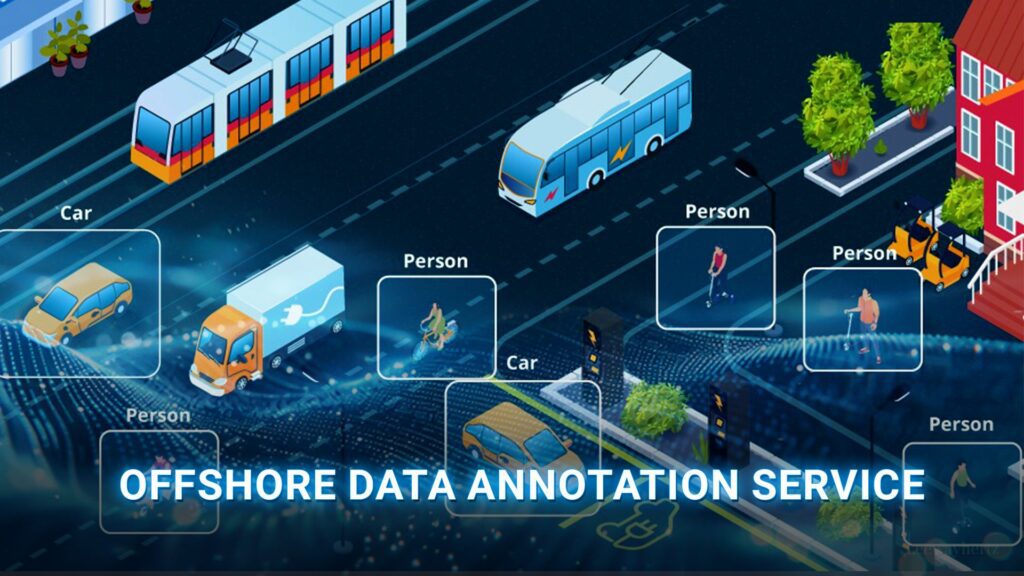
Data annotation services label and structure data for machine learning projects. Depending on the task, this may involve classifying images, identifying objects in video, labeling entities in text, transcribing audio or aligning information across multiple data types.
This guide compares 15 data annotation providers and explains how to evaluate service scope, quality controls, security, pricing and delivery. The right choice depends on your dataset, required expertise and acceptance criteria rather than a single provider ranking.
DIGI-TEXX provides data annotation services. Its published service information and project examples are included alongside other providers to help you assess project fit. For a practical example, see DIGI-TEXX’s vehicle annotation case study for traffic monitoring.
>>> See more:
- In-House vs Outsourced Data Entry: Which One is Right for Your Business?
- Data Entry Outsourcing for Healthcare: Ensuring Accuracy & Compliance
- What Is A Back Office Service? Examples, Benefits, And Cost In 2026
- What are the 6 steps of the data analysis process?
What Is Data Annotation?
Data annotation is the process of adding labels or structured information to data so that a machine learning system can learn from or be evaluated against defined examples. Labels may identify categories, entities, relationships, locations, speech or events, depending on the task.
Examples include drawing boxes around objects in images, labeling customer intent in text, transcribing speech and maintaining object identities across video frames. Multimodal projects may connect labels across more than one data type.
Data annotation services can include project setup, guideline development, labeling, review and delivery in an agreed output schema. Annotation quality and model performance are different measures: reliable labels support training and evaluation but do not by themselves guarantee a model’s performance.
High-quality annotation directly influences AI performance. Accurate labels improve model precision, reduce bias, and accelerate training, while inconsistent annotations can lead to poor predictions, higher retraining costs, and unreliable AI systems. This is why many organizations choose to outsource data annotation services to experienced providers that combine skilled human annotators, AI-assisted workflows, and rigorous quality assurance processes.

How Outsourced Data Annotation Services Work
Professional data annotation companies follow a structured workflow to deliver accurate, scalable, and secure labeled datasets for AI and machine learning projects. Although every data annotation service provider has its own internal process, most outsourced data annotation services include project planning, data preparation, annotation guideline development, labeling, quality assurance, and dataset delivery. Understanding this workflow helps businesses evaluate annotation service vendors, compare data annotation companies, and choose the right partner for long-term AI initiatives.
Stage 1: Project scoping and requirement analysis
Define the intended model task, data types, annotation methods, dataset volume, delivery schedule, and acceptance criteria. Specify the unit used to estimate work, such as images, records, documents, audio minutes, or video frames.
The client should explain how the labels will be used and which mistakes would make them unsuitable. For example, a document project may require specific entity fields, while an audio project may require speaker labels as well as a transcript. The provider can then identify staffing and tool and review requirements. Agree on what is included in the quotation, how scope changes will be handled, and who approves deliverables. The output of this stage is a shared project brief.
Stage 2: Data preparation and onboarding
Check file quality, metadata, and access permissions. Select representative samples, including difficult examples relevant to the task. Confirm transfer methods, processing locations, and any masking requirements before sharing data.
Create an inventory of the files supplied and flag duplicates, unreadable records, or missing assets before production begins. Agree on whether problematic files should be repaired, excluded, or returned to the client, and retain a record of those decisions. Configure project access so each team member can use the materials needed for their role. A small test transfer helps both sides check that files open correctly and remain traceable to their original identifiers.
Stage 3: Annotation guideline development
Document label definitions, accepted examples, ambiguous cases, and escalation rules. Guidelines may cover class boundaries, text spans, transcription conventions, or visual geometry. Assign a version and an owner who can resolve questions.
Turn the instructions into a working handbook with positive examples, counterexamples, and rules for cases that do not fit an existing label. For text, clarify how to mark overlapping entities; for audio, explain how to handle unclear speech or multiple speakers. Ask annotators to label the same sample and discuss differences with the reviewer. Use the exercise to clarify the handbook before production, then record approved changes so the team follows one current version.
Stage 4: Data Annotation And Labeling
Run a representative pilot using the proposed tools and delivery team. Where AI-assisted labels are used, define how they will be reviewed. Approve pilot quality and guideline changes before increasing production volume.
Once the pilot is accepted, divide the dataset into traceable batches and assign work according to task complexity, language, or subject expertise. Annotators apply the approved labels and flag uncertain items for review instead of guessing. The project lead should monitor completed work, unresolved questions, and review queues together, because a growing backlog can delay accepted deliveries. Use early production batches to check that the agreed process remains workable as more annotators join.
Stage 5: Quality assurance (QA) and validation
Review outputs against task-specific rules and an approved reference set. Record the review sample, error types, and pass criteria. Do not treat a single accuracy figure as sufficient evidence for every annotation task.
Combine file-level checks with review of the annotations themselves. Automated checks can flag missing fields, invalid label values, or broken asset references; reviewers assess whether the labels match the source and project instructions. For example, a valid text span can still identify the wrong entity, and a correctly formatted timestamp can still mark the wrong segment. Summarize findings by error type and return affected work for correction before recording the batch as accepted.
How to Evaluate Annotation Quality
Start with an agreed reference set, a written definition of an error and a documented review sample. Separate missing or incorrect labels, inconsistent attributes, annotation-boundary errors and invalid output files so that a single average does not hide serious defects.
Use measures that fit the task: label and span correctness for text, transcription and timestamp checks for audio, and geometry and missing-object checks for images. For video, also review object-ID continuity and frame coverage. Inter-annotator agreement can reveal ambiguity, but agreement alone does not prove that a label is correct.
Report quality by relevant class, language, data source or difficult example type, not only for the full batch. Define when an error triggers correction of a sample or a complete batch, who approves the revised output and how repeat errors are prevented.
The acceptance record should include the dataset and guideline versions, reviewed sample size, review method, pass criteria, observed defects, rework status and approval owner.
Stage 6: Iteration and feedback loop
Resolve disagreements, correct rejected outputs and update the guidelines when needed. Track recurring errors and communicate changes to the delivery team so that later batches remain consistent with approved rules.
Use a shared issue log to distinguish labeling mistakes from unclear instructions or newly introduced requirements. When reviewers disagree, the designated decision-maker should record the resolution and add an example to the guidelines. Determine whether the change affects only future work or also requires earlier batches to be checked again. A regular feedback review helps the client and provider resolve repeated problems, agree any schedule impact and avoid applying different rules to different parts of the dataset.
Stage 7: Data delivery and integration
Export data in the agreed schema and validate a sample import into the receiving system. Deliver versioned batches with an asset manifest, quality report, and unresolved-exception log. Agree on acceptance and correction procedures before ongoing production.
At handoff, reconcile the delivered files against the agreed batch inventory and confirm that each annotation points to the correct source asset. The client should test the delivered package in its intended workflow and record any rejected or missing items within the agreed review period. Resolve exceptions before closing the batch. Finally, follow the agreed retention, return, or deletion instructions for project data and access permissions; ongoing projects should also define how subsequent versions will be delivered.
Specify the Output Schema Before Production
Agree on the exact export schema, version, and annotation task before labeling begins. JSON, XML, CSV, and text files can hold different kinds of annotations; the file extension alone does not establish compatibility. COCO-style JSON, Pascal VOC XML, and YOLO-family formats are examples of particular computer vision workflows.
Confirm the fields required by the task: label IDs, text offsets, language codes, timestamps, speaker IDs, coordinates, masks, or video track identifiers. For visual datasets, specify coordinate conventions and image dimensions. For text and audio, agree on encoding, segment boundaries, and timestamp units.
Request a small sample export and import it into the target pipeline during the pilot. Each production delivery should include the annotations, an asset manifest, the relevant guideline version and a report of unresolved exceptions.
Common Annotation Output Formats:
| Format | Common Use Cases |
| COCO | Object Detection |
| YOLO | Computer Vision |
| Pascal VOC | Detection |
| JSON | NLP |
| XML | Enterprise Integration |
| CSV | Classification |
| TXT | Text Annotation |
Why Businesses Outsource Data Annotation?
Outsourcing data annotation can help businesses access labeling resources, task-specific expertise and a managed delivery process. The value depends on the project’s complexity, internal capacity and quality requirements. Assess total cost, management effort and accepted output before deciding whether to outsource.
Save Time And Money
Building an internal annotation team requires significant investment in recruitment, training, infrastructure, software licenses, and ongoing workforce management. These expenses increase further when projects require domain experts or multiple annotation types.
According to Deloitte Global Outsourcing Survey, cost reduction remains one of the top reasons businesses outsource business processes, with more than 70% of organizations citing cost optimization as a primary outsourcing objective.
By partnering with an experienced data annotation service provider, businesses can reduce operational costs while gaining immediate access to trained annotators, mature workflows, and enterprise-grade annotation platforms.
“Businesses can reduce annotation costs by 30–60% when outsourcing to experienced offshore providers, depending on project complexity and annotation type. – (Source: Deloitte, industry reports)”

Access to Skilled Annotators
Annotation quality directly impacts AI model performance. A study from Google Research found that inaccurate or inconsistent labels can significantly reduce model accuracy, even when advanced machine learning algorithms are used.
Professional data annotation companies employ trained annotators supported by detailed annotation guidelines, domain experts, and multi-stage quality assurance processes. Many providers also measure annotation quality using IoU, Precision, Recall, F1-score, and Inter-Annotator Agreement (IAA) to ensure consistency across millions of labels.

>>> See more:
- Understanding the 6 Key Data Quality Dimensions
- How to Automate Documentation in 2026: Step By Step Guide
- Accounts Receivable Service | Invoicing, Billing & AR Management
Faster Project Scalability
Modern AI projects often require millions of annotations within short development cycles. For example, autonomous vehicle datasets such as Waymo Open Dataset contain millions of labeled 3D objects and camera images, making internal annotation teams difficult to scale efficiently.
Professional outsourced data annotation services allow businesses to rapidly increase or reduce annotation capacity based on project requirements without hiring additional full-time employees.
Data Security
AI training datasets frequently contain sensitive information, including healthcare records, financial documents, customer conversations, and personally identifiable information (PII).
According to IBM’s Cost of a Data Breach Report 2024, the global average cost of a data breach reached approximately USD 4.88 million, highlighting the importance of secure data handling throughout the annotation process.
Leading data annotation service providers implement:
- ISO 27001-certified information security management
- GDPR and HIPAA compliance
- Role-based access control
- End-to-end encryption
- Secure annotation environments
- Comprehensive audit logs
These measures help reduce compliance risks while protecting valuable AI training data.
Better AI Performance
High-quality annotation not only improves model accuracy but also reduces retraining time.
According to MIT Sloan Management Review, data quality issues account for a significant proportion of AI project failures, with poor-quality data often having a greater impact than the choice of machine learning algorithm itself.
Many modern AI annotation companies combine AI-assisted pre-labeling with human verification, enabling organizations to:
- Shorten annotation time.
- Reduce manual labeling effort.
- Improve consistency.
- Accelerate AI deployment
This human-in-the-loop approach has become a best practice for enterprise-scale AI and ML data annotation services.
Types Of Data Annotation Services
Modern AI models rely on different types of annotated data depending on the machine learning task. A professional data annotation company typically offers image, text, audio, video, document, and 3D annotation services to support computer vision, natural language processing (NLP), speech recognition, and generative AI applications.
Choosing the right data annotation service depends on the type of AI model being trained, the complexity of the dataset, and the required level of annotation accuracy.
1. Image Annotation Services
Labels can identify an image’s category or describe objects through boxes, polygons, masks and keypoints. Choose the method according to the training or evaluation task.
Image annotation services support computer vision projects by describing what appears in a picture and, where needed, exactly where it appears. The annotation method should match the question the model must answer: whether an image contains a defect, where a product is located, or which pixels belong to a particular object.
Common methods include:
- Image classification: assign a category to an entire image, such as an acceptable or defective product.
- Bounding boxes and polygons: mark object locations; polygons follow irregular outlines more closely than rectangular boxes.
- Semantic and instance segmentation: classify pixels by category, or distinguish separate objects within the same category.
- Keypoints and landmarks: mark defined positions for tasks such as pose estimation or facial-feature localization.
- Projected cuboids: represent an object’s estimated three-dimensional extent in an image when the project supplies appropriate geometry and labeling rules. This should be distinguished from labeling a LiDAR point cloud.
Applications include manufacturing inspection, product recognition, agricultural monitoring and healthcare imaging. For example, inspecting a component may require marking a defect’s location rather than simply labeling the photograph “defective.” Agree rules for small, overlapping and partially visible objects, and confirm whether specialist reviewers are needed. DIGI-TEXX’s image annotation services page provides further information on its visual-labeling offering.
2. Text Annotation Services
Text labels can identify entities, categories, sentiment or relationships, depending on the task. Define language-specific conventions, label boundaries and rules for ambiguous examples.
Text annotation services turn written content into labeled examples for natural language processing (NLP), document automation and language-model workflows. Projects may use short customer messages, long documents or complete conversations, so the unit of annotation should be defined before work starts.
Common tasks include:
- Named entity recognition (NER) and entity linking: identify text spans such as organization names and connect them to specified records where required.
- Sentiment, intent and topic classification: distinguish how a writer expresses an opinion, what they want to do and what the text discusses.
- Part-of-speech tagging and relation extraction: label grammatical roles or connections between entities.
- Question-answer annotation: identify or create answers grounded in a supplied passage, with instructions for questions the passage cannot answer.
- LLM evaluation and preference labeling: assess responses against a written rubric or compare alternatives. These tasks require separate criteria from standard entity labeling.
For example, a support message can contain both a refund request and negative sentiment; treating these as separate labels preserves the distinction. Legal and financial document projects may also require domain expertise. Define text-span boundaries, overlapping labels, multilingual conventions and ambiguous cases. Reviewers should evaluate labels against the source text and agreed rules rather than infer facts that are not present.
3. Audio Annotation Services
Audio annotation labels spoken language and environmental sounds so AI models can Audio work may include transcription, speaker labels and sound-event labels. Specify language, timestamps and conventions for unclear or overlapping speech.
Audio annotation services add text, timing or category labels to recordings for speech and acoustic-event projects. A transcript alone may be sufficient for one dataset, while another needs to show who spoke, when a sound occurred or which language was used.
Common tasks include:
- Speech transcription: convert spoken words into text using agreed verbatim or edited conventions.
- Speaker diarization: separate the recording into speaker turns using consistent speaker IDs. Speaker identification is a distinct task that associates speech with a known identity when an appropriate reference is available.
- Language, accent and keyword labeling: identify specified linguistic features or the occurrence of target terms.
- Sound-event annotation: label events such as alarms or machinery noise and mark their time intervals where needed.
- Emotion labeling: apply clearly defined categories with uncertainty and disagreement rules, rather than treating subjective impressions as verified emotional states.
Use cases include voice assistants, call-center analysis, multilingual speech recognition and specialist transcription. For example, a call-center dataset may need a transcript, customer and agent turns, and markers for overlapping speech. Agree timestamp precision, handling of background noise, unintelligible speech and code-switching. Include difficult recording conditions in review samples so clean audio does not conceal weaknesses elsewhere in the dataset.
4. Video Annotation Services
Video projects may require frame-level labels and consistent object identities across time. Agree frame sampling, occlusion handling and tracking requirements before estimating the workload.
Video annotation services describe objects, actions and events over time. Unlike labeling unrelated still images, many video tasks require annotations to remain consistent as objects move, change appearance or become temporarily hidden.
Common tasks include:
- Object detection and multi-object tracking: locate objects in selected frames and maintain their identifiers across the agreed sequence.
- Action and activity labeling: identify defined behaviors or activities, with clear distinctions between similar classes.
- Temporal event segmentation: mark when an event begins and ends rather than assigning a label to an entire clip.
- Lane, pose and crowd-related annotation: label road geometry, body keypoints or people according to the monitoring objective.
Applications include traffic monitoring, robotics, warehouse operations, sports analysis and industrial inspection. For example, counting vehicles crossing a defined boundary requires different labels from classifying a complete traffic clip. Video annotation services should therefore be scoped around the required output, not only the number of source videos.
Agree which frames require labels, how IDs are handled after occlusion or re-entry, and whether interpolated labels need manual review. Check temporal consistency as well as individual-frame quality. DIGI-TEXX’s vehicle annotation case study offers a related traffic-monitoring example; confirm the documented project scope before assuming it includes cross-frame tracking.
5. Multimodal Data Annotation Services
Multimodal projects connect information across two or more data types. Agree how corresponding assets, timestamps and labels will remain aligned.
Multimodal data annotation services label relationships between connected data sources, rather than treating each source as an isolated dataset. The central requirement is alignment: a text label, image region or sound segment must refer to the correct corresponding asset or event.
Examples include:
- Images and text: connect a caption, question or referring phrase to the relevant picture or region.
- Video and audio: align a visible action with speech or another sound at the correct point in a recording.
- Document images, OCR text and layout: associate extracted words and fields with their positions on the source page. OCR output is derived text, so its relationship to the image must be retained.
- LiDAR and camera data: associate labels across calibrated sensor views using agreed identifiers and timing.
- Medical images and clinical notes: connect relevant observations under an appropriate expert-review process and project access requirements.
These projects can support document understanding, multimodal assistants, robotics and other systems that use several input types. For example, an invoice dataset may need the invoice number’s text, bounding region and field label to remain connected through export.
Check each modality’s labels and the relationships between them. Missing files, incorrect timestamps or mismatched document pages can make otherwise accurate annotations unusable. Define how incomplete pairs, uncertain matches and corrected source assets will be handled before production begins.
>>> See more:
- Top 10 Data Cleansing Companies for Businesses
- Top 10 Data Entry Outsourcing Companies to Hire in 2026
- Ecommerce Back Office Support Services For Fast Growth
Data Annotation Companies Overview & Comparison
The comparison below is intended to help buyers identify providers to evaluate. It is not an independently tested ranking. Compare the type of data, required expertise, delivery model and quality process against your project requirements, and confirm current capabilities directly with each provider.
| Company | Delivery Model | Core Strength | Best For | LLM Support | CV / 3D Capabilities |
| DIGI-TEXX | Vendor-managed, flexible tooling | High-volume annotation, AI-assisted workflows | Offshore large-scale annotation projects | Moderate | Strong |
| 1840 & Company | Dedicated full-time embedded teams | Workforce management, global scaling | Long-term AI operations | Yes | Yes |
| Scale AI | Managed platform, workforce | High-precision annotation | Advanced AI / CV projects | Moderate | Very strong |
| Surge AI | Managed NLP workforce | RLHF + text annotation | LLM & chatbot training | Strong | Limited |
| Sama | Managed global workforce | Ethical sourcing + enterprise annotation | High-volume AI pipelines | Moderate | Strong |
| iMerit | Managed expert teams | Regulated data + high accuracy | Healthcare, finance, AV | Moderate | Very strong |
| Playment (TELUS Digital) | Enterprise managed workforce | Large-scale CV annotation | Fortune 500 AI programs | Moderate | Very strong |
| KeyMakr | Managed CV specialist | Precision annotation | Robotics, retail AI | Limited | Strong |
| Turing | Contractor marketplace | Domain experts | Complex AI / LLM tasks | Strong | Limited |
| Label Your Data | Vendor-managed | Security & compliance | Sensitive data projects | Limited | Yes |
| Encord | SaaS + managed platform | End-to-end ML lifecycle | Enterprise AI teams | Strong | Very strong |
| TaskUs | Enterprise BPO model | Secure large-scale ops | Regulated enterprise AI | Moderate | Strong |
The top data annotation companies differ in their delivery models, industry expertise, security standards, and scalability. While some providers specialize in computer vision or LLM training, others focus on regulated industries such as healthcare and finance. When evaluating data annotation service providers, businesses should compare annotation quality, domain expertise, compliance certifications, pricing flexibility, and project scalability rather than choosing based solely on cost. Selecting the right annotation company can significantly improve AI model accuracy while reducing long-term operational expenses.
Data Annotation Companies to Compare In The USA 2026
The following data annotation companies provide image, video, text, audio, and multimodal labeling services for AI and machine learning projects. They differ in delivery models, annotation expertise, scalability, pricing, and industry focus, making them suitable for different business needs.
1. DIGI-TEXX
Company Information
| Founded | 2003 |
| Headquarters | Ho Chi Minh City, Vietnam |
| Global Presence | Vietnam, Germany, USA, Japan |
| Delivery Model | Managed data annotation services |
| Security Certifications | ISO 27001, ISO 9001 |
| Pricing | Custom quotation |
| Rating | ⭐ 4.8/5 (Clutch) |
| Website | digi-texx.com |
DIGI-TEXX is a Vietnam-headquartered business process outsourcing (BPO) company providing data annotation services and AI data preparation solutions for enterprises worldwide. Since its establishment in 2003, the company has supported organizations across Europe, North America, and Asia-Pacific by delivering high-quality training datasets for computer vision, natural language processing (NLP), document AI, and intelligent automation projects.
Beyond traditional data labeling services, DIGI-TEXX combines experienced annotators with AI-assisted workflows to improve productivity while maintaining annotation quality through multi-level quality assurance. The company supports a broad range of data types, including images, videos, text, audio, and business documents, allowing organizations to outsource both simple and complex annotation tasks under a single managed service model. With internationally recognized ISO 27001 and ISO 9001 certifications, DIGI-TEXX also places a strong emphasis on information security and regulatory compliance, making it suitable for projects involving sensitive business data.
Why We Picked It: DIGI-TEXX stands out for its ability to combine enterprise-scale data annotation outsourcing with broader business process expertise. Unlike many annotation providers that focus solely on labeling, the company offers end-to-end support-from data preparation and annotation to document processing and quality validation. Its multilingual workforce, AI-assisted annotation workflow, and flexible deployment options make it a strong choice for organizations building AI models with large, diverse datasets.
Services Offered:
- Image Annotation Services
- Video Annotation Services
- Text Annotation Services
- Audio Annotation Services
- Document Annotation Services
- Bounding Box Annotation
- Polygon Annotation
- Semantic Segmentation
- Instance Segmentation
- Keypoint Annotation
- OCR & Document Labeling
- AI Training Data Preparation
- Human-in-the-Loop (HITL) Validation
- Data Quality Assurance & Validation
Industry Expertise:
- Artificial Intelligence & Machine Learning
- Healthcare
- Banking & Financial Services
- Insurance
- Manufacturing
- Retail & E-commerce
- Logistics
- Government
Best For: Medium and large enterprises that require a secure, scalable managed data annotation partner capable of handling multilingual datasets, high-volume labeling projects, and complex AI training data across multiple industries.

>>> See more:
- Define Business Process Outsourcing (BPO): Meaning, Examples & Benefits 2026
- Accounts Payable Outsourcing: How It Works, Benefits & Top Providers
- Outsourcing Advantages & Disadvantages: What Businesses Should Know?
2. 1840 & Company
Company Information
| Founded | 2014 |
| Headquarters | Overland Park, Kansas, USA |
| Global Presence | 150+ countries |
| Delivery Model | Dedicated managed annotation teams |
| Security Certifications | GDPR-compliant workflows |
| Pricing | Custom quotation |
| Rating | ⭐ 4.8/5 (Clutch) |
| Website | 1840andco.com |
1840 & Company is a global workforce solutions provider offering data annotation services through dedicated offshore teams. Rather than operating as a traditional annotation platform, the company builds and manages full-time annotation teams that support AI and machine learning projects across computer vision, natural language processing (NLP), document AI, and large language models (LLMs).
Leveraging its global talent network spanning more than 150 countries, 1840 & Company helps businesses scale annotation operations without the overhead of recruiting, training, payroll management, or workforce administration. Its managed delivery model enables organizations to quickly expand labeling capacity while maintaining consistent quality and operational flexibility.
Why We Picked It: 1840 & Company stands out for combining data annotation outsourcing with global workforce management. Unlike software-only providers, the company manages the entire annotation workforce-from recruitment and onboarding to quality management and compliance-making it an ideal partner for organizations requiring long-term, scalable annotation operations.
Services Offered:
- Image Annotation
- Video Annotation
- Text Annotation
- Audio Annotation
- Document Annotation
- 3D Point Cloud Annotation
- Bounding Box Annotation
- Polygon Annotation
- Semantic Segmentation
- Named Entity Recognition (NER)
- Sentiment Analysis
- RLHF Data Labeling
- Human-in-the-Loop (HITL)
- AI Training Data Preparation
Industry Expertise:
- Artificial Intelligence
- Autonomous Vehicles
- Healthcare
- Financial Services
- Retail
- E-commerce
- Manufacturing
- Robotics
Best For: Organizations looking to build dedicated offshore annotation teams while outsourcing recruitment, workforce management, compliance, and day-to-day annotation operations.
3. Scale AI
Company Information
| Founded | 2016 |
| Headquarters | San Francisco, California, USA |
| Global Presence | North America, Europe, Asia-Pacific |
| Delivery Model | Managed annotation platform + enterprise workforce |
| Security Certifications | SOC 2 Type II, ISO 27001 |
| Pricing | Custom quotation |
| Rating | ⭐ 4.7/5 (G2) |
| Website | scale.com |
Scale AI is one of the world’s leading data annotation companies, providing enterprise-grade AI data annotation services for organizations building advanced artificial intelligence and machine learning models. Founded in 2016, the company has become a trusted partner for major technology companies, automotive manufacturers, government agencies, and AI research organizations requiring high-quality labeled datasets.
The company specializes in producing large-scale training data for computer vision, large language models (LLMs), autonomous driving, robotics, geospatial AI, and generative AI applications. Scale AI combines AI-assisted labeling, automation, and human reviewers to accelerate annotation while maintaining high accuracy. Its proprietary annotation platform also enables customers to manage data pipelines, evaluate model performance, and continuously improve dataset quality throughout the AI development lifecycle.
Why We Picked It: Scale AI is widely recognized for delivering enterprise-grade data annotation services at exceptional quality and scale. Its advanced annotation platform, experienced workforce, and strong focus on AI model evaluation make it an excellent choice for organizations building complex computer vision, autonomous driving, robotics, and foundation AI models.
Services Offered:
- Image Annotation
- Video Annotation
- Text Annotation
- Audio Annotation
- LiDAR & 3D Point Cloud Annotation
- Bounding Box Annotation
- Polygon Annotation
- Semantic Segmentation
- Instance Segmentation
- Keypoint Annotation
- RLHF (Reinforcement Learning from Human Feedback)
- LLM Data Labeling
- AI Model Evaluation
- Human-in-the-Loop (HITL)
Industry Expertise:
- Artificial Intelligence
- Autonomous Vehicles
- Robotics
- Defense & Government
- Geospatial Intelligence
- Healthcare
- Logistics
- Manufacturing
Best For: Large enterprises, AI startups, and autonomous vehicle companies requiring high-quality AI training data, computer vision annotation, and LLM data labeling at enterprise scale.
>>> See more:
- An Overview of Document Processing Company: What You Need to Know
- Best Insurance Claims Processing Outsourcing BPO in the US 2026
4. Surge AI
Company Information
| Founded | 2020 |
| Headquarters | San Francisco, California, USA |
| Global Presence | North America, Europe, Asia-Pacific |
| Delivery Model | Managed AI data annotation workforce |
| Security Certifications | Enterprise-grade security controls |
| Pricing | Custom quotation |
| Rating | ⭐ 4.8/5 (G2) |
| Website | surge.ai |
Surge AI is one of the fastest-growing AI data annotation companies, specializing in high-quality text annotation services for large language models (LLMs), generative AI, and natural language processing (NLP). Rather than focusing on traditional computer vision projects, Surge AI has built its reputation by providing human-generated datasets that improve reasoning, instruction following, and conversational AI performance.
The company works with leading AI labs and technology companies to deliver large-scale datasets for reinforcement learning from human feedback (RLHF), prompt evaluation, preference ranking, content moderation, and factuality assessment. Its managed workforce consists of carefully vetted annotators who complete complex language-related tasks that require strong comprehension, critical thinking, and domain expertise.
Why We Picked It: Surge AI stands out for its deep specialization in LLM data annotation and RLHF. Its rigorous quality control process and highly selective annotator network enable organizations to build more reliable generative AI systems while reducing hallucinations and improving model alignment.
Services Offered:
- Text Annotation
- RLHF (Reinforcement Learning from Human Feedback)
- Prompt Evaluation
- Preference Ranking
- Human Feedback Collection
- Sentiment Analysis
- Named Entity Recognition (NER)
- Intent Classification
- Content Moderation
- Question & Answer Annotation
- AI Response Evaluation
- Data Validation
- Human-in-the-Loop (HITL)
- LLM Training Data Preparation
Industry Expertise:
- Artificial Intelligence
- Large Language Models (LLMs)
- Generative AI
- Natural Language Processing (NLP)
- Conversational AI
- Search Engines
- Technology
- Research
Best For: AI companies, foundation model developers, and enterprises building LLMs, chatbots, virtual assistants, or other NLP applications that require high-quality human feedback and large-scale text annotation.
5. Sama
Company Information
| Founded | 2008 |
| Headquarters | San Francisco, California, USA |
| Global Presence | North America, Europe, Africa |
| Delivery Model | Managed enterprise annotation services |
| Security Certifications | ISO 27001, GDPR-compliant |
| Pricing | Custom quotation |
| Rating | ⭐ 4.5/5 (G2) |
| Website | sama.com |
Sama is a global data annotation service provider best known for combining enterprise AI data labeling with an ethical sourcing model. As a Certified B Corporation, the company delivers high-quality training data while creating employment opportunities in underserved communities. Sama supports organizations building AI solutions for autonomous vehicles, retail, robotics, healthcare, and computer vision applications.
The company provides managed annotation teams capable of handling image, video, text, and sensor data at enterprise scale. Its proprietary AI-assisted annotation platform helps improve labeling efficiency while maintaining consistent quality through multiple validation layers. Sama is particularly recognized for supporting complex computer vision datasets that require precise object detection, segmentation, and tracking.
Why We Picked It: Sama differentiates itself by combining enterprise-grade data annotation services with responsible AI practices. Organizations looking for scalable annotation projects while maintaining strong ESG and ethical sourcing standards will find Sama an attractive long-term partner.
Services Offered:
- Image Annotation
- Video Annotation
- Text Annotation
- Audio Annotation
- 3D Point Cloud Annotation
- Bounding Box Annotation
- Polygon Annotation
- Semantic Segmentation
- Instance Segmentation
- Object Tracking
- LiDAR Annotation
- AI Training Data Preparation
- Human-in-the-Loop (HITL)
- Data Validation & QA
Industry Expertise:
- Artificial Intelligence
- Autonomous Vehicles
- Robotics
- Retail
- Manufacturing
- Healthcare
- Agriculture
- Smart Cities
Best For: Enterprise organizations seeking high-volume data annotation services for computer vision projects while prioritizing ethical sourcing, workforce sustainability, and enterprise-level quality assurance.
6. iMerit
Company Information
| Founded | 2012 |
| Headquarters | California, USA |
| Global Presence | USA, India, Bhutan |
| Delivery Model | Managed expert annotation teams |
| Security Certifications | ISO 27001, SOC 2 Type II, GDPR-compliant |
| Pricing | Custom quotation |
| Rating | ⭐ 4.7/5 (G2) |
| Website | imerit.net |
iMerit is a leading data annotation company specializing in high-accuracy AI training data for enterprise machine learning applications. Founded in 2012, the company has become a trusted annotation partner for Fortune 500 companies and AI innovators by delivering high-quality datasets across computer vision, natural language processing (NLP), geospatial AI, and autonomous systems.
Unlike general-purpose annotation providers, iMerit focuses on projects where annotation quality directly impacts AI performance. Its managed workforce consists of domain-trained specialists capable of handling complex annotation tasks for highly regulated industries such as healthcare, autonomous driving, financial services, and geospatial intelligence. The company also combines human expertise with AI-assisted annotation workflows to improve productivity while maintaining strict quality standards.
Why We Picked It: iMerit stands out for its exceptional annotation accuracy and deep expertise in regulated industries. Its combination of domain-trained annotators, enterprise security, and multi-level quality assurance makes it one of the strongest choices for organizations building mission-critical AI models.
Services Offered:
- Image Annotation
- Video Annotation
- Text Annotation
- Audio Annotation
- Medical Image Annotation
- LiDAR & Point Cloud Annotation
- Bounding Box Annotation
- Polygon Annotation
- Semantic Segmentation
- Instance Segmentation
- Keypoint Annotation
- Named Entity Recognition (NER)
- Human-in-the-Loop (HITL)
- AI Training Data Preparation
Industry Expertise:
- Healthcare & Medical AI
- Autonomous Vehicles
- Geospatial Intelligence
- Financial Services
- Government
- Manufacturing
- Retail
- Artificial Intelligence
Best For: Organizations developing AI applications in highly regulated industries that require expert annotators, enterprise-grade security, and consistently high annotation accuracy.
>>> See more:
- Professional Fashion Photo Editing Services for Stunning Visuals
- Outsourcing Data Management: Benefits, Services & Best Practices
- Purchase Orders Processing: Steps, Types, Best Practices
7. Playment (TELUS Digital)
Company Information
| Founded | 2015 |
| Headquarters | Vancouver, Canada (TELUS Digital) |
| Global Presence | 50+ countries |
| Delivery Model | Managed enterprise annotation workforce |
| Security Certifications | ISO 27001, SOC 2, GDPR-compliant |
| Pricing | Custom quotation |
| Rating | ⭐ 4.6/5 (G2) |
| Website | telusdigital.com |
Playment, now operating as part of TELUS Digital, is an enterprise data annotation service provider specializing in large-scale computer vision datasets. Originally established as an AI data labeling company for autonomous driving applications, Playment expanded significantly after joining TELUS Digital, gaining access to a global delivery network and enterprise-grade infrastructure.
The company provides managed annotation services across image, video, LiDAR, and sensor data while supporting organizations building AI models for autonomous vehicles, retail analytics, robotics, manufacturing, and smart city applications. Its annotation workflows integrate AI-assisted labeling with multiple quality assurance layers to improve productivity without compromising accuracy.
Why We Picked It: Playment combines specialized computer vision expertise with the global operational scale of TELUS Digital. It is particularly well suited for enterprise organizations managing millions of annotations and requiring secure, scalable delivery for long-term AI projects.
Services Offered:
- Image Annotation
- Video Annotation
- LiDAR Annotation
- 3D Point Cloud Annotation
- Sensor Fusion Annotation
- Bounding Box Annotation
- Polygon Annotation
- Semantic Segmentation
- Instance Segmentation
- Object Tracking
- Cuboid Annotation
- Human-in-the-Loop (HITL)
- AI Training Data Preparation
- Data Validation & QA
Industry Expertise:
- Autonomous Vehicles
- Artificial Intelligence
- Robotics
- Retail
- Manufacturing
- Smart Cities
- Logistics
- Computer Vision
Best For: Large enterprises and AI companies that require scalable computer vision annotation services, particularly for autonomous driving, robotics, and high-volume image or video labeling projects.
8. KeyMakr
Company Information
| Founded | 2018 |
| Headquarters | New York, USA |
| Global Presence | North America, Europe, Eastern Europe |
| Delivery Model | Managed data annotation services |
| Security Certifications | GDPR-compliant workflows |
| Pricing | Custom quotation |
| Rating | ⭐ 4.9/5 (Clutch) |
| Website | keymakr.com |
KeyMakr is a specialized data annotation company focused on delivering high-precision image annotation services and video annotation services for computer vision applications. The company supports AI development by providing manually verified training data across object detection, semantic segmentation, instance segmentation, polygon annotation, and 3D point cloud labeling.
Unlike large-scale annotation vendors that prioritize volume, KeyMakr emphasizes annotation quality through experienced human annotators and multi-stage quality assurance. Its flexible workflows allow AI teams to customize annotation guidelines based on unique business requirements, making the platform well suited for projects where labeling accuracy directly affects model performance. KeyMakr also supports secure data handling and enterprise collaboration throughout the annotation lifecycle.
Why We Picked It: KeyMakr stands out for its exceptional annotation accuracy and customization capabilities. It is particularly suitable for AI companies building computer vision models that require pixel-level precision rather than massive annotation volumes. Its human-centric quality control process helps reduce labeling inconsistencies while improving training data reliability.
Services Offered:
- Image Annotation
- Video Annotation
- Bounding Box Annotation
- Polygon Annotation
- Semantic Segmentation
- Instance Segmentation
- Keypoint Annotation
- Cuboid & 3D Annotation
- LiDAR & Point Cloud Annotation
- Object Tracking
- OCR Annotation
- Medical Image Annotation
- Quality Assurance & Validation
Industry Expertise:
- Computer Vision
- Autonomous Vehicles
- Robotics
- Retail
- Smart Cities
- Security & Surveillance
- Agriculture
- Healthcare
Best For: Organizations developing high-accuracy computer vision models that require customized data annotation services, particularly for object detection, semantic segmentation, and complex image labeling tasks.
9. Turing
Company Information
| Founded | 2019 |
| Headquarters | Warsaw, Poland |
| Global Presence | Europe, North America |
| Delivery Model | Managed data annotation services |
| Security Certifications | ISO/IEC 27001, GDPR, PCI DSS |
| Pricing | Custom quotation |
| Rating | ⭐ 4.9/5 (Clutch) |
| Website | labelyourdata.com |
Label Your Data is a European data annotation company specializing in secure, high-quality AI training data for machine learning projects. The company provides human-powered annotation services across image, video, text, audio, and document datasets while placing a strong emphasis on data privacy and regulatory compliance.
Its annotation teams work with customized workflows tailored to each project, making the company a suitable choice for organizations handling confidential information or operating in regulated industries. Every dataset undergoes multiple validation stages to ensure consistency and accuracy before delivery, helping businesses improve AI model performance with reliable labeled data.
Why We Picked It: Label Your Data differentiates itself through its strong focus on security, compliance, and annotation quality. With ISO/IEC 27001 certification and GDPR-compliant processes, it is an excellent option for organizations handling sensitive datasets that require strict governance throughout the annotation lifecycle.
Services Offered:
- Image Annotation
- Video Annotation
- Text Annotation
- Audio Annotation
- Document Annotation
- Bounding Box Annotation
- Polygon Annotation
- Semantic Segmentation
- Instance Segmentation
- OCR Annotation
- Named Entity Recognition (NER)
- Sentiment Analysis
- Human-in-the-Loop (HITL)
- Data Validation & Quality Assurance
Industry Expertise:
- Artificial Intelligence
- Healthcare
- Financial Services
- Insurance
- Government
- Retail
- E-commerce
- Legal Technology
Best For: Organizations requiring secure data annotation services for sensitive datasets, especially businesses operating in regulated industries that prioritize compliance, privacy, and annotation accuracy.
>>> See more:
- Construction Invoice Reconciliation: Best Practices, Software & Outsourcing
- Top 10 Outsourced AI Training Data Companies in 2026
- Healthcare BPO Services: Overview, Benefits & Key Solutions 2026
10. Label Your Data
Company Information
| Founded | 2020 |
| Headquarters | London, United Kingdom |
| Global Presence | Worldwide |
| Delivery Model | SaaS platform + Managed annotation services |
| Security Certifications | SOC 2 Type II, HIPAA, GDPR |
| Pricing | Free plan + Enterprise pricing |
| Rating | ⭐ 4.8/5 (G2) |
| Website | encord.com |
Encord is an enterprise AI data platform that combines data annotation services, dataset management, active learning, and model evaluation into a single solution. Unlike traditional annotation vendors, Encord offers both an advanced annotation platform and managed labeling teams, enabling AI organizations to build, manage, and optimize high-quality training datasets throughout the machine learning lifecycle.
The platform supports multimodal AI datasets, including images, videos, audio, documents, DICOM medical images, and 3D point clouds. AI-assisted labeling, automated quality checks, and integrated collaboration tools help reduce annotation time while maintaining high labeling consistency for production AI systems.
Why We Picked It: Encord stands out because it goes beyond traditional annotation by supporting the entire AI data pipeline. Organizations can manage datasets, annotate data, evaluate model performance, and continuously improve training data within one ecosystem, making it one of the most comprehensive enterprise AI data platforms available.
Services Offered:
- Image Annotation
- Video Annotation
- Audio Annotation
- Text Annotation
- DICOM Medical Annotation
- 3D Point Cloud Annotation
- Object Tracking
- Semantic Segmentation
- Instance Segmentation
- Polygon Annotation
- AI-assisted Annotation
- Dataset Management
- Active Learning
- Model Evaluation
Industry Expertise:
- Artificial Intelligence
- Healthcare
- Autonomous Vehicles
- Robotics
- Manufacturing
- Agriculture
- Retail
- Defense
Best For: Enterprise AI teams looking for an end-to-end AI data annotation platform that combines annotation, dataset management, quality assurance, and model evaluation within a single workflow.
11. Encord
Company Information
| Founded | 2020 |
| Headquarters | London, United Kingdom |
| Global Presence | Worldwide |
| Delivery Model | Enterprise AI data platform (SaaS + managed workflows) |
| Security Certifications | SOC 2 Type II, HIPAA, GDPR |
| Pricing | Custom quotation |
| Rating | ⭐ 4.8/5 (G2) |
| Website | encord.com |
Encord is an enterprise AI data platform that helps organizations manage, annotate, curate, and evaluate training datasets throughout the machine learning lifecycle. Rather than operating solely as a traditional data annotation company, Encord combines annotation tools, data management, quality assurance, and model evaluation into a unified platform designed for enterprise AI teams.
The platform supports a wide range of multimodal datasets, including images, videos, medical DICOM files, audio, documents, text, and LiDAR point clouds. Its AI-assisted annotation capabilities, collaborative workflows, and automated quality monitoring enable organizations to accelerate labeling while maintaining high dataset accuracy. Encord is widely adopted by companies developing computer vision, healthcare AI, autonomous driving, robotics, and foundation models.
Why We Picked It: Encord stands out for providing an end-to-end AI data infrastructure rather than simply offering annotation services. Its powerful collaboration features, AI-assisted labeling, active learning capabilities, and model evaluation tools make it one of the most comprehensive enterprise platforms for managing AI training data at scale.
Services Offered:
- Image Annotation
- Video Annotation
- Text Annotation
- Audio Annotation
- Medical Image Annotation (DICOM)
- LiDAR & 3D Annotation
- AI-assisted Annotation
- Active Learning
- Data Curation
- Dataset Management
- Quality Assurance
- Model Evaluation
- Human-in-the-Loop (HITL)
Industry Expertise:
- Healthcare
- Autonomous Vehicles
- Robotics
- Manufacturing
- Artificial Intelligence
- Computer Vision
- Medical Imaging
- Enterprise AI
Best For: Enterprise AI teams looking for a complete AI data annotation platform that combines annotation, dataset management, quality control, and model evaluation within a single ecosystem.
12. TaskUs
Company Information
| Founded | 2008 |
| Headquarters | New Braunfels, Texas, USA |
| Global Presence | 20+ countries |
| Delivery Model | Managed enterprise annotation teams |
| Security Certifications | ISO 27001, SOC 2, GDPR, HIPAA |
| Pricing | Custom quotation |
| Rating | ⭐ 4.4/5 (Glassdoor / Gartner Peer Insights) |
| Website | taskus.com |
TaskUs is a global business process outsourcing (BPO) company that provides enterprise-grade data annotation services as part of its AI Operations portfolio. Leveraging its experience in digital customer experience and content moderation, TaskUs helps organizations prepare high-quality AI training data for computer vision, natural language processing (NLP), generative AI, and large language model (LLM) development.
The company operates dedicated annotation teams within secure delivery centers, making it well suited for organizations handling confidential or regulated datasets. In addition to annotation, TaskUs offers workforce management, project governance, quality monitoring, and compliance support, allowing enterprises to outsource end-to-end AI data operations at scale.
Why We Picked It: TaskUs combines enterprise BPO expertise with AI data operations, making it an excellent choice for organizations that require highly secure, long-term data annotation outsourcing. Its managed delivery model, dedicated workforce, and mature governance framework make it particularly attractive for regulated industries.
Services Offered:
- Image Annotation
- Video Annotation
- Text Annotation
- Audio Annotation
- Document Annotation
- LiDAR & 3D Point Cloud Annotation
- Bounding Box Annotation
- Semantic Segmentation
- Object Tracking
- OCR Annotation
- RLHF Data Labeling
- Human-in-the-Loop (HITL)
- AI Data Validation
- Content Moderation
Industry Expertise:
- Generative AI
- Healthcare
- Financial Services
- Retail
- Technology
- Autonomous Vehicles
- Trust & Safety
- Government
Best For: Large enterprises looking for secure, fully managed AI data annotation services with dedicated teams, enterprise governance, and strong compliance capabilities.
13. SuperAnnotate
Company Information
| Founded | 2018 |
| Headquarters | San Francisco, California, USA |
| Global Presence | Worldwide |
| Delivery Model | Annotation platform + managed workforce |
| Security Certifications | SOC 2 Type II, GDPR |
| Pricing | SaaS + Custom Enterprise |
| Rating | ⭐ 4.7/5 (G2) |
| Website | superannotate.com |
SuperAnnotate is a collaborative data annotation platform built for AI teams developing computer vision and multimodal machine learning models. The platform combines enterprise annotation software with optional managed annotation services, enabling businesses to scale both internal and outsourced labeling operations efficiently.
Its solution supports images, videos, LiDAR, medical imaging, text, and document annotation while providing advanced project management, collaboration, version control, and AI-assisted labeling capabilities. SuperAnnotate is particularly popular among organizations building autonomous driving systems, robotics solutions, medical AI applications, and enterprise computer vision models.
Why We Picked It: SuperAnnotate combines enterprise-grade annotation software with flexible workforce options, allowing organizations to choose between in-house annotation, outsourced labeling, or hybrid workflows while maintaining complete project visibility.
Services Offered:
- Image Annotation
- Video Annotation
- LiDAR Annotation
- Medical Image Annotation
- Text Annotation
- Document Annotation
- Polygon & Bounding Box Annotation
- Semantic Segmentation
- Instance Segmentation
- Keypoint Annotation
- AI-assisted Labeling
- Human-in-the-Loop (HITL)
- Dataset Management
Industry Expertise:
- Healthcare
- Autonomous Vehicles
- Robotic
- Manufacturing
- Retail
- Artificial Intelligence
- Computer Vision
Best For: AI development teams seeking an enterprise annotation platform with collaborative workflows, advanced project management, and flexible managed annotation services.
14. CloudFactory
Company Information
| Founded | 2010 |
| Headquarters | Durham, North Carolina, USA |
| Global Presence | USA, Nepal, Kenya, United Kingdom |
| Delivery Model | Managed human-powered annotation services |
| Security Certifications | ISO 27001 |
| Pricing | Custom quotation |
| Rating | ⭐ 4.6/5 (G2) |
| Website | cloudfactory.com |
CloudFactory is a managed workforce provider specializing in data annotation services, data processing, and AI training data preparation. Unlike software-centric annotation platforms, CloudFactory focuses on delivering highly trained human teams that support AI initiatives requiring accuracy, scalability, and continuous quality assurance.
The company provides annotation services across images, text, audio, documents, and video while emphasizing human oversight for complex labeling tasks. CloudFactory is widely used by organizations developing logistics AI, retail automation, document intelligence, financial AI, and computer vision applications that require reliable human-in-the-loop workflows.
Why We Picked It: CloudFactory differentiates itself through its human-powered delivery model, combining dedicated annotation teams with structured quality control processes. Its approach is well suited for businesses requiring consistent long-term annotation support rather than self-service software.
Services Offered:
- Image Annotation
- Video Annotation
- Text Annotation
- Audio Annotation
- Document Annotation
- OCR Verification
- Data Labeling
- Human-in-the-Loop (HITL)
- Data Collection
- Data Validation
- AI Training Data Preparation
- Quality Assurance
Industry Expertise:
- Retail
- Logistics
- Financial Services
- Healthcare
- Artificial Intelligence
- Document Processing
- Computer Vision
Best For: Organizations looking for dedicated managed data annotation teams capable of delivering consistent, high-quality AI training data through human-centered workflows.
15. Appen
Company Information
| Founded | 1996 |
| Headquarters | Sydney, Australia |
| Global Presence | 170+ countries |
| Delivery Model | Crowdsourcing platform + managed annotation services |
| Security Certifications | ISO 27001, GDPR |
| Pricing | Custom quotation |
| Rating | ⭐ 4.4/5 (G2) |
| Website | appen.com |
Appen is one of the world’s largest providers of AI training data and data annotation services, supporting enterprises, research organizations, and technology companies with multilingual datasets across hundreds of languages. Through its global crowd workforce, Appen delivers annotation, data collection, transcription, search relevance evaluation, and reinforcement learning datasets for AI model development.
The company supports image, text, speech, video, document, and search annotation projects at massive scale, making it a long-standing partner for organizations building large language models (LLMs), conversational AI, search engines, recommendation systems, and computer vision applications.
Why We Picked It: Appen offers one of the largest global annotation workforces in the industry, providing multilingual AI training data across more than 170 countries. Its ability to rapidly scale annotation projects and support hundreds of languages makes it a preferred choice for global AI initiatives.
Services Offered:
- Image Annotation
- Video Annotation
- Text Annotation
- Speech & Audio Annotation
- Search Relevance Evaluation
- RLHF Data Labeling
- Data Collection
- Transcription
- Named Entity Recognition (NER)
- Sentiment Analysis
- Human-in-the-Loop (HITL)
- AI Training Data Preparation
Industry Expertise:
- Generative AI
- Large Language Models (LLMs)
- Search Engines
- Government
- Healthcare
- Automotive
- Retail
- Artificial Intelligence
Best For: Global enterprises requiring multilingual AI training data, large-scale crowdsourced annotation, and human feedback datasets for generative AI, search, and machine learning applications.
>>> See more:
- What Is Business Process Outsourcing (BPO)? Definition & Benefits
- Business Process Automation Solutions: Benefits, Example & Service Company
- Invoice Reconciliation Process: Step-By-Step Guide & Key Steps
How to Choose the Right Data Annotation Partner?
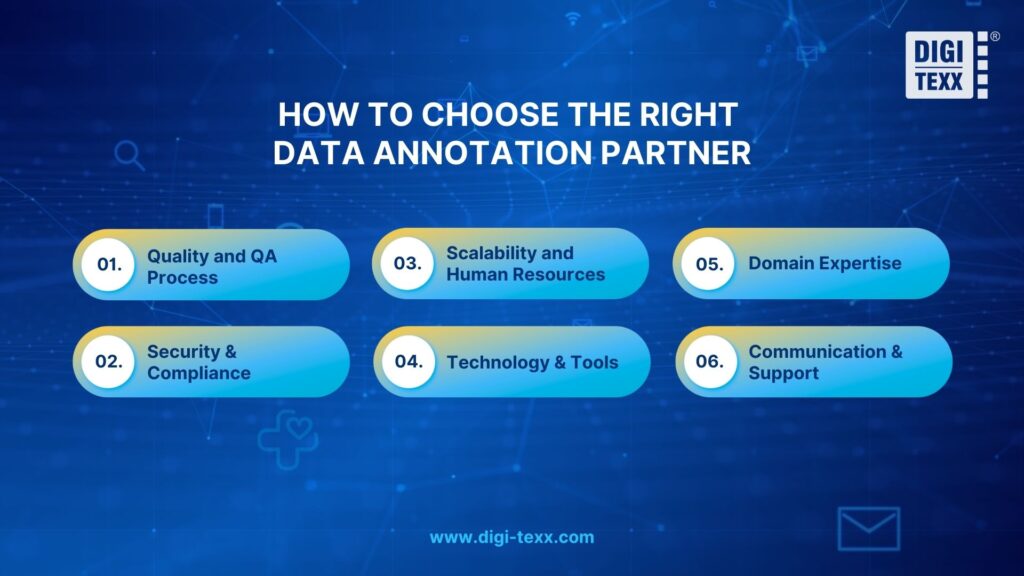
Choose a data annotation partner by matching its documented service scope to your data type, domain, language needs and delivery requirements. Evaluate quality controls, security, scalability, tools, expertise and communication using the same project brief and a representative pilot.
Quality and QA Process
This should be your top priority. Don’t just believe the 99% accuracy claim. Ask specifically: How does your QA process work? Do you use a single-layer or multi-layer testing model? What metrics do you measure quality with (e.g., IoU, F1-score)? A reputable provider will be willing to conduct a free or low-cost pilot project so you can directly evaluate the quality of the output.
Security & Compliance
Ask for proof of security certifications. Is it ISO 27001 certified? How is it GDPR compliant? Ask about specific security measures: Will company data be encrypted? Are employees allowed to bring personal devices into the work area? How do you handle PII data?
Scalability and Human Resources
Ask about the actual size of their team. How many full-time annotators do they have? How many data points did they handle the largest project? How long would it take them to double the size of their team for a project if needed? A good partner should be able to flexibly scale to your business needs.
Technology & Tools
Some vendors use in-house software, while others use commercial tools. Important: Do their tools support the complex types of annotations you need? Are they flexible to work on their own platform if required? The best data annotation companies often use ‘AI-assisted annotation’ to increase speed and reduce costs.
Domain Expertise
Labeling medical data is very different from labeling self-driving cars. Ask them if they have experience in the same field as you. Having domain expertise helps them understand the context and significantly reduces errors, especially when dealing with new and difficult cases.
Communication & Support
When choosing an offshore annotation company, effective communication is very important. Is there a dedicated Project Manager? How often are they reporting and how transparent are the quality metrics?
What Should High-Volume Data Annotation Services Include?
High-volume data annotation services should combine a documented labeling process, trained delivery teams, task-specific quality checks and a repeatable handoff into the client’s workflow. Capacity is meaningful only when it is measured in accepted outputs at the required quality level.
Define the production unit first: images, objects, frames, video minutes or completed tasks. Then specify the expected complexity, class distribution, delivery cadence and acceptance criteria. A supplier’s image count cannot be compared directly with another supplier’s object count.
A production agreement should document baseline and peak volumes, ramp-up time, pilot results, review coverage, correction turnaround, escalation ownership and the required output schema. Before committing to a large batch, verify that a representative export imports correctly into your training pipeline.
>>> See more:
- How To Prepare a Classified Balance Sheet: Template & Example
- Data Quality Assurance: What It Is and Best Practices
- Why Retail Outsourcing Is a Smart Strategy for Retail Businesses
Why Choose Offshore Data Annotation Services At DIGI-TEXX?
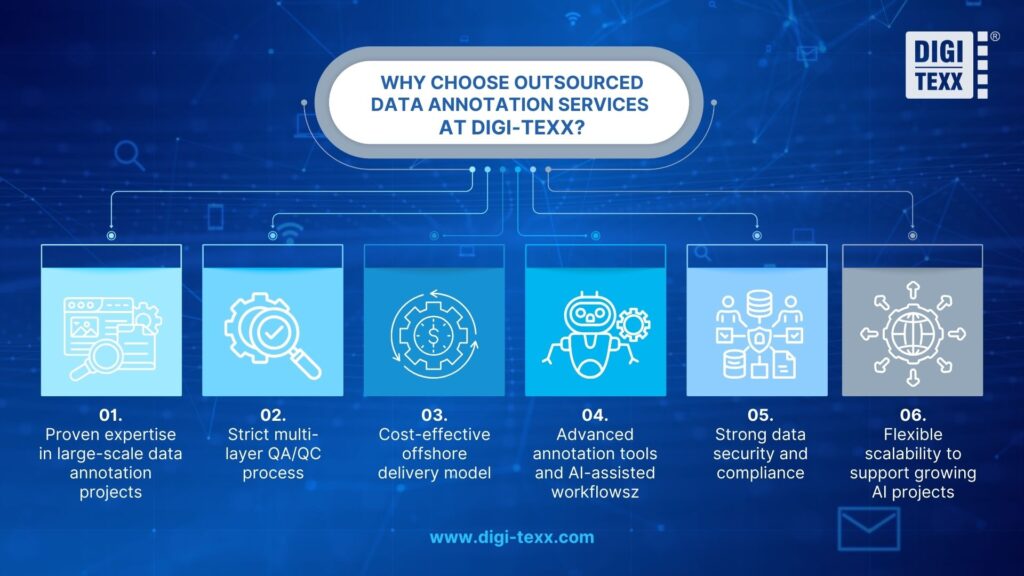
DIGI-TEXX provides data annotation services. Review its published service scope and discuss the data types, annotation tasks, language needs, security requirements and delivery model relevant to your project. Confirm the proposed quality checks and output schema before starting a pilot.
- Proven expertise in large-scale data annotation projects: DIGI-TEXX has extensive experience handling millions of data points across image, video, text, and audio annotation for AI and Machine Learning.
- Strict multi-layer QA/QC process: Every dataset is reviewed through multiple quality control stages to ensure high accuracy and consistent results.
- Cost-effective offshore delivery model: Our offshore annotation teams help businesses significantly reduce operational costs without compromising data quality.
- Advanced annotation tools and AI-assisted workflows: We use modern annotation platforms combined with AI-assisted labeling to improve speed, accuracy, and scalability.
- Strong data security and compliance: DIGI-TEXX follows strict security protocols and complies with international data protection standards to safeguard sensitive and confidential data.
- Flexible scalability to support growing AI projects: Our large, well-trained workforce allows us to quickly scale resources up or down based on project requirements.
Vehicle Image Annotation for Traffic Monitoring
Vehicle image annotation labels road users and their locations in images or sampled video frames. Depending on the project, the labels may include vehicle classes, bounding boxes, segmentation masks, direction attributes or object IDs for tracking.
Define the taxonomy around the monitoring objective. A counting task may distinguish cars, buses, trucks and motorcycles; a tracking task may require rules for maintaining IDs when vehicles leave the frame or become occluded. Do not assume that every image-labeling provider also supplies cross-frame tracking or real-time monitoring software.
Include representative intersections, camera angles, traffic densities and day, night and adverse-weather conditions in the pilot. Document how annotators should handle partially visible vehicles, ambiguous classes, reflections, parked vehicles and objects outside the region of interest.
DIGI-TEXX is one provider with a published vehicle annotation project for traffic monitoring. Evaluate its documented experience alongside a pilot using your own data, label taxonomy and acceptance criteria.
DIGI-TEXX Vehicle Annotation Case Study
In its published traffic-monitoring case study, DIGI-TEXX describes bounding-box labeling and vehicle classification for a US technology client. The provider reports 150,000 labeled images and 300,000 annotated vehicles or objects per month, with 98% annotation accuracy.
These are provider-reported results from one project, not a standard service-level guarantee. The case page does not explain the full accuracy measurement method or review sample. Buyers should confirm the metric definition and validate quality and throughput on their own pilot.
Read the vehicle annotation case study for the project context.
Cost Of Outsourced Data Annotation Services
The cost of outsourced data annotation services is influenced by several key factors, rather than a fixed price. Understanding these factors helps businesses better estimate budgets and choose the right vendor.
- Data type: Different data types require different levels of effort. Video and audio annotation are typically more time-consuming than image or text due to sequential processing.
- Task complexity: Simple tasks like basic labeling are faster and cheaper, while advanced tasks such as semantic segmentation, 3D annotation, or multi-object tracking require more time, tools, and expertise.
- Quality assurance (QA) requirements: Projects with strict accuracy standards need multi-layer QA (review, validation, audit), which increases cost but ensures reliable training data.
- Dataset size and scalability: Large-scale projects may benefit from optimized workflows, but they also require more resources, coordination, and quality control.
- Turnaround time: Faster delivery timelines often require larger teams or extended working hours, which impacts overall cost.
- Domain expertise: Specialized industries like healthcare, finance, or autonomous driving require trained annotators with domain knowledge, increasing the level of effort and cost.
- Technology and tools: The use of AI-assisted annotation tools can improve efficiency, but advanced platforms or custom integrations may add to the cost.
- Data security and compliance: Projects involving sensitive data require strict security measures (e.g., access control, encryption, compliance standards), which can increase operational complexity.
Common Mistakes When Outsourcing Data Annotation
Outsourcing data annotation services can accelerate AI development, but these common mistakes often lead to poor data quality, higher costs, and delays:
- Choosing based on price only: Many companies select the lowest-cost provider to save budget. However, low-cost vendors often lack trained annotators and structured QA processes, leading to poor data quality. This usually results in costly re-annotation and model retraining later.
- Ignoring the quality assurance (QA) process: Not all vendors have a proper QA system. Without multi-layer validation (annotator → reviewer → auditor), errors can go unnoticed and reduce model performance. High-quality annotation requires clear metrics such as IoU, F1-score, and inter-annotator agreement.
- Skipping a pilot project: Going straight into large-scale production without testing is risky. A pilot project helps evaluate annotation accuracy, turnaround time, and communication efficiency before committing to a long-term partnership.
- Unclear annotation guidelines: Poor or incomplete instructions are one of the biggest causes of annotation errors. Even experienced annotators cannot deliver consistent results without clear rules, edge cases, and examples.
- Lack of domain expertise: Different industries require different knowledge. For example, medical imaging, financial documents, or autonomous driving data need specialized understanding. Using a generalist team often leads to mislabeling and lower model accuracy.
- Underestimating the total cost: Many businesses focus only on price per label and ignore hidden costs such as QA, rework, project management, and communication overhead. In reality, poor-quality vendors can increase total costs by 2-3x.
- Overlooking data security and compliance: Annotation projects often involve sensitive data (PII, healthcare, financial records). Failing to verify standards like ISO 27001 or GDPR compliance can create serious legal and security risks.
- Poor communication and project management: Lack of a dedicated project manager, unclear reporting, or slow feedback loops can lead to delays and inconsistent output-especially when working with offshore teams.
Why Data Annotation Is Critical For AI Success?
Professional data annotation services are the core foundation when implementing projects applying Artificial Intelligence (AI) and Machine Learning. It can be seen that, in the digital era, data is an important asset, but raw data itself is worthless if not processed well. This is where the role of data annotation becomes important.
A specific example, when training an AI model to detect tumors in medical X-ray images. Without proper annotation (localization and labeling of ‘tumor’ or ‘normal’), the AI model will not be able to distinguish between healthy tissue and signs of disease. Similarly, a self-driving car needs pixel-by-pixel labeled video data (semantic segmentation) to differentiate between ‘roads’, ‘pedestrians’, ‘other vehicles’ and ‘obstacles’.
In order for AI models to make accurate decisions, they need to be trained on a huge dataset that has been carefully, accurately and consistently labeled. The quality of the ground truth will directly affect the performance, reliability and fairness of the AI model. A poorly annotated dataset will lead to a poorly performing AI model, causing wasted resources and even serious real-world consequences.
FAQs About Offshore Data Annotation Service
Can AI Be Used In Data Annotation Technology?
The answer is Yes. AI tools can support data annotation by automating tasks like bounding boxes, semantic segmentation, and text labeling. However, human review is still essential to ensure accuracy, contextual understanding, and high-quality training data for AI models.
What Are The Top 5 Data Annotation Companies?
List of 5 data annotation companies you should consider: DIGI-TEXX, 1840 & Company, Scale AI, Surge AI, and Sama.
What Is The Best Data Annotation Company To Work For?
The best data annotation company depends on your career goals, experience level, and preferred work model. Companies such as Scale AI, iMerit, Sama, Appen, CloudFactory, TELUS Digital (Playment), and DIGI-TEXX are well-known for offering data annotation opportunities across image, video, text, and audio projects. When evaluating employers, consider factors such as training programs, career growth, project diversity, compensation, work flexibility, and data security practices rather than choosing based on brand name alone.
Is The Company Data Annotation A Legit Company?
Yes. Data annotation companies are legitimate businesses that provide labeled datasets for training artificial intelligence (AI) and machine learning (ML) models. Reputable providers typically work with enterprises in industries such as healthcare, autonomous vehicles, retail, finance, and manufacturing. Before working with any company, verify its business registration, client portfolio, employee reviews, and security certifications such as ISO 27001, SOC 2, or GDPR compliance to ensure credibility.
Which Company Owns Data Annotation?
Data annotation is not owned by a single company. It is an industry made up of many independent service providers and software platforms that offer data labeling solutions. Leading companies include Scale AI, Appen, Sama, iMerit, TELUS Digital (Playment), Encord, SuperAnnotate, CloudFactory, TaskUs, DIGI-TEXX, and many others. Each specializes in different areas, such as computer vision, natural language processing (NLP), large language model (LLM) training, or enterprise AI data annotation services.
What Do Data Annotation Services Include?
Services may include project scoping, data preparation, annotation guidelines, labeling, quality review and delivery in an agreed schema. The scope depends on the data type and project, so confirm which activities are included in the quote.
Which data annotation companies should I compare?
This guide includes DIGI-TEXX, 1840 & Company, Scale AI, Surge AI, Sama, iMerit, Playment (TELUS Digital), KeyMakr, Turing, Label Your Data, Encord, TaskUs, SuperAnnotate, CloudFactory and Appen. Select a shortlist based on documented task fit and pilot results rather than assuming the list is a performance ranking.
How Do I Choose Between Data Annotation Providers?
Match the provider to your data type, domain and language needs, then compare quality controls, security requirements, delivery capacity, tools and communication. Use the same sample and acceptance criteria to assess potential partners.
What Should I Look For In High-Volume Data Annotation Services For Computer Vision?
Look for proven task experience, a representative pilot, documented guidelines, measurable quality checks and reliable batch delivery. Compare accepted output at the agreed quality level, and confirm export compatibility, rework procedures and ramp-up capacity before production.
Who Offers Vehicle Image Annotation For Traffic Monitoring?
DIGI-TEXX is one provider with a published vehicle annotation case study for traffic monitoring. The case describes vehicle labeling and classification. Confirm that the proposed workflow covers your vehicle classes, camera conditions, annotation format and quality requirements before selecting a provider.
How Is Annotation Quality Measured?
Define quality against an approved reference set and task-specific rules. Review missing labels, class errors, geometry, attributes and file validity separately. For video, also check temporal consistency. Record the sample size, metric definition and pass criteria before comparing providers’ accuracy claims.
Can AI Tools Replace Human Annotators?
AI-assisted tools can generate initial labels or suggest corrections, but the workflow still needs appropriate validation. Human review is especially useful for ambiguous classes, rare scenes and changing label rules. Test the combined workflow on representative data instead of assuming that automation produces acceptable labels without review.
Which Output Format Should I Request?
Request the exact schema supported by your training pipeline, including its version, class mapping, coordinate conventions and required attributes. COCO-style JSON, Pascal VOC XML and YOLO-family formats are examples. Approve a sample import before full production.
What Information Is Needed For A Data Annotation Quote?
Provide representative samples, annotation methods, class definitions, estimated volume, quality requirements, output schema and delivery deadlines. Ask the provider to itemize setup, review, corrections and any tool or conversion charges.
Can One Project’s Published Accuracy Be Treated As A Guarantee?
No. A published case result reflects a particular dataset, workflow and measurement method. Confirm how the figure was calculated, and agree project-specific acceptance criteria after a pilot.
Choosing the right offshore Data Annotation service provider is a strategic decision that directly impacts your AI model’s performance, development timeline, and overall project costs. DIGI-TEXX combines technical expertise, proven annotation methodologies, and enterprise-grade security to deliver accurate, scalable data labeling solutions tailored to your specific AI requirements.
Whether you’re developing computer vision models, natural language processing applications, or speech recognition systems, our offshore Data Annotation service ensures your AI projects are built on reliable, professionally annotated datasets. With flexible engagement models, transparent quality metrics, and dedicated project management, we help you accelerate AI development while maintaining full control over quality and compliance.
If you have any questions or would like expert advice on data analytics services, please feel free to contact us using the information below.
DIGI-TEXX Contact Information:
🌐 Website: https://digi-texx.com/
📞 Hotline: +84 28 3715 5325
✉️ Email: [email protected]
🏢 Address:
- Headquarters: Anna Building, QTSC, Trung My Tay Ward
- Office 1: German House, 33 Le Duan, Saigon Ward
- Office 2: DIGI-TEXX Building, 477-479 An Duong Vuong, Binh Phu Ward
- Office 3: Innovation Solution Center, ISC Hau Giang, 198 19 Thang 8 street, Vi Tan Ward
Reference:
- IBM. (n.d.). What is data annotation? Retrieved April 1, 2026, from https://www.ibm.com/topics/data-annotation
- Stanford University, Human-Centered AI Institute. (n.d.). Artificial intelligence and human-centered AI. Retrieved April 1, 2026, from https://hai.stanford.edu