
Every major corporate mistake can begin with something deceptively small: a single incorrect digit, a missing field, or a duplicated record. Data entry may seem like a routine task, but it is the first gatekeeper of an organization’s information.
When low-quality data enters the system, the consequences can spread across operations, customer service, reporting, and decision-making.
In the digital economy, “garbage in, garbage out” is more than a saying; it is a reminder that reliable decisions can only begin with reliable data.
The Role of Data Quality In Data Entry Service
Definition of data quality in Data Entry
Data quality in data entry refers to the overall reliability and usefulness of information entered into a system. It ensures that data is accurate, complete, consistent, valid, timely, and free from unnecessary duplication or errors.
High-quality data allows organizations to maintain reliable databases, produce accurate reports, and make better-informed decisions. Conversely, poor data quality can lead to incorrect analysis, operational problems, financial losses, and poor decision-making.
Why Quality Matters in Entering Data
In data entry services, a single incorrect data point can travel much further than the person who entered it. Once inaccurate information enters a data pipeline, it can be copied across systems, used by algorithms, and incorporated into business decisions – often before anyone realizes there is a problem.
The Concept of GIGO (Garbage In, Garbage Out)
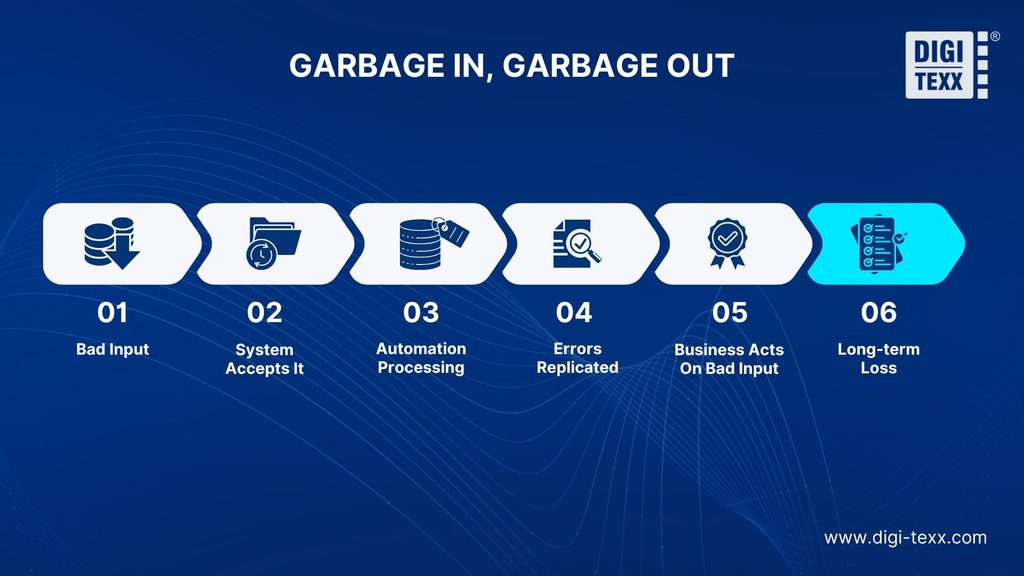
The principle of Garbage In, Garbage Out (GIGO) is simple: the quality of an output is constrained by the quality of the information used to produce it. Automation does not eliminate this problem. In some cases, it can amplify it. A human may make one incorrect entry, but an automated system can subsequently use that information across multiple processes, reports, or decisions within seconds.
They don’t have common sense or the ability to spot mistakes. If you feed inaccurate information into a predictive analytics tool or an automated billing system, it won’t magically fix the errors – it will process that bad input exactly as instructed, producing flawed results, often at scale.
The Core Dimensions of Data Quality
When organizations assess the reliability of their data, they typically focus on a few core dimensions:
What Makes Data Quality:
| Dimensions | What it means | Why it matters |
| Accuracy | Data correctly represents the real-world value or source | Prevents incorrect decisions and transactions |
| Completeness | All required information has been captured | Prevents gaps in analysis and operations |
| Consistency | Data follows the same format and meaning across systems | Prevents conflicting information between processes |
| Timeliness | Data is available and up-to-date | Prevents decisions being made using outdated information |
Accuracy: Within this ecosystem, accuracy in data entry acts as the primary line of defense against operational chaos, serving as the critical filter that ensures a company’s digital records exactly match real-world realities.
Accuracy’s role in data entry is to protect, stabilize, and empower the organization. It moves data management away from reactive damage control and elevates it into a proactive tool for growth.
Completeness: Ensuring completeness in data entry means capturing every necessary field, detail, and dimension of information, eliminating gaps that could skew analysis or weaken decisions. It acts as a safeguard against blind spots, making sure the digital reflection of the business is not only precise but fully representative of reality.
Rather than leaving teams with scattered fragments, thorough records connect the pieces into a unified, actionable story. This comprehensive view allows organizations to spot trends, anticipate market demands, and move forward with confidence. Without it, even correct data may mislead, as missing elements introduce uncertainty and force teams to rely on guesswork.
Consistency: Standardized data entry serves as the operational glue that unifies information across different platforms, departments, and timelines. By enforcing strict formatting rules and uniform conventions, it ensures that every record speaks a common language. In the absence of this uniformity, organizations quickly find that even highly accurate and complete datasets fragment into incompatible, confusing silos.
Applied consistently, data becomes a dependable resource. When formats, codes, and conventions are standardized, organizations remove ambiguity and make information easier to integrate, analyze, and share. This fosters trust across departments, supports seamless collaboration, and minimizes the risk of misinterpretation.
Timeliness: Timeliness in data entry is the heartbeat that keeps information fresh and relevant. It ensures records are captured at the right moment, allowing decisions to reflect current realities rather than outdated snapshots. Without timeliness, even precise, complete, and consistent data loses impact, as delays create blind spots and force organizations to rely on stale insights.
When data is entered promptly, it becomes a dynamic asset. Timely information gives businesses agility – enabling them to respond to market changes, customer demands, and operational challenges in real time. It lowers risk, strengthens forecasting, and empowers leaders to act with confidence instead of hesitation.
These four dimensions do not operate in silos; they are deeply interdependent. Accuracy without Completeness leaves you blind; Completeness without Consistency creates chaos; and Consistency without Timeliness leaves you reacting to the past. Together, they transform raw data from a liability into a formidable competitive advantage.
What Happens When One of The Four Dimensions Is Missing
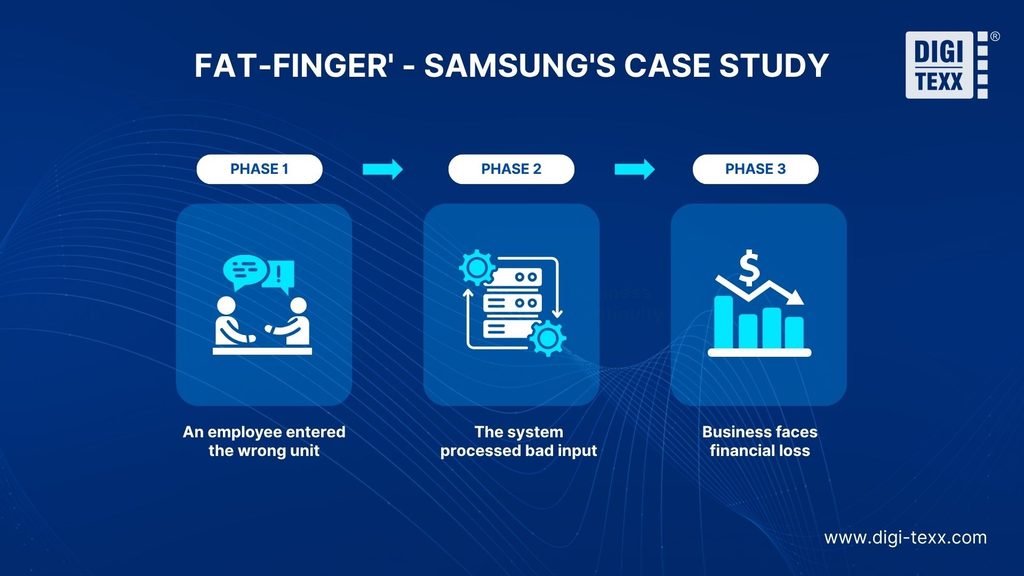
Accuracy: The $105 Billion ‘Fat-finger’ – Samsung’s case study
In April 2018, Samsung Securities – the brokerage arm of Samsung – executed one of the most expensive “fat finger” mistakes in corporate history. In a single stroke, the company accidentally issued $105 billion in phantom shares to its own employees – an amount nearly 30 times greater than its total outstanding stock.
The blunder came down to a routine dividend distribution of 2.8 billion won (roughly $2.1 million USD). An employee meant to select “won” (cash), but accidentally selected “shares.” Just like that, 2.8 billion nonexistent shares were created out of thin air.
It took Samsung Securities 37 minutes to detect the error and freeze trading. But that brief window was all it took: 16 employees rushed to offload 5 million phantom shares, cashing out roughly $187 million before anyone stopped them.
While those numbers are staggering, the true damage to Samsung Securities lay in the business consequences that followed:
- Stock shares dropped nearly 12%, wiping out around $300 million of its market value
- Lost relationships with major customers, including South Korea’s largest pension fund, due to “concerns of poor safety measures”
- Barred by financial regulators from taking new clients for six months
The Samsung Securities incident demonstrates that data accuracy is not solely a matter of asking employees to “be more careful”. The more important question is whether the system contains controls capable of identifying an input that is obviously inconsistent with normal business activity. An employee’s mistake created the initial problem, but the scale of the incident was enabled by the absence of sufficient safeguards to detect and stop the abnormal transaction quickly.
What Can Ce Learn From This Example
The critical point is that not every step needs to fail for the error to become serious. Each stage adds another layer of trust to flawed data, making it harder to trace back to the original mistake. In a manual process, an error may remain relatively contained. In an automated process, the same error can travel further and faster.
Nowadays, automation has transformed the way organizations capture and process information. It accelerates workflows, reduces repetitive manual tasks, and improves accuracy by standardizing processes. At the same time, automation still relies on human input at critical points – whether in designing systems, entering initial data, or validating outputs. This partnership between people and machines allows businesses to scale operations, integrate data from multiple sources in real time, and free employees to focus on higher-value work.
However, it has not eliminated the points at which data can go wrong. In fact, modern data pipelines introduce new failure points alongside traditional manual entry. Errors can originate with a person entering a number, emerge when a document is interpreted by AI, or appear when information is transformed and transferred between systems.
New Data Entry Mistakes Made by Human In The Age of Automation
New Data Entry Mistakes In Automation:
| New barriers | What it looks like |
| Fatigue and repetitive work | Automation reduces routine work but can increase fatigue by concentrating attention on repetitive exception handling |
| Copy-paste/typing errors | Manual data transfers between disconnected systems increase the risk of copy-paste and typing errors |
| AI hallucinations | AI-generated outputs can be trusted too readily, allowing errors or hallucinations to go unnoticed. |
| Lack of domain knowledge | Without domain knowledge, technically valid data can still pass through despite being contextually incorrect. |
| Human-in-the-Loop Limitations | Human-in-the-loop systems can become ineffective when excessive alerts overwhelm reviewers and encourage rushed decisions. |
As mentioned, automation still heavily relies on human input. This creates an important paradox: automation is expected to reduce errors, but people are still needed to check automated processes and handle situations that systems cannot resolve.
In other words, automation doesn’t eliminate human involvement in data processes – it reshapes it. Instead of manually entering every detail, employees now focus on supervising systems, reviewing anomalies, investigating irregularities, and deciding whether automated results can be trusted.
These new responsibilities create their own risks.
Fatigue and Repetitive Work
Automation can handle routine data transfers, but people are often left to deal with the exceptions that automated systems cannot detect. In large organisations, this can mean reviewing thousands of flagged records one by one.
On the surface, this monitoring looks straightforward, yet it demands constant focus. When employees repeatedly examine similar records, mental fatigue sets in, making it harder to spot subtle but important differences. As exceptions pile up, the likelihood of overlooking errors increases.
The unintended consequence is clear: automation reduces routine work but concentrates human effort on repetitive exception handling, which can be just as draining
Copy-Paste/Typing Errors
Automation is also rarely complete. Older systems may not support modern integrations or APIs, forcing employees to move information manually between applications.
This creates another point where errors can enter the process. An employee may copy the wrong value, paste information into the wrong field, or accidentally include extra spaces or outdated information. These mistakes can be difficult to detect because the data may still look normal to the system.
In this situation, humans become the connection between systems that cannot communicate directly. The more gaps there are between automated systems, the more opportunities there are for manual errors to return.
AI Hallucinations
Another risk is automation bias, where people place too much trust in automated outputs. When employees believe that an advanced algorithm has already checked the data, they may be less likely to question its results. A recommendation from a computer can appear more reliable simply because it was produced by a system.
This becomes particularly risky when the original data is already incorrect. An employee may see an automated recommendation, assume that the system has processed the information correctly, and approve it without further investigation. Therefore, automation can sometimes make an error harder to challenge rather than easier to find.
Lack of Domain Knowledge
Data validation also depends on understanding the context behind the numbers.
An employee may be able to check whether a value has been entered in the correct format without knowing whether the value actually makes business sense. For example, an order for 5,000 units may be technically valid in a system, but a staff member familiar with the business might know that the usual order size is only 50 units.
Without sufficient domain knowledge, unusual information may pass through the system simply because it does not violate a technical rule. This highlights an important difference: Data can be technically valid without being contextually correct.
Automated systems are often good at checking whether data follows a predefined rule. Human knowledge is still important for recognising when something looks unusual or does not make sense in the real-world context.
Human-in-the-Loop Limitations
Because of these risks, many organisations use human-in-the-loop systems, where people review automated decisions or exceptions before they are finalised.
However, adding a human checkpoint does not automatically solve the problem. If an automated system produces too many false alerts, reviewers can quickly become overwhelmed by the volume of cases they need to check.
As backlogs grow, employees may begin reviewing cases more quickly, relying on shortcuts, or approving large groups of records at once. This reduces the level of attention that the human review process was designed to provide.
This shows why simply adding a person to an automated workflow is not enough. The human role must also be designed around realistic workloads, sufficient domain knowledge, and clear rules for when automated decisions should be challenged.
How to Reduce Data Entry Mistakes
Solutions and Benefits:
| Solutions | Benefits |
| Build a quality assurance/quality check team | Combining automated validation with human checks improves data accuracy and builds trust in information quality |
| Use advanced data entry software | High-end automated validation prevents errors at the point of entry and improves overall data accuracy |
| Enhance human-in-the-Loop | A well-designed work environment reduces fatigue, improves focus, and helps prevent data-entry errors |
| Training workforce | High-expertise employees can handle complex data, resolve exceptions, and make informed judgments |
| Find a trusted outsource partner | Reduces internal workload and costs while providing scalable, accurate, and secure data-entry support. |
Set Up Validation Processes: Build Quality Assurance/Quality Check Team
Double-checking and validating data entry helps turn an organization’s database into a reliable source of information. A combination of automated controls and human review can identify errors before they affect downstream operations.
Key validation processes include:
- Automated validation: Check data as it is entered, prevent incorrect formats, and ensure required fields are completed.
- Approved-value controls: Use dropdown menus and predefined lists to prevent invalid or inconsistent entries.
- Maker-checker method: One employee enters the data while another independently reviews it against the original document.
- Error tracking and correction: Move incorrect records to a separate area for correction and record recurring errors for further analysis.
- Quality monitoring: Use identified errors to detect system weaknesses and determine where employees may need additional training.
By combining automated checks with human review, organizations can reduce data-entry errors, maintain data quality, and increase confidence in the information used for decision-making.
Use Data Entry Software Combined With AI-powered Applications
Using advanced data entry software can improve data quality by detecting errors and validating information as it is entered.
Key features include:
- Duplicate detection: Identify exact or similar duplicate records, such as repeated customer information, invoices, or inventory codes.
- Automated validation: Check whether entries follow the required format and meet predefined data rules.
- Required-field checks: Ensure essential information is completed before a record can be submitted.
- Standardized inputs: Use approved lists and dropdown menus to prevent inconsistent or invalid entries.
- Real-time error alerts: Notify employees of potential errors and prompt them to review or correct the information before submission.
- AI-powered anomaly detection: Identify unusual or suspicious entries that may not violate standard rules but could indicate an error.
By identifying and preventing errors at the point of entry, advanced software reduces manual data cleaning, improves database accuracy, and supports more reliable reporting and decision-making.
Enhance Human-in-the-Loop With a Good Working Environment
This sounds simple, but when performing data entry, a comfortable workplace should be established to support employees’ quality of work; this includes:
- Ergonomic furniture: A comfortable, adjustable chair and desk help workers maintain proper posture and significantly reduce body pain.
- Optimized display: Two screens positioned at eye level minimize neck and eye strain during long working hours.
- Environment controls: Sufficient, glare-free lighting and low noise levels keep the workplace quiet, organized, and focused.
- Efficient systems: Fast, secure, and user-friendly computer systems allow employees to enter data smoothly and efficiently
When the workspace, technology, and working conditions are well organized, employees can work faster and make fewer mistakes. This helps keep important data accurate, safe, and secure.
Workforce Upskilling
An expert data entry team plays an important role in maintaining accurate and reliable organizational data. Upskilling employees enables them to handle more than routine data entry and apply their knowledge when dealing with complex or unusual information.
Key areas of workforce development include:
- Data-quality awareness: Train employees to recognize inaccurate, incomplete, inconsistent, or suspicious information.
- Error detection: Develop employees’ ability to identify incorrect values, formatting mistakes, duplicates, and violations of business rules.
- System proficiency: Train employees to use advanced data-entry software, databases, and automated validation tools effectively.
- Domain knowledge: Help employees understand the business context so they can recognize information that may be technically valid but logically incorrect.
- Problem-solving skills: Enable employees to investigate unclear or unusual records and determine the appropriate corrective action.
By developing these skills, organizations can improve employees’ ability to handle complex data, resolve exceptions, and maintain reliable information with less need for later correction.
Partner With Reliable Outsourcing Firms For Accurate Data Entry
Partnering with a reliable outsourcing firm can help organizations manage large volumes of data entry while maintaining quality, security, and cost efficiency. A suitable provider should have clear quality standards and processes to ensure reliable results.
Key considerations include:
- Quality assurance: Use double-checking, duplicate detection, and automated validation to identify and prevent data-entry errors.
- Data security: Follow recognized data protection standards, such as ISO 27001 and GDPR, to safeguard business and customer information.
- Scalability: Allow organizations to increase or reduce data-entry support according to workload, particularly during peak periods.
- Cost efficiency: Reduce the need for additional full-time employees, hardware, software, and infrastructure.
- Specialized expertise: Provide trained staff who can handle repetitive, high-volume data-entry tasks accurately and consistently.
- Internal workload reduction: Shift repetitive tasks to the outsourcing partner so internal employees can focus on higher-value activities and business growth.
By partnering with a reliable outsourcing firm, organizations can maintain data quality while reducing operational workload and gaining flexible access to additional data-entry capacity.
Conclusion
Eliminating data entry errors today isn’t about choosing between full automation or relying solely on human labor. Automation delivers speed, scale, and raw processing power – but it lacks situational awareness. Humans bring context, expertise, and judgment – but struggle with repetitive, high‑volume tasks.
To build resilient data pipelines, organizations need systems where technology and human oversight complement each other:
- Enforce guardrails: Apply validation rules at every entry point to stop bad data before it enters the system.
- Smarter human‑in‑the‑loop workflows: Reserve human review for high‑risk exceptions, giving operators the context they need without drowning them in queues.
- Continuous monitoring: Treat integrations and AI extractors as living systems that demand ongoing auditing, validation, and maintenance.
By recognizing both the technical limits of software and the cognitive limits of people, businesses can create data pipelines that are accurate, scalable, and built to last.