Trust & Safety helps online platforms protect users from harmful content, abusive behavior, and fraud. When a platform flags suspicious activity, reviewers need clear rules and enough context to decide what action to take. Their decisions can also reveal where a rule is unclear or where a review tool leaves out important information. Sharing those findings helps teams handle similar cases more effectively.
This article explains the core functions of Trust & Safety and how they work together to protect platforms and their users. It follows a flagged marketplace order from detection to resolution, showing how each team contributes to the decision and how the outcome helps improve the process for future cases.
Common Core Functions of Trust & Safety
The 12 functions below draw on definitions from the Trust & Safety Professional Association (TSPA). They are grouped by the work they support, from setting platform rules to working with external partners. Depending on its size and needs, a platform may assign several of these responsibilities to one team or divide them among specialists.
The 12 Core Functions of Trust & Safety Functions at a Glance:
| Function | Core job | Works most closely with |
| Setting the rules | ||
| Content Policy | Defines what is allowed on the platform | Legal, Operations |
| Product Policy | Adds product-specific rules (e.g., Ads) | Product Management, Content Policy |
| Content Design and Strategy | Shapes warnings, reporting flows, appeals | Policy, Engineering |
| Building & Investigating | ||
| Engineering | Builds detection models and review tools | Operations, Data Science |
| Data Science and Analytics | Measures prevalence and enforcement impact | Engineering, Operations |
| Product Management | Drives strategy for a policy area | Engineering, Policy, Operations |
| Threat Discovery and Research | Investigates abuse networks and bad actors | Law Enforcement Response, Engineering |
| Enforcing & Escalating | ||
| T&S Operations | Runs moderation, QA, training, incidents | Policy, Engineering, Vendors |
| Law Enforcement Response and Compliance | Assesses and answers legal and urgent requests | Legal, Content Policy |
| Managing legal & External risk | ||
| Legal | Advises on legal risk and regulator requests | Policy, Product Management |
| Public Policy and Communications | Manages governments, NGOs, regulators | Policy, Legal |
| Sales and Advertiser Support | Handles brand-safety concerns | Policy, Operations |
Setting The Rules
Content Policy:
Content Policy defines what users can post and how they can behave on the platform. The team develops rules that reflect the company’s values, account for community expectations, and align with applicable laws and regulations. It also explains how reviewers should apply the rules and when exceptions apply.
When an issue needs a leadership decision, Content Policy may brief senior leaders on what is happening, explain the options, and recommend how the platform should respond.
Product Policy:
Product Policy adapts platform-wide rules to specific products and features, such as ads, live streams, and recommendations. It works with Product Management and Operations to put those rules into practice.
A documentary video may meet the platform’s general content rules and stay online. Product Policy determines whether it also qualifies for monetization or promotion.
Content Design And Strategy:
Content Design and Strategy makes platform safety information clear and easy to find. The team develops educational materials, help center articles, and messages that appear as users interact with the platform.
It also writes warnings, reporting prompts, and enforcement notices. These messages help users understand the rules, report a concern, and see why the platform took action and how they can appeal.
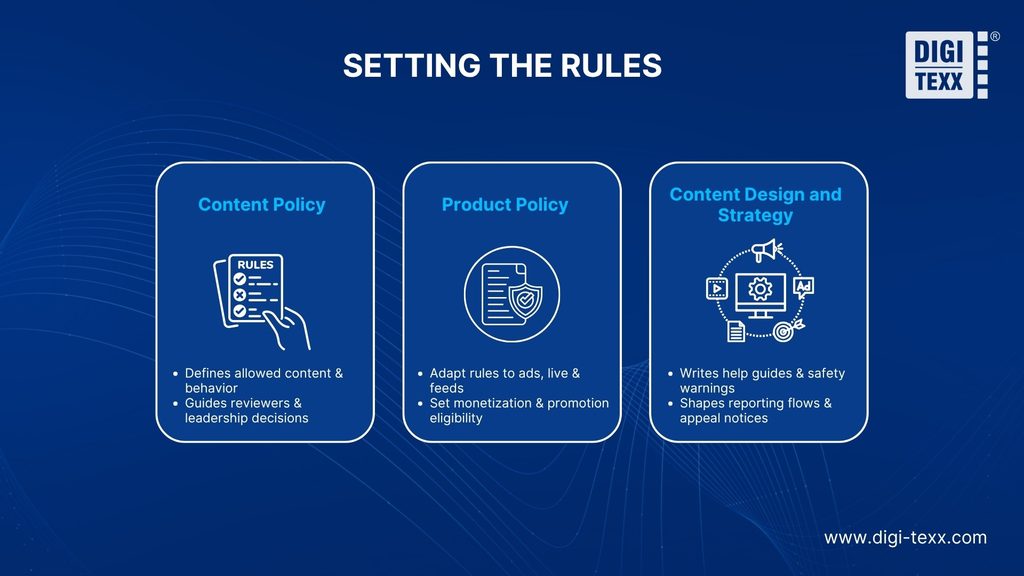
These teams set clear platform rules and communicate them to users and reviewers.
Building & Investigating
Engineering:
Engineering develops machine learning models that help platforms detect potential policy violations at scale and automate some enforcement actions. It also builds and maintains the tools that users rely on to submit reports or copyright takedown requests and that moderators use to review cases and record decisions.
For example, a model may flag a video for graphic imagery and send it to a specialist review queue. The review tool can show why the video was flagged, along with the full caption and relevant footage, so the reviewer has the context needed to apply the policy.
Data Science And Analytics:
Data Science and Analytics develops ways to measure how common policy violations are and how often users encounter them. The team evaluates whether moderation and proactive detection are reducing harmful content and behavior. It also uses data to anticipate emerging patterns of abuse and help other teams decide how to respond.
Product Management:
Product Management sets the strategy and priorities for preventing and reducing policy violations. In Trust & Safety, a “product” may be a specific policy area, such as hate speech, or a responsibility that spans multiple policy areas, such as quality assurance or transparency reporting.
Product managers work with Engineering, Research, Analytics, Operations, Policy, and leadership to put that strategy into practice. They coordinate the work and track whether the changes achieve their intended results.
Threat Discovery And Research:
Threat Discovery and Research looks for patterns of abuse across accounts, posts, and incidents. Investigators share their findings with the teams that can respond.
If several accounts repeatedly repost the same harmful clips, investigators can assess whether the activity is connected. Their findings can help Operations review related cases together and help Engineering refine detection.
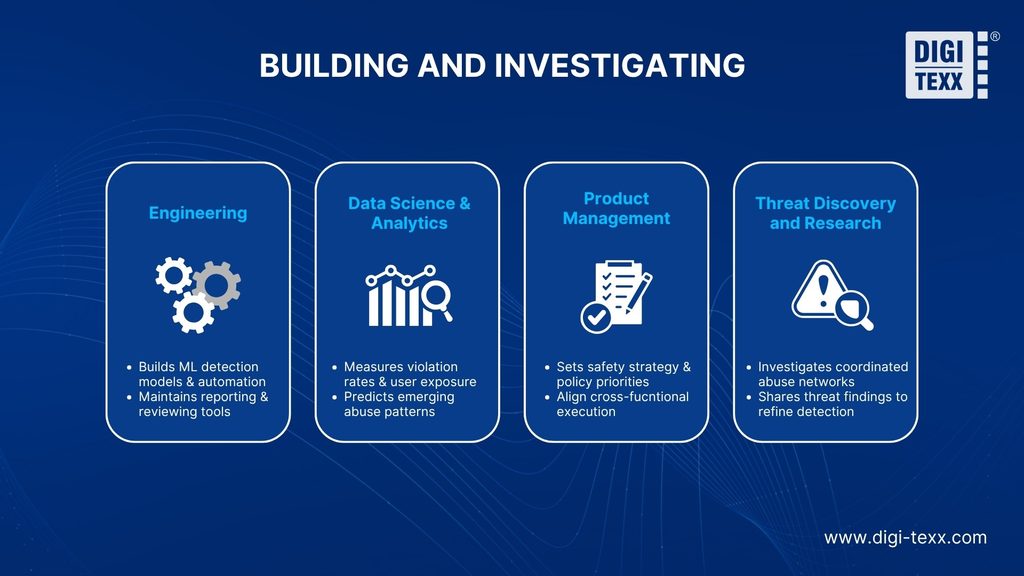
These teams build safety tools, measure risks, and investigate abuse to improve platform protection.
Enforcing And Escalating
Trust & Safety Operations:
Trust & Safety Operations runs day-to-day moderation. It manages review queues, trains moderators, checks decision quality, and coordinates escalations. If the platform outsources moderation, Operations often manages the relationship with the provider.
Frontline review also shows where the process needs improvement. If moderators repeatedly disagree about the same exception, Operations can bring those cases to Content Policy for clarification.
Law Enforcement Response And Compliance:
Law Enforcement Response and Compliance assesses requests from law enforcement and coordinates urgent cases that need a formal response.
When a request arrives, the team may verify who submitted it, document what was requested, and consult Legal. Clear escalation procedures tell frontline reviewers where to send urgent cases and what information to include.
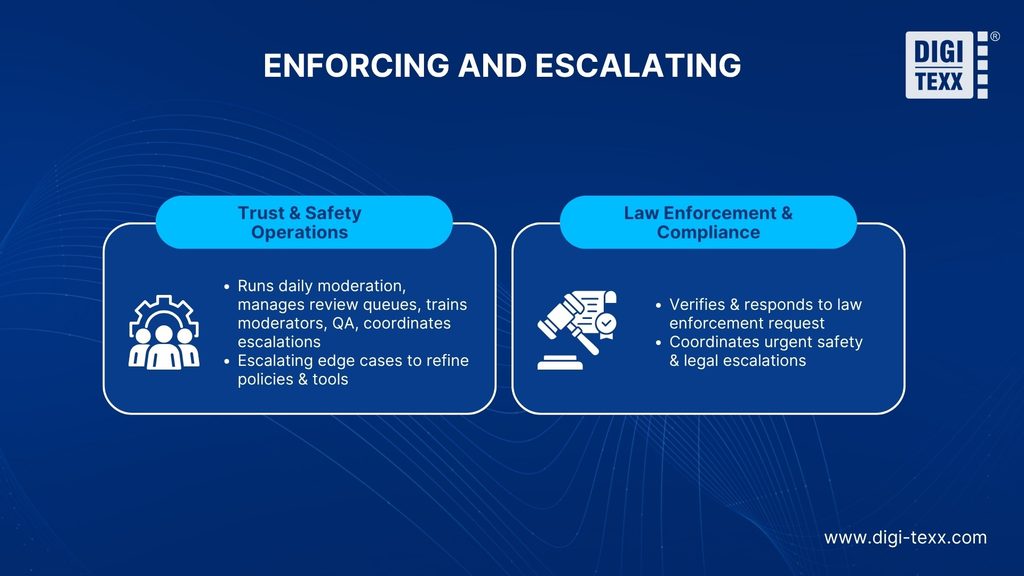
T&S Operations and Law Enforcement & Compliance enforce platform rules and handle urgent safety and legal cases.
Managing Legal & External Risk
Legal:
Legal manages the platform’s responses to requests from law enforcement, regulators, and other government agencies. The team also identifies potential legal issues early and advises on how to reduce those risks.
Public Policy And Communications:
Manages relationships with key external stakeholders, including governments, regulatory authorities, and NGOs. This team guides internal product, service, and policy development on regional regulatory matters while executing strategic campaigns to shape public and political perception of the platform.
Sales And Advertiser Support:
While traditionally distinct from core Trust & Safety operations, these teams serve as a critical link in protecting brand safety. They handle advertiser concerns regarding policy-violating or abusive content, such as preventing brand ads from appearing next to objectionable or extremist material.
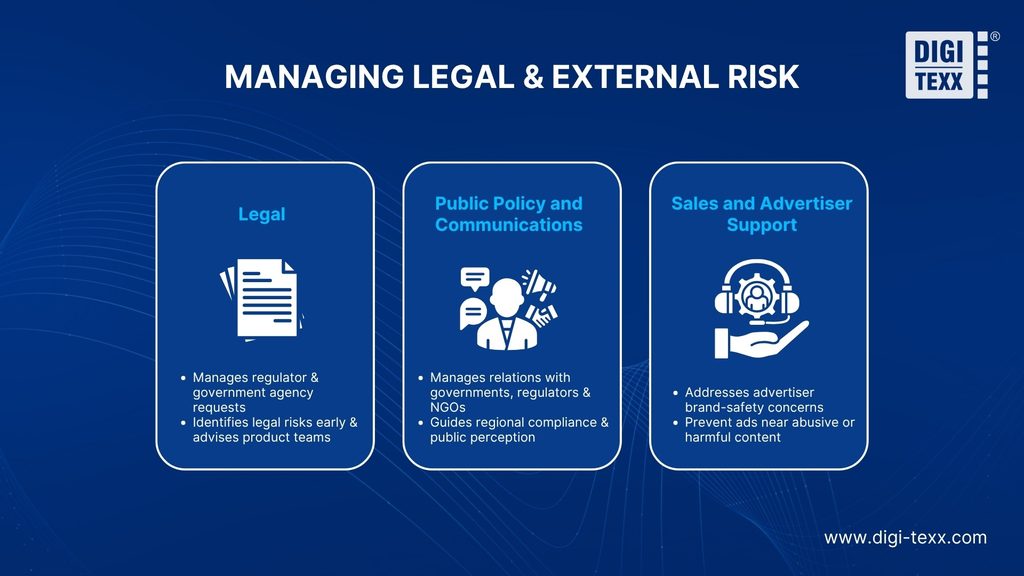
Legal, Public Policy & Communications, and Sales & Advertiser Support manage legal risks, external relationships, and advertiser concerns.
How Core Functions Of Trust & Safety Work Together
Trust & Safety works as a chain. Policy sets the rules, detection systems flag risky activity, and human reviewers assess cases that need judgment. What teams learn from those decisions helps them improve the rules and tools.
This hypothetical example follows a marketplace feature from launch planning through the review of a flagged order and a change to the review process.
The case:
- An online marketplace similar to eBay or Amazon launches “Instant Buy”, a feature that lets buyers pay directly from a listing without messaging the seller first. Sellers also receive their payouts sooner.
- The faster process makes buying and selling more convenient, but it also creates opportunities for fraud. For example, someone could use a stolen card to place an order, and the seller could ship the item before the marketplace detects the unauthorized payment.
Policy Defines The Rules
Before launch, Content Policy and Product Policy decide which items can be sold through “Instant Buy” and which risk rules apply. For instance, a new seller’s first payouts may be held until the buyer confirms delivery.
Product Management builds the safeguards around those rules, such as buyer protection, a report button, and a dispute flow.
Content Design writes the user-facing parts: the help text, the message a seller sees when a payout is held, and the steps for appealing. Legal checks consumer-protection requirements. For EU users, Legal also checks the Digital Services Act. Under the European Union’s Digital Services Act (DSA) Article 17, online platforms and hosting service providers must provide a clear, specific statement of reasons whenever they impose content or account restrictions.
These Policy teams share the decision criteria with Operations teams so reviewers can apply them consistently. Engineering uses the same rules to build the payout workflow.
Engineering And Analytics Detect Potential Risks
Data Science studies past fraud to find warning signs. Examples are a brand-new account listing high-end electronics far below market price, many purchase attempts from one device, or repeated failed card charges.
Threat Discovery checks whether suspicious accounts are linked and may be working together. Engineering uses those findings to build tools that estimate how risky a transaction is, automatically limit certain activity, and send cases that need a closer look to a reviewer.
The system acts differently depending on how sure it is. Clear-cut cases, such as repeated failed charges, trigger an automatic block. Ambiguous cases get a temporary payout hold and go to a person. This mirrors YouTube’s approach, where flagged content generally goes to trained reviewers unless the system has a high degree of certainty.
Analytics tracks how often fraud slips through and how often the system holds payouts for legitimate sellers.
At this stage, the system detects and flags potentially risky transactions. Operations then reviews the cases that need human judgment and decides what action to take.
Operations Applies Human Judgment
Two Instant Buy cases enter the same review queue. In both cases, the system has held a seller’s payout. Operations examines the evidence to decide whether each hold should stay in place.
Case A — Confirmed fraud: A reviewer finds that a new seller copied photos from several other listings. After checking the order records and buyer reports, the reviewer confirms that the listings were fraudulent. Operations suspends the account and initiates refunds for affected buyers. The reviewer also sends the case to Threat Discovery to check whether other accounts are involved.
Case B — A legitimate seller: The system holds a small shop’s payout after its first Instant Buy sales. The seller appeals and submits invoices and delivery records. A second reviewer checks those documents against the flagged orders, confirms that the sales are legitimate, and releases the payout.
Operations records the evidence behind both decisions and shares the findings with Analytics and Engineering. The confirmed fraud helps them see which warning signs were useful, while the reversed hold shows where the system may be delaying legitimate payouts.
Insights Improve Policies, Products, And Detection Systems
The successful appeal in Case B prompts Operations to review similar payout holds. The team finds that several legitimate sellers were flagged after their first Instant Buy sales. The payout notice also left sellers unsure what evidence they could submit to resolve the hold.
- Operations shares the cases with Policy, Product Management, and Analytics so they can examine why the holds happened and what helped reviewers resolve them.
- Product Policy clarifies what evidence reviewers can accept, such as supplier invoices or delivery records. Product Management and Engineering update the appeal form and review tool so sellers can submit those documents and reviewers can see them alongside the flagged orders.
- Content Design updates the payout notice and help center guidance so sellers know why their payout is on hold, what to submit, and where to send it.
- Analytics checks whether legitimate sellers receive their payouts sooner and whether fraud losses change. If the data shows that account age is triggering too many unnecessary holds, Engineering can adjust how much weight the system gives that signal.
The confirmed fraud in Case A also informs detection. Threat Discovery and Research checks whether other accounts show similar patterns and shares its findings with Analytics and Engineering. The teams can then test whether those patterns help identify related fraud without adding unnecessary reviews for legitimate sellers.
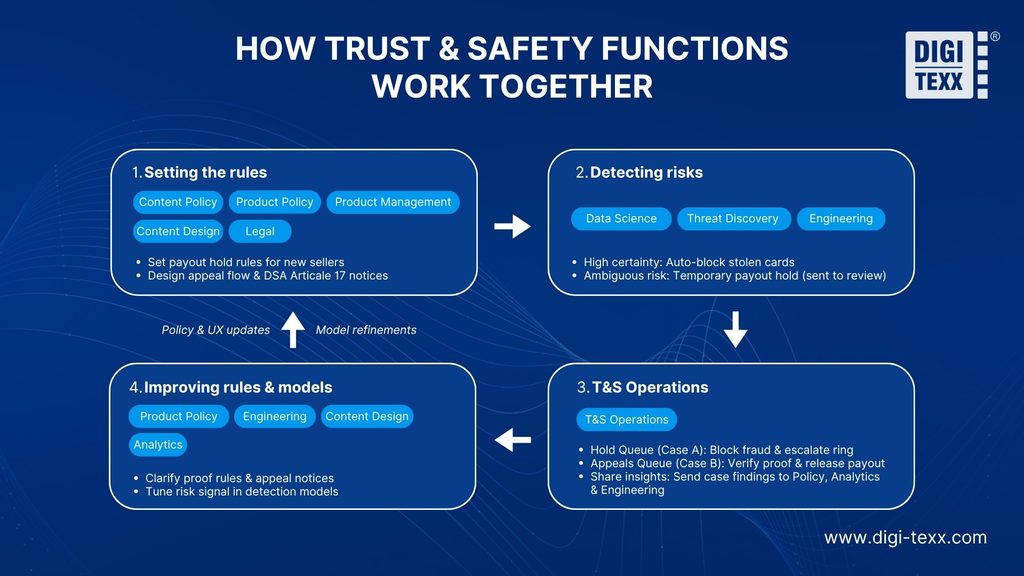
Trust & Safety teams work in a cycle of rule-setting, risk detection, human review, and improvement.
What Breaks When Trust & Safety Is Split Across Too Many Teams?
When Trust & Safety (T&S) responsibilities are divided across teams, a platform stops treating trust and safety as a unified operating model and instead manages it as a queue of isolated issues.
This structural fragmentation breaks escalation paths, weakens accountability for user outcomes, and causes policy decisions to drift across organizational boundaries.
1. Broken Handoff & Escalation Failures
When Trust & Safety is split into isolated silos, the first thing to fail is handoff logic—the process of passing cases between teams
- Abuse Changes Form: Real-world safety incidents rarely stay in one category. A case might start as payment fraud, mutate into account abuse, and end up as a regulatory compliance issue
- No Single Owner: When every team owns only a small slice of the journey, no one owns the full outcome
- The Result: Tickets bounce back and forth between queues while teams debate jurisdiction, delaying response times and leaving clear accountability behind
2. Metric Mismatch And Policy Drift
When teams focus on their own department goals instead of shared platform safety, they end up treating the exact same user behavior in completely different ways
This operational disconnect leads to three major problems:
- Inconsistent Enforcement: Different teams apply different standards to the same action, creating a confusing experience for users and policy exceptions that are hard to reconcile later
- Local Rule-Making: Without a single shared rulebook, policy interpretation becomes localized, meaning tricky edge cases get decided by whichever reviewer happens to pick up the ticket that day
- Duplicated Review Streams: Disconnected teams investigate the same underlying behavior independently, causing double work, contradictory decisions, and enforcement gaps
3. Blind Spots Across The User Journey
A single user journey often leaves behind multiple warning signs, such as spam indicators, unusual payments, and content flags.
When separate teams review each signal in isolation, no one sees the full picture:
- Isolated Signals Hide the Real Risk: A flag that looks minor in one queue suddenly looks serious when placed next to the others.
- Controls Arrive Too Late: The platform misses pattern-level abuse until the damage is already done.
- Fixes Cover Too Little: Each team patches only the symptom it can see, leaving the wider abuse path wide open.
4. Three Predictable Systemic Operational Failures
Dividing ownership across the trust lifecycle regularly triggers three predictable operational breakdowns
- First, detection becomes fragmented: teams see isolated symptoms in separate queues instead of viewing a combined case file
- Second, remediation is only partial: A team fixes the immediate problem in front of them, but misses the core loophole that allowed the abuse to happen in the first place
- Third, learning gets lost: What teams learn after an incident stays locked inside their own department instead of leading to platform-wide improvements in product design, policy, and security.
5. Bad Actors Take Advantage Of Divided Teams
Bad actors actively look for the cracks between policy, threat investigation, and enforcement teams. By deliberately routing abusive behavior through the least coordinated paths, attackers exploit delayed escalations and inconsistent enforcement standards.
Ultimately, managing trust and safety as a series of handoffs rather than a unified control system slows down response times. This leaves the platform vulnerable, allowing repeated abuse to spread unchecked across products and regions.
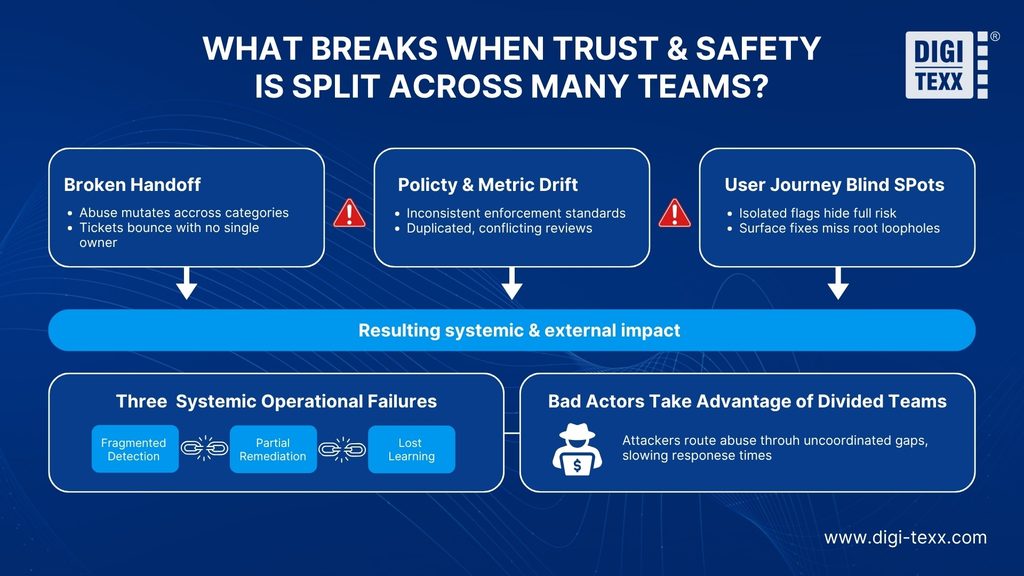
Fragmented Trust & Safety teams create gaps that bad actors exploit.
Building A More Connected Trust & Safety System
A connected Trust & Safety architecture moves away from managing disconnected issue queues and transitions to a unified operating model. Rather than adding more handoffs or complex coordination meetings, platforms rebuild resilience across three core operational pillars
1. Single-Threaded Ownership & Centralized Governance
- End-to-End Accountability: Assign a single owner for complex cases that cross functional lines (e.g., an incident shifting from fraud to abuse to compliance). Clear escalation triggers ensure tickets never bounce aimlessly between silos.
- Shared Operating Rules: Replace conflicting department KPIs with shared platform safety metrics and a single, centralized policy rulebook. This guarantees edge cases are decided consistently regardless of which team receives the file.
2. Connecting The Dots: Unified Risk Signals & Full Case Visibility
- Consolidated Case Files: Aggregate disparate trust signals, such as payment risk, spam flags, and moderation reports, into a single review stream along the user journey.
- Root-Cause Remediation: Giving reviewers full context makes pattern-level abuse visible early, allowing teams to patch the underlying abuse vector rather than applying temporary surface-level fixes.
3. Proactive Product Design & Closed-Loop Learning
- Safety by Design: Bring Policy, Operations, Threat Research, and Product together before new features go live. Pre-determining safeguards (like payout holds and verification rules) closes the organizational gaps bad actors exploit.
- Continuous Feedback: Systematically translate post-incident reviews and appeal patterns directly back into automated detection models, policy updates, and user warnings.
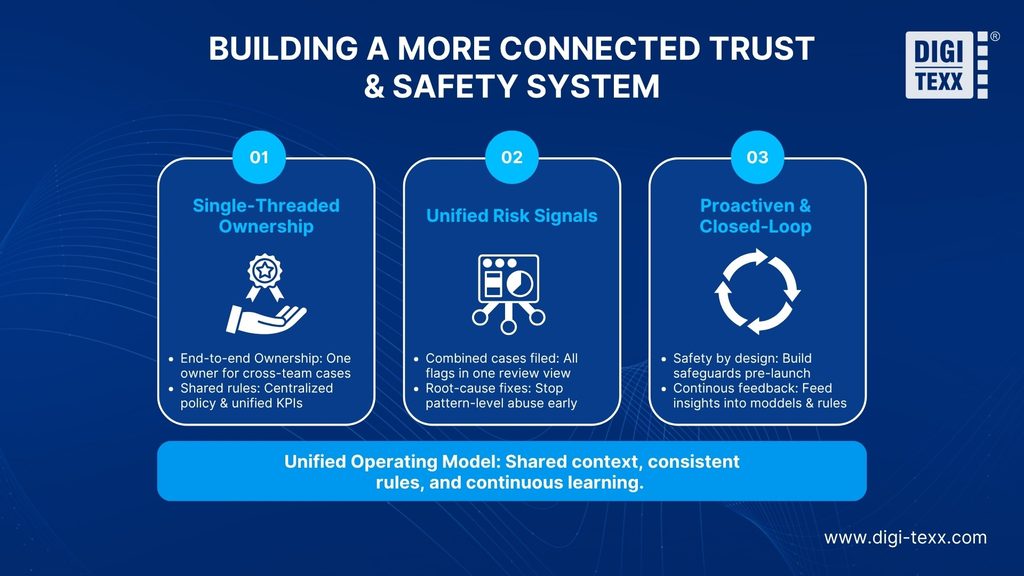
Build a connected T&S system through clear case ownership, unified risk signals, and continuous feedback
FAQs
What Is The Main Function Of Trust & Safety?
Its main function is to protect users and the platform from harmful content and behavior. No single team does that alone. Policy defines the rules, engineering and analytics detect and measure risk, operations enforces with human judgment, and other functions handle legal, external, and user-facing needs. TSPA describes these as the common functions across T&S teams.
Is Content Moderation A Trust & Safety Function?
Yes. Content moderation is one function within T&S. According to TSPA, content moderation professionals are typically housed within operations teams. They work alongside policy, engineering, analytics, legal, and other functions rather than in isolation.
How Do Trust & Safety Teams Work Together?
Policy sets the rules, detection systems flag risky activity, and operations reviews it. Appeals and quality checks then show where policies, tools, or models need to change. In the Instant Buy example, a reversed payout hold led to a new verification path for legitimate sellers. YouTube describes a similar pattern: flagged content generally goes to trained reviewers, and mistakes are analyzed so measures can prevent them. The teams work well together when those findings reach every function that needs them.
What Is The Role Of Human Review In Trust & Safety?
Human review applies context and judgment that automated systems struggle with, such as telling a fraud ring from a legitimate new seller. It also handles appeals and generates feedback for policy and detection. Under the DSA, internal complaint decisions must be taken under the supervision of appropriately qualified staff, not solely by automated means (Article 20).
Can Trust & Safety Operations Be Outsourced?
Yes. TSPA notes that platforms may outsource moderation to an external vendor, and that the platform’s own operations team often manages that relationship. A practical split is to keep policy ownership, strategy, and legal decisions in-house, and to give the vendor clear guidance, QA, and a feedback channel so that what it learns reaches your policy and product teams.
Reference:
- European Union. (2022). Regulation – 2022/2065 – en – DSA – EUR-Lex. Europa.Eu. https://eur-lex.europa.eu/eli/reg/2022/2065/oj/eng
- Key Functions and Roles – Trust & Safety Professional Association. (2021, June 18). Trust & Safety Professional Association. https://www.tspa.org/curriculum/ts-curriculum/functions-roles/
- YouTube Community Guidelines Enforcement FAQs – transparency report help center. (2018). Google.Com. https://support.google.com/transparencyreport/answer/9209072?hl=en