An insurance claim often begins during a difficult moment. A policyholder may be recovering from an illness, arranging vehicle repairs, or managing property damage. Repeated document requests, unclear instructions, and the need to chase updates add customer effort to an already stressful situation.
Insurance business process outsourcing (BPO) can help reduce this effort through coordinated intake, document processing, verification, and customer support. This article explores where unnecessary customer effort arises, how insurance BPO helps address it, and what insurers should consider when choosing a partner.
Why Customer Effort Matters In Insurance Claims?
Customer effort is the time and work required to submit evidence, respond to requests, and follow a claim through to resolution. When customers must repeat information or chase updates, the process adds frustration to an already stressful situation.
The consequences extend beyond inconvenience. J.D. Power’s analysis of its 2024 U.S. Auto Claims Satisfaction Study found that overall satisfaction was more than 200 points lower on a 1,000-point scale when communication was perceived as high effort rather than low effort. Nearly 40% of high-effort customers contacted their insurer four or more times, often across multiple channels.
These findings highlight an important issue: customers’ effort depends on how much work they must do while waiting, as well as how long the claim takes. An unanswered inquiry can lead to another call, followed by an email and another explanation of the same problem.
For insurers, these repeated interactions increase service demand and can reveal workflow weaknesses. Monitoring customer effort helps identify where incomplete records, unclear requirements, or inconsistent follow-up create unnecessary work for both customers and staff.
How Customer Effort Score (CES) Is Measured
Customer Effort Score (CES) measures how easy or difficult customers find a claims interaction, such as submitting documents or getting an update. Customers rate their experience on a defined scale, and the average is calculated as:
CES = Total response scores ÷ Number of responses
CES helps insurers identify where customers struggle and track whether changes, including insurance BPO support, make those interactions easier. Customer comments, repeat document requests, and follow-up contacts help explain the results.
What Customers Expect During The Claims Journey
The claims journey extends from reporting an incident through assessment, resolution, and follow-up. While the steps vary by insurance product and claim complexity, customers need to understand what to do, how their claim is progressing, and what happens next.
J.D. Power’s 2026 U.S. Property Claims Satisfaction Study includes trust, communication, settlement time, and ease of starting and resolving a claim among its satisfaction dimensions. These priorities highlight the importance of both reliable handling and clear guidance.
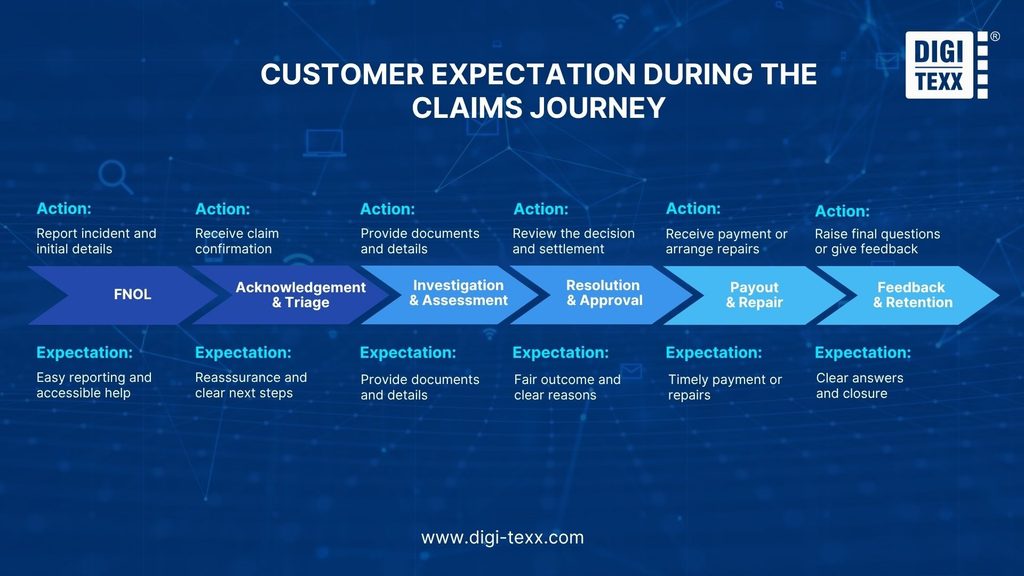
Customer expectation during the claims journey:
| Key Stage | Action | Customer Expectation |
| First Notice of Loss (FNOL) | The customer reports the incident and provides initial details. | A straightforward reporting process and accessible assistance. |
| Acknowledgment and Triage | The insurer confirms receipt and assigns the claim to the appropriate team. | Reassurance, a claim reference, and clear next steps. |
| Investigation and Assessment | The insurer reviews evidence and policy terms, requesting further information where needed. | Specific requests, timely updates, and understandable explanations. |
| Decision and Settlement | The insurer determines coverage and explains the outcome and proposed settlement, where applicable. | A fair assessment and transparent reasoning. |
| Payment or Repair | Approved payment or repair arrangements proceed according to the settlement. | Timely completion and support if problems arise. |
| Closure and Follow-Up | The insurer confirms completion, addresses remaining questions, and may request feedback. | Clear closure and an opportunity to raise unresolved concerns. |
Simplicity And Ease
Customers expect clear requirements and straightforward submission steps. They need to know which documents to provide, which formats are accepted, and where to submit them, with assistance readily available when needed.
That ease should continue after submission. Information already provided should remain accessible to the relevant teams, so customers do not have to resend documents or repeat details as their claim progresses.
Speed And Efficiency
Long gaps between submission, review, and response leave customers waiting without a sense of progress. They expect their claim to move forward promptly, with missing information identified early and documents passed to the right team without unnecessary delays.
More complex cases may take longer, but clear timelines and timely follow-up help customers understand what to expect.
Clear Communication And Transparency
Knowing that a claim is “under review” tells customers little about its progress. They want to understand what has been completed, what remains outstanding, and whether they need to act.
Specific updates make the process easier to follow. If an itemized invoice is missing, the message should identify it clearly and explain how to submit it.
Empathy And Accessibility Support
During a claim, even routine paperwork may feel overwhelming. Patient explanations and an understanding of the customer’s circumstances help make interactions more manageable.
Assistance also needs to be accessible. Language support, alternative submission methods, and help with digital forms allow customers to complete requirements in a way that works for them.
Realistic Timelines And Next Steps
A clear timeline gives customers something to plan around. They need to know the next step, when to expect a response, and which factors might extend the process.
When that timeframe changes, an explanation and a revised update point help reduce uncertainty and the need to chase information.
Where Unnecessary Customer Effort Begins
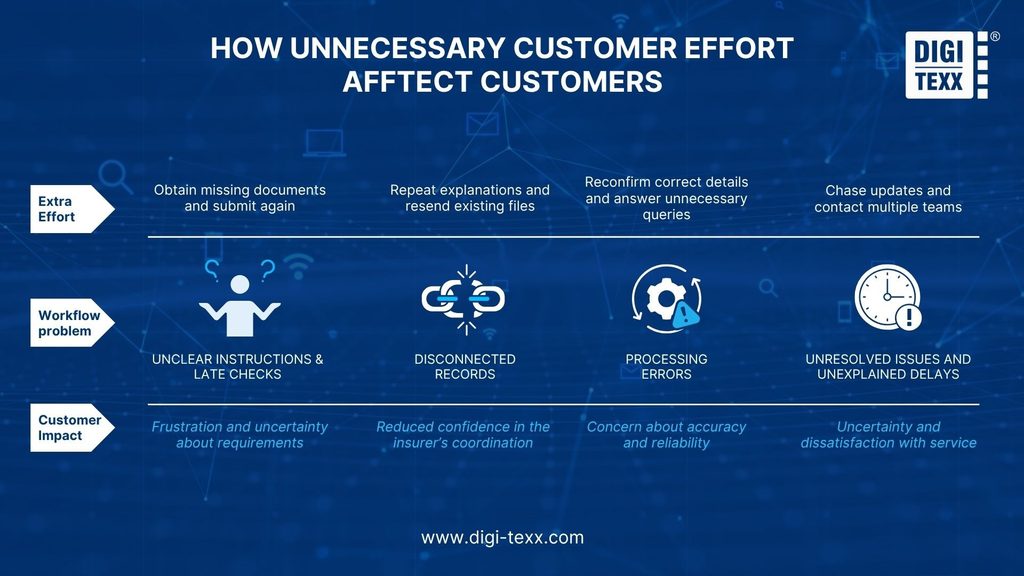
Unclear instructions, disconnected records, and unresolved processing issues can turn routine claims requirements into repeated work.
How unnecessary problems affect customers:
| Workflow Problem | Additional Customer Effort | Potential Impact on Customer Experience |
| Unclear instructions and late checks | Obtaining additional documents and repeating submission steps. | Frustration and uncertainty about requirements. |
| Disconnected records | Explaining previous submissions and resending existing information. | Reduced confidence in coordination and reliability. |
| Processing errors | Reconfirming details and responding to avoidable queries. | Concern about accuracy and frustration with corrections. |
| Unresolved issues and unexplained delays | Making repeated inquiries and contacting different teams. | Greater uncertainty and dissatisfaction with responsiveness. |
Confusing Instructions And Incomplete Submissions
A request for “supporting medical documents” may leave customers unsure whether to provide a discharge summary, an itemized bill, or both. They submit what seems appropriate, only to learn later that something is missing.
If the gap is identified several days after submission, obtaining the additional document may require another hospital visit or call. Unclear guidance and late checks turn a necessary requirement into another round of paperwork.
Repeated Information Requests Across Teams
A customer may report an incident by phone, upload photographs through a portal, and submit paperwork at a branch. When these records are not connected, one team may request something another has already received.
The customer then has to explain what was submitted and when, sometimes sending another copy to keep the claim moving. An internal information gap becomes the policyholder’s responsibility to resolve.
Processing Errors And Unexplained Delays
An incorrectly entered policy number or a document attached to the wrong file can trigger questions about information the customer supplied correctly.
Other claims stall when a discrepancy moves between teams without a clear owner. With no explanation of what is outstanding, customers contact the insurer again to find out whether they need to act.
The Role Of Insurance BPO In Claims Support
The workflow problems above highlight the need for consistent administrative support. Insurance BPO providers take on agreed claims activities, helping insurers manage incoming information and coordinate work across teams.
Depending on the engagement, responsibilities may include:
- Claims intake and FNOL support: Recording initial reports and registering claim details.
- Document processing: Scanning, classifying, and linking submissions to the correct claim.
- Data extraction and verification: Capturing relevant information and checking it against source documents.
- Administrative follow-up: Tracking missing information and outstanding tasks.
- Customer assistance: Responding to inquiries and communicating approved updates.
- Exception escalation: Referring unresolved issues to the appropriate specialist.
The insurer and provider agree on the service scope, system access, and escalation procedures, with clear boundaries around claims decision-making authority.
How Insurance BPO Makes The Claims Journey Easier
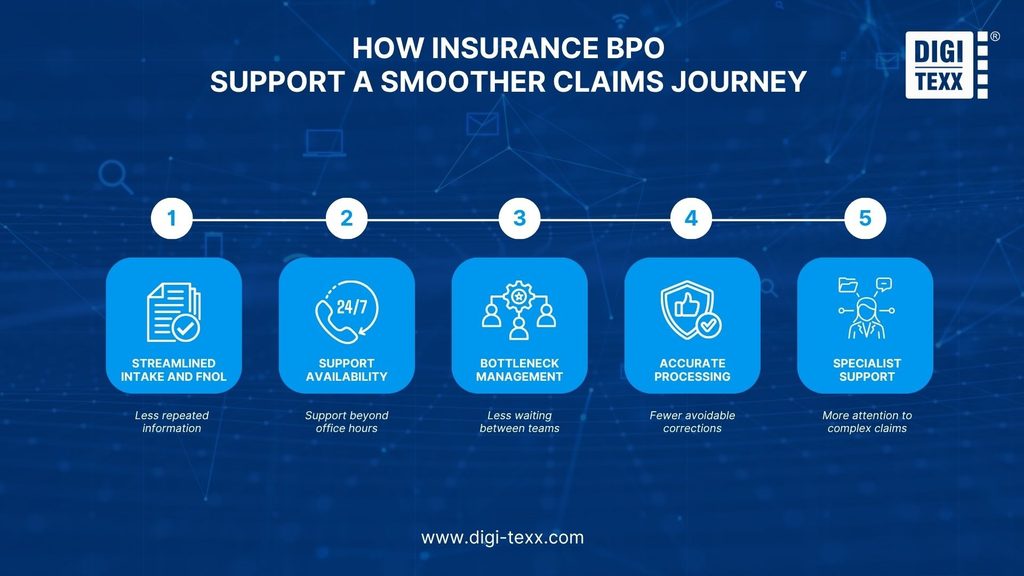
These responsibilities reduce customer effort when they prevent repeated work and help each stage move forward. From the initial report to specialist assessment, insurance BPO supports a more coordinated claims experience in five ways.
Insurance BPO Services and Their Impact on Customer Effort:
| Insurance BPO Service | How It Reduces Customer Effort |
| Streamlined Intake and FNOL | Less repeated information and earlier identification of missing details. |
| Round-the-Clock Support | Help outside office hours, where available. |
| Bottleneck Management | Less waiting between teams and fewer follow-up inquiries. |
| Processing Accuracy | Fewer corrections caused by administrative errors. |
| Administrative Support for Adjusters | More focused attention on complex customer needs. |
Faster Intake And First Notice Of Loss (FNOL)
The initial report sets the foundation for the claim. When important details are captured consistently, customers are less likely to face the same questions again as their file moves between teams.
BPO teams supporting FNOL follow structured questions and record the customer’s account for subsequent reviewers. Early document checks also help identify missing or unreadable information before it holds up further processing.
Customers receive a clearer starting point: confirmation that their report has arrived, guidance on outstanding requirements, and an explanation of what follows.
Round-The-Clock Support
Questions about a claim do not always arise during office hours. Extended-hours or 24/7 BPO support, where included in the engagement, gives customers more flexibility to seek assistance.
For someone completing paperwork after work, access to help may resolve uncertainty about a document or submission step immediately. This reduces the need to pause the task and rearrange their schedule to contact the insurer.
When specialist input is required, the support team records the issue and explains when follow-up is expected, so the customer knows how the inquiry will proceed.
Reducing Bottlenecks
A claim can stall between teams even when the customer has completed every requested action. Without clear ownership, an outstanding query may remain unresolved until the customer calls again.
BPO teams help manage these gaps by tracking pending tasks, identifying overdue items, and escalating issues to the responsible team. Handoffs include the information needed to continue, reducing time spent reconstructing the file.
This helps prevent customers from becoming responsible for keeping their claim moving. It also gives service representatives a clearer explanation of any remaining delay.
Higher Accuracy And Fewer Errors
Accurate processing helps prevent customers from being asked to clarify information they already provided correctly. Insurance BPO providers support this through specialized training, automated validation, and human review.
Insurance BPO vs In-house accuracy comparison:
| Metric / Factor | Insurance BPO | In-House Operations |
| Accuracy Rate | >98% for standardized, high-volume tasks when backed by domain-specific training and AI tools | Varies widely (often 95%–98% depending on internal training consistency and staff turnover) |
| Domain Expertise | Specialized processing experience, supported by training on the insurer’s documents and requirements. | Direct familiarity with the insurer’s products, systems, and procedures. |
| Error and Rework Management | Agreed quality checks, validation rules, and correction procedures support consistent output. | Internal review and correction processes provide direct control over quality. |
| Turnover and Continuity | Provider-managed staffing and cross-training support continuity when backed by documented procedures. | Continuity depends on internal knowledge transfer, cross-training, and succession planning. |
Freeing In-House Adjusters To Focus On Assessment
Complex claims need specialist attention. When adjusters spend time on routine administrative work, they have less capacity to investigate evidence, explain assessment questions, and address individual circumstances.
BPO support helps prepare cases for that attention. An escalation presents the relevant evidence, checks already completed, and the specific issue requiring judgment.
The customer is less likely to repeat the background of the claim and more likely to have the conversation focus on the unresolved question. Adjusters can concentrate on assessment while administrative teams support the work around it.
The Strategic Advantages Of Insurance BPO
An easier claims journey benefits the insurer as well as the customer. Reducing unnecessary interactions and administrative work helps control service costs, strengthen processing capacity, and support longer-term customer relationships.
Lower Administrative Costs And Less Rework
Every avoidable correction or repeat inquiry adds to the cost of handling a claim. Consistent processing and quality checks help reduce the staff time spent resolving these issues.
The financial value becomes clearer through measures such as rework rates, repeat contacts, and cost per claim. A complete assessment also accounts for transition, integration, and provider oversight costs.
Greater Capacity For Complex Claims
Insurance BPO gives insurers more flexibility to allocate resources as workloads change. Agreed processing capacity helps manage administrative queues during busy periods while preserving internal expertise for complex cases.
This flexibility supports a more balanced workload across the claims operation, provided additional capacity is backed by appropriate training and quality controls.
Stronger Customer Advocacy And Higher NPS
The claims experience is an opportunity for insurers to demonstrate dependable service. When customers find the process manageable and receive helpful responses, they may be more willing to recommend their insurer.
Net Promoter Score (NPS) tracks that willingness. Reviewing NPS alongside claims feedback and Customer Effort Score helps insurers understand how service improvements relate to customer advocacy.
Better Retention And Higher Customer Lifetime Value
A well-handled claim can reinforce the value customers see in their insurance relationship. That confidence may support renewal and extend the relationship over time.
For insurers, stronger retention can increase customer lifetime value (CLV) and reduce the need to replace departing policyholders. Reliable BPO support helps sustain the service behind that relationship, alongside other influences such as pricing, coverage, and claim outcomes.
Choosing An Insurance BPO Partner That Reduces Customer Effort
A successful outsourcing arrangement starts with identifying where customers struggle and which activities need improvement. This gives insurers a clear basis for defining the scope, evaluating providers, and setting performance targets.
DIGI-TEXX provides outsourcing claims processing services, supporting document intake, data extraction, verification, and administrative follow-up. These services help insurers reduce repetitive workloads and support a smoother claims journey for customers.
Decide Which Claims Activities To Outsource
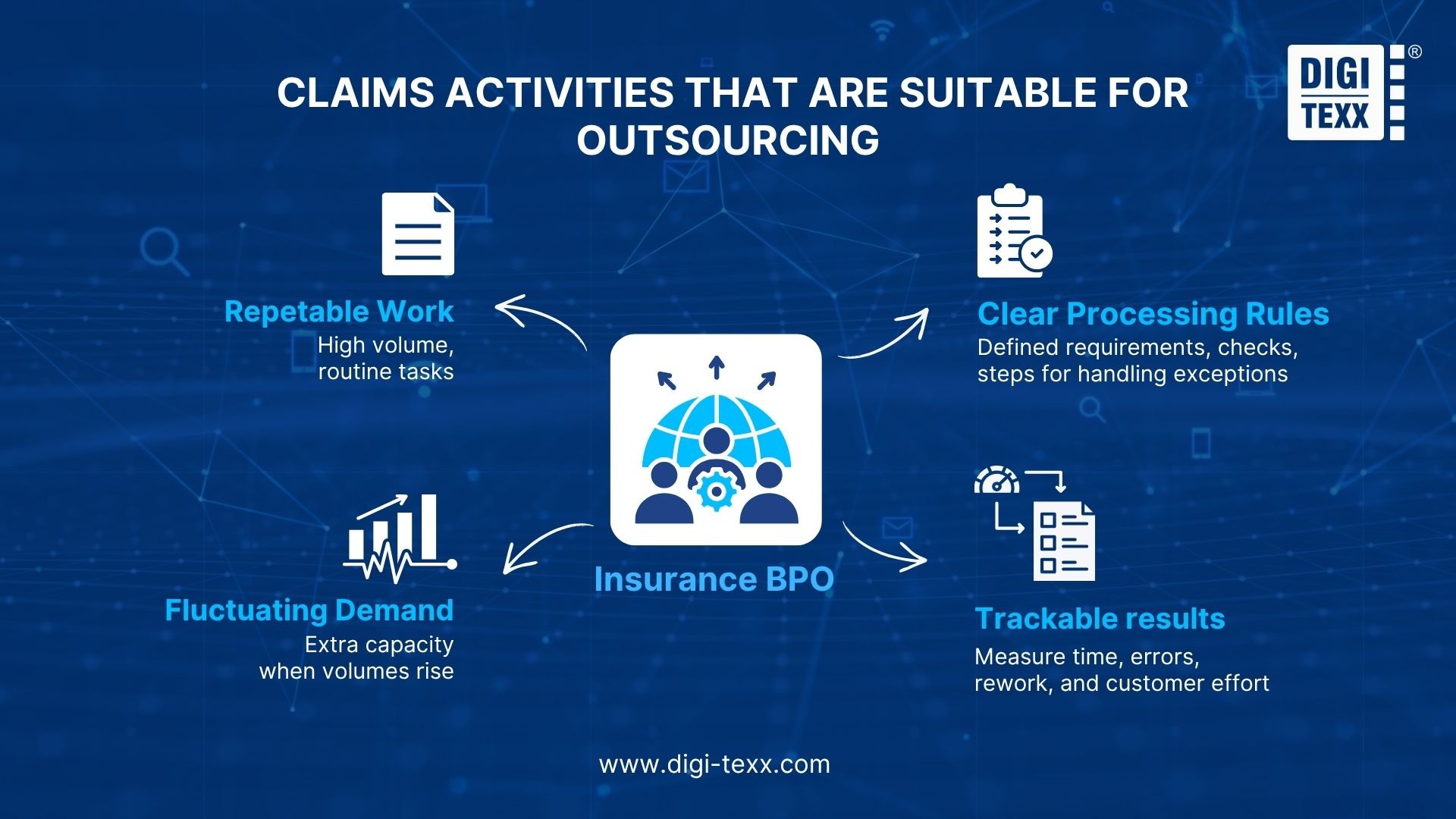
Start with tasks where administrative friction creates repeated work for customers or delays for internal teams. Suitable activities often involve:
- High volumes and repetition: Document intake, classification, data entry, and routine inquiries.
- Clear processing rules: Tasks with defined requirements, validation checks, and escalation paths.
- Fluctuating demand: Workloads that exceed internal capacity during peak periods.
- Measurable results: Activities assessed through turnaround time, accuracy, rework, and customer effort.
Processes requiring complex judgment or decision-making authority need closer review before inclusion. A focused initial scope helps establish whether the arrangement improves performance before expanding.
Look For Relevant Claims Experience
The provider’s experience should match the proposed scope. Medical document processing, FNOL assistance, and claims inquiries require different knowledge and procedures.
Review comparable projects and staff training practices. A pilot using representative cases helps assess how the provider handles routine work and exceptions.
Check Integration And Accountability
Confirm how documents, processing results, and outstanding actions will become available to authorized teams. The arrangement should improve visibility across the workflow.
Define responsibility for receipt confirmation, discrepancy resolution, customer communication, and escalation. Each handoff needs a clear owner so customers do not have to chase progress between teams.
Assess Support Availability And Scalability
Operating hours, language capabilities, and staffing arrangements should match the customers being served. For extended-hours or 24/7 support, confirm which inquiries staff can resolve and how specialist follow-up is handled.
Review how additional capacity is introduced during volume increases, including training, backup coverage, and quality checks.
Review Quality Assurance And Data Security
Examine how accuracy is measured, which information is verified, and how errors are corrected. Quality targets should reflect the documents and tasks being outsourced.
Security criteria should cover access permissions, secure transfer, storage, and traceable processing records, taking account of the sensitivity of claims information.
Frequently Asked Questions
What Is Insurance BPO?
Insurance BPO is the outsourcing of defined insurance-related business processes to an external provider. Services may include document processing, data verification, administrative support, and customer assistance, depending on the engagement.
Which Claims Activities Can An Insurance BPO Provider Support?
Potential activities include intake, scanning, classification, extraction, verification, administrative tracking, and customer support. The exact scope depends on the provider’s capabilities, access arrangements, and agreed responsibilities.
How Can Insurance BPO Reduce Repeated Document Requests?
A BPO team can help link submissions to the correct claim, check existing records before flagging missing information, and identify gaps earlier. Coordinated follow-up can reduce duplication between teams.
Does Insurance BPO Replace Claims Decision-Making?
An administrative BPO arrangement does not automatically transfer authority to approve or deny claims. Any decision responsibilities must be explicitly defined within the service scope and applicable governance arrangements.
Explore related articles:
- BPO Services For Insurance: Definition, Types, Benefits & Top Companies
- Best Insurance Claims Processing Outsourcing BPO In The US 2026
- Automated Document Processing for Insurance: How It Works & Benefits
Reference:
- Insurance 2030: From customer worst to customer first. (n.d.). Retrieved October 21, 2026, from https://www.pwc.com/us/en/industries/financial-services/library/images/pwc-insurance-2030-customer-first-insurance.pdf
- 2024 U.S. auto claims satisfaction study – JD power. (2024, October 26). JD Power. https://www.jdpower.com/business/press-releases/2024-us-auto-claims-satisfaction-study/
- O’Brien, K., & Downie, A. (2024). Customer effort score. Ibm.Com. https://www.ibm.com/think/topics/customer-effort-score