

Digital platforms have transformed how people communicate, shop, work, and build communities. As these platforms grow, however, they also face increasingly complex challenges, from harmful content and harassment to scams, fake accounts, and coordinated abuse.
Addressing these risks requires more than simply removing inappropriate content. Platforms need a broader approach to protect users, maintain platform integrity, and respond to evolving forms of online abuse.
This is where Trust and Safety (T&S) comes in. But what exactly is Trust & Safety, what does it involve, and how does it work?
What Is Trust and Safety?
Trust and Safety (T&S) refers to the teams, policies, processes, and technologies digital platforms use to protect users from harmful and unwanted experiences and reduce abuse of their services.
The Trust & Safety Professional Association (TSPA) describes Trust & Safety as an umbrella term for teams at internet companies and service providers that work to ensure users are protected from harmful and unwanted experiences.
In practice, Trust & Safety helps platforms define acceptable behavior, identify potential violations, enforce platform rules, investigate abuse, and respond to emerging risks.
However, Trust & Safety does not look exactly the same at every company. A social media platform may focus heavily on harmful content and user behavior, while an online marketplace may place greater emphasis on scams, fraudulent accounts, and transaction-related abuse.
How Has Trust and Safety Evolved?
Trust and Safety has evolved alongside the growth of the internet, expanding from addressing common forms of online abuse to playing a broader role in how digital platforms protect users.
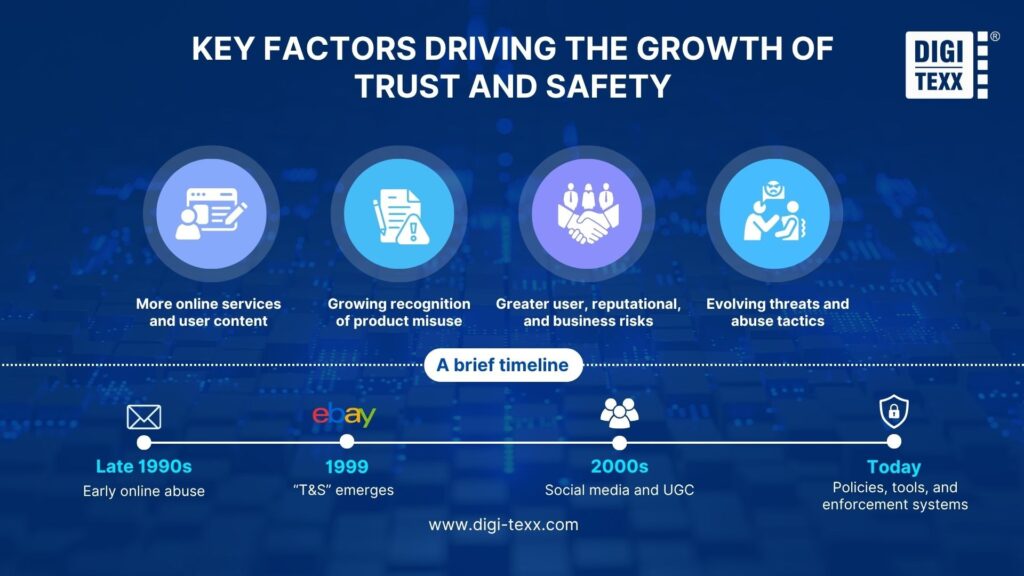
According to the Trust & Safety Professional Association (TSPA), online safety efforts have existed since the early days of the web, while the term “Trust & Safety” emerged between 1999 and 2010.
A Brief Timeline of Trust and Safety:
| Period | Key Development |
| Late 1990s | Early teams address fraud, scams, phishing, spam, and other online abuse. |
| 1999 | The term “Trust & Safety” emerges, with eBay as an early adopter. |
| 2000s | Social media and UGC increase the scale and complexity of online risks. |
| Today | T&S expands into policy, enforcement, tools, and systems. |
According to TSPA, the growth of Trust & Safety reflects the convergence of four key factors:
- The proliferation of online services and user-generated content (UGC): More services and user-created content have increased the scale and variety of online activity that platforms need to manage.
- Growing recognition of product misuse: Companies increasingly recognize that digital products and features can be exploited in unintended and potentially harmful ways.
- Greater user, reputational, and business risks: Unaddressed misuse and abuse can negatively affect user experiences while also eroding company reputation and profits.
- Constantly evolving threats and abuse tactics: Online safety issues and the techniques used by bad actors continue to change, requiring ongoing and adaptive responses.
As these challenges have evolved, Trust & Safety has moved beyond simply identifying and removing harmful content. Its role has expanded to include the development of content and product policies, as well as the tools, systems, and techniques used to enforce them.
What Are the Common Functions of Trust and Safety?
Trust & Safety is a cross-functional discipline that can involve policy, operations, technology, product, legal, analytics, and research. The exact functions and organizational structure vary across platforms.
According to the Trust & Safety Professional Association (TSPA), common functions performed by Trust & Safety professionals include:
- Content policy
- Content design and strategy
- Data science and analytics
- Engineering
- Legal
- Law enforcement response and compliance
- Operations
- Product policy
- Product management
- Public policy and communications
- Sales and advertiser support
- Threat discovery and research
Not every organization has separate teams for all of these functions. The structure of Trust & Safety depends on factors such as the platform’s size, products, users, business model, and risk profile.
These functions also work together. Policy teams may define platform rules and enforcement standards, while operations teams apply those rules to real cases.
Data science and engineering can support detection and enforcement at scale, while product teams consider safety when designing platform features. Threat researchers may also investigate emerging or coordinated forms of abuse.
Together, these functions allow platforms to address both individual violations and broader patterns of harmful behavior.
What Types of Risks Does Trust and Safety Address?
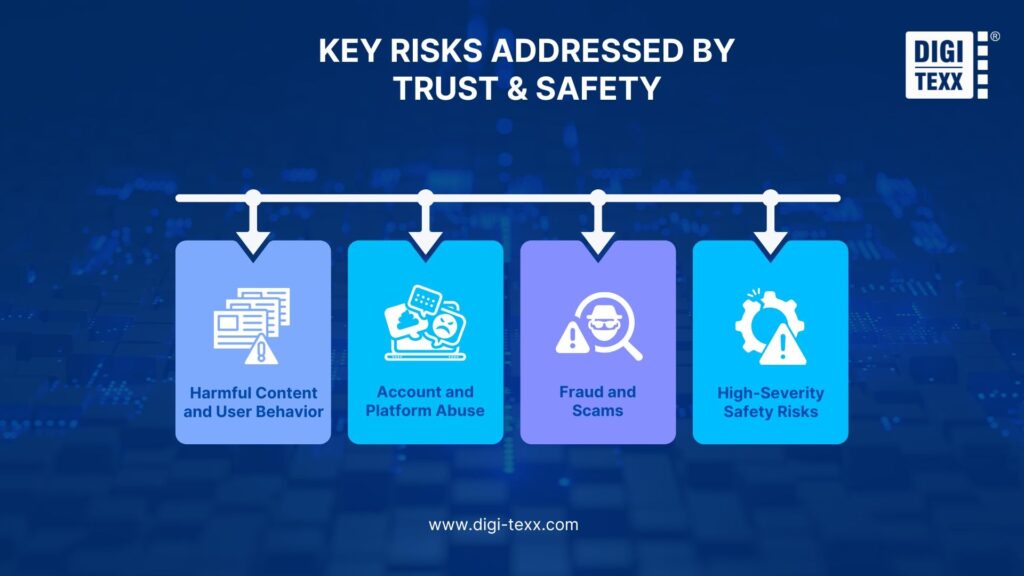
Trust & Safety can address risks including harmful content, harassment, fake accounts, impersonation, scams, fraud, coordinated abuse, platform manipulation, and high-severity safety threats. The risks a T&S team manages depend on the platform and how people use it.
A social network, marketplace, gaming platform, and sharing-economy application, for example, may face very different combinations of risks.
Harmful Content and User Behavior
One of the most visible areas of Trust & Safety involves what users post, share, and communicate.
Depending on a platform’s policies and applicable legal requirements, this may include hate speech, harassment, bullying, violent or extremist content, graphic or sexually explicit material, spam, harmful misinformation, and other policy-violating user-generated content.
Platforms establish policies defining what is permitted and develop moderation and enforcement processes to apply those rules.
Content moderation plays an important operational role in this area, but it is only one part of the broader Trust & Safety ecosystem.
Account and Platform Abuse
Online harm does not always originate from an individual post or comment.
Bad actors may create fake accounts, impersonate legitimate users, coordinate activity across multiple accounts, or repeatedly attempt to evade platform enforcement.
Trust & Safety teams may therefore address fake or deceptive accounts, impersonation, spam networks, the misuse of bots and automation, coordinated inauthentic behavior, and repeated attempts to evade platform rules.
Addressing these risks requires platforms to look beyond individual pieces of content and identify patterns of behavior across users, accounts, and networks.
Fraud and Scams
Fraud and scams can also fall within the scope of Trust & Safety, particularly for marketplaces, e-commerce platforms, sharing-economy applications, and other services that enable transactions between users.
Examples may include:
- Online scams
- Phishing
- Fraudulent profiles or listings
- Account takeover
- Buyer or seller abuse
- Transaction-related manipulation
The ownership of these risks differs across organizations. Depending on the platform, Trust & Safety may work alongside fraud prevention, payments, risk, identity, or cybersecurity teams.
High-Severity Safety Risks
Some forms of online harm require specialized review and escalation because of their severity.
These risks may include threats to children’s safety, such as grooming, as well as human trafficking, credible threats of violence, and content that encourages or provides instructions for self-harm.
Platforms may establish dedicated workflows, specialist teams, and technologies for detecting and responding to these cases. Depending on the type of harm and applicable legal requirements, some cases may also require reporting or coordination with relevant authorities or specialist organizations.
How Does Trust and Safety Work?
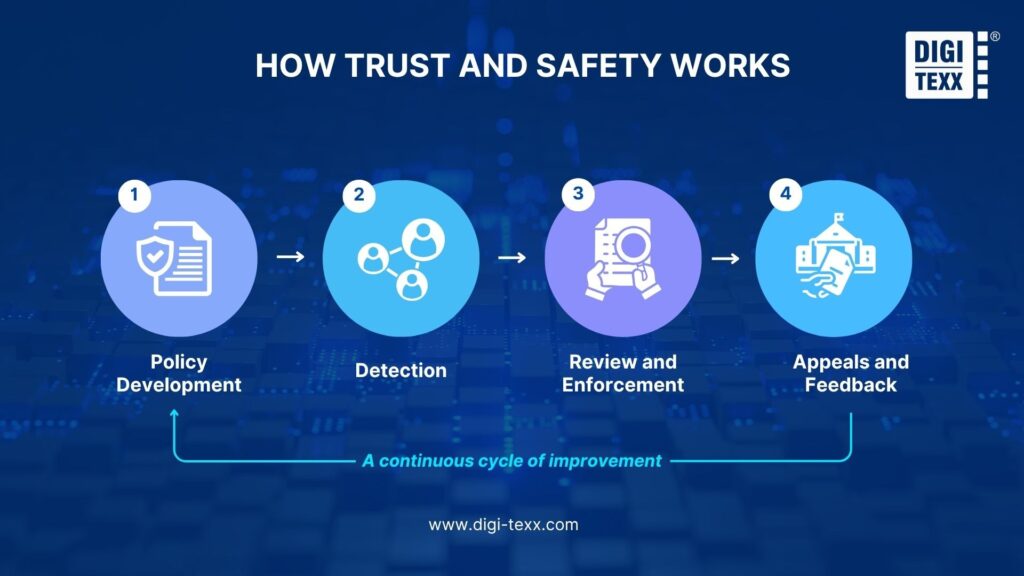
Trust & Safety typically works as a continuous process in which platforms establish policies, detect potential violations, review cases, take enforcement action, and use appeals and operational feedback to improve future decisions.
There is no single Trust & Safety workflow used by every platform. However, a simplified way to understand the process is:
Policy → Detection → Review & Enforcement → Appeals & Feedback
1. Policy Development
Trust & Safety begins with defining the rules of the platform.
Policy teams develop community guidelines, enforcement standards, and internal guidance that establish what content and behavior are permitted.
These policies can reflect the platform’s purpose, product design, risk profile, applicable legal requirements, and the cultural or regional contexts in which it operates.
Clear policies provide the foundation for detection, moderation, and enforcement.
2. Detection
Once rules are established, platforms need ways to identify potential violations.
Detection can be both proactive and reactive. Platforms may use automated systems to identify suspicious content or behavior, while user reports and investigations can surface additional violations.
Common methods include machine learning models, rules and heuristics, keyword and pattern detection, behavioral signals, user reports, and internal investigations.
The appropriate method depends on the type of risk, platform, and severity of the potential violation.
3. Review and Enforcement
Potential violations then need to be evaluated against platform policies.
Depending on the case, this may involve automated decisions, human review, or escalation to specialized teams.
If a violation is confirmed, enforcement can range from warnings and content removal to feature restrictions, temporary suspensions, or permanent account removal, depending on the platform’s policies.
4. Appeals and Feedback
Trust & Safety decisions are not always straightforward, and enforcement systems can make mistakes.
Appeal mechanisms can give users an opportunity to challenge eligible decisions and allow platforms to reassess whether their policies were applied correctly.
At the same time, insights from appeals, quality assurance, investigations, and emerging abuse patterns can reveal gaps in policies or detection systems.
These insights can then feed back into policy, detection, training, and enforcement processes, creating a continuous cycle of improvement.
How Do AI and Human Review Work Together in Trust and Safety?
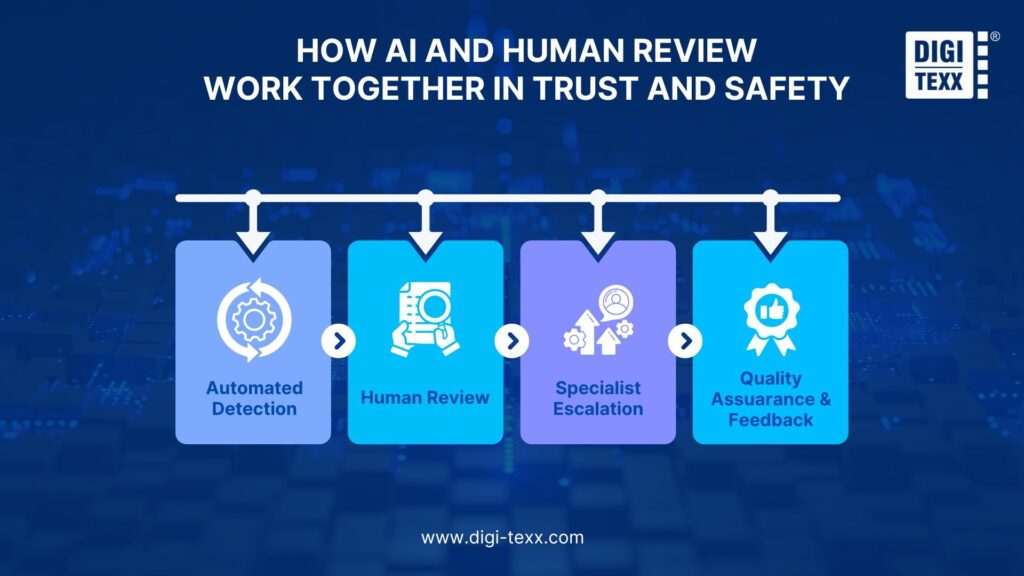
AI and human review play complementary roles in Trust & Safety. Automated systems help detect, classify, and prioritize potentially harmful activity at scale, while human reviewers handle cases that require greater context, judgment, or specialist escalation.
AI can efficiently identify suspicious patterns and process repetitive or clearly defined violations. However, factors such as language, cultural context, intent, humor, and emerging threats can make some cases difficult to assess through automation alone.
A typical human-in-the-loop workflow may look like:
Automated Detection → Human Review → Specialist Escalation → Quality Assurance & Feedback
Together, automation provides speed and scale, while human review adds contextual judgment. Reviewer feedback can also help improve policies, workflows, training, and detection systems over time.
>>> See more: Human-in-the-Loop Automation: How It Works, When To Use It
Trust and Safety vs. Content Moderation vs. Cybersecurity
Trust & Safety has a broader scope than content moderation, covering areas such as policy, account abuse, fraud, investigations, and enforcement.
While content moderation focuses on user-generated content, cybersecurity focuses on protecting systems, networks, applications, and data from security threats.
Core differences among Trust & Safety, Content Moderation, and Cybersecurity:
| Feature | Trust & Safety | Content Moderation | Cybersecurity |
| Primary focus | User safety & platform integrity | User-generated content | Systems, networks & data |
| Key risks | Abuse, scams, fraud, account misuse | Harmful content, spam, harassment | Malware, hacking, data breaches |
| Key activities | Policy, enforcement, investigations, risk mitigation | Review, labeling, removal, escalation | Threat detection, access control, incident response |
| Scope | Broad, cross-functional discipline | Core function within T&S | Separate but overlapping discipline |
How Do These Areas Overlap?
These three areas are distinct, but they can overlap when the same incident involves content, user behavior, and system security.
Content moderation is generally a function within the broader Trust & Safety ecosystem, focusing specifically on user-generated content and whether it complies with platform policies. Trust & Safety extends beyond individual content to address wider issues such as account abuse, fraud, investigations, enforcement, and platform integrity.
Cybersecurity is a separate but overlapping discipline. While cybersecurity focuses on protecting systems, networks, applications, and data, some risks can involve both security and user or platform abuse. Account takeover, phishing, compromised accounts, and certain forms of fraud are common examples where Trust & Safety and cybersecurity teams may need to work together.
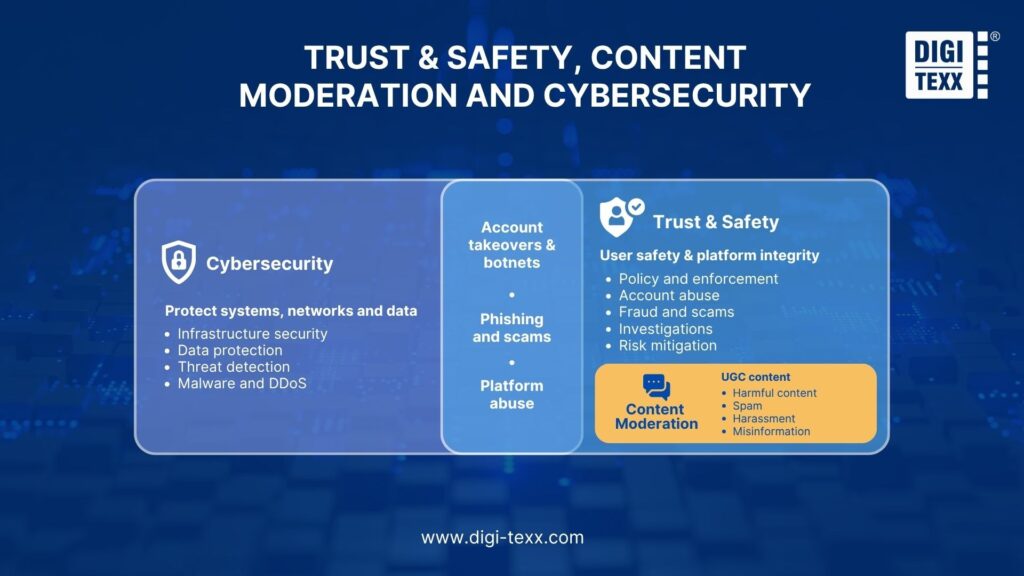
Consider account takeover as an example:
- Cybersecurity: Investigates how unauthorized access occurred and works to secure the account and underlying systems.
- Trust & Safety: Assesses how the compromised account is being used, such as for impersonation, scams, or platform abuse.
- Content Moderation: Reviews individual posts, images, or messages created by the compromised account against platform policies.
The three areas can therefore overlap on the same risk while addressing different aspects of it
>>> See more: How to Moderate User-Generated Content: Complete Guide 2026
FAQs
What does Trust and Safety mean?
Trust & Safety refers to the teams, policies, processes, and technologies digital platforms use to protect users from harmful and unwanted experiences and reduce abuse of their services. Its scope can include policy, moderation, operations, investigations, enforcement, analytics, product safety, and other functions.
What does a Trust and Safety team do?
Trust & Safety teams help platforms define rules, identify harmful or abusive activity, enforce policies, investigate threats, and improve systems for preventing online harm. The exact responsibilities vary depending on the platform, its products, users, and risk profile.
Is Trust and Safety the same as content moderation?
No. Content moderation is an important part of Trust & Safety, but the two terms are not interchangeable. Content moderation focuses primarily on reviewing user-generated content against platform policies, while Trust & Safety can also include policy development, account integrity, investigations, fraud and scam prevention, enforcement, product safety, and risk mitigation.
What is the difference between Trust and Safety and cybersecurity?
Trust & Safety primarily focuses on protecting users and platform integrity from harmful behavior and abuse. Cybersecurity primarily focuses on protecting systems, networks, applications, and data from security threats. The two disciplines can overlap in areas such as account takeover, fraud, and certain forms of identity abuse.
What types of platforms need Trust and Safety?
Trust & Safety is particularly relevant to digital platforms where users create content, communicate, transact, or interact with one another. This can include social media platforms, online marketplaces, gaming communities, e-commerce platforms, sharing-economy applications, and other online services.
Explore related articles:
- E-commerce Content Moderation: Essential Guide for Platform Owners & E-commerce Businesses
- Content Moderation Companies: 10 Best Providers In 2026
- Outsourced Content Moderation Services: Top Providers & How to Choose 2026
References:
- DTSP Press. (2023, January 27). Glossary of Trust & Safety Terms – Digital Trust & Safety Partnership. Digital Trust & Safety Partnership. https://dtspartnership.org/glossary/
- Look, S. (2023, April 9). (Part 3) Lifecycle of a Trust & Safety Operation. Medium. https://sylvialook.medium.com/part-3-lifecycle-of-t-s-operation-6715480a88d0
- Trust & Safety Professional Association. (2022d, September 21). Industry Overview – Trust & Safety Professional Association. https://www.tspa.org/curriculum/ts-fundamentals/industry-overview/
- Trust & Safety Professional Association. (2022b, September 2). Introduction to Trust & Safety – Trust & Safety Professional Association. https://www.tspa.org/curriculum/ts-fundamentals/industry-overview/intro-to-ts/
- Trust & Safety Professional Association. (2022a, September 1). Key Elements of a Trust & Safety Team – Trust & Safety Professional Association. https://www.tspa.org/curriculum/ts-fundamentals/industry-overview/ts-team-elements/
- Trust & Safety Professional Association. (2021, June 18). Key Functions and Roles – Trust & Safety Professional Association. https://www.tspa.org/curriculum/ts-curriculum/functions-roles/
- Trust & Safety Professional Association. (2022c, September 19). What Is Content Moderation? – Trust & Safety Professional Association. https://www.tspa.org/curriculum/ts-fundamentals/content-moderation-and-operations/what-is-content-moderation/