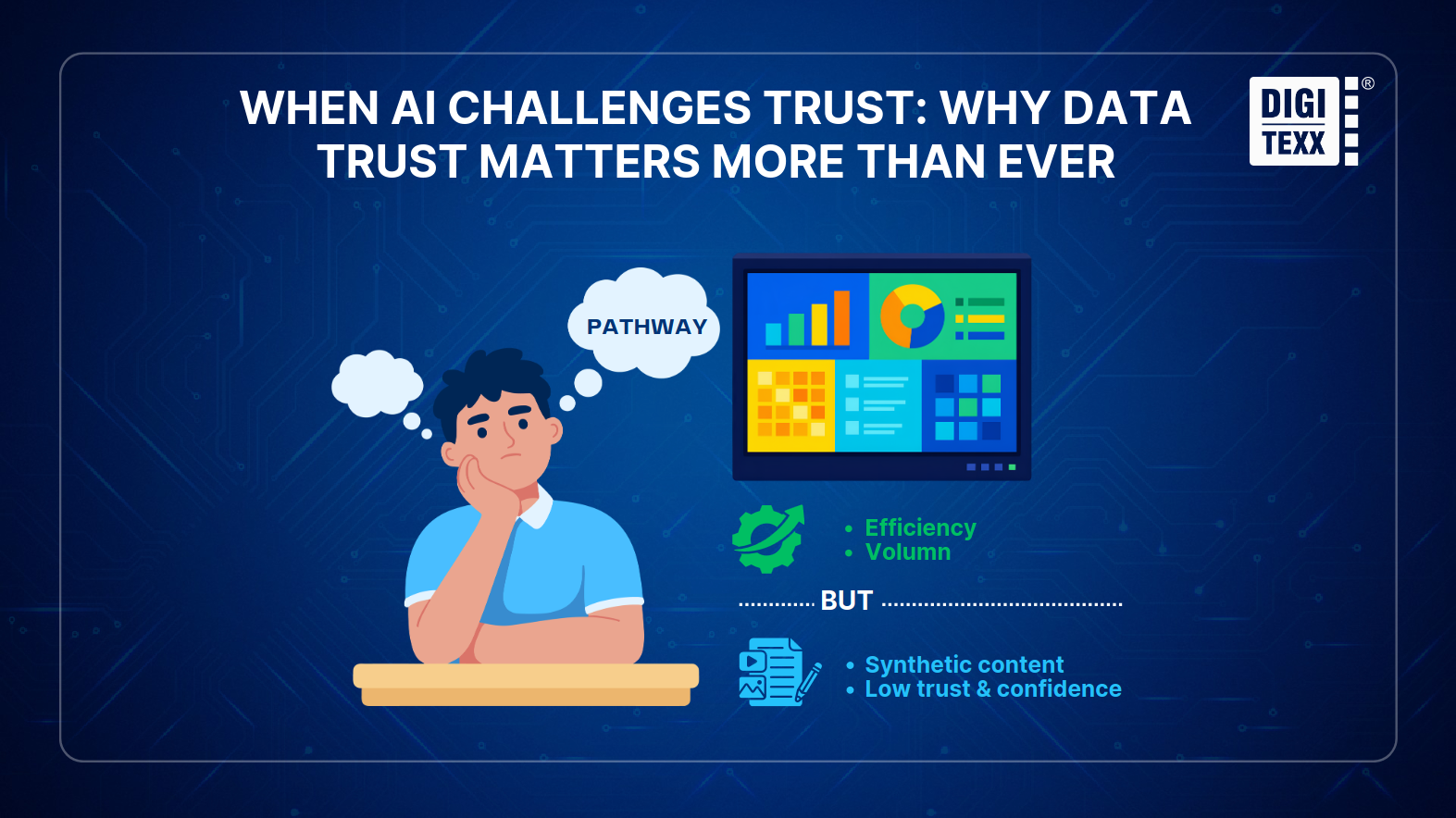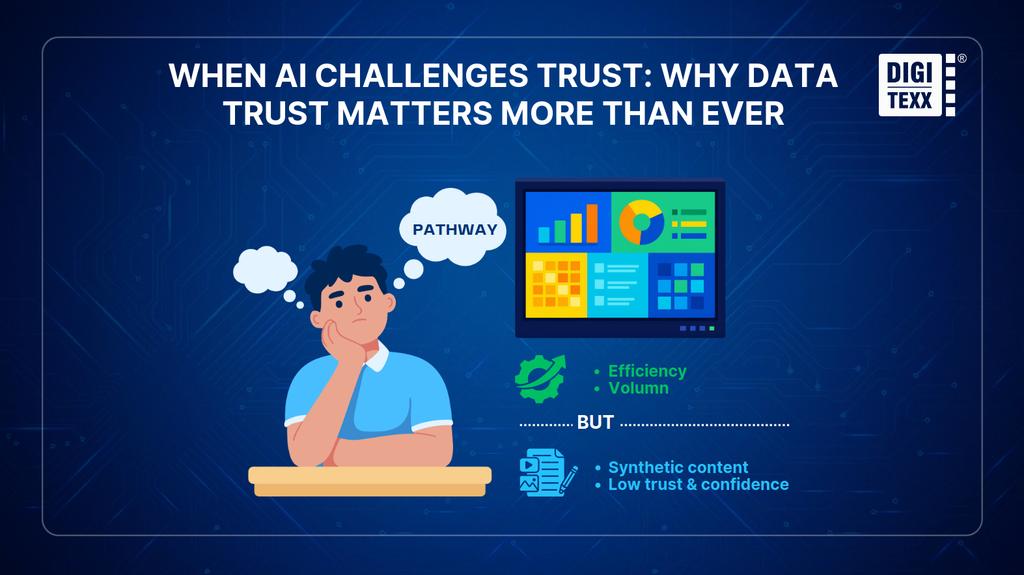
Trust is an invaluable asset and the foundation of economic systems, crucial for effective transactions, fostering collaboration, and creating a favorable business climate. Yet as business shifts rapidly toward digital platforms and automated interactions, the way we build and protect this foundation is changing.
When face-to-face handshakes are replaced by screens, algorithms, and data exchanges, genuine credibility becomes harder to prove – and far more valuable to earn. For modern businesses, maintaining that trust is no longer just a background necessity; it is the ultimate competitive advantage.
Why Does Data Trust Matter?
Data plays a central role in almost every business function. Organizations use it to understand customer behavior, monitor financial performance, manage resources, identify risks, and plan for growth.
However, the value of data depends on how confidently it can be used. When information is inaccurate, incomplete, or inconsistent, even the most sophisticated analytics tools can produce misleading insights.
So, a strong data trust enables organizations to:
- Make better-informed decisions. Reliable information gives decision-makers a clearer understanding of business performance, helping them identify opportunities, evaluate risks, and respond with greater confidence.
- Improve operational efficiency. When employees can rely on the information available to them, they spend less time checking records, correcting errors, and reconciling conflicting figures.
- Strengthen customer and partner relationships. Accurate customer records, consistent communication, and dependable reporting help businesses deliver on their commitments.
- Support digital transformation. Automation, advanced analytics, and AI applications all depend on reliable data to deliver meaningful results.
- Meet regulatory and compliance requirements. Organizations need clear records of how information is collected, processed, stored, and used to demonstrate accountability.
Ultimately, data trust connects information quality with business confidence. Without it, investments in technology may deliver far less value than expected.
The Cost of Poor Data Trust
The consequences of unreliable data extend far beyond incorrect records. When businesses fail to maintain clean, accurate, and well-governed data, even the most sophisticated software will amplify errors rather than solve them – leading to several critical challenges:
- Operational inefficiencies: Employees spend valuable time checking, correcting, and reconciling information instead of focusing on higher-value activities. These repeated tasks slow down workflows and increase operational costs.
- Financial losses: Incorrect figures can affect financial reporting, resource allocation, forecasting, and payment processing. Even relatively small discrepancies can lead to costly decisions when they go unnoticed.
- Compliance and reputational risks: Inconsistent records and incomplete documentation make audits more difficult and can undermine confidence among regulators, customers, and business partners.
- Poor customer experiences: Incorrect customer information, inconsistent communication, and processing errors can damage relationships and reduce customer satisfaction.
- Reduced confidence in technology: When employees repeatedly encounter unreliable reports or questionable AI-generated results, they become less willing to use the systems designed to support their work.
One of the biggest challenges is that data problems are not always immediately visible. A small discrepancy may pass through several systems before affecting a financial report, triggering an incorrect automated action, or reaching a customer.
By the time the problem is discovered, tracing it back to its original source can be difficult.
The real cost of poor data trust, therefore, is not simply inaccurate information. It is the uncertainty, inefficiency, and business risk that unreliable data creates throughout the organization.
Data Trust in The Digital Age: Digital Trust vs. Data Trust
As businesses become increasingly dependent on interconnected digital environments, trust has taken on a broader meaning.
Two concepts are particularly important: Digital Trust and Data Trust. Although the two concepts sound closely related, they address different aspects of confidence in the digital business environment.
| Digital trust | Data trust | |
| Core questions | Can I rely on this system and the organization behind it? | Can I rely on the information being used? |
| Definition | Confidence in digital systems, technologies, and interactions | Confidence in the quality and reliability of information |
| Focus | Security, privacy, identity, transparency, and system reliability | Accuracy, completeness, consistency, and timeliness |
| Business role | Enables secure digital interactions, protects stakeholder relationships, and supports technology adoption. | Supports informed decision-making, consistent operations, and dependable business insights. |
Digital trust refers to the confidence people and organizations place in digital technologies, platforms, systems, and the businesses operating them.
It encompasses areas such as cybersecurity, data privacy, identity verification, transparency, system reliability, and responsible technology use.
Data trust, on the other hand, focuses on the information itself. It concerns whether data is accurate, complete, consistent, traceable, and suitable for its intended purpose.
Digital trust and data trust are not interchangeable; they address different parts of the same trust equation. Digital trust establishes confidence in the technologies and environments through which businesses operate, while data trust establishes confidence in the information those technologies process and generate.
Neither can fully compensate for the absence of the other. A secure system working with unreliable data can still produce misleading outcomes, while trustworthy information processed through an insecure system remains vulnerable.
This interdependence becomes particularly important in the AI era, because both forms of trust are essential to establishing AI trust.
AI systems rely on secure platforms to run and on dependable data to learn from, and a weakness in either can undermine every output they produce.
The Challenge: Why Does AI Make Data Trust More Complicated?
Data trust challenges and the technologies behind it:
| Key data trust challenge | Technologies involved | Impact on data trust |
| Flawed inputs across connected systems | Machine learning (ML) pipelines; Enterprise AI assistants (RAG) | Compromised data quality, fragmented information, and loss of context. |
| Unreliable outputs and synthetic content | Generative AI and LLMs; IDP and AI-powered OCR; Synthetic data and deepfakes | Difficulty distinguishing accurate information from fabricated, misinterpreted, or manipulated content. |
| Automated actions without oversight | AI agents and workflow automation | Errors can propagate into business operations and trigger incorrect actions at scale. |
AI creates significant opportunities for businesses. It can accelerate decision-making, automate repetitive work, improve customer experiences, and help organizations extract insights from information that would otherwise be difficult to analyze.
However, AI fundamentally changes how data is created, processed, and consumed. As organizations integrate these tools into daily operations, maintaining reliable information becomes much harder. Three connected technological shifts explain why data trust is now a critical priority.
Flawed Inputs Across Connected Systems
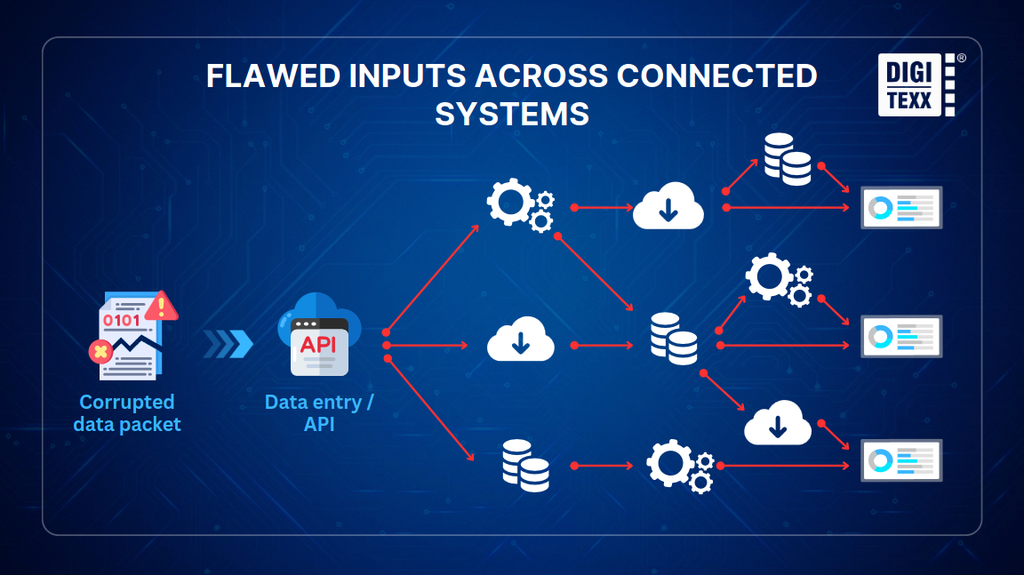
Trust in AI begins with the foundation: the information feeding into the system. When companies rely on fragmented data ecosystems – where files are scattered across cloud apps, APIs, and devices – information easily loses context or falls out of sync. This lack of unified data directly undermines two core technologies:
- Machine learning (ML) pipelines: Models trained on outdated or biased historical records inherit and repeat those flaws. Even when initial data is clean, model accuracy steadily drops as real-world customer behavior shifts – a phenomenon known as data drift.
- Enterprise AI assistants (RAG): Internal chatbots connected to company files rely on retrieval-augmented generation to answer questions. If those folders contain duplicate documents or outdated policies, the assistant will surface misleading answers as fact.
Unreliable Outputs and Synthetic Content
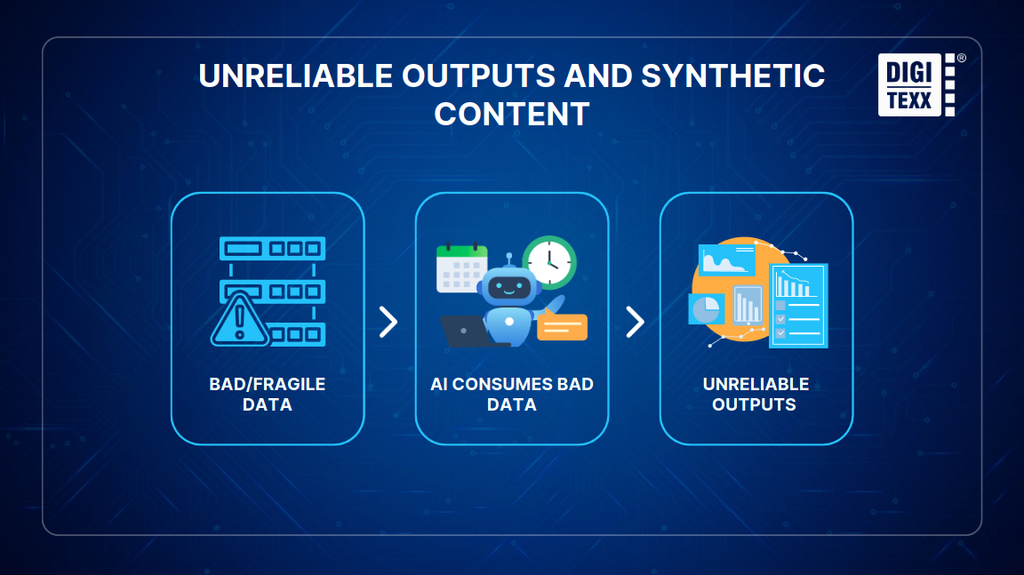
Beyond struggling with flawed inputs, modern AI introduces risks in what it produces. Rather than simply analyzing existing facts, today’s systems actively generate and extract new material that can look convincing even when it is wrong:
- Generative AI and LLMs: Large language models can write confident, authoritative responses based on fabricated facts. Worse, if this AI-generated text is recycled into company databases as future source material, teams can no longer separate real facts from synthetic ones.
- Intelligent document processing (OCR): While AI speeds up reading invoices and contracts, extraction is never flawless. A single misread account number or misplaced decimal can slip into a database unnoticed, corrupting financial or operational records.
- Synthetic data and deepfakes: Advances in generative technology make fake documents, voices, and identities look authentic. As a result, verifying where data came from is now just as critical as checking whether it is accurate..
Automated Actions Without Oversight
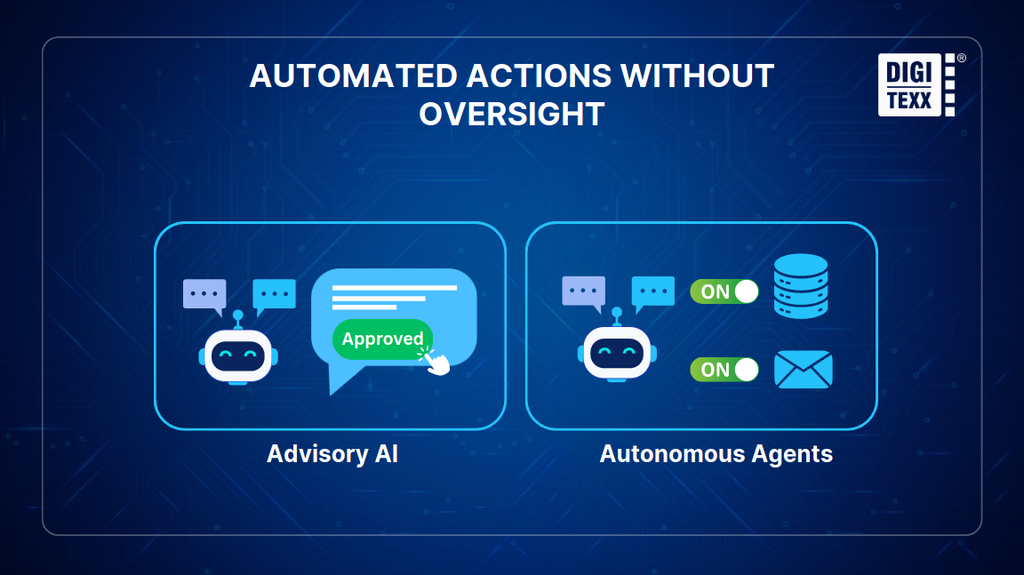
Unreliable outputs become an immediate operational hazard when AI moves from generating text to taking action. Unlike basic tools that only offer advice, autonomous AI agents connect directly to business software to execute tasks:
- AI agents and workflow automation: These systems independently update customer records, process requests, and trigger multi-step business workflows. If the underlying data is flawed or misinterpreted, the automated action executes that error instantly – making human validation vital for high-stakes decisions.
Overall picture of data trust In the age of AI:
The challenge is no longer just ensuring that data is accurate at the point of collection. Businesses must establish trust throughout its entire lifecycle – from its origin and processing to its interpretation and eventual use.
What Do These Data Trust Challenges Mean for Business Leaders?
For business leaders, the implications go beyond technical data management. They directly affect operational performance, investment decisions, accountability, and organizational confidence.
Accountability Becomes Harder To Establish.
When an AI-assisted decision produces an unexpected result, organizations need to understand which information influenced it, where that information originated, and how it was processed.
Without clear data lineage and ownership, identifying the source of a problem becomes much more difficult.
AI Investments Depend On Reliable Data Foundations.
A sophisticated AI model cannot compensate for inaccurate or inconsistent inputs. For example, an AI-powered forecasting tool may be technically advanced, but its predictions will remain questionable if it relies on incomplete financial records or outdated sales information.
This is why organizations should evaluate their data readiness before scaling AI initiatives. Investing in more advanced technology will not automatically resolve weaknesses in the underlying information.
Faster Automation Increases The Consequences Of Errors.
Automation reduces the time between receiving information and taking action. While this creates efficiency, it also means that incorrect information can spread through business processes before anyone has an opportunity to intervene.
Organizations need to move beyond informal quality checks and introduce validation directly into their workflows.
Regulatory And Customer Expectations Are Increasing.
As AI becomes more widely used, businesses face growing expectations around transparency, accountability, privacy, and responsible data use.
Organizations need to understand how their information is collected, processed, and used, particularly when it influences decisions affecting customers, employees, or business partners.
Internal Confidence Can Be Difficult To Rebuild.
When employees repeatedly encounter inconsistent dashboards or unreliable AI outputs, they naturally become more cautious about using these tools.
They may return to spreadsheets, manual verification, and disconnected processes, reducing the efficiency gains that digital transformation was supposed to deliver.
These challenges highlight an important point: AI Trust cannot be established through technology alone. It requires confidence in the information behind every recommendation, prediction, and automated action.
4 Essential Components of Data Trust
When organizations assess the reliability of their data, they typically focus on a few core dimensions:
What Makes Data Quality:
| Dimensions | What it means | Why it matters |
| Accuracy | Data correctly represents the real-world value or source | Prevents incorrect decisions and transactions |
| Completeness | All required information has been captured | Prevents gaps in analysis and operations |
| Consistency | Data follows the same format and meaning across systems | Prevents conflicting information between processes |
| Timeliness | Data is available and up-to-date | Prevents decisions being made using outdated information |
These four dimensions do not operate in silos; they are deeply interdependent. Accuracy without Completeness leaves you blind; Completeness without Consistency creates chaos; and Consistency without Timeliness leaves you reacting to the past. Together, they transform raw data from a liability into a formidable competitive advantage.
Why Data Trust Is The Future Business Competitive Advantage
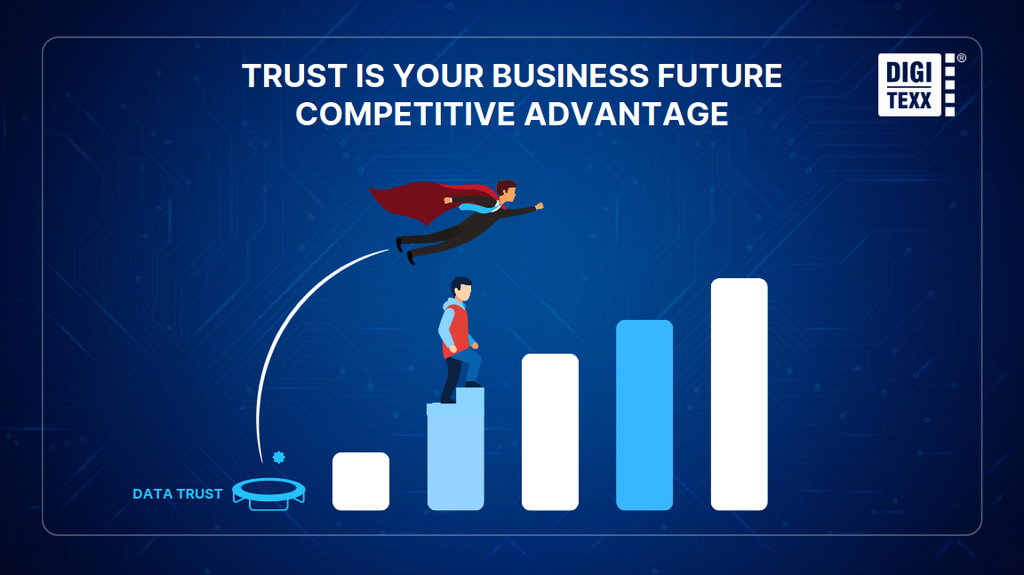
Because AI magnifies both data flaws and data strengths at scale, access to technology is no longer the primary differentiator between businesses. Cloud platforms, automation tools, analytics solutions, and advanced AI models are increasingly available across industries.
What sets leading organizations apart is how effectively they use these technologies to improve business performance. And that depends largely on the reliability of their underlying data.
Organizations that establish strong data trust gain several important advantages:
- Faster and more confident decisions: Reliable information reduces the need for repeated manual verification, allowing teams to spend less time questioning the data and more time evaluating opportunities and taking action.
- Better returns on AI investments: Dependable data provides a stronger foundation for analytics and automation, helping organizations move beyond isolated AI pilot projects and integrate these capabilities into everyday business operations.
- Stronger business relationships: Accurate records, transparent processes, and consistent interactions help build confidence among customers, suppliers, and business partners.
- Lower operational and compliance risks: Clear data ownership, governance, and lineage make it easier to identify errors, trace their origins, and demonstrate accountability when regulatory requirements arise.
- Greater employee adoption of digital tools: Employees are more likely to embrace new technologies and automated workflows when they can rely on the information and outputs those systems provide.
In the digital age, businesses increasingly compete on their ability to turn information into meaningful action. Two organizations may have access to the same AI platforms and software, but the one with more reliable data is better positioned to make informed decisions, operate efficiently, and respond to changing business needs.
Technology can be purchased and software can be replicated. However, a culture of data responsibility, supported by reliable information, clear ownership, and consistent governance, takes time and commitment to build.
That is what makes data trust more than a data management priority. It is a business capability that can create a lasting competitive advantage.
How to Ensure Data Trust In Your Operations
Maintain data trust:
| Name of the solution | How |
| Establish strong data foundations | Assign clear data ownershipValidate data at the point of captureStandardize definitions and formats |
| Maintain data integrity and visibility | Automate data quality monitoringTrack data lineage and provenanceControl access and maintain audit trails |
| Balance automation with human accountability | Keep humans involved in high-impact decisionsBuild a culture of data responsibility |
Building trust in data is not a one-time cleanup exercise. It requires consistent practices embedded in how information is collected, managed, shared, and used across the organization.
Rather than treating data quality as an isolated responsibility, businesses should approach it as an ongoing operational priority. The following nine practices can help establish and maintain data trust across three key areas.
Establish Strong Data Foundations
Assign clear data ownership: Every critical dataset should have an accountable owner responsible for defining quality standards, maintaining accuracy, and resolving issues. Without clear ownership, data problems can easily go unnoticed because no individual or team feels responsible for addressing them.
Validate data at the point of capture: Preventing errors early is far more efficient than correcting them after they have spread across multiple systems. Use required fields, standardized formats, validation rules, and automated checks when information first enters your business environment.
Standardize definitions and formats: Different departments often interpret the same business terms differently. For example, one team may define an “active customer” based on recent purchases, while another uses account status. Establishing shared definitions and consistent formats helps ensure that information remains reliable across departments and reporting systems.
Maintain Data Integrity and Visibility
Automate data quality monitoring: Regular automated checks help identify duplicates, missing values, inconsistencies, and unusual patterns before they affect downstream processes. Set up alerts to notify the appropriate teams when issues arise, allowing them to investigate and resolve problems promptly.
Track data lineage and provenance: Maintain clear visibility into where information originated, how it has been transformed, and how it moves between systems. This makes it easier to trace errors, investigate unexpected results, and demonstrate accountability during audits.
Control access and maintain audit trails: Not everyone needs permission to modify every dataset. Implement role-based access controls and maintain records of data changes to protect information from unauthorized modifications. These measures help preserve data integrity while supporting broader digital trust.
Balance Automation With Human Accountability
Keep humans involved in high-impact decisions: AI can accelerate execution, but not every decision should be fully automated. Establish clear review requirements for financial transactions, legal obligations, sensitive customer information, and other high-impact activities where errors could have significant consequences.
Build a culture of data responsibility: Data trust is not solely the responsibility of IT teams or data specialists. Employees across every department influence data quality through how they collect, enter, update, and use information. Ongoing training, clear responsibilities, and open channels for reporting errors help make data responsibility part of everyday business operations.
Implementing these practices does not have to happen all at once. Businesses can start by identifying one critical workflow, such as invoice processing, customer onboarding, or financial reporting, and assessing where data quality issues are most likely to occur.
By addressing these gaps first, organizations can build a stronger foundation for data trust and gradually extend those practices across their operations.
Conclusion
As businesses become increasingly dependent on digital technologies and AI-powered operations, data trust is no longer just a matter of information quality. It has become a foundation for reliable decisions, efficient workflows, and sustainable business growth.
While AI creates new opportunities to process information, generate insights, and automate operations, it also magnifies the risks associated with inaccurate, incomplete, inconsistent, or unverified data. A secure digital environment alone cannot guarantee trustworthy information, just as accurate data cannot deliver its full value without reliable systems and processes to support it.
Ultimately, building data trust requires a holistic approach that brings together technology, data governance, validation mechanisms, and human expertise. By ensuring information remains reliable throughout its lifecycle, businesses can make better-informed decisions, strengthen operational confidence, and unlock the full potential of digital transformation.
In an increasingly AI-driven business environment, competitive advantage will not simply come from how much data organizations possess or how advanced their technologies are, but from how confidently they can put that data to work.