Outsourcing data entry can reduce costs and free internal teams to focus on higher-value work. However, it also means allowing an external provider to access and process sensitive information, including customer records, financial data, health information, or proprietary business data. This makes data security an important consideration when choosing a data entry provider.
This guide covers the key security risks, compliance considerations, and practical steps businesses should take to evaluate how a provider protects their data.
Why Data Security Is The Biggest Concern In Data Entry Outsourcing
When data entry is outsourced, sensitive or business-critical information may be handled outside the company’s direct environment. This introduces security risks that can affect not only the outsourced process, but also the wider business.
A security incident can lead to compliance issues, operational disruption, financial impact, and loss of customer trust. Data security should therefore be considered a core part of any data entry outsourcing decision.
Outsourcing Expands The Data Security Boundary
An external provider may receive, access, process, store, or transfer client data. Depending on the delivery model, this can involve provider employees, processing locations, technology platforms, and third parties.
As more parties and systems become involved, businesses have less direct control over how their data is handled. They therefore need clear visibility into:
- Where data is processed and stored
- Who can access it and for what purpose
- Whether third parties are involved
- What safeguards apply throughout the outsourced process
This becomes particularly important for projects involving sensitive or business-critical data. A security issue at the provider level can affect not only the outsourced task itself, but also downstream operations and the organization that owns the data.
Outsourcing Does Not Remove Data Protection Responsibilities
Outsourcing data entry does not transfer responsibility for data protection entirely to the provider. Under the GDPR, businesses must ensure that providers processing personal data have appropriate measures in place to protect it.
This means security should be evaluated as carefully as cost, accuracy, scalability, and turnaround time. The required safeguards will depend on factors such as the sensitivity of the data, applicable legal or contractual requirements, and the potential impact of a security incident.
The goal is not to eliminate all risk, but to choose a provider whose security measures are appropriate for the specific data and work being outsourced.
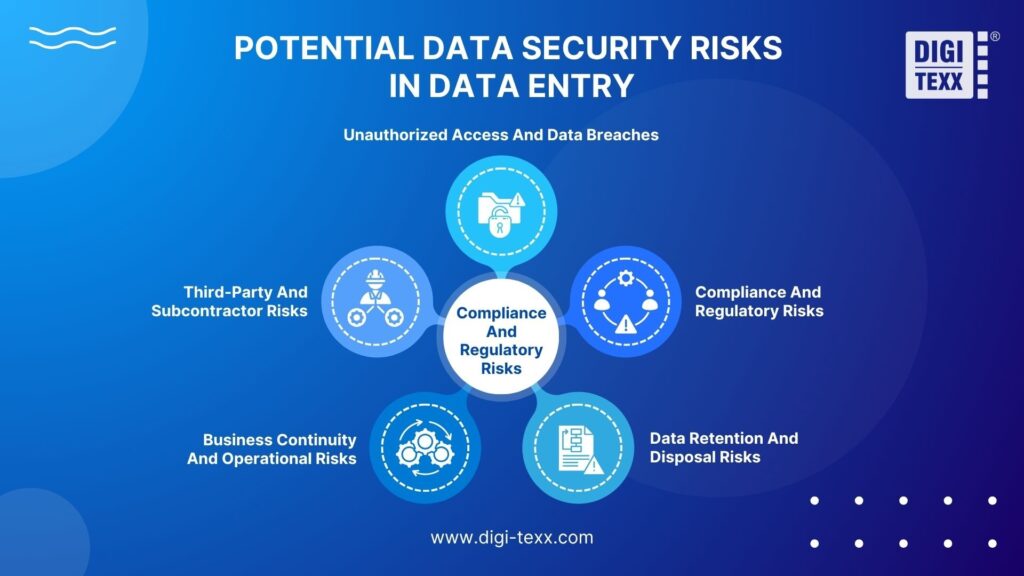
Potential Data Security Risks In Data Entry
Outsourced data entry can introduce risks at different points of the engagement. Understanding these risks helps businesses determine which controls and evidence should matter most when evaluating a provider.
Overview of Data Security Risks in Data Entry Outsourcing:
| Risk | What can happen | Potential impact |
| Unauthorized access | Data is accessed by unauthorized users or compromised accounts | Data breach, confidentiality loss |
| Compliance risk | Data is processed without meeting applicable requirements | Regulatory and contractual consequences |
| Third-party risk | Subcontractors or other service providers introduce additional exposure | Reduced visibility and control |
| Retention risk | Data remains stored longer than necessary or is not securely deleted | Unnecessary data exposure |
| Operational risk | Cyberattacks, outages, or infrastructure failures interrupt processing | Delays and business disruption |
Unauthorized Access And Data Breaches
As mentioned earlier, outsourced data entry often involves sensitive and business-critical information. If access is poorly controlled, excessive permissions or compromised accounts can expose that data to people who do not need it for their work.
Common sources of exposure include:
- Shared or compromised credentials
- Excessive user permissions
- Weak authentication methods
- Unsecured devices or endpoints
- Accidental data disclosure
Businesses need visibility into who can access their data, what permissions are granted, and how those permissions are managed over time.
Compliance And Regulatory Risks
Outsourcing data entry can make compliance more complex, especially when data is processed by external providers or across different countries.
The requirements will depend on the type of data, industry, processing location, and regulations involved. Under the GDPR, businesses may need to consider contracts with data processors, the use of subprocessors, international data transfers, data retention, and security incident requirements.
Businesses should therefore assess compliance based on how and where their data will actually be processed, rather than relying on a provider’s general claim of being compliant.
Third-Party And Subcontractor Risks
The contracted data entry provider may not be the only external organization involved. Cloud infrastructure, software platforms, hosting providers, or subcontractors can also support the service.
Each additional party introduces another security dependency. Without clear oversight, businesses may have less control over how their data is handled across the service chain.
Businesses should therefore expect transparency around third-party involvement and clear evidence that the provider applies appropriate security requirements to those relationships.
Data Retention And Disposal Risks
Security risks can continue after data entry is complete.
Copies of client information may remain in databases, temporary storage, backups, transfer locations, or other systems. If retention periods are unclear, sensitive information can remain exposed long after it is needed for the original task.
Businesses should establish how long data will be retained, which copies are covered by the retention policy, and how deletion is performed and verified when the information is no longer required.
Effective data protection therefore requires clear retention limits and a defined process for securely disposing of data when it is no longer needed.
Business Continuity And Operational Risks
Data security also includes availability. A provider may protect information from unauthorized access but still create business risk if critical processing cannot continue during a disruption.
Cyberattacks, network failures, power outages, infrastructure problems, or other incidents can interrupt data entry operations without causing a data breach.
For example, an outage affecting invoice data entry during month-end processing could create a backlog that delays downstream finance operations.
Businesses should therefore consider the operational impact of provider downtime and whether critical processing can be restored within an acceptable timeframe.
Best Practices For Protecting Data When Outsourcing
Data protection should begin before data is shared with an outsourcing provider. Businesses should first understand what data will be outsourced and how it will be processed to define the right security requirements.
Internal Audit & Process Mapping
Before approaching a data entry provider, businesses should review the current workflow and identify the data, systems, and people involved.
Identify And Classify The Data
Start by identifying what information will be outsourced and how sensitive it is. The type of data involved should influence the level of security required from the provider.
| Data category | Data entry example | What this means for outsourcing |
| Public | Product names, specifications, public catalog data | Lower sensitivity, but access should still be limited to authorized project users |
| Internal | Inventory records, internal forms, operational data | Access should be restricted to assigned teams and approved systems |
| Confidential | Contracts, invoices, financial records | Stronger access restrictions and protection during transfer and storage may be required |
| Personal or regulated | Customer profiles, employee records, identity or health information | Additional privacy, compliance, retention, and processing requirements may apply |
For example, entering product specifications into an e-commerce catalog presents a different level of risk from processing identity documents or customer financial records. Classifying the data upfront helps businesses set security requirements that match the actual sensitivity and risk of the project.
Map The Data Flow
Next, map how information will move through the outsourced operation:
Data Source → Data Transfer → Data Entry → Quality Control → Output Delivery → Retention or Deletion
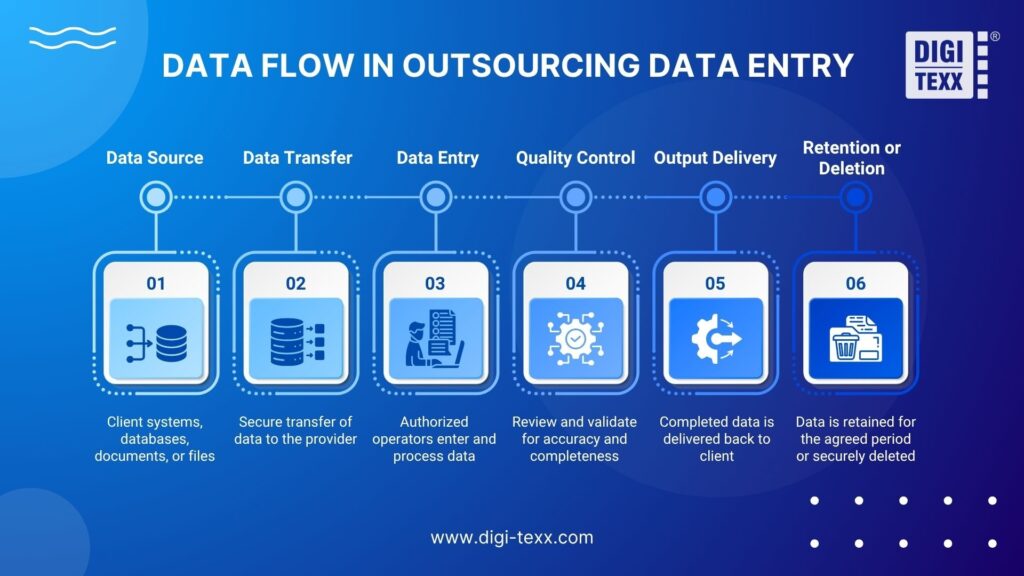
At each stage, determine:
- Who can access the data?
- Where is it processed and stored?
- Which systems are involved?
- Are any third parties involved?
- How long does the data remain there?
This step helps businesses see who and what is involved in handling their data. For example, a data entry provider may also rely on cloud storage, file-transfer tools, or other third-party systems to deliver the service.
With a clear view of the data flow, businesses can identify where data may be exposed and which stages require stronger security controls.
Define Security Requirements & Responsibilities
Once the data and workflow are understood, translate those findings into clear security requirements for the provider.
Set Security Requirements Based On Project Risk
The level of security assessment should reflect the project’s risk. Processing publicly available product information, for example, may not require the same safeguards as handling identity documents, financial records, or personal data.
Depending on the project, requirements may cover:
- Access to sensitive information
- Data storage and processing locations
- Regulatory and contractual obligations
- Third-party involvement
- Incident reporting and recovery
- Data retention and deletion
Defining these requirements early gives businesses a clear basis for comparing providers and determining whether their security measures are suitable for the project.
Clarify Client And Provider Responsibilities
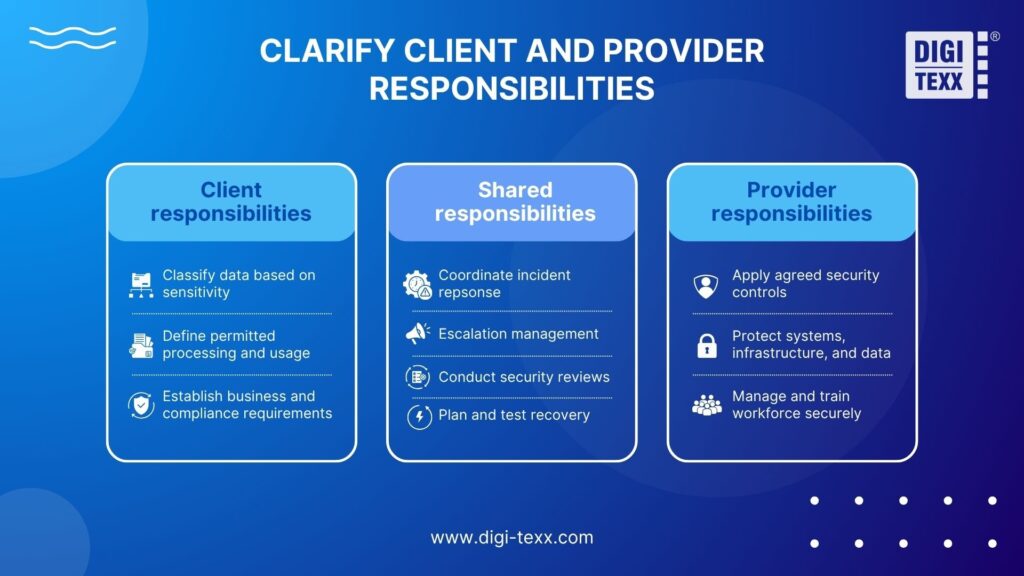
Security responsibilities should be agreed before the provider receives any data. The outsourcing arrangement should clearly define:
- Client responsibilities: Classify data, define permitted processing, and establish relevant business and compliance requirements.
- Provider responsibilities: Apply the agreed security controls across its systems, processing environment, and workforce.
- Shared responsibilities: Coordinate incident response, escalation, security reviews, and recovery where required.
The agreement should also define what happens when an incident occurs and how client data will be returned or deleted when the engagement ends.
This gives businesses a clearer basis for assessing providers against the specific security needs of the project, rather than relying on general security claims.
What Makes A Data Entry Outsourcing Provider Secure?
A secure data entry provider should have multiple safeguards in place to protect client data throughout the outsourced process. These include encryption, access controls, secure infrastructure, security standards, and employee practices.
Key Security Measures to Look for in a Data Entry Provider:
| Security area | What to look for | Why it matters |
| Data encryption | Encryption in transit and at rest | Protects data during transfer and storage |
| Access controls | Role-based access, least privilege, MFA | Limits unnecessary or unauthorized access |
| Security standards | Relevant certifications and compliance practices | Provides evidence of structured security management |
| Secure infrastructure | Network, endpoint, monitoring, and backup controls | Protects the systems used to process data |
| Employee governance | Training, confidentiality, access procedures | Reduces human and insider-related risks |
These controls work together to protect the confidentiality, integrity, and availability of information, the three core principles of information security recognized by ISO/IEC 27001.
End-To-End Data Encryption
Encryption helps protect sensitive information throughout the outsourced data entry process, particularly when data is being transferred or stored.
Businesses should verify how the provider protects:
- Data in transit: when information is transferred between the client, provider, and authorized systems.
- Data at rest: when information is stored in databases, servers, or backups.
- Encryption keys: how keys are stored, managed, and protected from unauthorized access.
Encryption should be assessed based on where and how it is applied, rather than relying on a general statement that data is encrypted.
Strong Access Controls
Even encrypted data can be exposed if an account is compromised or employees have more access than they need.
A secure provider should limit access based on job responsibilities and business needs. Key controls may include:
- Unique user accounts
- Role-based access control
- Least-privilege access
- Multi-factor authentication
- Regular access reviews
- Timely access removal when employees change roles or leave
- Logging and monitoring of access activities
For example, a data entry operator should only be able to access the records needed for assigned tasks, rather than the client’s entire database.
Compliance And Security Certifications
Independent certifications can provide evidence that a provider follows a structured approach to information security.
One widely recognized standard is ISO/IEC 27001:2022, which specifies requirements for an Information Security Management System (ISMS). The standard takes a risk-based approach that brings together people, policies, processes, and technology rather than treating cybersecurity solely as an IT issue.
However, certification alone should not determine vendor selection.
Businesses should verify:
- Whether the certification is current
- Which legal entity and locations are covered
- Which services and systems fall within its scope
- Whether the certified environment will actually process their data
Other regulatory or industry-specific requirements may also apply depending on the data type, industry, processing location, and client obligations.
Secure Infrastructure And Network Protection
A secure data entry provider should have appropriate safeguards to protect the systems and networks used to process client data from unauthorized access, malware, vulnerabilities, and service disruptions.
Depending on the project and level of risk, these safeguards may include:
- Network segmentation and firewalls
- Endpoint protection and secure remote access
- Security monitoring and logging
- Vulnerability and patch management
- Backup and recovery mechanisms
- Controls on removable media and unauthorized data transfers
For sensitive data entry projects, businesses should also understand where data is processed and what operators are allowed to do with it. This includes whether client data can be downloaded, copied, printed, or transferred outside the approved processing environment.
These controls help reduce the risk of data leaving the intended environment while supporting secure and reliable data processing.
Employee Security And Operational Governance
Technology alone cannot protect outsourced data. Because data entry often requires employees to work directly with client information, providers also need clear policies and procedures for how employees handle that data.
Key measures may include:
- Confidentiality agreements
- Security and privacy training
- Clear data-handling procedures
- Security incident reporting
- Background screening where appropriate and legally permitted
For sensitive projects, physical security controls can provide an additional layer of protection. In controlled production areas, providers may restrict personal mobile phones, cameras, smartwatches, paper, pens, or other items that could be used to capture or remove client information.
Regular security awareness training also helps employees recognize threats such as phishing, credential theft, social engineering, and accidental data disclosure. These measures should be supported by clear operational governance to ensure security policies are consistently followed, and incidents are properly reported and addressed.
A secure provider should be able to demonstrate how employee practices, physical controls, and operational procedures work together with technical safeguards to protect client data.
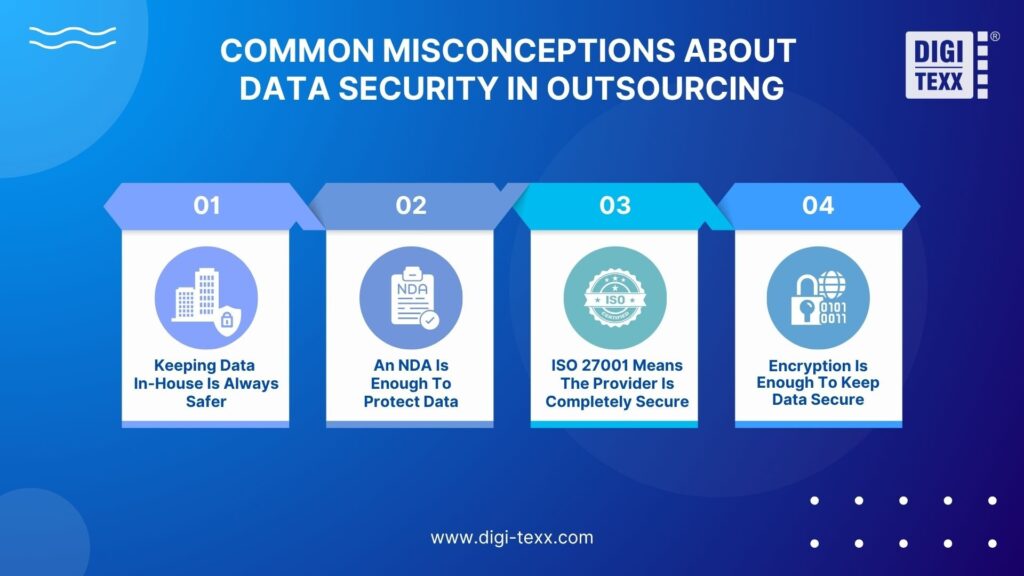
Common Misconceptions About Data Security In Outsourcing
Several common assumptions can create a false sense of security when outsourcing data entry.
Keeping Data In-House Is Always Safer
Keeping data internally does not automatically make it more secure. Security depends on access management, infrastructure protection, employee practices, and monitoring, not simply where the data is processed.
An NDA Is Enough To Protect Data
An NDA establishes confidentiality obligations, but it cannot prevent unauthorized access, cyberattacks, or accidental data exposure. Appropriate technical and operational security controls are still required.
ISO 27001 Means The Provider Is Completely Secure
ISO/IEC 27001 demonstrates a structured approach to information security management, but certification does not eliminate security risks. Businesses should still verify its scope and evaluate the controls relevant to their data entry workflow.
Encryption Is Enough To Keep Data Secure
Encryption is an important layer of protection, but it cannot protect data on its own. Secure outsourcing also requires strong access controls, secure infrastructure, employee governance, monitoring, and incident response.
Ultimately, secure outsourcing depends on multiple safeguards working together throughout the data lifecycle.
How To Evaluate A Data Entry Outsourcing Provider
A provider may have strong security policies and certifications, but these do not automatically apply to every service, location, or processing environment.
The purpose of vendor evaluation is to confirm that the provider’s security measures are relevant to the specific data entry operation being outsourced and supported by appropriate evidence.
Ask About The Actual Delivery Model
Start with how the service will work in practice. Businesses should understand where data will be processed and stored, which teams and locations will handle it, whether third parties are involved, and what happens to the data when the engagement ends.
For sensitive or regulated data, incident communication and retention requirements should also be clarified before processing begins.
The answers should be specific to the proposed service. A provider should be able to give a clear picture of where the data goes, who handles it, and who is responsible at each stage.
Verify Claims With Relevant Evidence
Security claims should be supported by evidence that is relevant to the proposed operation. Depending on the project, this could include current certifications, a Data Processing Agreement, relevant security policies, subprocessor information, or incident response and business continuity documentation.
The important point is relevance rather than volume. For example, an ISO/IEC 27001 certificate provides stronger assurance when its scope covers the entity, location, and operation that will actually deliver the service.
The same principle applies to other evidence: businesses should verify not only that a document exists, but also that it applies to their specific outsourcing arrangement.
Look For Gaps Between Claims And Practice
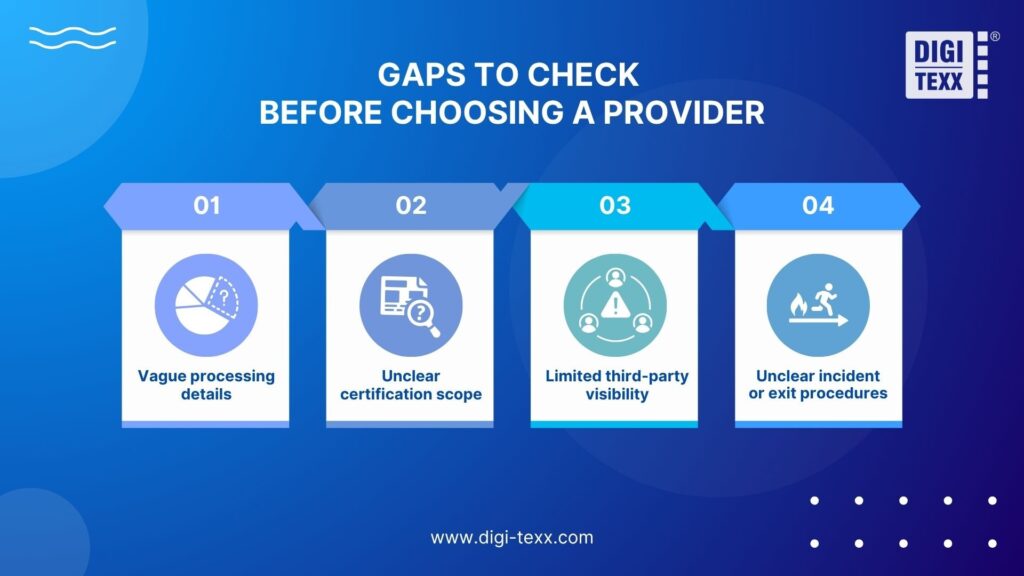
Certain gaps during the evaluation process deserve closer attention:
- Vague processing details: The provider cannot clearly explain where or by whom the data will be processed.
- Unclear certification scope: A certification is presented, but it is unclear whether the relevant service or location is covered.
- Limited third-party visibility: The provider cannot clearly identify whether subprocessors or other third parties will handle client data.
- Unclear incident or exit procedures: There is no clear explanation of how incidents will be communicated or how data will be returned or deleted when the engagement ends.
These issues do not automatically mean a provider is unsuitable, but they indicate areas that should be clarified before a decision is made.
Vendor Security Evaluation Checklist
| Evaluation area | What to verify | Evidence to review |
| Service scope | Security measures apply to the proposed service and location | Service documentation |
| Certification scope | Relevant operations and locations are covered | Current certificate and scope |
| Data governance | Processing, retention, and deletion responsibilities are defined | DPA and relevant policies |
| Third parties | Subprocessors involved in the service are disclosed | Subprocessor information |
| Incident management | Responsibilities and communication procedures are clear | Incident response documentation |
| Business continuity | Recovery arrangements cover the proposed operation | BCP or DR evidence |
| Contract exit | Data return or deletion is clearly defined | Contract terms |
Ultimately, the evaluation should answer three questions:
- Do the security measures apply to this service?
- Can the provider demonstrate them?
- Are responsibilities clear if something goes wrong?
The depth of verification should reflect the sensitivity of the data and the potential impact of a security incident or service disruption.
FAQs
What Are The Top Data Security Risks When Outsourcing Data Entry?
The main risks include unauthorized access and data breaches, regulatory non-compliance, third-party exposure, improper data retention or disposal, and operational disruption.
The level of risk depends on the sensitivity of the data and how the outsourced workflow is structured. Businesses should therefore understand where data is processed, who can access it, which third parties are involved, and how the provider manages data throughout the engagement.
What Security Certifications Should An Outsourced Data Entry Provider Have?
There is no single security certification required for every data entry outsourcing provider. The appropriate standards depend on the type of data, industry, regulatory requirements, and scope of the service.
ISO/IEC 27001 is a widely recognized standard for information security management systems and can provide evidence of a structured approach to managing information security risks.
When reviewing a certification, businesses should verify not only that it is current, but also whether its scope covers the entity, location, and services that will process their data.
How Do You Ensure GDPR Compliance With An Outsourced Data Entry Provider?
For data subject to the GDPR, businesses should first determine their role and the provider’s role in the processing arrangement. Where the provider acts as a processor, the controller must select a processor that provides sufficient guarantees of appropriate technical and organizational measures.
The arrangement should also address relevant requirements such as processing instructions, confidentiality, security measures, subprocessors, data retention and deletion, incident management, and international data transfers where applicable.
A Data Processing Agreement should document applicable responsibilities and processing requirements.
What Should Be Included In A Vendor Security Evaluation Checklist?
A vendor security evaluation checklist should cover the areas most relevant to how the provider will handle the organization’s data, including:
- Data processing and storage locations
- Access and data-handling practices
- Relevant certifications and their scope
- Data retention and secure deletion
- Subprocessor involvement
- Incident response and notification
- Business continuity and disaster recovery
- Data return or deletion when the contract ends
The checklist should be adapted to the sensitivity of the data, regulatory requirements, and potential business impact, rather than applied identically to every provider.
Common Compliance Standards For Global Data Protection
The standards and regulations relevant to outsourced data processing vary by country, industry, data type, and processing activity.
Common frameworks and requirements businesses may encounter include:
- GDPR for the processing of personal data within its territorial scope
- ISO/IEC 27001 for information security management systems
- ISO 22301 for business continuity management
- Applicable national privacy and data protection laws
- Industry-specific requirements depending on the information being processed
Businesses should distinguish between legal requirements and voluntary standards. GDPR, for example, is a regulation, while ISO/IEC 27001 is a certifiable management-system standard. The relevant requirements should therefore be determined for each outsourcing arrangement rather than assuming that one compliance framework applies globally.
Reference:
- IBM. (2025a). Cost of a data breach report 2025. In IBM. https://www.ibm.com/reports/data-breach
- IBM. (2025b). Cost of Data Breach. In Ibm.com. https://www.ibm.com/think/insights/data-matters/cost-of-a-data-breach
- bender911. (2025). GDPR article 28 explained: Processor obligations, contracts, and 5 practical examples – general data protection regulation. In General Data Protection Regulation. https://gdprinfo.eu/gdpr-article-28-explained-processor-obligations-contracts-and-5-practical-examples
- Holloway, D. (2022, November 9). How to demonstrate compliance with GDPR article 28 | ISMS.Online. ISMS.Online. https://www.isms.online/general-data-protection-regulation-gdpr/gdpr-article-28-compliance/
- Bluefin. (2025). IBM’s 2025 data breach report: Key findings and the year’s biggest attacks. In Bluefin. https://www.bluefin.com/bluefin-news/ibms-2025-data-breach-report-key-findings-and-the-years-biggest-attacks/
- meg. (2025). ISO/IEC 27001:2022 – The information security management standard. In GRC Solutions. https://grcsolutions.io/guide-to-iso-iec-27001-2022/