
Having an online presence is a powerful way to grow your business, but it also comes with challenges. In a world where information spreads rapidly across social media and other online channels, a single harmful post or wave of inappropriate comments can affect how people perceive your brand.
Whether you’re running a new business or managing an established brand, content moderation services can help you maintain a safer and more positive online environment.
Today, customers are no longer passive observers of online brands. They actively shape public perception through comments, reviews, posts, and discussions.
While this engagement creates opportunities to build relationships with your audience, it can also expose your business to spam, abusive content, and other online risks. So, let’s explore how these evolving changes affect brand safety.
What is Brand Safety
Brand safety is the toolkit that helps to protect a company’s reputation online. It makes sure that your brand does not show up next to harmful or inappropriate content, such as hate speech, violence, or illegal activities.
Traditionally, brand safety has been associated with advertising and the need to keep ads away from content or environments that could be harmful, offensive, or misleading.
Why Brand Safety Still Matters In 2026
With the rise of social media, brand safety now goes beyond where ads are placed. It also involves monitoring how a brand is mentioned, discussed, and represented online.
This shift is largely driven by the rapid growth of user-generated content (UGC), which has made the online environment more diverse and dynamic.
For marketers, this growing volume of content creates countless opportunities to connect with target audiences. At the same time, it increases the chances that a brand’s ads or online presence may appear alongside inappropriate, harmful, or misleading content.
These risks highlight why effective brand safety strategies remain essential nowadays for protecting a company’s reputation and maintaining consumer trust.
Common Threats to Brand Safety
To better illustrate these common threats, this section breaks them down into two distinct dimensions: brand safety versus brand suitability
Common threats:
| Brand safety threats | Brand suitability threats |
| Hate speech & discriminationTerrorism & extreme violenceAdult & explicit contentPiracy & ad fraud | Tone & mood clashesTarget audience mismatchesCategory adjacencyIndustry-specific sensitivities |
Brand Safety Threats (The Universal Baseline)
These are non-negotiable, globally condemned environments. Appearing alongside such content can lead to reputational damage, public backlash, and potential legal consequences, regardless of the industry your business operates in.
- Hate speech & discrimination: Content that attacks, insults, or encourages violence against people based on their race, religion, gender, or sexual orientation.
- Terrorism & extreme violence: Content showing terrorist propaganda, graphic violence, war footage, gore, or physical abuse.
- Adult & explicit content: Pornography, highly sexual content, or extremely offensive language that is not suitable for most advertising environments.
- Piracy & ad fraud: Websites that share copyrighted content without permission or use bots and other methods to create fake ad views and waste advertising budgets.
Brand Suitability Threats (The Contextual Mismatches)
These environments are completely safe, legal, and legitimate, but they pose a risk because they clash with your specific product, tone, or target demographic. And remember this, what is a threat to one brand might be a perfect opportunity for another.
- Tone & mood clashes: A fun, cheerful ad for an amusement park appearing right before a serious news story about a natural disaster
- Target audience mismatches: An ad for a retirement community appearing on a gaming stream mainly watched by teenagers, or an R-rated movie trailer shown next to a children’s cartoon.
- Category adjacency: An airline’s ad appearing next to coverage of a major flight cancellation or safety incident involving the airline.
- Industry-specific sensitivities: A meat brand appearing on a channel focused on veganism, animal rights, or plant-based living
Content Moderation: An Effective Brand Safety Strategy
Content moderation plays a vital role in protecting brand safety in today’s digital environment, where harmful content can spread rapidly and influence public perception.
By monitoring and managing online interactions, businesses can reduce reputational risks, maintain consumer trust, and ensure their brands are represented in a safe and appropriate environment. The following are the key reasons why content moderation matters.
Key Reasons Content Moderation Benefits Brand Safety
How content moderation supports business:
| What | How | Benefits |
| Protecting brand reputation | Identify and remove inappropriate content | Maintains a positive public image |
| Building trust and safety | Enforce guidelines and remove abusive content and behavior | Fosters a safe, welcoming brand community |
| Maintaining a positive user experience | Filter out disruptive material while allowing meaningful discussions to continue | Supports a better user experience and encourages more positive interactions with the brand |
| Preventing unsafe advertising placements | Help identify unsuitable content and inappropriate ad placements | Protects brand image and advertiser confidence |
See more in this article: E-commerce Content Moderation: Essential Guide for Platform Owners & E-commerce Businesses
AI in Content Moderation
What is AI content moderation?
AI content moderation is the automated review of user-generated and machine-generated content. It uses machine learning systems to detect, classify, and act on content that violates a platform’s rules.
Will Content Moderation Be Replaced By AI?
Content moderation is not being completely replaced by artificial intelligence, though AI is taking over the vast majority of high-volume and repetitive tasks
The Evolution of Content Moderation: From Human Review to AI-Driven Systems
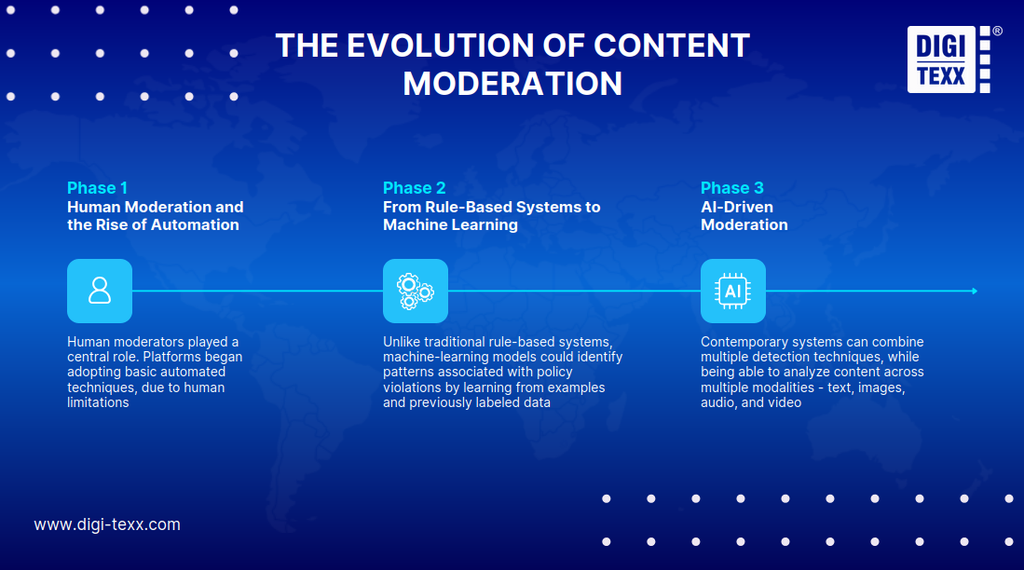
Content moderation has undergone a significant transformation as digital platforms have expanded in scale, complexity, and social influence.
Back then, content moderation relied heavily on human judgment, with moderators manually reviewing user-generated content to determine whether it complied with established community guidelines.
As online communities grew, however, the increasing volume and speed of content production made purely manual moderation increasingly difficult to sustain. This challenge prompted a gradual shift toward automated detection systems, machine learning, and, more recently, increasingly sophisticated artificial intelligence (AI) technologies.
The evolution of content moderation therefore represents not simply the replacement of human labor with technology, but a broader transformation in how platforms identify, evaluate, and respond to potentially harmful content.
Human Moderation and the Rise of Automation
In the early stages of online content moderation, human moderators played a central role in interpreting platform policies and making enforcement decisions.
Their responsibilities included reviewing text, images, videos, and user reports to identify violations such as harassment, hate speech, explicit material, and spam. Human judgment was particularly valuable when evaluating ambiguous content or interpreting language within its cultural and social context.
Despite these advantages, manual moderation was labor-intensive, time-consuming, and difficult to scale. As online communities expanded and social media platforms enabled continuous content sharing, moderation teams faced increasing pressure to process large volumes of material within increasingly short timeframes.
The reliance on human reviewers also made it challenging to maintain consistent enforcement across different cases and contexts.
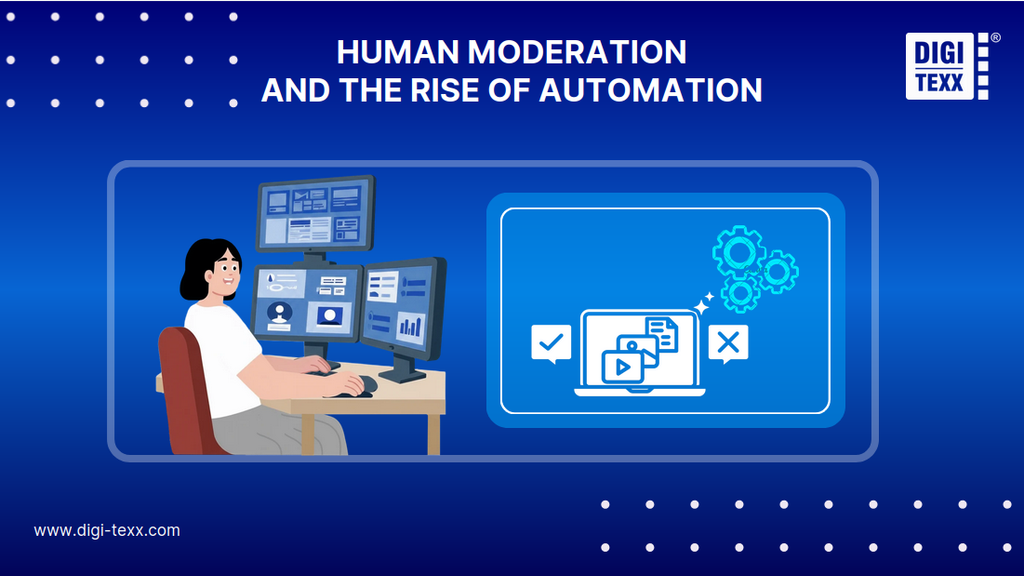
To address these limitations, platforms began adopting basic automated techniques, including keyword filters, predefined rules, and pattern-matching systems. These tools helped identify straightforward violations and repetitive forms of unwanted content more efficiently, reducing the need for human intervention in routine cases.
From Rule-Based Systems to Machine Learning
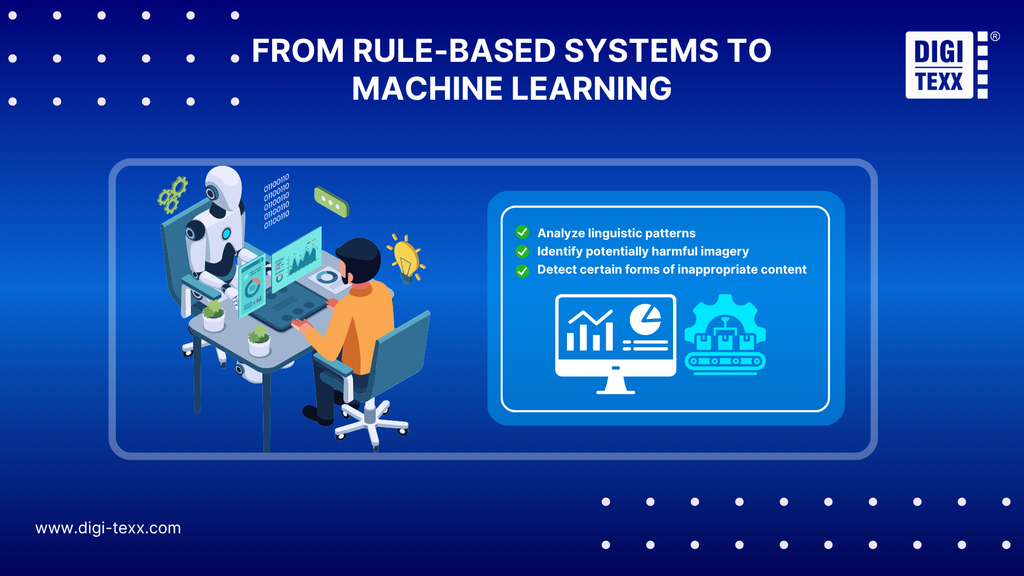
The development of machine learning marked an important turning point in content moderation. Unlike traditional rule-based systems, which relied on predetermined keywords and conditions, machine-learning models could identify patterns associated with policy violations by learning from examples and previously labeled data.
This enabled moderation systems to recognize more complex patterns in user-generated content, extending their capabilities beyond simple keyword detection. Advances in natural language processing and computer vision further expanded these capabilities.
Systems could analyze linguistic patterns, identify potentially harmful imagery, and detect certain forms of inappropriate content across different media formats. As a result, platforms gained the ability to process substantially larger volumes of content and identify potential violations that might not be captured by conventional filtering rules.
Machine learning also changed the timing and organization of moderation. Rather than depending exclusively on user reports after content had been published, platforms could increasingly screen content during upload or distribution, flag suspicious material for further review, and intervene before certain forms of harm spread widely
AI-Driven Moderation
More recently, advances in AI have expanded the role of automated moderation in platform governance. Contemporary systems can combine multiple detection techniques, analyze different types of content, prioritize high-risk cases, and support the enforcement of platform policies at a scale that would be difficult to achieve through human review alone.
These capabilities allow platforms to respond more rapidly to emerging threats and manage the growing complexity of online interactions. Another important development is the increasing capacity of AI systems to analyze content across multiple modalities, including text, images, audio, and video.
By combining information from different sources, these systems can potentially identify patterns of harmful behavior that may be difficult to detect through isolated analysis. AI can also assist human moderators by ranking reported content according to potential severity, identifying recurring patterns, and directing complex cases to specialized review teams.
Do they have downsides?
The effectiveness of AI-driven moderation should not be measured solely by processing speed or the volume of content reviewed.
Automated systems may still struggle with sarcasm, satire, culturally specific expressions, and discussions of sensitive subjects in educational or journalistic contexts. Their performance also depends on how platform policies are translated into computational criteria and how well these criteria reflect the diversity of online communication.
AI therefore expands the operational capacity of moderation systems while introducing new questions about accuracy, consistency, and the appropriate balance between automated decisions and human judgment.
New Risks to Brand Safety After The Applications of AI In Content Moderation
AI has improved content moderation by enabling platforms to identify and process large volumes of content at a speed that human reviewers alone cannot match. However, its effectiveness depends on how accurately it interprets content and applies moderation rules.
These limitations can create risks for brands, particularly when harmful content remains visible or legitimate conversations are incorrectly restricted.
| New risks | How it looks like | Case studies |
| Contextual limitations | AI struggles to interpret meaning that depends on context | Meta’s Virginia Woolf ad ban |
| Algorithmic bias | AI may interpret content differently across languages and communities. | Racial bias in hate speech and abusive language datasets |
| Undermoderation | AI systems fail to identify harmful content | February 2026 mass shooting at Tumbler Ridge secondary school |
| Overmoderation | AI system incorrectly flags, removes, or restricts legitimate content | Meta says it’s mistakenly moderating too much |
Contextual Limitations
Case Study: Meta’s Virginia Woolf ad ban
The September 2026 case involving Meta’s rejection of an advertisement for a theatrical adaptation of Virginia Woolf’s A Room of One’s Own illustrates the potential limitations of automated content moderation
The Barcelona-based Teatre Raval was informed that references to feminism, civil rights, and social reform could be classified by Meta’s automated systems as social topics. The advertisement was subsequently restored after Meta acknowledged that it had been removed in error.
This incident highlights the risk of over-moderation, in which legitimate content is restricted because an automated system has lacked understanding of contextual interpretation
What to know
AI systems can recognise patterns in text, images, and videos, but may struggle to interpret meaning that depends on context. Sarcasm, regional slang, cultural references, and emerging internet memes can be difficult to classify accurately.
Content that appears offensive in one situation may be harmless in another, while content that complies with platform policies may still conflict with a particular brand’s values or audience expectations.
Impact on brand safety: Harmless content is incorrectly flagged as unsafe or political. Advertisers may lose access to appropriate audiences, while publishers lose advertising revenue.
Mitigation: Brands and platforms can establish brand-specific content taxonomies and suitability guidelines to complement general moderation rules. These guidelines should define sensitive topics, unacceptable associations, and context-specific risks. Human reviewers can then assess ambiguous cases that require cultural understanding or nuanced judgment.
Algorithmic Bias
Case Study: Study From Cornell University
Research by Davidson, Bhattacharya, and Weber (2019) demonstrates how machine-learning-based content moderation can produce unequal outcomes across racialized language varieties.
By examining five Twitter datasets annotated for abusive language, the researchers found that classifiers consistently labeled tweets associated with African American English as abusive at higher rates than tweets associated with Standard American English.
This case illustrates a fundamental limitation of machine-learning moderation: high-volume automated classification does not necessarily guarantee fairness or contextual accuracy. It shows that bias can originate in human labeling practices and subsequently be reproduced by automated systems.
What to know
AI models learn from training data that may contain historical biases, uneven language representation, or demographic imbalances. As a result, moderation systems may interpret similar content differently depending on the language, dialect, or community involved.
For example, legitimate discussions using certain dialects or identity-related terms may be flagged disproportionately, while harmful language targeting particular communities may go undetected.
Impact on brand safety: When a platform or brand-safety vendor uses demographic or linguistic characteristics as proxies for toxicity, content from restricted creators and communities may be disproportionately excluded from monetization or deemed ineligible for advertising. Brands can lose access to relevant audiences and diverse creators, even when their content is harmless.
Mitigation: Platforms should regularly audit moderation outcomes across languages, dialects, and relevant demographic contexts. Fairness testing, representative evaluation datasets, and human reviews of disputed decisions can help identify patterns of inconsistent enforcement.
Brands can also monitor whether the platforms on which they advertise provide transparent and reliable moderation practices.
Undermoderation
Case Study: February 2026 Mass Shooting at Tumbler Ridge Secondary School
The September 2026 lawsuit filed by British Columbia against OpenAI and its CEO, Sam Altman, illustrates the challenges of managing serious threats identified through AI-driven safety systems.
OpenAI’s safety team had flagged the Tumbler Ridge shooter’s ChatGPT conversations months before the February 2026 school shooting. The lawsuit alleges that staff recommended notifying law enforcement, but the company’s leadership decided against doing so because the conversations did not meet its internal threshold for reporting an imminent and credible threat.
This case illustrates how under-moderation can occur even when a platform has the technical capacity to identify potentially dangerous behavior. Rather than a failure to detect harmful content, the alleged shortcoming involved the decision not to escalate the flagged activity to external authorities
What to know
A false negative occurs when an AI system fails to identify harmful content that should have been flagged or restricted under the applicable moderation rules. This may include hate speech, threats, explicit imagery, or other prohibited material.
Such failures can occur when content uses coded language, disguises harmful intent, or falls outside the patterns the model has learned to recognise.
Impact on brand safety: Advertisers may reconsider spending on a platform perceived as insufficiently effective at preventing serious harm, especially if the platform’s safety claims are called into question.
This leads to campaign pauses, reduced investment, additional contractual safeguards or demands for independent safety audits. These are potential responses, not confirmed outcomes for every advertiser in this case.
Mitigation: Platforms should combine AI detection with risk-based escalation procedures. Low-confidence decisions and potentially severe violations can be prioritised for human review, while advertisers should use suitable inventory exclusions, placement controls, and ongoing monitoring. These measures provide additional protection when content moderation fails to detect a threat.
Overmoderation
Case Study: Harmless Content is Mistakenly Taken Down by Meta
In January 2025, Meta announced a major revision to its content moderation policies under the initiative More Speech and Fewer Mistakes. The company stated that its existing enforcement systems were removing too much harmless content and that automated moderation had become overly restrictive.
Meta reported that in December 2024, it removed millions of pieces of content daily, estimating that one to two out of every ten enforcement actions could have been mistakes. The company explained that its automated systems had been scanning for a broad range of policy violations, resulting in legitimate content being incorrectly removed or restricted.
This case illustrates how overmoderation can occur when automated systems enforce content policies too aggressively, even when their purpose is to protect users from harmful information
What to know
A false positive occurs when an AI system incorrectly flags, removes, or restricts legitimate content. This may include harmless customer reviews, product discussions, satire, or user-generated content that contains words or images associated with prohibited material.
The problem arises when a system interprets surface-level patterns without adequately understanding the content’s meaning or purpose.
Impact on brand safety: Brands rely on user-generated content, hashtag campaigns, and organic community engagement. So, the biggest consequence is the loss of control over a brand’s own community and marketing outcomes.
Automated moderation may be designed to protect platform safety, but false positives can suppress the very customer advocacy, creator relationships and authentic engagement that brands rely on to build trust.
Mitigation: Platforms should provide accessible appeal mechanisms and clear explanations for moderation decisions. Human reviewers can reassess disputed cases, while validated appeal outcomes can inform subsequent model improvements. Brands should also monitor whether moderation practices are unnecessarily restricting legitimate discussions about their products, services, or communities.
Human-in-the-Loop: Finding the Right Balance Between AI and Human Judgment
The solution is not to choose between AI efficiency and human judgment, but to combine the strengths of both through a human-in-the-loop (HITL) approach. AI can handle the scale and speed of content moderation by screening large volumes of content, identifying potential risks, and prioritising cases that require attention.
Human reviewers, in turn, provide the contextual understanding, cultural awareness, and nuanced judgment that automated systems often lack.
This collaboration is particularly valuable in brand safety, where the goal is not simply to remove harmful content, but also to ensure that legitimate conversations, diverse perspectives, and brand-appropriate content are not unfairly restricted.
By escalating ambiguous or high-risk cases to human reviewers, using human feedback to improve model performance, and continuously auditing moderation outcomes, platforms can reduce both false negatives and false positives.
Ultimately, effective content moderation is not about removing humans from the process, but about putting human judgment where it matters most. For brands, this balanced approach offers a more reliable path to protecting their reputation without sacrificing audience reach, creator partnerships, or authentic engagement.
References
- Burgen, S. (2026, September 21). Meta bans ads for Virginia Woolf play in Spain because they relate to feminism. The Guardian. https://www.theguardian.com/technology/2026/sep/21/meta-ban-virginia-woolf-a-room-of-ones-own-barcelona-teatre-raval
- Lefkowitz, M. (2019, August 5). Study finds racial bias in tweets flagged as hate speech. Cornell Chronicle. https://news.cornell.edu/stories/2019/08/study-finds-racial-bias-tweets-flagged-hate-speech Robins-Early, N., & agencies. (2026, September 22). British Columbia sues OpenAI and Sam Altman over Tumbler Ridge mass school shooting. The Guardian. https://www.theguardian.com/technology/2026/sep/22/british-columbia-sues-openai-sam-altman-tumbler-ridge-school-shooting
- Kaplan, J. (2025, January 7). More speech and fewer mistakes. Meta. https://about.fb.com/news/2025/01/meta-more-speech-fewer-mistakes/