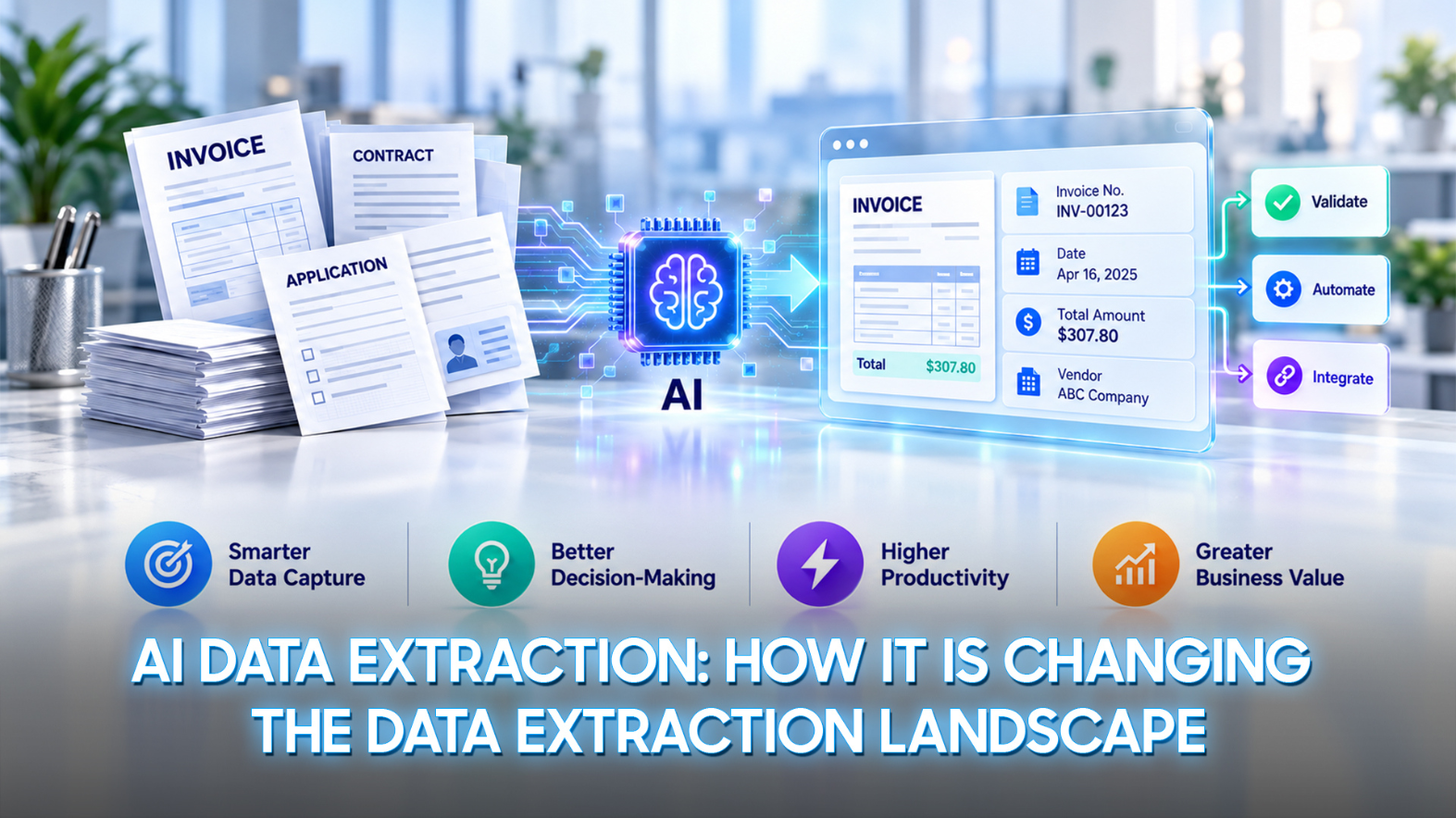
Every day, businesses process thousands of documents, including invoices, purchase orders, contracts, receipts, forms, and web pages. These documents contain critical information needed for accounting, customer support, legal reviews, and supply chain operations.
As business operations move faster, organizations can no longer afford the bottlenecks created by old extraction methods. Artificial intelligence (AI) is transforming this process by moving away from fixed rules and allowing software to read, understand, and extract information from documents automatically.
Understanding this shift requires looking at both sides of the technology: how AI expands the possibilities of data extraction and what businesses must do to ensure the information they collect remains reliable.
Understanding the Shift from Rule-Based Extraction to AI Data Extraction
To understand how AI is changing data extraction, it is important to first understand how traditional extraction methods work.
How Traditional Data Extraction Works
Traditional data extraction often relies on predefined rules, fixed templates, and structured fields. A system may be configured to retrieve information from specific locations in a document or identify values that match a known format. This approach can be highly effective when the input remains consistent.
However, problems arise when a supplier changes its invoice layout, moves information to another section, or introduces a new format. The extraction rules may no longer identify the correct fields, requiring developers or employees to update the configuration.
Traditional systems can also struggle with information that does not follow a predictable structure. Extracting a customer’s name from a standardized form is relatively straightforward. Identifying the reason for a complaint from a lengthy email requires a different level of interpretation.
These limitations do not mean traditional methods are ineffective. In fact, predefined rules remain valuable when information follows consistent patterns and accuracy requirements are clearly defined. The challenge is that businesses increasingly need to process information that does not always fit these conditions.
How AI Became A Game Changer In Data Extraction
AI introduces a more flexible approach by allowing systems to recognize patterns, interpret context, and identify relevant information across different formats.
Rather than relying exclusively on the position of a field, an AI-powered system may use surrounding text and document structure to determine which value represents an invoice number, payment deadline, or total amount.
Several technologies contribute to this capability:
- Modern Optical Character Recognition (OCR): Converts text in scanned documents and images into machine-readable text. Modern AI-enhanced OCR systems can also support layout and document-structure recognition.
- Machine learning (ML): Learns patterns from data to support tasks such as document classification, field identification, and information extraction.
- Natural Language Processing (NLP): Helps systems process and analyze human language, including identifying entities, categories, and relationships.
- Large Language Models (LLMs): Can interpret natural-language instructions, identify relevant information in complex text, and return extracted fields in a requested format.
These technologies can be combined within broader solutions, including Intelligent Document Processing (IDP), which brings together document capture, classification, extraction, validation, and workflow automation. The phrase “One key, many locks” aptly captures how AI is transforming data extraction, with different AI technologies working together to address diverse data processing challenges.
The important shift is that extraction no longer needs to depend entirely on where information appears. AI can use patterns and context to help determine what information means and which fields it belongs to.
Side-by-side Comparison Between Traditional and AI Data Extraction
The introduction of AI is changing data extraction in several connected ways. These changes affect not only the types of information businesses can process but also how extraction systems operate within everyday workflows.
Traditional vs. AI Data Extraction:
| Comparison | Traditional data extraction | AI data extraction |
| Extracting unstructured data | Relies on predefined rules, templates, and predictable patterns | Uses contextual clues and learned patterns to extract |
| Adapting to different document formats | Often requires manual template adjustments when layouts change | Handle a wider variety of document formats and layouts |
| Interpreting context | Uses OCR, predefined patterns, and extraction rules | Analyzes surrounding text, field labels, and document structure |
| Integrating into automated workflows | Automates extraction and data transfer through predefined rules and workflows | Combines flexible extraction with APIs and workflow automation |
| Key limitations | Heavily relies on predefined rules, making it less flexible | May misinterpret information or produce inaccurate results |
Extracting Information From Unstructured Data
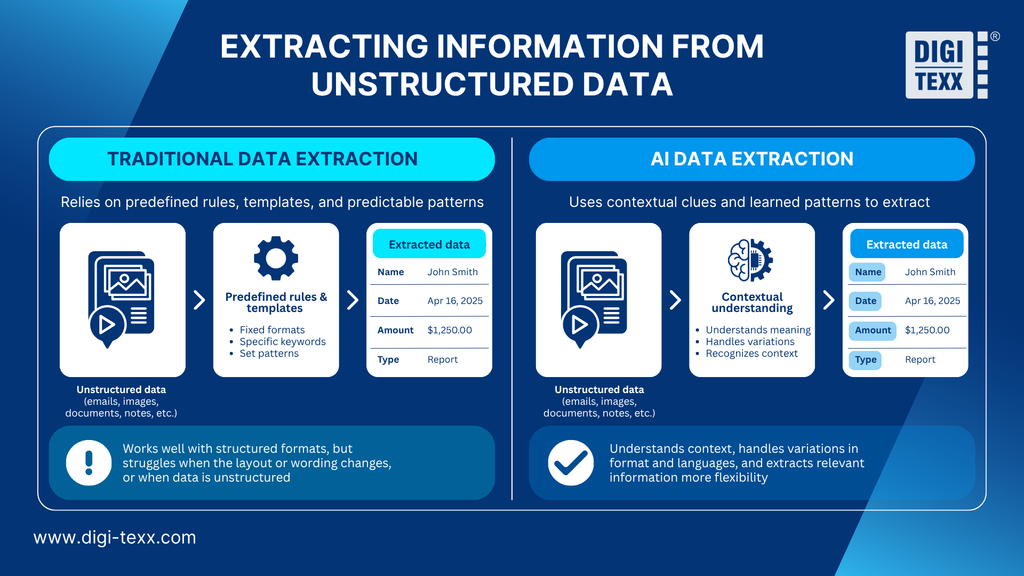
Traditional methods: Often rely on predefined rules, templates, and predictable patterns. They work well for consistent data but can require additional configuration when document structures, wording, or content vary significantly.
AI-Powered systems: Use contextual clues and learned patterns to identify relevant information in less predictable sources. They can handle a wider range of document variations, although performance still depends on the source material and the capabilities of the system.
Adapting to Different Document Formats
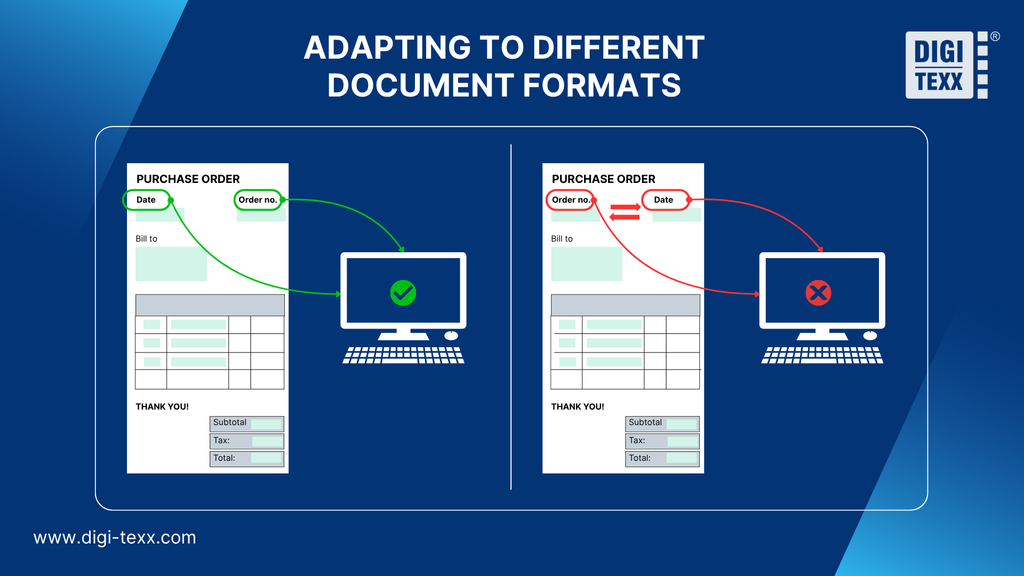
Traditional methods: Often depend on predefined templates or extraction rules that may require manual adjustments when supplier invoices, contracts, or application forms change their layouts, field names, or languages.
AI-Powered systems: Can identify required fields, such as supplier names, invoice numbers, and dates, across different document layouts by using contextual information and learned patterns. This can reduce the need for constant template maintenance, although unfamiliar formats may still require configuration and testing.
Moving From Text Recognition To Contextual Interpretation
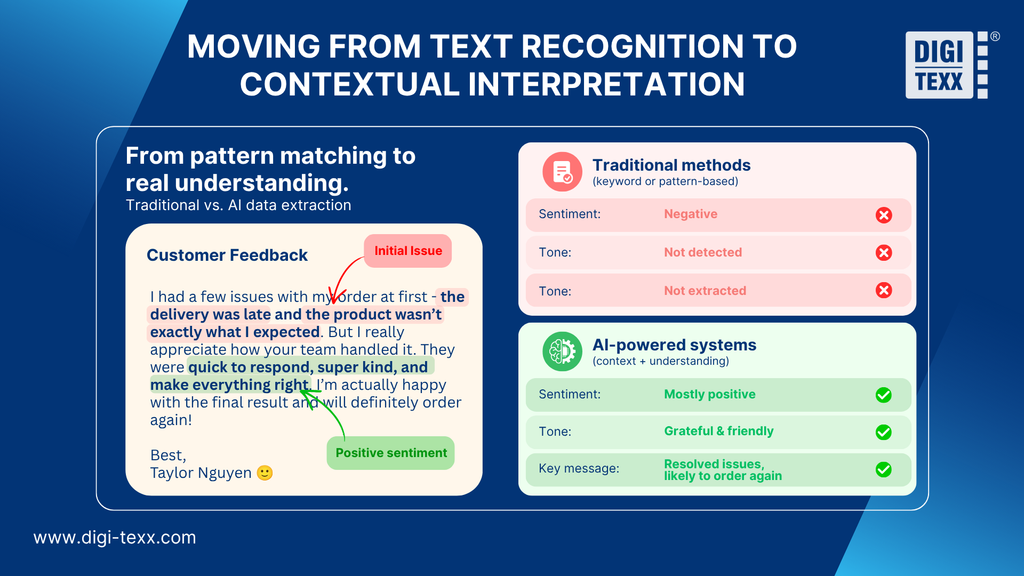
Traditional methods (OCR and rule-based extraction): OCR converts scanned text into machine-readable content, while rule-based methods use predefined patterns, positions, or rules to identify specific fields. These approaches can be effective for predictable documents but may struggle when contextual interpretation is required.
AI-powered systems: Analyze surrounding text, language patterns, and context to interpret information beyond individual keywords. For example, an AI-powered system can recognize that customer feedback expressing initial frustration may still convey an overall positive experience when the customer praises the support team and indicates they will order again.
Optimize Workflows for Greater Efficiency
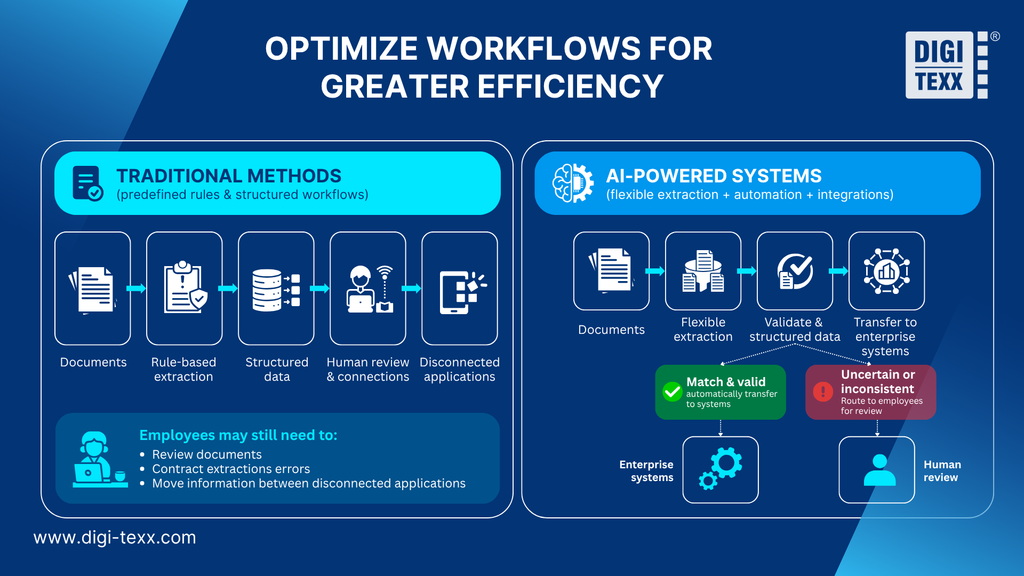
Traditional methods: Can automate extraction and data transfer but may rely on predefined rules and structured workflows. Employees may still need to review documents, correct extraction errors, or move information between disconnected applications.
AI-Powered systems: Can combine flexible data extraction with workflow automation and integrations such as APIs. Extracted information can be structured, checked against business rules, and transferred to enterprise systems, while uncertain or inconsistent results can be routed to employees for review.
The Benefits For Business and Its Related Stakeholders From AI Data Extraction
Benefits For Business and Its Related Stakeholders:
| Aspects | Business benefits | Stakeholders benefits |
| Extracting unstructured data | Less manual data entry | Employees spend less time searching for details |
| Adapting to document formats | Lower template maintenance & greater flexibility | IT teams may spend less time on configuration work |
| Interpreting context | Reliable information for downstream processes | Finance teams can process invoices more reliably |
| Automating workflows | Faster processing, less repetitive work | Employees can focus on exceptions and decisions |
Extracting information from unstructured data
Turn information buried in emails, reports, contracts, and customer feedback into structured data that businesses can search, analyze, and act on.
- Business benefit: Less manual data entry and access to information that would otherwise be difficult to analyze at scale.
- Stakeholder benefit: Employees spend less time searching for details, while managers gain better visibility into customer needs, operational issues, and business trends.
- Potential KPI: Manual processing time, extraction accuracy, and time required to retrieve information.
Adapting to different document formats
Reduce the effort required to maintain extraction rules when documents arrive from different suppliers, customers, or business units.
- Business benefit: Lower template maintenance effort and greater flexibility when processing documents from multiple sources.
- Stakeholder benefit: Finance and procurement teams can handle more document variation, while IT teams may spend less time updating extraction configurations.
- Potential KPI: Configuration and maintenance hours, document exception rates, and processing cost per document.
Moving from text recognition to contextual interpretation
Help identify what extracted values mean, reducing confusion between similar fields and improving the usability of the resulting data.
- Business benefit: Fewer field-mapping errors and more reliable information for downstream processes, subject to validation.
- Stakeholder benefit: Finance teams can process invoices more reliably, while compliance and risk teams can review relevant information more consistently.
- Potential KPI: Field-level accuracy, error correction rates, validation failure rates, and the number of discrepancies detected before processing.
Integrating extraction into automated workflows
Feed validated information directly into business applications, allowing subsequent process steps to run with less manual intervention.
- Business benefit: Shorter processing cycles, less repetitive work, and more consistent movement of information between systems.
- Stakeholder benefit: Employees can focus on exceptions and decisions, managers can monitor process performance, and customers or suppliers may receive faster responses.
- Potential KPI: End-to-end processing time, straight-through processing rate, manual intervention rate, and cost per completed transaction.
AI Data Extraction: A Big Picture
In evaluating the adoption of AI data extraction, organizations should consider not only the immediate gains in speed and accuracy but also the broader impact on operational models, cost structures, and decision-making capabilities
- Operational efficiency: Automating repetitive extraction tasks can reduce manual effort and help employees process larger document volumes without increasing manual workload at the same rate.
- Cost optimization: Reducing manual handling, template maintenance, and avoidable rework may lower the total cost of document processing. These savings should be evaluated against implementation, integration, licensing, and oversight costs.
- Data quality and control: Contextual extraction combined with validation can help identify inconsistencies before data enters downstream systems. Human review remains important for uncertain or high-impact cases.
- Scalability and decision support: Businesses can potentially process a wider variety of documents and make more information available for reporting and analysis, supporting growth and better-informed decisions.
AI Data Extraction And Real-World Applications
Healthcare
Healthcare organizations handle clinical notes, laboratory reports, referral letters, prescriptions, and insurance documentation. Pulling essential information from these diverse sources can be labor-intensive and repetitive, especially when formats differ across systems, departments, and institutions
Cleveland Clinic:
- Ambient documentation (Ambience Healthcare): Live for 4,000+ clinicians; trims 14 minutes of daily EHR note time, restoring focus to patient care.
Manufacturing and industrial operations
Manufacturing companies process large volumes of operational and administrative documents, including invoices, claims, supplier records, and other business paperwork. Extracting relevant information from these documents can be repetitive and time-consuming, particularly when formats vary across suppliers, languages, and departments.
Volvo Group:
- Volvo Group developed a solution using Microsoft Azure AI: Save more than 10,000 hours of manual work, reduce document-handling effort across industrial and administrative operations
The New Challenges In AI Data Extraction
Despite these advantages, greater automation does not automatically translate into greater accuracy. AI enables businesses to extract information from more complex sources, interpret context, and process documents at scale.
Yet, the same flexibility that makes these systems powerful can also introduce new uncertainties. Traditional rule-based systems may struggle when information deviates from predefined formats, whereas AI-powered systems can interpret unfamiliar inputs but may misread, misclassify, or generate unsupported information.
As a result, the challenge is no longer simply how to extract data efficiently, but how to ensure that the extracted information can be trusted. This creates a new set of challenges that businesses must address before fully relying on AI-powered extraction.
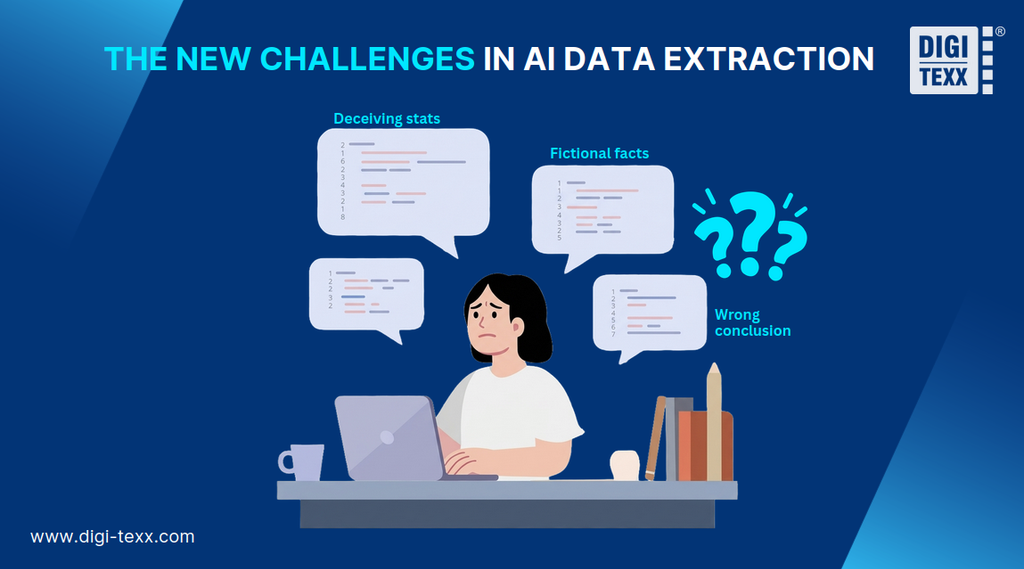
Difficulty Interpreting Nuanced Data
AI can identify explicitly stated information, but interpreting its precise meaning becomes more difficult when documents contain ambiguous wording, subtle distinctions, or statements whose meaning depends on context.
Why it matters: When nuance is lost, extracted data may appear accurate while misrepresenting the original meaning. This is particularly risky in contracts, financial records, and compliance documents, where a small difference in wording can affect how an entire statement is interpreted.
Limitations in Handling Implicit Information
Not all relevant information is presented in a single field or explicitly stated in a document. AI may need to connect references across sections, identify relationships between fields, or interpret information in the context of earlier statements. However, it can struggle to distinguish a well-supported inference from an unsupported assumption.
Why it matters: Businesses may receive incomplete or incorrectly inferred data when systems fail to connect relevant information or draw conclusions without sufficient evidence. Equally important, AI may fail to recognize when information is genuinely missing and should be left unresolved rather than inferred.
Risk of Hallucinated Information
When source information is missing, incomplete, or difficult to read, AI models may generate plausible but unsupported details instead of returning an empty field or flagging uncertainty. These details could include dates, monetary amounts, company names, or other values that never appeared in the original document.
Why it matters: Unlike an obvious extraction failure, fabricated information can go unnoticed and enter databases, financial workflows, or business reports. This undermines data integrity and can lead to decisions based on information that cannot be verified against the original source.
These challenges highlight an important limitation of AI data extraction: processing information automatically does not guarantee that the results are reliable. To maintain data quality, businesses need mechanisms to validate extracted information, identify uncertainty, and correct errors before they affect downstream operations. This is where human-in-the-loop approaches become essential
Human-in-the-Loop In AI Data Extraction
Rather than relying entirely on automated outputs, businesses incorporate human-in-the-loop into the extraction workflow to validate results, resolve uncertainties, and correct errors before they affect downstream operations.
With human-in-the-loop validation, businesses can ensure their data rests on four core pillars: accuracy, completeness, consistency, and timeliness.
Because these four dimensions do not operate in silos; they are deeply interdependent:
- Accuracy without completeness leaves you blind
- Completeness without consistency creates chaos
- And consistency without timeliness leaves you reacting to the past.
Together, they transform raw data from a potential liability into a powerful competitive advantage.
Finding the Right Balance Between AI In Data Extraction and Human Expertise

The goal of human-in-the-loop validation is not to replace automation with manual work, but to ensure that human expertise is applied where it matters most. Routine extractions can proceed automatically when they meet predefined quality requirements, while ambiguous, inconsistent, or high-risk results are escalated for review.
This approach allows businesses to benefit from AI’s speed and scalability without treating every automated output as inherently reliable. By combining machine processing with human judgment, organizations can build data extraction workflows that are not only efficient but also more dependable, transparent, and adaptable to changing business needs.
Ultimately, the value of AI data extraction depends not simply on how quickly information can be processed, but on how confidently businesses can use the results. By combining intelligent automation with appropriate human oversight, organizations can turn extracted data into a more reliable foundation for informed decisions and sustainable growth.
References
- Microsoft. (2023, November 16). Volvo Group streamlines invoice and claims processing with Azure AI and AI Document Intelligence. https://www.microsoft.com/en/customers/story/1703814256939529124-volvo-group-automotive-azure-ai-services
- Prosper AI. (2026, July 22). Top 5 hospitals using AI in May 2026. https://www.getprosper.ai/blog/hospitals-using-ai