
What is data labeling in machine learning? It is a key concept that enables AI models to understand and work with real-world data. In this article, DIGI-TEXX will help you explore how it works, why it matters, and the best practices to improve accuracy and performance.
>>> See more:
- Accounts Payable Outsourcing: How It Works, Benefits & Top Providers
- Best Business Process Automation Solutions & Tools 2026
- Define Business Process Outsourcing (BPO): Meaning, Examples & Benefits 2026
What Is Labeled Data In Machine Learning?
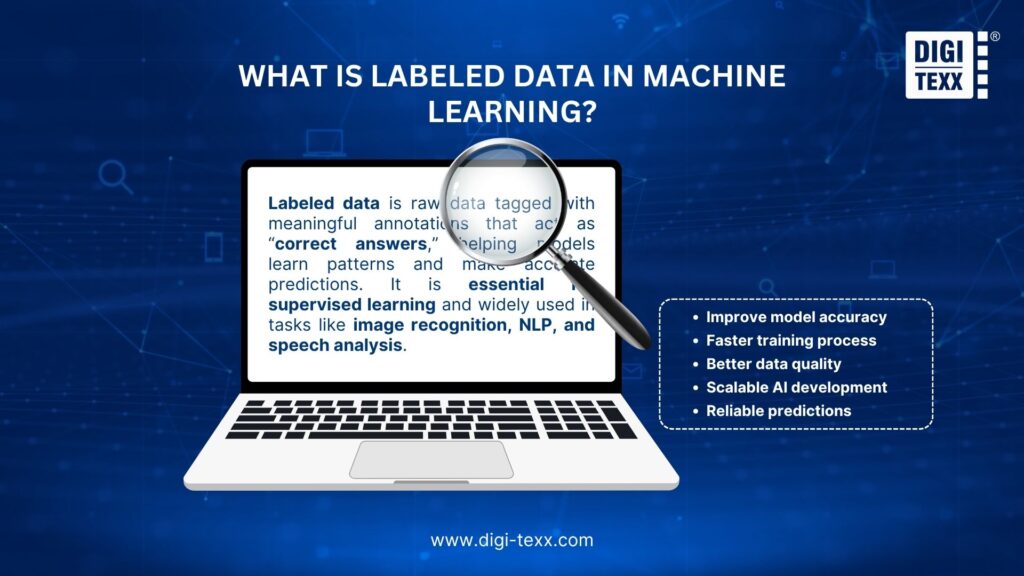
Labeled data in machine learning refers to raw data that has been tagged with meaningful annotations to provide context for training models. These labels act as the “correct answers” that help algorithms learn patterns and make accurate predictions.
For example, an image labeled as “cat” or “car,” a text marked with sentiment such as “positive” or “negative,” or an audio file transcribed into words are all forms of labeled data. This type of data is essential in supervised learning, where models rely on predefined labels to understand relationships between input and output.
By using labeled data, machine learning systems can improve accuracy, reduce errors, and perform reliably across tasks such as image recognition, natural language processing, and speech analysis.
Data Labelling Examples
Below are common data labeling examples used across AI and machine learning applications:
Image & Video Labeling
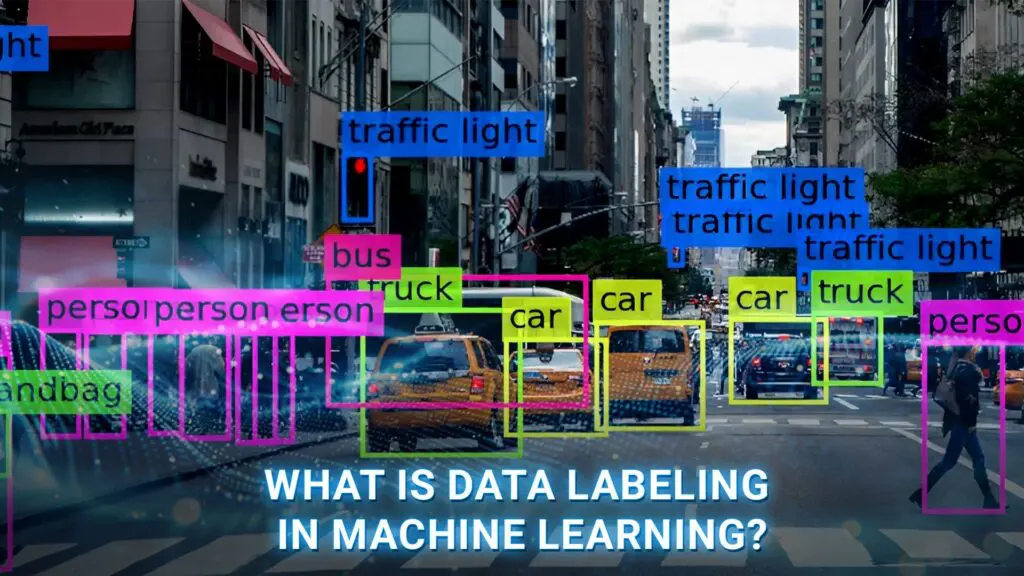
- Bounding boxes: Draw rectangles around objects (cars, pedestrians, traffic lights) for object detection.
- Semantic segmentation: Label every pixel to define regions like road, sky, or buildings.
- 3D cuboids: Add depth-aware boxes to represent objects in 3D space (e.g., distance in autonomous driving).
- Key-point & landmark annotation: Mark specific points such as facial features, joints, or poses.
- Polygon annotation: Outline irregular shapes with high precision.
Text Labeling
- Sentiment analysis: Classify text as positive, negative, or neutral.
- Named entity recognition (NER): Identify names, locations, organizations.
- Intent classification: Detect user intent in queries or messages.
Audio Labeling
- Speech-to-text: Convert spoken audio into text.
- Speaker identification: Label who is speaking.
- Emotion detection: Identify tones such as happy, angry, or neutral.
Video Labeling
- Object tracking: Track objects across frames.
- Action recognition: Label activities or behaviors in video clips.
These examples highlight how labeled data provides structure and context, enabling AI models to learn and make accurate predictions.
>>> See more:
- AI-Powered Data Annotation Technologies Efficiency Accuracy Guide For AI Projects
- 5 Key Indicators Of A Business Process Outsourcing Provider You Should Track
- Best Data Conversion Services in 2026 | DIGI-TEXX
How To Do Data Labeling?
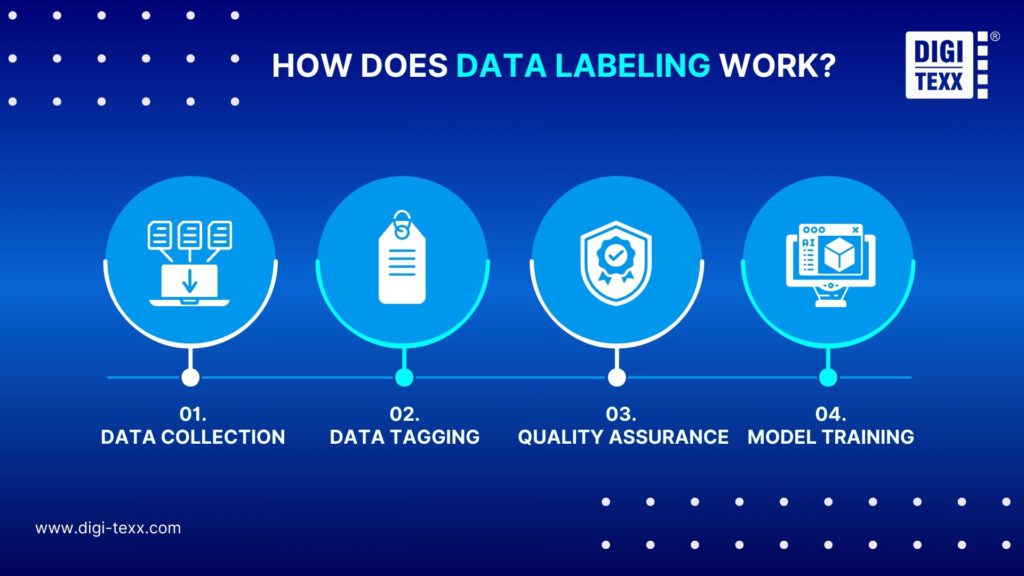
Data labeling works by assigning meaningful tags to raw data so machine learning models can learn input–output relationships. Most models today rely on supervised learning, which requires a labeled dataset to make accurate predictions.
The process typically begins with human annotators reviewing unlabeled data and assigning labels based on specific criteria, such as identifying whether an image contains an object or marking exact elements within it. These human-provided labels are then used to train the model, helping it recognize patterns and make decisions on new data.
This labeled dataset, often called “ground truth,” serves as the standard for training and evaluation. The higher the labeling accuracy, the more reliable and effective the model will be.
Common Types Of Data Labeling
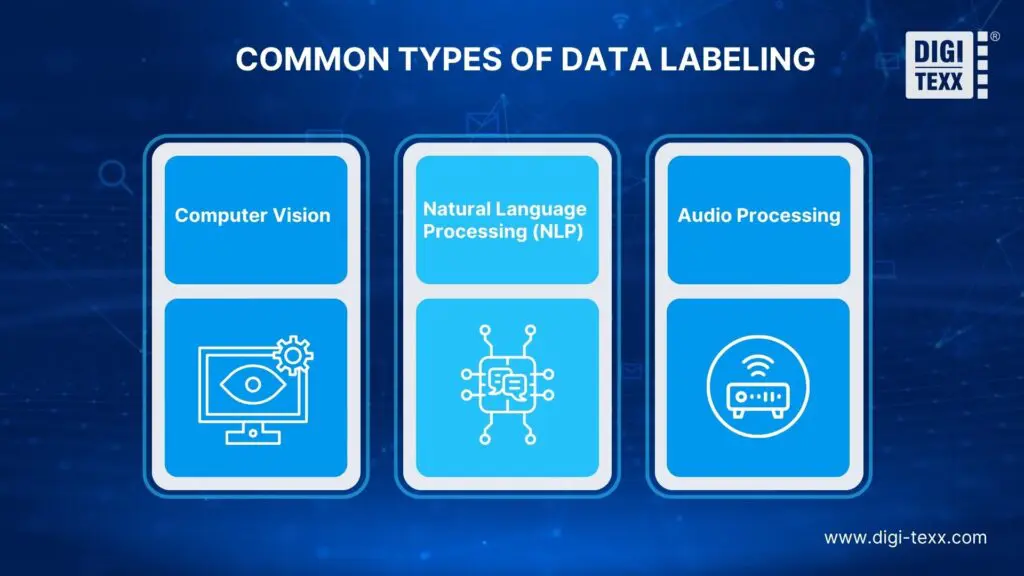
Data labeling is typically applied across three main domains, depending on the type of data used in machine learning:
Computer Vision
In computer vision, data labeling involves annotating images or videos by tagging objects, drawing bounding boxes, marking key points, or performing pixel-level segmentation.
For example, images can be classified by content (what appears in the image) or by type (such as product vs. lifestyle images). These labeled datasets enable models to automatically categorize images, detect objects, identify key features, and perform image segmentation.
Natural Language Processing (NLP)
For NLP, labeling focuses on identifying and tagging meaningful elements within text. This may include detecting sentiment or intent, recognizing entities like names and locations, or analyzing grammatical structures.
In some cases, text within images or documents is first localized using bounding boxes and then transcribed. These labeled datasets are essential for applications such as sentiment analysis, named entity recognition, and optical character recognition.
Audio Processing
Audio labeling involves converting sounds into structured data that machines can understand. This often starts with transcribing audio into text, followed by tagging and categorizing different sounds such as speech, environmental noise, or alerts. The labeled audio data is then used to train models for tasks like speech recognition, sound classification, and audio analysis.
>>> See more:
- Why Retail Outsourcing Is a Smart Strategy for Retail Businesses
- Healthcare BPO Services: Overview, Benefits & Key Solutions 2026
- An Overview of Document Processing Company: What You Need to Know
What Are Some Best Practices For Data Labeling?
To improve both speed and accuracy in data labeling, businesses often apply a few proven practices:
- Design simple, intuitive labeling interfaces to reduce confusion and help annotators work faster with fewer errors.
- Use multiple annotators (consensus labeling) so results can be cross-checked and bias from individuals is minimized.
- Regularly audit and refine labels to maintain data quality and correct any inconsistencies.
- Apply active learning to prioritize the most valuable data, allowing models to learn faster while reducing manual effort.
These practices help ensure high-quality datasets while optimizing time and cost.
Benefits Of Data Labeling
Data labeling is a foundational step in any machine learning or AI project. It involves assigning meaningful tags to raw data, such as images, texts, audio, or video, so that machines can learn to interpret and analyze it. When implemented properly, data labeling brings several key benefits that directly impact the performance and reliability of AI systems:
1. Makes AI Smarter and More Accurate
Training an AI model effectively requires a large volume of accurately labeled data. When provided with clear and consistent labels, the model learns to recognize patterns faster and with greater precision.
For instance, an image recognition system trained on properly labeled photos of cats and dogs will have a much higher chance of correctly identifying a new picture of a puppy or kitten. High-quality labeled data is the foundation for building reliable and intelligent AI systems.

2. Prepares AI for Real-World Challenges
Labeled data that reflects a wide range of real-world conditions, such as varying lighting, accents, and weather patterns, allows AI systems to learn how to adapt and perform reliably in unpredictable situations.
This diversity in training data improves the model’s ability to generalize, enabling it to make accurate predictions even when it encounters unfamiliar inputs.
3. Forms the Foundation of Supervised Learning
Supervised learning depends on labeled data, which provides the correct answers (ground truth) that a model learns from.
Without these ground truths, models cannot effectively measure errors or adjust their internal parameters. Labeled data is essentially the reference that guides the entire learning process.
4. Powers Advanced AI Applications
Labeled data drives powerful AI solutions in fields like computer vision, speech recognition, and natural language processing.
In high-stakes applications such as medical diagnostics or autonomous driving, the precision of labeled datasets is critical. Errors in labeling can lead to misdiagnoses or unsafe decisions by the system.
5. Enhances User Experience
Well-labeled data allows AI systems to better understand user intent, leading to more natural and personalized interactions.
When AI understands context accurately, it can reduce friction and frustration for users, improving satisfaction and boosting engagement with digital services.
For instance, when analyzing customer feedback, annotators review each comment and assign sentiment labels like positive, neutral, or negative. In some cases, they may also highlight specific aspects mentioned, such as complaints about delivery time or praise for customer service.
Through this process, the model gradually learns to recognize tone, sentiment, and underlying context when processing new, unseen feedback
6. Enables AI Scalability Across Industries
Each industry, such as healthcare, retail, finance, or manufacturing, has its own unique data and situations. When data is labeled according to the specific context and characteristics of each field, AI can learn and deliver more accurate results that meet real-world needs. This helps AI not only perform effectively but also integrate seamlessly into the specific workflows of each industry.
AI implementation becomes more effective when the system understands the unique requirements, processes, and operational practices within each sector. As a result, businesses can harness AI in a practical way, saving time and effort while increasing its real-world value.
7. Supports Model Evaluation and Improvement
Labeled data allows for clear and direct performance evaluation. By comparing model predictions to the correct labels, technical teams can measure accuracy, identify gaps, and take appropriate steps to improve the model.
Maintaining fully labeled validation datasets is crucial for monitoring model drift over time, addressing emerging issues, and ensuring stable performance during long-term operation.
8. Saves Time and Money in the Long Run
Accurate labeling from the start minimizes the need for repeated model retraining or troubleshooting later on. By investing in high-quality data early, businesses can avoid costly errors during the deployment process.
Moreover, well-labeled data shortens the feedback loop between model development and deployment, improving overall operational efficiency.
9. Drives Innovation and Breakthroughs
Labeled datasets are a key resource in AI research and development. In fields like healthcare, environmental science, or finance, clean and structured data enables teams to experiment, test ideas, and develop smarter solutions.
Breakthroughs in AI often begin with high-quality labeled data. This data provides the foundation needed to train models, explore new techniques, and evaluate performance with clarity and consistency.
>>> See more:
- 10 Best AI Process Automation Tools Free In 2026
- 5 Advantages Of Data Annotation Outsourcing Services for AI Projects
- Why Businesses Outsource Data Management in 2026?
Challenges Of Data Labeling
Data labeling comes with several challenges that can impact accuracy, efficiency, and overall project success. Below are some of the most common issues businesses often face during the labeling process.
1. Uneven Data Quality
The raw data we collect from various sources is often imperfect. It may contain errors, missing information, or even misleading data, making the labeling process more complex.
For example, an image may be blurry, noisy, or missing important parts, which makes it difficult to accurately assign labels. When data is not clean and clear from the outset, the labeling process faces many obstacles, potentially leading to errors during model training.
2. Subjectivity
When data annotators have different understandings and evaluations of the same dataset, inconsistencies in label application can occur. This is a common issue, especially in large-scale data labeling projects involving multiple annotators.
When dealing with complex data such as images, videos, or text, each annotator may have a different perspective and interpretation of the features that need to be labeled, leading to inconsistencies in label quality.
3. Cost and Time
Manual labeling is a time-consuming and resource-intensive task, especially when labeling large datasets or data that requires deep expertise in a specific field. This process is not only costly financially but also impacts the project’s timeline.
Maintaining a team of annotators with the appropriate skills and knowledge is crucial for ensuring the quality of work, but it also significantly increases costs.
4. Large Data Volume
AI and machine learning (ML) applications require vast amounts of data to train and improve models. With such large datasets, ensuring that each data point is accurately labeled becomes a significant challenge.
As the demand for high-quality labeled data increases, the team must maintain a consistent process and manage it effectively to avoid mislabeling or omissions.
5. Domain Expertise
Fields like healthcare, law, and engineering require data annotators to have specialized knowledge of industry-specific terms, processes, and contexts. A lack of this understanding can result in incorrect or irrelevant labels, which directly affects the quality of the data.
However, recruiting and training annotators with expertise in these specialized areas is often difficult, costly, and time-consuming.
6. Data Security and Privacy
During the labeling process, some datasets may contain sensitive information, such as personal data or medical records. To ensure user privacy and data security, measures like data encryption, access control, and compliance with data protection regulations such as GDPR or HIPAA must be strictly enforced.
Without these safeguards, there is a risk of data leakage or misuse, which could harm stakeholders and violate data security laws.
7. Scaling Challenges
As a data labeling project grows larger, maintaining the quality and speed of the labeling process becomes increasingly challenging. Managing a large team of annotators, distributing tasks effectively, and ensuring data quality control are significant hurdles.
Additionally, maintaining label consistency and ensuring high-quality labeled data throughout the scaling process requires careful attention and continuous adjustments to the process.
8. Lack of Effective Tools
Although automated or semi-automated labeling tools can help reduce manual labor, they are not always accurate. Especially for complex data types such as images, structured text, or unstandardized data, these tools can easily make errors, leading to mistakes in the labels.
Therefore, despite the use of such tools, human intervention is still needed to ensure the accuracy of the labels.

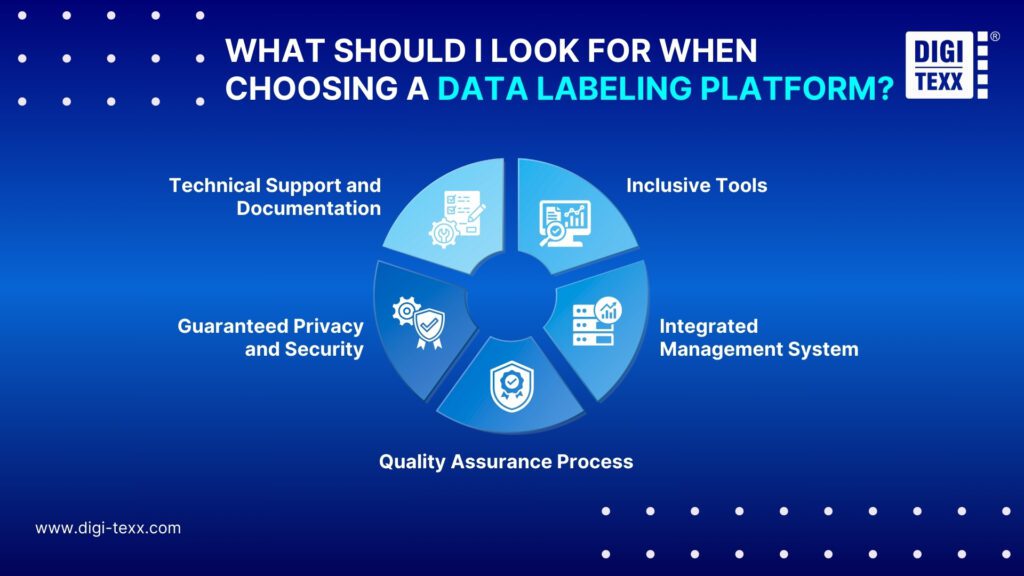
What Should I Look For When Choosing A Data Labeling Platform?
High-quality data requires a skilled data labeling team and robust tools. You can either purchase a platform, build one yourself if no suitable option is available, or utilize data labeling services. When selecting a platform for your data labeling project, it’s important to consider several key factors.
1. Inclusive Tools
Before selecting a data labeling platform, consider the tools that are essential for your use case. For instance, you might need a polygon tool to label cars or a rotating bounding box to label containers. Ensure the platform you choose includes the necessary tools to create high-quality labels.
It’s also wise to think ahead about the labeling tools you may require in the future. Investing time and resources in a platform that won’t be suitable for future projects can be costly. Training your team on a new platform consumes both time and money, so planning can help you avoid unnecessary challenges down the road.
2. Integrated Management System
Effective management is a key element for the success of a data labeling project. Therefore, the platform you choose should include an integrated management system that allows for the tracking of projects, data, and users. A robust data labeling platform should also enable project managers to monitor project progress, user productivity, communicate with annotators about mislabeled data, implement annotation workflows, edit and review labels, and oversee quality control.
Powerful project management features play an essential role in delivering accurate prediction results. When selecting a platform, be sure to consider features like advanced filtering and real-time analytics, as these tools help ensure the smooth execution of the project and the delivery of high-quality outcomes.
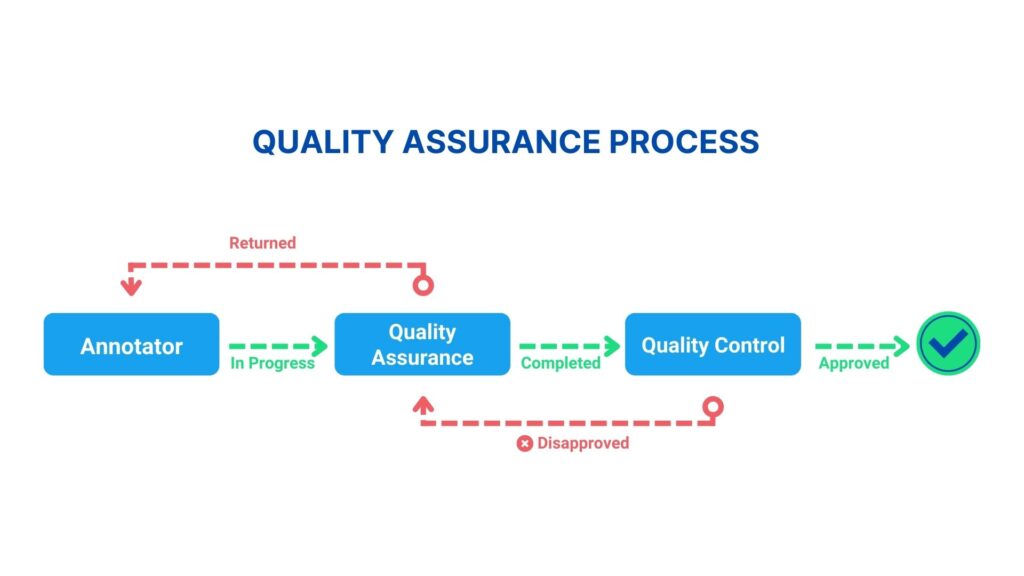
3. Quality Assurance Process
The quality of your machine learning model relies heavily on the accuracy of the data used. Ensure that the data labeling platform you select includes a robust quality assurance process that allows project managers to oversee and maintain the quality of labeled data. Additionally, it’s crucial that the data annotation services you choose are staffed with trained, vetted professionals who can consistently deliver high-quality results, helping you achieve optimal performance.
4. Guaranteed Privacy and Security
Protecting the privacy of your data should be a top priority. Choose a labeling platform that offers strong security features and can be trusted with your sensitive information. If your data is highly specialized, ensure the platform employs a workforce skilled in handling specific project requirements, minimizing the risks of mislabeling or data leakage. Additionally, review the security standards and regulations that the platform adheres to. Key security-related questions to consider include:
- How is access to data controlled?
- How are passwords and credentials managed and stored on the platform?
- Where is the data hosted, and what are the security measures in place for the hosting environment?
5. Technical Support and Documentation
A platform that offers comprehensive, up-to-date documentation and responsive technical support is essential. Technical issues can arise during data labeling, and having a support team available to troubleshoot problems quickly is crucial to minimize disruption. Before choosing a platform, ask about the types of support available and how troubleshooting assistance is provided.
By considering these factors, tools, management system, quality assurance, security, and support, you’ll be able to choose a data labeling platform that aligns with your needs, ensuring a smooth and efficient process for labeling data for machine learning models.
>>> See more:
- Top 10 Best Data Entry Outsourcing Companies in USA 2026
- Outsourcing Advantages & Disadvantages: What Businesses Should Know?
- Accounts Receivable Service | Invoicing, Billing & AR Management
FAQs About What Is Data Labeling In Machine Learning
What Is AI Data Labeling?
AI data labeling (also called annotation) is the process of tagging raw data—such as images, text, audio, or video—with meaningful labels so AI models can understand and learn from it. These labels serve as the “ground truth,” helping algorithms recognize patterns and make accurate predictions. It is a core step in supervised learning, powering applications like computer vision, natural language processing, and speech recognition.
What Is Unlabeled Data In Machine Learning?
Unlabeled data refers to raw data-such as images, text, audio, or sensor data-that has no predefined tags or classifications. It is mainly used in unsupervised learning, where models analyze the data to discover patterns, structures, and relationships on their own.
How Can Data Labeling Be Done Efficiently?
Data labeling becomes more efficient by combining human input with machine learning. A model is first trained on a small set of human-labeled data, then automatically labels new data when confident, while uncertain cases are reviewed by humans. Over time, the model improves and handles more data automatically, reducing time and cost.
In conclusion, understanding what is data labeling in machine learning is essential for building accurate and reliable AI systems. From improving model performance to enabling real-world applications, high-quality labeled data plays a critical role at every stage. By applying the right tools, processes, and best practices, businesses can optimize their data labeling efforts and unlock the full potential of AI.
DIGI-TEXX Contact Information:
🌐 Website: https://digi-texx.com/
📞 Hotline: +84 28 3715 5325
✉️ Email: [email protected]
🏢 Address:
- Headquarters: Anna Building, QTSC, Trung My Tay Ward
- Office 1: German House, 33 Le Duan, Saigon Ward
- Office 2: DIGI-TEXX Building, 477-479 An Duong Vuong, Binh Phu Ward
- Office 3: Innovation Solution Center, ISC Hau Giang, 198 19 Thang 8 street, Vi Tan Ward
Reference:
- IBM. (n.d.). What is data labeling? Retrieved from https://www.ibm.com/topics/data-labeling
- Stanford NLP Group. (n.d.). Natural language processing research. Retrieved from https://nlp.stanford.edu/