

Leading intelligent document processing companies are helping enterprises automate document classification, data extraction, validation, and workflow processing at scale. In this guide, DIGI-TEXX explores 10 leading IDP companies in 2026, compares their capabilities and use cases, and explains how businesses can choose the right solution for their document processing needs.

What Is Intelligent Document Processing?
Businesses rarely receive information in a single, standardized format. A finance team may receive invoices as PDFs, email attachments, scanned images, spreadsheets, or paper documents. Insurance teams may handle claims forms and supporting records, while banks process loan applications, statements, and identity documents.
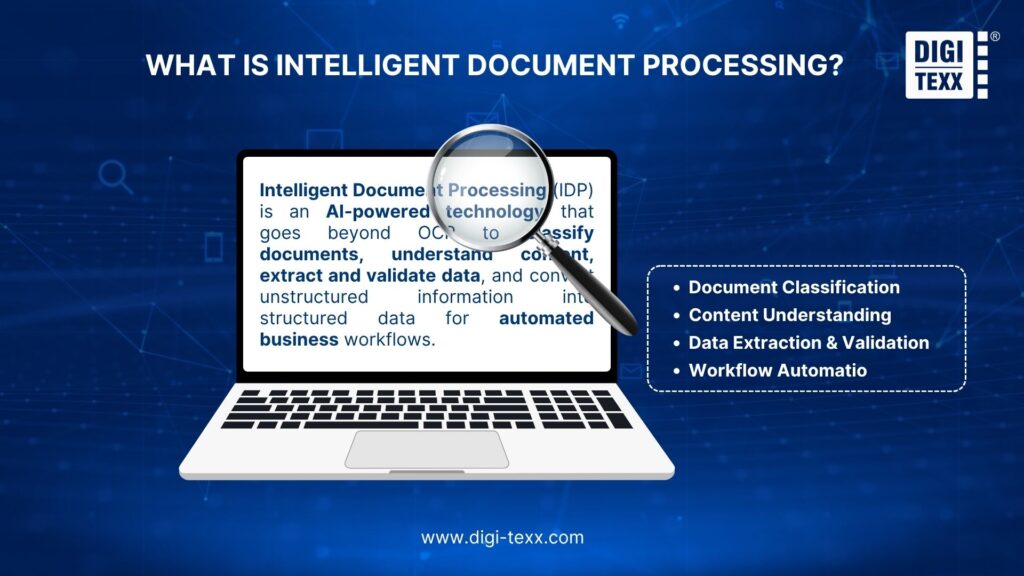
Traditional OCR can convert text from these documents into machine-readable characters. IDP goes further by identifying what the document contains, understanding its structure, extracting relevant fields, validating the results, and sending structured data into downstream systems.
The scale of document-based information helps explain why this broader approach is needed. A 2025 survey of 600 enterprises by the Association for Intelligent Information Management (AIIM) found that 76.6% of organizations store between 25% and 75% of their data in documents, yet only 38.1% rate their document data as “excellent” for AI use (Association for Intelligent Information Management [AIIM], 2025). This gap highlights why enterprises need more than basic OCR: documents must be classified, understood, extracted, validated, and transformed into reliable data before they can support automated business processes.
Gartner’s 2025 Critical Capabilities research evaluates IDP solutions across capabilities including data extraction, data review, integration, orchestration and automation, retrieval and synthesis, secure handling, automated processing, and data enrichment.
>>> See more:
- What is Automated Document Processing and How Does It Work?
- Automated Invoice Processing: How It Works, Benefits & Best Software
- What Is Digitization Service? Common Types of Digitization Services
How Intelligent Document Processing Works?
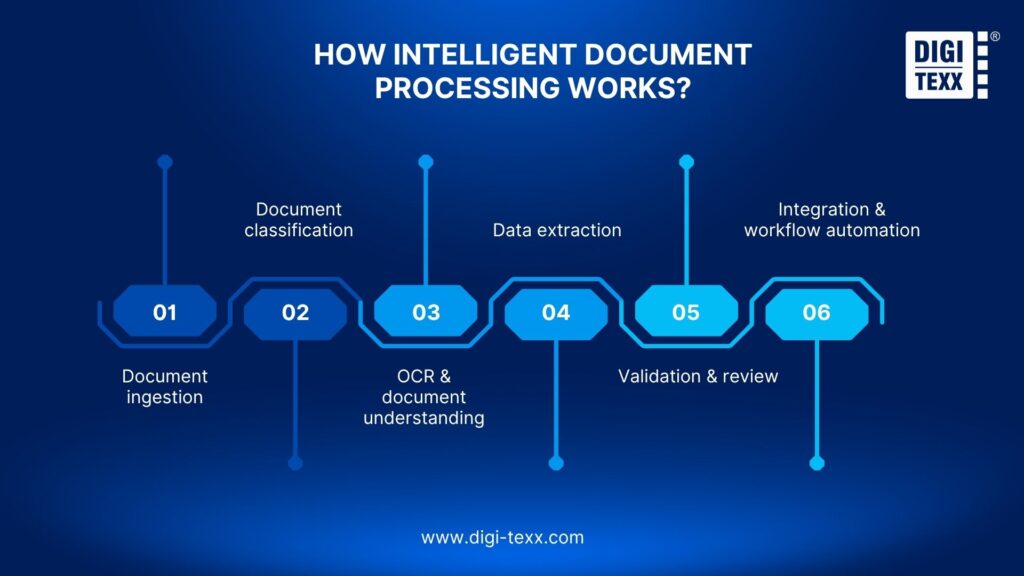
A typical IDP workflow includes several connected stages:
1. Document ingestion
Documents enter the processing workflow through sources such as scanners, email, cloud storage, enterprise applications, digital forms, or document repositories.
2. Document classification
AI models identify the document type and determine which processing rules or extraction model should be applied. A mixed file containing invoices, purchase orders, and delivery notes can therefore be separated into the appropriate document categories.
3. OCR and document understanding
OCR converts printed or handwritten content into machine-readable information. More advanced document understanding technologies also analyze layout, tables, fields, relationships, and context.
4. Data extraction
The system extracts relevant business information such as names, dates, invoice numbers, addresses, amounts, policy numbers, or contract terms.
5. Validation and review
Extracted information can be checked against business rules, confidence thresholds, reference data, or human review processes. This step is particularly important when documents contain poor scans, handwriting, unusual layouts, or ambiguous information.
6. Integration and workflow automation
Validated data is transferred to ERP, CRM, accounting, claims, document management, or other enterprise systems. The goal is not simply to digitize a document but to make its information usable in a business process.
For example, Amazon Textract can detect printed and handwritten text and extract forms, tables, signatures, and other document information through APIs. It also provides confidence scores and specialized capabilities for invoices, receipts, identity documents, and lending workflows.
Google Document AI follows a similar document-understanding approach, transforming unstructured document information into structured data while supporting OCR, classification, extraction, splitting, custom models, and integration with Google Cloud services.
>>> See more:
- Wedding Photo Editing Service | Elevating Your Wedding Photos
- Top AI Document Processing Tools to Automate Your Data Workflow
- Enterprise Document Management System: Top 13 Solutions & Features 2026
IDP vs. OCR: Key Differences
OCR and IDP are related, but they are not interchangeable.
| Capability | OCR | Intelligent Document Processing |
| Text recognition | Yes | Yes |
| Handwriting recognition | Varies | Often supported |
| Document classification | Limited | Yes |
| Layout understanding | Limited | Yes |
| Data extraction | Basic | Advanced |
| Structured and semi-structured documents | Limited | Yes |
| Unstructured documents | Limited | Increasingly supported |
| Data validation | Usually external | Built into many platforms |
| Human review | External workflow | Often integrated |
| Workflow automation | No | Yes |
| Enterprise integration | API/export | APIs, connectors, workflow integration |
10 Leading Intelligent Document Processing Companies In 2026
The companies below should not be interpreted as a strict 1-to-10 ranking. The IDP market contains different types of providers, including dedicated IDP platforms, automation vendors, cloud technology providers, and document processing service providers.
Gartner’s 2025 research confirms the market includes more than 100 vendors, while its evaluated vendor set includes many of the technology providers discussed below.
1. ABBYY
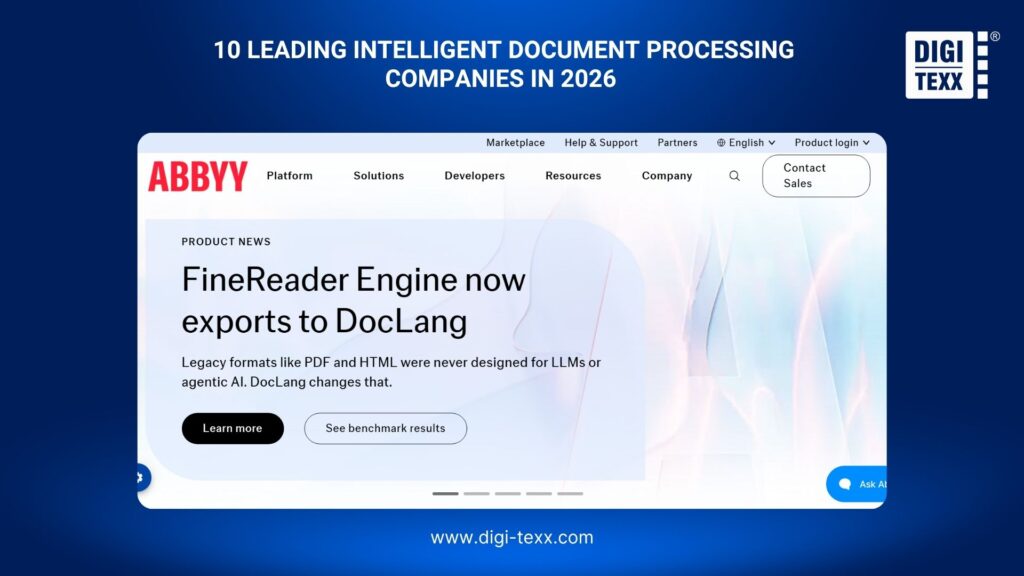
ABBYY is one of the most established names in document processing and enterprise automation. Its flagship IDP platform, ABBYY Vantage, combines document input, OCR/ICR, document classification, data extraction, validation, analytics, and APIs.
Vantage supports structured, semi-structured, and unstructured documents and provides pre-trained AI skills alongside tools for creating custom document skills. ABBYY also supports integrations with RPA, BPM, ERP, ECM, and other enterprise systems.
ABBYY was named a Leader in Gartner’s inaugural 2025 Magic Quadrant for Intelligent Document Processing Solutions.
- Strengths: Enterprise IDP, document classification, extraction, OCR/ICR, pre-trained models, workflow integration.
- Best suited for: Large organizations with complex document workflows and established automation environments.
- Potential limitation: Organizations looking for a lightweight document extraction API may find a full enterprise IDP platform broader than necessary.
2. UiPath
UiPath approaches IDP as part of a broader automation ecosystem. Its Document Understanding technology combines AI with robotic process automation to extract and interpret information from documents, including PDFs, images, handwriting, signatures, checkboxes, and tables.
UiPath also incorporates human-in-the-loop validation and connects document processing with broader enterprise automation workflows.
In 2025, UiPath was named a Leader in Gartner’s inaugural Magic Quadrant for Intelligent Document Processing Solutions. Its newer UiPath IXP offering combines Document Understanding, Communications Mining, and generative extraction for unstructured and complex documents.
- Strengths: RPA integration, end-to-end automation, AI extraction, human validation, enterprise workflow automation.
- Best suited for: Enterprises already using UiPath or planning to automate document-driven processes alongside other business processes.
- Potential limitation: Businesses seeking document processing as an isolated capability may not need the broader automation platform.
3. Automation Anywhere
Automation Anywhere combines intelligent document processing with its broader automation platform through Document Automation.
The solution uses AI technologies to classify, extract, and validate information from documents and place that data directly into business workflows. Supported use cases include invoices, purchase orders, loan applications, insurance claims, healthcare records, HR documents, and logistics documents.
Automation Anywhere also positions Document Automation as workflow-embedded IDP, connecting document data with automation and human-in-the-loop processes.
- Strengths: IDP combined with RPA and workflow automation, broad enterprise use cases, cloud and on-premise options.
- Best suited for: Enterprises that want document automation integrated with a larger automation strategy.
- Potential limitation: Organizations focused only on document extraction may find the wider automation ecosystem unnecessary.
>>> See more:
- What Is a Document Management System (DMS)?
- How to Ensure Data Accuracy: Best Practices & AI Guide 2026
- Wedding Photography Retouching: Professional Techniques & Services
4. Rossum
Rossum takes a cloud-native, AI-first approach to document processing, with a particular focus on transactional documents.
Its platform is designed to automate the document journey from capture and extraction through validation, post-processing, and reporting. Rossum emphasizes template-free processing and uses its Aurora transactional LLM to handle changing document layouts.
Common applications include invoices, purchase orders, supplier documents, and other transaction-heavy workflows.
Rossum was recognized as a Challenger in Gartner’s 2025 Magic Quadrant for Intelligent Document Processing Solutions.
- Strengths: Transactional document processing, invoice automation, template-free extraction, cloud-native deployment.
- Best suited for: Finance, accounts payable, procurement, and supply-chain teams processing high volumes of transactional documents.
- Potential limitation: Its strongest positioning is around transactional workflows, so businesses with highly specialized enterprise content requirements may need to compare broader platforms.
5. Hyperscience
Hyperscience focuses on enterprise AI and complex document processing through its Hypercell platform.
The platform uses a model-based architecture to process structured and unstructured documents and supports integration with enterprise systems and multiple cloud environments. It also includes human review capabilities and tools for adapting workflows to different document types and business requirements.
Hyperscience was positioned as a Leader in Gartner’s 2025 Magic Quadrant for Intelligent Document Processing Solutions. Its platform has also received recognition from IDC, Forrester, and GigaOm for document intelligence capabilities.
- Strengths: Complex and unstructured documents, enterprise-scale processing, model flexibility, human-in-the-loop workflows.
- Best suited for: Large organizations handling high volumes of complex or variable documents.
- Potential limitation: The platform is oriented toward sophisticated enterprise use cases rather than simple OCR requirements.
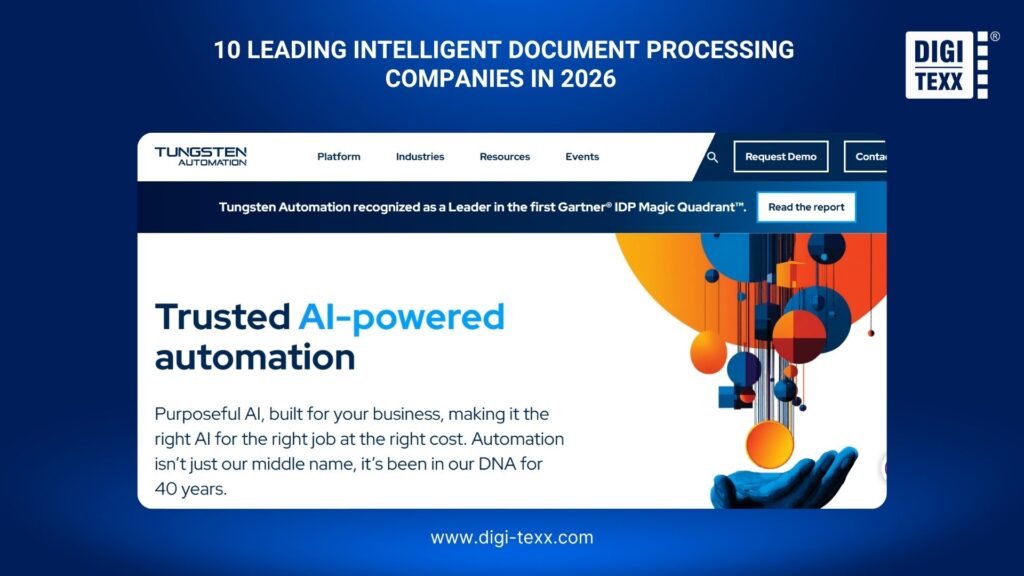
6. Tungsten Automation
Tungsten Automation’s TotalAgility combines document capture, classification, extraction, validation, verification, and workflow automation.
Its current platform includes AI-powered document classification and extraction, generative AI classification, trainable document separation, and multiple document ingestion options.
TotalAgility can also connect document capture to downstream enterprise systems and processes. Its document library covers use cases such as government IDs, tax forms, legal documents, and compliance records.
- Strengths: Document capture, IDP, workflow automation, enterprise integrations, industry-specific document libraries.
- Best suited for: Enterprises with established document capture and workflow automation requirements.
- Potential limitation: Its broad platform scope may require more implementation planning than a focused cloud document extraction service.
7. Microsoft
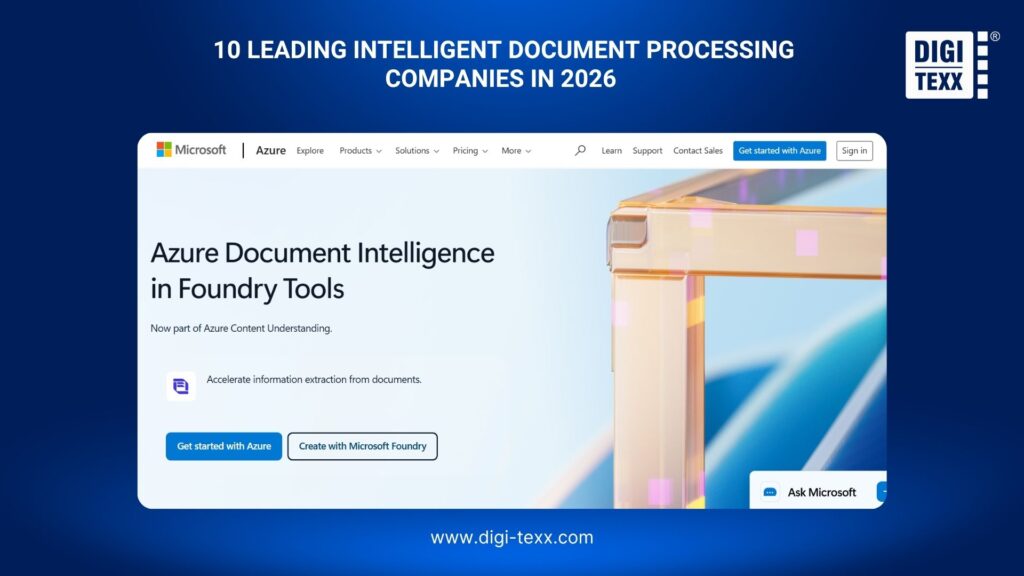
Microsoft provides document intelligence capabilities through Azure Document Intelligence, part of its cloud-based AI services.
Azure Document Intelligence uses machine learning and OCR to extract text, tables, structure, and key-value pairs. It provides prebuilt models for documents such as invoices, receipts, and identity documents, while custom models can be trained for specific document types.
Microsoft is also expanding document processing through Azure Content Understanding. Microsoft describes Document Intelligence as providing deterministic extraction for structured documents, while Content Understanding adds LLM-powered analysis for complex, unstructured, and multimodal content.
- Strengths: Azure ecosystem, APIs, prebuilt and custom models, enterprise cloud infrastructure.
- Best suited for: Organizations already invested in Microsoft Azure and teams building document intelligence into their own applications.
- Potential limitation: Implementing an end-to-end IDP workflow may require additional Azure services and development resources.
8. Google Cloud
Google Cloud’s Document AI is a cloud-based document understanding platform designed to transform unstructured document information into structured data.
Its capabilities include OCR, document classification, document splitting, form parsing, layout analysis, custom extraction, and pretrained processors. Document AI can also connect with Google Cloud services such as Cloud Storage, BigQuery, and Vertex AI Search.
- Strengths: Cloud-native architecture, AI and machine learning capabilities, custom extraction, Google Cloud integration.
- Best suited for: Enterprises and development teams building scalable document processing applications on Google Cloud.
- Potential limitation: Organizations seeking a fully managed document processing operation may require additional services beyond the core platform.
9. Nanonets
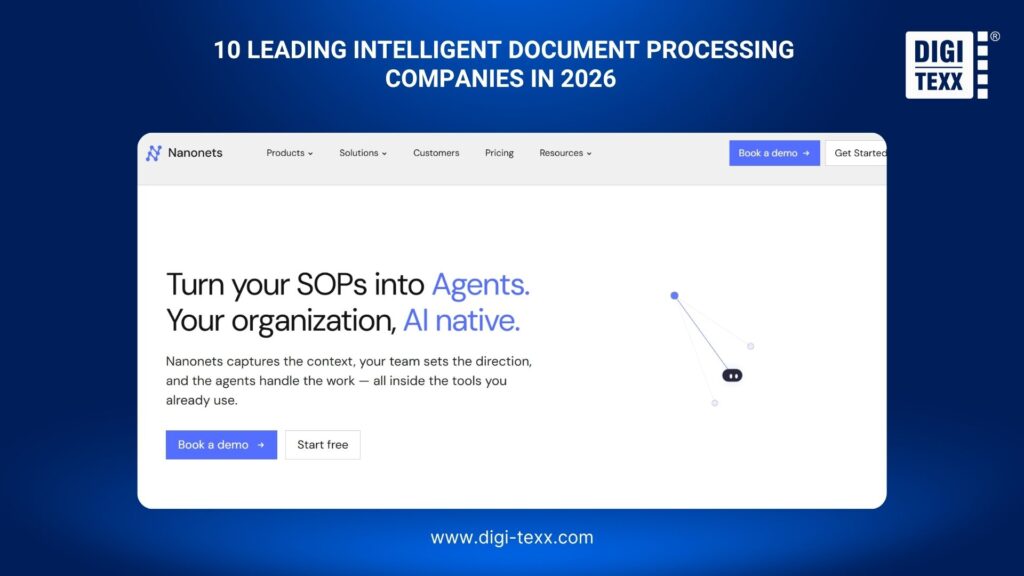
Nanonets is positioned around AI-powered document processing and workflow automation, with particular relevance to business processes such as accounts payable, invoice processing, and data extraction.
Its appeal is generally strongest for organizations seeking a relatively accessible way to automate document-heavy workflows without building an IDP environment entirely from scratch.
- Strengths: Document extraction, workflow automation, finance use cases, relatively accessible implementation.
- Best suited for: Mid-market and enterprise teams looking to automate specific document-centric workflows.
- Potential limitation: Organizations with highly complex enterprise architecture should evaluate integration, governance, security, deployment, and customization requirements carefully against larger IDP platforms.
10. DIGI-TEXX
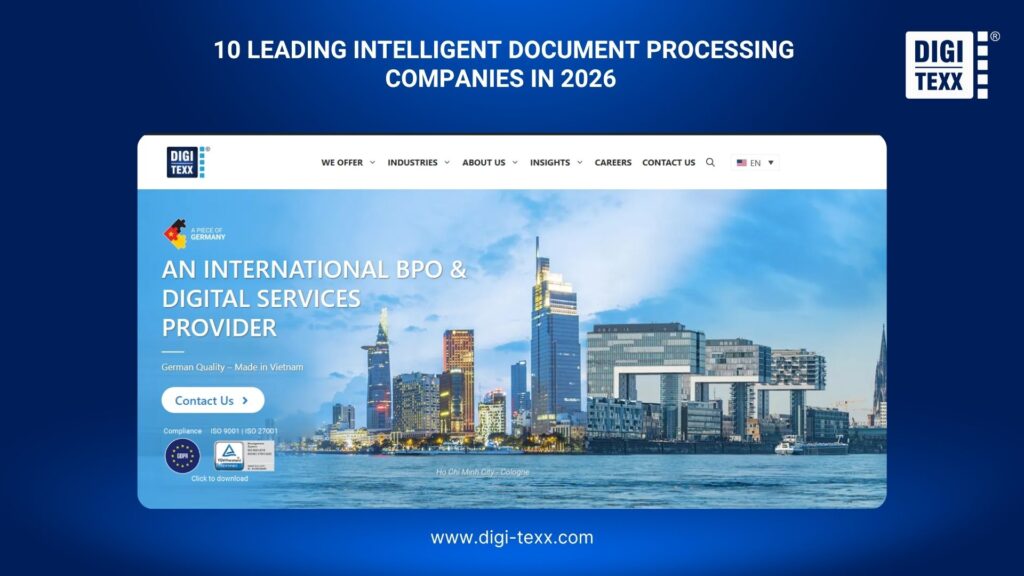
DIGI-TEXX differs from many companies in this list because it combines intelligent document processing technology with document processing and data processing services.
Its DIGI-Xtract solution uses machine learning and deep learning for document classification, data extraction, and quality control. It supports structured, semi-structured, and unstructured documents, including invoices, receipts, purchase orders, bank statements, medical records, contracts, handwritten documents, and other specialized content. DIGI-Xtract can be hosted remotely at the DIGI-TEXX data center or deployed at the client’s premises.
DIGI-TEXX also provides document processing services that combine OCR/ICR, AI and machine learning with specialist review. This hybrid approach is relevant when documents contain poor-quality scans, handwriting, stamps, annotations, or exceptional cases that automated models cannot reliably resolve on their own.
- Strengths: IDP technology plus managed document processing, human quality control, structured/semi-structured/unstructured documents, customized workflows, scalable processing.
- Best suited for: Enterprises that need both technology and operational support for high-volume document processing.
- Potential limitation: Businesses looking strictly for a self-service developer API may prefer a cloud-native platform such as Microsoft, Google Cloud, or AWS.
>>> See more:
- Top 10 Scanning Apps You Need: Turn Your Device Into a Portable Scanner
- Top 10 Automated Document Processing Software
Leading Intelligent Document Processing Companies Compared
The companies above do not all offer the same type of solution. Some are software platforms, some are cloud infrastructure providers, and others combine technology with managed document processing outsourcing services.
| Company | Core Strength | Document Processing | AI & Automation | Integration | Best Use Case |
| ABBYY | Enterprise IDP | Structured, semi-structured, unstructured | AI, ML, OCR, classification, extraction | APIs, RPA, BPM, ERP | Enterprise IDP |
| UiPath | Automation + IDP | Multiple document formats | AI + RPA + human validation | Strong automation ecosystem | End-to-end automation |
| Automation Anywhere | Workflow-embedded IDP | Broad document types | AI, NLP, computer vision, GenAI | Automation platform | Enterprise automation |
| Rossum | Transactional documents | Invoices and business documents | AI-first extraction | APIs and workflows | AP and finance |
| Hyperscience | Complex documents | Structured and unstructured | ML, AI, human review | Enterprise systems | High-volume complex documents |
| Tungsten Automation | Capture + workflow | Broad document types | AI classification and extraction | Enterprise connectors | Capture and workflow |
| Microsoft | Cloud document intelligence | Forms, invoices, IDs, custom documents | ML, OCR, LLM capabilities | Azure ecosystem | Azure-based applications |
| Google Cloud | Cloud Document AI | Structured and unstructured | ML, GenAI, OCR | Google Cloud | Custom cloud applications |
| Nanonets | Workflow automation | Business documents | AI extraction | Business systems | Finance and operational workflows |
| DIGI-TEXX | IDP + managed services | Structured, semi-structured, unstructured | ML, deep learning, OCR, NLP | Customized enterprise integration | Outsourced high-volume processing |
The comparison should not be interpreted as a universal ranking. Gartner’s research itself emphasizes that the IDP market is crowded and that vendor differentiation requires evaluating specific capabilities rather than relying on a single overall label. Its 2025 Critical Capabilities research examines areas such as extraction, review, integration, orchestration, secure handling, and automated processing.
For example, an organization building a proprietary application on AWS may prioritize API access and cloud scalability. Amazon Textract provides APIs for text, forms, tables, queries, signatures, invoices, receipts, IDs, and lending documents.
How To Choose An Intelligent Document Processing Company?
Choosing an IDP provider should start with the business process rather than the technology name. The same platform can perform very differently depending on document quality, document variation, extraction requirements, integration architecture, and the amount of human review required.
Evaluate Document Processing Accuracy
Accuracy should be measured against the actual documents the business needs to process.
A vendor demonstration using clean, standardized documents does not necessarily predict performance on production documents. Test representative samples that include:
- Different document layouts
- Poor-quality scans
- Handwritten information
- Multi-page documents
- Tables and line items
- Multiple languages
- Stamps and annotations
- Different suppliers or document issuers
The evaluation should measure not only field-level extraction accuracy but also the percentage of documents that can pass through the workflow without manual intervention.
Check AI And Automation Capabilities
A strong IDP solution should do more than recognize characters.
Evaluate whether the platform can:
- Classify documents
- Split multi-document files
- Extract specific fields
- Understand document layout
- Handle structured and unstructured content
- Validate extracted information
- Apply business rules
- Support human review
- Route data to downstream processes
For example, Google Document AI supports classification, splitting, OCR, extraction, custom processors, and document review workflows.
Microsoft Azure Document Intelligence similarly supports prebuilt and custom models for extracting information from structured, semi-structured, and unstructured documents.
Consider Integration And Scalability
IDP should fit into the existing technology environment.
Key questions include:
- Does the provider offer APIs?
- Are prebuilt connectors available?
- Can extracted data reach ERP, CRM, ECM, or workflow platforms?
- Can the solution process increasing document volumes?
- Can multiple business units share the same platform?
- Can new document types be added without rebuilding the workflow?
For enterprises, scalability also means operational scalability. A solution that handles 10,000 documents per month may need a different architecture from one processing millions of pages across multiple countries.
Compare Security And Deployment Options
Document processing often involves sensitive financial, personal, medical, legal, or commercial information.
Review:
- Data residency
- Encryption
- Access controls
- Audit trails
- Compliance requirements
- Retention policies
- Cloud deployment
- Private cloud options
- On-premise deployment
- Human reviewer access
Deployment flexibility can be particularly important for regulated organizations.
ABBYY, for example, supports cloud deployment as well as private-cloud and on-premise options for Vantage.
DIGI-Xtract can also be remotely hosted at the DIGI-TEXX data center or deployed at the client’s premises.
Assess Pricing And Total Cost of Ownership
Comparing license prices alone can produce misleading results.
The total cost may include:
- Software licenses
- API usage
- Document volume
- Implementation
- Model training
- Integration
- Infrastructure
- Human validation
- Maintenance
- Support
- Process redesign
A lower software price does not necessarily mean a lower operating cost if the solution requires extensive customization or manual review.
For organizations evaluating a document processing service, it is useful to compare the total cost per processed document, the percentage of documents requiring human intervention, processing turnaround time, and the resources needed to operate the solution.
Why Choose DIGI-TEXX For Intelligent Document Processing?
DIGI-TEXX combines AI-powered document processing with operational expertise in document and data processing. This model can be particularly relevant for enterprises that need more than a software license and want a partner capable of supporting the document workflow from input through validation and structured output.
DIGI-TEXX’s document processing services cover document processing, invoice processing, historical document processing, insurance claims processing, and data cleansing. The company reports 24/7, 365-day operations, processing capabilities across more than 30 languages, more than 1,200 experienced employees, and a focus on data security and quality assurance.
AI-Powered Document Classification And Data Extraction
DIGI-TEXX’s DIGI-Xtract solution uses machine learning and deep learning to classify documents, extract information, and perform quality control. It can be customized for specific document types, business languages, and client requirements.
The current DIGI-TEXX IDP workflow includes document classification, document structure analysis, data extraction, text transcription, annotation and validation, and segmentation. OCR, NLP, and machine learning are used to convert information from documents into structured, actionable data.
This makes the solution relevant to processes where document understanding is only one part of the overall workflow.
Support For Structured, Semi-Structured, And Unstructured Documents
Enterprise documents rarely follow one consistent format.
DIGI-Xtract supports structured documents such as invoices, receipts, bank statements, purchase orders, and applications. It also supports semi-structured documents such as medical histories, labor contracts, incident reports, and confirmation letters, as well as unstructured content including handwritten documents and specialized historical or technical records.
This range matters for businesses undertaking document digitization for large companies, where document collections often contain decades of mixed-format information rather than a single standardized document type.
Human-in-the-Loop Quality Control
Automation does not remove the need for human review in every document workflow.
Poor-quality scans, unusual handwriting, stamps, handwritten notes, and exceptional document layouts can create cases that automated systems need to escalate. DIGI-TEXX combines AI technology with experienced data processing specialists to address these exceptions and maintain data quality.
This hybrid model can be useful when the business requirement is not simply the highest possible automation percentage but reliable business-ready data.
Human review can also be used selectively rather than treating every document in the same way. Straightforward documents can follow automated processing, while low-confidence or exceptional cases can be routed for review.
Flexible Cloud And On-Premise Deployment
Enterprise IT teams often have different requirements for where document processing occurs.
DIGI-Xtract can be securely hosted remotely at the DIGI-TEXX data center or deployed at the client’s premises.
This flexibility allows deployment decisions to be considered alongside data governance, security, integration, infrastructure, and operational requirements.
Scalable Document Processing Services
Software automation alone does not always solve a document processing problem.
Organizations may need to process large document backlogs, digitize historical records, manage seasonal peaks, or maintain ongoing document operations after automation is implemented.
DIGI-TEXX combines document processing technology with experienced processing teams. Its document processing service is designed for high-volume workloads and can adapt to changing processing volumes.
This makes DIGI-TEXX particularly relevant when a business is evaluating document processing outsourcing services rather than purchasing IDP software alone.
Industry-Specific Document Processing Solutions
Document workflows vary significantly by industry.
A bank may need to process loan applications and identity documents. An insurer may handle claims and supporting evidence. A healthcare organization may process medical records and forms. A manufacturer may need to extract information from purchase orders, invoices, delivery notes, and technical documents.
DIGI-TEXX has applied intelligent document and data processing across document-heavy business processes and provides customized solutions for different document types and requirements.
FAQs About Leading Intelligent Document Processing Companies
What Are The Leading Intelligent Document Processing Companies In 2026?
Leading intelligent document processing companies in 2026 include ABBYY, UiPath, Automation Anywhere, Rossum, Hyperscience, Tungsten Automation, Microsoft, Google Cloud, Nanonets, and DIGI-TEXX.
However, DIGI-TEXX stands out by combining intelligent document processing technology with end-to-end document processing services, human-in-the-loop quality control, and scalable outsourcing capabilities. This combination allows enterprises to automate document workflows while maintaining accuracy and handling complex or exceptional documents that require human review.
How Much Does Intelligent Document Processing Cost?
Intelligent document processing costs vary based on document volume, complexity, processing accuracy, integration requirements, and human review. Software-based IDP typically charges by usage or document volume, while outsourced document processing services are priced according to workload and service requirements.
Choosing among leading intelligent document processing companies depends on document complexity, processing volume, integration, security, and scalability. For enterprises seeking both AI-powered automation and reliable operational support, DIGI-TEXX combines IDP technology with scalable document processing outsourcing services and human-in-the-loop quality control to support complex, high-volume document workflows.
DIGI-TEXX Contact Information:
🌐 Website: https://digi-texx.com/
📞 Hotline: +84 28 3715 5325
✉️ Email: [email protected]
🏢 Address:
- Headquarters: Anna Building, QTSC, Trung My Tay Ward
- Office 1: German House, 33 Le Duan, Saigon Ward
- Office 2: DIGI-TEXX Building, 477-479 An Duong Vuong, Binh Phu Ward
- Office 3: Innovation Solution Center, ISC Hau Giang, 198 19 Thang 8 street, Vi Tan Ward
Reference:
- UNESCO. (2026). Digitization projects. https://www.unesco.org/en/archives/digitizationprojects
- UNESCO. (2026, May 6). Digitizing our shared UNESCO history. https://www.unesco.org/en/articles/digitizing-our-shared-unesco-history