How to ensure data accuracy is essential for organizations that rely on data to support daily operations and strategic decisions. Poor-quality data can lead to costly errors, inefficient workflows, and unreliable reporting. In this guide, DIGI-TEXX explores the common causes of inaccurate data, explains how to measure and improve data quality, and shares practical best practices and AI-powered solutions to help businesses build a trusted, high-quality data foundation.
>>> See more:
- What is Automated Document Processing and How Does It Work?
- Top 13 Enterprise Document Solutions for Your Business Processes
- Top AI Document Processing Tools to Automate Your Data Workflow in 2025
Why Is Data Accuracy Important?
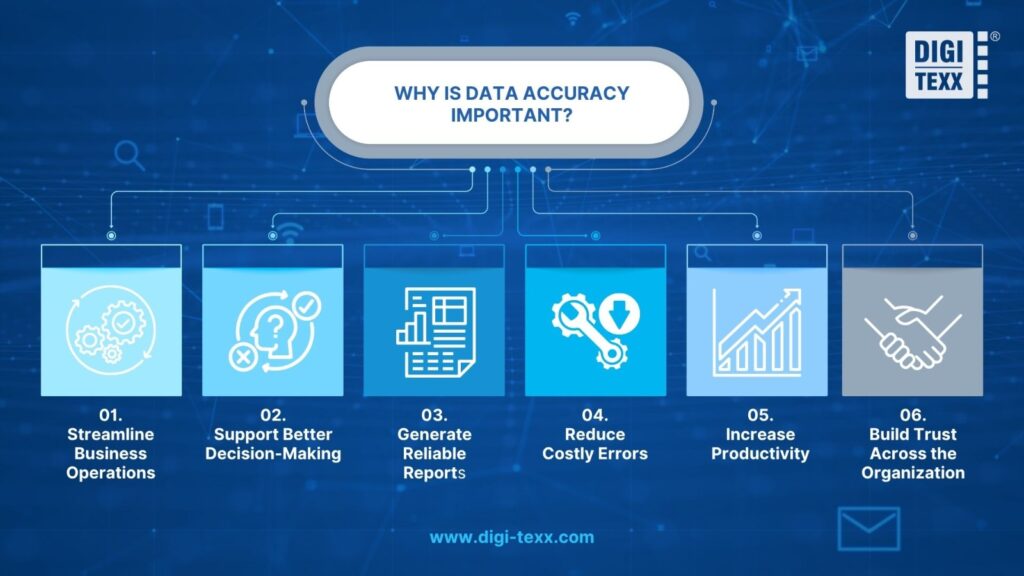
Accurate data is the foundation of effective business operations and informed decision-making. When information is complete, consistent, and error-free, organizations can streamline workflows, generate reliable reports, and make confident strategic decisions. In contrast, inaccurate data often leads to operational inefficiencies, costly mistakes, compliance risks, and poor customer experiences.
Maintaining high data accuracy also improves productivity by reducing the need for manual corrections and rework. With reliable data in place, businesses can automate processes more effectively, gain meaningful insights, and build greater trust in their data across departments.
Understanding its importance is the first step toward improving data quality. The next section explores practical strategies to ensure data accuracy throughout the entire data lifecycle.
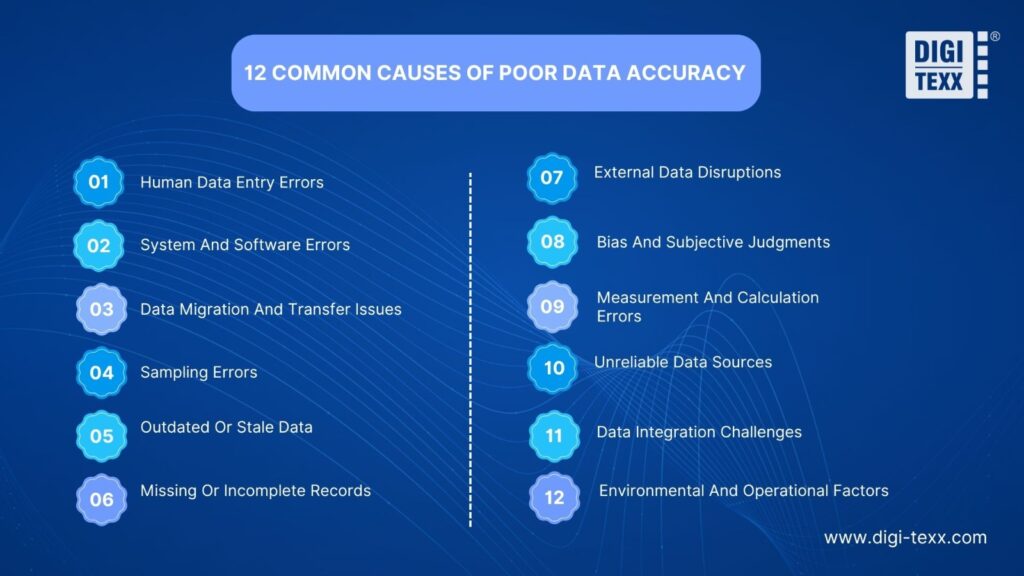
12 Common Causes Of Poor Data Accuracy
Poor data accuracy rarely stems from a single issue. Instead, it often results from a combination of human errors, inconsistent processes, outdated systems, and unreliable data sources. Identifying these root causes helps organizations implement effective controls, reduce costly mistakes, and maintain high-quality data.
1. Human Data Entry Errors
Manual data entry remains one of the leading causes of inaccurate data. Typing mistakes, skipped fields, inconsistent formatting, and misunderstanding data entry guidelines can all introduce errors. These issues become more common when employees work under tight deadlines, handle repetitive tasks, or lack proper training.
2. System And Software Errors
Technology improves efficiency, but software bugs, outdated applications, database failures, or incorrect system configurations can still generate inaccurate records. Regular system maintenance and updates are essential to minimize these risks.
3. Data Migration And Transfer Issues
Migrating data between systems can result in missing records, formatting conflicts, duplicate entries, or data corruption if the migration process is not carefully planned and validated. Even minor migration errors can affect reporting and business operations.
4. Sampling Errors
Organizations often rely on sample data for research and analysis. However, biased sampling methods or insufficient sample sizes may produce results that fail to represent the entire population, leading to inaccurate conclusions and poor decision-making.
5. Outdated Or Stale Data
Business information constantly changes. Customer contact details, inventory levels, pricing, and employee records can quickly become outdated if they are not updated regularly. Using stale data increases the risk of inaccurate reports and ineffective business decisions.
6. Missing Or Incomplete Records
Incomplete datasets reduce data reliability and limit meaningful analysis. Missing values often result from skipped input fields, incomplete forms, system failures, or inconsistent data collection processes.
7. External Data Disruptions
Cyberattacks, unauthorized modifications, malware, and accidental data corruption can compromise data integrity. Without strong security controls and backup strategies, organizations risk losing the accuracy and reliability of critical business information.
8. Bias And Subjective Judgments
Bias can occur when data is collected, interpreted, or categorized based on personal assumptions rather than objective criteria. Inconsistent survey questions, subjective classifications, or selective data collection may distort analytical results.
9. Measurement And Calculation Errors
Faulty measuring equipment, incorrect formulas, calibration issues, or computational mistakes can introduce inaccurate values into datasets. Regular equipment calibration and validation checks help ensure reliable measurements.
10. Unreliable Data Sources
Data is only as trustworthy as its source. Collecting information from outdated, unverified, or low-quality sources increases the likelihood of inaccurate records. Organizations should validate source credibility before integrating external data into their systems.
11. Data Integration Challenges
Combining data from multiple applications, departments, or third-party platforms often creates inconsistencies due to different data formats, naming conventions, or validation standards. Without proper data mapping and standardization, integration can significantly reduce data quality.
12. Environmental And Operational Factors
External conditions such as power outages, network interruptions, hardware failures, or unsuitable operating environments can disrupt data collection and processing. Establishing reliable infrastructure and disaster recovery plans helps minimize these operational risks.
>>> See more:
- What Is a Document Management System (DMS)?
- How Automated Invoice Processing Saves Time and Reduces Errors?
- What Is Document Digitization and Why Should You Digitize Your Documents?
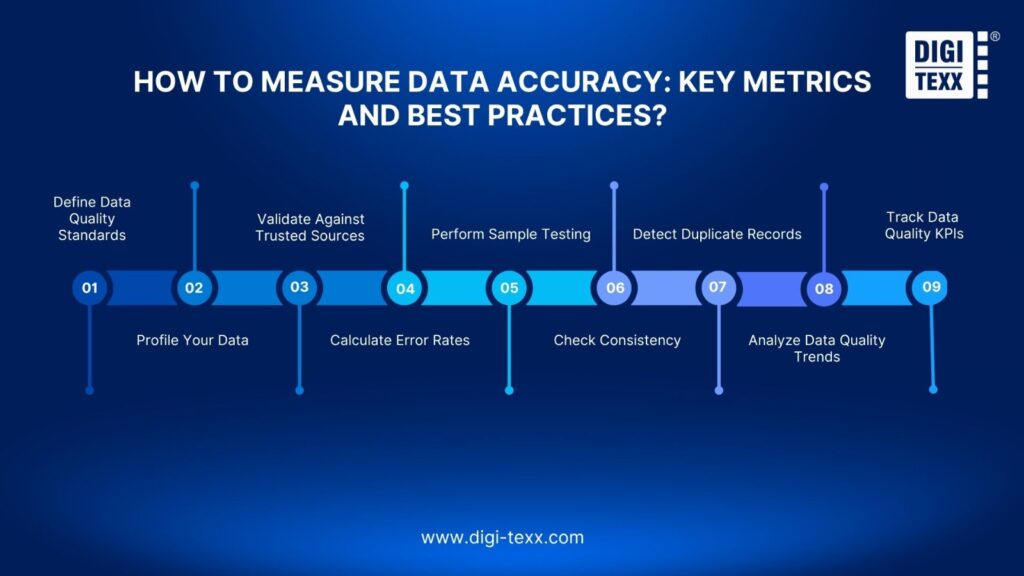
How To Measure Data Accuracy: Key Metrics And Best Practices?
Measuring data accuracy helps organizations determine whether their data is complete, reliable, and fit for decision-making. By evaluating data against predefined standards and monitoring key quality metrics, businesses can identify errors early, prioritize improvements, and maintain high-quality datasets over time.
Define Data Quality Standards
Start by establishing clear criteria for what constitutes accurate data. Define requirements for formats, mandatory fields, acceptable values, and business rules to create a consistent benchmark for evaluating data quality.
Profile Your Data
Analyze your datasets to identify patterns, missing values, invalid entries, outliers, and inconsistencies. Data profiling provides a comprehensive overview of data quality and highlights issues that require immediate attention.
Validate Against Trusted Sources
Compare records with verified internal databases or authoritative external sources to confirm their accuracy. Cross-validation helps detect outdated, duplicated, or incorrect information before it impacts business operations.
Calculate Error Rates
Measure the percentage of inaccurate, incomplete, or invalid records within a dataset. Tracking error rates over time enables organizations to assess the effectiveness of their data quality initiatives and identify recurring issues.
Perform Sample Testing
Review a representative sample of records to verify accuracy through manual checks or independent validation. Sample testing offers a practical way to assess data quality without auditing every record.
Check Consistency
Evaluate whether the same information remains consistent across databases, applications, and business systems. Inconsistent values often indicate integration problems, duplicate records, or non-standardized data entry practices.
Detect Duplicate Records
Identify duplicate customers, products, suppliers, or transactions that may distort reporting and analytics. Regular duplicate detection helps maintain a single, accurate source of truth across the organization.
Analyze Data Quality Trends
Monitor changes in data quality over time by tracking recurring errors, completeness rates, and validation results. Trend analysis helps identify root causes and supports continuous improvement initiatives.
Track Data Quality KPIs
Measure performance using key indicators such as accuracy, completeness, consistency, validity, uniqueness, and timeliness. Monitoring these KPIs provides a clear picture of overall data quality and helps organizations evaluate progress toward their data governance goals.
>>> See more:
- An Overview of Document Processing Company: What You Need to Know
- Online Data Processing Services: Streamline Your Data Management
- Top 10 Scanning Apps You Need in 2025: Turn Your Device Into a Portable Scanner
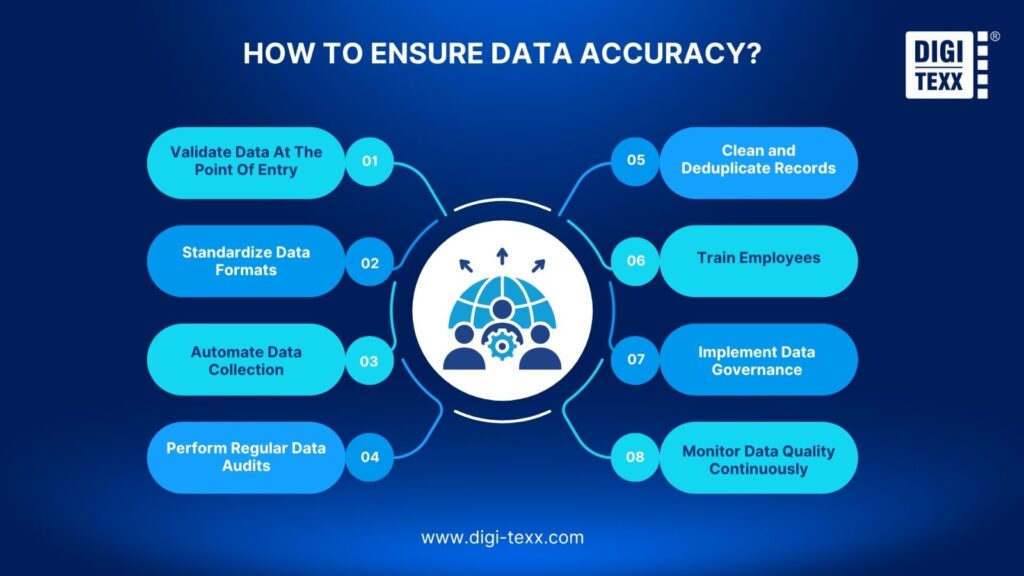
How To Ensure Data Accuracy?
Ensuring data accuracy requires more than careful data entry. Businesses need standardized processes, reliable validation methods, and ongoing quality control to minimize errors and maintain trustworthy information. The following best practices help improve data quality while supporting efficient and consistent operations.
Validate Data At The Point Of Entry
The most effective way to improve data accuracy is to prevent errors before they enter the system. Use required fields, data validation rules, input masks, and format checks to ensure only complete and correctly formatted information is accepted. Early validation minimizes manual corrections and improves downstream data quality.
Standardize Data Formats
Inconsistent formats for dates, addresses, phone numbers, currencies, or product names often create duplicate records and reporting errors. Establishing organization-wide data standards ensures information remains consistent across departments and simplifies integration between business systems.
Automate Data Collection
Manual data entry is one of the leading causes of inaccurate data. Automating data capture through OCR, AI-powered document processing, digital forms, APIs, or system integrations significantly reduces human error while improving processing speed and consistency. Research by Gartner shows that automation can substantially improve data quality by reducing repetitive manual tasks and enforcing standardized workflows.
Perform Regular Data Audits
Data quality should be monitored continuously rather than treated as a one-time initiative. Schedule routine audits to identify missing values, formatting inconsistencies, outdated information, and invalid records. Regular assessments help detect problems early and maintain reliable datasets over time.
Clean and Deduplicate Records
Duplicate and outdated records reduce reporting accuracy and create inconsistencies across business systems. Regular data cleansing removes redundant, incomplete, or obsolete information, ensuring employees and decision-makers work with a single, reliable source of truth.
Train Employees
Even with advanced technology, people remain essential to maintaining data quality. Employees should receive clear guidelines on data entry standards, validation procedures, and quality control practices. Consistent training reduces common input errors and encourages greater accountability for data accuracy.
Implement Data Governance
Strong data governance establishes clear ownership, standardized policies, access controls, and quality management procedures throughout the data lifecycle. According to the Data Management Association (DAMA), well-defined governance frameworks help organizations maintain accurate, consistent, and trustworthy data while supporting regulatory compliance.
Monitor Data Quality Continuously
Data accuracy should be measured using key quality metrics such as accuracy, completeness, consistency, timeliness, and validity. Continuous monitoring, automated alerts, and performance dashboards enable organizations to identify anomalies quickly, resolve issues proactively, and maintain high-quality data as business information evolves.
>>> See more:
- Top 10 Automated Document Processing Software
- How to Retouch Wedding Photos: Best Techniques and Tools
- Wedding Photo Editing Service | Elevating Your Wedding Photos
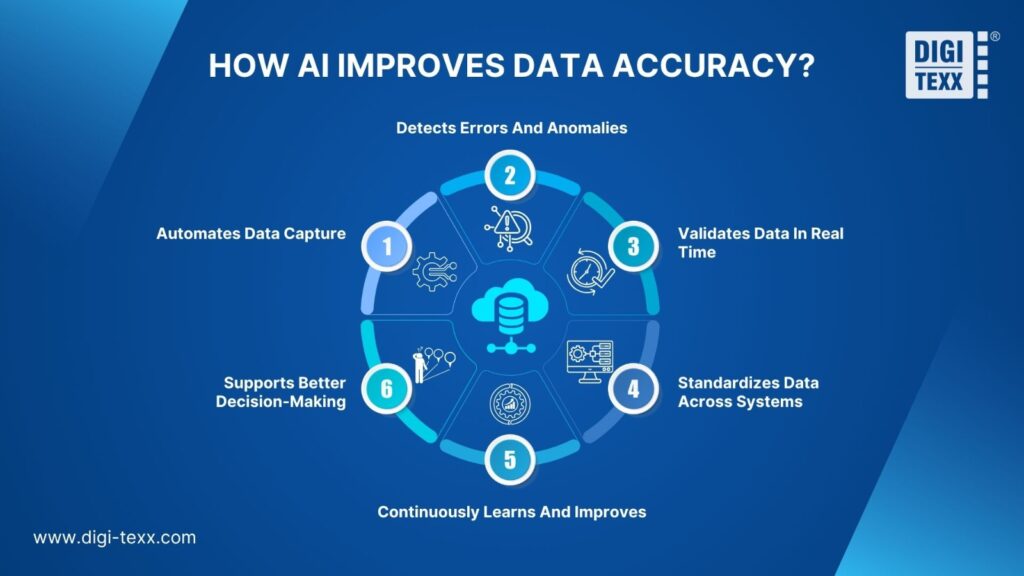
How AI Improves Data Accuracy?
Artificial intelligence (AI) is transforming how organizations capture, validate, and manage data. Unlike manual processes that are prone to human error, AI can analyze large volumes of information in real time, identify anomalies, and apply consistent validation rules across datasets. By combining machine learning, OCR, and intelligent automation, businesses can significantly improve data quality while reducing manual effort.
Automates Data Capture
AI-powered technologies such as Optical Character Recognition (OCR) and Intelligent Document Processing (IDP) automatically extract data from invoices, forms, contracts, and other business documents. This reduces manual data entry, speeds up processing, and minimizes transcription errors.
Detects Errors And Anomalies
Machine learning algorithms continuously analyze datasets to identify missing values, duplicate records, unusual patterns, and inconsistent entries. Detecting anomalies early helps organizations correct issues before they impact reporting or business decisions.
Validates Data In Real Time
AI can automatically verify incoming data against predefined business rules, historical records, or trusted external sources. Real-time validation prevents invalid or incomplete information from entering business systems and improves overall data reliability.
Standardizes Data Across Systems
Data collected from multiple sources often varies in format and structure. AI automatically normalizes dates, addresses, names, and other fields, ensuring consistent data across databases and enterprise applications.
Continuously Learns And Improves
Unlike rule-based automation, AI models improve over time by learning from historical data and user feedback. As more data is processed, AI becomes better at recognizing patterns, reducing false positives, and increasing validation accuracy.
Supports Better Decision-Making
High-quality data leads to more reliable analytics, forecasting, and business intelligence. By improving data accuracy and consistency, AI enables organizations to make faster, more informed decisions while reducing operational risks.
FAQs About How To Ensure Data Accuracy
What Are The Five C’s Of Data Quality?
The five C’s of data quality are consistency, completeness, credibility, currency, and correctness. Together, these principles help organizations maintain reliable, accurate, and actionable data by ensuring information is standardized, complete, trustworthy, up to date, and error-free.
How Do You Ensure 100% Accuracy In Data Entry?
While achieving absolute accuracy is challenging, organizations can significantly reduce errors by following proven data entry best practices:
- Group similar tasks together to minimize context switching and improve consistency.
- Choose the right data entry software based on your workload, business needs, and automation requirements.
- Automate repetitive tasks with tools like Excel formulas, macros, or workflows to reduce manual input.
- Use AutoFill and text snippets to speed up recurring entries while maintaining consistency.
- Apply validation rules and default values to prevent incorrect or incomplete data from being entered.
- Review and verify data regularly through quality checks or audits to identify and correct errors before they affect business operations.
Data accuracy is not achieved through a single process but through continuous improvement across every stage of the data lifecycle. By identifying the root causes of poor data quality, measuring performance with meaningful metrics, implementing proven data management practices, and leveraging AI-powered automation, organizations can reduce errors, improve operational efficiency, and make more confident business decisions. As data volumes continue to grow, investing in a comprehensive data quality strategy is essential for maintaining reliable information and creating long-term business value.
DIGI-TEXX Contact Information:
🌐 Website: https://digi-texx.com/
📞 Hotline: +84 28 3715 5325
✉️ Email: [email protected]
🏢 Address:
- Headquarters: Anna Building, QTSC, Trung My Tay Ward
- Office 1: German House, 33 Le Duan, Saigon Ward
- Office 2: DIGI-TEXX Building, 477-479 An Duong Vuong, Binh Phu Ward
- Office 3: Innovation Solution Center, ISC Hau Giang, 198 19 Thang 8 street, Vi Tan Ward
Reference:
- IBM. (2016). The true cost of bad data. IBM Institute for Business Value. https://www.ibm.com/thought-leadership/institute-business-value/report/the-true-cost-of-bad-data
- Data Management Association International. (2017). The DAMA guide to the data management body of knowledge (DAMA-DMBOK2) (2nd ed.). Technics Publications.