Healthcare back-office support services help healthcare organizations streamline administrative workflows, improve data accuracy, and manage growing volumes of patient and insurance information. From medical data entry and claims processing to document management and insurance verification, outsourcing these tasks can reduce operational workloads and support more efficient healthcare operations.
In this article, DIGI-TEXX will help you explore 10 healthcare back-office services, their key benefits, and essential factors to consider when choosing an outsourcing partner.

>>> See more: Healthcare organizations often require more than medical administration to maintain efficient day-to-day operations. DIGI-TEXX’s business support services provide flexible administrative and operational assistance, helping businesses streamline repetitive tasks, optimize resource allocation, and focus on their core activities.
What Are Healthcare Back-Office Support Services?
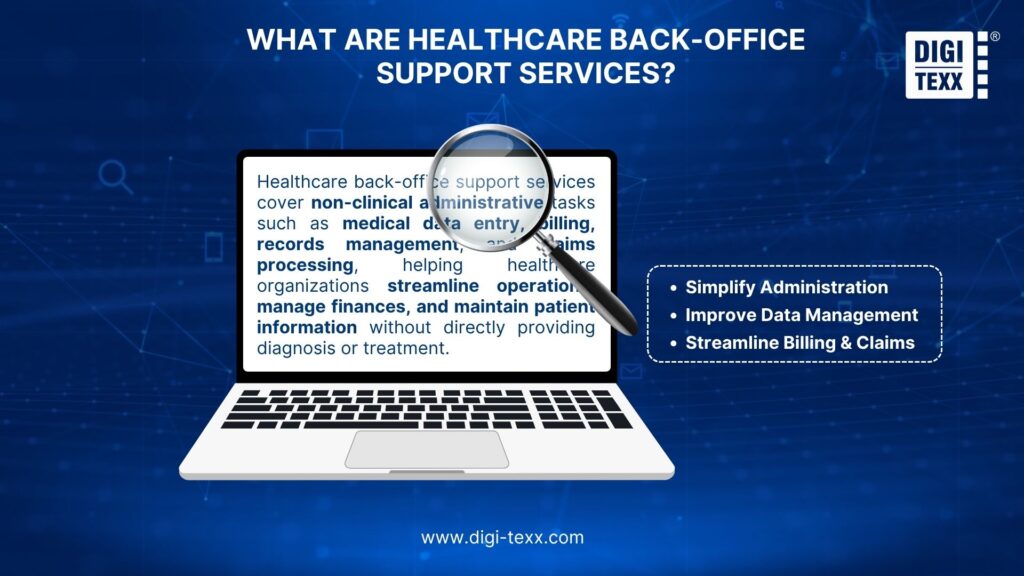
Healthcare back-office support services cover non-clinical administrative and operational tasks that help hospitals, medical practices, clinics, and other healthcare organizations run efficiently. These services include medical data entry, records management, billing support, insurance verification, claims processing, and healthcare document processing.
Unlike clinical services, back-office operations do not involve diagnosing or treating patients. Instead, they support the administrative workflows behind patient care, financial management, and healthcare information management.
The Role Of Healthcare Back-Office Operations
Healthcare back-office operations keep essential administrative processes organized, accurate, and up to date. They help medical organizations manage information, coordinate with insurance providers, maintain patient records, and process financial transactions.
Typical responsibilities include:
- Patient data management: Entering, updating, and maintaining patient information in electronic health records (EHRs) and databases.
- Medical documentation: Transcribing clinical notes, organizing medical records, and digitizing paper-based documents.
- Revenue cycle support: Assisting with medical billing, coding documentation, claims submission, and payment tracking.
- Insurance administration: Verifying patient eligibility, reviewing coverage details, and organizing insurance documentation.
- Data processing and reporting: Extracting, validating, classifying, and organizing healthcare information for operational use.
These activities directly affect administrative accuracy and workflow continuity. According to the 2024 CAQH Index, healthcare administrative activities account for approximately $440 billion in annual spending in the United States. The report also identifies an additional $20 billion in potential annual savings through the adoption of fully electronic administrative workflows.
For healthcare organizations handling large volumes of patient and insurance information, efficient back-office support can help reduce manual workloads and improve data consistency.
Front-Office vs. Back-Office Functions In Healthcare
Front-office and back-office operations serve different purposes but work together to support healthcare delivery. Front-office teams interact directly with patients, while back-office teams handle the administrative processes and information needed to keep operations running.
| Comparison | Healthcare Front Office | Healthcare Back Office |
| Primary role | Patient-facing services | Administrative and operational support |
| Main activities | Patient reception, appointment coordination, inquiries, and check-in | Data entry, records management, billing support, and document processing |
| Patient interaction | Direct interaction | Primarily indirect interaction |
| Key objective | Improve patient access and experience | Maintain accurate information and efficient workflows |
| Outsourcing examples | Call center support and appointment scheduling | Medical data entry, claims documentation, and healthcare data processing |
>>> See more:
- Healthcare BPO Services – Cost Optimization & Improve Care 2026
- Intelligent Document Processing Services: How It Works & Business Benefits
- Secure Data Annotation Services: Top Companies & How to Choose
- 15 Best Data Labeling Service Providers In 2026
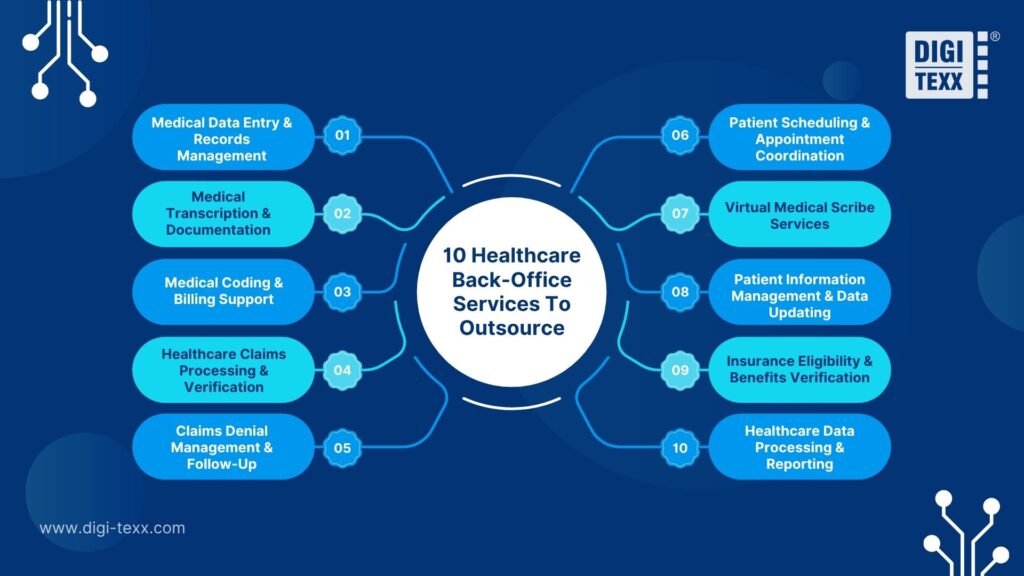
10 Healthcare Back-Office Services That Medical Organizations Can Outsource
Healthcare organizations can outsource various administrative functions depending on their operational requirements, transaction volumes, and internal resources. The following 10 healthcare back-office services cover common opportunities to reduce manual workloads and improve administrative efficiency.
Medical Data Entry And Records Management
Medical data entry services involve capturing, entering, updating, and validating patient information in electronic health records (EHRs), electronic medical records (EMRs), and healthcare databases.
Common tasks include:
- Entering patient demographics and contact information.
- Updating medical histories and treatment-related records based on authorized source documents.
- Recording insurance details and patient registration information.
- Organizing and indexing digital patient records.
- Checking data for missing fields, duplicate entries, and formatting inconsistencies.
Outsourced medical data entry helps healthcare providers maintain structured, accessible, and accurate records. It also reduces the administrative workload associated with transferring information from paper forms, scanned documents, and digital submissions into healthcare systems.
Medical Transcription And Documentation
Medical transcription converts recorded clinical information into written documentation. Healthcare professionals may dictate patient histories, examination notes, consultation summaries, and other medical information that needs to be documented.
Medical transcription services typically involve:
- Converting recorded medical dictations into written text.
- Formatting clinical notes according to predefined templates.
- Reviewing transcripts for spelling, terminology, and formatting accuracy.
- Organizing completed documents for authorized review and record storage.
Accurate medical documentation supports continuity of care and helps healthcare professionals retrieve relevant patient information when needed. Outsourcing transcription can also reduce the time clinicians spend on repetitive documentation tasks.
Medical Coding And Billing Support
Medical coding and billing support involves organizing clinical and administrative information required for healthcare reimbursement. Medical coding translates documented diagnoses, procedures, and services into standardized codes, while billing uses this information to prepare charges and payment requests.
Common coding systems include:
- ICD-10-CM: Used to classify diagnoses and health conditions.
- CPT: Used to identify medical procedures and professional services.
- HCPCS: Used to classify certain healthcare products, supplies, and services.
Depending on the outsourcing arrangement, providers may assist with document preparation, coding data entry, billing documentation, and claim information validation. Actual coding decisions and billing activities should be assigned to appropriately qualified personnel.
Outsourcing medical billing support can help practices manage administrative workloads, organize reimbursement documentation, and reduce avoidable data-entry errors.
Healthcare Claims Processing And Verification
Healthcare claims processing involves reviewing and organizing information submitted by healthcare providers to insurance companies for reimbursement.
The process generally includes:
- Receiving claim forms and supporting documents.
- Checking patient, provider, and insurance information.
- Validating required fields against established processing rules.
- Identifying missing information or inconsistencies.
- Organizing complete records for submission or further review.
- Tracking claim status and maintaining processing records.
Outsourced healthcare claims processing support can help manage high document volumes, improve information consistency, and reduce delays caused by incomplete submissions.
For organizations handling multiple insurance plans and large numbers of claims, structured data validation and document management are particularly important.
Claims Denial Management And Follow-Up
Claims denial management focuses on identifying, reviewing, and organizing information related to rejected or denied insurance claims.
Common reasons for claim denials include:
- Missing or incorrect patient information.
- Incomplete supporting documentation.
- Coding or billing discrepancies.
- Missing prior authorization.
- Eligibility or coverage issues.
- Failure to meet payer-specific submission requirements.
Outsourced denial management support may include reviewing denial records, categorizing rejection reasons, checking supporting documentation, updating claim information, and preparing cases for authorized follow-up.
By organizing denial-related information and identifying recurring errors, healthcare organizations can improve administrative workflows and support more effective revenue cycle management.
Patient Scheduling And Appointment Coordination
Patient scheduling services help healthcare organizations coordinate appointments between patients and medical professionals.
Typical responsibilities include:
- Recording appointment requests.
- Checking provider availability.
- Scheduling, rescheduling, and canceling appointments.
- Sending appointment confirmations and reminders.
- Updating scheduling records.
- Coordinating administrative information between patients and healthcare teams.
Outsourcing appointment coordination can help medical practices manage high call volumes and reduce the workload on front-desk staff.
However, organizations should establish clear communication protocols to ensure that appointment-related information is handled accurately and escalated appropriately when clinical input is required.
Virtual Medical Scribe Services
Virtual medical scribe services provide remote documentation assistance during patient consultations. A virtual scribe records information communicated by healthcare professionals and organizes it into the appropriate clinical documentation format.
Their responsibilities may include:
- Documenting patient histories and consultation notes.
- Recording examination findings provided by clinicians.
- Updating relevant sections of electronic medical records.
- Organizing clinical documentation for physician review.
- Checking notes for completeness and formatting consistency.
Unlike general administrative data entry, medical scribing requires familiarity with clinical terminology and healthcare documentation workflows.
A virtual medical scribe supports documentation efficiency but does not replace the clinical judgment or final approval of the treating healthcare professional.
Patient Information Management And Data Updating
Patient information management involves maintaining accurate and consistent administrative records throughout the patient lifecycle.
Healthcare organizations may outsource tasks such as:
- Updating patient registration details.
- Maintaining contact and demographic information.
- Organizing medical history documentation.
- Identifying duplicate patient records.
- Checking inconsistencies across multiple data sources.
- Updating insurance and administrative records based on authorized information.
This service differs from general medical data entry because it focuses on maintaining data consistency across existing records rather than simply entering new information.
Reliable patient information management helps reduce administrative discrepancies and supports more efficient information retrieval.
Insurance Eligibility And Benefits Verification
Insurance eligibility and benefits verification determines whether a patient’s health insurance coverage is active and what benefits may apply to a particular service.
Administrative support tasks typically include:
- Checking insurance member information.
- Reviewing policy and coverage details.
- Verifying eligibility dates.
- Recording copayments, deductibles, and coinsurance information.
- Identifying missing or inconsistent insurance details.
- Updating verification records for billing and registration teams.
Outsourced insurance verification support helps healthcare providers organize insurance information before appointments and billing activities.
However, coverage verification does not guarantee claim approval or reimbursement. Final payment decisions remain subject to payer policies and applicable coverage requirements.
Healthcare Data Processing And Reporting
Healthcare data processing services involve converting information from paper documents, scanned files, forms, and digital sources into structured, usable data.
Depending on the organization’s needs, outsourced healthcare data processing may cover:
- Data extraction: Capturing relevant information from medical forms, insurance documents, and administrative records.
- Document classification: Categorizing files by document type, department, or predefined business rules.
- Data validation: Checking extracted information against source documents and established requirements.
- Data cleansing: Identifying duplicate, incomplete, inconsistent, or incorrectly formatted records.
- Digital archiving: Converting paper-based documents into searchable digital records.
- Data reporting: Organizing processed information into structured reports for operational analysis.
Technologies such as Optical Character Recognition (OCR), Intelligent Document Processing (IDP), and machine learning can help automate document classification and information extraction. Human review remains important for complex layouts, handwritten content, poor-quality scans, and exceptions that automated systems cannot reliably resolve.
For healthcare organizations managing large volumes of administrative documents, outsourced data processing can improve information accessibility and reduce repetitive manual work.
>>> See more:
- Construction Invoice Reconciliation: Best Practices, Software & Outsourcing
- Top 10 Data Processing Software For Business 2026 – Best Tool Reviewed
- How To Prepare a Classified Balance Sheet: Template & Example
- Professional E-commerce Data Entry Services by DIGI-TEXX
Why Do Healthcare Organizations Outsource Back-Office Support Services?
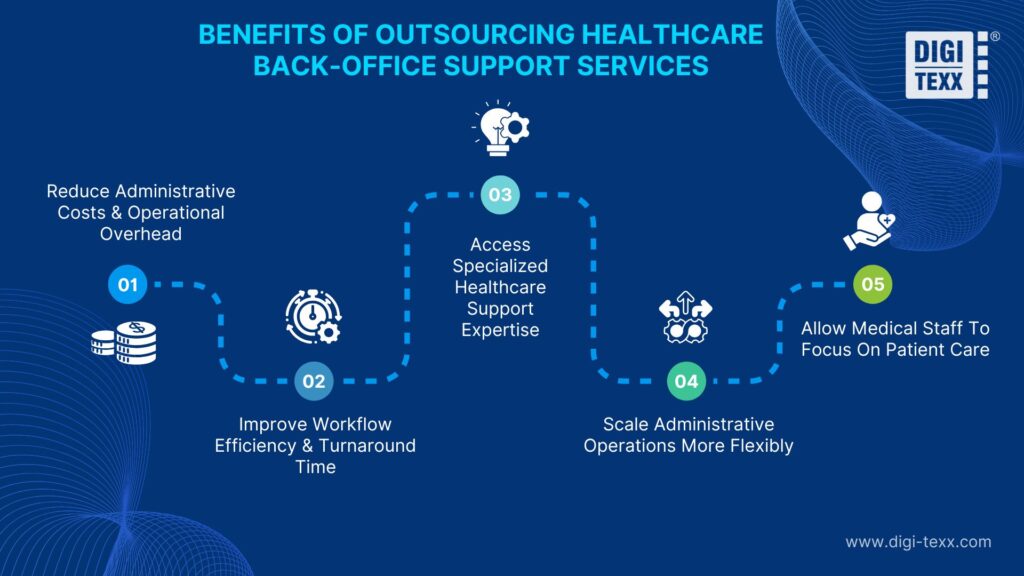
Healthcare organizations outsource back-office support services to manage administrative workloads, address staffing challenges, and improve operational performance. The right outsourcing model can also provide access to specialized resources without requiring organizations to build every function internally.
Reduce Administrative Costs And Operational Overhead
Maintaining an in-house administrative team involves more than employee salaries. Healthcare organizations must also account for recruitment, employee benefits, training, office space, software, and technology infrastructure.
Outsourcing converts some of these fixed operational expenses into service-based costs. Organizations can select pricing models based on transaction volume, processed documents, working hours, or dedicated resources.
The 2024 CAQH Index estimates that healthcare organizations could save an additional $20 billion annually by moving eligible administrative transactions toward fully electronic workflows. Although this figure relates to automation rather than outsourcing alone, it demonstrates the financial opportunity associated with improving administrative processes.
Improve Workflow Efficiency And Turnaround Time
Manual data entry, document classification, and information verification can create processing bottlenecks, especially when healthcare organizations handle high document volumes.
Outsourcing provides access to dedicated teams and standardized workflows that can help:
- Process administrative documents more consistently.
- Reduce backlogs during peak workloads.
- Improve data validation and error identification.
- Maintain structured records for easier retrieval.
- Support faster completion of repetitive administrative tasks.
Combining automation with human review can further improve processing efficiency while maintaining quality standards.
Access Specialized Healthcare Support Expertise
Healthcare administration involves specific terminology, documentation requirements, insurance procedures, and information management standards.
Outsourcing allows organizations to access trained personnel with relevant administrative and data processing experience without developing every capability internally.
Depending on the provider’s scope, healthcare organizations can obtain support for medical documentation, patient data management, insurance records, claims administration, and healthcare document processing.
For specialized activities such as medical coding and clinical documentation, organizations should verify the qualifications and relevant experience of assigned personnel.
Scale Administrative Operations More Flexibly
Patient volumes, insurance transactions, and documentation workloads can fluctuate throughout the year. An in-house team may struggle to adjust quickly without additional recruitment and training.
Healthcare back-office outsourcing offers more flexible resource allocation through:
- Dedicated teams for ongoing administrative operations.
- Project-based support for document digitization.
- Volume-based processing for fluctuating workloads.
- Extended operating hours for time-sensitive tasks.
- Scalable workflows to accommodate business growth.
This flexibility helps healthcare organizations manage workload changes without continuously expanding their internal administrative departments.
Allow Medical Staff To Focus On Patient Care
Administrative tasks can take time away from clinical responsibilities. According to the American Medical Association’s 2025 analysis of physician work patterns, physicians reported spending an average of 7.3 hours per week on administrative tasks in 2024, in addition to 13 hours on indirect patient care activities such as documentation, order entry, and referrals.
Outsourcing suitable non-clinical tasks, such as data entry, document processing, and administrative record management, can reduce repetitive workloads for internal teams.
This allows healthcare professionals to dedicate more time to clinical activities while specialized support teams handle eligible administrative processes.
How To Choose The Right Healthcare Back-Office Outsourcing Partner
Selecting the right healthcare back-office outsourcing partner requires more than comparing service prices. Healthcare organizations should assess the provider’s industry experience, data security controls, processing capabilities, and ability to meet operational requirements.
Evaluate Healthcare Industry Experience And Expertise
A qualified provider should understand healthcare documentation, patient information management, and the administrative workflows relevant to the services being outsourced.
Before selecting a partner, evaluate:
- Experience handling healthcare-related documents and datasets.
- Familiarity with medical terminology and administrative workflows.
- Ability to process structured and unstructured documents.
- Experience with EHR/EMR-related data entry, where applicable.
- Qualifications for specialized tasks such as medical coding and billing.
Ask for relevant case studies, sample workflows, and quality performance metrics to assess whether the provider can meet your requirements.
Verify Data Security And Regulatory Compliance
Healthcare organizations must ensure that outsourcing partners can protect sensitive patient information and meet applicable regulatory obligations.
For US healthcare operations, the Health Insurance Portability and Accountability Act (HIPAA) establishes requirements for protecting Protected Health Information (PHI).
When evaluating a provider, check for:
- Documented information security policies.
- Role-based access controls and employee authorization.
- Data encryption during transmission and storage.
- Secure data transfer and storage procedures.
- Employee confidentiality agreements and security training.
- Incident reporting and data breach response procedures.
- Appropriate Business Associate Agreements (BAAs), when required.
ISO/IEC 27001 certification can provide additional evidence of an established information security management system. However, ISO certification alone does not establish HIPAA compliance.
Assess Technology, Workflow, And Quality Control
Technology and quality assurance directly influence the accuracy and efficiency of healthcare back-office operations.
A capable provider should demonstrate how it uses automation and human review to manage different document types and processing requirements.
Evaluate the following capabilities:
- OCR and Intelligent Document Processing for information extraction.
- Automated document classification and indexing.
- Data validation and duplicate detection.
- Human review for exceptions and complex documents.
- Quality assurance checkpoints throughout the workflow.
- Reporting dashboards and processing performance tracking.
Ask providers to explain their error-handling procedures, accuracy measurement methods, and escalation processes before signing a service agreement.
Consider Scalability, Pricing, And Service Flexibility
Outsourcing costs and delivery models should align with the organization’s actual workload and service requirements.
Compare providers based on:
- Pricing per document, transaction, hour, or dedicated resource.
- Minimum processing volumes and contract commitments.
- Turnaround time and operating hours.
- Ability to accommodate fluctuating workloads.
- Availability of dedicated project management.
- Service-level agreements (SLAs) and performance reporting.
Request a detailed quotation based on document types, monthly volumes, processing complexity, and required quality standards rather than comparing headline prices alone.
>>> See more:
- Invoice Reconciliation Process Steps | DIGI-TEXX
- Outsourced Order Processing Services – Fast & Accurate
- Best 25 Document Management Software For Business 2026
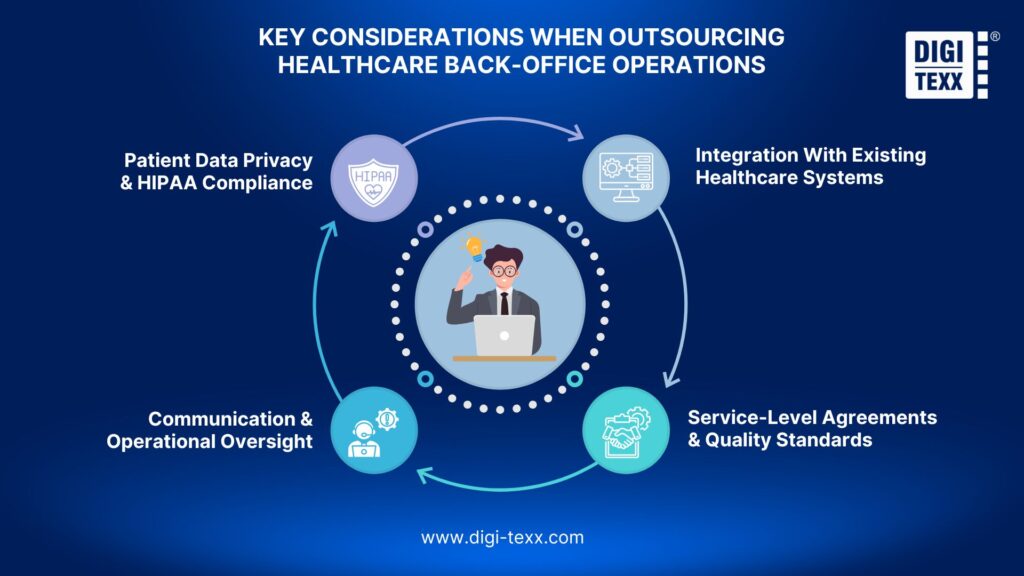
What To Consider Before Outsourcing Healthcare Back-Office Operations
Before transferring administrative workflows to an external provider, healthcare organizations should establish clear responsibilities, technical requirements, and security controls. These considerations help reduce operational risks and maintain service continuity.
Patient Data Privacy And HIPAA Compliance
Patient information is sensitive and requires appropriate protection throughout the outsourcing process.
Under HIPAA, a third-party provider that qualifies as a business associate and handles PHI on behalf of a covered entity generally requires a Business Associate Agreement (BAA). The agreement must define permitted uses and disclosures of PHI, establish safeguards, and address relevant reporting and subcontractor obligations.
Healthcare organizations should also determine whether offshore processing introduces additional contractual, regulatory, or cross-border data protection requirements.
Integration With Existing Healthcare Systems
Outsourced back-office services must work with the organization’s existing technology environment.
Before implementation, confirm:
- Compatibility with EHR/EMR platforms and document management systems.
- Supported file formats, such as PDF, TIFF, JPEG, CSV, and XML.
- Secure data transfer methods and system access permissions.
- Data mapping and standardized output formats.
- Procedures for handling system errors and incomplete records.
A clearly defined integration process reduces duplicate work and helps maintain data consistency across systems.
Service-Level Agreements And Quality Standards
A service-level agreement defines the expected service quality, delivery timelines, and responsibilities of each party.
Important SLA elements include:
- Processing turnaround time.
- Data accuracy and quality thresholds.
- Document completion and exception rates.
- Response and escalation time.
- Reporting frequency.
- Data security and incident notification responsibilities.
Healthcare organizations should establish measurable KPIs and conduct regular performance reviews to ensure that outsourced services meet operational expectations.
Communication And Operational Oversight
Outsourcing does not eliminate the need for internal management. Healthcare organizations still need to monitor service performance and maintain control over important administrative workflows.
Establish a communication structure that includes:
- A designated project manager or service delivery contact.
- Defined reporting schedules.
- Standard operating procedures (SOPs).
- Escalation channels for urgent issues.
- Regular quality reviews and process improvement meetings.
Clear communication helps resolve exceptions quickly and keeps outsourced operations aligned with internal requirements.
Why Choose DIGI-TEXX For Healthcare Back-Office Support Services?
DIGI-TEXX provides business process outsourcing (BPO), document processing, and data management services that can support selected healthcare back-office workflows. By combining document processing technology with trained personnel, DIGI-TEXX helps organizations digitize records, extract information, validate data, and manage document-intensive administrative processes.
With operations in Vietnam since 2003, DIGI-TEXX serves international clients through scalable data processing and business support solutions.
Reliable Data Processing And Document Management Capabilities
Healthcare organizations handle various document types, including patient registration forms, medical histories, insurance documents, and claims-related records. Managing these documents manually can increase processing time and create data inconsistencies.
DIGI-TEXX provides document and data processing services covering:
- Document digitization and scanning.
- Medical and administrative document data extraction.
- Document classification and indexing.
- Data entry and validation.
- Data cleansing and duplicate identification.
- Digital archiving and structured data delivery.
These capabilities can support healthcare organizations that need to convert paper-based or unstructured information into organized digital records.
AI-Powered Solutions Combined With Human Expertise
Automated document processing can accelerate repetitive tasks, but document quality and complexity often require human intervention.
DIGI-TEXX combines OCR, machine learning, and automated data extraction with trained operators who review exceptions and validate extracted information.
Its DIGI-Xtract solution supports document classification, data extraction, and quality control across structured, semi-structured, and unstructured documents, including patient medical history documents.
This hybrid approach helps organizations manage different document formats while maintaining human oversight for cases that require additional verification.
Strong Commitment To Data Security And Quality Assurance
Data security and processing quality are essential when handling sensitive business and healthcare-related information.
DIGI-TEXX maintains management systems aligned with internationally recognized standards, including:
- ISO/IEC 27001:2022: Information security management.
- ISO 9001:2015: Quality management.
These certifications support structured information security and quality management practices. Healthcare clients should additionally assess the specific contractual safeguards, PHI handling procedures, and HIPAA-related obligations applicable to their projects.
Flexible Outsourcing Solutions For Healthcare Organizations
Different healthcare organizations have different document volumes, processing requirements, and operational priorities. DIGI-TEXX offers flexible outsourcing models that can be tailored to project scope and business needs.
Available service capabilities include:
- Document-based processing projects.
- Dedicated processing resources.
- Volume-based data entry and extraction.
- Customized workflows and automation.
- 24/7 operational support.
Whether your organization needs to digitize historical records, process administrative documents, or improve data management workflows, DIGI-TEXX can help design an outsourcing solution around your requirements.

>>> See more:
- Business Process Automation Solutions: Benefits, Examples & Service Company
- Best Real Estate Image Processing Services 2026: Top 15 Providers
- Top 10 Data Entry Outsourcing Companies to Hire in 2026
- Top Data Entry Skills You Need to Get Hired in 2025
FAQs About Healthcare Back-Office Support Services
What Is A BPO In Healthcare?
Healthcare BPO (Business Process Outsourcing) refers to the practice of partnering with a third-party provider to manage non-clinical administrative, financial, and operational tasks. These services may include medical data entry, claims processing, billing support, and medical records management. By outsourcing these time-consuming responsibilities, healthcare organizations can streamline operations and allow doctors, nurses, and other medical staff to focus more on patient care.
How Much Does Healthcare Back-Office Outsourcing Cost?
Healthcare back-office outsourcing costs vary according to service type, document volume, processing complexity, required expertise, turnaround time, and security requirements. Common pricing models include per-document, per-transaction, hourly, and dedicated-team arrangements. Healthcare organizations should request customized quotations based on their actual workloads rather than rely on a universal price estimate.
What Are Some Examples Of Back Office Services?
In healthcare, back-office services cover non-clinical tasks that support the daily operations of hospitals, clinics, and other medical organizations. Common examples include:
- Medical Data Entry: Entering, updating, and validating patient information, treatment records, and other medical data.
- Medical Records Management: Organizing, digitizing, indexing, and maintaining electronic and paper-based patient records.
- Medical Billing and Claims Processing: Preparing billing information, submitting insurance claims, and tracking claim status.
- Insurance Eligibility Verification: Checking patients’ insurance coverage, benefits, and eligibility before appointments or procedures.
- Medical Transcription and Documentation: Converting recorded medical dictations into written reports and clinical documents.
- Patient Scheduling Support: Coordinating appointments, updating schedules, and managing administrative follow-ups.
- Healthcare Data Processing and Reporting: Extracting, organizing, and analyzing healthcare data to support reporting and operational decisions.
Healthcare back-office outsourcing enables medical organizations to manage administrative workloads more efficiently, maintain accurate records, and allocate more resources to patient care. Choosing the right partner requires careful evaluation of industry expertise, data security, technology capabilities, service quality, and scalability.
With experience in data processing, document management, and AI-powered solutions, DIGI-TEXX provides flexible support for document-intensive healthcare workflows. If your organization is looking to streamline administrative operations and improve information management, explore how DIGI-TEXX can help build an outsourcing solution aligned with your operational needs.
DIGI-TEXX Contact Information:
🌐 Website: https://digi-texx.com/
📞 Hotline: +84 28 3715 5325
✉️ Email: [email protected]
🏢 Address:
- Headquarters: Anna Building, QTSC, Trung My Tay Ward
- Office 1: German House, 33 Le Duan, Saigon Ward
- Office 2: DIGI-TEXX Building, 477-479 An Duong Vuong, Binh Phu Ward
- Office 3: Innovation Solution Center, ISC Hau Giang, 198 19 Thang 8 street, Vi Tan Ward
Reference:
- Centers for Medicare & Medicaid Services. (n.d.). Medicare claims processing manual (Publication No. 100-04). https://www.cms.gov/regulations-and-guidance/guidance/manuals/internet-only-manuals-ioms-items/cms018912
- Office of the National Coordinator for Health Information Technology. (2025, December 10). Electronic health records and their benefits. https://healthit.gov/health-it-basics/benefits-ehrs