Prepare a classified balance sheet by organizing assets, liabilities, and equity into clear categories to assess a company’s financial position. In this guide, DIGI-TEXX will help you understand the preparation process, follow a classified balance sheet template, and review a practical example. You’ll also learn the correct classified balance sheet order, how it differs from a standard balance sheet, and how to avoid common classification errors.
>>> See more:
- Best Insurance Claims Processing Outsourcing BPO in the US 2026
- Outsource Data Annotation Services to Scale Your AI Faster
- Outsourcing Data Cleansing: What You Need to Know
What Is A Classified Balance Sheet?
A classified balance sheet is a financial statement that groups assets and liabilities into current and noncurrent categories, with equity presented separately. This structure helps users evaluate short-term liquidity, long-term resources, and how a company finances its operations.
A typical classified balance sheet contains five categories:
- Current assets: Cash, accounts receivable, inventory, and other assets expected to be realized or used within the operating cycle.
- Noncurrent assets: Property, plant and equipment, long-term investments, and recognized intangible assets.
- Current liabilities: Accounts payable, accrued expenses, and the current portion of long-term debt.
- Noncurrent liabilities: Long-term debt and other obligations classified as noncurrent.
- Equity: Contributed capital, retained earnings, and other applicable equity components.
Classification changes how financial information is organized, not the underlying accounting equation.
>>> See more:
- Best Insurance Claims Processing Outsourcing BPO in the US 2026
- Outsource Data Annotation Services to Scale Your AI Faster
- Outsourcing Data Cleansing: What You Need to Know
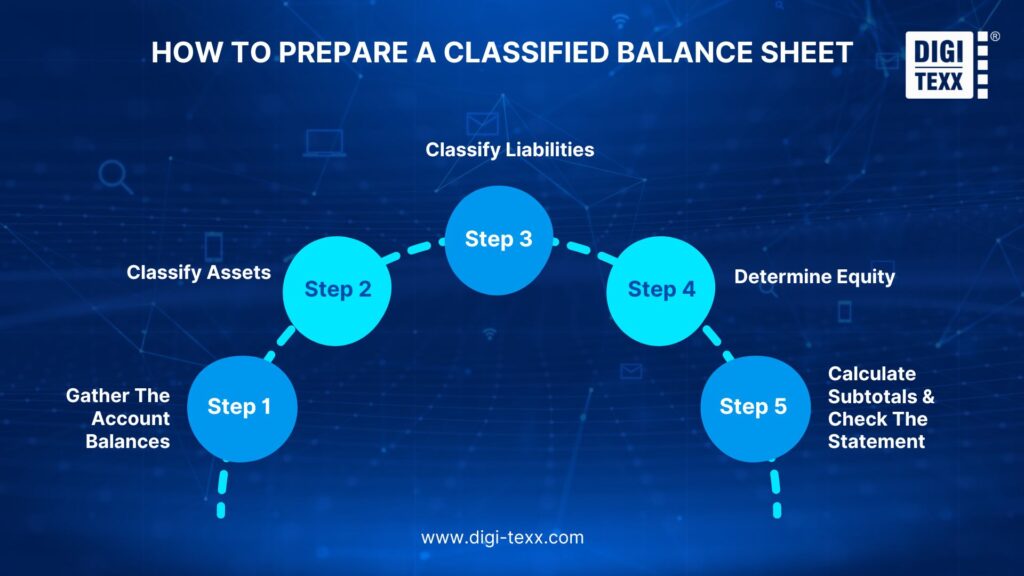
How To Prepare A Classified Balance Sheet
Prepare a classified balance sheet by organizing verified account balances into the appropriate categories, calculating subtotals, and checking that total assets equal total liabilities plus equity.
1. Gather The Account Balances
Start with an adjusted trial balance or reconciled general ledger for the reporting date. Review supporting records to confirm each account’s balance and classification.
Key accounts include:
- Cash and bank balances
- Accounts receivable
- Inventory and prepaid expenses
- Property, plant and equipment and accumulated depreciation
- Accounts payable and accrued liabilities
- Loans and other borrowings
- Contributed capital and retained earnings
Ensure all balances relate to the same entity, reporting date, and currency.
For example, a company with a $680,000 loan and $30,000 due within the current period should assess the two portions separately rather than classify the entire loan as noncurrent.
2. Classify Assets
Group assets into current and noncurrent categories based on their nature and the applicable accounting requirements.
Current assets typically include:
- Cash and cash equivalents
- Accounts receivable
- Inventory
- Prepaid expenses
Noncurrent assets typically include:
- Property, plant and equipment
- Long-term investments
- Recognized intangible assets
Classification depends on the applicable reporting criteria, including the normal operating cycle where relevant. Do not automatically apply a 12-month rule to every asset.
3. Classify Liabilities
Separate liabilities into current and noncurrent categories according to the applicable classification criteria.
Current liabilities commonly include accounts payable, accrued expenses, taxes payable, and the current portion of long-term borrowings.
Noncurrent liabilities include qualifying long-term debt and other obligations that meet the relevant criteria.
Use the loan repayment schedule to identify each portion. For a $680,000 loan with $30,000 due in the current period:
- Current portion: $30,000
- Noncurrent portion: $650,000
- Total loan: $680,000
This approach ensures the full obligation is reported without double-counting.
4. Determine Equity
Identify the equity accounts applicable to the business, such as:
- Common or contributed capital
- Retained earnings
- Additional paid-in capital
- Other applicable equity components
Do not use equity as a balancing figure without investigating discrepancies. If the statement does not balance, review the underlying accounts, adjustments, and classifications.
5. Calculate Subtotals And Check The Statement
Calculate the following totals in order:
- Total current assets
- Total noncurrent assets
- Total assets
- Total current liabilities
- Total noncurrent liabilities
- Total liabilities
- Total equity
Finally, confirm that total assets equal total liabilities plus total equity.
A balanced statement is mathematically consistent, but this check alone does not confirm that every account has been measured and classified correctly.
>>> See more:
- Top 10 Data Cleansing Companies for Businesses in 2026
- Outsource Data Annotation Services to Scale Your AI Faster
- Architectural Photo Editing Service in the US | Top 5 Providers
Classified Balance Sheet Example
The following example demonstrates how to prepare a classified balance sheet from individual account balances.
Given Account Balances
Assume ABC Manufacturing reports the following balances in U.S. dollars at the reporting date:
| Account | Amount |
| Cash | $90,000 |
| Accounts receivable, net | $100,000 |
| Inventory | $210,000 |
| Prepayments | $20,000 |
| Property, plant and equipment, cost | $1,400,000 |
| Accumulated depreciation | $(300,000) |
| Recognized intangible assets, net | $180,000 |
| Accounts payable | $100,000 |
| Accrued expenses | $50,000 |
| Current portion of borrowings | $30,000 |
| Long-term loans | $650,000 |
| Contributed capital | $600,000 |
| Retained earnings | $270,000 |
The figures are illustrative and are intended to demonstrate the preparation process rather than represent an audited financial statement.
Step 1: Classify Each Account
Before preparing the statement, map each account to the appropriate balance sheet category.
| Account | Classification |
| Cash | Current asset |
| Accounts receivable | Current asset |
| Inventory | Current asset |
| Prepayments | Current asset |
| Property, plant and equipment | Noncurrent asset |
| Accumulated depreciation | Contra-asset |
| Recognized intangible assets | Noncurrent asset |
| Accounts payable | Current liability |
| Accrued expenses | Current liability |
| Current portion of borrowings | Current liability |
| Long-term loans | Noncurrent liability |
| Contributed capital | Equity |
| Retained earnings | Equity |
This classification step is the core of how to prepare a classified balance sheet. The account name alone is not always sufficient; the underlying terms, operating cycle, settlement rights, and applicable accounting requirements may need to be reviewed.
Step 2: Calculate Each Subtotal
Calculate the current assets first:
Current assets = $90,000 + $100,000 + $210,000 + $20,000
Current assets = $420,000
Next, calculate noncurrent assets:
Property, plant and equipment, net = $1,400,000 − $300,000 = $1,100,000
Noncurrent assets = $1,100,000 + $180,000 = $1,280,000
Therefore:
Total assets = $420,000 + $1,280,000 = $1,700,000
Calculate liabilities:
Current liabilities = $100,000 + $50,000 + $30,000 = $180,000
Noncurrent liabilities = $650,000
Total liabilities = $180,000 + $650,000 = $830,000
Finally:
Total equity = $600,000 + $270,000 = $870,000
Step 3: Prepare the Classified Balance Sheet
The calculated amounts can now be presented in a standard classified format.
ABC Manufacturing
Classified Balance Sheet
Reporting Date
Amounts in USD
| Assets | USD |
| Current Assets | |
| Cash | $90,000 |
| Accounts receivable, net | $100,000 |
| Inventory | $210,000 |
| Prepayments | $20,000 |
| Total Current Assets | $420,000 |
| Noncurrent Assets | |
| Property, plant and equipment, net | $1,100,000 |
| Recognized intangible assets, net | $180,000 |
| Total Noncurrent Assets | $1,280,000 |
| Total Assets | $1,700,000 |
| Liabilities and Equity | |
| Current Liabilities | |
| Accounts payable | $100,000 |
| Accrued expenses | $50,000 |
| Current portion of borrowings | $30,000 |
| Total Current Liabilities | $180,000 |
| Noncurrent Liabilities | |
| Long-term loans | $650,000 |
| Total Liabilities | $830,000 |
| Equity | |
| Contributed capital | $600,000 |
| Retained earnings | $270,000 |
| Total Equity | $870,000 |
| Total Liabilities and Equity | $1,700,000 |
Step 4: Check Assets = Liabilities + Equity
The final check is:
Total Assets = $1,700,000
Total Liabilities + Equity = $830,000 + $870,000 = $1,700,000
Therefore:
$1,700,000 = $1,700,000
The statement balances.
This check is essential, but a balanced statement does not automatically mean the classification is correct. For example, moving a liability from current to noncurrent can leave total liabilities unchanged while materially affecting working capital.
>>> See more:
- What are the 6 Steps of the Data Analysis Process?
- Manual vs. Automated Data Entry: Which Is Better for Your Business?
- Top 12 Data Entry Outsourcing Companies In United States
Classified Balance Sheet Format
A classified balance sheet generally follows a clear order that groups similar accounts together and provides subtotals for current and noncurrent categories.
Assets
Assets are generally presented first and divided into current and noncurrent sections.
A simplified format is:
| Section | Common Accounts |
| Current assets | Cash, accounts receivable, inventory, prepayments |
| Noncurrent assets | Property, plant and equipment, long-term investments, intangible assets |
Contra-asset accounts such as accumulated depreciation reduce the carrying amount of the related asset rather than representing a separate liability.
Liabilities
Liabilities are divided into current and noncurrent categories.
| Section | Common Accounts |
| Current liabilities | Accounts payable, accrued expenses, taxes payable, current debt |
| Noncurrent liabilities | Long-term debt and other qualifying long-term obligations |
For debt with scheduled installments, separate the current portion from the remaining noncurrent balance when required.
Equity
Equity is presented separately from liabilities. Depending on the entity, it can include:
- Common or contributed capital
- Additional paid-in capital
- Retained earnings
- Other applicable equity components
Equity is not normally divided into current and noncurrent categories.
How To Classify Accounts On A Balance Sheet
Use the account’s nature, expected realization or settlement, operating cycle, and applicable reporting requirements rather than relying only on the account name.
| Account | Typical Classification | Key Consideration |
| Cash | Current asset | Available for near-term use, subject to applicable restrictions |
| Accounts receivable | Current asset | Expected collection within the relevant operating cycle or applicable period |
| Inventory | Current asset | Held for sale or use in the normal operating cycle |
| Prepaid expenses | Current asset | Benefits expected to be consumed in the relevant period |
| Equipment | Noncurrent asset | Used in operations over multiple periods |
| Accumulated depreciation | Contra-asset | Reduces the carrying amount of depreciable assets |
| Accounts payable | Current liability | Normally settled through the operating cycle |
| Accrued expenses | Current liability | Amounts owed for recognized expenses |
| Current portion of long-term debt | Current liability | Principal meeting current classification requirements |
| Long-term debt | Noncurrent liability | Remaining qualifying balance |
| Common stock | Equity | Represents contributed ownership capital |
| Retained earnings | Equity | Accumulated earnings less applicable distributions and adjustments |
When an account does not fit a simple rule, review the underlying agreement and the reporting framework before assigning its classification.
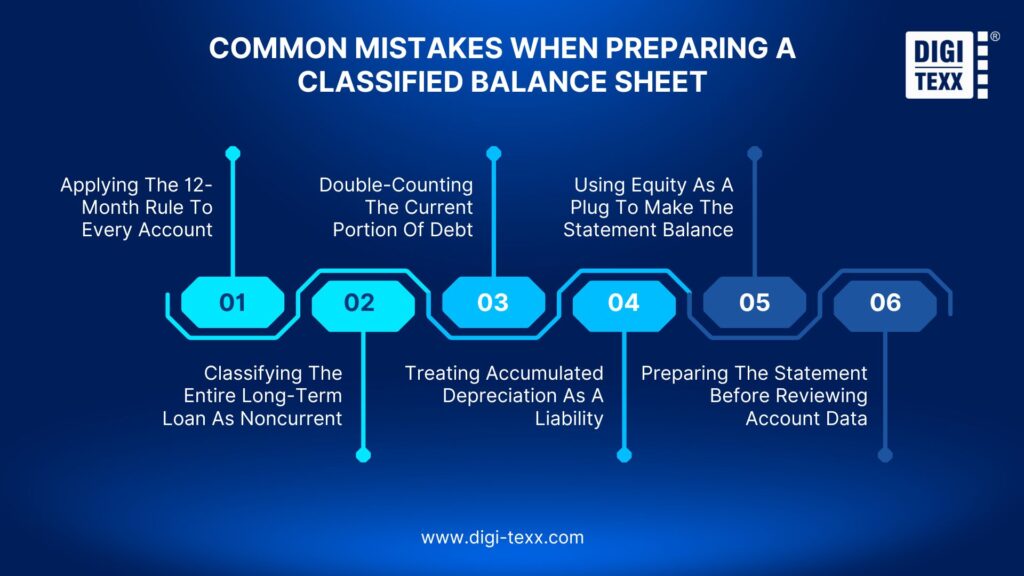
Common Mistakes When Preparing A Classified Balance Sheet
When you prepare a classified balance sheet, errors in account classification, debt allocation, and reconciliation can distort reported financial information. Avoiding the following mistakes helps improve accuracy and ensures that the final statement reflects the company’s financial position.
1. Applying The 12-Month Rule To Every Account
Not every account should be classified solely according to whether it will be realized, settled, or used within 12 months. The normal operating cycle and applicable accounting requirements may affect classification. For example, inventory or trade receivables associated with a longer operating cycle may qualify as current even when realization takes more than 12 months.
How to avoid this mistake: Review the nature of each account, the company’s normal operating cycle, and the applicable reporting framework before assigning its classification.
2. Classifying The Entire Long-Term Loan As Noncurrent
A long-term loan may include installments due in the current period. Reporting the entire balance as noncurrent can understate current liabilities and make the company’s short-term liquidity appear stronger than it is.
For example, if a company has a $680,000 loan and $30,000 qualifies as current, the balance sheet should generally show $30,000 as current debt and $650,000 as noncurrent debt, subject to the applicable classification requirements.
How to avoid this mistake: Use the loan agreement and repayment schedule to determine the portions that qualify as current and noncurrent at the reporting date.
3. Double-Counting The Current Portion Of Debt
Separating a loan into current and noncurrent portions does not create two separate obligations. The two amounts must add up to the original outstanding balance.
Using the example above, the $30,000 current portion must be excluded from the $650,000 noncurrent portion. Including it in both categories would overstate total liabilities by $30,000.
How to avoid this mistake: Reconcile the classified portions against the outstanding loan balance before calculating total liabilities.
4. Treating Accumulated Depreciation As A Liability
Accumulated depreciation is a contra-asset account, not a liability. It records depreciation recognized over an asset’s useful life and reduces the carrying amount of the related property, plant and equipment.
For example, equipment costing $1,400,000 with accumulated depreciation of $300,000 has a net carrying amount of $1,100,000, before considering any other applicable adjustments. Reporting accumulated depreciation as a liability would misstate both assets and liabilities.
How to avoid this mistake: Present accumulated depreciation as a deduction from the related fixed assets when calculating their net carrying amount.
5. Using Equity As A Plug To Make The Statement Balance
When total assets do not equal total liabilities plus equity, changing retained earnings or another equity account merely to eliminate the difference can conceal an underlying accounting error.
Possible causes include omitted transactions, duplicate entries, incorrect account balances, unrecorded adjustments, or classification errors. The difference should be investigated rather than assigned to equity without supporting evidence.
How to avoid this mistake: Reconcile the trial balance, review adjusting entries, and verify the supporting schedules before finalizing equity and the statement.
6. Preparing The Statement Before Reviewing Account Data
Entering figures directly into a classified balance sheet template before checking the underlying records can lead to missing accounts, duplicated balances, or incorrect subtotals. The final presentation should be based on verified accounting records, not assumptions about where each amount belongs.
How to avoid this mistake: Review the adjusted trial balance and supporting schedules first. Then classify each account, calculate current and noncurrent subtotals, prepare the statement, and verify the totals against the underlying records. This process makes discrepancies easier to identify before the balance sheet is finalized.
>>> See more:
- What Is Data Integrity? A Complete Guide for Businesses
- What Is Intelligent Document Recognition? Applications & Challenges
- How Automated Invoice Processing Saves Time and Reduces Errors?
Classified vs. Unclassified Balance Sheet
Both statements report assets, liabilities, and equity. The main difference is how the accounts are grouped.
| Feature | Classified Balance Sheet | Unclassified Balance Sheet |
| Current assets | Separately identified | Not necessarily separated |
| Noncurrent assets | Separately identified | Not necessarily separated |
| Current liabilities | Separately identified | Not necessarily separated |
| Noncurrent liabilities | Separately identified | Not necessarily separated |
| Equity | Presented separately | Presented separately |
| Liquidity analysis | Easier | Requires additional analysis |
| Working capital analysis | Current subtotals are readily available | Current subtotals may need to be derived |
A classified format is particularly useful when readers need to evaluate short-term resources and obligations separately from longer-term balances.
FAQs About Prepare A Classified Balance Sheet
What Are The 5 Main Classifications Used On A Classified Balance Sheet?
The 5 main classifications on a classified balance sheet are:
- Current assets: Resources expected to be converted into cash, sold, or used within the operating cycle or applicable current classification period, such as cash, accounts receivable, and inventory.
- Noncurrent assets: Long-term resources, including property, plant and equipment, long-term investments, and intangible assets.
- Current liabilities: Obligations generally due within the operating cycle or applicable current classification period, such as accounts payable and accrued expenses.
- Noncurrent liabilities: Long-term obligations, such as qualifying long-term loans and other debts.
- Shareholders’ equity: The owners’ interest in the company, including contributed capital and retained earnings.
What’s The Difference Between A Balance Sheet And A Classified Balance Sheet?
A standard balance sheet presents assets, liabilities, and equity in a basic format, while a classified balance sheet organizes them into specific categories to make a company’s financial position easier to assess.
| Feature | Standard Balance Sheet | Classified Balance Sheet |
| Structure | Presents accounts in a basic format with limited subgrouping. | Groups accounts into defined categories. |
| Assets | May list assets without clearly separating current and noncurrent items. | Separates current assets from noncurrent assets. |
| Liabilities | May present liabilities without clearly distinguishing short-term and long-term obligations. | Separates current liabilities from noncurrent liabilities. |
| Equity | Presents the company’s equity. | Presents equity, often with its individual components. |
| Financial analysis | Requires additional review to assess liquidity and short-term obligations. | Makes it easier to evaluate working capital, short-term liquidity, and long-term financial obligations. |
How To Prepare A Balance Sheet Step By Step?
To prepare a balance sheet, follow these five steps:
- Gather financial records: Collect the adjusted trial balance, general ledger, and supporting schedules for the reporting date.
- Classify assets and liabilities: Separate assets and liabilities into current and noncurrent categories where applicable.
- Determine equity: Identify contributed capital, retained earnings, and other relevant equity accounts.
- Calculate totals: Add the asset, liability, and equity balances, including the relevant subtotals for a classified balance sheet.
- Verify the statement: Confirm that total assets equal total liabilities plus total equity, then investigate any discrepancies before finalizing the report.
What Are The 5 Elements Of A Balance Sheet?
A balance sheet has three core elements: assets, liabilities, and shareholders’ equity. Revenue and expenses are the other two elements commonly associated with financial statements, but they are reported on the income statement rather than directly presented as separate elements on the balance sheet.
- Assets: Resources controlled by a company, such as cash, inventory, and property.
- Liabilities: Financial obligations owed to external parties, such as accounts payable and bank loans.
- Shareholders’ equity: The residual interest in the company after deducting liabilities from assets.
- Revenue: Income earned from selling goods or providing services, reported on the income statement.
- Expenses: Costs incurred to generate revenue, also reported on the income statement.
Learning how to prepare a classified balance sheet helps businesses present financial information clearly and evaluate short-term liquidity and long-term obligations. By following the correct classification order, using a reliable template, and checking each account balance, you can prepare an accurate statement. Review the classified balance sheet example in this guide for practice, or use a free Excel template to organize your figures and verify that total assets equal total liabilities plus equity.
Reference:
- University of Minnesota. (n.d.). Introduction to financial accounting. Open Textbook Library. https://open.umn.edu/opentextbooks/textbooks/introduction-to-financial-accounting
- Yale University. (n.d.). The accounting identity. Learning Accounting. https://learning-accounting.yale.edu/basics-accounting/20-accounting-identity