
Data integrity definition is at the core of every data driven organization. Without accurate, consistent, and reliable data, even the most advanced technologies cannot deliver meaningful business insights. As data volumes continue to grow, maintaining data integrity requires a combination of governance, technology, and specialized operational support.
In this article, DIGI-TEXX will help you understand what is data integrity, why it is essential, the different types of data integrity, common risks, and best practices for protecting business data.

What Is Data Integrity?
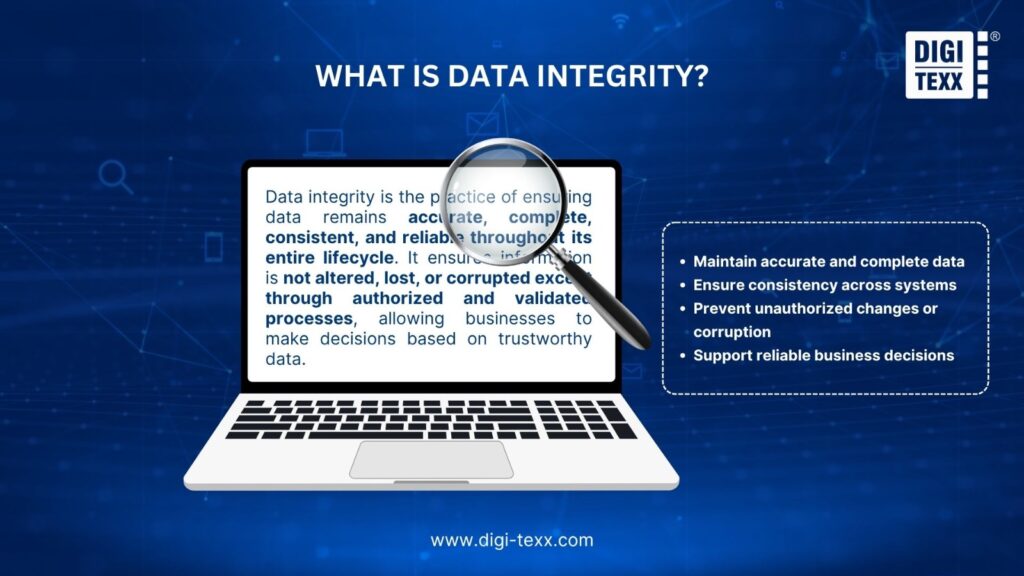
Data integrity is the practice of ensuring data remains accurate, complete, consistent, and reliable throughout its entire lifecycle. It ensures information is not altered, lost, or corrupted except through authorized and validated processes, allowing businesses to make decisions based on trustworthy data.
Maintaining data integrity requires a combination of technologies, processes, and governance practices, including:
- Data validation to detect and prevent errors before data enters the system.
- Access controls and encryption to protect data from unauthorized modification or exposure.
- Backup and recovery mechanisms to minimize the risk of data loss.
- Data governance policies that define how data is created, managed, and maintained across the organization.
As organizations rely more heavily on data for analytics, automation, AI, and regulatory compliance, maintaining data integrity becomes a business necessity rather than a technical requirement. High integrity data improves decision making, strengthens security, supports compliance, and ensures long term confidence in business information.
Why Is Data Integrity Important?
Understanding the data integrity definition is only the first step. Its real value lies in ensuring business data remains accurate, consistent, and trustworthy, allowing organizations to make confident decisions while reducing operational and compliance risks.
Key reasons why data integrity is essential include:
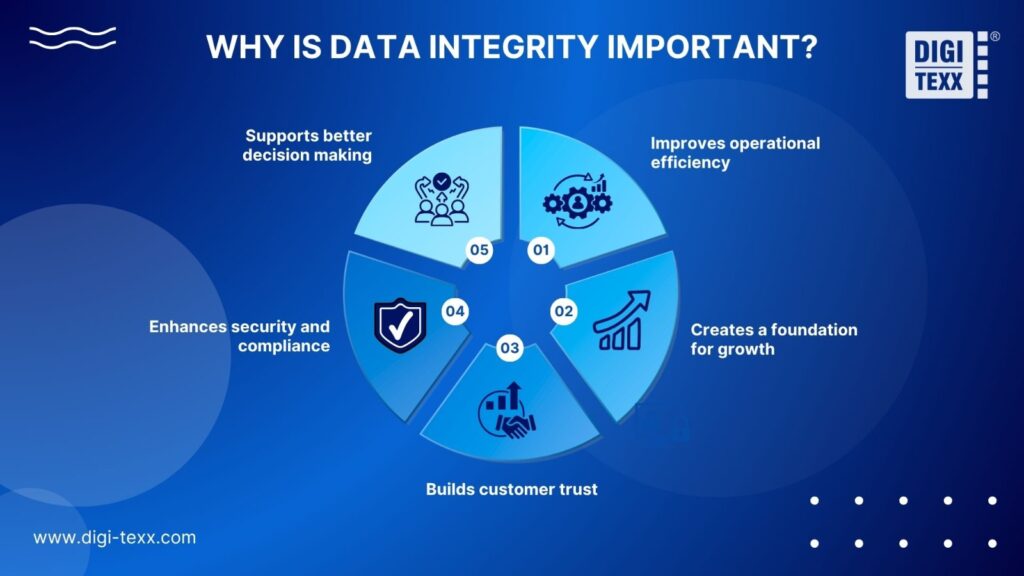
- Supports better decision making: Reliable data improves analytics, forecasting, and business planning by ensuring every insight is based on accurate information.
- Improves operational efficiency: Consistent data reduces duplicate records, manual corrections, and workflow disruptions, enabling teams to work more effectively.
- Enhances security and compliance: Validation, access controls, encryption, and backups help protect data from unauthorized changes while supporting regulatory requirements.
- Builds customer trust: Accurate records and secure data handling reduce errors, protect sensitive information, and strengthen customer confidence in your business.
- Creates a foundation for growth: High quality data supports digital transformation, AI initiatives, and scalable business operations with greater confidence.
Types Of Data integrity
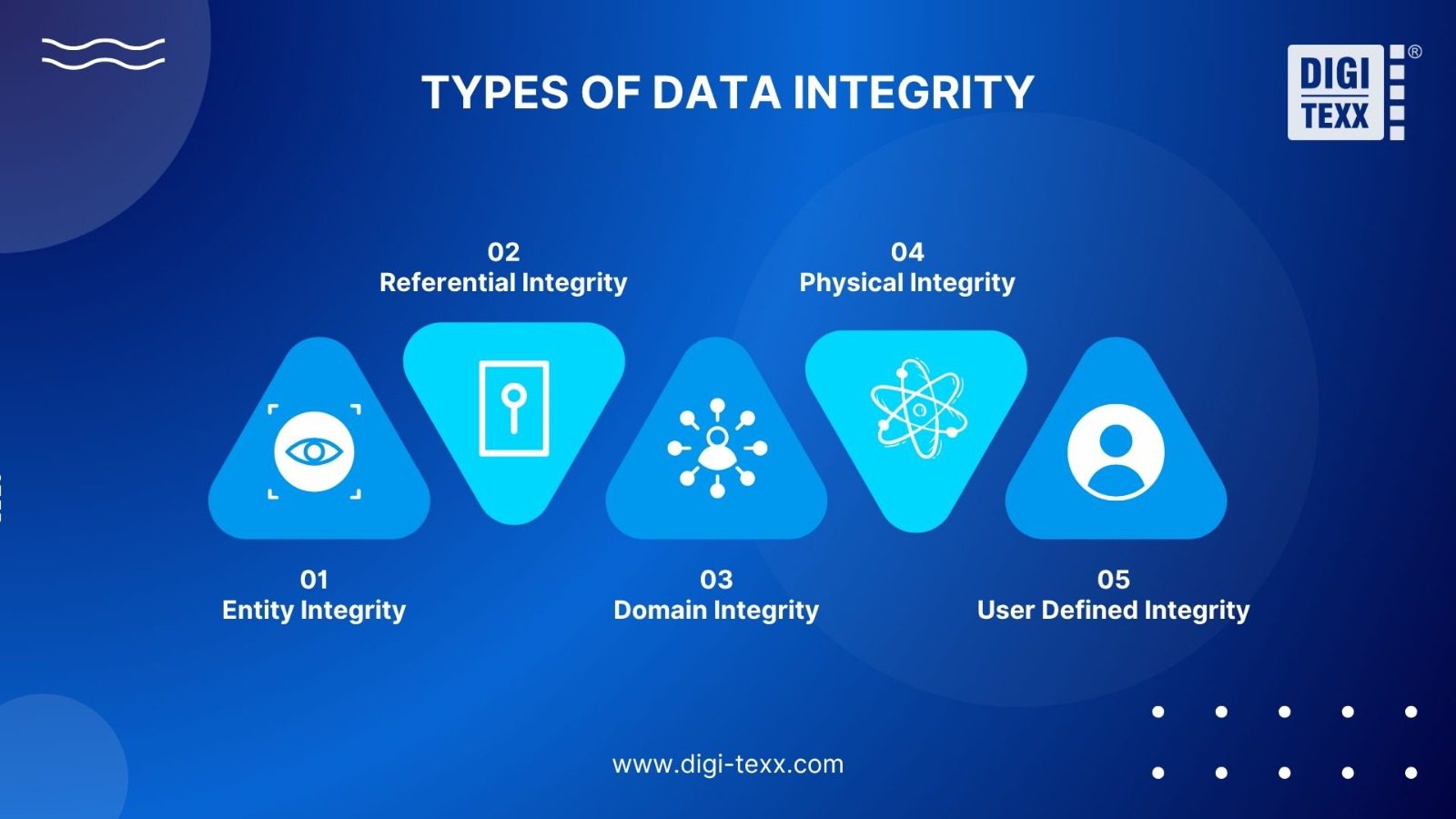
Data integrity is maintained through different mechanisms, each designed to protect data accuracy, consistency, and reliability in specific situations. Together, these five types help organizations ensure data remains trustworthy throughout its lifecycle.
1. Entity Integrity
Entity integrity ensures that every record in a database is uniquely identifiable through a primary key. This prevents duplicate records and maintains the accuracy of stored data.
2. Referential Integrity
Referential integrity preserves consistent relationships between linked tables by ensuring every reference points to a valid record. It prevents broken links and orphan records that could compromise data consistency.
3. Domain Integrity
Domain integrity enforces predefined rules for each data field, such as data type, format, range, and allowable values. This helps prevent invalid or inconsistent data from entering the system.
4. Physical Integrity
Physical integrity protects data from loss or corruption caused by hardware failures, power outages, cyberattacks, or natural disasters. Organizations typically maintain it through backups, redundant storage, and disaster recovery strategies.
5. User Defined Integrity
User defined integrity consists of custom business rules that reflect an organization’s operational requirements. These constraints ensure data remains accurate and aligned with specific workflows that standard database rules cannot enforce.
Data Integrity vs. Data Quality vs. Data Security
Although data integrity, data quality, and data security are closely related, they serve different purposes in data management. The table below highlights their key differences.
| Aspect | Data Integrity | Data Quality | Data Security |
| Primary focus | Ensuring data remains accurate, complete, consistent, and reliable throughout its lifecycle. | Ensuring data is fit for its intended use by maintaining accuracy, completeness, timeliness, and consistency. | Protecting data from unauthorized access, disclosure, modification, or cyber threats. |
| Main objective | Preserve the trustworthiness of data from creation to deletion. | Improve the usability and value of data for business operations and analytics. | Safeguard data confidentiality, integrity, and availability. |
| How it is achieved | Data validation, integrity constraints, governance policies, auditing, backups, and controlled access. | Data cleansing, standardization, deduplication, validation, and continuous monitoring. | Encryption, authentication, access control, network security, and backup strategies. |
| Business impact | Enables reliable decision making, regulatory compliance, and consistent business operations. | Delivers more accurate insights, reporting, and customer experiences. | Reduces security risks, prevents data breaches, and protects sensitive information. |
| Relationship | An overarching concept that relies on both high quality data and strong security controls. | Supports data integrity by ensuring data is accurate and complete. | Supports data integrity by preventing unauthorized changes and protecting data assets. |
Data Integrity Example
Data integrity is essential in any industry that depends on accurate, reliable, and compliant data. Below are some common real world applications.
Healthcare
Electronic health records must remain accurate and up to date to support diagnosis, treatment, and patient safety. Strong data integrity practices also help healthcare providers comply with regulations and reduce the risk of medical errors.
Financial Services
Banks and financial institutions rely on data integrity to maintain accurate transaction records, verify customer identities, and detect fraudulent activities. Reliable financial data is also essential for regulatory reporting and risk management.
Manufacturing
Manufacturers use data integrity to ensure production data, equipment logs, and quality inspection records remain consistent throughout the production process. This improves product quality, traceability, and operational efficiency.
Pharmaceutical
Clinical research data and manufacturing records must be protected from unauthorized changes throughout the product lifecycle. Maintaining data integrity helps organizations meet regulatory standards while ensuring product safety and effectiveness.
Cloud and Enterprise Systems
Cloud service providers implement validation, access controls, backups, and audit logs to preserve customer data. These measures help prevent data corruption, support disaster recovery, and ensure business continuity.
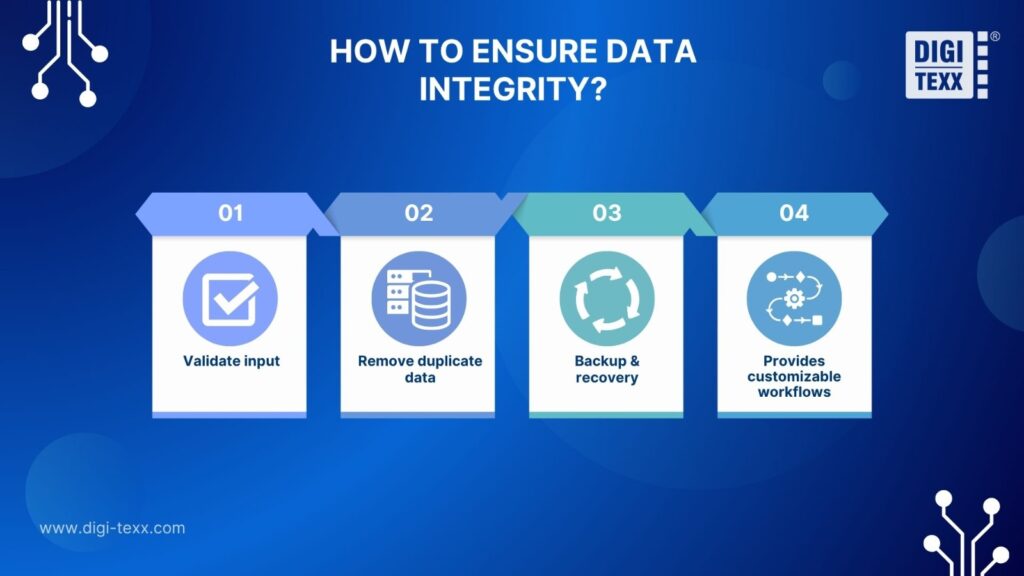
How To Ensure Data Integrity?
To ensure and maintain effective data integrity, here are some steps that any organization can take right away:
- Validate input: Organizations will need to establish rules to check and validate data as it is entered into the system, ensuring that it complies with defined formats and limits.
- Remove duplicate data: Use tools and processes to identify and remove duplicate records, helping to maintain data consistency.
- Backup & recovery: Regularly back up data and have a clear recovery plan in place to quickly restore data after incidents or natural disasters.
- Access control & audit trails: Limit access to sensitive data to authorized users only and record all logs made to the data, making it easy to track and detect unauthorized changes.
- Encryption & cybersecurity measures: Use encryption to protect data as it is transmitted and stored, and apply cybersecurity measures to prevent external attacks.
What Are The Most Common Risks To Data Integrity?
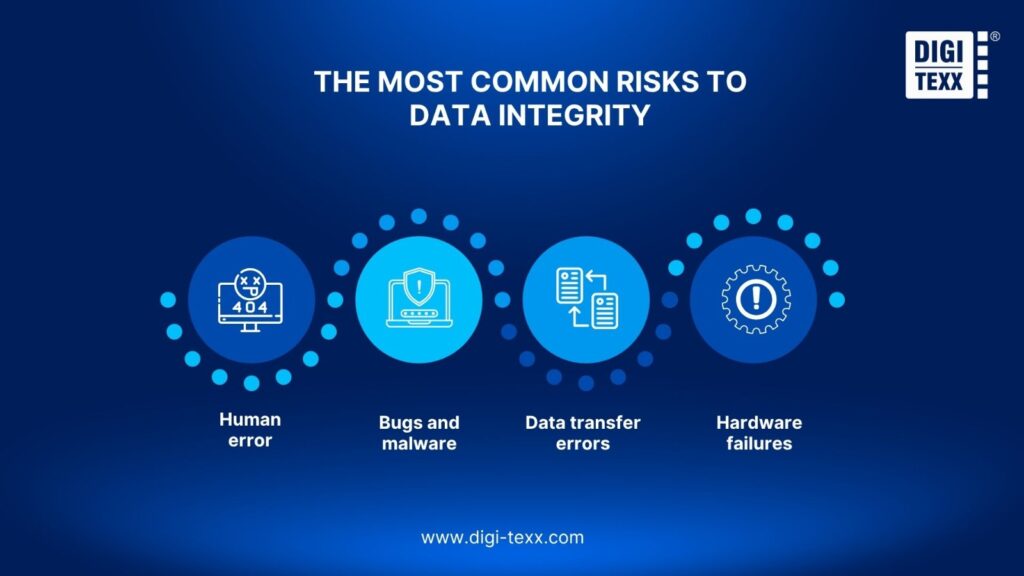
Understanding the data integrity definition also means recognizing the factors that can compromise data accuracy, consistency, and reliability. The most common risks include:
- Human error: Incorrect data entry, accidental deletion, duplicate records, or failure to follow established procedures can quickly undermine data integrity.
- Bugs and malware: Software bugs, viruses, ransomware, and other malicious programs may alter, corrupt, or delete data, resulting in unreliable records and potential security breaches.
- Data transfer errors: Incomplete or failed data transfers between systems can create missing, duplicated, or inconsistent records, especially during database migration or system integration.
- Hardware failures: Server crashes, storage device failures, power outages, and other hardware issues can damage data, limit accessibility, or lead to permanent data loss if recovery measures are not in place.
FAQs About Data Integrity Definition
What Is The Meaning Of Data Integrity?
Data integrity refers to the ability of data to remain accurate, complete, consistent, and reliable throughout its entire lifecycle. It ensures information is protected from unauthorized changes, corruption, or loss during storage, processing, transfer, and retrieval, allowing organizations to rely on trusted data for daily operations and decision making.
What Are The 5 Principles Of Data Integrity?
The five principles of data integrity provide a framework for ensuring data remains trustworthy, accurate, and fit for business use throughout its lifecycle. These principles include:
- Accuracy: Data should correctly represent the real world and remain free from errors.
- Completeness: All required data must be captured without missing or incomplete records.
- Consistency: Data should remain uniform across different systems, databases, and processes.
- Validity: Data must comply with predefined formats, rules, and business requirements.
- Reliability: Data should remain dependable, authentic, and protected from unauthorized changes throughout its lifecycle.
What Are The Three Pillars Of Data Integrity?
The three pillars of data integrity are commonly based on the CIA triad, a widely adopted information security framework that helps organizations protect and manage their data effectively. These pillars include:
- Confidentiality: Ensures sensitive data is accessible only to authorized users, preventing unauthorized access or disclosure.
- Integrity: Protects data from unauthorized modification, ensuring it remains accurate, complete, and consistent throughout its lifecycle.
- Availability: Ensures data and systems are accessible whenever authorized users need them, minimizing disruptions caused by system failures, cyberattacks, or disasters.
Understanding how to define data integrity is the first step toward building reliable, secure, and high quality data that supports every aspect of your business. By implementing effective governance, validation processes, and security controls, organizations can minimize risks, improve operational efficiency, and make more confident decisions based on trusted information.
If you’re looking to strengthen your data management strategy, DIGI-TEXX provides end to end data processing and back office solutions that help ensure your business data remains accurate, consistent, and ready for long term growth.
DIGI-TEXX Contact Information:
🌐 Website: https://digi-texx.com/
📞 Hotline: +84 28 3715 5325
✉️ Email: [email protected]
🏢 Address:
- Headquarters: Anna Building, QTSC, Trung My Tay Ward
- Office 1: German House, 33 Le Duan, Saigon Ward
- Office 2: DIGI-TEXX Building, 477-479 An Duong Vuong, Binh Phu Ward
- Office 3: Innovation Solution Center, ISC Hau Giang, 198 19 Thang 8 street, Vi Tan Ward
Reference:
- Financial Industry Regulatory Authority. (n.d.). Financial Industry Regulatory Authority. https://www.finra.org
- Cybersecurity and Infrastructure Security Agency. (n.d.). Cybersecurity best practices. https://www.cisa.gov