
Outsource order processing is becoming a strategic move in the modern BPO industry as businesses manage growing multi-channel order volumes with limited staff and increasing error risks. While order processing may seem like just one step in the workflow, poor execution can delay fulfillment, inflate costs, and harm customer experience.
By combining data processing, data cleansing, and business process automation solutions with tools like document management systems, invoice processing software, and optical character recognition (OCR) technologies, organizations can significantly improve accuracy and efficiency.
In this article, DIGI-TEXX explores the role of order processing, key industry challenges, and how outsourcing enables more scalable, data-driven, and resilient operations.
>>> See more:
- What Is Business Process Outsourcing (BPO)? Definition & Benefits
- How To Prepare a Classified Balance Sheet: Template & Example
- Financial Data Quality Management: What It Is & Why It Matters
- Top Data Entry Skills You Need to Get Hired in 2025
What Is Outsourcing Order Processing?
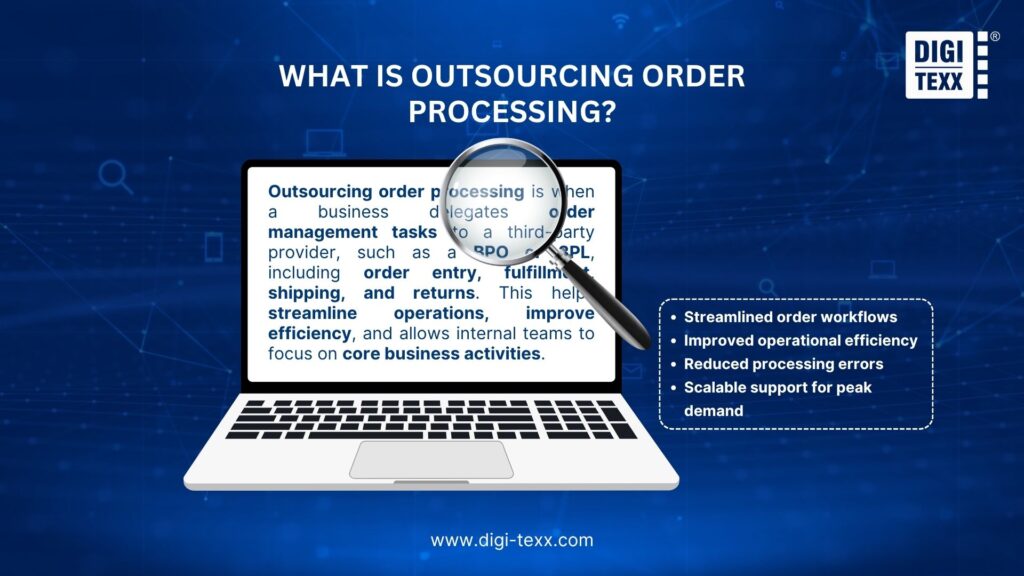
Outsourcing order processing means hiring an external partner-such as a BPO or third-party logistics (3PL) provider-to handle all or part of your order management tasks, from order entry to shipping and returns. It streamlines operations, leverages specialist technology, and frees your team to focus on core business.
Key entities involved include your business, outsourced order processing providers (BPOs or 3PLs), and sometimes specialist fulfillment centers leveraging advanced software. Typically, core order management, fulfillment, inventory checks, shipping, and returns are handled by the partner, while strategic oversight and sales remain in-house.
Sample Outsourcing Order Processing Workflow:
- Order Received: The outsourcing partner receives new orders via software integration or manual feed.
- Verification & Payment: Orders are validated; payments are processed if needed.
- Inventory Check & Allocation: Items are confirmed in stock and allocated for fulfillment.
- Picking, Packing, & Shipping: Warehouse staff pick, pack, and arrange for shipment.
- Returns & Customer Updates: The provider handles returns and customer communications as agreed.
This model is broadly used in eCommerce, manufacturing, and retail businesses seeking scalable and efficient order fulfillment.
Benefits Of Outsourcing Order Processing
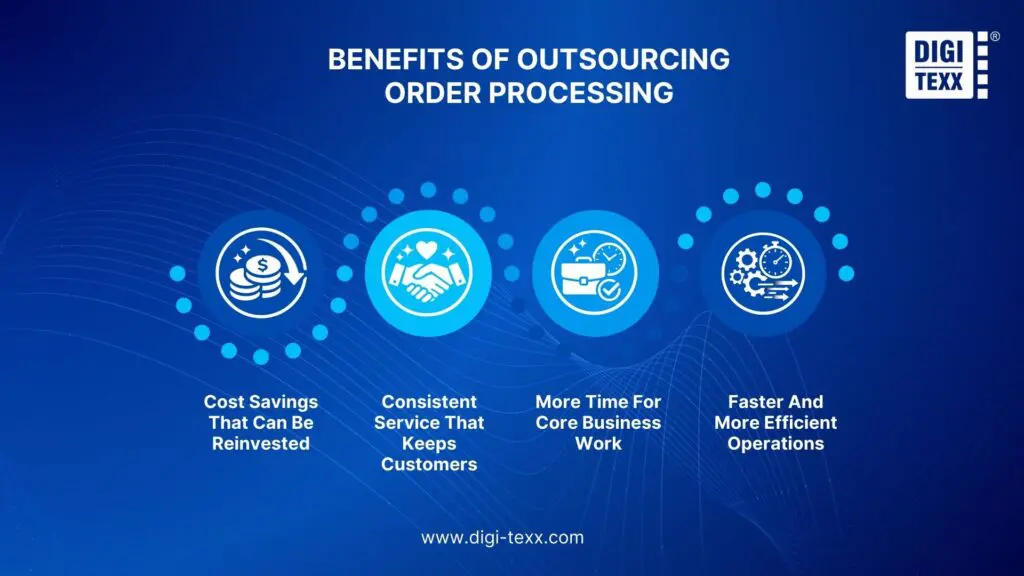
Outsourcing order processing is not only a cost-control tactic but a strategic move to strengthen operations as businesses scale. By transferring complex, high-volume order handling to specialized providers, companies can improve efficiency, service consistency, and long-term growth readiness.
Cost Savings That Can Be Reinvested
Instead of maintaining an in-house order processing team with ongoing costs for recruitment, training, technology, and infrastructure, businesses can convert fixed expenses into flexible operating costs through outsourcing. The savings generated can be reinvested in revenue-driving initiatives such as product development, marketing, or market expansion while still gaining access to skilled teams and modern order processing systems without heavy upfront investment.
Consistent Service That Keeps Customers
Professional outsourcing providers operate with standardized workflows and clear performance metrics, ensuring consistent order processing quality even as volumes fluctuate. Higher accuracy, faster processing times, and reliable order information help reduce errors and customer complaints. This service consistency plays a critical role in protecting customer trust and encouraging repeat purchases.
More Time For Core Business Work
Manual order processing often consumes significant management attention and internal resources. By outsourcing order processing, businesses can free their teams from repetitive operational tasks and redirect focus toward strategy, innovation, and growth. This shift allows leadership and key functions to spend more time on product expansion, customer experience improvement, and competitive differentiation.
Faster And More Efficient Operations
Outsourcing enables businesses to leverage optimized processes, supporting technologies, and dedicated processing teams to shorten order turnaround times and improve overall efficiency. The ability to scale resources quickly during peak seasons or demand spikes ensures operational speed is maintained without sacrificing service quality. As a result, order processing becomes faster, more efficient, and better equipped to support long-term growth.
According to Deloitte, businesses that outsource order management and fulfillment operations can reduce operational costs by up to 30% while improving order accuracy and customer satisfaction.” – Deloitte Insights.
>>> See more:
- Construction Invoice Reconciliation: Best Practices, Software & Outsourcing
- Top 10 Outsourced AI Training Data Companies in 2026
- 20 Best Data Integration Tools: Definition, Benefits & Features
- Define Business Process Outsourcing (BPO): Meaning, Examples & Benefits 2026
What Are The Risks Of Outsourcing Order Processing?
Outsourcing order processing can boost efficiency, but it also comes with certain risks. Understanding these challenges upfront helps you make better decisions and put the right controls in place.
Common Risks:
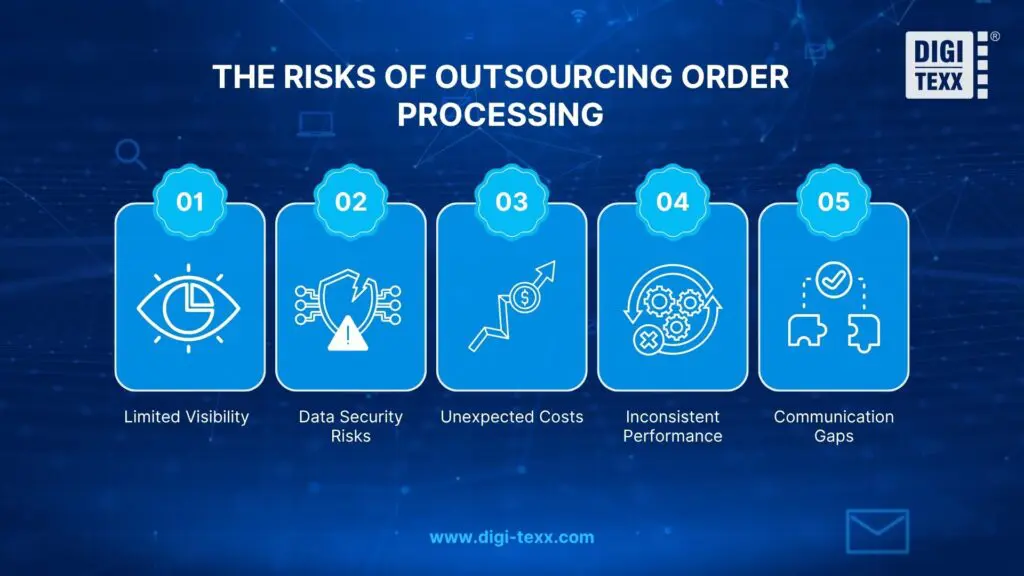
- Limited Visibility: Less direct control over daily operations and customer experience.
- Data Security Risks: Sharing sensitive customer and order data requires strict security and compliance measures.
- Unexpected Costs: Additional fees may arise for urgent requests, returns, or system integrations.
- Inconsistent Performance: Service quality may vary if the provider fails to meet agreed standards.
- Communication Gaps: Differences in language, time zones, or workflows can affect coordination.
How to Mitigate These Risks:
- Define clear SLAs and KPIs to set expectations and measure performance.
- Establish regular reporting and reviews to maintain transparency.
- Partner with providers that offer strong security standards and structured onboarding.
With the right approach, businesses can minimize risks while still benefiting from scalable and efficient order processing.
Benefits & Challenges Of Outsourcing Order Processing
| Benefits | Challenges |
| Cost savings and flexible operating expenses | Reduced visibility and day-to-day control |
| Consistent service quality and improved customer experience | Data security and compliance concerns |
| More focus on core business and strategic growth | Potential hidden or unexpected costs |
| Faster processing and higher operational efficiency | Inconsistent performance if SLAs are not met |
| Scalable operations to support business growth | Communication and coordination challenges |
How Outsourced Order Processing Works?
Outsourced order processing follows a clear, structured workflow that seamlessly connects your sales channels with the provider’s fulfillment system, ensuring accuracy, speed, and full visibility.
Typical Outsourced Order Processing Workflow:
- Integration & Order Capture: Orders from your eCommerce platform, CRM, or ERP are automatically transferred to the provider via API or data feeds.
- Order Validation: Each order is checked for accuracy, completeness, and payment confirmation.
- Inventory Check & Allocation: Stock availability is verified and items are reserved for fulfillment.
- Picking & Packing: Warehouse teams pick, pack, and label orders according to your requirements.
- Shipping & Tracking: Orders are dispatched, and tracking details are shared with both your system and customers.
- Returns & Customer Updates: Returns are processed, inventory is updated, and customer communication is handled as agreed.
Workflow Process Overview
| Stage | Who Handles It | Systems & Tools |
| Order data transfer | Both (setup & sync) | eCommerce platforms, ERP, OMS, API integrations |
| Order review & payment check | DIGI-TEXX | Order management tools, payment systems |
| Stock verification | DIGI-TEXX | Warehouse management systems (WMS), inventory tools |
| Order fulfillment (pick & pack) | DIGI-TEXX | Barcode systems, fulfillment software |
| Delivery & tracking updates | DIGI-TEXX | Shipping systems, carrier platforms |
| Customer communication & returns | Shared (based on agreement) | CRM, return management solutions |
In-House & Outsourced Order Processing: Which Option Fits Your Business Best?
Deciding whether to keep order processing in-house or outsource it comes down to your scale, growth plans, and how much control you want over operations. Smaller, stable businesses may prefer to manage everything internally, while fast-growing or high-volume companies often benefit from the flexibility and efficiency of outsourcing.
| Criteria | In-House Processing | Outsourced Processing |
| Control | Full visibility and direct management | Managed by an external partner |
| Cost Structure | Higher fixed costs and staffing expenses | More flexible, usage-based pricing |
| Scalability | Limited, requires hiring and training | Easily scales up or down on demand |
| Technology | Requires internal investment and maintenance | Access to ready-to-use advanced systems |
| Operational Effort | High workload for internal teams | Reduced internal management burden |
| Speed & Efficiency | Slower due to resource constraints | Faster with optimized workflows |
When outsourcing makes more sense:
- Order volume starts exceeding your team’s capacity.
- Seasonal spikes or unpredictable demand create bottlenecks.
- You plan to expand into new markets without heavy logistics investment.
- Your team needs to focus more on growth, product, or customer experience.
How To Choose The Right Partner For Outsource Order Processing?
Choosing the right partner for outsource order processing is essential to ensure smooth operations, consistent service quality, and long-term scalability. To make the right decision, focus on the following key criteria:
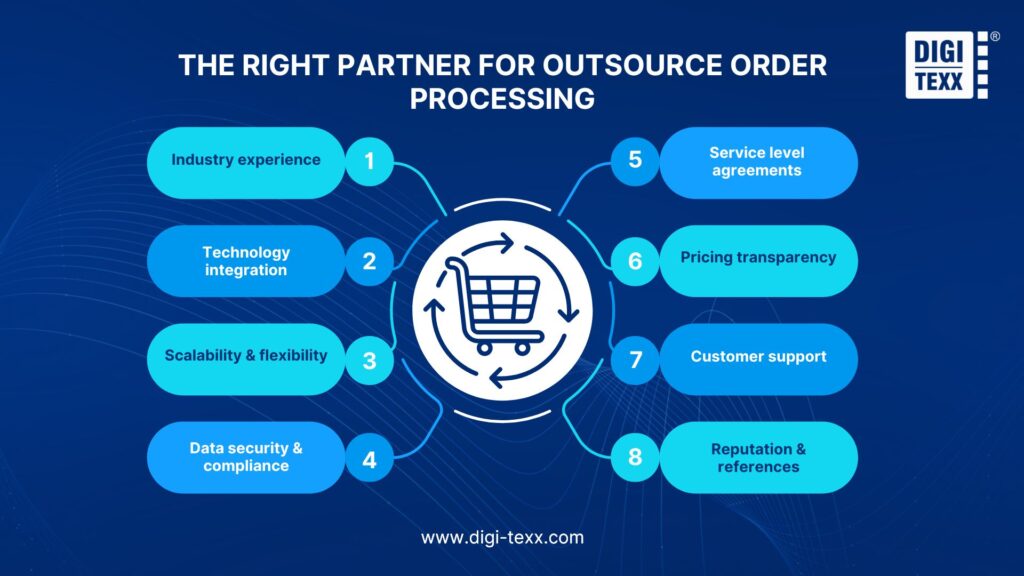
- Industry experience: Providers with proven experience in your sector can quickly understand workflows, reduce errors, and deliver more reliable results.
- Technology integration: Seamless connection with your existing systems (ERP, CRM, inventory) helps avoid disruptions and ensures real-time data flow.
- Scalability & flexibility: A capable partner can easily handle growth, seasonal spikes, and changing business demands.
- Data security & compliance: Strong security standards and certifications (e.g. GDPR, SOC 2) protect sensitive customer and business data.
- Service level agreements (SLAs): Clear metrics for accuracy, speed, and performance help maintain consistent service quality.
- Pricing transparency: Well-defined cost structures prevent hidden fees and support better financial planning.
- Customer support: Responsive communication and clear escalation processes ensure issues are resolved quickly.
- Reputation & references: Verified case studies and client feedback provide confidence in the provider’s reliability.
Industry Specific Order Processing Challenges & Solution
Order processing challenges vary across industries due to differences in order volume, fulfillment speed, inventory structure, and regulatory requirements. Understanding industry-specific challenges allows businesses to design order processing workflows that remain efficient, accurate, and scalable.
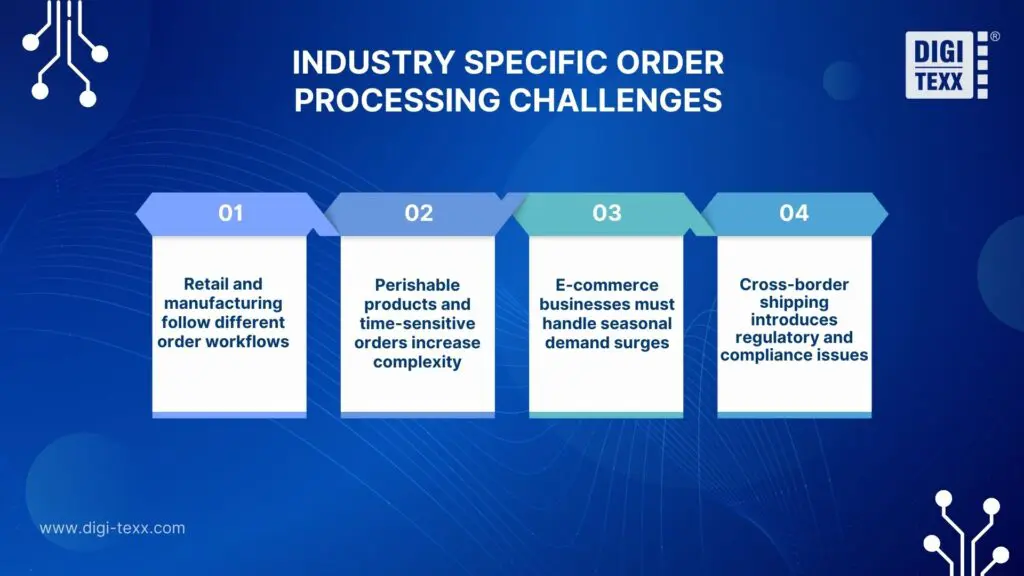
Retail And Manufacturing Follow Different Order Workflows
Retail and manufacturing businesses face fundamentally different order processing challenges. Retailers manage high volumes of small, frequent orders that require speed and efficient handling of returns, while manufacturers process fewer but larger orders involving bulk quantities, longer lead times, and product customization. These differences extend to inventory priorities, with retail focusing on finished goods and manufacturing emphasizing raw materials and production planning. Addressing this complexity requires tailored order processing workflows, standardized data structures, and clear process handoffs.
Perishable Products And Time-Sensitive Orders Increase Complexity
Industries handling perishable or time-sensitive products operate under strict time constraints and higher risk of loss. Short shelf life, cold-chain dependencies, and regulatory requirements increase the margin for error in order processing. Any delay or data inaccuracy can lead to spoilage, missed delivery windows, or compliance issues. Effective solutions focus on faster order validation, real-time visibility, and data-driven coordination between inventory, fulfillment, and logistics.
E-commerce Businesses Must Handle Seasonal Demand Surges
E-commerce businesses frequently experience sharp spikes in order volume during promotions and peak seasons, placing heavy pressure on internal teams and manual processes. Fixed capacity and limited automation often lead to order backlogs, fulfillment delays, and higher error rates. To manage these surges, businesses need scalable order processing supported by demand forecasting, standardized workflows, and flexible execution models.
Cross-Border Shipping Introduces Regulatory And Compliance Issues
Cross-border order processing adds complexity through varying customs regulations, taxes, tariffs, and documentation requirements across markets. Errors in data or compliance can result in shipment delays, penalties, and unexpected costs, while data security and privacy regulations further raise operational risk. Addressing these challenges requires standardized documentation, accurate data handling, and clear compliance workflows.
>>> See more:
- How to Automate Documentation in 2026: Step By Step Guide
- What Is A Back Office Service? Examples, Benefits, And Cost In 2026
- Top 10 Data Processing Software For Business 2026 – Best Tool Reviewed
- Best Real Estate Image Processing Services 2026: Top 15 Providers
Outsourced Order Processing Services By DIGI-TEXX
DIGI-TEXX provides outsourced order processing services to help businesses optimize their order processing workflows with effective control over costs, quality, and accuracy. Instead of investing in additional personnel, systems, and complex internal processes, businesses can transfer all or part of their order processing operations to DIGI-TEXX to ensure stable, flexible, and consistent operation.
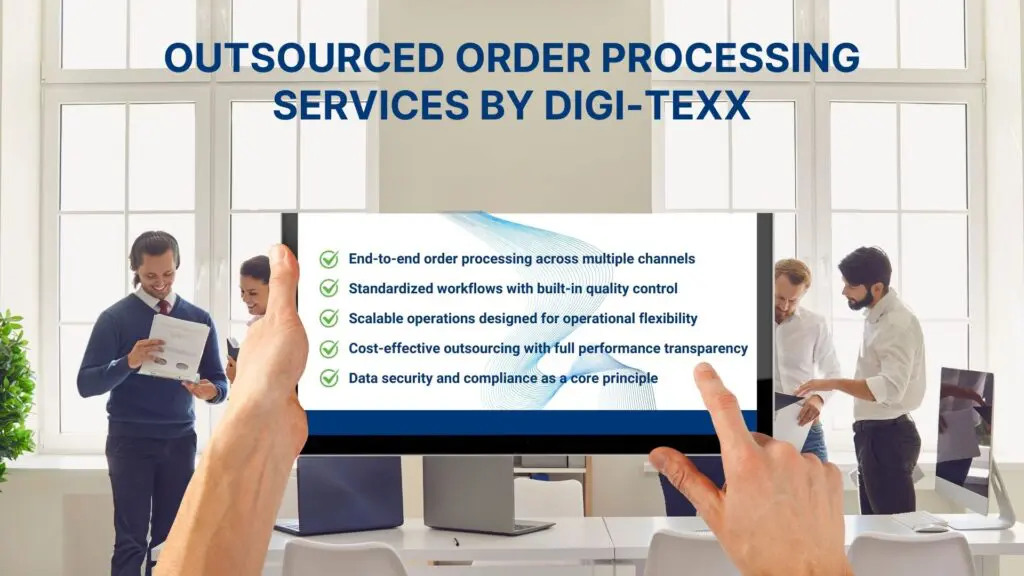
- End-to-end order processing across multiple channels: DIGI-TEXX handles order intake and processing across websites, emails, ERP systems, and integrated sales platforms. Orders are standardized and validated through agreed workflows to reduce errors and ensure consistent handover.
- Standardized workflows with built-in quality control: DIGI-TEXX’s services are built on standardized workflows with multi-layer quality control. Key performance indicators such as processing time, exception rates, and rework frequency are continuously monitored to identify inefficiencies and address bottlenecks early, ensuring consistent order handling even during volume spikes.
- Scalable operations designed for operational flexibility: DIGI-TEXX enables businesses to scale order processing capacity up or down in response to seasonal demand, sales campaigns, or expansion needs. Resources are structured to adapt quickly, ensuring service continuity without overloading internal teams or underutilizing capacity.
- Cost-effective outsourcing with full performance transparency: By leveraging a BPO delivery model and experienced teams, DIGI-TEXX helps organizations optimize operational costs compared to in-house order processing. Transparent reporting provides clear visibility into order status, turnaround time, and performance metrics in real time or through scheduled reports.
- Data security and compliance as a core principle: Data security and regulatory compliance are foundational to DIGI-TEXX’s order processing services. Order and customer data are protected through strict security policies, controlled access, and disciplined procedures, enabling businesses to confidently outsource mission-critical processes.
FAQs About Outsource Order Processing
What Are The Future Trends Of Order Processing Outsourcing?
Future trends in order processing outsourcing focus on increased automation and AI adoption, deeper use of data-driven analytics, and stronger omnichannel integration. Providers are also placing greater emphasis on data security, sustainability, and transparency, especially for cross-border and multi-channel operations.
How to Ensure Success When You Outsource Order Processing?
To ensure success when you outsource order processing, businesses should clearly define objectives, select a provider with relevant industry experience, and establish clear SLAs and performance metrics. Ongoing communication and performance monitoring are essential to maintain accuracy, service quality, and long-term operational alignment.
How Much Does Outsourcing Order Processing Cost?
The cost of outsourcing order processing varies based on order volume, complexity, service scope, and technology needs. For a tailored quote and expert guidance, contact DIGI-TEXX via hotline +84 28 3715 5325.
>>> See more:
- Top 10 Data Entry Outsourcing Companies to Hire in 2026
- Top 10 Best Big Data Processing Tool for Business 2026
- Professional E-commerce Data Entry Services by DIGI-TEXX
Outsourced order processing has become a practical solution for businesses facing growing order volumes, multi-channel complexity, and rising accuracy demands. By standardizing workflows, applying data-driven controls, and scaling execution flexibly, businesses can maintain speed, accuracy, and visibility across the entire order lifecycle.
With proven experience in multi-channel order processing, DIGI-TEXX delivers reliable outsourced order processing services that help businesses reduce manual workload, improve order accuracy, and scale operations with confidence. If you are looking for a trusted partner to support fast, accurate, and scalable order processing, DIGI-TEXX is ready to support your operational growth.
DIGI-TEXX Contact Information:
🌐 Website: https://digi-texx.com/
📞 Hotline: +84 28 3715 5325
✉️ Email: [email protected]
🏢 Address:
- Headquarters: Anna Building, QTSC, Trung My Tay Ward
- Office 1: German House, 33 Le Duan, Saigon Ward
- Office 2: DIGI-TEXX Building, 477-479 An Duong Vuong, Binh Phu Ward
- Office 3: Innovation Solution Center, ISC Hau Giang, 198 19 Thang 8 street, Vi Tan Ward
References:
- APICS / Association for Supply Chain Management (ASCM) (.org) https://www.ascm.org/
- Institute for Supply Management (ISM) (.org) https://www.ismworld.org/