

In today’s digital economy, businesses rely on data to make informed decisions and improve operational efficiency. However, raw information only becomes valuable when structured and analyzed effectively. Data processing transforms scattered data into accurate, actionable insights that reduce costs, improve accuracy, and strengthen strategic planning. In this article, DIGI-TEXX explores what data processing is, why it matters, and how it delivers measurable business value. In this article, DIGI-TEXX helps you understand what data processing is, why it matters, and how it creates measurable value for your business.
>>> See more:
- Top 10 Data Cleansing Companies for Businesses in 2026
- What are the 6 steps of the data analysis process?
- Top 10 Data Entry Outsourcing Companies to Hire in 2026
- How to Automate Documentation in 2026: Step By Step Guide
What Is Data Processing?
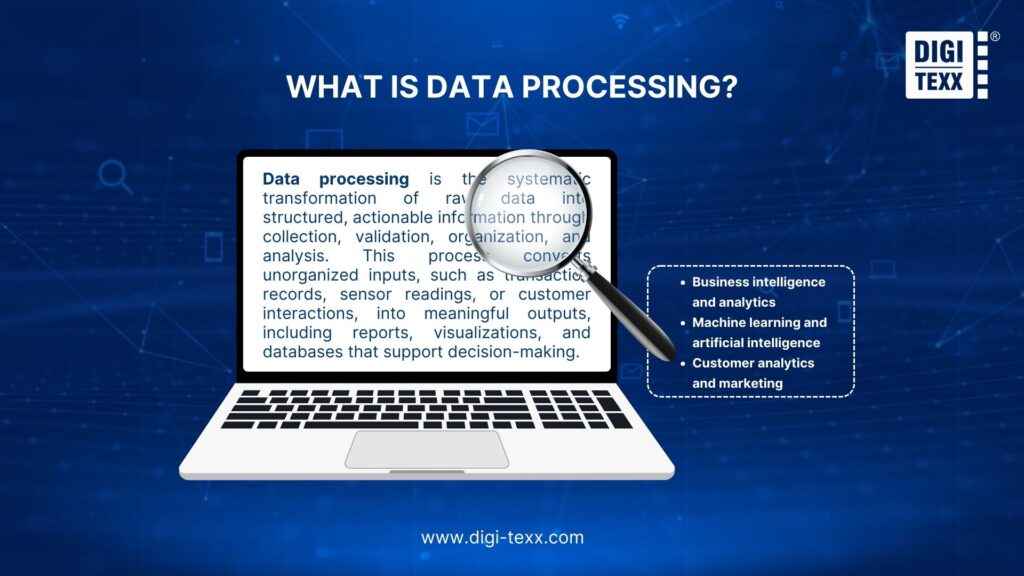
Data processing is the systematic transformation of raw data into structured, actionable information through collection, validation, organization, and analysis. This process converts unorganized inputs, such as transaction records, sensor readings, or customer interactions, into meaningful outputs, including reports, visualizations, and databases that support decision-making.
Modern data processing operates through automated computer systems executing millions of operations per second. Organizations process data to extract insights, identify patterns, and generate intelligence that drives business strategy.
Data processing serves critical functions across:
- Business intelligence and analytics: Transforming operational metrics into strategic insights
- Machine learning and artificial intelligence: Preparing training datasets for predictive algorithms
- Customer analytics and marketing: Converting interaction data into behavior patterns
- Scientific research: Processing experimental observations for statistical analysis
- Supply chain optimization: Analyzing logistics data to improve efficiency
- IoT and sensor networks: Managing real-time data streams from connected devices
- Financial analysis: Processing transaction data for compliance and forecasting
The evolution from manual ledgers to electronic systems reduced processing time from weeks to milliseconds. This acceleration enables organizations to analyze billions of data points daily, supporting real-time decision-making and advanced analytics that were impossible with manual methods.
What Are The Stages Of Data Processing?
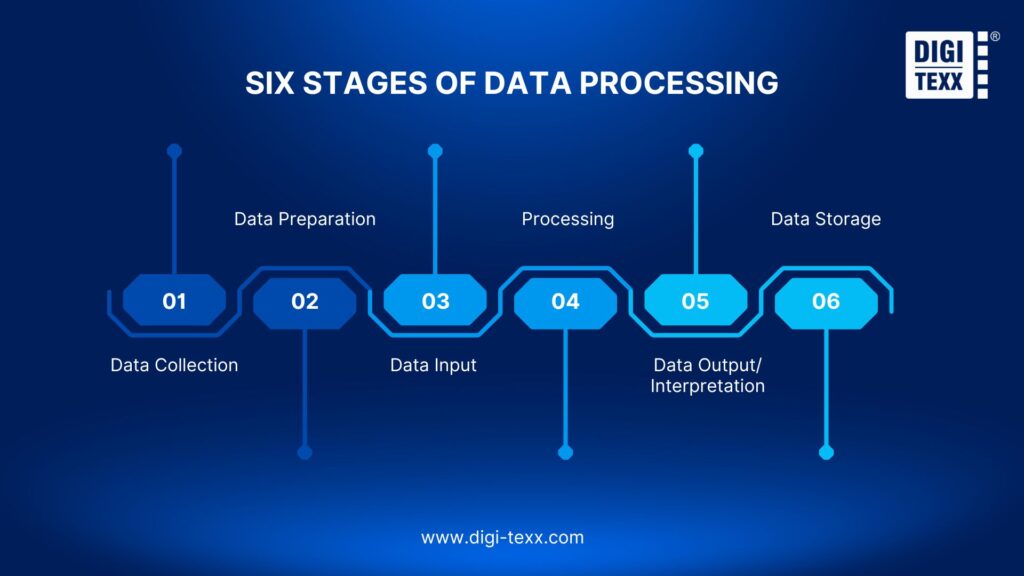
Data processing transforms raw inputs into actionable intelligence through six interconnected stages. Each stage builds systematically from collection Data processing follows a structured lifecycle that converts raw data into reliable information. While the exact workflow varies depending on business requirements and technology infrastructure, most enterprise data processing systems include six core stages: data collection, preparation, input, processing, output and interpretation, and storage.
1. Data Collection
Data collection is the first stage of data processing, where organizations gather raw data from different internal and external sources. The goal of this stage is to collect relevant, accurate, and complete data that supports specific business objectives.
Enterprise data can come from various sources, including:
- Transaction records from business applications
- Customer information from CRM systems
- Financial data from ERP platforms
- Website and application activity logs
- IoT sensors and connected devices
- Customer surveys and feedback
- Documents, emails, and other unstructured data sources
For example, an e-commerce company may collect data from customer purchases, product interactions, payment transactions, and website behavior to understand buying patterns and improve customer experiences.
The quality of collected data directly affects every following stage of the data processing lifecycle. Incomplete, outdated, or inaccurate data can create unreliable insights and negatively impact business decisions.
To improve data reliability, organizations typically establish data collection standards, validation rules, and governance practices to ensure that collected information is relevant, consistent, and trustworthy.
2. Preparation
Data preparation is often considered one of the most important and time-consuming stages of data processing because raw data is rarely ready for immediate analysis.
During this stage, organizations clean, organize, standardize, and enhance datasets to improve accuracy and usability. High-quality data preparation ensures that downstream systems, analytics platforms, and AI models receive reliable information.
Key activities in data preparation include:
Data Cleansing
Data cleansing involves identifying and correcting inaccurate, incomplete, or duplicate records.
Common data cleansing activities include:
- Removing duplicate entries
- Correcting incorrect values
- Filling missing information
- Removing outdated or irrelevant records
- Identifying inconsistencies between datasets
For example, customer records collected from multiple systems may contain different formats for names, addresses, or contact information. Data cleansing helps create a consistent and accurate dataset.
Data Transformation
Data transformation converts data into a standardized format that can be processed efficiently by analytical systems.
Examples include:
- Converting different date formats into a unified structure
- Standardizing measurement units
- Converting text-based information into structured values
- Normalizing data formats across multiple sources
Data transformation is especially important when organizations combine information from different systems, such as integrating CRM data with financial or operational databases.
Data Validation
Data validation ensures that processed data meets predefined quality rules and business requirements.
Validation checks may include:
- Data accuracy
- Data completeness
- Data consistency
- Data format compliance
For example, a financial system may validate whether transaction records contain required fields before they are used for reporting.
Data Enrichment
Data enrichment enhances existing datasets by adding relevant information from additional sources.
Businesses may enrich customer or operational data with:
- Demographic information
- Geographic data
- Industry classifications
- External business information
By improving data completeness, enrichment helps organizations generate deeper insights and make better-informed decisions.
3. Data Input
Data input is the next step. This step involves feeding the cleaned and prepared data into a processing system, which could be software or an algorithm made for a particular kind of data or analysis objective. Data can be entered into the processing system using a variety of techniques, including manual entry, data import from outside sources, and automatic data capture.
4. Processing
The processing stage is the core part of the data processing lifecycle, where raw data is analyzed, organized, and transformed into meaningful information.
Depending on business objectives, organizations apply different data processing techniques, including:
- Sorting
Sorting organizes data based on specific criteria to make information easier to analyze.
Example: A company may sort customer transactions by purchase date, region, or transaction value to identify business trends.
- Filtering
Filtering removes unnecessary information or selects specific data subsets based on defined conditions.
Example: A marketing team may filter customer data to analyze only users from a specific geographic market.
- Calculation
Calculation applies mathematical operations to generate new insights from existing data.
Examples include: Revenue calculations, average customer spending, Performance metrics, statistical analysis
- Aggregation
Aggregation combines multiple data records into summarized information.
Examples: Monthly sales reports, customer activity summaries, operational performance dashboards
- Classification
Classification organizes data into predefined categories based on specific characteristics.
Examples: Categorizing customer segments, detecting fraudulent transactions, classifying documents automatically
Modern enterprise data processing increasingly combines traditional techniques with advanced technologies such as artificial intelligence, machine learning, and cloud computing to process complex datasets at scale.
5. Data Output/Interpretation
After processing, data needs to be presented in a format that business users can understand and apply. The output stage transforms processed data into useful formats, including:
- Reports
- Dashboards
- Data visualizations
- Analytical summaries
- Machine learning predictions
However, producing output is only part of this stage. Organizations must also interpret the results to identify patterns, understand trends, and make informed decisions.
For example, a business intelligence dashboard may show declining sales performance, but interpretation helps decision-makers understand the underlying causes, such as changing customer behavior, pricing issues, or market conditions.
Effective data interpretation connects technical processing activities with measurable business outcomes.
6. Data Storage
The final stage of data processing involves storing processed information so it can be accessed, analyzed, and reused when needed.
Organizations typically store processed data in:
- Relational databases
- Data warehouses
- Data lakes
- Cloud storage platforms
Data storage is not only about keeping information available. Enterprise organizations must also ensure that stored data remains secure, compliant, and accessible.
Important considerations include:
- Data Security: Organizations implement access controls, encryption, and monitoring systems to protect sensitive information.
- Compliance Management: Proper storage helps businesses meet regulatory requirements related to data privacy and retention.
- Future Analysis: Stored data provides a foundation for future analytics, reporting, artificial intelligence models, and business optimization.
A strong data storage strategy ensures that processed information remains valuable throughout its lifecycle.
>>> See more:
- Best Offshore Data Annotation Service Providers in 2026
- An Overview of Document Processing Company: What You Need to Know
- Document Indexing Services For Efficient Search & Data Access
Why Is Data Processing Important?
Organizations generate more data than ever before, but raw information alone does not create business value. Without an effective data processing strategy, organizations struggle with inconsistent records, slow reporting, poor decision-making, and compliance risks.
By transforming raw data into structured, reliable information, data processing enables businesses to improve operational performance, automate repetitive workflows, and support data-driven decision-making across every department.
Supports Better Decision-Making
Business leaders rely on timely and accurate information to make strategic decisions. Data processing consolidates information from multiple systems, removes inconsistencies, and transforms fragmented records into meaningful business insights.
Instead of reviewing thousands of individual transactions, executives can analyze dashboards, KPIs, forecasts, and trend reports that support faster and more confident decision-making.
Improves Operational Efficiency
Manual data handling often creates bottlenecks, duplicate work, and unnecessary operational costs. Automated data processing reduces repetitive tasks, accelerates workflows, and allows employees to focus on higher-value activities.
Organizations processing invoices, insurance claims, customer applications, or financial transactions can significantly reduce processing time while maintaining consistent quality.
Enhances Data Quality
Poor-quality data affects every downstream business process. During data processing, organizations apply validation, cleansing, deduplication, and standardization techniques to improve accuracy and consistency before data enters operational or analytical systems. High-quality data also improves reporting accuracy and increases confidence in AI and business intelligence initiatives.
Strengthens Security And Compliance
Enterprise data processing incorporates governance policies, access controls, encryption, audit trails, and validation mechanisms that help organizations protect sensitive information while complying with regulations such as GDPR, HIPAA, and industry-specific standards.
Enables AI And Advanced Analytics
Artificial intelligence, predictive analytics, and machine learning depend on clean, structured, and well-governed datasets. Effective data processing prepares information for AI training, business forecasting, intelligent automation, and real-time analytics, making it a critical foundation for digital transformation.
Reduces Costs While Increasing Scalability
Automated processing minimizes manual labor, reduces operational errors, and enables organizations to process significantly larger data volumes without proportional increases in staffing or infrastructure. Cloud-native processing platforms further improve scalability by allocating computing resources based on business demand.
>>> See more:
- Outsourcing Data Management: Benefits, Services & Best Practices
- Invoice Processing Services – Outsourcing Data Entry
- Secure Data Annotation Services: Top Companies & How to Choose
Types Of Data Processing
Organizations process data in different ways depending on business objectives, response-time requirements, data volume, and computing resources. While some workloads prioritize processing large datasets efficiently, others require immediate responses to support real-time operations. Understanding these processing types helps organizations select the most appropriate architecture for their applications and business workflows.

1. Commercial Data Processing
Commercial data processing supports day-to-day business operations by handling transactional and operational data generated across an organization. Common examples include sales transactions, customer records, invoices, inventory updates, payroll, and financial reporting.
Businesses often combine commercial data processing with CRM, ERP, and accounting systems to improve operational efficiency, reduce manual work, and generate timely business insights.
Typical use cases:
- Retail and e-commerce transactions
- Banking and financial operations
- Inventory management
- Customer relationship management (CRM)
- Enterprise resource planning (ERP)
2. Scientific Data Processing
Scientific data processing focuses on analyzing large volumes of experimental or observational data to support research and discovery. Unlike commercial processing, which emphasizes business transactions, scientific processing prioritizes accuracy, repeatability, and computational analysis.
This approach is widely used in research institutions, healthcare, engineering, climate science, and pharmaceutical development, where massive datasets must be processed before statistical analysis or simulation.
Typical use cases:
- Clinical research
- Weather forecasting
- Genomics and bioinformatics
- Engineering simulations
- Academic research
3. Batch Data Processing
Batch processing executes large groups of data at scheduled intervals rather than processing each transaction individually. Because results are not required immediately, organizations often run batch jobs during off-peak hours to improve system efficiency and reduce infrastructure costs.
Batch processing is ideal for repetitive workloads involving millions of records.
Typical use cases:
- Payroll processing
- Monthly financial reports
- Utility billing
- ETL and data warehouse loading
- Large-scale invoice processing
4. Online Data Processing (OLTP)
Online data processing handles transactions immediately as users interact with an application. Every request—such as placing an order, updating account information, or making a payment—is processed individually while the user waits for a response.
Unlike batch processing, online processing prioritizes responsiveness and transaction integrity.
Typical use cases:
- E-commerce checkout
- ATM transactions
- Airline reservations
- Hotel booking systems
- Customer self-service portals
>>> Explore more:
- Everything You Need to Know About Business Data Processing
- AI Data Processing Company: Transforming Data into Intelligent Business Insights
- Data Cleaning Methods: 6 Core Techniques For Clean Data
5. Real-Time Data Processing
Real-time data processing analyzes incoming data immediately after it is generated, enabling organizations to respond within seconds or even milliseconds. This approach is essential when delayed processing could lead to financial loss, operational disruption, or safety risks.
Unlike online processing, which focuses on user transactions, real-time processing often supports automated decision-making for machines and systems.
Typical use cases:
- Fraud detection
- IoT sensor monitoring
- Autonomous vehicles
- Industrial automation
- Healthcare monitoring systems
6. Distributed Data Processing
Distributed processing divides workloads across multiple servers or computing nodes, allowing large datasets to be processed simultaneously. By distributing tasks, organizations improve scalability, fault tolerance, and processing performance.
Modern big data platforms such as Apache Hadoop and Apache Spark rely on distributed processing to analyze massive datasets efficiently.
Typical use cases:
- Big data analytics
- Enterprise data lakes
- Large-scale log analysis
- AI model training
- Cloud-based analytics platforms
7. Parallel Processing (Multiprocessing)
Parallel processing uses multiple CPUs, processor cores, or GPUs to execute multiple computational tasks simultaneously within a single system. This approach significantly reduces execution time for complex calculations and resource-intensive workloads.
Although often used alongside distributed processing, parallel processing typically occurs within one machine or tightly connected computing environment.
Typical use cases:
- Image processing
- Video rendering
- Scientific simulations
- Machine learning training
- Financial modeling
>>> See more:
- Ecommerce Photo Retouching Services | Boost Image Quality
- Fashion Photo Retouching: Key Techniques, Benefits, and Tips
- Healthcare Back-Office Support Services For Efficient Operations
8. Stream Processing
Stream processing continuously analyzes data as it flows into a system instead of waiting for scheduled batches. Organizations use this approach to process high-velocity event streams generated by applications, IoT devices, websites, and connected systems.
Because data is processed continuously, stream processing enables faster operational visibility and real-time analytics.
Typical use cases:
- Website clickstream analytics
- Social media monitoring
- Financial market analysis
- IoT telemetry
- Network monitoring
9. Cloud-Based Data Processing
Cloud-based data processing leverages cloud infrastructure to scale storage and computing resources on demand. Rather than maintaining on-premises hardware, organizations can process data using managed services from providers such as AWS, Microsoft Azure, or Google Cloud.
Cloud platforms simplify deployment while providing flexibility, scalability, and cost optimization for data-intensive workloads.
Typical use cases:
- Cloud data warehouses
- Business intelligence
- Enterprise analytics
- AI model deployment
- Data lake processing
Data Processing Methods
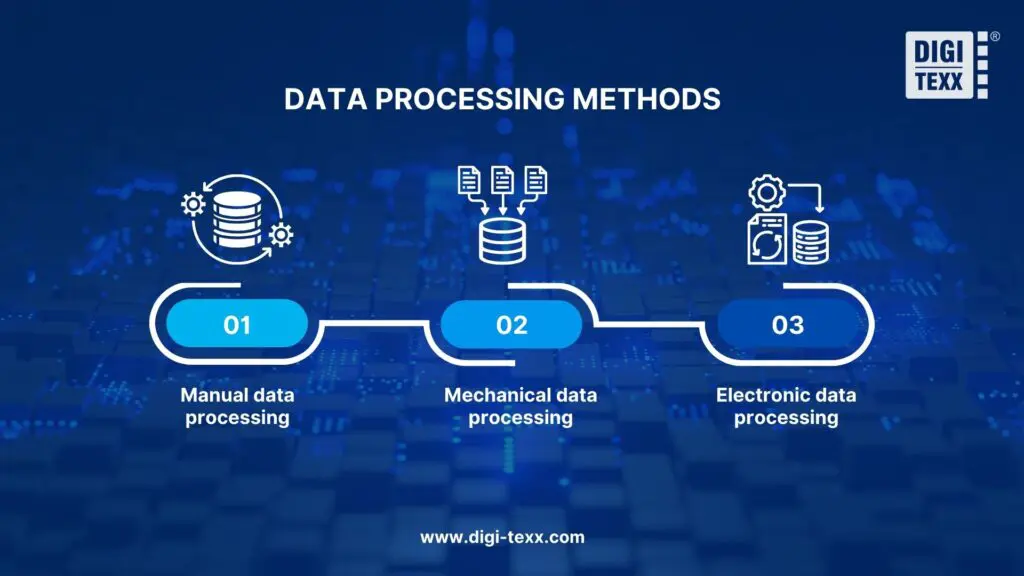
While the processing types above describe how workloads are executed, data processing methods describe how data is handled throughout the processing lifecycle. The three traditional methods reflect the evolution of data processing from manual operations to fully computerized systems.
1. Manual Data Processing
Manual data processing relies entirely on human effort to collect, calculate, organize, and interpret information. Employees typically use paper documents, spreadsheets, or calculators to complete processing tasks.
Although suitable for small datasets or situations requiring human judgment, manual processing is slow, difficult to scale, and more susceptible to human error.
2. Mechanical Data Processing
Mechanical data processing uses physical devices to assist repetitive data-handling tasks. Historically, organizations relied on machines such as punch card systems, adding machines, and tabulators before electronic computers became widely available.
Today, mechanical processing survives primarily in data capture technologies such as barcode scanners, card readers, and automated sorting equipment, where physical devices help collect or organize information.
3. Electronic Data Processing (EDP)
Electronic Data Processing (EDP) uses computers and software to automate the complete data processing lifecycle, from collection and validation to analysis, storage, and reporting.
Modern EDP systems integrate databases, enterprise applications, cloud platforms, and AI technologies to process millions of records accurately and efficiently. As a result, electronic processing has become the standard approach across industries, enabling advanced analytics, business intelligence, and machine learning applications.
>>> See more:
- 15 Best Data Labeling Service Providers In 2026
- Outsourced Order Processing Services – Fast & Accurate
- Business Process Automation Solutions: Benefits, Example & Service Company
Technologies That Power Modern Data Processing
Modern data processing depends on multiple technologies working together rather than a single platform or tool. Cloud infrastructure provides scalable computing resources, big data frameworks process massive datasets, artificial intelligence extracts insights automatically, and edge computing enables real-time processing closer to where data is generated. Together, these technologies help organizations process larger volumes of data faster, more accurately, and at lower operational costs.
1. Cloud Computing And Big Data Platforms
Cloud computing enables organizations to process data without investing heavily in on-premises infrastructure. Major cloud providers such as Amazon Web Services (AWS), Microsoft Azure, and Google Cloud offer managed services for data storage, integration, analytics, and large-scale processing that can scale based on business demand.
For organizations working with massive datasets, big data frameworks such as Apache Hadoop and Apache Spark distribute processing workloads across multiple computing nodes. This distributed architecture allows businesses to analyze terabytes or even petabytes of structured and unstructured data more efficiently than traditional systems.
These technologies are commonly used for:
- Enterprise data lakes and data warehouses
- Customer behavior analytics
- Business intelligence reporting
- Large-scale ETL pipelines
- Predictive analytics
2. Artificial Intelligence And Machine Learning
Artificial intelligence (AI) and machine learning (ML) have become integral components of modern data processing. Instead of simply organizing data, AI systems can automatically identify patterns, detect anomalies, classify information, and generate predictions from large datasets.
Machine learning frameworks such as TensorFlow, PyTorch, and scikit-learn enable organizations to build models that continuously improve as more data becomes available. Combined with automated data processing pipelines, AI helps reduce manual analysis while accelerating decision-making.
Common applications include:
- Fraud detection
- Customer segmentation
- Demand forecasting
- Intelligent document processing (IDP)
- Predictive maintenance
- Natural language processing (NLP)
3. Edge Computing And On-Device Processing
Not all data needs to be sent to a centralized cloud platform before it is processed. Edge computing brings data processing closer to where data is generated, such as IoT devices, manufacturing equipment, medical devices, or connected vehicles.
Processing data locally reduces network latency, lowers bandwidth usage, and enables faster responses for time-sensitive applications. Rather than waiting for information to travel to a remote data center, edge devices can analyze events almost immediately and send only relevant results to the cloud.
Typical use cases include:
- Industrial IoT monitoring
- Smart manufacturing
- Autonomous vehicles
- Healthcare monitoring systems
- Smart cities
- Retail edge analytics
>>> See more:
- Data Validation & Verification: Differences With Clear Examples
- Purchase Orders Processing: Steps, Types, Best Practices
- Professional E-commerce Data Entry Services by DIGI-TEXX
FAQs About Data Processing
What Do You Mean By Data Processing?
Data processing is the method of turning raw facts into useful information. It involves three key steps: collection, transformation, and storage.
What Are The Four Types Of Data Processing?
The four main types of electronic data processing are batch processing, real-time processing, distributed processing, and multiprocessing.
What Are The Five Steps Of Data Processing?
The standard data processing cycle consists of five primary stages: collection, preparation, input, processing, and output/storage.
What Are The Best Tools For Data Processing?
Data processing tools transform raw data into actionable insights, spanning ETL, big data frameworks, and analytics software. Key tools include Apache Spark and Hadoop for large-scale processing, SQL for database manipulation, Python/R for analysis, and Talend/Airflow for automation. They enable cleaning, transformation, and storage of data.
What Are The Benefits Of Data Processing?
- Increased productivity and profits. Some data can be processed once and shared with your organization for different tasks and projects. …
- Better business decisions. …
- Limited operational costs. …
- Improved data storage, distribution, and reporting.
Data processing is no longer optional, it’s essential for competitive success. Organizations that implement effective data processing strategies gain faster decision-making, improved efficiency, better data quality, and a foundation for advanced AI and machine learning capabilities.
Whether you’re handling customer data, optimizing operations, or driving innovation, proper data processing transforms information into a strategic advantage. DIGI-TEXX specializes in comprehensive data analytics and processing solutions designed for organizations seeking to extract maximum value from their data assets. Our expert team combines industry best practices with cutting-edge technology to deliver results that drive measurable business impact.
If you have any questions or would like expert advice on data analytics services, please feel free to contact us using the information below.
DIGI-TEXX Contact Information:
Website: https://digi-texx.com/
Hotline: +84 28 3715 5325
Email: [email protected]
Address:
- Headquarters: Anna Building, QTSC, Trung My Tay Ward
- Office 1: German House, 33 Le Duan, Saigon Ward
- Office 2: DIGI-TEXX Building, 477-479 An Duong Vuong, Binh Phu Ward
- Office 3: Innovation Solution Center, ISC Hau Giang, 198 19 Thang 8 street, Vi Tan Ward
Reference:
- Apache Software Foundation. (n.d.). Apache Hadoop. https://hadoop.apache.org/
- Apache Software Foundation. (n.d.). Apache Spark: Unified analytics engine for large-scale data processing. https://spark.apache.org/