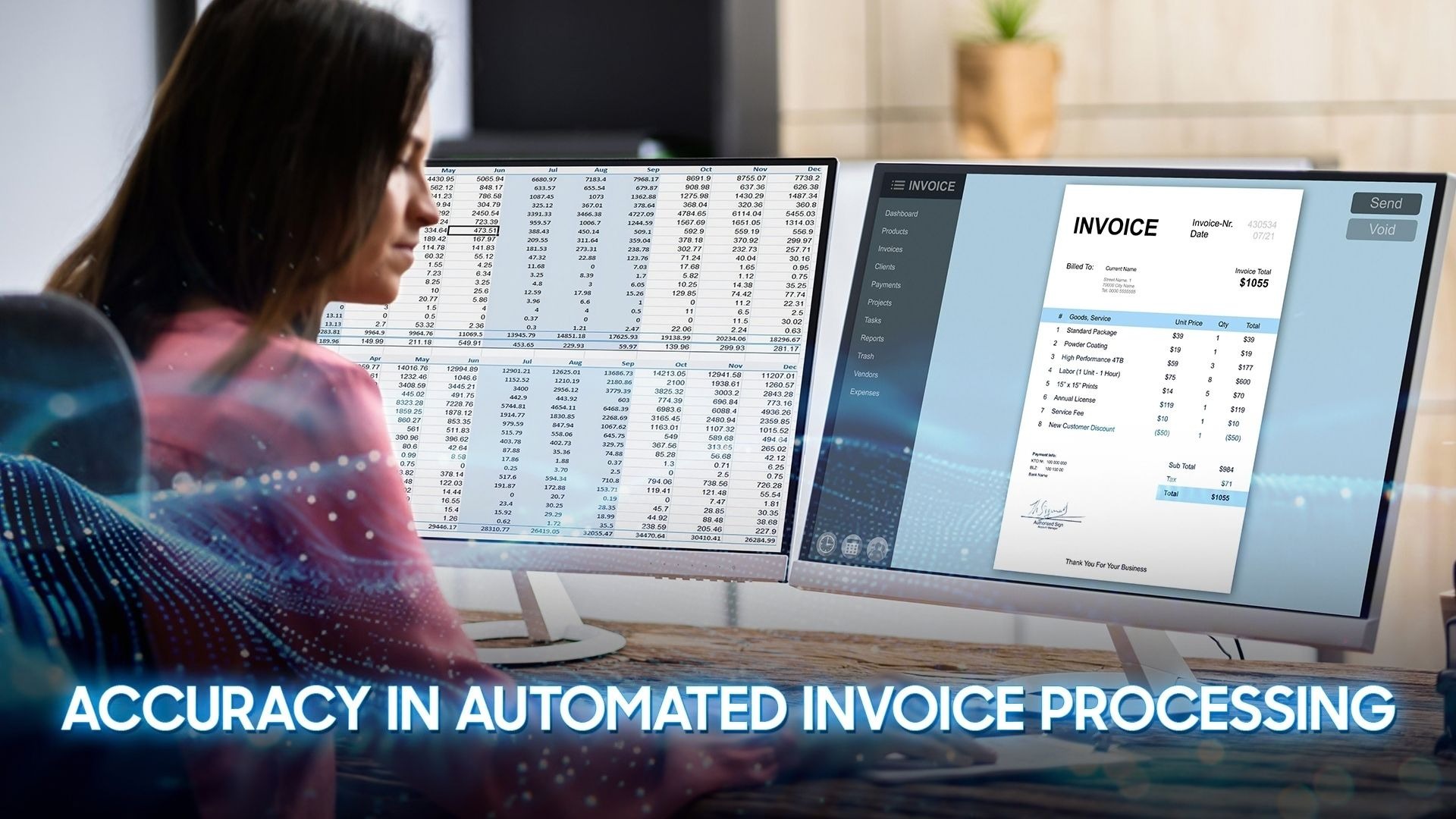

Data validation & verification are essential for maintaining accurate, consistent, and trustworthy business data. Whether supporting data entry services, invoice processing services, or intelligent document processing services, these processes help prevent costly errors, improve data quality, and ensure information is ready for reporting, compliance, and decision making. In this article, DIGI-TEXX will help you understand the key differences between data validation and data verification, explore real world examples, and discover why both are fundamental to effective data management.
>>> See more:
- Construction Invoice Reconciliation: Best Practices, Software & Outsourcing
- How To Prepare a Classified Balance Sheet: Template & Example
- Ecommerce Photo Retouching Services For High Quality Product Images
What Is Data Validation & Data Verification?
Data validation & verification are two fundamental processes that safeguard data quality and integrity. While data validation focuses on ensuring that incoming information is accurate, complete, and properly formatted before it enters your system, data verification ensures that the stored data remains consistent, accurate, and reliable over time.
To better understand how each process works and why both are essential, let’s explore data validation and data verification in more detail below.
What Is Data Validation?
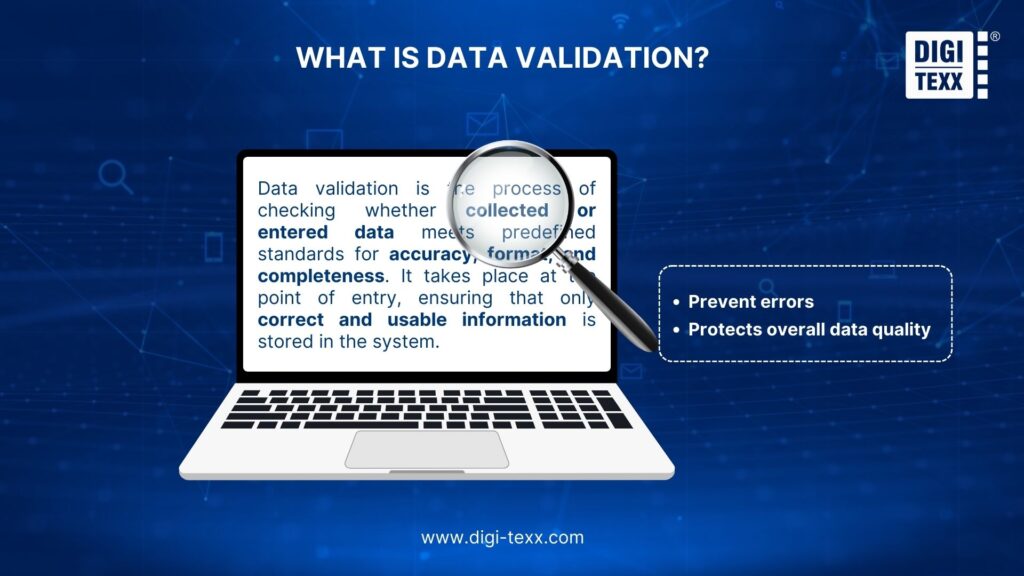
Data validation is the process of checking whether data meets predefined rules for accuracy, completeness, format, and consistency before it is accepted into a system. By identifying invalid, incomplete, or incorrectly formatted information at the point of entry, data validation helps prevent errors and ensures only high quality data is stored and processed.
A typical data validation process includes:
- Defining validation rules based on business requirements.
- Capturing data from forms, documents, APIs, or other sources.
- Checking data against predefined rules and constraints.
- Rejecting or flagging invalid, incomplete, or duplicate records.
- Accepting and storing validated data for further processing.
Common data validation checks include:
- Data Type Check: Ensures the input matches the expected data type, such as text, number, or date.
- Range Check: Confirms that numeric values or dates fall within an acceptable range.
- Presence Check: Verifies that required fields are not left blank.
- Format Check: Ensures data follows a specific pattern, such as a valid email address, phone number, or date format.
- Length Check: Validates that the input contains the required number of characters.
The key benefits of data validation include:
- Provides reliable data for reporting, analytics, and AI driven decision making.
- Improves data quality and accuracy from the point of entry.
- Reduces manual corrections and operational costs.
- Prevents invalid or duplicate data from entering databases.
- Supports regulatory compliance and data governance.
What Is Data Verification?
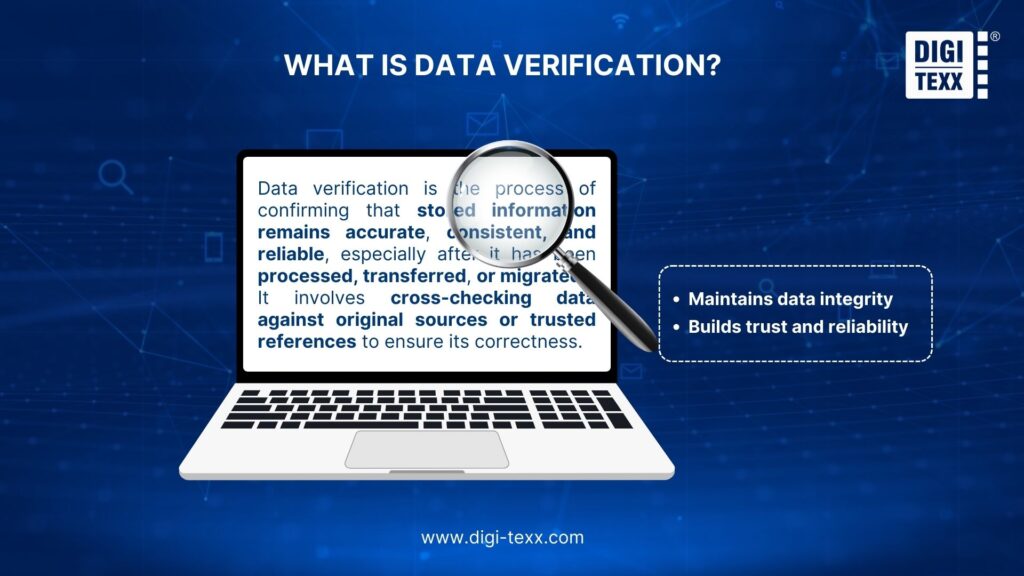
Data verification is the process of confirming that stored, transferred, or processed data remains accurate, complete, and consistent with its original source. Unlike data validation, which prevents incorrect information from entering a system, data verification ensures information remains trustworthy throughout its lifecycle.
A typical data verification process includes:
- Identifying the records or datasets that require verification.
- Comparing data against original documents or trusted databases.
- Detecting discrepancies, duplicate records, or missing information.
- Correcting errors through automated tools or manual review.
- Confirming the accuracy of updated records through ongoing quality checks.
Common data verification methods include:
- Manual verification: Reviewing records against original documents.
- Double entry verification: Comparing two independently entered versions of the same data.
- Source document verification: Matching stored information with contracts, invoices, or application forms.
- Database cross checking: Comparing records with trusted internal or external databases.
- Automated verification: Using AI, OCR, and business rules to identify inconsistencies at scale.
The key benefits of data verification include:
- Enhances the performance of analytics, automation, and AI applications.
- Improves data accuracy and integrity.
- Supports regulatory compliance and audit readiness.
- Reduces errors, duplicate records, and operational costs.
- Increases confidence in reporting and business decisions.
What Is An Example Of Validation And Verification?
To better understand the difference between data validation and data verification, consider a company that processes supplier invoices using an automated document processing system. While both processes help maintain high quality data, they are performed at different stages of the workflow.
Data validation takes place before invoice data is accepted into the system. The system checks whether:
- Required fields, such as the invoice number, supplier name, and invoice date, are complete.
- Data formats, currencies, and dates follow predefined rules.
- Invoice totals are calculated correctly.
- Duplicate invoice numbers or missing information are detected before processing.
Data verification takes place after the invoice has been captured and stored. The system then:
- Compares the extracted data with the original supplier invoice.
- Cross checks information against the purchase order and goods receipt.
- Flags discrepancies in quantities, prices, or payment amounts for review.
- Confirms the verified data is accurate before payment is approved.
This example shows that data validation prevents errors before they enter the system, while data verification confirms that stored information remains accurate, consistent, and ready for business operations.
>>> See more:
- Top 10 Outsourced AI Training Data Companies in 2026
- Best Real Estate Image Processing Services 2026: Top 15 Providers
- Top 10 Data Processing Software For Business 2026 – Best Tool Reviewed
- Financial Data Quality Management: What It Is & Why It Matters
What Is The Difference Between Validating And Verifying Data?
| Criteria | Data Validation | Data Verification |
| Purpose | Ensures data meets predefined rules before it is accepted into the system. | Confirms stored or processed data remains accurate, consistent, and reliable. |
| Timing | Performed during data collection or data entry. | Performed after data is stored, processed, transferred, or migrated. |
| Primary Focus | Preventing invalid or incomplete data from entering the database. | Detecting and correcting inaccuracies in existing data. |
| Input | Raw data entered by users, applications, APIs, or imported files. | Existing records compared against original documents or trusted data sources. |
| Output | Clean, complete, and properly formatted data ready for storage. | Verified data that accurately reflects the original or current information. |
| Common Techniques | Format checks, range checks, required field checks, data type validation, uniqueness checks, and business rule validation. | Source document comparison, double entry verification, database reconciliation, automated cross-checking, and manual review. |
| Automation | Commonly automated using validation rules built into forms, databases, or applications. | Can be automated through AI, business rules, data matching, or human-assisted verification. |
| Business Goal | Improve data quality by preventing errors at the source. | Maintain long-term data accuracy, integrity, and compliance. |
| Typical Use Cases | Online forms, CRM data entry, customer registration, invoice submission, API requests, and ETL pipelines. | Data migration, customer record audits, financial reconciliation, document processing, compliance reporting, and master data management. |
| Example | Rejecting an email address entered in an invalid format or preventing a birth date in the future. | Comparing a customer’s stored address with official records or confirming invoice data against the original document. |
| Result | Fewer input errors, cleaner databases, and higher-quality data from the beginning. | Greater confidence in business data, reduced inconsistencies, and more reliable reporting and analytics. |
>>> See more: Best Insurance Claims Processing Outsourcing BPO in the US 2026
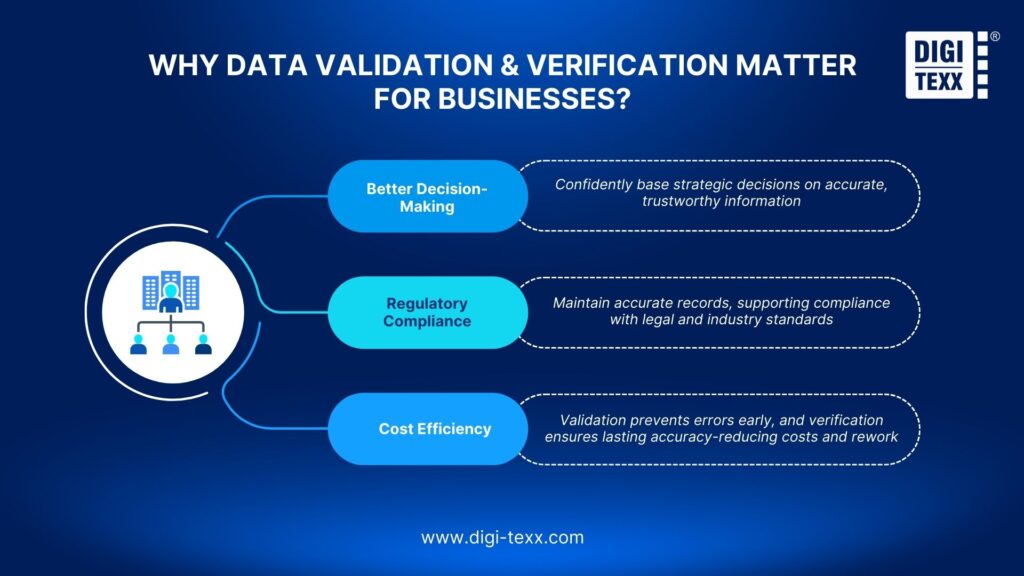
Why Data Validation & Verification Are Essential For Businesses?
Data validation & verification work together to protect the quality, accuracy, and reliability of your business data. Without both processes in place, errors can slip through, leading to poor decisions, compliance risks, and unnecessary costs.
Better Decision-Making
When your data is validated and verified, you can confidently base strategic decisions on accurate, trustworthy information.
Regulatory Compliance
Ongoing verification helps maintain accurate records, supporting compliance with legal and industry standards.
Cost Efficiency
Validation prevents errors at the point of entry, while verification ensures long-term accuracy. Together, they reduce rework, operational disruptions, and costly mistakes.
“It costs ten times as much to complete a unit of simple work when the data are flawed in any way as it does when they’re perfect.” – Thomas C. Redman
>>> See more:
- What Is Business Process Outsourcing (BPO)? Definition & Benefits
- Top 10 Best Data Entry Outsourcing Companies in USA 2026
- What Is A Back Office Service? Examples, Benefits, And Cost In 2026
- 20 Best Data Integration Tools: Definition, Benefits & Features
FAQs About Data Validation & Verification
What Comes First, Verification Or Validation?
Verification comes first, followed by validation. Verification checks whether the product meets specifications and design requirements through reviews, walkthroughs, and inspections, helping detect issues early. Validation comes next and ensures the final product meets user needs through testing in real-world scenarios. Simply put, verification confirms you built it right; validation confirms you built the right thing.
What Are The 5 Types Of Verification?
The five most common data verification methods include:
- Manual verification: Comparing records with original documents.
- Double entry verification: Matching two independently entered versions of the same data.
- Source document verification: Cross checking stored data against source files or forms.
- Database verification: Comparing records with trusted internal or external databases.
- Automated verification: Using AI and business rules to detect inconsistencies.
What Are The 5 Validation Checks?
The five most common data validation checks used to ensure input data is accurate, complete, and logical are:
- Step 1: Data Type Check – Ensures the input matches the expected type, such as text, number, or date.
- Step 2: Range Check – Confirms that numeric values fall within an acceptable range.
- Step 3: Presence Check – Verifies that required fields are not left blank.
- Step 4: Format Check – Ensures data follows a specific pattern, such as DD/MM/YYYY for dates or a valid email structure.
- Step 5: Length Check – Validates that the input contains the correct number of characters.
>>> See more:
- Business Process Automation Solutions: Benefits, Examples & Service Company
- Healthcare BPO Services – Cost Optimization & Improve Care 2026
- Secure Data Annotation Services: Top Companies & How to Choose
- Best 25 Document Management Software For Business 2026
Strong data quality starts with effective data validation & verification. When both processes are properly implemented, businesses can prevent errors at the source, maintain long-term data accuracy, and make confident, data-driven decisions.
However, managing large volumes of documents and data manually can be time-consuming and error-prone. That’s where professional support makes a difference.
With DIGI-TEXX’s Document & Data Processing Services, businesses can streamline data capture, validation, verification, and ongoing quality control. By combining structured workflows, advanced technologies, and experienced data specialists, DIGI-TEXX helps ensure your information is accurate, consistent, and ready for operational and strategic use.
If you’re looking to enhance data quality while optimizing efficiency, explore how DIGI-TEXX’s Document & Data Processing solutions can support your business growth.
DIGI-TEXX Contact Information:
🌐 Website: https://digi-texx.com/
📞 Hotline: +84 28 3715 5325
✉️ Email: [email protected]
🏢 Address:
- Headquarters: Anna Building, QTSC, Trung My Tay Ward
- Office 1: German House, 33 Le Duan, Saigon Ward
- Office 2: DIGI-TEXX Building, 477-479 An Duong Vuong, Binh Phu Ward
- Office 3: Innovation Solution Center, ISC Hau Giang, 198 19 Thang 8 street, Vi Tan Ward
References:
- University of Michigan – Data Quality Resources https://deepblue.lib.umich.edu/
- Data & Analytics Research (edu) https://mitsloan.mit.edu/