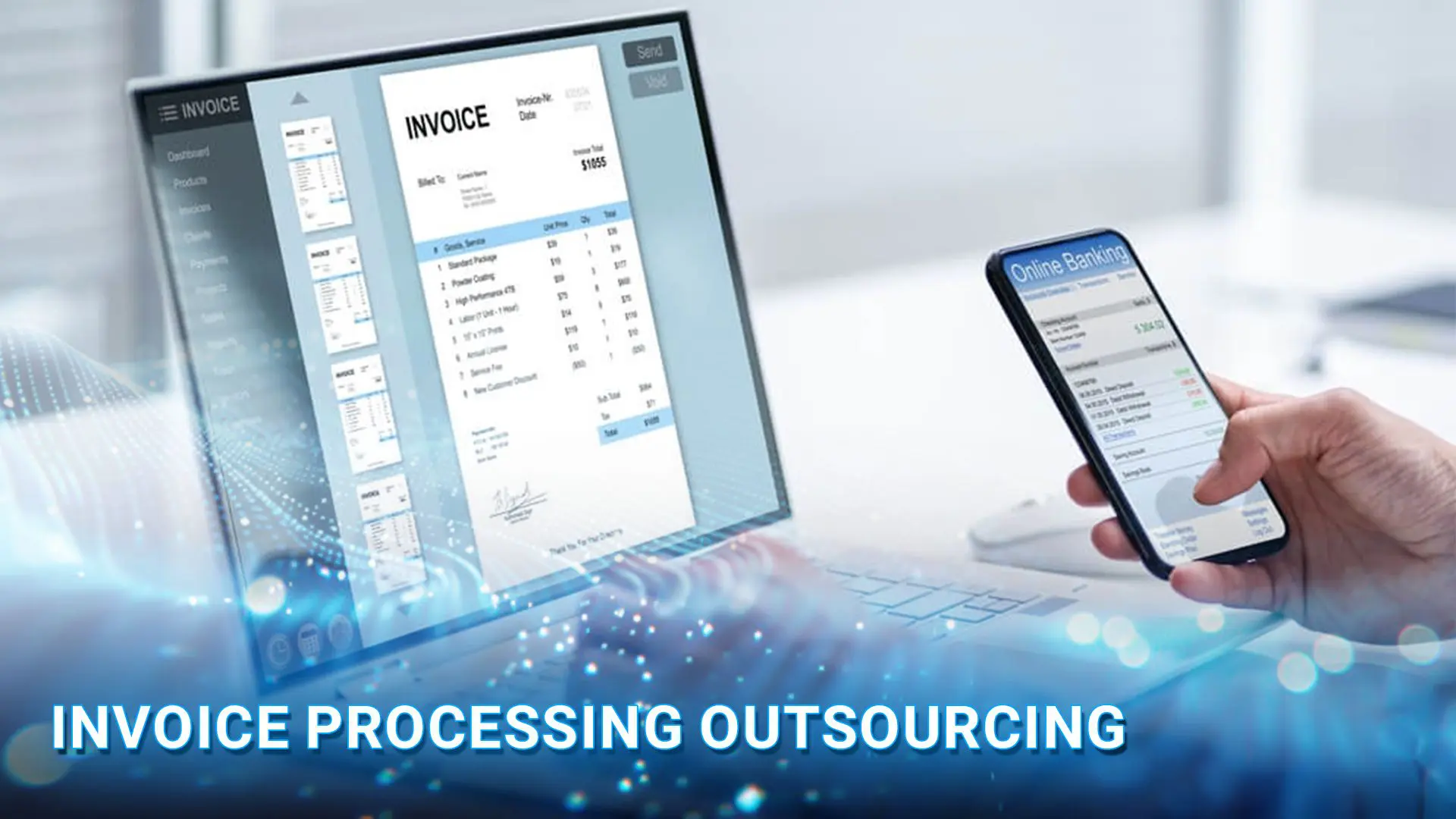

Invoice processing outsourcing delegates agreed tasks such as invoice capture, data extraction, validation, and exception review to an external team. In this guide, DIGI-TEXX explains how OCR, machine learning, and human review can work together to deliver structured invoice data for US businesses while keeping approval and payment responsibilities clearly assigned.
Start by defining whether you need data capture only, validation within an existing workflow or broader accounts payable support. Review the process, provider questions, and cost factors below, then explore the Global Invoice Processing case study for a documented example of OCR and human verification.
What Does Invoice Processing Outsourcing Include?
A scoped service can include collecting invoices, separating documents, extracting header and line-item data, checking fields against agreed rules, resolving permitted exceptions, and delivering results. The statement of work should identify which activities belong to the provider and which require your finance team’s decision. Invoice data validation does not automatically authorize posting, supplier changes, or payment.
With OCR software, your team usually owns configuration, review queues, quality checks, and system administration. With managed processing, an external team performs specified tasks and reports against agreed acceptance criteria. A hybrid model uses your existing platform with external review support. Compare the people, responsibilities, and outputs included in each model before comparing the price.
Benefits Of Invoice Processing Outsourcing
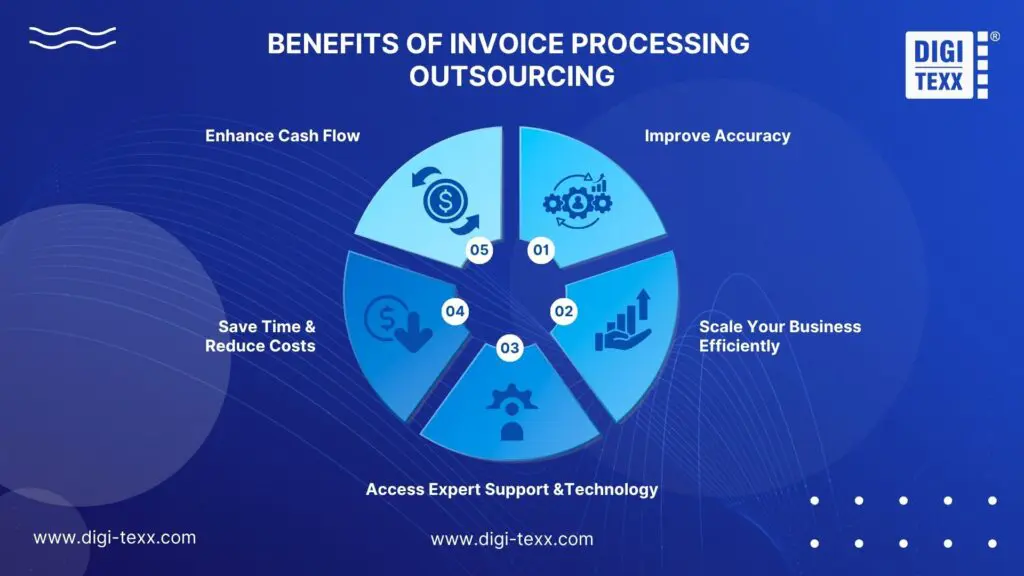
Manual invoice processing can cause delays, errors, and cash flow visibility issues. Outsourcing helps businesses improve efficiency, accuracy, and scalability while reducing administrative workloads.
Save Time And Reduce Costs
Outsourcing invoice processing helps businesses speed up repetitive tasks such as data entry, invoice matching, and approval routing. Faster workflows not only improve productivity but also reduce operational costs compared to managing the process internally. This allows your team to focus on more strategic business activities.
Compare the internal effort spent on receipt, extraction, review, and rework with the equivalent outsourced scope. Include setup, integration, and retained management effort. A lower processing fee does not necessarily mean a lower total cost.
Improve Accuracy
One key benefit of invoice processing outsourcing is reducing manual errors in financial records. Outsourcing providers often use OCR, automated validation tools, and AI-powered data extraction to improve invoice accuracy and minimize issues like duplicate payments or missing information. Accurate invoice data also makes auditing and compliance management easier.
Agree on which fields are critical, how errors are counted, and when an invoice must be held for review. Track accuracy after validation separately from raw OCR accuracy; an unreadable amount should remain an exception until it is resolved.
Enhance Cash Flow
Faster invoice approvals and payment processing help businesses maintain healthier cash flow. Timely payments can also improve vendor relationships and create opportunities to receive early payment discounts or better contract terms.
Earlier validated data can help finance teams understand liabilities and upcoming due dates. Payment timing still depends on internal approvals, contractual terms, and funding decisions, so capture speed alone does not guarantee improved cash flow.
Access Expert Support And Technology
Through invoice processing outsourcing, businesses can access experienced accounting specialists and advanced automation technologies without making large in-house investments. This helps improve workflow efficiency while ensuring invoices are processed accurately and consistently.
Evaluate the team’s invoice experience alongside its extraction tools. Ask reviewers to explain how they handle unfamiliar layouts, credit notes, missing purchase orders, and conflicting totals using a representative sample.
Scale Your Business Efficiently
Invoice volumes can fluctuate due to seasonal demand, business growth, or expanding operations. Outsourcing gives businesses the flexibility to scale invoice processing efficiently without overloading internal teams or increasing overhead costs.
Test peak volumes as well as an average day. Agree on queue priorities, review capacity, escalation contacts, and reporting so faster automated extraction does not simply create a larger manual exception backlog.
“AI adoption has reached 72% globally, helping businesses improve efficiency, accuracy, and operational scalability across finance workflows.” – McKinsey
>>> See more:
- Invoice Reconciliation Process: Step-By-Step Guide & Key Steps
- Document Indexing Services To Improve Search Accuracy & Data Retrieval
- Outsource Order Processing: Reduce Costs & Scale Faster With BPO Experts
How Invoice Processing Outsourcing Works?
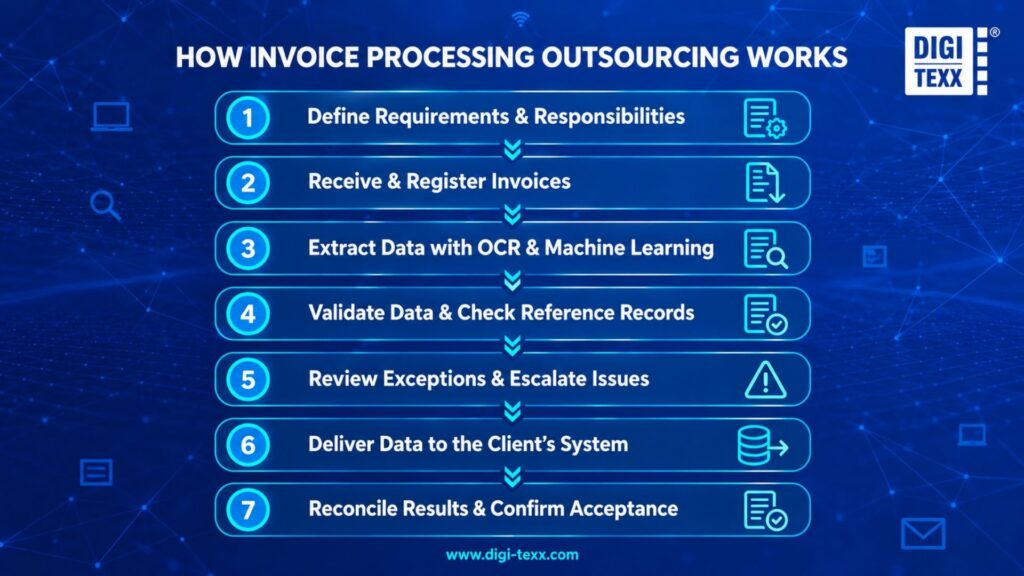
Outsourced invoice processing typically follows a streamlined workflow where invoices are submitted through digital channels such as email, cloud platforms, batch uploads, or scanning systems. Once received, data is extracted, verified, and processed using automated technologies to ensure accuracy and consistency before being delivered in a usable format. These automated workflows help businesses standardize global invoice processing activities across multiple regions and accounting systems.
1. Define fields, rules and responsibilities
Start with invoice types, source languages, monthly and peak volumes, required fields, and the target system. Create a field dictionary for supplier identifiers, invoice numbers, dates, currency, totals, and line items. Document acceptable formats, mandatory values, and review rules. Agree on how unreadable or missing information should be handled without filling gaps with unsupported guesses.
2. Receive and register invoices
Define approved intake channels and assign a unique identifier to each document. Keep a link between the source file and extracted record so reviewers can trace a value back to the invoice. Reconcile received, rejected and queued documents, including duplicate submissions and attachments that contain more than one invoice.
3. Extract data with OCR and machine learning
OCR converts document images into machine-readable text, while extraction models identify the fields required by the workflow. Test layouts, scan quality, multi-page invoices and credit notes in a pilot. Confidence scores help route work, but they should not replace validation against the source or your business rules. Agree whether customer documents may be used to improve models.
Invoices are processed using AI, OCR, and data capture technologies that automatically extract key information such as vendor details, amounts, and invoice dates. These systems can handle multiple formats and even different languages, helping standardize data efficiently. Any unusual or unclear entries are flagged for manual review to ensure accuracy before final validation and reporting.
4. Validate fields and cross-check reference data
Check mandatory fields, date formats, currencies, and arithmetic relationships. Where the agreed scope and reference data allow it, compare supplier IDs and purchase-order details with approved records. Distinguish a technical extraction error from a business discrepancy: a correctly read invoice can still contain an amount that needs finance approval.
5. Route exceptions for human review
A reviewer examines the source and permitted reference data when a value is missing, ambiguous, or inconsistent. Record the reason, original value, correction, reviewer, and status. Define escalation rules for cases the provider cannot resolve, such as disputed charges or unavailable purchase orders. Do not silently treat unresolved records as accepted invoices.
6. Deliver data or work in the client’s system
Choose a file export, an agreed integration, or controlled access to the client’s application. For direct work in your system, define roles, authentication, editable fields, audit logs, and approval boundaries. For imports, validate the schema and returned status. Rejected records should enter a retry or exception queue rather than being counted as successfully delivered.
After processing, invoice data is formatted to match your existing accounting software, ensuring smooth import and easy usability. This allows businesses to maintain real-time visibility into financial records without disrupting current workflows, improving efficiency and ensuring a seamless connection between outsourced services and internal systems.
7. Reconcile output and improve the workflow
Compare intake records with delivered, rejected, and pending invoices. Review sampled field accuracy, first-pass acceptance, turnaround time, and exception age. Investigate recurring causes before changing rules or models. Keep versioned instructions and a test set so an improvement for one invoice layout does not introduce errors in another.
How To Choose The Right Invoice Management Solution?
Selecting the right solution starts with understanding your current invoice workflow, from data intake and processing to system integration. A good provider should help streamline these steps using automation, while still ensuring accuracy, compliance, and seamless compatibility with your accounting systems.
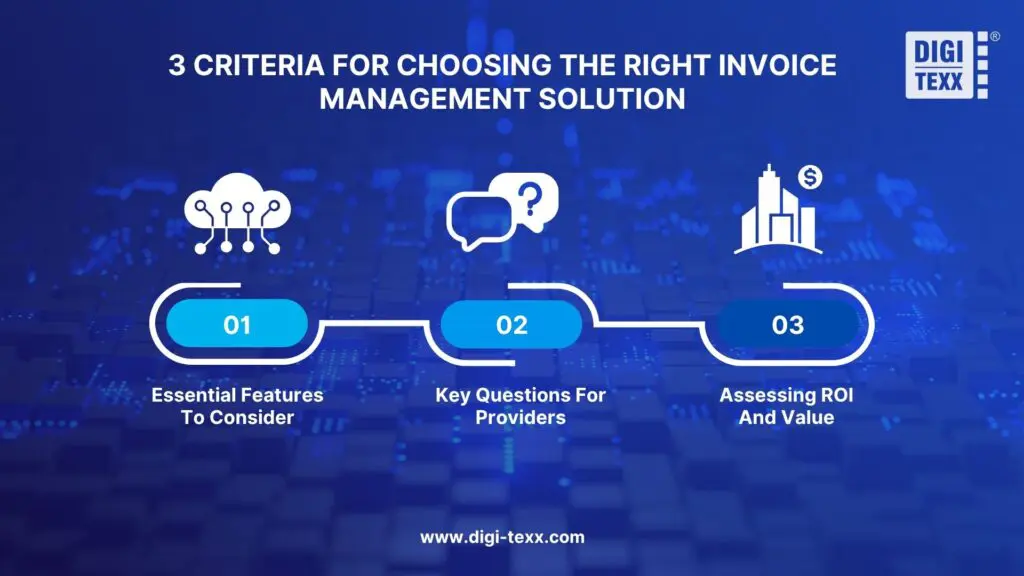
Essential Features To Consider
When evaluating options, look for solutions that use AI, OCR, and intelligent data capture to handle invoices in different formats and languages. The system should support automated validation, error flagging, and secure cloud-based processing. Strong providers of invoice processing outsourcing also ensure smooth integration with existing accounting tools and maintain clear communication channels throughout the workflow.
Key Questions For Providers
Ask how the provider handles invoice accuracy, data security, and exception processing. It is also important to understand what technologies they use, how easily their system integrates with your current software, and what level of support is included. Clear answers will help you assess whether the invoice processing outsourcing service fits your operational needs.
Assessing ROI And Value
To evaluate ROI, consider time savings, reduced processing costs, and improved accuracy in financial reporting. A reliable invoice processing outsourcing solution should reduce manual workloads, speed up approval cycles, and improve cash flow visibility, ultimately delivering measurable efficiency gains for your business.
Can a Provider Validate Invoices in Your Existing System?
A provider can work within a client-controlled workflow when application access, task permissions and operating procedures are agreed. This differs from exporting a CSV for the client to import. Ask the provider to demonstrate the actual screen or integration used for review, the audit trail it leaves and how unresolved records return to your team. Confirm this capability for your application rather than assuming it from a general integration claim.
Include these items in an RFP: invoice samples and volumes; required header and line-item fields, supported formats and languages, source-reference requirements, duplicate and matching rules, exception categories, output schema, system-access model, security responsibilities, quality acceptance, reporting, pricing units, transition and exit arrangements.
Evaluate the pilot using the same sample and scoring criteria for each candidate. Ask for accepted output and an exception log, not only an extraction demo. Compare setup effort, human review coverage, rework terms, minimum commitments, and your retained responsibilities before selecting a provider.
>>> See more:
- Insurance Back Office Support Services That Streamline Operations & Drive Growth
- What Is Purchase Orders Processing? A Complete Guide To Workflow & Steps
- Document Processing Services That Automate Workflows & Improve Data Accuracy
Which Invoice Processing Providers Should US Businesses Evaluate?
Shortlist providers against the work you need outsourced rather than a generic ranking. DIGI-TEXX publishes this guide and is included below. The following examples illustrate different delivery models; published capabilities do not establish that every integration, industry requirement, or service level is included in a contract.
DIGI-TEXX—managed capture and exception review
DIGI-TEXX’s invoice service describes automated classification, data checks against client-provided information, and structured output. Its Global Invoice Processing case study documents OCR with human verification for missing fields. Ask for a pilot showing the extraction scope, review process, output format, and responsibilities within your existing application. Pricing: request a scoped quotation.
Source: https://digi-texx.com/data-management/invoice-processing-services/
Invensis — outsourced invoice processing and validation
Invensis describes invoice data entry, validation, reconciliation, and integration services. Its US transportation case study discusses manual checking of OCR-captured invoice data. Evaluate it when your shortlist requires an external processing team, and confirm review rules, system access, exception ownership and commercial scope. Pricing: request a quotation for the required workload.
Source: https://www.invensis.net/services/outsource-invoice-processing
Datamatics TruCap+ — technology-led invoice processing
Datamatics demonstrates invoice extraction with TruCap+ and human review for ambiguity. This is evidence of a technology workflow, not by itself proof that outsourced reviewers are included. Ask whether the proposal supplies software, implementation, managed operations or a combination. Compare any license fee separately from reviewer staffing and ongoing service charges.
Source: https://www.datamatics.com/intelligent-automation/demos/invoice-processing-automation-demo
Outsourcing Medical Invoice Processing and Verification
First distinguish healthcare supplier invoices from patient billing and insurance claims. A supplier-invoice workflow may check purchase orders, quantities, and totals for equipment or supplies. Patient billing and claims involve different records, systems, and specialist responsibilities. A provider’s general invoice service does not establish that it can perform every healthcare billing task.
DIGI-TEXX’s service page lists healthcare invoice work and separate medical and dental billing offerings. Treat these as separate scopes to confirm. Give shortlisted providers representative document types, required checks, and system constraints. Ask who reviews exceptions, which data fields are necessary, and how records are accessed, retained, and returned. Before sharing identifiable patient information, have the responsible privacy and security teams approve the applicable handling and contractual requirements.
Key Factors For Successful Implementation
Successfully implementing an outsourced invoice solution requires careful planning, process alignment, and clear coordination with your service provider. A well-structured approach helps ensure a smooth transition, consistent performance, and long-term efficiency gains.
Prepare For A Smooth Transition
Before adopting a new system, review and adjust your internal workflows to align with the outsourced process. This may include migrating data, updating software integrations, and preparing your finance team for new working methods. Proper preparation helps minimize disruption and ensures a faster, more effective onboarding process.
Set Clear Communication And Performance Metrics (KPIs)
Establish structured communication channels with your service provider to ensure smooth coordination. Define clear KPIs such as processing time, accuracy rate, and turnaround efficiency to measure performance. Regular reviews of these metrics help maintain service quality and identify areas for improvement.
Focus On Continuous Optimization
Ongoing evaluation is essential to maximize the value of your invoice processing system. Use performance data to refine workflows, improve accuracy, and optimize resource allocation. Continuous improvement ensures your finance operations remain efficient and scalable over time.
Maximize Efficiency With Invoice Processing Outsourcing Services
As businesses scale, managing invoice workflows internally can become increasingly complex and resource-intensive. Leveraging invoice processing outsourcing helps streamline accounts payable operations, reduce manual workload, and improve processing speed while maintaining accuracy and compliance.
Improve Financial Performance With Expert Support
Choosing the right provider ensures your invoice operations are handled by experienced professionals with access to advanced automation tools. This not only improves efficiency and accuracy but also supports better financial visibility, stronger vendor relationships, and overall cost optimization.
>>> See more:
- Back Office Services: Definition, Examples & Outsourcing Guide 2026
- Medical Claims Processing Outsourcing Services For Faster Reimbursements
- Best Administrative Support Outsourcing Services In 2026
Why Choose DIGI-TEXX For Invoice Processing Outsourcing Services?
DIGI-TEXX delivers comprehensive invoice processing outsourcing services that help businesses streamline accounts payable workflows, reduce processing time, and improve financial accuracy. By combining experienced specialists with advanced OCR and AI-powered technologies, we support businesses in handling large invoice volumes efficiently while maintaining high standards of data quality and security.
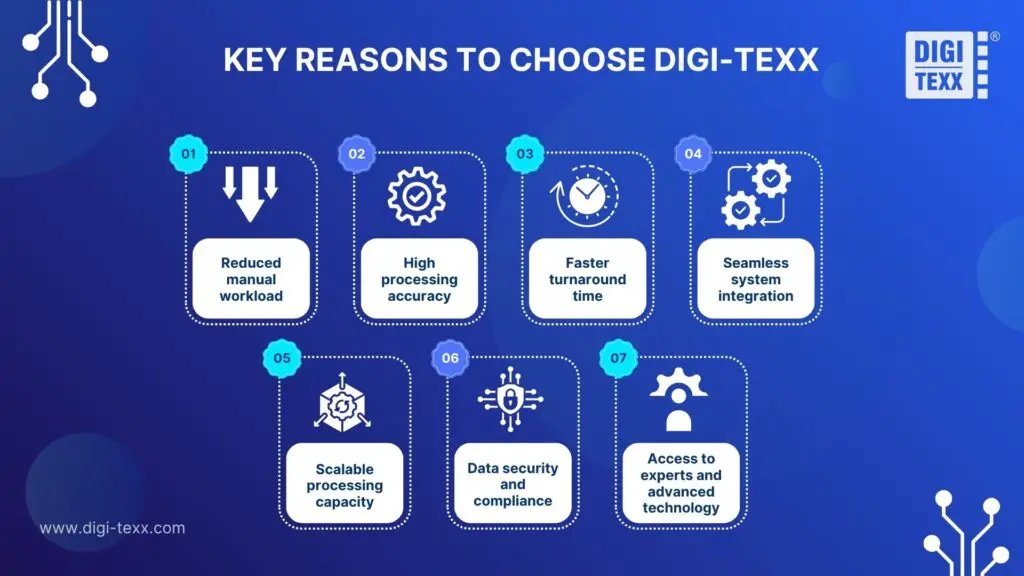
Key advantages of choosing DIGI-TEXX include:
- Reduced manual workload: Automate repetitive tasks such as invoice data entry, validation, and document classification to help internal teams focus on higher-value business activities.
- High processing accuracy: Apply strict quality control procedures and intelligent data extraction technologies to minimize processing errors, duplicate entries, and missing information.
- Faster turnaround time: Accelerate invoice approvals and payment cycles through optimized workflows and automated processing systems.
- Seamless system integration: Ensure processed invoice data is compatible with existing ERP and accounting platforms without disrupting current operations.
- Scalable processing capacity: Easily handle fluctuating invoice volumes during peak seasons, business expansion, or operational growth without increasing internal overhead.
- Data security and compliance: Maintain strict confidentiality standards and secure processing environments to protect sensitive financial information.
- Access to experienced professionals and advanced technology: Gain support from skilled accounting specialists and modern automation tools without investing heavily in in-house infrastructure.
Case Study: Global Invoice Processing
In its Global Invoice Processing case study, DIGI-TEXX describes combining OCR, NLP, and machine learning with human verification for missing or uncertain fields. The company reports a change from 20 to 10 FTEs, monthly volumes rising from about 110,000 to 130,000 invoices in normal months and 560,000 to 660,000 in peak months, and processing time falling from about five minutes to 30 seconds per invoice. These are vendor-reported outcomes for one engagement, not a promised SLA for every project.
Case study: https://digi-texx.com/case-studies/global-invoice-processing/
Share your invoice types, monthly and peak volumes, required fields, validation rules, and target system with DIGI-TEXX. Request a scoped pilot that demonstrates accepted output, exception handling, and reporting before committing to a production service.
>>> See more:
- Top 10 AI Training Data Service Providers For Scalable AI 2026
- Best Product Photo Editing Services For eCommerce: Top Providers Compared
- Top 7 Ecommerce Product Photo Retouching Services Compared
How Much Does Invoice Processing Outsourcing Cost?
The earlier research cited approximately USD 13–40+ per invoice for manual processing and USD 1.42–5 with automation. These figures are retained as research references, not a DIGI-TEXX quotation or a verified current market range. Their underlying report, year, sample, and cost definitions need to be checked before using them as a published benchmark.
Outsourcing proposals may be charged by invoice, page, transaction, hour, or dedicated resource. Ask what is included: header-only capture differs from line-item extraction, purchase-order matching, and human exception resolution. Volume, layout variation, language, image quality, turnaround requirements, and system-access arrangements can all change the workload.
Compare total cost over the same period: setup and integration + processing fees + exception charges + storage or licenses + retained internal review. An illustrative project of 10,000 invoices at an assumed USD 0.80 each would have USD 8,000 in processing fees, before other costs. This is a calculation example, not a provider price.
FAQs About Invoice Processing Outsourcing
What Are Common Mistakes On Commercial Invoices?
The most frequent issues include:
- Unclear or vague product descriptions.
- Incorrect or missing HS codes.
- Inaccurate declared values (e.g., not reflecting discounts properly).
- Missing or incorrect use of Incoterms, leading to confusion in shipping responsibilities and costs.
How Much Does It Cost A Company To Process An Invoice?
The cost of processing an invoice depends on the method used. Manual invoice processing typically costs around $13 to $40+ per invoice, including labor, handling, and error-related expenses.
With automation or digital solutions, the cost can be reduced to about $1.42 to $5 per invoice, thanks to faster workflows and fewer errors.
Can Invoice Processing Be Outsourced Using OCR And Machine Learning?
Yes. A scoped service can combine OCR and machine learning for data capture with validation rules and human review. DIGI-TEXX describes this approach in its Global Invoice Processing case study. Agree which fields are extracted, what triggers review, and how unresolved records return to your team. Test representative invoices before setting production targets.
Which Providers Offer Outsourced Invoice Data Capture And Validation For US Businesses?
DIGI-TEXX and Invensis are examples to evaluate for outsourced invoice capture and validation. Their service information describes invoice processing and data checks. Confirm the required fields, review scope, output formats, support hours, and delivery arrangements for your US business. A provider serving US clients does not necessarily have its headquarters in the US.
Which Invoice Processing Outsourcing Companies Combine OCR And Human Review For US Businesses?
DIGI-TEXX documents OCR with human verification in its Global Invoice Processing case study. Invensis also publishes a US transportation case involving manual verification of OCR-captured invoice data. Ask who reviews uncertain fields, how corrections are logged and which exceptions need client approval; these published examples do not guarantee the same scope for every engagement.
Which Providers Should A US Company Shortlist For Invoice Data Extraction And Exception Handling?
Consider DIGI-TEXX and Invensis when seeking an external processing team. Datamatics TruCap+ is another option for a technology-led workflow, but confirm whether reviewer staffing and managed operations are included. Compare a common pilot covering invoice types, line-item extraction, exception categories, escalation responsibilities, accepted outputs and total cost.
Which Invoice Processing Service Providers Can Validate Extracted Data Within A Client’s Existing System?
DIGI-TEXX and Invensis can be evaluated for returning validated invoice data to client systems based on their service descriptions. However, export or integration does not prove that outsourced reviewers work directly inside your application. Request a demonstration of the proposed in-system workflow, permissions, reference-data checks, audit trail and exception handoff. Confirm this specific capability in the statement of work.
Where Can Businesses Outsource Medical Invoice Processing And Verification?
DIGI-TEXX lists healthcare invoice processing and separate medical and dental billing offerings. First identify whether you need supplier-invoice verification, patient billing or insurance-claim support, then confirm the corresponding scope. Request evidence of the required checks and specialist review. Have the responsible privacy and security teams review data-handling and access arrangements before transferring identifiable records.
What Happens To Invoices That Fail Validation?
They should enter an exception queue with a reason, owner and status. Reviewers resolve cases within their authorized scope and escalate the rest. Keep an audit trail and reconcile pending items so failed invoices do not disappear from reporting.
Does Outsourcing Invoice Capture Include Payment Approval?
Not automatically. Capture, validation, posting, approval and payment are separate responsibilities. Define them in the scope and access model so completing a data task is not mistaken for approval to release funds.
For detailed consultation and pricing, please contact DIGI-TEXX via hotline +84 28 3715 5325 for support and a customized quotation.
DIGI-TEXX Contact Information:
🌐 Website: https://digi-texx.com/
📞 Hotline: +84 28 3715 5325
✉️ Email: [email protected]
🏢 Address:
- Headquarters: Anna Building, QTSC, Trung My Tay Ward
- Office 1: German House, 33 Le Duan, Saigon Ward
- Office 2: DIGI-TEXX Building, 477-479 An Duong Vuong, Binh Phu Ward
- Office 3: Innovation Solution Center, ISC Hau Giang, 198 19 Thang 8 street, Vi Tan Ward
Reference:
- Association for Intelligent Information Management. (n.d.). AIIM: The Association for Intelligent Information Management. https://www.aiim.org
- Institute of Finance & Management. (n.d.). IOFM: Institute of Finance & Management. https://www.iofm.com