
Manual processing methods are no longer suitable as semi-structured documents appear more and more. Stubbornly refusing to change technology will lead to high costs, delays, and significant errors. For that reason, AI document processing tools have become a pioneering technology, providing a transformational solution for data management. These processes will use AI to automate the extraction, classification, and processing of information from all types of documents, reshaping the way organizations operate. This article will delve into why businesses need this technology in 2025 and explore the leading tools on the market today.
Why Businesses Need AI Document Processing in 2025
Factors of cost, speed, and data quality all push businesses to seek advanced automated data extraction solutions. Here are the specific reasons
Overview of increasing document volume and the need for automation.

As the amount of global data is exploding, and much of this data is still hidden in business documents. Modern businesses are faced with a huge volume of documents coming from various channels – email, portals, legacy systems and physical papers. Traditional human-based document processing has reached its limits, unable to keep up with this growth in speed and volume. Manual document processing always leads to delays, which directly impacts the sales cycle (for contracts), payment cycle (for invoices) and customer experience (for new applications). Deploying document AI software is the only way to efficiently process thousands, even millions of documents quickly and systematically. The need for automated data extraction has never been greater.
Tools to reduce manual errors
When employees have to manually enter data from documents into ERP, CRM, or database systems, the error rate is always high and creates many serious problems. Typos, data errors, or missing important information not only cost time to correct but also lead to errors when making judgments based on data. AI document processing tools will solve this problem by using ML to recognize, extract, and validate data with accuracy that is superior to humans. The ability to improve data accuracy is one of the core benefits, helping businesses have more confidence in the quality of their data.
Connection between AI document processing and digital transformation

AI document processing tools in this era have played a role as the backbone of businesses’ digital transformation strategies. To meet the needs of information readiness, data needs to be easily accessible and usable. Paper documents and static PDF files are the biggest barriers. Document AI software converts these documents into structured, searchable, and interactive data, then integrates them into automated business processes.
Applying these tools helps businesses:
- Digitize from the source: Start digital workflows right from the document receipt step.
- Speed up Processes: Reduce processing time from days to minutes.
- Optimize resources: Allow employees to focus on strategic work instead of repetitive data entry.
What Is AI Document Processing?

AI document processing is the use of technologies such as Deep Learning, Natural Language Processing and Computer Vision to automate the extraction of information, classification and validation of data from documents.
Unlike OCR technology, document AI software has the ability to understand the context of the document. This means that the tool not only reads text but also recognizes important data fields, regardless of their position on different document layouts (e.g., invoice templates from different suppliers). This automated data extraction technology is the foundation for AI workflow automation in document-related tasks.
Top AI Document Processing Tools in 2025
The year 2025 – when AI technology develops, always marks the maturity of the AI document processing tools market with many specialized and flexible solutions. Below are the top tools that are highly appreciated:
Rossum: strong in invoice and receipt processing.
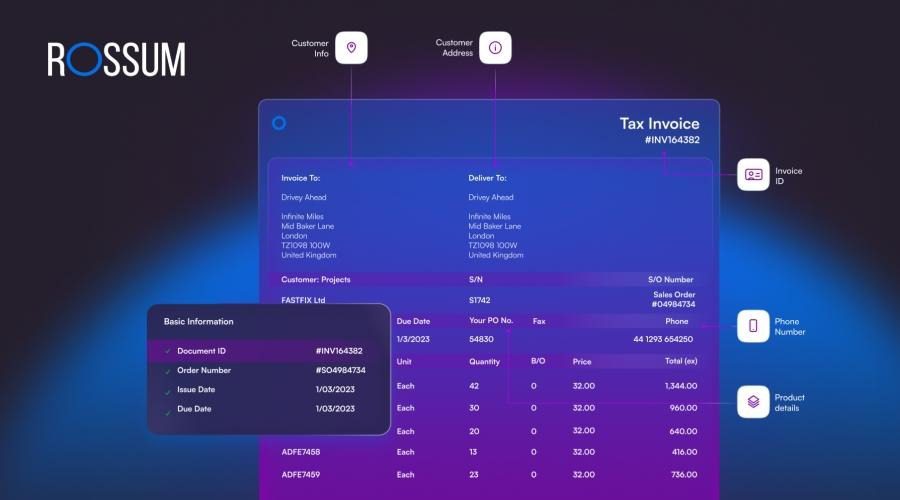
Rossum is a document AI software platform that stands out for its ability to process invoices, receipts, and financial documents. It uses an AI architecture that can learn and extract data from structured and unstructured documents with high accuracy. Rossum’s automated data extraction capabilities are highly appreciated for its user-friendly interface, tools that allow users to train AI models without deep programming knowledge. It is an ideal choice for Accounting and Purchasing departments that want to improve data accuracy in their AP processes.
ABBYY FlexiCapture: enterprise-grade OCR and data extraction.
ABBYY is a big name in OCR technology, and FlexiCapture is an enterprise-grade AI document processing tools solution. It combines market-leading OCR technology with advanced machine learning capabilities to process all types of documents – from highly structured forms to complex contracts. FlexiCapture is powerful in its high-volume processing, flexibility in workflow customization, and deep integration with many other business systems. ABBYY FlexiCapture is often chosen by large organizations for large-scale digital transformation projects involving AI workflow automation.
Hyperscience: combines AI and human-in-the-loop review.

Hyperscience focuses on processing complex, low-quality, or handwritten documents. This tool stands out with its AI-in-the-loop (HITL) approach. AI performs automated data extraction and processes the majority of the data, only passing low-confidence fields to human reviewers for validation. This ensures high speed while maintaining maximum data accuracy. This solution is often used in industries that require absolute accuracy such as Finance, Insurance, and Healthcare.
Docsumo: best for SMBs needing automation at scale.
Docsumo is a cloud-based solution that provides easy-to-use document AI software, especially suitable for small and medium-sized businesses (SMBs) looking to scale automation. It specializes in processing invoices, bank statements, and IDs/passports. Docsumo provides powerful APIs for automated data extraction and advanced auto-learning features, helping users quickly start AI workflow automation projects without large investments in infrastructure.
Google Document AI: advanced NLP and integration with Google Cloud.

Google Document AI (DocAI) is a set of specialized APIs that leverage Google’s leading Natural Language Processing (NLP) technology. DocAI provides specialized Processors for specific document types (e.g., invoices, contracts, driver’s licenses), ensuring superior accuracy. The biggest advantage is the ability to deeply integrate with the Google Cloud ecosystem, making it easy to build customized AI document processing tools solutions at scale, combined with other Google data and analytics services. Especially in the context of AI Gemini, data processing with this model is increasingly appreciated by businesses.
Kofax: reliable enterprise automation with workflow management.
Kofax is a comprehensive AI document processing tools solution provider, famous for its enterprise-level automation platform. Kofax’s solution not only focuses on automated data extraction but also provides good workflow management capabilities, helping to automate the entire process from end to end. Kofax is a solid choice for organizations that need a single solution to manage business process automation and intelligent document processing.
Benefits of Using AI Document Processing Tools
Using AI document processing tools always brings strategic benefits and supports smoother business operations, let’s explore specific benefits such as:
Time and cost savings from automation

By automating data extraction and entry tasks, document AI software reduces the labor costs associated with manual document processing. Businesses applying these technologies to their processes report that they have reduced document processing costs by an average of 60% to 80%. Furthermore, the rapid processing speed – from days to minutes – helps businesses respond faster to business requirements, improve cash flow and optimize supply chains. This is the foundation for any AI workflow automation project.
Higher accuracy and reduced manual labor
These tools use advanced AI, thereby improving data accuracy to near-perfect levels (often above 95% accuracy for many types of documents). Manual errors are completely eliminated, minimizing costs arising from correcting data errors, responding to incorrect queries, or delaying payments. The reduced data entry burden allows finance, administrative, and legal staff to focus on tasks that require analytical thinking, creativity, and customer interaction, improving the overall value of human resources.
Real-time document insights for decision-making

In manual processes, data from documents often takes a long time to be entered into the system, leading to decision-making based on outdated information. AI document processing tools provide real-time automated data extraction. When data is extracted immediately, analytics and BI systems can access this information immediately. From there, business leaders make strategic decisions based on the most accurate and timely financial, operational, and customer picture.
Improved compliance and data governance
Many highly regulated industries require businesses to maintain detailed audit records and comply with data protection regulations (e.g., GDPR, HIPAA). Document AI software creates a detailed electronic audit trail for each document processed, recording every step from receipt to data integration. This not only simplifies the audit process but also improves data governance and security because sensitive data is handled and stored to high standards.
Scalable for growing document volumes

Flexibility and scalability are strategic benefits of AI document processing tools. Cloud-based solutions can easily scale processing to accommodate sudden increases in document volumes (e.g., during peak seasons, mergers, or market expansion). Scalability allows businesses to increase processing capacity without large investments in personnel or infrastructure, ensuring that growth is not hindered by outdated document processing processes.
Conclusion
The year 2025 is the year when AI document processing tools are at their most developed, and every business is pursuing these tools to stay competitive and respond flexibly to technology and process automation. Proper implementation will significantly reduce costs and errors through automated data extraction to improve data accuracy, while increasing speed and scalability through AI workflow automation.
If you are ready, let DIGI-TEXX accompany you in exploiting the full potential of document data. Contact us today for expert advice on AI document processing tools to optimize your workflow.