
Data entry services are essential for organizations that need to manage large volumes of business information accurately and efficiently. As companies continue to digitize operations, maintaining clean, structured, and accessible data has become a key factor in improving productivity, compliance, and decision-making. Whether supporting customer databases, financial records, or operational documents, data entry plays a critical role in modern business processes.
Today, data entry services often extend beyond simple data input to include solutions such as data conversion services, invoice processing outsourcing, and document management outsourcing, helping businesses transform unstructured information into valuable digital assets. As part of comprehensive back office support services, these solutions reduce administrative workloads while enabling teams to focus on higher-value activities.
In this article, DIGI-TEXX explores what data entry services are, why they matter, and the 10 most common types of data entry services that help organizations improve data accuracy, streamline workflows, and support sustainable business growth.
What Is A Data Entry Service?
A data entry service is a professional solution that helps businesses capture, input, organize, and manage data accurately within digital systems. Companies often outsource these tasks to specialized providers to reduce manual workload, improve efficiency, and maintain data quality.
Data entry services can include document digitization, database updates, form and invoice processing, CRM data management, and data conversion. Modern providers often combine skilled professionals with technologies such as OCR and automation tools to process information faster and more accurately.
By ensuring data is accurate, structured, and easily accessible, data entry services help businesses streamline operations, support better decision-making, and focus on higher-value activities.
The Importance Of Data Entry Services In Modern Business Operations
As businesses handle increasing amounts of information, maintaining accurate and organized data becomes essential for efficiency and growth. Professional data entry services help organizations manage data effectively while supporting daily operations through the following benefits:
- Improve data accuracy by minimizing manual errors and maintaining consistent records.
- Enhance operational efficiency through faster data processing and streamlined workflows.
- Support better decision-making with reliable, up-to-date information.
- Ensure regulatory compliance by maintaining accurate and audit-ready records.
- Reduce administrative workload so employees can focus on higher-value tasks.
- Improve customer experiences by keeping customer information accurate and accessible.
- Enable seamless system integration across CRM, ERP, accounting, and other business platforms.
- Scale data management processes efficiently as business data volumes continue to grow.
By delivering accurate and structured information, data entry services help businesses operate more efficiently, reduce risks, and make informed decisions.
“Poor data quality costs organizations an average of $12.9 million annually, demonstrating why accurate data entry remains a critical foundation for operational efficiency and informed business decision-making.” – Thomas C. Redman
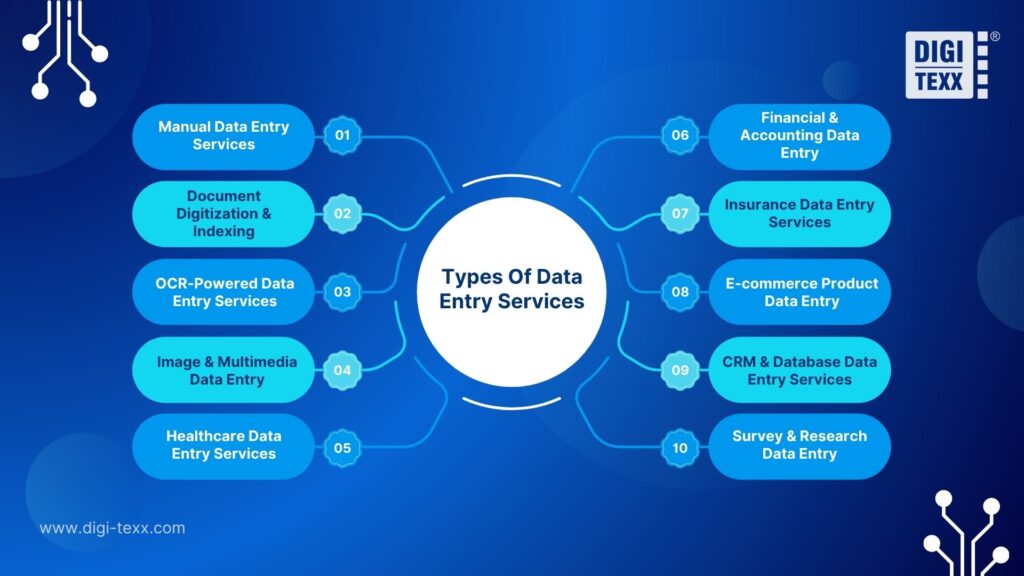
10 Types Of Data Entry Services For Modern Businesses
Businesses use different types of data entry services depending on their data sources, operational requirements, and industry needs. Below are 10 common data entry solutions that support accurate data management and efficient business operations.
1. Manual Data Entry Services
Manual data entry services involve entering information from physical or digital sources into databases, spreadsheets, CRM systems, ERP platforms, or other business applications. Common sources include handwritten forms, invoices, receipts, PDFs, scanned documents, and legacy records.
Unlike automated solutions, human operators can identify inconsistencies, interpret unclear content, and apply validation rules to ensure data accuracy.
Applications
Manual data entry services are commonly used for:
- Customer and contact database management
- Invoice and financial record processing
- Healthcare and patient data management
- Insurance claims and policy administration
- Legacy data migration projects
- Document digitization and record updating
Benefits
- Higher accuracy for handwritten, unstructured, or complex documents
- Improved data quality through human verification
- Greater flexibility for non-standard formats and workflows
- Enhanced compliance by reducing data entry errors
- Reliable support for digitization and business operations
Why Does It Still Matter?
Although automation improves efficiency, manual data entry services provide the quality control and validation needed for sensitive or complex information. For many organizations, human oversight remains essential for maintaining accurate, reliable, and business-ready data.
2. Document Digitization & Indexing
Document digitization and indexing services convert physical records and unstructured documents into organized, searchable digital assets. The process typically involves scanning paper documents, extracting key information, and assigning metadata to improve document classification and retrieval.
By transforming paper-based records into structured digital formats, these services help businesses improve accessibility, streamline workflows, and support digital transformation initiatives.
Applications
Document digitization and indexing services are commonly used for:
- Patient records and medical document management
- Invoice, tax, and financial document processing
- Insurance policy and claims documentation
- Contract and legal document repositories
- Employee records and HR documentation
- Archive digitization and records management
Benefits
- Faster document search and retrieval
- Reduced physical storage requirements
- Improved document organization and accessibility
- Enhanced compliance and audit readiness
- Better collaboration through centralized digital records
- Stronger foundation for workflow automation and data management
Why Does It Still Matter?
Many organizations continue to rely on large volumes of paper-based or unstructured documents. Document digitization and indexing services transform these records into searchable, business-ready information, enabling faster access, improved operational efficiency, and more effective data-driven decision-making.
3. OCR-Powered Data Entry Services
OCR-powered data entry services use optical character recognition (OCR) technology to extract text and data from scanned documents, images, PDFs, and forms. The captured information is then converted into structured digital data that can be stored in databases, spreadsheets, CRM systems, or enterprise applications.
By automating data extraction, OCR significantly reduces manual input efforts while improving processing speed and operational efficiency for high-volume document workflows.
Applications
OCR-powered data entry services are commonly used for:
- Invoice and accounts payable processing
- Insurance forms and claims documentation
- Patient records and medical reports
- Bank statements and financial documents
- Application forms and registration records
- Large-scale document digitization projects
Benefits
- Faster data capture and processing
- Reduced manual workload and operational costs
- Improved consistency across large datasets
- Enhanced searchability and accessibility of information
- Increased scalability for high-volume document processing
- Better integration with digital workflows and business systems
Why Does It Still Matter?
Organizations generate and process vast amounts of document-based information every day. OCR-powered data entry services help convert these documents into usable digital data quickly and efficiently. When combined with human validation, OCR delivers a balance of speed, accuracy, and scalability, making it an essential solution for modern data management and business operations.
4. Image & Multimedia Data Entry
Image and multimedia data entry services involve extracting, organizing, tagging, and managing information from visual and audio-based content, including images, videos, scanned graphics, and audio files. These services transform unstructured multimedia assets into searchable, categorized, and business-ready data.
By adding relevant metadata and classifications, businesses can improve asset organization, accessibility, and overall data management efficiency.
Applications
Image and multimedia data entry services are commonly used for:
- Product image tagging and catalog management
- Medical image and diagnostic record organization
- Insurance claim image classification
- Video and audio metadata tagging
- Digital asset management for marketing teams
- Archiving and indexing multimedia libraries
Benefits
- Improved searchability and retrieval of visual assets
- Better organization of large multimedia databases
- Increased accuracy through consistent tagging and classification
- Enhanced customer experience in content-driven platforms
- Reduced time spent managing digital assets
- Greater efficiency in reporting and content management workflows
Why Does It Still Matter?
As businesses generate increasing volumes of visual and multimedia content, managing these assets effectively becomes more challenging. Image and multimedia data entry services ensure that valuable information is properly categorized and easily accessible, helping organizations improve operational efficiency, content management, and decision-making across digital systems.
5. Healthcare Data Entry Services
Healthcare data entry services involve capturing, updating, and managing patient, clinical, and administrative information within electronic healthcare systems. Data is typically collected from medical records, patient intake forms, prescriptions, insurance documents, laboratory reports, and other healthcare-related sources.
These services help healthcare organizations maintain accurate records, streamline operations, and support high-quality patient care while meeting strict data security and compliance requirements.
Applications
Healthcare data entry services are commonly used for:
- Patient registration and demographic data management
- Electronic health record (EHR) updates
- Medical billing and claims processing
- Laboratory and diagnostic report entry
- Insurance verification and documentation
- Prescription and treatment record management
Benefits
- Improved accuracy of patient and medical records
- Faster access to critical healthcare information
- Reduced administrative workload for healthcare staff
- Enhanced compliance with healthcare regulations
- Better support for billing and reimbursement processes
- Stronger data security and record consistency
Why Does It Still Matter?
Healthcare organizations process large volumes of sensitive information every day, where even minor data errors can affect patient care, claims processing, and regulatory compliance. Healthcare data entry services help ensure data accuracy, integrity, and security, enabling providers to deliver efficient care while maintaining compliance and operational efficiency.
6. Financial & Accounting Data Entry
Financial and accounting data entry services involve capturing, organizing, and maintaining financial information within accounting systems, ERP platforms, and business databases. Common data sources include invoices, receipts, purchase orders, bank statements, expense reports, payroll records, and tax documents.
These services help businesses maintain accurate financial records, support regulatory compliance, and ensure the integrity of critical financial data used for reporting and decision-making.
Applications
Financial and accounting data entry services are commonly used for:
- Accounts payable and accounts receivable processing
- Invoice and expense data entry
- Payroll and employee compensation records
- Bank statement and transaction reconciliation
- Tax and compliance documentation management
- Financial reporting and bookkeeping support
Benefits
- Improved accuracy of financial records
- Reduced risk of data entry errors and discrepancies
- Faster reconciliation and reporting processes
- Enhanced audit readiness and regulatory compliance
- Better visibility into financial performance
- Increased efficiency for accounting and finance teams
Why Does It Still Matter?
Financial data drives critical business decisions and regulatory reporting. Even small inaccuracies can lead to reconciliation issues, reporting errors, or compliance risks. Financial and accounting data entry services help organizations maintain consistent, accurate, and audit-ready records, ensuring smoother financial operations and more reliable business insights.
7. Insurance Data Entry Services
Insurance data entry services involve capturing, organizing, and updating information related to insurance policies, claims, renewals, endorsements, and customer records. Data is typically collected from application forms, claim documents, adjuster reports, correspondence, and supporting files before being entered into policy administration or claims management systems.
These services help insurers maintain accurate records, streamline workflows, and support faster policy and claims processing.
Applications
Insurance data entry services are commonly used for:
- Policy application and underwriting data entry
- Claims processing and documentation management
- Policy renewal and endorsement updates
- Customer and beneficiary record maintenance
- Insurance correspondence and document indexing
- Regulatory and compliance reporting support
Benefits
- Improved accuracy of policy and claims data
- Faster claims processing and policy administration
- Reduced risk of errors, disputes, and duplicate records
- Enhanced compliance with industry regulations
- Better visibility into customer and policy information
- Increased operational efficiency and service quality
Why Does It Still Matter?
Insurance providers handle large volumes of sensitive and time-critical information every day. Accurate data entry is essential for efficient claims processing, policy management, customer service, and regulatory compliance. Insurance data entry services help ensure data consistency, reduce operational risks, and support a smoother experience for both insurers and policyholders.
8. E-commerce Product Data Entry
E-commerce product data entry services involve capturing, organizing, and maintaining product information across online stores, marketplaces, and inventory management systems. Data typically includes product titles, descriptions, specifications, images, pricing, categories, SKUs, and inventory details sourced from suppliers, manufacturers, or internal databases.
These services help businesses maintain accurate and consistent product catalogs, ensuring customers have access to reliable information throughout the purchasing journey.
Applications
E-commerce product data entry services are commonly used for:
- Product catalog creation and management
- Product description and specification updates
- SKU, category, and attribute management
- Pricing and inventory data updates
- Marketplace listing management
- Product image tagging and organization
Benefits
- Improved accuracy and consistency across product listings
- Faster product launches and catalog updates
- Enhanced customer experience through reliable product information
- Reduced listing errors and inventory discrepancies
- Better search visibility and product discoverability
- Increased efficiency in managing large product catalogs
Why Does It Still Matter?
Accurate product information is essential for attracting customers, reducing purchase friction, and building trust in online shopping environments. E-commerce product data entry services help businesses maintain high-quality product catalogs, streamline catalog management, and support stronger sales performance across multiple digital channels.
9. CRM & Database Data Entry Services
CRM and database data entry services involve capturing, updating, organizing, and maintaining customer and business information within CRM platforms, databases, and enterprise systems. Data may come from web forms, emails, spreadsheets, customer interactions, sales activities, or other business records.
These services help organizations maintain accurate, consistent, and up-to-date data, enabling more effective customer relationship management and business operations.
Applications
CRM and database data entry services are commonly used for:
- Customer and prospect record management
- Lead and contact database updates
- Sales activity and interaction tracking
- Customer profile enrichment and maintenance
- Data migration and database cleansing projects
- Marketing and customer segmentation support
Benefits
- Improved data accuracy and consistency
- Reduced duplicate and outdated records
- Better customer relationship management
- Enhanced sales, marketing, and reporting performance
- More effective automation and workflow management
- Increased operational efficiency across teams
Why Does It Still Matter?
Customer and business data are valuable assets that drive sales, marketing, and decision-making. Inaccurate or incomplete records can lead to missed opportunities, inefficient workflows, and poor customer experiences. CRM and database data entry services help organizations maintain clean, reliable, and actionable data, supporting stronger customer engagement and long-term business growth.
10. Survey & Research Data Entry
Survey and research data entry services involve collecting, organizing, and converting survey responses, questionnaires, interview records, and research data into structured digital formats for analysis. Data may come from paper forms, online surveys, field studies, focus groups, or academic research projects.
These services help organizations transform raw data into accurate, organized datasets that support reporting, statistical analysis, and evidence-based decision-making.
Applications
Survey and research data entry services are commonly used for:
- Market research and consumer surveys
- Academic and scientific research projects
- Customer satisfaction and feedback analysis
- Public sector and social research studies
- Employee engagement surveys
- Field data collection and reporting
Benefits
- Improved accuracy and consistency of research data
- Faster data processing and analysis
- Reduced risk of coding and transcription errors
- Better data organization for reporting and insights
- Enhanced reliability of research outcomes
- Increased efficiency in large-scale data collection projects
Why Does It Still Matter?
The quality of research findings depends on the accuracy of the underlying data. Incomplete, inconsistent, or incorrectly entered responses can compromise analysis and decision-making. Survey and research data entry services help ensure data integrity, enabling organizations to generate reliable insights, identify trends, and make informed strategic decisions with confidence.
DIGI-TEXX Contact Information:
🌐 Website: https://digi-texx.com/
📞 Hotline: +84 28 3715 5325
✉️ Email: [email protected]
🏢 Address:
- Headquarters: Anna Building, QTSC, Trung My Tay Ward
- Office 1: German House, 33 Le Duan, Saigon Ward
- Office 2: DIGI-TEXX Building, 477-479 An Duong Vuong, Binh Phu Ward
- Office 3: Innovation Solution Center, ISC Hau Giang, 198 19 Thang 8 street, Vi Tan Ward
Reference:
- Data Management Association International. (n.d.). DAMA international. https://www.dama.org
- Financial Accounting Standards Board. (n.d.). Financial accounting standards board. https://www.fasb.org