
Business data is increasingly fragmented, messy, and inconsistent – especially as data sources continue to increase in the digital age. And once this discrepancy becomes serious, businesses will need data normalization services. These are specialized solutions to fix data inconsistencies, improve accuracy, and help businesses’ data systems process more intelligently. By applying advanced technologies such as generative AI data cleaning, these services provide an effective normalization workflow for businesses.
When Your Data Becomes a Liability Instead of an Asset

Data is an important asset for businesses, but when it is not properly managed and standardized, it will quickly become a liability. Inconsistencies in data format, structure, or values can have serious consequences:
- Bad Decision Making: If sales reports list the same customer under three different names (e.g., ‘DIGITEXX’, ‘Digi-Texx Co. Ltd’, and ‘DigiTexx’), managers will not have an accurate view of total revenue or campaign performance.
- Increased Operational Costs: Employees must spend time manually processing data – a costly and inefficient process. This is a hidden cost that reduces profits, leading to a lack of human resources to perform important tasks.
- AI/ML Failure: Machine Learning models are only as good as the data they are fed. Dirty, unstandardized data will cause algorithms to make inaccurate or completely incorrect predictions.
Therefore, to achieve the speed and accuracy required in the modern business environment, the conversion from unreliable data to standardized data, through data normalization services, is a prerequisite and needs to be implemented by businesses.
What Data Normalization Services Actually Do

Data normalization services are technical and business processes designed to organize and restructure data sets, ensuring that all data values comply with a common set of rules and standards. The main purpose is to eliminate redundancy, ensure integrity and overcome data inconsistencies.
Technically, data normalization includes many actions, from simple to complex:
- Cleansing: The system will remove typos, invalid characters, or missing data.
- Formatting: This step ensures format consistency (e.g., converting all date formats to YYYY-MM-DD, converting all addresses to uppercase).
- Matching and Merging: This step identifies and merges duplicate or similar records (e.g., merging different versions of customer names into one standard record).
- Transformation: This is where the system applies complex business logic to transform values (e.g., converting units of measurement or encoding data according to a standard set of classification rules).
These services are now strongly supported by new technologies such as generative AI data cleaning. Generative AI has the ability to automatically suggest normalized values, adjust ambiguous records, and fill in blank data,… which alone shows that with AI, these services have gone far beyond the capabilities of traditional search and replace tools, while also speeding up the entire normalization workflow.
Signs Your Business Needs Data Normalization Right Now
If your business is experiencing any of the following signs, it is time to urgently seek data normalization services to solve the data backlog problem your business is facing.
Reports don’t match numbers between departments

This is the most common sign of data inconsistencies. If Marketing reports 100 new leads, but Sales only sees 80, or if the financial reports from ERP don’t match the spreadsheets in Accounting, the problem is almost certainly data inconsistencies. If businesses still stubbornly try to handle these problems manually, it will take a lot of time and cannot guarantee complete effectiveness.
AI/ML models perform poorly due to inconsistent datasets
AI and machine learning models, including generative AI data cleaning projects, always require standardized input data. If your inventory demand or customer behavior prediction model consistently produces incorrect results, it is often due to ‘dirty data’. Unnecessary variations in the data will also reduce the model’s learning ability and predictive performance.
High error rates in CRM, ERP, or e-commerce platforms

When core business systems (CRM, ERP, e-commerce platforms) repeatedly display errors, reject orders, or record incorrect data, it is a reflection of data inconsistencies at the source. This is especially true when data is ingested from multiple touchpoints (e.g., online orders, manual data entry, email). High error rates directly impact customer experience and operational efficiency.
>>> Read more: Top 10 Data Cleansing Companies for Businesses in 2025
Time Lost Reconciling Data Manually
If your employees spend more than 30% of their work time manually collating, correcting, reformatting, or merging data sets, in short, working with data, it’s time to reconsider. That time should be spent on analysis and strategy. Frequent manual data processing is the clearest evidence that a sustainable, automated normalization workflow is needed.
What a Normalization Project Workflow Looks Like
A successful data normalization services implementation project typically follows a structured normalization workflow, which includes the following key steps:
Data profiling and quality assessment.
The first step is to gain a deep understanding of the current state of the data. This phase involves analyzing the data to quantify data inconsistencies (e.g., missing value rate, number of different date formats, duplicate record rate). This quality assessment helps define the scope of work and establish baseline metrics to measure project success.
Defining normalization rules and schemas.
After the assessment, experts will work with the business team to define normalization rules and target schemas. This includes deciding on a standard format for each field (e.g., state name, currency) and setting up aggregation rules to handle duplicate records. These rules are the foundation for the automated normalization workflow.
Automated transformation.
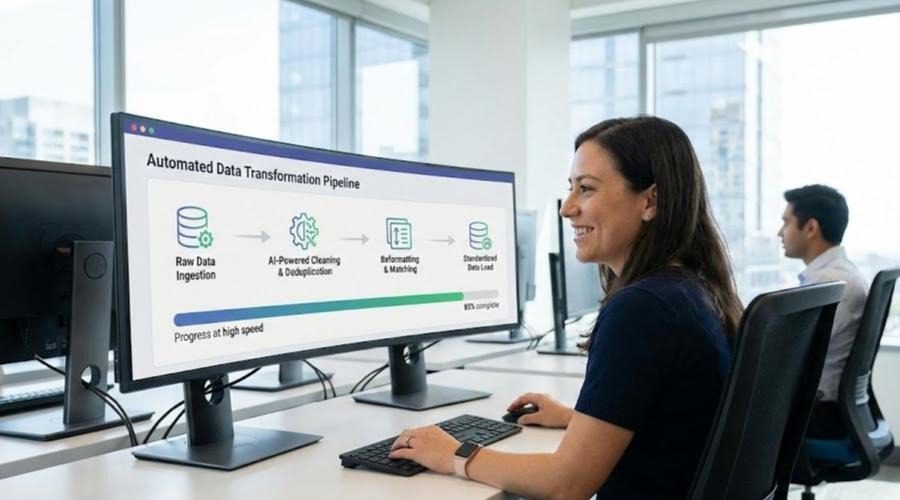
This is the core implementation phase where data normalization services technologies are always applied. Using ETL tools combined with AI will help data be automatically cleaned, automatically reformatted if errors or duplicates are detected, matched and transformed according to the defined rules. Thanks to those actions, the process will be optimized to handle large volumes of data at a higher speed than manual data processing.
Manual validation for edge cases.
While automation is the norm for these systems, not all complex cases can be handled by AI and computers. Records that are low in confidence or too ambiguous are passed to data experts for manual review and adjustment. This establishes an important feedback loop that helps AI models continue to learn and improve the normalization workflow in the future.
Output testing and system integration
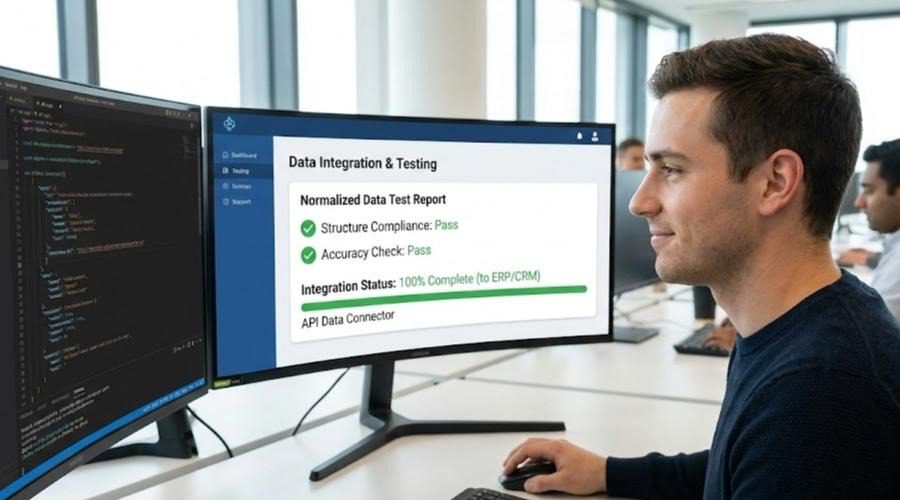
Normalized data is thoroughly tested to ensure compliance with the target structure and appropriate accuracy. The data is then integrated back into business systems (ERP, CRM) via APIs or data connectors. Integration must be done carefully to ensure data integrity throughout the process.
Conclusion
As can be seen, data normalization services are not just a technical process, but a strategic investment in the quality and scalability of the business. Overcoming data inconsistencies through a structured normalization workflow, supported by advanced technologies such as generative AI data cleaning. By cleaning data, businesses can enhance the performance of AI/ML models, reducing operational costs for manual data processing.
As leading experts in data normalization services and data quality management, our DIGI-TEXX team is committed to helping your business transform raw data into strategic assets. Contact us today to build a custom normalization workflow that will help you eliminate data inconsistencies and get ready to scale smarter.
>>> See more: What is Data Cleaning? Benefits, Process, and How It Works