
Historically, insurance carriers have fiercely guarded their operations, managing everything internally to maintain absolute control over data and processes. Yet today, a massive structural shift is underway: increasingly, insurers are choosing to delegate these critical workflows to external Business Process Outsourcing (BPO) partners.
What is driving this sudden change? As the industry faces mounting pressures from rapid digital transformation, unpredictable workload surges, and a tightening talent pool, the traditional in-house model is being heavily tested.
Organizations are realizing that outsourcing is no longer just a tactical move to cut costs; it is a strategic imperative to unlock flexible scalability and free up internal experts for high-value work.
In this article, DIGI-TEXX provides an objective comparison of these operational frameworks.
By evaluating both in-house insurance operating structures and modern insurance BPO solutions, we offer a practical guide to help you determine the strategy that best aligns with your firm’s specific resources and growth imperatives.
Summary Matrix: In-House Vs. Outsourced Operations
Before exploring the operational details of each model, it is useful to first establish a high-level view of how Insurance BPO and in-house operations differ in terms of cost structure, scalability, operational control, and long-term strategic flexibility.
| Strategic Factor | In-House Operations | Insurance BPO |
| Primary objective | Maintain full operational control | Improve efficiency and scalability |
| Cost structure | Fixed costs (salaries, infrastructure, systems,…) | Variable costs aligned with workload |
| Speed of scaling | Slower due to hiring and training cycles | Faster through vendor capacity expansion |
| Technology adoption | Requires internal investment | Often included through vendor capabilities |
| Operational control | Direct management of teams and processes | Governance through SLAs and KPIs |
| Regional expertise | Deep, localized market knowledge and cultural alignment | Broad, multi-regional market access and compliance support |
| Best suited for | Complex, strategic, or sensitive operations | High-volume, standardized workflows |
Many modern insurers are also adopting a hybrid model, keeping sensitive and strategic functions internally while outsourcing high-volume administrative processes to specialized partners.
Defining In-House Insurance Operations
What Are In-House Insurance Operations?

In-house insurance operations refer to a model where an insurance company manages its core operational processes using internal teams, internal systems, and company-owned infrastructure rather than relying on external service providers.
While this structure provides maximum operational visibility and direct control, research from McKinsey & Company and Deloitte consistently shows that maintaining fully internal operations requires significant long-term investment in workforce development, process governance, and technology modernization to remain competitive as transaction volumes grow.
These processes include the following scopes of work:
- Underwriting and policy administration: Internal teams manage policy setup, endorsements, renewals, and premium adjustments. This often includes manual data validation, risk documentation review, and ensuring policy accuracy across systems.
- Claims processing and claims support: Claims teams typically handle first notice of loss (FNOL), documentation review, coverage validation, and coordination with adjusters. These processes can become resource-intensive due to the volume of documentation and the need for accuracy.
- Regulatory compliance and documentation control: Insurers must ensure internal processes follow local and international data protection and compliance requirements. Managing these activities internally allows companies to maintain direct oversight of sensitive policyholder and claims data.
- Customer support and policy servicing: Internal teams manage policyholder communication, billing inquiries, and service requests to maintain a consistent customer experience.
By internalizing these comprehensive scopes, carriers maintain an unbroken chain of custody over their insurance operations.
Why Some Organizations Continue To Invest In In-House Operations
Despite the increasing adoption of outsourcing models, many insurers deliberately maintain internal operations for specific strategic reasons. In most cases, this decision is not driven by organizational inertia, but by considerations related to operational control, intellectual capital protection, and regulatory risk management.
Maintaining Operational Control And Data Governance
For many insurers, the primary reason to retain internal operations is the need to maintain direct control over sensitive data and critical operational workflows.
Because insurers handle sensitive financial and medical data, some organizations retain internal operations to maintain governance control within their security perimeter.
This level of control becomes particularly important in highly regulated markets. As noted in the industry analysis referenced in your article, insurers operating under strict compliance regimes often consider internal operations a risk-management mechanism rather than simply an operational preference.
Preserving Institutional Expertise And Proprietary Processes
Insurance operations often depend heavily on accumulated institutional knowledge developed through years of underwriting decisions, claims experience, and process evolution.
This expertise frequently includes proprietary pricing logic, internal risk assessment frameworks, and nuanced operational practices that are difficult to fully codify into standardized procedures. Insurers often view these specialized workflows as core intellectual property that provides long-term competitive advantage.
As a result, some insurers deliberately retain these functions internally to ensure continuity, protect proprietary expertise, and maintain tighter integration between operational execution and strategic decision-making.
Managing Regulatory Complexity And Long-Term Operational Risk
In certain markets, data sovereignty laws and regulatory obligations can make outsourcing more complex or introduce additional compliance layers. Research highlights that insurers in highly regulated regions often prioritize regulatory certainty over cost optimization, choosing to absorb higher internal operating costs to avoid potential legal and reputational risks associated with third-party data handling.
In markets where skilled labor remains cost-competitive, maintaining internal teams may support both regulatory alignment and long-term capability development.
Defining Insurance BPO
What Is Insurance BPO?
Insurance BPO involves outsourcing defined insurance operational processes, system development, or infrastructure. Insurance BPO typically involves the execution and continuous improvement of day-to-day operational processes such as claims administration, policy servicing, underwriting support, and document processing.
This allows insurance organizations to focus internal resources on strategic functions while external partners manage standardized, high-volume operational work.
The Technology Factor Driving Insurance BPO Adoption
Automation technologies are a major driver of Insurance BPO adoption.
Modern BPO providers increasingly integrate tools such as:
- Optical Character Recognition (OCR) for document digitization
- Robotic Process Automation (RPA) for repetitive workflows
- Artificial Intelligence (AI) for classification and validation
- Intelligent Document Processing (IDP) for complex document extraction
These tools reduce manual effort in document-heavy processes such as claims intake and compliance review. As a result, outsourcing is increasingly viewed as a technology access strategy, allowing insurers to adopt automation capabilities without large upfront investments.
Market Growth Reflects Structural Industry Shift
The rapid growth of Insurance BPO reflects a core challenge for modern insurers: the need to balance daily efficiency with increasing operational complexity. Rather than struggling to manage heavy administrative workloads internally, companies are actively seeking smarter ways to scale.
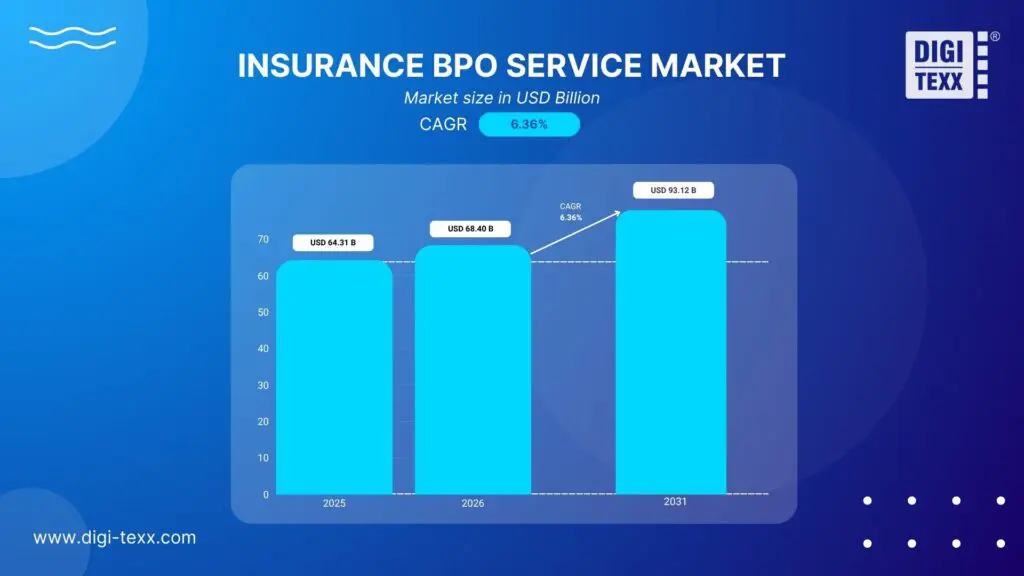
This strategic shift is clearly visible in recent market forecasts. For example, data from Mordor Intelligence projects that the global Insurance BPO services market will reach an impressive USD 93.12 billion by the year 2031[6] (Mordor Intelligence, 2026).
This expansion represents a strong compound annual growth rate (CAGR) of 6.36%[6] (Mordor Intelligence, 2026). Such consistent growth highlights a key trend: outsourcing is no longer just a temporary cost-cutting measure, but a long-term strategy for insurers to remain flexible and competitive.
Why Organizations Consider Insurance BPO
Despite strong internal capabilities, some insurers evaluate Insurance BPO when operational demands begin to stretch internal resources or when administrative workloads start competing with strategic priorities.
Similar to the decision to maintain in-house operations, outsourcing decisions are rarely driven by a single objective. Instead, they typically reflect how organizations balance scalability needs, talent allocation, and technology investment priorities.
Scaling Operations More Flexibly
As insurance companies grow, operational workloads such as policy administration and claims support often increase faster than internal hiring can realistically support. Building internal teams requires hiring, training, and regulatory onboarding, which slows scaling speed.
Insurance BPO can provide additional processing capacity without requiring permanent increases in internal headcount, allowing organizations to respond more flexibly to business growth or workload fluctuations.
Crucially, this flexibility does not sacrifice speed or quality. By partnering with an established BPO provider, insurers gain immediate access to advanced document management and automated technologies, such as Optical Character Recognition (OCR).
Industry data shows that these modern solutions can improve document processing times by 90% and maintain a 99% data extraction accuracy[1] (Conduent, 2020). Ultimately, this means that scaling operations rapidly also results in faster, more reliable service for policyholders.
Allowing Internal Experts To Focus On Higher-Value Work
Insurance organizations depend heavily on specialized expertise in underwriting, claims assessment, and risk advisory. However, these professionals often spend considerable time on routine operational activities such as documentation checks, data validation, and process coordination.
Outsourcing selected administrative processes can enable internal experts to focus more on complex decision-making and customer-facing activities where their expertise delivers greater business value.
Accessing Operational Technology And Process Capabilities
Modern insurance operations increasingly rely on automation and workflow technologies. However, building these capabilities internally often requires significant investment, system integration effort, and change management.
Insurance BPO providers frequently offer established processing frameworks supported by automation tools such as document processing platforms and workflow management systems. For some insurers, outsourcing provides a lower-risk path to operational modernization without large upfront transformation investments. (Accenture, 2022).
Learn more:
- Automated Document Processing for Insurance: How It Works & Benefits
- How Automation Enhances Fraud Detection | Safeguarding the Future of Insurance Claims
Insurance BPO Vs. In-House Operations: Which Is The Optimal Solution For Your Company?
Cost Structure Comparison: Fixed Investment Vs. Variable Operating Models
When evaluating operational models, financial analysis must extend beyond simple cost reduction to examine how expenses are fundamentally structured. The core financial distinction between in-house operations and Insurance BPO lies in the shift from rigid capital investments to flexible operating expenses. Understanding this structural difference is critical for insurers looking to align their financial commitments with actual business volumes and long-term strategic goals.
In-House Operations: Higher Fixed Investment With Long-Term Cost Commitments
In-house operations require significant fixed investment in talent, IT, and compliance. Internal operating models can generate efficiencies when processing volumes remain stable. However, when demand fluctuates, insurers may face utilization challenges while still carrying fixed employment and technology costs.
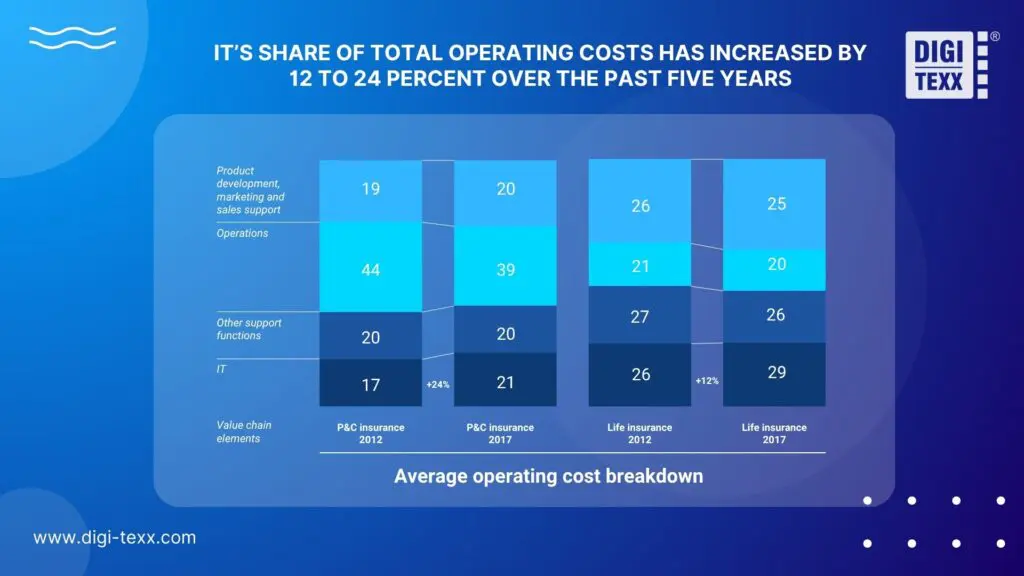
Technology spending in particular has become a growing cost driver. As insurers modernize legacy systems and invest in digital capabilities, IT spending has steadily increased as a proportion of operating expenses. While providing control, they create cost rigidity, especially as IT spending rises from 12% to 24% of expenses[5] (McKinsey, 2017). This trend illustrates a key structural trade-off: while in-house models provide greater governance and process ownership, they may also create long-term cost rigidity due to ongoing infrastructure and modernization requirements.
Insurance BPO: Converting Fixed Costs Into More Flexible Operating Expenses
Insurance BPO models typically change how operational costs are structured rather than simply reducing them. Instead of maintaining full internal teams and infrastructure, insurers contract defined services based on transaction volumes, service scope, or performance agreements.
This approach allows insurers to convert portions of their operational cost base from fixed investments into more variable cost structures that better align with business activity levels.
Beyond workforce economics, efficiency gains often come from process specialization and technology leverage. BPO providers frequently operate standardized delivery environments supported by workflow automation, productivity monitoring, and process optimization practices developed across multiple clients.
Insurers adopting outsourcing strategies for administrative functions often report improved cost predictability and better alignment between operational spending and workload variability.
Operations Management: Internal Control Vs. SLA Governance
Beyond cost considerations, operational control is often a defining factor when insurers evaluate whether to maintain internal operations or work with Insurance BPO providers. The difference typically lies not in whether control exists, but in how governance is exercised and how operational visibility is maintained.
In-House Operations: Direct Visibility And Governance Integration
Internal operations allow insurers to maintain direct oversight of workflows, performance management, and process adjustments. Decision-making can often happen faster because operational teams sit within the same organizational structure, reducing coordination layers.
This governance proximity can be particularly valuable in environments where operational changes must align closely with underwriting strategy, regulatory interpretation, or evolving risk frameworks.
Additionally, internal teams often benefit from informal knowledge sharing and tacit operational experience that may not always be fully captured in formal documentation. This can make exception handling and complex case management more fluid compared to highly standardized external delivery models.
For insurers operating in highly regulated environments, this level of direct operational visibility can simplify audit preparation, internal investigations, and regulatory reporting processes.
Insurance BPO: Structured Governance Through Service Management Frameworks
While outsourcing introduces organizational distance, mature Insurance BPO relationships typically operate through structured governance models designed to maintain operational transparency. These may include service level agreements (SLAs), performance dashboards, escalation protocols, and regular operational reviews.
Rather than direct supervision, insurers manage performance through contractual governance and defined reporting mechanisms. When implemented effectively, this model can enable insurers to maintain outcome-based control while reducing the need for day-to-day operational supervision.
However, this model also requires different internal capabilities. Instead of managing processes directly, organizations must develop skills in vendor governance, performance monitoring, and service integration.
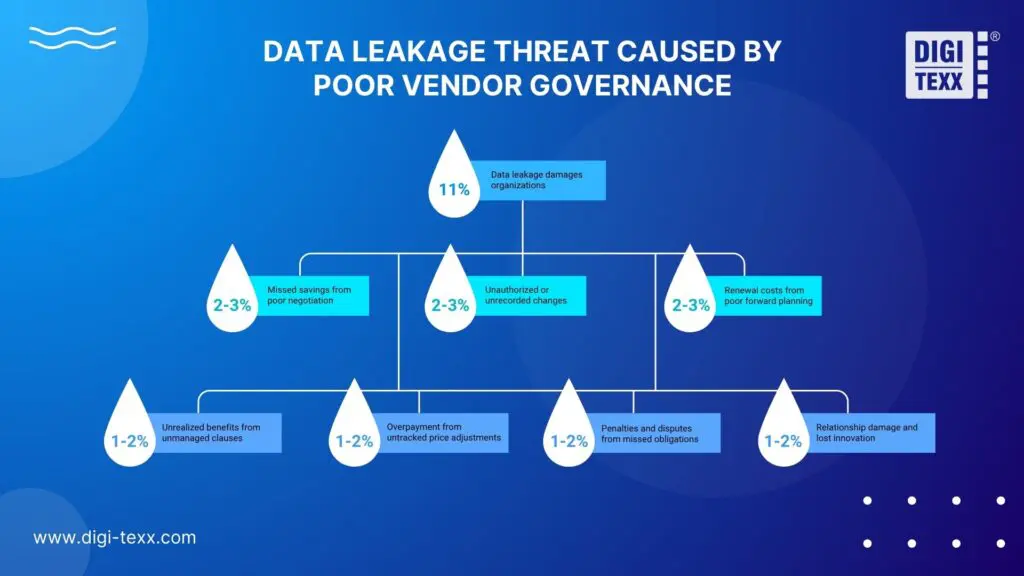
Research from WorldCC suggests that while outsourcing adoption continues to grow, many organizations underestimate the internal governance maturity required to effectively manage external providers (Cummins, T., 2026). Supporting this concern, industry data indicates that organizations without strong governance models may experience around 11% contract value leakage[2] due to misalignment, unclear performance ownership, or ineffective supplier coordination.
The Often Overlooked Trade-Offs: Supplier Management And Coordination Complexity
While outsourcing can reduce internal operational workload, it may also introduce coordination responsibilities that are not always visible in initial cost comparisons.
These may include:
- Vendor selection and transition management
- Knowledge transfer and process documentation efforts
- Ongoing performance monitoring
- Contract governance and service review processes
- Quality assurance and exception handling coordination
These governance activities do not eliminate the value of outsourcing, but they do change the type of operational effort required internally. This is why many insurers find that successful outsourcing is less about reducing operational involvement and more about changing how operational oversight is performed.
Organizations that achieve the best outcomes from Insurance BPO often treat vendor management as a strategic capability rather than a procurement activity.
The financial risk of ignoring this oversight is substantial. When companies view outsourcing as a “set it and forget it” arrangement without proper coordination, hidden losses quickly destroy any expected savings. Industry research reveals that poor contract management costs the average business 9.2% of its annual revenue.
For organizations with the weakest oversight, this lack of governance can drain up to 9% of annual revenue, or even up to 15% in more complex industries[7] (WorldCC, 2025). Ultimately, without active management, the initial cost benefits of outsourcing can easily disappear.
Scalability Comparison: Capacity Ownership Vs. Elastic Operating Models
Scalability is another critical dimension insurers evaluate when choosing between in-house operations and Insurance BPO. As insurance workloads often fluctuate due to seasonal demand, claims surges, or business expansion, the ability to scale operations efficiently can directly impact service quality, processing speed, and cost efficiency.
In-House Operations: Capacity Ownership With Scaling Constraints
Internal operations give insurers full ownership of their workforce capacity, allowing organizations to directly control hiring plans, training programs, and resource allocation strategies. This can provide stability when operational volumes remain predictable, and workforce planning can be aligned with long-term business forecasts.
However, scaling internal operations typically requires significant lead time. Recruitment cycles, onboarding processes, and role-specific training can take months before new hires reach full productivity. During periods of sudden demand increases, this may create operational bottlenecks.
Conversely, during slower periods, insurers may face underutilization challenges while still maintaining fixed staffing costs.
Industry workforce studies frequently highlight that operational hiring cycles in specialized insurance functions can range from several weeks to multiple months, depending on role complexity and regulatory requirements[5] (McKinsey, 2018).
This illustrates a structural trade-off: internal models provide stability and knowledge continuity, but scaling speed may be constrained by labor market realities and training timelines.
Insurance BPO: Access To Flexible Operational Capacity
Insurance BPO providers typically operate shared delivery environments designed to support multiple clients, allowing resources to be reallocated based on demand fluctuations. This operating model allows insurers to scale certain operational functions faster compared to building new internal teams.
Rather than expanding permanent headcount, insurers may instead adjust service scope, transaction volumes, or support tiers depending on operational needs.
Efficiency advantages may also come from process specialization and operational standardization. Because BPO providers focus on defined operational functions across multiple engagements, they often develop optimized workflows and automation support designed to improve processing consistency.
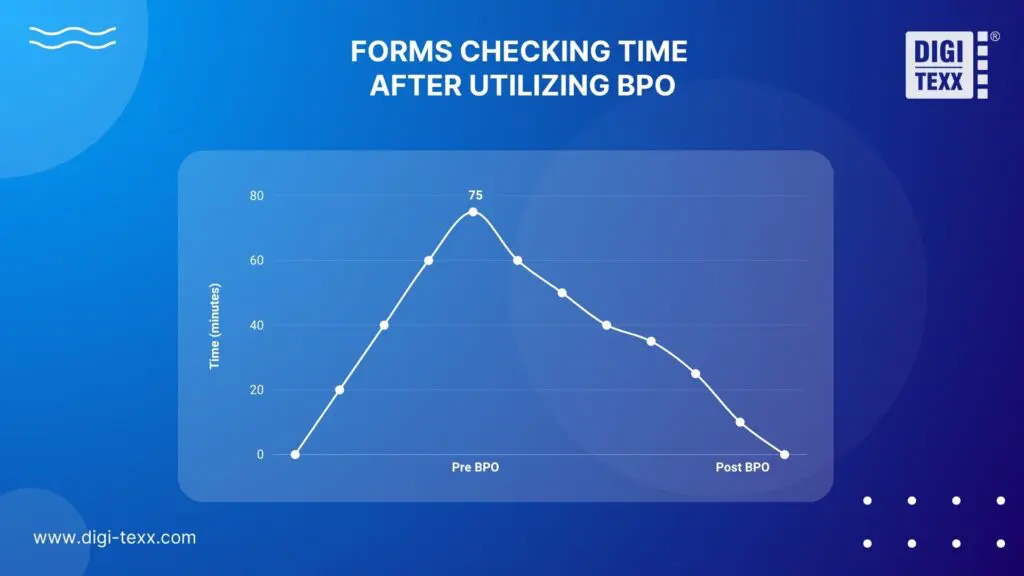
Documented implementation examples illustrate how these models can translate into measurable operational improvements. For example, one insurance operations case study reported a 86% reduction in manual processing effort[4] after introducing structured automation and workflow optimization into policy review processes (Exdion, 2024).
While outcomes vary depending on process scope, technology adoption, and governance maturity, such examples demonstrate how scale-focused operating models can improve operational responsiveness when properly implemented.
Scalability Decisions Often Depend On Growth Predictability
In practice, scalability decisions often depend less on absolute growth and more on how predictable that growth is.
Organizations experiencing steady, predictable expansion may prefer internal scaling strategies that build institutional expertise over time. Meanwhile, insurers facing volatile demand patterns, rapid growth initiatives, or transformation programs may benefit from more flexible operating models that reduce the need for permanent workforce expansion.
This is one reason why some insurers adopt hybrid models, maintaining core strategic functions internally while using Insurance BPO to support volume-driven processes that require flexible scaling capacity.
When In-House Operations Vs Insurance BPO Makes Strategic Sense
In practice, the decision between in-house operations and Insurance BPO is rarely absolute. Most insurance organizations evaluate their operating model based on process complexity, regulatory exposure, internal capabilities, and long-term transformation priorities.
Rather than asking which model is better overall, insurers often focus on identifying which model better fits specific operational scenarios.
When In-House Operations Typically Make More Sense
Maintaining internal operations often makes the most sense when processes involve high strategic sensitivity or require deep institutional knowledge that may be difficult to transfer externally.
This commonly applies to functions such as complex underwriting decisions, regulatory reporting, product design support, or processes closely tied to competitive differentiation. In these cases, the value of internal knowledge continuity and decision proximity may outweigh potential efficiency gains from outsourcing.
Organizations may also prefer in-house models when regulatory requirements create additional complexity around data access, localization, or operational accountability. In such environments, maintaining direct operational ownership may simplify compliance management.
In-house operations may also be the preferred model when insurers are actively investing in long-term operational capabilities, particularly when operations are viewed as a strategic function rather than purely administrative support.
Typical scenarios where insurers retain internal operations include:
- Processes requiring complex judgment or exception handling
- Functions involving sensitive customer or regulatory data
- Core activities tied to competitive differentiation
- Organizations prioritizing long-term internal capability building
When Insurance BPO Typically Becomes A Strong Option
Insurance BPO often becomes attractive when organizations need greater operational flexibility, cost variability, or access to specialized processing capabilities without expanding internal headcount.
This frequently applies to high-volume, rules-based processes such as policy administration support, claims data processing, document management, or back-office servicing functions where efficiency and turnaround consistency are primary priorities.
Organizations undergoing transformation initiatives may also consider outsourcing to enable internal teams to focus on higher-value activities such as customer experience improvement, digital initiatives, or product innovation.
In these cases, outsourcing is often less about reducing cost alone and more about reallocating internal focus toward strategic priorities.
Common scenarios where Insurance BPO may be considered include:
- High-volume, standardized operational processes
- Situations requiring rapid operational scaling
- Cost optimization or cost variability initiatives
- Transformation programs requiring internal focus shifts
- Access to specialized processing capabilities or technology support
When Hybrid Operating Models May Provide The Best Balance
Increasingly, many insurers adopt hybrid operating models that combine internal ownership of complex or strategic processes with outsourcing of standardized operational activities.
This approach allows organizations to retain control where differentiation matters while leveraging external efficiency where scale and standardization create advantages.
For example, insurers may retain underwriting authority, claims decisioning, or compliance management internally while outsourcing document processing, data extraction, or routine servicing workflows.
This model reflects a broader shift in insurance operations strategy, where outsourcing is treated not as a binary decision but as a selective optimization tool within a broader operating model design.
Applying Selective Insurance BPO Approaches: A Practical Example
To illustrate how insurers apply selective outsourcing strategies in practice, many organizations begin by identifying operational areas where automation and standardized processing can improve efficiency without affecting strategic control.
One common example is insurance claims document processing, where high document volumes, structured data extraction requirements, and turnaround time expectations make process optimization a priority.
A practical example of this approach can be seen in an automated insurance claims processing initiative implemented. In this case, intelligent document processing technologies combining OCR, machine learning, and human quality validation were applied to support claims data extraction and verification workflows.
The objective was not to replace core insurance decision-making functions, but to improve the efficiency of document-heavy operational steps that support the claims lifecycle.
Documented outcomes from this implementation included improved processing speed through automation workflows and data accuracy levels reaching up to 99.95% for critical data fields[3] through combined automation and human verification approaches (DIGI-TEXX, 2025).
Read the full case study: Automated Insurance Claims
Such examples illustrate how insurers may selectively apply outsourcing and automation not as a full operating model replacement, but as a targeted way to improve operational efficiency while maintaining internal ownership of complex decisions.
Rather than viewing Insurance BPO purely as a cost lever, many organizations increasingly treat it as an operational design tool that allows internal teams to focus on higher-value activities while standardized workflows are optimized externally.
Risk Comparison: How Operational Risk Shifts Between In-House And BPO Models
Beyond cost and scalability considerations, the decision between in-house operations and Insurance BPO often comes down to how organizations prefer to own and manage operational risk. Rather than eliminating risk, each model redistributes it across different parts of the organization.
In-house operations concentrate risks internally across workforce stability, technology investment, and process continuity. While this provides stronger visibility and direct control, it also means insurers must continuously invest in talent retention, process documentation, and system modernization to maintain operational resilience.
Insurance BPO, by contrast, shifts certain operational execution risks to external partners but introduces governance complexity. Instead of managing daily execution risks, insurers must ensure strong vendor management capabilities, clearly defined service expectations, and structured performance monitoring.
Industry outsourcing research consistently shows that outsourcing success is strongly correlated with governance maturity rather than vendor selection alone.
Organizations with clearly defined KPIs, escalation frameworks, and internal vendor management ownership typically achieve more stable outsourcing outcomes compared to those treating outsourcing purely as a procurement exercise.
Rather than asking which model carries less risk, insurance leaders often evaluate which risk structure better aligns with their organizational strengths.
How To Choose Between Insurance BPO And In-House Operations
There is no single operating model that is universally better across all insurance organizations. Instead, the more practical question is which model better fits an organization’s operational structure, risk tolerance, and strategic priorities.
In-house operations often make more sense for insurers that prioritize operational control, regulatory oversight, and long-term capability development, particularly for processes involving complex decision-making or competitive differentiation.
Insurance BPO, on the other hand, may be better suited for organizations seeking operational flexibility, scalability, and efficiency improvements in high-volume, standardized processes. This model is often most effective when supported by strong internal governance and clear performance management structures.
For many insurers, the most effective approach is not choosing one model entirely, but combining both through a selective or hybrid operating strategy. By retaining strategic and judgment-driven functions internally while leveraging external partners for process-intensive activities, organizations can balance control with efficiency.
Ultimately, the better model is the one that aligns with how an insurer operates today and how it plans to evolve its operating model in the future.
Exploring the right operating model approach
For insurers evaluating how Insurance BPO may complement internal operations, a structured assessment of process complexity, governance readiness, and long-term business priorities can help identify where external operational support may create the most value.
Organizations looking to better understand how selective outsourcing strategies can support insurance operations may benefit from exploring practical implementation approaches and operational design considerations with experienced insurance operations partners.
Explore the suitable solutions with us: DIGI-TEXX’s Insurance solutions
FAQs About Insurance BPO Vs. In-House Operations
Question 1: What is the most significant financial difference between maintaining in-house operations and utilizing BPO? The primary distinction lies in cost elasticity. An In-house model typically incurs high fixed costs, including salaries, infrastructure, and IT systems. Conversely, Insurance BPO converts these investments into variable costs based on transaction volume or performance. This flexibility is particularly advantageous during market fluctuations, allowing firms to avoid resource wastage during low-volume periods.
Question 2: Why do some organizations report increased costs after outsourcing? According to research from WorldCC, many organizations underestimate the internal governance capabilities required to manage a provider. Without a robust governance model, businesses can lose up to 11% of contract value due to inconsistency and poor coordination. Furthermore, weak contract management can lead to an average loss of 9.2% of a firm’s annual revenue.
Question 3: How can we access advanced technologies like AI or OCR without a massive initial IT budget? Modern BPO providers integrate tools such as Optical Character Recognition (OCR), Robotic Process Automation (RPA), and AI directly into their service workflows. Partnering allows insurers to leverage these automation capabilities without bearing the initial investment risks or ongoing system maintenance costs. Evidence suggests that automation can reduce manual processing efforts by up to 86% while achieving 99.95% accuracy for critical data fields.
Question 4: What are the speed-to-market limitations of an In-house model during rapid growth? Scaling internally often requires months of recruitment and training, creating operational bottlenecks during periods of high growth. In contrast, BPO partners operating in a shared services environment can reallocate resources more rapidly to meet sudden surges in workload, ensuring business continuity.
Question 5: Does transitioning to a BPO model mean losing control over data and processes? It is not a loss of control, but rather a shift in governance methodology. In an In-house model, you manage people and processes directly. With BPO, you govern through outputs based on Service Level Agreements (SLAs) and Key Performance Indicators (KPIs). For firms in highly regulated environments, a Hybrid model is often the optimal solution: retaining sensitive functions (such as claims adjudication or complex underwriting) internally while leveraging external partners for high-volume administrative tasks.
Question 6: When should an insurer strictly maintain an entirely In-house model? An In-house model remains a strategic choice when:
- Processes require deep, proprietary institutional knowledge or unique pricing models that cannot be transferred.
- The organization prioritizes direct control over the entire value chain to maintain a specific competitive edge.
- Local data sovereignty and regulatory requirements make sharing data with third parties prohibitively complex.
Reference:
- Conduent (2020). Business Operations Solutions Business Operations Solutions. [online] Available at: https://downloads.conduent.com/content/usa/en/brochure/AAR-FactSheet-Business-Operations-Solutions.pdf
- Cummins, T. (2026). Contracting: The Overlooked Source of Procurement Value. [online] Worldcc.com. Available at: https://news.worldcc.com/news-from-worldcc/contracting-the-overlooked-source-of-procurement-value
- DIGI-TEXX (2025). Automated Insurance Claims. [online] Digi-texx.com. Available at: https://digi-texx.com/case-studies/automated-insurance-claims/
- Exdion Solutions, Inc (2024). The Challenge Client Profile High Costs: Over $1.2 Million Invested in Manual Policy Evaluation. [online] Available at: https://www.exdioninsurance.com/wp-content/uploads/2024/02/Case-Study-1.pdf
- Freysoldt, T., Johansson, S., Szymanowska, C., Münstermann, B. and Vogelgesang, U. (2018). Evolving insurance cost structures | McKinsey. [online] www.mckinsey.com. Available at: https://www.mckinsey.com/industries/financial-services/our-insights/evolving-insurance-cost-structures.
- Mordor Intelligence (2026). Insurance BPO Services Market Size, Share, Report 2031. [online] Mordor Intelligence. Available at: https://www.mordorintelligence.com/industry-reports/insurance-bpo-services-industry
- WorldCC (2025). Contract Management Whitepaper – August 2025. [online] Worldcc.com. Available at: https://info.worldcc.com/contract-management-aug-2025