
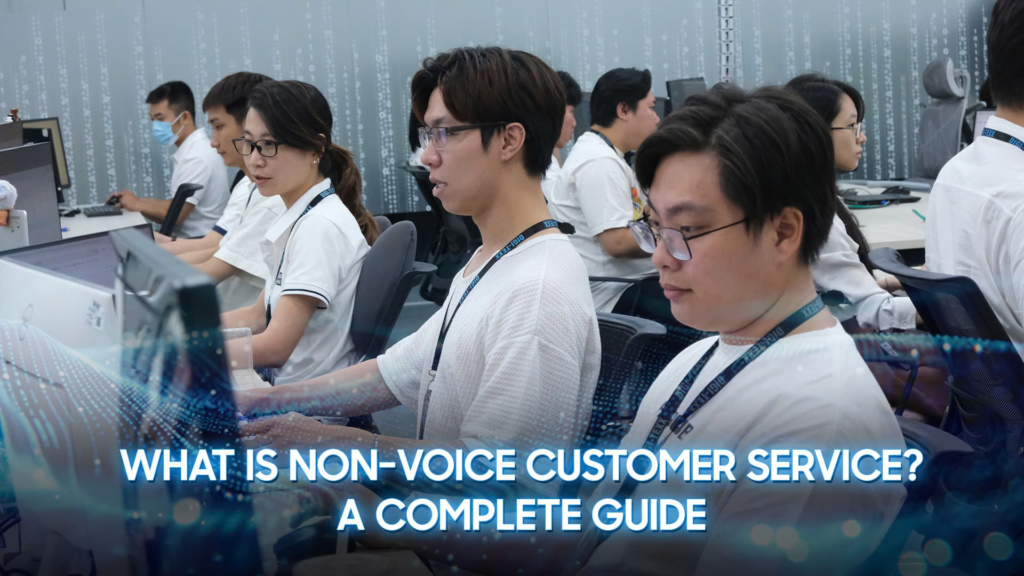
Imagine you need to update a billing address or resolve a minor order discrepancy. Would you rather sit on hold for 15 minutes listening to elevator music, or send a quick text message while working on your laptop?
For modern consumers, the choice is clear.
The traditional voice-based call center is no longer the sole pillar of the customer experience. Instead, businesses are turning toward digital-first strategies to meet users where they are.
According to the Qualtrics XM Institute’s 2025 Consumer Trends Report, poor customer experiences put up to $3.8 trillion in global revenue at risk annually[8].
If you are looking to lower customer effort and improve operational efficiency, understanding non-voice customer service is an essential first step.
Reading the detailed essay below explores what this support model looks like, the consumer psychology behind its success, and how to implement it.
Key Takeaways
- Non-voice customer service utilizes digital text-based channels such as email, live chat, social messaging, and self-service portals to resolve user inquiries.
- Unlike voice processes, which limit agents to one-to-one interactions, non-voice channels enable concurrency, allowing a single representative to manage multiple conversations simultaneously to significantly lower operational costs.
- Key benefits include reduced overhead, greater alignment with Gen Z and Millennial communication preferences, and seamless integration with automation and artificial intelligence tools.
- Critical implementation challenges include managing cognitive load for multi-tasking agents and preserving emotional empathy through written text.
- Successful deployment requires unified omnichannel platforms, strict service level agreements, and intensive training on tone, written clarity, and troubleshooting.
What Is Non-voice Customer Service?
Non-voice customer service is any customer support delivered through written, text-based or digital channels instead of a phone call. It typically includes:
- Live chat and application chat
- Social media and messaging apps (DMs, WhatsApp, Messenger)
- Email and ticketing management
- Self-service and Chatbots
Research in the Journal of Consumer Psychology indicates that text-based communication allows consumers to process information at their own pace, reducing the social anxiety often associated with speaking to a stranger over the phone[3].
It gives users the freedom to multitask, shifting the dynamic from a high-pressure conversation to a convenient, low-friction exchange.
>>> See more:
- What Is Business Process Outsourcing (BPO)? Definition and How It Works?
- Common Challenges In Building Strong Customer Engagement: How to Overcome With Business Support Service
- Customer Support Service
Voice Vs. Non-Voice Customer Service: What’s The Difference?
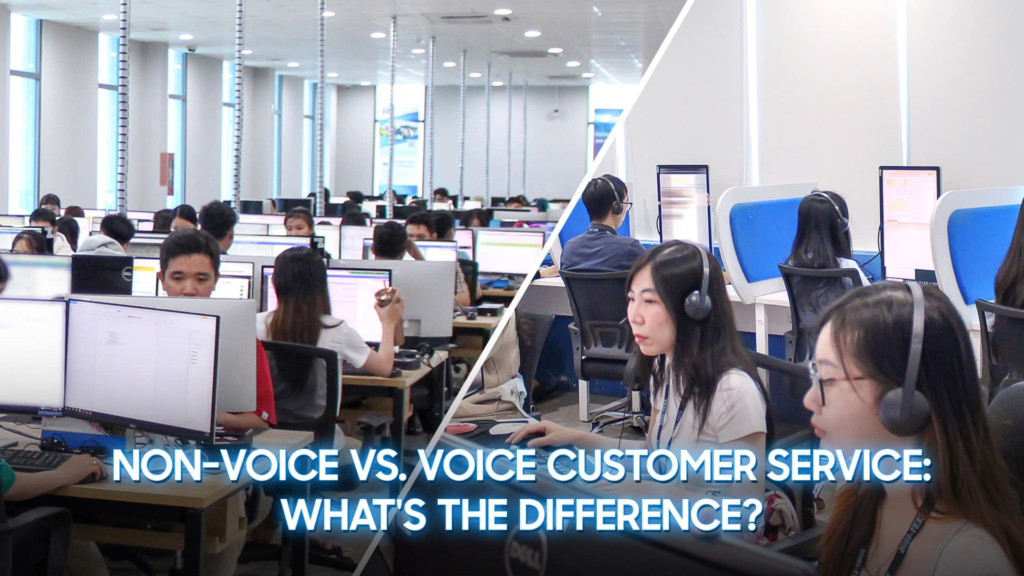
The two aren’t really competitors. They’re different tools built for different jobs.
| Voice Support | Non-Voice Support | |
|---|---|---|
| Format | Real-time, spoken | Written, often asynchronous |
| Best for | Urgent, complex, or emotionally sensitive issues | Routine, well-defined, or low-urgency issues |
| Agent capacity | One conversation at a time | Several conversations at once (chat, email) |
| Speed | Fast once connected, but hold times add friction | Instant (chat) to hours (email) |
| Cost per contact | Higher – one agent, one caller | Lower – agents multitask, self-service scales for free |
| Conveying empathy | Natural, through tone of voice | Requires deliberate word choice |
| Documentation | Needs call recording or notes | Built in – it’s already text |
Most businesses don’t choose one over the other. They use voice for the moments that genuinely need a human voice, such as a billing dispute, a service outage, a frustrated customer, and non-voice for everything that can be handled just as well, or better, in writing.
>>> See more:
- Contact center outsourcing service
- Contact Center Outsourcing as a Strategic Growth Lever: Scaling Customer Support for Rapid Expansion
Types Of Non-voice Customer Service Channels
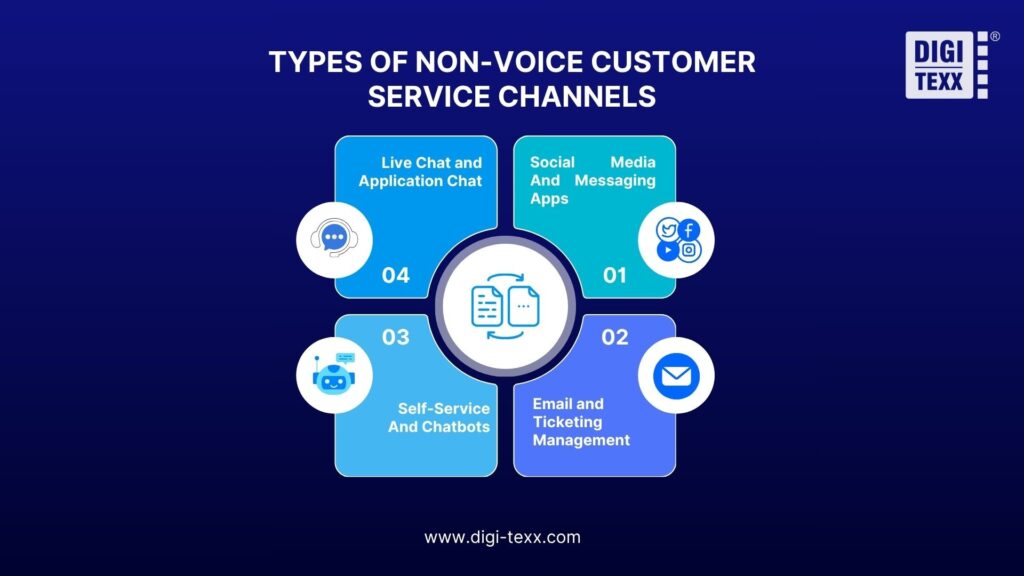
Implementing a robust non-voice strategy requires a balanced mix of channels, each serving a distinct purpose in the customer journey:
Live Chat and Application Chat
Live chat provides real-time assistance directly on your digital storefront. It is a powerful conversion driver, helping pre-purchase customers resolve doubts instantly. According to HubSpot consumer behavior data, 26% of consumers prefer live chat over any other support channel due to its immediacy[7].
Social Media And Messaging Apps
Platforms like Facebook Messenger, WhatsApp, and Zalo have evolved into primary customer service touchpoints. Consumers appreciate these channels because the chat history remains persistent, allowing them to pause and resume conversations over days without losing context.
Email and Ticketing Management
Email is still the backbone of non-voice support. It is best for complex, technical, or legal issues that need a paper trail. It provides a permanent record that builds trust. When linked to a CRM, email tickets let teams collaborate and track metrics like Net Promoter Scores. Because it’s asynchronous, customers can explain their problems in detail without the pressure of a live clock.
Self-Service And Chatbots
This includes knowledge bases, frequently asked questions, and conversational AI. Gartner notes that modern customers do not just want answers from AI. They expect generative AI to actively complete tasks on their behalf, like processing refunds or changing subscription plans.
>>> See more:
Key Benefits Of Non-voice Customer Service
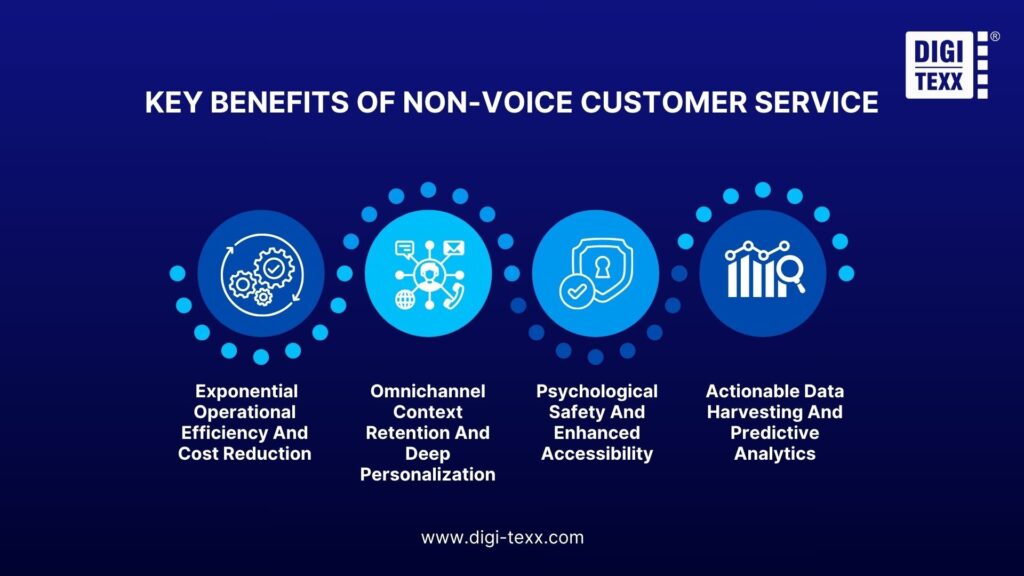
Adopting non-voice customer service delivers clear, measurable advantages to both business operations and the bottom line:
Exponential Operational Efficiency And Cost Reduction
Non-voice service scales. One trained agent can handle two or three chats at once. This breaks the one-to-one limit of phone calls, letting you do more with less. Adding AI chatbots to handle routine questions can cut operational costs by 30%. Digital channels are essential for handling volume spikes without crashing your system[4].
Omnichannel Context Retention And Deep Personalization
Digital platforms keep better records. 60% of customers hate repeating their story to multiple agents. Integrated non-voice channels fix this. When a customer chats, the agent sees their purchase history and past complaints instantly[2]. This allows for deep personalization. Since 76% of customers expect tailored service, this builds loyalty and cuts acquisition costs[1].
Reduced Customer Anxiety and Effort
Text-based channels feel safer for many people. Phone calls can cause anxiety, especially if a customer expects a fight. Text support allows people the time to explain their problem clearly without feeling rushed or threatened. This comfort leads to better reporting and less hostility for agents, making the interaction more productive for everyone.
Actionable Data Harvesting And Predictive Analytics
Every text interaction leaves a transcript you can analyze. Unlike phone calls, you don’t need complex software to read chats and emails. You can use AI to spot trending product bugs or confusing site navigation. This data helps leaders fix flaws before they affect more customers.
>>> See more:
Challenges Businesses Should Know
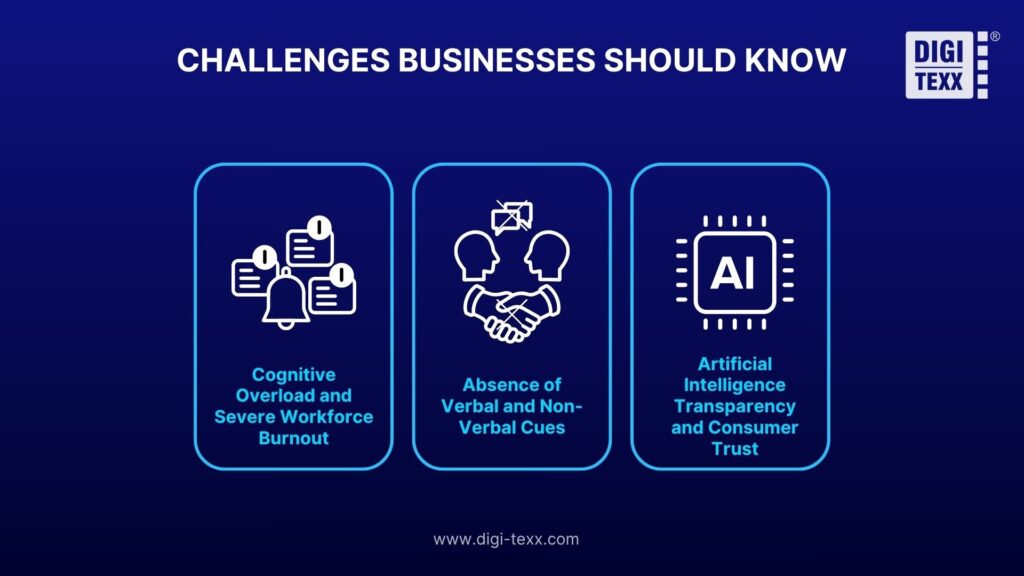
While the benefits are substantial, running a successful non-voice operation comes with specific hurdles:
Cognitive Overload and Severe Workforce Burnout
Multitasking comes with a mental cost. Academic research published in the journal Behaviour & Information Technology demonstrates that while instant messaging tools in the workplace increase interactivity, they also increase task interruptions and cognitive workload if not managed properly[6]. Pushing agents beyond a concurrency level of three or four chats often leads to cognitive fatigue, slower response times, and a sharp decline in service quality.
Absence of Verbal and Non-Verbal Cues
Showing empathy without a voice is hard. Phone agents can sound warm; text agents lose that. Strict rules against emojis make it even harder. Agents must de-escalate angry customers using only words. Balancing professionalism with warmth remains a major challenge in digital service.
Artificial Intelligence Transparency and Consumer Trust
Some customers hate bots because they seem cold or like a roadblock. People are actually three times more likely to use a third-party AI than a company bot, showing a lack of trust. If a bot tries to give a complex apology, it sounds fake. AI works best when it sticks to concrete facts.
Essential Skills For Non-Voice Customer Service Representatives
To overcome these challenges, non-voice agents require a distinct skill set compared to traditional phone representatives:
- Exceptional Written Communication: The ability to write clearly, concisely, and with correct grammar is paramount. Agents must convey complex instructions in simple, easy-to-read paragraphs.
- Strong Written Empathy: Knowing how to use positive phrasing, proper punctuation, and appropriate formatting to project warmth and understanding through text.
- High Cognitive Flexibility: The capacity to switch rapidly between different customer contexts, maintaining accuracy and speed across multiple open chat windows.
- Information Retrieval Speed: The skill to quickly navigate internal databases and knowledge bases to find accurate answers without making the customer wait.
Best Practices For Implementing Non-Voice Customer Support
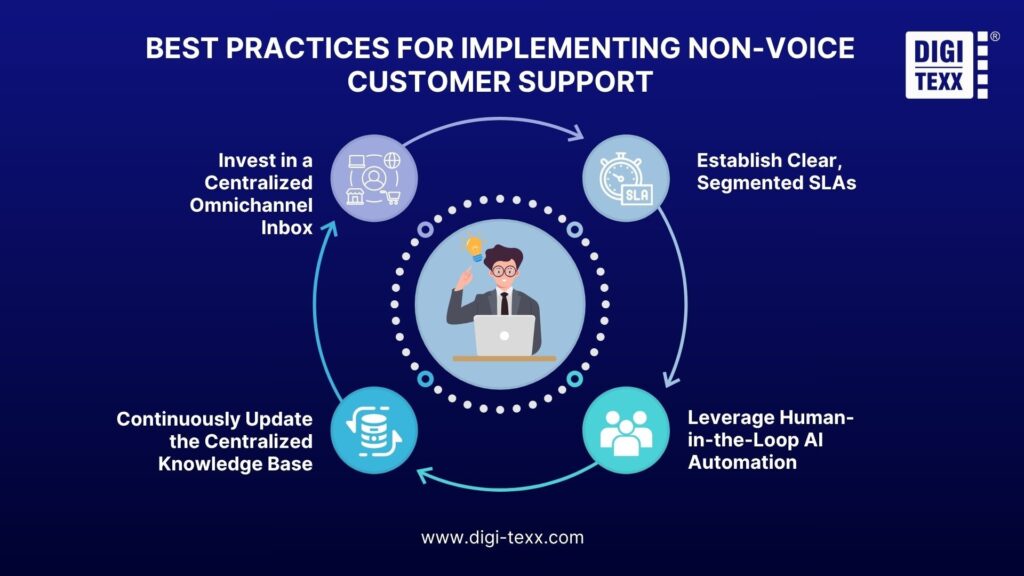
To ensure a successful transition to non-voice channels, businesses should adhere to these core best practices:
- Invest in a Centralized Omnichannel Inbox: Ensure that email, live chat, and social messages route to a single agent console to prevent context switching.
- Establish Clear, Segmented SLAs: Set realistic expectations for response times, such as under one minute for live chat and under twelve hours for email.
- Leverage Human-in-the-Loop AI Automation: Use chatbots for the initial triage and basic data collection, but ensure a friction-free escalation pathway to a human agent when complexity arises.
- Continuously Update the Centralized Knowledge Base: Empower both agents (with internal macros) and customers (with external FAQs) with a single source of truth.
>>> See more:
Non-voice & AI Chatbot: Which one is better?
Comparing human non-voice support to artificial intelligence chatbots is not a matter of choosing one over the other, as both serve distinct and complementary operational purposes.
According to data from the Salesforce State of Service report, 71% of customers prefer interacting with a human agent when dealing with complex issues, highlighting the irreplaceable value of human empathy and nuanced problem-solving[5]. Human non-voice agents excel at navigating emotional customer frustrations and investigating multi-step technical anomalies that require critical thinking.
Conversely, AI chatbots are vastly superior in terms of speed, scaling, and 24h availability. A well-designed chatbot can instantly resolve simple inquiries like order tracking or basic FAQs, deflecting high volumes of low-effort tickets without human intervention.
Ultimately, the most effective customer experience strategies do not treat this as a competition. Instead, they deploy a hybrid model where AI chatbots act as the first line of defense, handling routine questions and gathering customer context, before seamlessly escalating complex or high-priority conversations to skilled human non-voice representatives.
>>> See more:
- AI Vs Human Content Moderation Solutions
- How AI-Powered Document Automation Transforms Business Operations
Moving Forward With Non-Voice Service
By 2028, over 50% of customer service organizations will double their technology spending. AI won’t kill human jobs; it will change them[9]. 80% of brands plan to move humans into specialized roles handling complex emotions and managing AI[10].
In 2026, “multimodal” will be the standard. Customers will switch between text, voice, and video in one thread without losing context. AI will move beyond chat to handle backend work autonomously. The winners will be brands using AI for power and humans for empathy. By balancing both, you build a resilient, profitable growth engine.
Frequently Asked Questions
What Is The Difference Between Voice And Non-Voice Call Center Jobs?
Voice call center jobs require agents to handle back-to-back telephone calls, relying on verbal communication, active listening, and voice modulation. Non-voice jobs focus entirely on text-based communication, requiring agents to manage live chats, emails, and social media tickets using strong typing speed and written empathy.
Can Non-Voice Customer Service Completely Replace Phone Support?
While non-voice channels handle the vast majority of routine and transactional inquiries, phone support remains valuable. Complex, highly sensitive, or emotionally charged issues, such as financial discrepancies or urgent travel changes, often benefit from the immediate personal connection of a voice call.
How Many Chat Sessions Should A Non-Voice Agent Handle At Once?
On average, a trained agent can effectively manage 3-4 chat sessions simultaneously. Pushing agents to handle more than five concurrent chats often leads to longer response times, cognitive fatigue, and a decline in customer satisfaction.
What Are Some Common Examples Of Non-Voice Customer Service?
Common examples include chatting with a support representative on an online retail website, receiving an order update via WhatsApp, interacting with an automated AI chatbot to track a package, or emailing a technical support desk to troubleshoot software.
Reference
- Zendesk (2026). 92 Customer service statistics you need to know in 2026. [online]. Available at: https://www.zendesk.com/blog/customer-service/satisfaction/customer-service-statistics/ [Accessed 16 July 2026a].
- Zendesk (2026). What is omnichannel?: A CX guide for 2026. [online]. Available at: https://www.zendesk.com/blog/customer-experience/expectations/omnichannel-experience/ [Accessed 16 July 2026b].
- Buechel, E.C. and Berger, J. (2017). Microblogging and the Value of Undirected Communication. Journal of Consumer Psychology, 28(1), pp.40–55. doi:10.1002/jcpy.1013.
- Gartner (2025). Gartner Predicts Agentic AI Will Autonomously Resolve 80% of Common Customer Service Issues Without Human Intervention by 2029. [online] Gartner. Available at: https://www.gartner.com/en/newsroom/press-releases/2025-03-05-gartner-predicts-agentic-ai-will-autonomously-resolve-80-percent-of-common-customer-service-issues-without-human-intervention-by-20290 [Accessed 16 July 2026].
- Nash, B. (2025). Customer Service Statistics 2026: 91+ Stats & Insights [Expert Analysis] – Marketing LTB. [online] Marketing LTB -. Available at: https://marketingltb.com/blog/statistics/customer-service-statistics/ [Accessed 16 July 2026].
- Yang, Q. and Feng, Y. (2024). Does the use of mobile instant messaging in the workplace increase employees’ workload? Behaviour & Information Technology, pp.1–15. doi:10.1080/0144929x.2024.2397681.
- (2022). How Consumers Use Live Chat for Customer Service [New Data]. [online] Blog.hubspot.com. Available at: https://blog.hubspot.com/service/live-chat-consumer-behavior [Accessed 16 July 2026].
- XM Institute (2025). $3.8 Trillion of Global Sales are at Risk Due to Bad Customer Experiences in 2025. [online] Qualtrics. Available at: https://www.qualtrics.com/articles/customer-experience/trillion-sales-at-risk-2025/ [Accessed 16 July 2026].
- Gartner (2026). Gartner Predicts Over 50% of Customer Service Organizations Will Double Their Technology Spend By 2028. [online]. Available at: https://www.gartner.com/en/newsroom/press-releases/2026-03-31-gartner-predicts-over-50-percent-of-customer-service-organizations-will-double-their-technology-spend-by-2028 [Accessed 16 July 2026a].
- Gartner (2026). Press Announcement: Gartner Survey Finds 91% of Customer Service Leaders Under Pressure to Implement AI in 2026. [online]. Available at: https://www.gartner.com/en/newsroom/press-releases/2026-02-18-gartner-survey-finds-ninety-one-percent-of-customer-service-leaders-under-pressure-to-implement-ai-in-2026 [Accessed 16 July 2026b].