
Understanding The Spectrum Of Human-AI Collaboration
As organizations continue adopting AI across their operations, one common misconception is that automation is a binary choice between fully manual processes and completely autonomous systems.
In reality, human-AI collaboration exists on a spectrum. Different workflows require different levels of human participation depending on operational risk, AI reliability, regulatory requirements, and the availability of human expertise.
There are many Human-AI loop configurations, each representing a distinct relationship between human operators and AI components.
Rather than replacing humans entirely, these configurations determine where people participate within the decision-making process and how authority is distributed between humans and machines.
| Feature | Human-in-the-Loop (HITL) | Human-on-the-Loop (HOTL) | Human-Out-of-the-Loop (HOOTL) |
| Core Concept | Direct human involvement in every decision. | Human supervision of automated routines. | Full AI autonomy with no intervention. |
| Human Involvement | High: Continuous and active. | Medium: Event-driven, intervenes only on exceptions. | Low: Pre-deployment only, humans perform design & maintenance. |
| AI Role | Support simple taskforces, enabling humans to focus on making decisions | Executes routines independently. | Makes all execution decisions. |
| Decision Authority | Human: can make the final verdict | Shared: AI handles routines, humans handle exceptions. | AI: executes based on predefined rules. |
Operational Risk | High Impact / Manual Control: Mistakes lead to major financial loss or regulatory penalties; requires mandatory human accountability. | Moderate Impact / Exception Control: Moderate risk mitigated by having humans investigate only flagged, high-priority anomalies. | Low Impact / Automated Control: Low-impact errors contained by automated safeguards, allowing safe operation at machine speed. |
| Workflow Predictability | Ambiguous: Frequent complex cases that AI lacks the context to resolve. | Mostly Predictable: Routine conditions with occasional edge cases that drop below AI confidence thresholds. | Highly Structured: Well-understood environments where predefined rules cover all scenarios. |
| Operational Taskforce Volume | Low to medium: Manageable volumes where human review does not create a severe operational bottleneck. | High: Mass transactions where reviewing every single output is physically or financially impractical. | Very high: Volumes or data velocities so extreme that humans cannot physically react in time. |
Source: MDPI
>>> See more:
- AI Data Processing Company: Transforming Data into Intelligent Business Insights
- Business Process Automation Solutions
What Is Human-In-The-Loop (HITL)?
Human-in-the-Loop (HITL) refers to an AI workflow in which humans actively participate in the decision-making process rather than allowing the system to operate entirely on its own. Human-in-the-Loop systems are characterized by direct human involvement in every decision, with humans retaining final authority over the outcome.
In enterprise environments, this means AI functions as a supporting technology rather than an independent decision-maker. Automated systems can analyze data, identify patterns, and generate recommendations, but the final action cannot proceed without human approval.
According to data from the McKinsey Global Institute, true “Human-Out-of-the-Loop” autonomy is incredibly rare; less than 5% of occupations consist of activities that are 100% automatable. Instead, the vast majority of enterprise workflows require a collaborative framework: about 60% of all occupations have at least 30% of their activities technically automatable.
Unlike passive monitoring, Human-in-the-Loop embeds human expertise directly into the operational cycle. The relationship between humans and AI is therefore collaborative: AI contributes speed and processing capability, while humans provide contextual understanding, professional judgment, and accountability.
As a result, Human-in-the-Loop enables organizations to leverage the efficiency of automation while maintaining control over decisions that require accuracy, domain expertise, or regulatory oversight.
How HITL Works
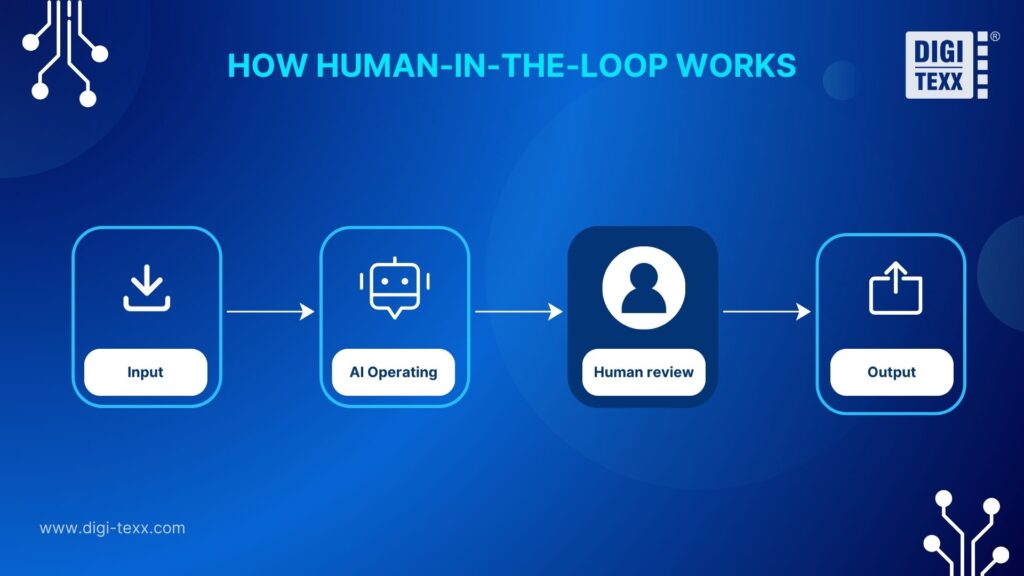
Human-in-the-Loop workflows are designed around collaboration between AI systems and human experts.
While AI serves as a supporting technology that handles repetitive processing and generates recommendations, humans provide oversight and make the final decisions.
Human-in-the-Loop workflows are designed around collaboration between AI systems and human experts. While AI serves as a supporting technology that handles repetitive processing and generates recommendations, humans provide oversight and make the final decisions.
In practice, the workflow follows a simple sequence:
- AI Analysis and Generation: The AI system first analyzes the available information and produces an initial output, such as a prediction, recommendation, or draft response.
- Human Review and Validation: Before the process can continue, a human expert reviews the AI-generated result, validates its accuracy, and determines whether the action should proceed.
- Approval and Execution: Only after receiving explicit human approval does the workflow move forward to final execution.
This creates a clear division of responsibilities between humans and machines:
- AI contributes speed and scalability by processing large volumes of information and automating routine tasks.
- Humans contribute judgment and accountability by applying contextual knowledge, business rules, and professional expertise.
The objective of Human-in-the-Loop is to combine the efficiency of AI with the precision and responsibility of human decision-making. As a result, organizations can improve productivity while maintaining control over processes where errors carry meaningful operational or regulatory consequences.
Typical Use Cases
Human-in-the-Loop is most commonly implemented in environments where decisions carry meaningful consequences, and organizations cannot afford to rely solely on automated outputs.
HITL systems are frequently adopted in industries where accuracy, accountability, and human expertise remain essential components of the decision-making process.
In these scenarios, AI supports the workflow, but humans are responsible for validating results, handling ambiguous cases, and maintaining oversight.
The table below highlights several common domains where Human-in-the-Loop architectures are widely applied.
| Industry | Why Human Oversight Is Required | Example Human Role |
| Healthcare | Patient safety and clinical decisions require expert validation and regulatory compliance. | Clinicians confirm or override AI recommendations. |
| Finance | Decisions involving lending, fraud detection, and risk assessment must remain transparent and auditable. | Analysts review borderline or high-risk cases. |
| Cybersecurity | Threat detection often requires contextual understanding and rapid incident response. | Security analysts investigate alerts and provide feedback. |
| Legal and Public Sector | Accountability, due process, and transparency are critical requirements. | Professionals review decisions and approve exceptions. |
| Manufacturing and Quality Inspection | Defects and edge cases may require human verification before action is taken. | Inspectors validate uncertain outputs and identify root causes. |
Source: MDPI
Although these industries differ significantly, they share a common characteristic: mistakes can lead to operational, financial, or regulatory consequences. As a result, organizations intentionally position human experts as the final checkpoint within the workflow.
Rather than replacing human decision-makers, Human-in-the-Loop enables AI to augment their capabilities by accelerating routine tasks while preserving the expertise and accountability required in high-stakes environments.
Why Organizations Choose HITL
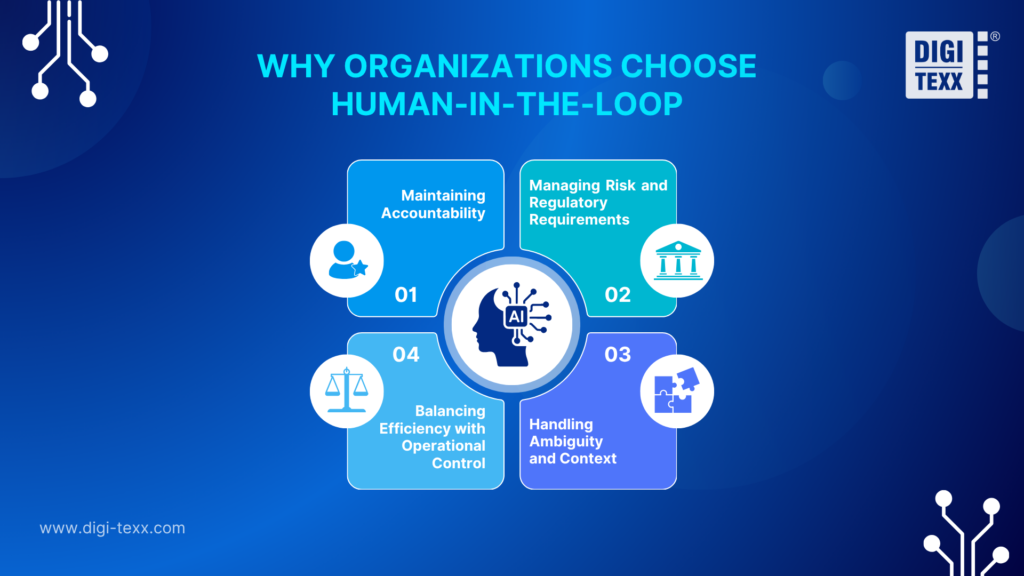
Organizations do not implement Human-in-the-Loop simply to add more manual work to an automated process. Instead, they adopt this approach when maintaining human oversight is essential to achieving business, operational, or regulatory objectives.
Several factors commonly drive the adoption of Human-in-the-Loop workflows.
Maintaining Accountability
In Human-in-the-Loop systems, humans retain final decision-making authority. This clear distribution of responsibility helps organizations ensure that important decisions remain attributable to qualified professionals rather than being delegated entirely to automated systems.
Managing Risk And Regulatory Requirements
Many industries operate under regulatory frameworks that emphasize accountability and human oversight when AI systems are used in sensitive environments.
For example, Article 14 of the European Union’s AI Act requires high-risk AI systems to be designed in a way that allows effective human oversight. Organizations must ensure that human operators can understand system outputs, monitor performance, intervene when necessary, and override or stop the system when risks emerge.
As a result, Human-in-the-Loop provides organizations with a practical approach to introducing automation while maintaining human control over decisions that affect health, safety, financial outcomes, or fundamental rights.
Handling Ambiguity And Context
AI systems excel at processing large volumes of information, but some situations require contextual understanding, domain expertise, or professional judgment.
Human reviewers provide the additional perspective needed to evaluate complex or uncertain cases that cannot be resolved through automation alone.
For example, an AI system may classify an insurance claim as suspicious because the submitted information does not match typical claim patterns. However, a claims specialist can review supporting documents, identify legitimate exceptions, and determine whether the claim should proceed.
This allows organizations to benefit from automation while ensuring unusual cases receive appropriate human review.
>>> See more:
Balancing Efficiency With Operational Control
Human-in-the-Loop allows organizations to benefit from the speed and scalability of AI while preserving oversight over critical decisions. By assigning repetitive processing tasks to AI and reserving final approval for human experts, organizations can improve efficiency without sacrificing control.
For example, an AI system can screen thousands of online transactions in real time and flag potentially fraudulent purchases. Instead of manually reviewing every transaction, fraud analysts only investigate suspicious cases before deciding whether to block or approve them. This approach enables organizations to scale operations while maintaining control over decisions that may affect customers and revenue.
Ultimately, Human-in-the-Loop is most valuable when the cost of an incorrect decision outweighs the benefits of fully autonomous execution. In these situations, organizations intentionally prioritize trust, accountability, and accuracy alongside automation.
What Is Human-On-The-Loop (HOTL)?
Human-on-the-Loop (HOTL) refers to an AI oversight model in which humans supervise automated systems without participating directly in every decision.
Instead of acting as mandatory checkpoints within the workflow, human operators monitor system performance and intervene only when exceptions, anomalies, or unexpected situations arise.
Human-on-the-Loop differs from Human-in-the-Loop in the distribution of authority. While Human-in-the-Loop requires direct human participation in every decision, Human-on-the-Loop allows AI systems to execute routine tasks autonomously under human supervision.
In practice, humans remain responsible for monitoring outcomes, reviewing performance, and retaining the ability to override or adjust the system when necessary. As a result, AI assumes greater operational autonomy while humans transition from decision-makers to supervisors.
This supervisory relationship enables organizations to scale automation beyond what would be practical under a Human-in-the-Loop model while still maintaining a level of human oversight appropriate for the task.
How HOTL Works
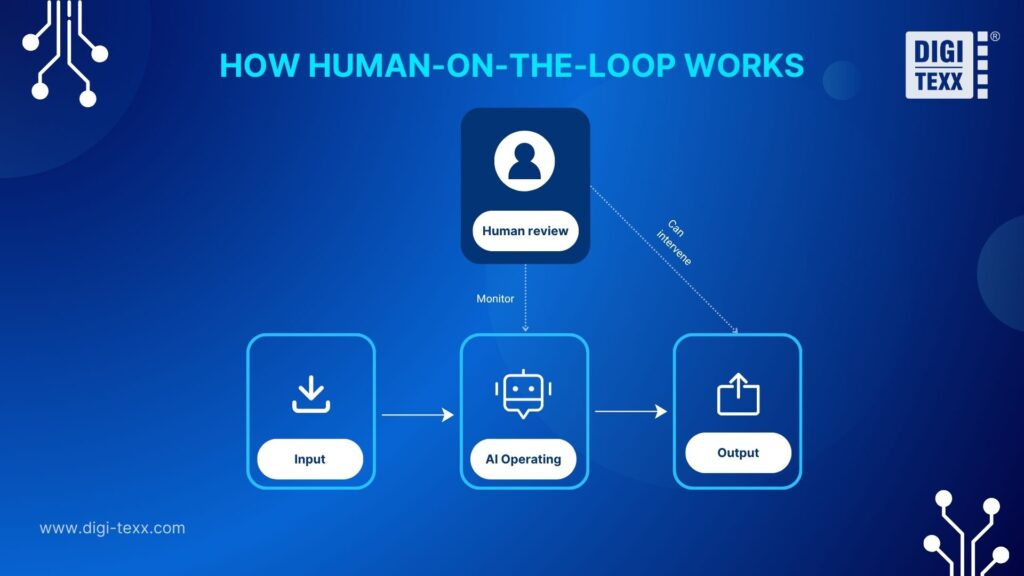
Human-on-the-Loop workflows are designed around supervisory control rather than direct participation.
Instead of reviewing every individual output, human operators oversee the overall performance of the AI system and intervene only when anomalies, exceptions, or high-risk situations occur. In practice, AI systems are allowed to execute routine tasks autonomously within predefined rules and operating boundaries.
Human involvement is therefore event-driven rather than decision-driven, enabling organizations to process larger volumes of work without requiring constant manual review.
A typical Human-on-the-Loop workflow operates through three key steps:
- Autonomous Execution: AI systems perform day-to-day operations independently, processing information and executing routine actions without waiting for human approval.
- Supervisory Oversight: Human operators monitor system behavior, review performance, and maintain visibility into outcomes.
- Exception-Based Intervention: When unusual situations, unexpected outputs, or predefined thresholds are triggered, human operators step in to investigate, adjust, or override the system.
This shift from direct decision-making to operational supervision allows organizations to scale automation beyond what would be practical under a Human-in-the-Loop approach.
For example, an AI-powered cybersecurity platform may continuously monitor network activity and automatically block suspicious behavior. Security analysts are not required to review every event, but they can investigate high-priority alerts and intervene when potential threats require additional analysis.
By allowing AI to handle routine operations while reserving human involvement for exceptional cases, organizations increase scalability without completely removing human oversight.
Typical HOTL Use Cases
Human-on-the-Loop is commonly adopted in environments where AI systems must operate continuously and at scale, making it impractical for humans to participate in every individual decision.
Instead, human operators supervise overall system performance and intervene only when exceptions or unexpected situations arise.
Human-on-the-Loop is particularly suitable for applications where routine operations can be executed autonomously while humans retain the ability to intervene when necessary.
The table below highlights several examples of Human-on-the-Loop applications identified in the literature.
| Domain | Why Supervisory Oversight Is Appropriate | Example Human Role |
| Cybersecurity | AI systems continuously monitor large volumes of events and detect potential threats, making manual review of every event impractical. | Security analysts investigate high-priority alerts and provide feedback when necessary. |
| Autonomous Driving | Vehicles can perform routine driving tasks independently, but unexpected road conditions and edge cases may still require human intervention. | Drivers or safety operators take control when exceptional situations occur. |
Source: MDPI
>>> See more:
Why Organizations Choose HOTL?
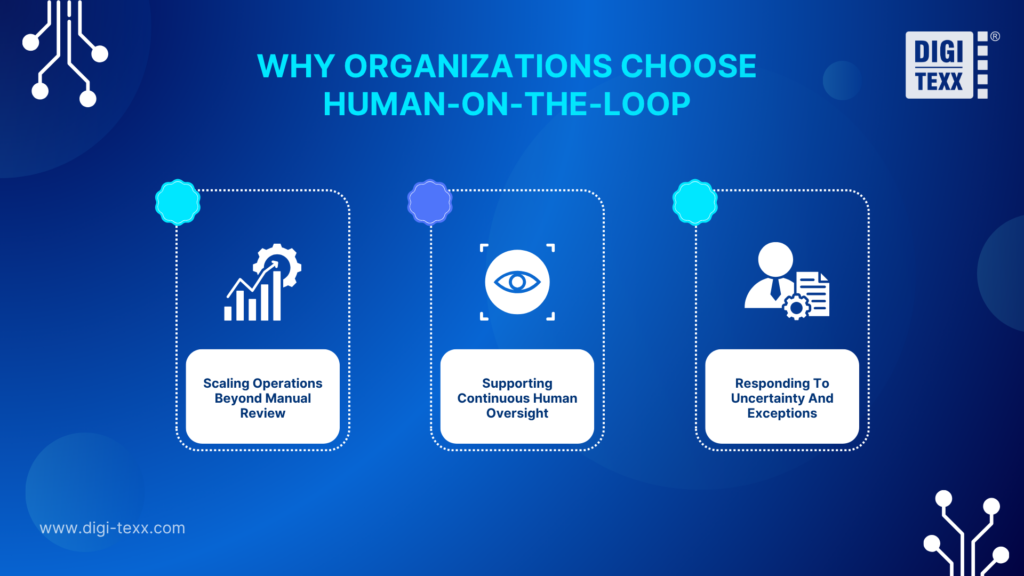
Organizations typically adopt Human-on-the-Loop when fully reviewing every AI-generated decision becomes impractical, but maintaining some degree of human oversight remains necessary. Rather than eliminating human involvement entirely, HOTL shifts people from active decision-makers to supervisory roles.
Scaling Operations Beyond Manual Review
As transaction volumes increase, requiring human approval for every output can become a bottleneck. Human-on-the-Loop enables organizations to allow AI systems to handle routine operations autonomously while reserving human attention for exceptional situations.
For example, a cybersecurity platform may analyze thousands of events every minute. Instead of reviewing every detection manually, security analysts focus only on high-priority alerts that require additional investigation.
Responding To Uncertainty And Exceptions
Although AI systems can manage routine tasks independently, unexpected scenarios and edge cases may still require human expertise. Human-on-the-Loop provides a mechanism for escalation when system outputs exceed predefined confidence thresholds or operating boundaries.
For example, an autonomous vehicle may handle normal driving conditions independently, but a safety driver remains available to intervene when unusual road conditions occur.
Supporting Continuous Human Oversight
Human-on-the-Loop systems enable humans to supervise AI behavior and retain the ability to intervene when necessary. This supervisory approach allows organizations to benefit from increased autonomy without completely removing human responsibility from the workflow.
Ultimately, Human-on-the-Loop is most appropriate when organizations need to process large volumes of work efficiently while preserving the ability to oversee, adjust, and intervene in exceptional situations.
What Is Human-Out-Of-The-Loop (HOOTL)?
Human-Out-of-the-Loop (HOOTL) refers to an AI operating model in which systems execute tasks autonomously without requiring real-time human participation or intervention.
Unlike Human-in-the-Loop, where humans approve every decision, or Human-on-the-Loop, where humans supervise system behavior, Human-Out-of-the-Loop places the execution process entirely under the control of the AI system. Human involvement is largely limited to designing, configuring, or maintaining the system rather than participating in day-to-day operations.
Human-Out-of-the-Loop becomes appropriate when human operators lack the local knowledge, expertise, or reaction speed required to respond effectively to time-critical situations. In these cases, autonomy becomes a necessity rather than a convenience.
For example, an AI-powered cybersecurity system may detect and isolate malicious network activity within milliseconds to prevent threats from spreading across critical infrastructure.
Because the response window is far shorter than human reaction times, waiting for manual approval could allow the attack to escalate.
In situations like these, fully autonomous execution enables organizations to respond at machine speed while relying on predefined rules and safeguards rather than real-time human intervention.
In enterprise environments, Human-Out-of-the-Loop is typically associated with fully autonomous execution supported by predefined guardrails, monitoring capabilities, and rollback mechanisms.
Rather than relying on continuous human supervision, organizations depend on system constraints and operational safeguards to ensure reliable performance.
How HOOTL Works
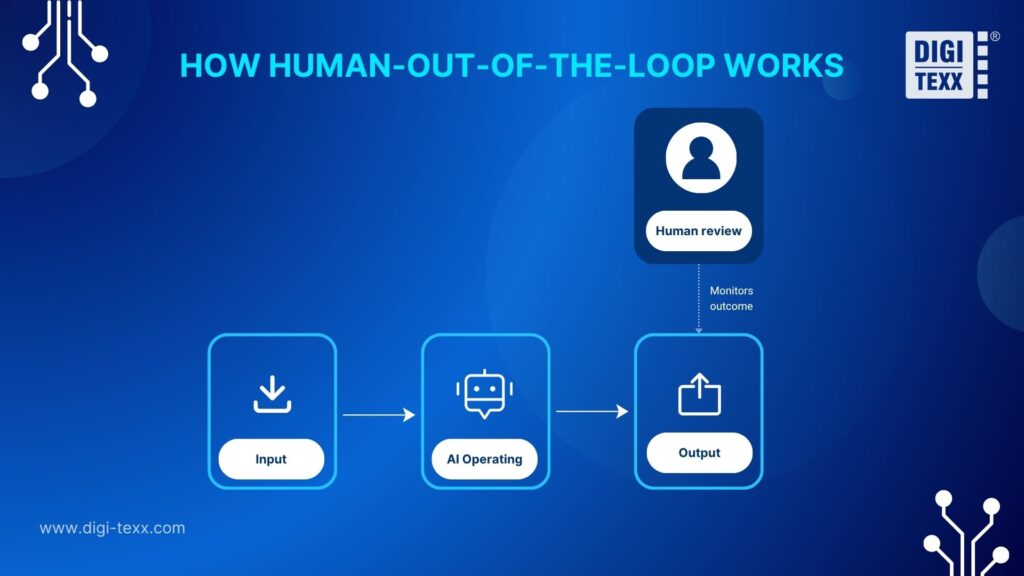
Human-Out-of-the-Loop workflows are designed for situations where AI systems can operate autonomously without requiring real-time human participation.
Rather than reviewing decisions or supervising day-to-day operations, humans establish the rules, constraints, and objectives that guide the system before execution begins.
In practice, human involvement shifts from operational oversight to system design, configuration, and maintenance. The workflow generally follows this sequence:
- Predeployment Configuration: Before deployment, human experts determine the system’s goals, operating parameters, and acceptable boundaries.
- Autonomous Execution: Once activated, the AI system performs tasks independently without waiting for human approval or intervention.
- Safeguards and Recovery: Organizations implement automated safeguards, including performance monitoring, alerts, and rollback procedures.
These initial instructions act as guardrails that define how the AI should behave under normal conditions. Consequently, decisions are made and executed automatically based on the predefined rules and the information available to the system.
Although humans are not involved in real-time operations, the established safeguards maintain reliability and respond to unexpected system failures.
By removing humans from operational execution, Human-Out-of-the-Loop enables organizations to respond at machine speed in environments where delays could increase risk or reduce effectiveness.
Typical HOOTL Use Cases
Human-Out-of-the-Loop is typically adopted in environments where systems must react faster than humans can reasonably respond or where continuous human participation would be impractical. Rather than relying on real-time oversight, organizations establish predefined rules and safeguards before allowing AI systems to operate autonomously.
The following examples illustrate situations where Human-Out-of-the-Loop architectures are commonly applied.
| Domain | Why Full Autonomy Is Appropriate | Example System Behavior |
| Cybersecurity | Cyber threats can spread across a company’s network within milliseconds, leaving insufficient time for human approval. Waiting for a person to review the alert allows the damage to be done. | The AI automatically detects and isolates suspicious activity based on predefined security policies, instantly locking down the infected computer before the virus spreads. |
| IT & Data Center Operations | Large-scale infrastructure generates more system alerts than a human team can process individually. Sudden traffic spikes can crash servers before staff can react. | Systems automatically redistribute workloads or recover failed services, turning on backup servers instantly to keep websites and software running without downtime. |
| Manufacturing & Production | Production environments require continuous and immediate responses to maintain stability and avoid safety hazards or broken equipment. | The AI adjusts operating parameters like machine speed or temperature without waiting for manual intervention, keeping the assembly line moving safely. |
| Financial Trading | Market conditions change faster than human traders can react. A human simply cannot read the data and click a button fast enough to capture the value. | Algorithms execute transactions automatically according to predefined strategies, buying or selling the exact moment specific pricing rules are met. |
Although these applications differ in their objectives, they share a common characteristic: the speed or scale of operations makes real-time human involvement either impractical or ineffective.
As a result, Human-Out-of-the-Loop is generally reserved for environments where autonomy is required to achieve operational objectives rather than simply improve efficiency.
Why Organizations Choose HOOTL?
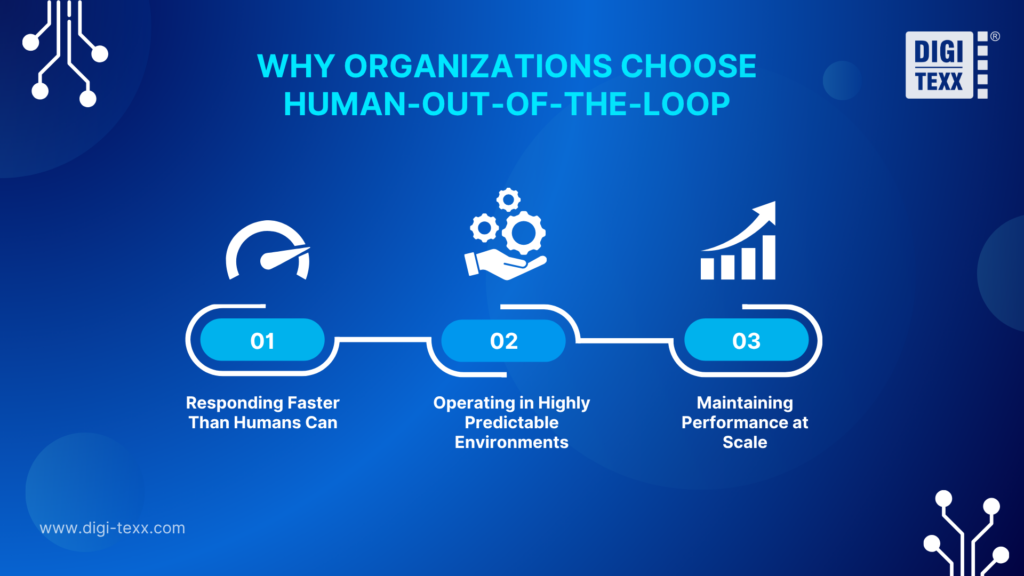
Unlike Human-in-the-Loop or Human-on-the-Loop, Human-Out-of-the-Loop is typically adopted when human participation becomes a limitation rather than an advantage.
Responding Faster Than Humans Can
Certain environments require decisions to be made within milliseconds, leaving insufficient time for human intervention. In these situations, autonomy becomes a necessity rather than a convenience.
For example, advanced driver-assistance systems can detect potential collisions and automatically intervene faster than human drivers can react, helping improve road safety during time-critical events.
Operating In Highly Predictable Environments
Human-Out-of-the-Loop is most appropriate when system behaviors are well understood and operating conditions are clearly defined. In these environments, organizations can establish rules and safeguards in advance, allowing systems to execute tasks autonomously without continuous oversight.
Maintaining Performance At Scale
As systems become more complex and process increasing volumes of information, requiring human participation in every decision can introduce delays and operational bottlenecks. Human-Out-of-the-Loop enables organizations to maintain continuous operations while relying on predefined controls instead of real-time intervention.
Ultimately, the appropriate level of human involvement depends on the context in which the system operates, the capabilities of the technology, and the risks associated with the decisions being made. Rather than eliminating human responsibility, Human-Out-of-the-Loop shifts human involvement from operational execution to system design, governance, and accountability.
Where Can Humans Intervene Throughout The AI Lifecycle?
Human involvement in AI extends far beyond approving outputs or supervising automated decisions. According to IBM, humans can contribute throughout the entire AI lifecycle, helping ensure that systems remain accurate, reliable, and aligned with business objectives.
Depending on the level of autonomy adopted, human participation may occur at different stages of the workflow.
| AI Lifecycle Stage | Human Contribution |
| Data Preparation | Curate datasets, remove inconsistencies, and ensure data quality before training. |
| Model Development | Define objectives, select evaluation criteria, and establish operational boundaries. |
| Training and Validation | Review outputs, label data, and provide feedback to improve model performance. |
| Deployment and Operations | Approve decisions, supervise system behavior, or establish guardrails depending on the oversight model. |
| Monitoring and Improvement | Evaluate outcomes, identify failures, and refine the system over time. |
The role humans play at each stage depends on the level of autonomy required by the application. In Human-in-the-Loop workflows, people may participate directly in operational decisions. In Human-on-the-Loop systems, humans transition into supervisory roles. In Human-Out-of-the-Loop environments, human involvement shifts further upstream toward system design, governance, and continuous improvement.
Regardless of the model chosen, successful AI adoption is rarely about removing humans entirely. Instead, it is about determining where human expertise creates the greatest value throughout the lifecycle.
>>> See more:
- What is data labeling? The ultimate guide
- 10 Essential Data Cleaning Techniques for Better Data Quality
- Outsource Data Annotation Services to Scale Your AI Faster
HITL, HOTL, And HOOTL: When And How To Use Them
In practice, organizations rarely start with fully autonomous AI systems. As models gain access to more data and workflows become better understood, human involvement often shifts gradually from direct decision-making to supervisory roles and eventually to autonomous execution.
Rather than representing three competing approaches, Human-in-the-Loop, Human-on-the-Loop, and Human-Out-of-the-Loop can be viewed as different stages in the evolution of AI maturity.
| Decision Factor | Human-in-the-Loop (HITL) | Human-on-the-Loop (HOTL) | Human-Out-of-the-Loop (HOOTL) |
| What is the cost of an error? | High-impact errors requiring direct human judgment | Moderate impact errors where intervention is needed only for exceptions | Low-impact errors with predefined safeguards |
| How predictable is the workflow? | Highly variable and context-dependent | Moderately variable with occasional exceptions | Stable, repetitive, and well-defined |
| What is the operational volume? | Low to medium volume | High volume | Very high volume or machine-speed operations |
| Are there regulatory requirements? | Strict compliance and mandatory human accountability | Moderate oversight requirements | Minimal regulatory constraints |
Human oversight in AI is not a fixed choice, but an evolving spectrum. Organizations beginning their automation journey often start with Human-in-the-Loop workflows to establish trust, collect feedback, and validate model performance.
As systems mature and processes become more predictable, oversight can gradually shift toward Human-on-the-Loop and, in suitable scenarios, Human-Out-of-the-Loop architectures.
The ultimate goal of automation is not to remove humans from the process, but to maximize efficiency and scalability while maintaining the level of oversight required for the task at hand.
By aligning human involvement with business risk, operational complexity, and regulatory requirements, organizations can build AI systems that are both effective and responsive.
FAQs
What Is The Difference Between HITL, HOTL, And HOOTL?
The main difference lies in the level of human involvement. Human-in-the-Loop (HITL) requires human review for every decision, Human-on-the-Loop (HOTL) allows humans to supervise and intervene when necessary, while Human-Out-of-the-Loop (HOOTL) enables AI systems to operate autonomously without real-time human participation.
Can AI Completely Replace Humans In These Frameworks?
Not entirely. Even in Human-Out-of-the-Loop (HOOTL) systems, humans remain responsible for defining objectives, establishing guardrails, and governing the AI. Rather than replacing humans, these frameworks determine how human involvement evolves as automation increases.
How Do AI Regulations Impact The Choice Of Oversight Model?
Regulatory frameworks heavily influence oversight requirements, particularly in high-risk industries. For example, the European Union’s AI Act requires high-risk AI systems to allow for effective human oversight. Consequently, strict regulatory environments generally necessitate an HITL model to ensure transparency, due process, and human accountability.
Why Shouldn’t An Organization Use HOOTL For All Processes To Maximize Efficiency?
HOOTL is generally reserved for environments where autonomy is a necessity to achieve operational objectives, such as reacting at machine speed, rather than just a tool to improve efficiency. If a workflow is highly variable or the cost of an error is high, prioritizing full autonomy over human judgment can introduce unacceptable operational or financial risks.
REFERENCES
- European Commission (2016). AI Act Service Desk – Article 14: Human oversight. [online] Europa.eu. Available at: https://ai-act-service-desk.ec.europa.eu/en/ai-act/article-14.
- Garn, D. (2026). AI operating models: Balancing autonomy and human oversight. [online] Search Data Center. Available at: https://www.techtarget.com/searchdatacenter/tip/AI-operating-models-Balancing-autonomy-and-human-oversight [Accessed 11 Jun. 2026].
- Lazaros, K., Vrahatis, A.G. and Kotsiantis, S. (2026). Human-in-the-Loop Artificial Intelligence: A Systematic Review of Concepts, Methods, and Applications. Entropy, [online] 28(4), p.377. doi: https://doi.org/10.3390/e28040377.
- Methnani, L., Aler Tubella, A., Dignum, V. and Theodorou, A. (2021). Let Me Take Over: Variable Autonomy for Meaningful Human Control. Frontiers in Artificial Intelligence, 4. doi: https://doi.org/10.3389/frai.2021.737072.
- Microsoft (2026). Microsoft Agent Framework Workflows – Human-in-the-loop (HITL). [online] Microsoft.com. Available at: https://learn.microsoft.com/en-us/agent-framework/workflows/human-in-the-loop?pivots=programming-language-csharp.
- Synvestable (2026). HITL: The Complete Implementation Guide for 2026. [online] Synvestable. Available at: https://www.synvestable.com/human-in-the-loop.html.