
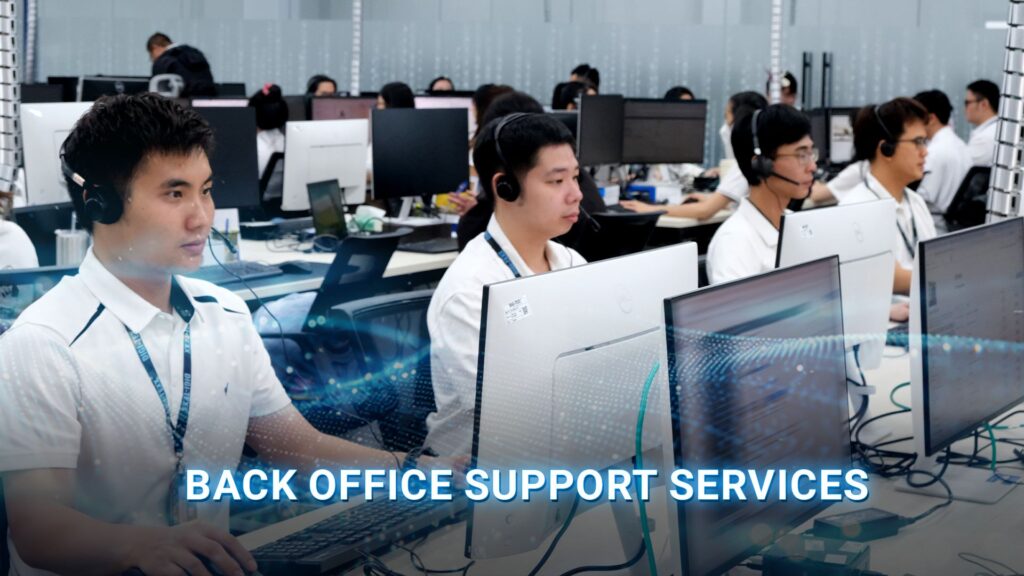
Back office support services help businesses manage high-volume administrative and operational workflows such as data entry, document processing, invoice processing, data validation, and order processing. The right outsourcing model can increase processing capacity, improve consistency, and reduce the pressure on internal teams while maintaining defined quality and security controls.
In this article, DIGI-TEXX will help you understand what back office support services include, how the outsourcing process works, what businesses should consider when choosing a provider, and how to evaluate the right model for their operational needs.
>>> See more:
- Construction Invoice Reconciliation: Best Practices, Software & Outsourcing
- Top 10 Outsourced AI Training Data Companies in 2026
- Top 10 Data Processing Software For Business 2026 – Best Tool Reviewed
- 20 Best Data Integration Tools: Definition, Benefits & Features
What Are Back Office Support Services?
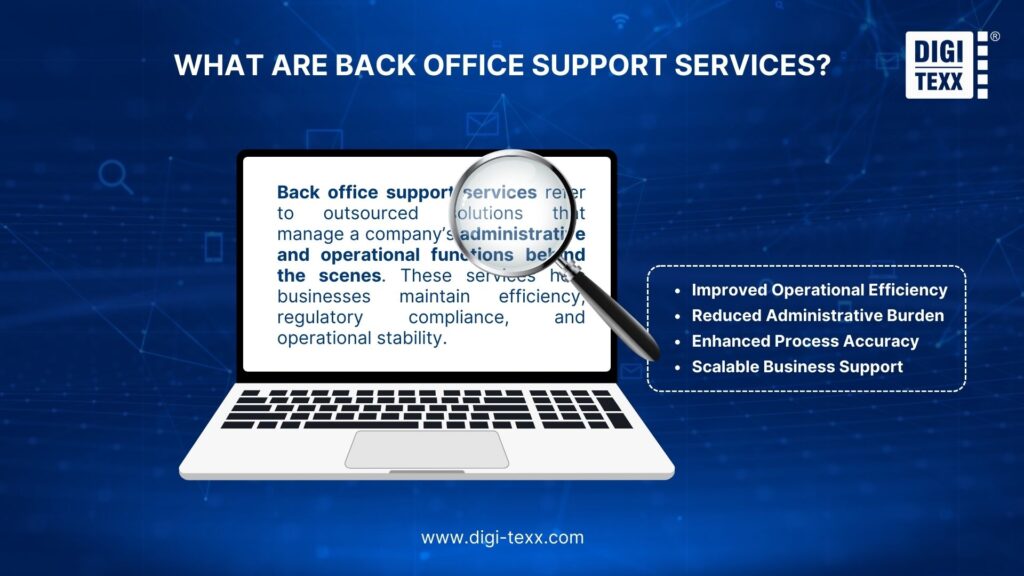
Back office support services are administrative and operational services that help businesses manage processes that do not directly involve customer-facing interactions. These activities support the day-to-day operation of a business by keeping data, documents, transactions, and internal workflows accurate and organized.
Common back office functions include:
- Data entry and data processing
- Document processing and digitization
- Invoice and financial document processing
- Data validation and verification
- Order processing
- Database and record maintenance
- Administrative support
- Document management
- Business process support
Back office support can be handled by an internal team, automated through technology, or outsourced to a third-party provider. For businesses with high-volume or repetitive workflows, outsourcing can provide additional processing capacity without requiring equivalent growth in internal headcount.
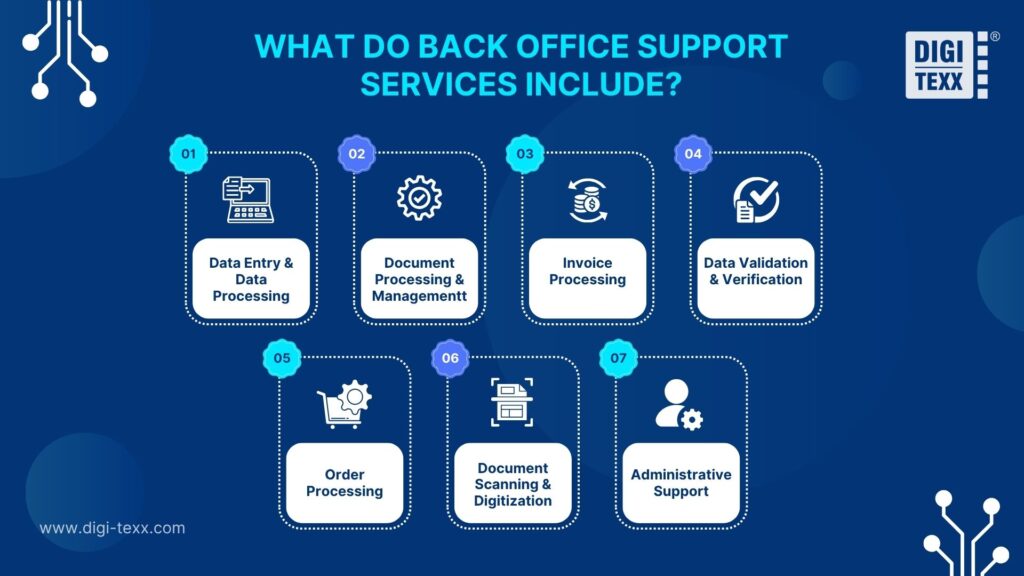
What Do Back Office Support Services Include?
The exact scope of back office support depends on a company’s processes, transaction volumes, systems, and service requirements. The following functions are commonly suitable for outsourcing.
Data Entry And Data Processing
Data entry services involve capturing, updating, organizing, and maintaining information in spreadsheets, databases, enterprise systems, or other business applications.
Businesses may outsource data entry when they need to process large volumes of structured or semi-structured information while keeping internal teams focused on higher-value activities.
Typical tasks include:
- Form and record data entry
- Database updates
- Spreadsheet management
- Data conversion
- Data extraction
- Data verification
- Record maintenance
Data processing can also involve validation and quality checks to identify missing, inconsistent, or incorrect information before it enters downstream systems.
Document Processing And Management
Document processing services help businesses capture, classify, extract, organize, and maintain information contained in business documents.
Depending on the workflow, outsourced teams may handle:
- Document classification
- Data extraction
- Indexing
- Document verification
- Document conversion
- Records management
- Document preparation
- Digital document organization
For document-heavy operations, combining human review with OCR and intelligent document processing can reduce manual workloads while maintaining quality controls.
Invoice Processing
Invoice processing services support finance and accounts payable workflows by handling repetitive document and data processing tasks.
Typical activities may include:
- Invoice data capture
- Invoice validation
- Data entry
- Purchase order matching
- Document verification
- Exception identification
- Invoice status updates
Businesses can outsource invoice processing when transaction volumes make manual processing time-consuming or when finance teams need additional operational capacity.
Data Validation And Verification
Data validation services help ensure business information meets predefined accuracy, completeness, and formatting requirements.
Depending on the workflow, validation may include:
- Checking required fields
- Comparing information against source documents
- Identifying duplicate records
- Verifying data formats
- Reviewing inconsistent information
- Flagging exceptions for further review
This function is particularly useful when inaccurate data can affect reporting, customer records, financial processing, or downstream business decisions.
Order Processing
Order processing services support the administrative workflow between receiving an order and completing the required internal processing steps.
Tasks can include:
- Order data entry
- Order verification
- Status updates
- Document processing
- Inventory-related data updates
- Exception handling
- Order tracking support
Outsourcing repetitive order processing activities can help businesses manage higher transaction volumes without continuously expanding internal administrative teams.
Document Scanning And Digitization
Document digitization services convert physical or image-based records into structured digital information that can be stored, searched, processed, and accessed more efficiently.
Depending on project requirements, services may include:
- Document scanning
- OCR
- Data capture
- Document classification
- Indexing
- Quality control
- Digital archive preparation
Digitization is particularly relevant for organizations managing large volumes of historical records or paper-based workflows.
Administrative Support
Administrative support services cover repetitive operational tasks that help internal teams maintain organized workflows.
Depending on business requirements, these may include:
- Data and record updates
- Document preparation
- Reporting support
- Information management
- Routine administrative processing
- Workflow coordination
The scope should be clearly defined through documented procedures, responsibilities, service levels, and escalation rules before outsourcing begins.
>>> See more:
- Invoice Reconciliation Process Steps | DIGI-TEXX
- Data Validation & Verification: Differences With Clear Examples
Why Outsource Back Office Support Services?
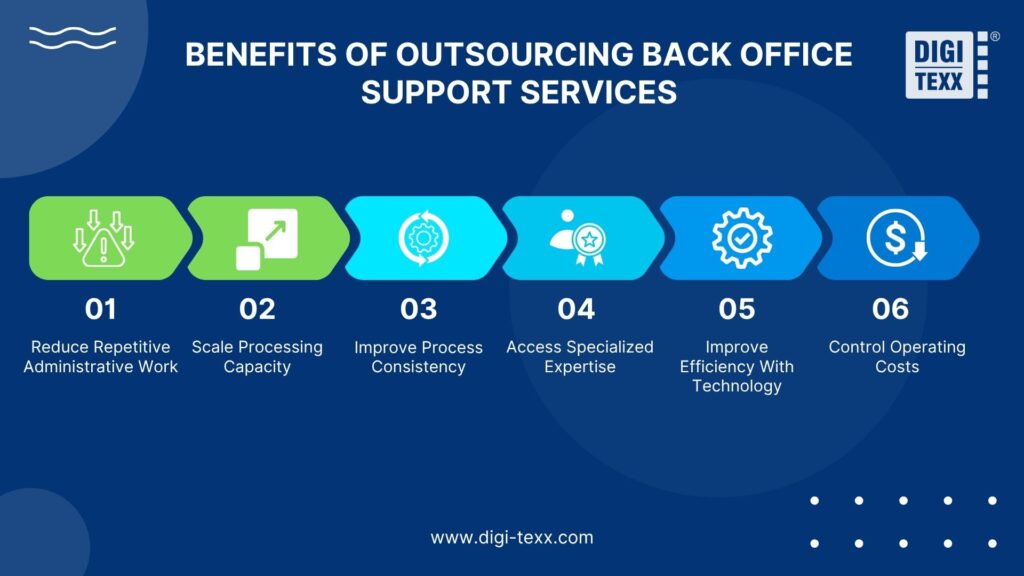
Businesses outsource back office support services to increase operational capacity, access specialized talent, and improve process efficiency without expanding internal teams for every increase in workload. Deloitte’s 2024 Global Outsourcing Survey of more than 500 executives found that 80% planned to maintain or increase investment in third-party outsourcing, while skilled talent and agility have become key drivers alongside cost reduction.
Reduce Repetitive Administrative Work
Outsourcing data entry, document processing, invoice processing, and transaction management frees internal employees from high-volume administrative work. This allows them to focus on activities requiring business knowledge, analysis, and decision-making.
Scale Processing Capacity
Back office outsourcing provides additional capacity when workloads increase due to seasonal demand, business growth, or temporary resource constraints. Instead of hiring permanently for peak volumes, businesses can scale external support around their operational needs.
Improve Process Consistency
Standardized SOPs, quality checks, SLAs, and performance metrics help make repetitive workflows more consistent and measurable. This gives businesses clearer visibility into accuracy, turnaround time, productivity, and error rates.
Access Specialized Expertise
Outsourcing can provide access to trained teams and established processes without requiring businesses to build the same capabilities internally. Talent availability is a significant consideration: 64% of respondents in Deloitte’s 2023 Global Shared Services and Outsourcing Survey identified talent availability as a pivotal factor influencing GBS strategy.
Improve Efficiency With Technology
Modern providers increasingly combine human expertise with OCR, intelligent document processing, workflow automation, and data validation. Deloitte found that 83% of surveyed executives were leveraging AI as part of their outsourced services, although the report notes that measurable productivity and cost benefits depend on effective governance and implementation.
Control Operating Costs
Outsourcing can reduce the need to recruit, train, manage, and maintain additional internal processing capacity. However, savings vary by workload, process complexity, service levels, location, technology requirements, and pricing model, so businesses should evaluate total operating costs rather than labor costs alone.
How Does Back Office Outsourcing Work?
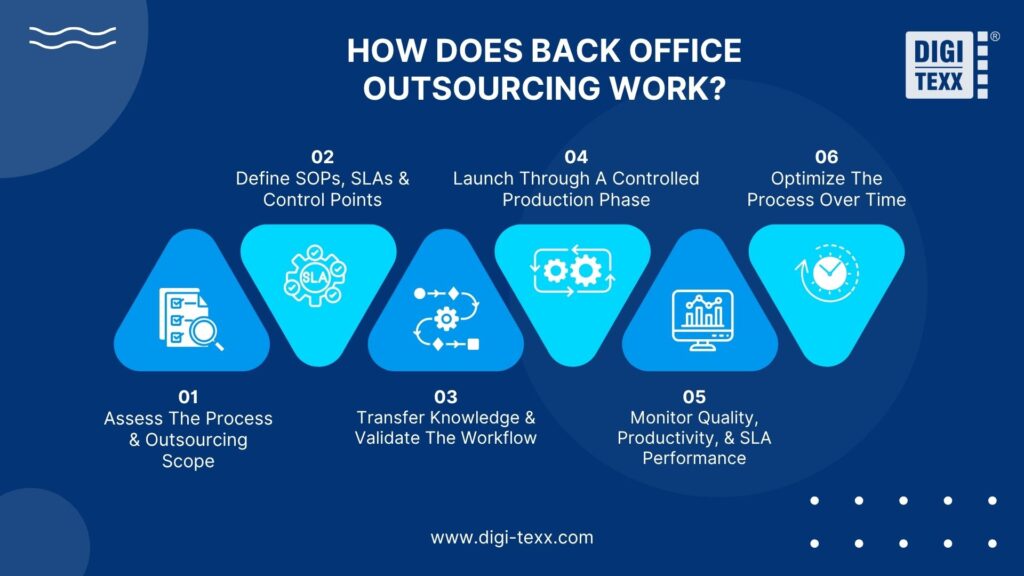
Back office outsourcing typically follows a structured transition from process discovery to production and ongoing optimization. The provider first defines what will be outsourced, how the work should be performed, and how quality will be measured before taking responsibility for live processing.
1. Assess The Process And Outsourcing Scope
The first step is to determine what should be outsourced and under what conditions. The provider reviews transaction volumes, process complexity, current turnaround times, error points, systems, input formats, and exception types.
This assessment helps separate standardized, repeatable activities from tasks that require internal judgment or business-critical decisions. It also establishes the baseline against which improvements can later be measured.
2. Define SOPs, SLAs, And Control Points
The client and provider then translate the existing workflow into documented SOPs and measurable service requirements. This typically covers task instructions, input and output requirements, quality thresholds, turnaround times, escalation rules, data-handling requirements, and approval responsibilities.
For example, an invoice-processing workflow may define which fields must be captured, how missing information is handled, when a transaction is rejected, and which exceptions must be escalated to the client.
3. Transfer Knowledge And Validate The Workflow
Before production starts, the provider needs more than general process documentation. The transition typically includes sample transactions, business rules, system workflows, exception scenarios, historical error patterns, and expected outputs.
The team can then process test cases and compare the results against agreed standards. This validation stage helps identify unclear instructions or edge cases before they affect live transactions.
4. Launch Through A Controlled Production Phase
Once the workflow and quality requirements are validated, the provider moves into live processing. Many projects use a phased or controlled ramp-up rather than immediately transferring the full workload.
During this stage, the client and provider closely monitor early production results, resolve process gaps, and adjust staffing or workflow rules as necessary. Technologies such as OCR, intelligent document processing, workflow automation, and data validation may be integrated where they can reduce manual effort.
5. Monitor Quality, Productivity, And SLA Performance
After go-live, performance should be managed against predefined KPIs and SLAs, rather than relying on general assessments of whether the provider is “doing well.”
Common metrics include:
| KPI | What It Measures |
| Accuracy rate | Correctly processed transactions |
| Turnaround time | Time required to complete a task |
| SLA compliance | Work completed within agreed targets |
| Productivity | Volume processed per resource or time period |
| Error/rework rate | Transactions requiring correction |
| Backlog | Unprocessed work remaining in the queue |
These metrics give both parties a common basis for identifying service gaps and determining whether additional training, staffing, or process changes are required.
6. Optimize the Process Over Time
Outsourcing should not end with process transfer. Performance data can reveal repetitive manual steps, recurring errors, unnecessary approvals, or workload fluctuations that can be addressed through workflow redesign, automation, retraining, or resource adjustments.
The provider can also review whether transaction volumes, SLAs, staffing levels, or technology requirements have changed as the business grows. This turns outsourcing from a one-time task transfer into an ongoing process improvement model.
>>> See more:
- Best Real Estate Image Processing Services 2026: Top 15 Providers
- What Is A Back Office Service? Examples, Benefits, And Cost In 2026
- Business Process Automation Solutions: Benefits, Examples & Service Company
- How to clean up data: 8 Essential Steps for Effective Data Cleaning
Back Office Support Services For U.S. Businesses
For U.S. businesses, evaluating back office support services involves more than comparing labor capacity or hourly rates. The right provider should be able to follow established processes, protect business information, meet agreed service levels, and scale its operations as business requirements change.
Common use cases include:
- High-volume data entry
- Document processing
- Invoice processing
- Data validation and verification
- Order processing
- Document digitization
- Administrative processing
- Database and record maintenance
Before selecting an offshore or international provider, U.S. businesses should consider the following factors.
Data Security And Access Controls
Determine how sensitive business and customer information is accessed, transferred, stored, and reviewed throughout the engagement. Review relevant security certifications, access controls, confidentiality measures, and data-handling procedures. These requirements should be clearly defined in the service agreement, particularly when the work involves financial records, customer data, or other sensitive information.
Service Levels And Turnaround Time
Set clear expectations for processing volume, turnaround time, accuracy, reporting, and escalation. Service-level agreements (SLAs) should define measurable performance targets so both parties have a consistent basis for monitoring delivery and addressing performance issues.
Workflow Compatibility
A provider should be able to work with existing standard operating procedures (SOPs), business rules, approval requirements, and exception-handling processes. This is particularly important for back office support services, where even small differences in how tasks are performed can affect downstream operations.
Scalability
Consider whether the provider can adjust processing capacity as demand changes. This can be especially valuable for U.S. businesses experiencing seasonal peaks, business growth, new product launches, or fluctuations in transaction and document volumes.
Quality Assurance
Ask how the provider maintains accuracy and consistency across outsourced processes. This may include sampling, multi-level reviews, error tracking, corrective actions, and regular performance reporting. Understanding these controls helps businesses assess whether the provider can maintain the required quality as processing volumes increase.
Ultimately, U.S. businesses should evaluate a provider based on its ability to deliver consistent quality, protect sensitive information, integrate with existing workflows, and scale with changing requirements. Cost matters, but it should be considered alongside service quality, operational risk, and the overall value of the engagement.
Back Office Support & In-House Operations
Businesses can manage back office processes internally or outsource selected functions to an external provider. The right model depends on workload, process complexity, internal resources, technology requirements, and long-term objectives.
| Factor | In-House Operations | Outsourced Back Office Support |
| Staffing | Requires internal hiring and management | Provider manages dedicated or shared resources |
| Scalability | Often requires additional recruitment | Capacity can be adjusted based on workload |
| Training | Internal team owns training | Provider handles operational training |
| Technology | Business funds and manages required tools | Provider may provide supporting technology |
| Process control | Direct internal control | Control is maintained through SOPs, SLAs, and reporting |
| Cost structure | Includes salary, benefits, infrastructure, and management | Typically based on agreed service or resource model |
| Expertise | Depends on internal capabilities | Access to specialized operational teams |
| Workload flexibility | More difficult during demand spikes | Better suited to recurring or variable workloads |
For many organizations, a hybrid model can be effective. Strategic activities and decision-making remain in-house, while repetitive, high-volume, or resource-intensive workflows are assigned to an outsourced team.
How Much Do Back Office Support Services Cost?
There is no fixed price for back office support services. The cost of back office outsourcing depends on the type of work, processing volume, process complexity, service-level requirements, technology needs, and delivery location.
Several factors typically influence back office support services pricing:
- Workload volume: Higher transaction, document, or data volumes may require larger teams or volume-based pricing. Some providers may charge per transaction, document, or completed task.
- Process complexity: Processes involving multiple validation steps, exception handling, specialized knowledge, or complex business rules generally require more time and skilled resources.
- Pricing model: Common back office outsourcing pricing models include hourly or daily rates, dedicated full-time equivalent (FTE) teams, per-transaction or per-document pricing, project-based fees, and hybrid models.
- Service-level requirements: Shorter turnaround times, higher accuracy targets, extended service coverage, dedicated resources, and detailed reporting can increase the overall cost of back office support services.
- Technology requirements: Automation tools, OCR, intelligent document processing, workflow systems, software integrations, and other technology requirements may add implementation or ongoing costs.
- Delivery location: Costs can vary depending on whether services are delivered onshore, nearshore, or offshore. Labor costs, infrastructure, and operating conditions in the delivery location can affect the final price.
When evaluating back office support services, businesses should look beyond hourly rates and compare the total cost of outsourcing with the expected improvements in processing capacity, accuracy, turnaround time, scalability, and operational efficiency. A lower hourly rate does not necessarily result in lower overall costs if the service requires more supervision, generates rework, or fails to meet required service levels.
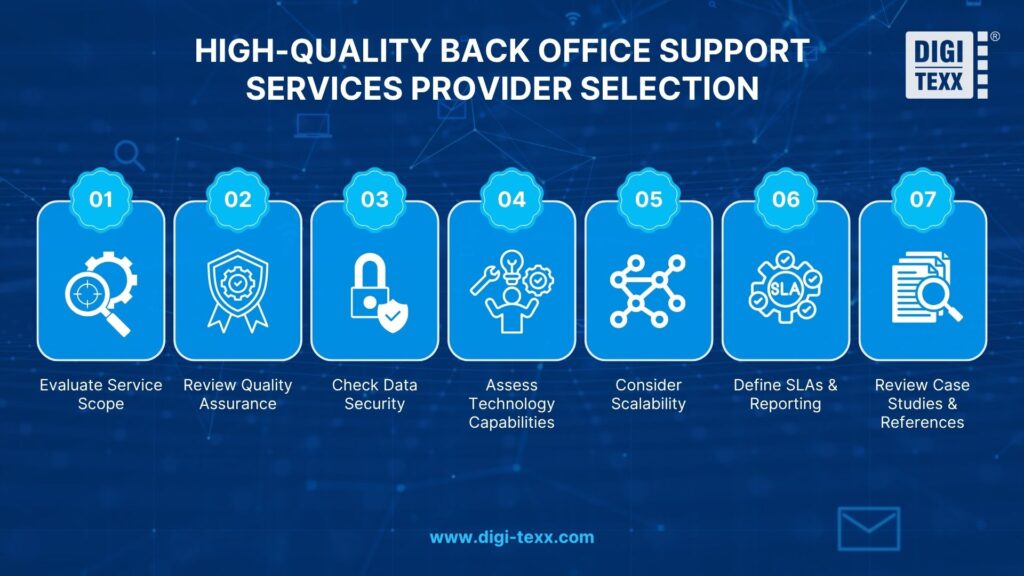
How Do You Choose A High-Quality Back Office Support Services Provider?
Selecting the right back office support provider requires more than comparing prices. Businesses should evaluate whether a provider can consistently manage the required workflows, maintain quality and security, scale with demand, and meet clearly defined service requirements.
Evaluate Service Scope
Confirm that the back office support provider has experience with the specific processes you plan to outsource, such as data entry, document processing, invoice processing, data validation, order processing, or administrative support. Review whether the provider can follow your business rules, work with your existing systems, and handle the expected transaction or document volume.
Review Quality Assurance
Ask how the provider measures accuracy and maintains consistent output quality. A reliable back office support provider should have documented quality-control procedures, regular accuracy checks, error tracking, corrective actions, and performance reporting. Clarify how errors are identified and resolved and whether quality metrics are monitored at both the individual and process levels.
Check Data Security
Review the provider’s information-security certifications, access controls, data handling procedures, confidentiality measures, and other controls relevant to your operations. If the outsourced process involves customer, financial, or business data, confirm how information is protected during processing, storage, transfer, and access.
Assess Technology Capabilities
Determine whether the back office support provider can use technologies such as OCR, intelligent document processing, workflow automation, and system integrations where appropriate. For document- and data-intensive workflows, combining automation with human review can help improve processing speed while maintaining control over exceptions and complex cases.
Consider Scalability
Assess whether the provider can adjust staffing and processing capacity as your workload changes. This is particularly important for businesses with seasonal demand, fluctuating transaction volumes, or plans to expand their outsourcing scope. The provider should have a clear approach to onboarding additional resources without significantly affecting service quality or turnaround times.
Define SLAs And Reporting
Establish measurable service-level agreements (SLAs) before the engagement begins. Depending on the workflow, these may cover accuracy, turnaround time, processing volume, backlog, response time, availability, and escalation procedures. Regular reporting should give your team visibility into whether the back office support provider is meeting agreed performance targets.
Review Case Studies And References
Case studies and client references can provide evidence of how the back office support provider has handled similar workflows, processing volumes, industries, or operational challenges. Look for specific evidence of service performance, scalability, quality management, and implementation experience rather than relying solely on general claims about capabilities.
The right back office support provider should align with your operational requirements, security expectations, workload, and growth plans. Evaluating these factors alongside pricing can help businesses select a provider that delivers sustainable value rather than simply the lowest initial cost.
>>> See more:
- How To Prepare a Classified Balance Sheet: Template & Example
- Healthcare BPO Services – Cost Optimization & Improve Care 2026
- AI in Investing – How AI Technology is Shaping the Future of Investment Strategies
Why Choose DIGI-TEXX For Back Office Support Services?
DIGI-TEXX provides back office support services that combine trained operational teams, structured workflows, quality controls, and technology-enabled processing. Its capabilities are particularly suited to data- and document-intensive operations, including data entry, document processing, invoice processing, document scanning, data validation, and order processing.
Experienced Operational Teams
DIGI-TEXX combines operational expertise, structured training, and defined workflows to support back office support services involving repetitive, rules-based, and high-volume processes. Teams can work according to client-specific procedures, quality requirements, and process guidelines.
Human Expertise And Intelligent Automation
DIGI-TEXX can combine human review with technologies such as OCR, intelligent document processing, and workflow automation to support back office support services. This approach can help automate repetitive tasks while retaining human oversight for exceptions, validation, and quality control where required.
Data Security And Compliance
Security and quality controls are important when back office support services involve business documents, customer information, financial records, or other sensitive data. DIGI-TEXX operates under information-security and quality-management frameworks, including ISO 27001 and ISO 9001, to support controlled and consistent service delivery.
Scalable Processing Capacity
With more than 1,200 employees and operations across Vietnam and Europe, DIGI-TEXX can provide additional processing capacity as workload requirements change. This scalability can support back office support services with fluctuating transaction volumes, high-volume processing requirements, or expanding operational needs.
Multilingual And Global Delivery Capabilities
DIGI-TEXX has capabilities supporting more than 30 languages across its operations, which can be relevant to multilingual processing requirements depending on the scope of the engagement. This capability can support back office support services for businesses operating across multiple markets.
Proven Process Expertise
DIGI-TEXX’s service portfolio covers data processing, document processing, image processing, intelligent document processing, and other operational workflows relevant to back office support services. This broader process expertise allows businesses to combine related workflows with a provider rather than managing each process separately.

Case Study: Back Office Support For E-commerce Order Processing
An e-commerce business receives thousands of orders across multiple sales channels each month. Its internal team is responsible for reviewing orders, validating customer and product information, updating order records, and resolving data discrepancies before orders are processed.
As order volumes increase, handling these repetitive tasks internally can create backlogs and take employees away from higher-value activities.
A back office support services provider can take over defined parts of the workflow. For example, the outsourced team may:
- Review and enter order information from different sales channels
- Validate customer, product, and shipping details
- Identify incomplete or inconsistent order data
- Update records in the client’s order management or ERP system
- Escalate exceptions that require internal approval
- Perform quality checks on processed orders
- Report processing volume, accuracy, and outstanding exceptions
This model allows the e-commerce business to add processing capacity without expanding its internal administrative team for every increase in order volume. The scope, access rights, quality requirements, and escalation rules can be defined in the service agreement to ensure that outsourced activities remain aligned with the company’s operating procedures.
The same approach can be adapted to other industries. The key is to identify back office support services that are repetitive, process-driven, measurable, and suitable for standardized handling while retaining internal control over sensitive or decision-critical activities.
FAQs About Back Office Support Services
What Are Some Examples Of Back office Services?
Back office services cover the administrative, operational, and data-related tasks that support a company’s core business without directly interacting with customers. The scope varies by business, but common examples include:
- Data entry and data processing: Capturing, updating, validating, and organizing information across spreadsheets, databases, CRM platforms, and business systems.
- Document processing and management: Digitizing paper records, extracting information from documents, classifying files, and maintaining organized document repositories.
- Accounting and financial administration: Processing invoices, reconciling transactions, maintaining financial records, and supporting accounts payable and accounts receivable workflows.
- Payroll and HR administration: Maintaining employee records, processing payroll information, coordinating onboarding documentation, and managing routine HR paperwork.
- Order processing: Entering and updating orders, verifying order details, coordinating fulfillment information, and maintaining transaction records.
- Inventory and data management: Updating inventory records, checking product information, reconciling stock data, and maintaining accurate databases.
- Administrative support: Managing records, preparing reports, updating databases, scheduling internal activities, and handling other routine administrative workflows.
- Quality control and data verification: Reviewing records, checking information for errors or inconsistencies, and validating data before it is entered into downstream systems.
What Are The Responsibilities Of Back Office Support?
Back office support is responsible for the internal processes that keep daily operations accurate, organized, and efficient. Rather than handling direct customer interactions, back office teams manage the administrative, financial, data, and operational work that enables front-office functions to run smoothly.
Key responsibilities typically include:
- Finance and accounting: Processing invoices and payments, maintaining financial records, reconciling transactions, supporting accounts payable and receivable, and preparing routine financial reports.
- Data management: Entering, validating, updating, and organizing business data across spreadsheets, databases, and enterprise systems. Teams may also prepare operational reports and perform data quality checks.
- Human resources administration: Supporting recruitment paperwork, employee onboarding, personnel record management, payroll administration, benefits coordination, and other routine HR processes.
- IT and system support: Maintaining internal systems, managing user access, resolving routine hardware or software issues, monitoring system performance, and supporting data security procedures.
- Compliance and documentation: Maintaining required records, organizing contracts and regulatory documents, tracking compliance-related information, and supporting internal audits or reporting requirements.
- Order and inventory administration: Processing purchase and sales orders, updating inventory records, checking transaction details, tracking shipment information, and reconciling discrepancies across systems.
- General administrative support: Preparing documents, updating databases, managing records, compiling reports, and handling other repetitive operational tasks that support internal teams.
>>> See more:
- Purchase Orders Processing: Steps, Types, Best Practices
- Secure Data Annotation Services: Top Companies & How to Choose
- Financial Data Quality Management: What It Is & Why It Matters
Back office support services can help businesses handle growing workloads, maintain consistent processing quality, and access specialized operational expertise without expanding internal teams. From data entry and document processing to invoice handling, order processing, and administrative support, these services can be integrated into existing workflows with defined SOPs, SLAs, quality controls, and escalation procedures.
When evaluating a provider, businesses should look beyond cost and consider factors such as service scope, data security, quality assurance, technology capabilities, scalability, and overall value. Providers such as DIGI-TEXX offer back office and data processing capabilities that can support businesses with structured, high-volume operational workflows.
DIGI-TEXX Contact Information:
🌐 Website: https://digi-texx.com/
📞 Hotline: +84 28 3715 5325
✉️ Email: [email protected]
🏢 Address:
- Headquarters: Anna Building, QTSC, Trung My Tay Ward
- Office 1: German House, 33 Le Duan, Saigon Ward
- Office 2: DIGI-TEXX Building, 477-479 An Duong Vuong, Binh Phu Ward
- Office 3: Innovation Solution Center, ISC Hau Giang, 198 19 Thang 8 street, Vi Tan Ward
References:
- University of Minnesota Libraries Publishing. (n.d.). Global sourcing and its role in business. In International business. https://open.lib.umn.edu/internationalbusiness/chapter/9-3-global-sourcing-and-its-role-in-business/
- APQC. (2026). How should procure-to-pay and accounts-payable performance be measured and improved? https://www.apqc.org/How-Should-Procure-to-Pay-And-Accounts-Payable-Performance-Be-Measured-And-Improved?