

Data may seem like numbers and words on a screen, but in reality, it tells the story of your business. Every customer record, sales report, and marketing list depends on accuracy.
When data is entered incorrectly, that story becomes distorted. Reports lose meaning, customer experiences suffer, and business growth slows down.
That’s why accuracy matters more than ever. In this blog, we’ll explore the most common data entry mistakes, their real cost to businesses, and how outsourcing can turn data management into a powerful competitive advantage.
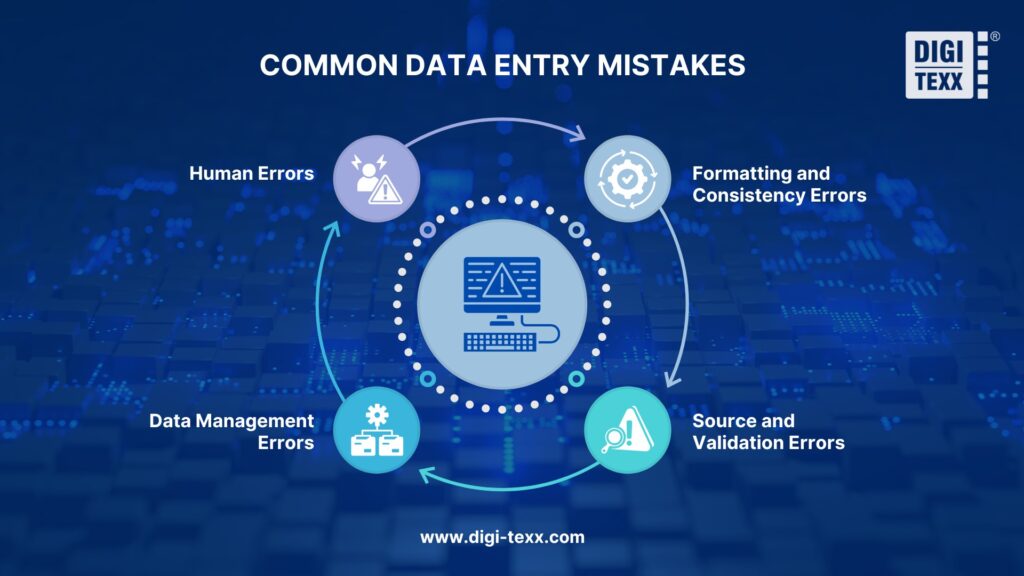
Common Data Entry Mistakes
- Human Errors
| Specific Error | Description | Example | Impact |
| Typographical Errors | Simple typing mistakes such as missing digits, wrong characters, or unnecessary spaces. | Typing “20224” instead of “2024” or “Ngyuen” instead of “Nguyen.” | Creates inaccurate records, incorrect invoices, or invalid product codes. |
| Transcription & Transposition Errors | Data copied incorrectly from another source, or digits/letters swapped during entry. | Misreading a “6” as a “0,” or typing “53421” instead of “54321.” | Leads to mismatched IDs, misfiled inventory, or wrong customer details. |
- Formatting and Consistency Errors
| Specific Error | Description | Example | Impact |
| Lack of Standardization | Different users apply varying formats, naming styles, or abbreviations without unified rules. | Using both “03/05/2025” and “05/03/2025” for dates; “Ho Chi Minh City,” “HCMC,” and “TP.HCM” for location names. | Creates confusion in reports, duplicate entries, and inconsistent data interpretation. |
| Mixed Units or Currencies | Using different measurements or monetary systems within one dataset. | Combining USD and VND, or kg and lbs. | Leads to conversion errors and inaccurate summaries. |
| Irregular Capitalization/Spacing | Inconsistent text formatting across fields or documents. | “john doe” vs. “John Doe.” | Causes search mismatches, duplicates, and CRM automation issues. |
- Data Management Errors
| Specific Error | Description | Example | Impact |
| Duplicate Records | The same record is entered multiple times by different users or imports. | Two entries for “Nguyen Van A” with different phone numbers. | Inflates database size, skews analytics, and wastes resources. |
| Missing or Incomplete Data | Key information was left blank or skipped during entry. | Customer profile without email or phone number. | Weakens marketing accuracy and customer engagement. |
| Outdated Information | Records are not reviewed or updated after changes occur. | Old address or job title still listed in the database. | Causes miscommunication, delivery errors, and poor decision-making. |
- Source and Validation Errors
| Error | Description | Example | Impact |
| Unclear Sources | Data taken from illegible handwriting, blurry scans, or unclear spreadsheets. | Misreading “1” as “7” from a paper form. | Incorrect input contaminates the database from the start. |
| Faulty Imports | Data imported from other systems without cleaning or verification. | Uploading an outdated spreadsheet with missing columns. | Adds duplicates, missing fields, and inconsistent formats. |
| No Validation | Lack of automated or manual checks to detect missing or invalid entries. | No rule to flag wrong email formats or blank fields. | Allows small errors to spread unchecked across systems. |
The Business Impact of Data Entry Errors
While data entry mistakes may initially seem minor, their ripple effects can seriously damage business performance. From slowing down daily operations to losing customer trust, inaccurate data silently eats away at a company’s efficiency and reputation. Let’s look at the key ways these errors impact organizations.
- Operational Inefficiencies

Data errors disrupt everyday workflows. When employees constantly have to double-check, correct, or reconcile inaccurate information, valuable time and resources are lost. Reports take longer to finalize, cross-department communication becomes confusing, and strategic projects get delayed.
For example, a duplicated record in a CRM system might cause two different sales representatives to contact the same client, wasting effort and creating confusion. Over time, these small disruptions accumulate and drag down overall productivity.
- Financial Consequences
Errors in data entry often translate directly into financial loss. Incorrect billing details, pricing errors, or wrong customer information can lead to delayed payments or even lost deals. Meanwhile, the costs of fixing those mistakes, from re-entering data to auditing entire systems, can quickly add up.
In industries like finance or logistics, even a small numerical error can cause compliance violations, late fees, or tax reporting problems. These aren’t just costly; they can also damage the company’s credibility with partners and regulators.
- Poor Decision-Making
Business decisions are only as good as the data behind them. When that data is flawed, leaders risk making strategic choices based on incomplete or inaccurate information. Misreported sales figures, for example, can lead management to overestimate demand in one region and underestimate it in another.
Over time, such errors skew forecasts, distort budgets, and reduce confidence in data-driven decision-making, forcing teams to rely on guesswork instead of insight.
- Damaged Customer Relationships

Perhaps the most visible consequence of poor data is its effect on customers. Errors in contact details, personalization, or order information can quickly frustrate clients and damage trust.
Imagine a loyal customer receiving an invoice with their name misspelled or an email meant for someone else. These mistakes make a brand look careless and unprofessional.
In the age of personalization, data accuracy is key to maintaining strong customer relationships. Without clean data, even the best marketing campaigns or customer support efforts can fall flat.
How Outsourcing Solves These Problems
Outsourcing is one of the most effective ways to minimize common data entry mistakes and improve data reliability. By partnering with specialized providers, businesses gain access to professional teams, advanced tools, and standardized processes that enhance both accuracy and efficiency.
- Access to Expertise and Dedicated Teams
Outsourcing partners employ trained professionals who specialize in handling high-volume, detail-oriented tasks. Unlike general administrative staff, these experts are accustomed to working with diverse data types, from customer databases and invoices to survey results and logistics records.
Their attention to detail and familiarity with best practices help minimize human errors like typos, missing fields, or formatting inconsistencies.
Moreover, most outsourcing firms apply a “double-entry” or “peer-review” process, where two operators independently input the same data to ensure accuracy before final submission. This systematic approach creates a level of precision that’s difficult to maintain internally.
- Use of Technology and Automation
Leading outsourcing providers combine human expertise with advanced technology. They leverage tools such as AI-powered validation, data cleansing software, and automated error detection systems to ensure accuracy and consistency.
For example, these systems can automatically detect duplicates, flag incorrect email formats, or identify unusual entries (like an unrealistic date of birth). This combination of automation and manual verification greatly reduces the likelihood of overlooked mistakes while also speeding up turnaround times.
- Standardized Processes and Quality Control
One of the biggest causes of data errors is inconsistency when different team members use different formats or naming rules. Outsourcing solves this by applying standardized data entry protocols.
Each project follows predefined templates, formatting guides, and validation rules, ensuring that all entries align perfectly across platforms and departments.
Additionally, outsourcing firms often conduct multi-layer quality checks, including audits and random sampling, to maintain long-term accuracy. This ensures that data not only looks clean but is also reliable enough for analysis and reporting.
- Cost and Time Efficiency

Hiring, training, and managing an in-house data entry team can be expensive, especially when the workload fluctuates. Outsourcing offers a scalable, on-demand workforce, meaning you only pay for what you need.
You can ramp up resources during peak periods and scale down when things are quiet, without the cost of full-time staff.
Beyond cost savings, outsourcing also frees up internal teams to focus on more strategic work, such as analysis, planning, or customer engagement, instead of repetitive manual input. The result is a more productive, efficient, and focused business operation.
- Enhanced Data Security
A common misconception is that outsourcing increases data security risks. In reality, reputable outsourcing providers operate under strict data protection policies. They use encrypted file transfers, limited access systems, and compliance with standards such as GDPR or ISO 27001 to ensure confidentiality.
This gives businesses peace of mind knowing that their sensitive information is being handled with professionalism and care.
Choosing the Right Data Entry Outsourcing Partner
- Expertise and Industry Experience
Experience matters. Choose a partner with a solid track record and a deep understanding of your industry’s data requirements.
Each sector has its own sensitivities, healthcare demands confidentiality and compliance, finance requires precision and traceability, while retail focuses on speed and scalability.
An experienced partner anticipates these nuances, reducing the learning curve and minimizing costly onboarding errors.
- Quality Control Processes
Accuracy is the foundation of effective data entry. A trustworthy partner should implement structured quality assurance procedures, such as double-entry verification, AI-assisted validation, and regular audits.
These checks ensure consistency and reliability across every record, even when dealing with high-volume or time-sensitive projects.
Reliable providers should confidently commit to 95%+ accuracy standards and provide transparent reporting on performance metrics.
- Technology and Data Security
Top-tier outsourcing firms leverage automation, machine learning, and real-time validation tools to eliminate errors at scale. At the same time, they enforce strict data protection protocols, from encrypted transfers and multi-factor authentication to compliance with international standards such as GDPR, ISO 27001, or SOC 2.
Always ensure your partner’s infrastructure supports both operational efficiency and data confidentiality.
- Scalability and Flexibility
The ideal partner should grow with your business. Whether you’re processing seasonal surges in customer data or managing large-scale audits, the provider should be able to scale resources quickly and seamlessly.
Flexible engagement models, such as pay-per-task or project-based support, help you optimize costs while maintaining continuity and speed.
- Communication and Transparency
Strong collaboration depends on clear communication. Select a provider that offers consistent status updates, transparent pricing, and a dedicated account manager who understands your priorities.
Regular performance reviews and progress reports foster accountability and build trust, turning your outsourcing relationship into a long-term strategic partnership rather than a transactional service.
Turning Data Challenges into Business Opportunities
Common data entry mistakes can slow down operations, distort insights, and hurt business credibility, but they also highlight areas where smarter systems and better processes can make a real difference. When organizations learn from these mistakes and address their root causes, data management shifts from being a liability to a true strategic advantage.
Outsourcing is one of the most effective ways to make that shift. By working with professionals who specialize in handling and validating data, businesses can significantly reduce manual errors, ensure consistent formatting, and maintain data integrity at every stage.
Through automation tools, structured workflows, and quality assurance checks, outsourcing providers help eliminate the most common data entry mistakes before they can cause damage.
What once seemed like small inaccuracies can become powerful lessons in building stronger data systems. Clean, reliable data enhances decision-making, supports accurate reporting, and fuels long-term business growth.
With the right outsourcing partner, companies can move beyond fixing errors and transform how data supports their success.
=> You may also be interested: