
Content moderation outsourcing helps businesses manage large volumes of user-generated content without building a fully in-house moderation operation. This guide explains how outsourced moderation works, its benefits and risks, key moderation models, costs, and how to choose a reliable provider.
DIGI-TEXX is also discussed as an outsourcing option for businesses seeking scalable content moderation support.
Why Content Moderation Outsourcing Matters in 2026
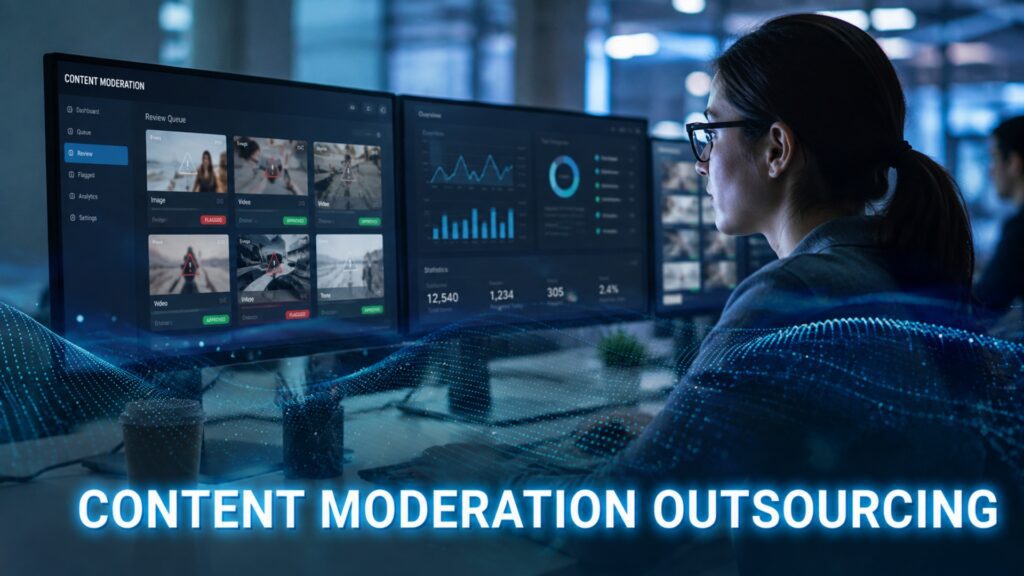
As platforms scale user-generated content across text, images, video, audio, and livestreams, moderation has become an operational, safety, and compliance function, not simply a customer-support task. Businesses need a model that can combine scalable technology with human judgment, especially when content is ambiguous, culturally specific, or high risk.
What Is Content Moderation Outsourcing?
Content moderation outsourcing is the strategic delegation of reviewing and managing user-generated content to a specialized external agency. This process utilizes human moderators, AI screening, or a hybrid model to enforce platform policies, remove harmful material, and protect brand reputation while reducing internal operational costs.
What Does A Content Moderator Do?
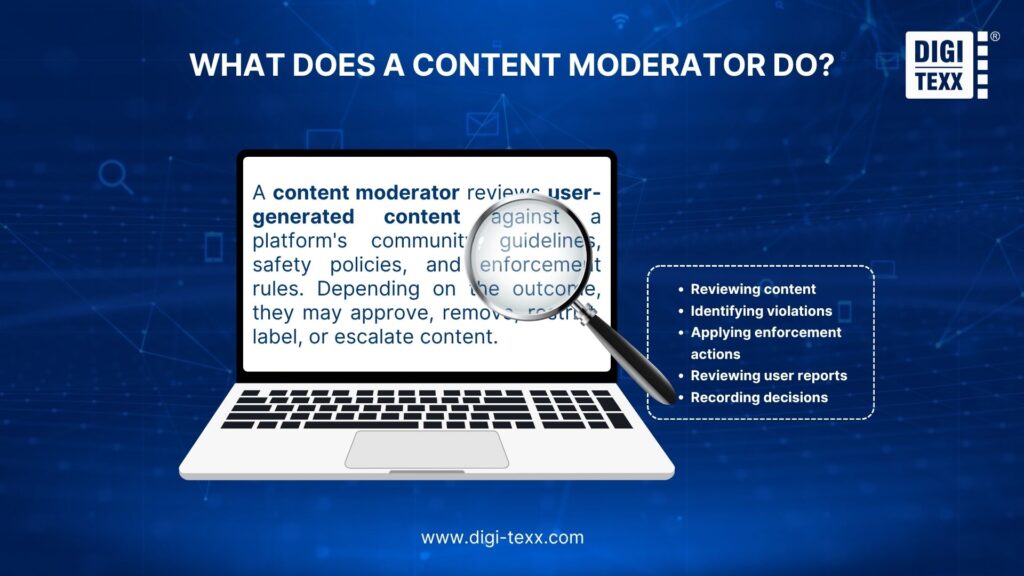
A content moderator reviews user-generated content against a platform’s community guidelines, safety policies, and enforcement rules. Depending on the outcome, they may approve, remove, restrict, label, or escalate content.
Common responsibilities include:
- Reviewing content: Checking posts, comments, images, videos, audio, profiles, and other user-generated content.
- Identifying violations: Detecting spam, harassment, hate speech, nudity, graphic violence, threats, fraud, and other policy violations.
- Applying enforcement actions: Removing or restricting content, applying labels, or escalating cases according to platform rules.
- Reviewing user reports: Assessing content flagged by users and handling appeals or disputed moderation decisions.
- Recording decisions: Documenting moderation outcomes for reporting, quality control, and policy enforcement.
In an outsourced model, moderators apply the client’s specific policies and enforcement rules when reviewing content. Their responsibilities can vary depending on the platform, content type, moderation model, and level of access provided by the client.
What Types Of Content Can Be Moderated?
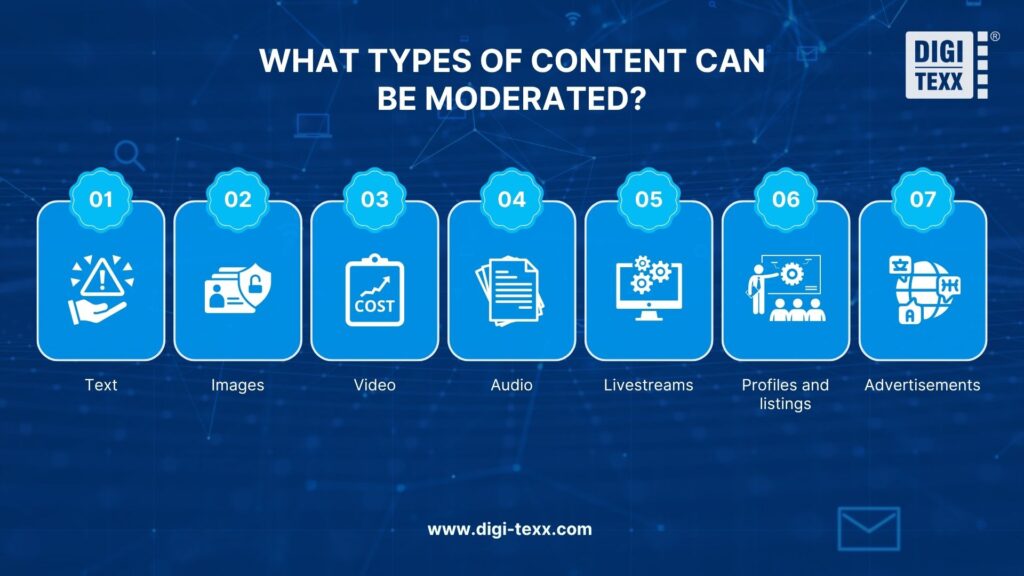
Content moderation can cover virtually any user-generated format, depending on the platform and the provider’s capabilities. Common categories include:
- Text: Posts, comments, messages, reviews, usernames, and profile descriptions.
- Images: Photos, profile pictures, memes, screenshots, and other visual content.
- Video: Short-form videos, uploaded videos, recorded media, and user-generated clips.
- Audio: Voice messages, recordings, podcasts, and other audio content.
- Livestreams: Real-time video, audio, and live chat requiring continuous monitoring.
- Profiles and listings: User profiles, seller listings, marketplace submissions, and account information.
- Advertisements: Promotional content reviewed against platform, brand-safety, and prohibited-content policies.
Depending on the business, moderation may also be performed before publication (pre-moderation), after publication (post-moderation), or in response to user reports and automated alerts (reactive moderation). The appropriate approach depends on the platform’s risk level, content volume, and user experience requirements.
>>> See more:
- E-commerce Content Moderation: Essential Guide for Platform Owners & E-commerce Businesses
- Outsourced Content Moderation Services: Top Providers & How to Choose 2026
- How to Moderate User-Generated Content: Complete Guide 2026
What Are The Benefits Of Outsourcing Content Moderation?
Outsourcing content moderation can reduce the operational burden of managing large volumes of user-generated content internally. Beyond cost savings, businesses can gain access to scalable moderation capacity, global coverage, specialized expertise, and external operational resources without building every capability in-house.
Lower Operating Costs
Outsourcing can reduce the cost of maintaining an internal moderation operation by shifting expenses such as recruitment, training, staffing, supervision, technology infrastructure, and workforce management to an external provider.
The potential savings are particularly relevant for platforms with fluctuating moderation volumes. Instead of maintaining a large permanent team sized for peak demand, a business can use an outsourced workforce that can be adjusted according to workload.
Cost efficiency does not necessarily mean choosing the lowest-cost provider. Businesses should evaluate the total cost of moderation, including technology, management overhead, quality assurance, coverage requirements, and the resources needed to operate the service internally.

Scale Moderation More Easily
Content volume can increase rapidly when a platform gains users, launches a new product, enters a new market, or experiences a major event. Building an internal moderation team at the same pace can require significant recruitment and training.
Outsourcing gives businesses access to an existing operational workforce and moderation infrastructure. Providers can often adjust staffing levels, workflows, and coverage according to changes in content volume.
This makes outsourcing particularly useful for businesses that need to support:
- Rapid user or content growth.
- Seasonal increases in activity.
- New product or market launches.
- Sudden spikes in reports or harmful content.
- Multiple content formats or platforms.
Scalability can also reduce the need to permanently overstaff an internal team for occasional peak workloads.

Provide 24/7 Global Coverage
User-generated content is created continuously, regardless of business hours or geographic location. An internal team operating during a single time zone may leave periods when harmful or policy-violating content remains unreviewed.
Outsourcing can provide round-the-clock moderation coverage through distributed teams operating across different regions and time zones. This is particularly valuable for social platforms, marketplaces, gaming communities, and other services with global user bases.
Depending on the provider’s capabilities, global coverage can include:
- 24/7 or extended-hour moderation.
- Multiple time-zone coverage.
- Support for different languages.
- Regional moderation teams.
- Continuous monitoring of high-risk content.
This can shorten response times and help businesses maintain more consistent safety coverage across markets.

Access Specialized And Multilingual Expertise
Content moderation often requires more than general customer-service skills. Providers may maintain teams trained in specific policy categories, content formats, languages, markets, and trust-and-safety workflows.
Outsourcing can therefore give businesses access to expertise that would be expensive or difficult to develop internally, particularly when they operate across multiple countries.
Multilingual and culturally informed moderators can help interpret:
- Local slang and colloquialisms.
- Cultural references and regional norms.
- Language-specific forms of harassment or hate speech.
- Localized scams and fraud patterns.
- Context that may be lost through direct translation.
This capability is especially important because the same phrase, image, gesture, or behavior can have different meanings across markets. Regional expertise can help reduce inconsistent enforcement caused by applying one cultural standard across a diverse user base.

Protect Users, Brand Reputation, And Internal Teams
Effective moderation helps businesses reduce exposure to harmful or abusive content that can negatively affect users and the wider platform environment. Consistent enforcement can contribute to a safer user experience and help protect the company’s brand reputation.
Outsourcing can also reduce the amount of highly sensitive or disturbing content that internal employees need to review. This is particularly relevant for businesses that do not have the specialized infrastructure, staffing model, or support systems required to operate a large-scale moderation team.
An experienced provider can take responsibility for defined moderation workloads while the business retains oversight of its policies, escalation requirements, and service-level expectations.
The result is not simply fewer moderation tasks for internal teams. A well-structured outsourcing model can allow product, trust-and-safety, and operations teams to focus more heavily on policy development, platform improvements, risk management, and strategic decisions, while the provider manages the agreed day-to-day moderation workload.

Who Should Consider Content Moderation Outsourcing?
Content moderation outsourcing is most useful for businesses that have significant user-generated content but do not want to build and manage the entire moderation operation internally.
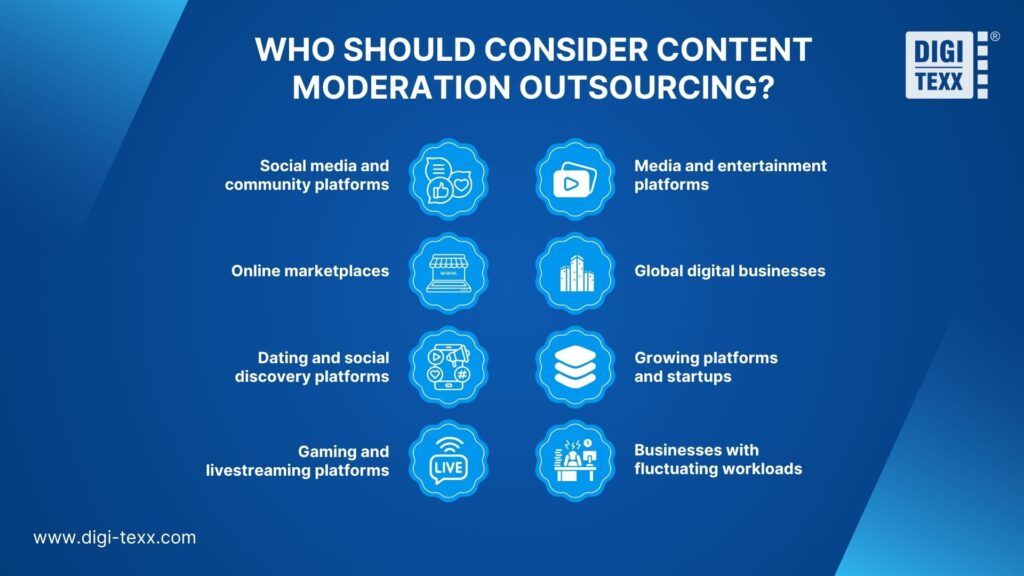
It can be a strong fit for:
- Social media and community platforms dealing with large volumes of posts, comments, images, videos, or messages.
- Online marketplaces that need to moderate product listings, reviews, seller content, and user interactions.
- Dating and social discovery platforms where safety, harassment, fraud, and inappropriate content require continuous monitoring.
- Gaming and livestreaming platforms where real-time interactions create large and rapidly changing moderation workloads.
- Media and entertainment platforms that receive substantial volumes of user-uploaded video, audio, or other media.
- Global digital businesses that require multilingual moderation across multiple markets and time zones.
- Growing platforms and startups that need moderation capacity before they have the resources to build a dedicated internal team.
- Businesses with fluctuating workloads that need to increase or reduce moderation capacity without continuously hiring or restructuring internal staff.
Outsourcing may be less suitable when a business handles highly sensitive workflows that require strict internal control, has relatively low and predictable content volumes, or already maintains a mature in-house trust and safety operation.
For many businesses, the decision does not have to be entirely in-house or outsourced. A hybrid approach can keep highly sensitive or policy-critical decisions internally while outsourcing high-volume, multilingual, routine, or after-hours moderation work.
>>> See more:
- Best Social Media Moderation Services Guide (2026)
- What Is Master Data Management (MDM)? Benefits, Process & Use Cases
What Are The Main Content Moderation Models?
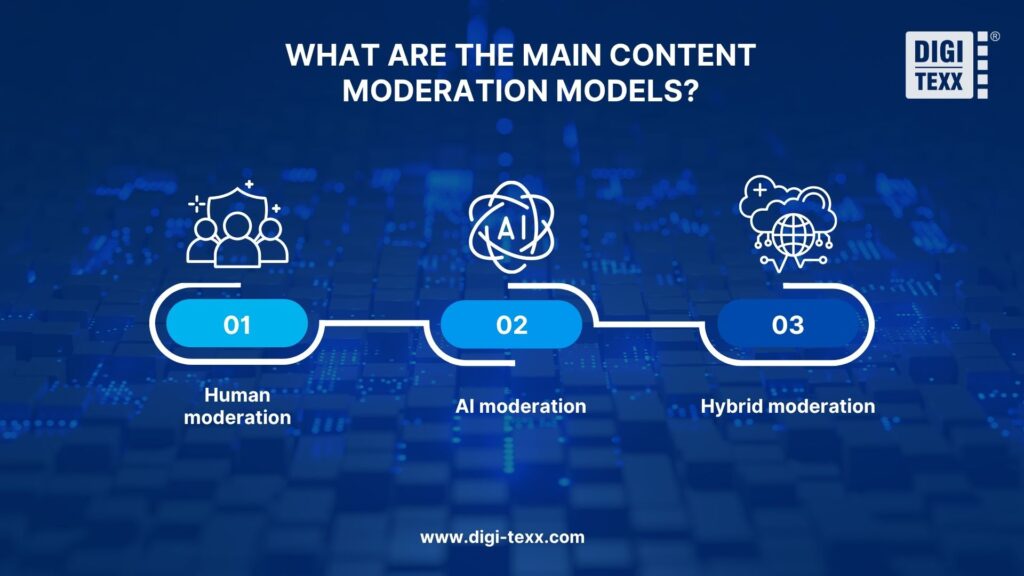
Content moderation outsourcing typically uses three models: human, AI, or hybrid moderation. Providers may offer one model or combine them based on content volume, risk level, response-time requirements, and the amount of human judgment needed.
| Model | Best for | Main advantage | Main limitation |
| Human | Complex and context-sensitive content | Strong contextual judgment | Higher cost and limited scalability |
| AI | High-volume, routine content | Speed and scalability | Limited contextual understanding |
| Hybrid | Large-scale, risk-sensitive platforms | Balances automation and human judgment | More complex to manage |
- Human moderation: Outsourcing providers assign trained moderators to review content, handle complex or sensitive cases, assess context and cultural nuances, and manage appeals or disputed decisions.
- AI moderation: Providers use automated systems to screen text, images, video, and audio at scale, detect predefined policy violations, assign risk scores, and route uncertain cases for further review.
- Hybrid moderation: Providers combine AI screening with human review, allowing automation to handle high-volume or straightforward cases while human moderators manage ambiguous, high-risk, or low-confidence content.
>>> See more:
- AI vs Human Content Moderation Solutions: Which Approach Works Best For E-commerce In 2026?
- AI Image Processing Tools: Top 10 for Automation In 2026
How Does Content Moderation Outsourcing Work?
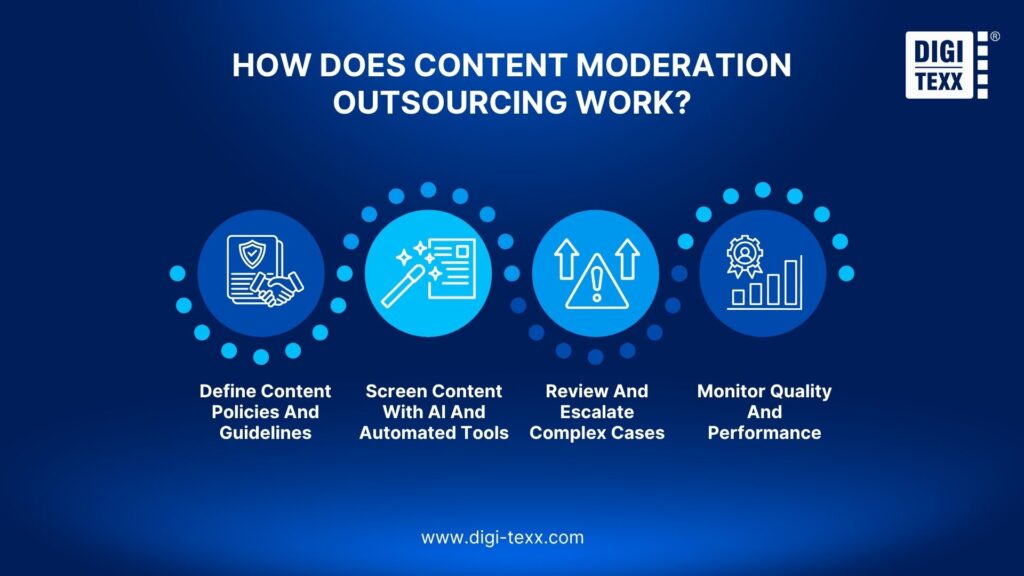
Content moderation outsourcing typically follows a structured workflow that combines client-defined policies, AI screening, human review, escalation, and quality assurance. The outsourcing provider applies the client’s moderation rules to incoming content and routes each case based on its risk, complexity, and required response time.
Define Content Policies And Guidelines
The process begins with clear moderation policies that define what content should be approved, restricted, removed, or escalated. The client and provider typically align on enforcement rules, severity levels, exceptions, and escalation procedures before moderation begins.
A moderation framework may define:
- Violation categories: Such as spam, harassment, hate speech, fraud, nudity, or graphic violence.
- Severity levels: Classifying violations based on their potential risk or impact.
- Enforcement actions: Defining when content should be approved, removed, restricted, labeled, or escalated.
- Contextual exceptions: Accounting for legitimate uses such as news, education, satire, or documentary content.
- Escalation criteria: Identifying cases that require senior moderators, policy specialists, or trust and safety teams.
- Regional requirements: Addressing language, cultural, and regulatory differences across markets.
These guidelines become the foundation for moderator training, AI configuration, quality assurance, and performance measurement. They should also be updated when platform policies, user behavior, or emerging abuse patterns change.
Screen Content With AI And Automated Tools
Once policies are established, AI and automated tools can screen incoming content at scale. Depending on the provider, automated systems may analyze text, images, video, and audio to detect potential policy violations and assign risk or confidence scores.
Common automated tasks include:
- Detecting spam, prohibited terms, and abusive language.
- Identifying hate speech, threats, or toxic content.
- Detecting nudity, graphic violence, or other visual risks.
- Analyzing video frames or audio for potentially harmful content.
- Prioritizing high-risk or uncertain cases for human review.
In a human-in-the-loop workflow, high-confidence cases may be automatically approved or actioned, while uncertain or high-risk content is routed to human moderators. This allows providers to process large volumes efficiently without relying entirely on automated decisions, which can still produce false positives and false negatives.
Review And Escalate Complex Cases
Human moderators review content that requires contextual judgment or cannot be confidently resolved by automated systems. They assess the content against the client’s policies and determine the appropriate enforcement action.
Human review is particularly valuable for:
- Sarcasm, satire, slang, and coded language.
- Borderline or ambiguous policy violations.
- Content where surrounding context affects the decision.
- Educational, journalistic, or documentary material.
- High-risk cases involving threats, exploitation, or severe violence.
Cases that exceed a moderator’s authority or require specialized expertise can be escalated to senior reviewers, policy specialists, legal teams, or trust and safety professionals. Appeals and overturned decisions can also be reviewed to identify unclear policies or recurring moderation errors.
Monitor Quality And Performance
Quality assurance ensures that the provider consistently applies the client’s policies and meets agreed service levels. Providers typically combine regular decision audits with operational metrics and reviews of difficult or disputed cases.
Key performance metrics include:
- Moderation accuracy: Whether decisions correctly follow the applicable policy.
- False-positive rate: The frequency of legitimate content being incorrectly actioned.
- False-negative rate: The frequency of policy-violating content being missed.
- Turnaround time: How quickly content is reviewed and actioned.
- Escalation rate: The percentage of cases requiring additional review.
- Queue backlog: The volume and age of unresolved cases.
- SLA compliance: Whether agreed response and resolution targets are met.
- Appeal overturn rate: How often moderation decisions are reversed after review.
Providers can use calibration exercises, benchmark samples, and regular audits to identify inconsistent decisions and systematic errors. These findings can then improve moderator training, moderation policies, and AI detection rules.
>>> See more:
- Machine Learning Algorithms for Intelligent Document Classification
- Data Labeling Service: What It Is, Types & Benefits For AI
- Data Annotation and Labeling Social Media Data To Predict The Pandemic
What Are The Risks Of Outsourcing Content Moderation?
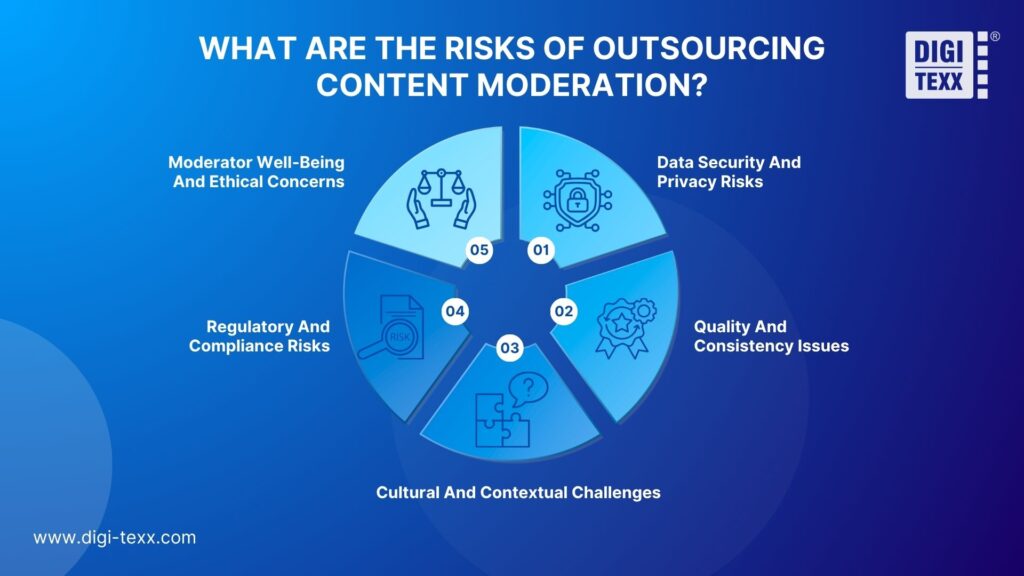
Outsourcing content moderation can improve scalability and access to specialized resources, but it also introduces risks that businesses must manage. The main concerns involve data security, moderation quality, cultural differences, regulatory compliance, and moderator well-being. These risks become more significant when providers handle sensitive user data or high-risk content at large scale.
Data Security And Privacy Risks
Outsourced moderators may need access to user-generated content, account information, messages, images, videos, or other sensitive data. Transferring this information to an external provider increases the number of parties, systems, and locations involved in the data-processing chain.
Security risks can include:
- Unauthorized access to user data.
- Data breaches or accidental disclosure.
- Insecure data transmission or storage.
- Excessive moderator access to sensitive information.
- Data being processed or stored across multiple jurisdictions.
- Inadequate controls for deleting or retaining moderation data.
The risk is particularly important for platforms handling personally identifiable information, private communications, financial information, or sensitive user content. Businesses therefore need to understand what data the provider can access, where it is processed, how access is controlled, and how long it is retained.
Quality And Consistency Issues
Outsourcing can create quality problems when external moderators interpret policies differently from the client’s internal teams. Inconsistent decisions can result in both false positives, where acceptable content is incorrectly removed, and false negatives, where policy violations are missed.
Quality can also vary across:
- Different moderation teams or locations.
- Languages and regional markets.
- Shifts and operating hours.
- Content categories and policy types.
- New or frequently changing policy requirements.
Poor moderation quality can affect user experience and make platform enforcement appear inconsistent. It may also increase the volume of appeals and require additional internal oversight.
Cultural And Contextual Challenges
Content does not always have the same meaning across languages, countries, and communities. Slang, humor, political references, gestures, symbols, and expressions can have different meanings depending on cultural context.
A moderator who lacks sufficient local knowledge may incorrectly classify content or apply a policy too broadly. Translation can also introduce ambiguity, particularly when harmful language depends on wordplay, local terminology, or cultural references.
This makes language coverage alone insufficient. Businesses operating globally may need moderators who understand both the language and cultural context of the markets they serve.
Regulatory And Compliance Risks
Content moderation can involve personal data, sensitive content, user communications, and decisions that affect access to a platform. Outsourcing therefore creates compliance considerations in addition to operational ones.
Depending on the markets involved, businesses may need to address requirements related to:
- Data protection and privacy.
- Cross-border data transfers.
- Data retention and deletion.
- User rights and appeals.
- Content removal and transparency.
- Industry-specific requirements.
Responsibility for compliance does not automatically transfer to the outsourcing provider. The business remains accountable for understanding its regulatory obligations and ensuring that the outsourcing arrangement supports them.
Moderator Well-Being And Ethical Concerns
Human moderators may regularly encounter graphic violence, sexual exploitation, harassment, hate speech, self-harm, or other disturbing material. Repeated exposure to such content can create significant psychological and occupational risks.
Outsourcing does not remove these concerns; it changes who manages the moderation workforce. Businesses should therefore consider whether providers have appropriate measures for moderator well-being, including workload management, exposure controls, breaks, psychological support, and appropriate working conditions.
Ethical concerns can also arise when moderation is treated primarily as a cost-reduction exercise. A sustainable moderation operation needs to balance user safety, business requirements, moderation accuracy, and the well-being of the people performing the work.
>>> See more:
- BPO Training Program 2026: Nurturing Talent, Launching Careers
- Top 10 Order Processing Outsourcing Companies To Consider In 2026
- Outsourcing Advantages & Disadvantages: What Businesses Should Know?
Outsourcing Vs. In-House Content Moderation
The choice between outsourcing and in-house moderation depends on a business’s content volume, risk profile, geographic coverage, available resources, and need for operational control. In-house moderation offers greater direct control, while outsourcing provides access to external capacity, expertise, and infrastructure.
| Factor | Outsourcing | In-house |
| Cost | Lower upfront investment; variable costs based on workload | Higher fixed costs for hiring, training, and infrastructure |
| Scalability | Easier to scale capacity up or down | Scaling requires internal hiring and workforce planning |
| Control | Shared control with the external provider | Full direct control over moderation operations |
| Expertise | Access to specialized moderation expertise | Expertise must be developed internally |
| 24/7 coverage | Easier access to round-the-clock coverage | Requires internal teams across shifts and time zones |
| Multilingual support | Access to multilingual and regional teams | Requires building multilingual teams internally |
| Setup time | Faster deployment using existing provider resources | Longer setup due to recruitment, training, and infrastructure |
Outsourcing is generally more suitable when a business needs to moderate large or fluctuating volumes of content, operate across multiple languages or time zones, or lacks the internal resources to build a specialized moderation operation.
It can be particularly appropriate when:
- Content volume changes significantly over time.
- The platform requires 24/7 or multilingual coverage.
- The business is expanding into new geographic markets.
- Building an internal moderation team would take too much time or resources.
- The company needs specialized moderation capabilities or technology.
- Internal teams need to focus on product, policy, or trust-and-safety strategy rather than day-to-day review.
In-house moderation may be preferable when the business requires maximum control over sensitive workflows, handles highly confidential content, or has sufficient volume and resources to justify maintaining a dedicated internal operation.
A hybrid operating model is also possible. A business can retain sensitive, high-risk, or policy-critical moderation internally while outsourcing routine, high-volume, multilingual, or after-hours workloads. This approach can provide greater control over critical decisions while using external capacity where it offers the most operational value.
How To Choose A Content Moderation Outsourcing Provider?
Choosing a content moderation outsourcing provider requires more than comparing prices. Businesses should evaluate a provider’s moderation expertise, technology, workforce quality, geographic coverage, security controls, quality management, and ability to meet changing workloads. The right provider should fit the platform’s content types, risk profile, languages, and service requirements.
Content Moderation Expertise
Start by evaluating whether the provider has experience moderating content similar to your platform and industry. A provider supporting a social network may require different capabilities from one handling marketplace listings, gaming communities, dating platforms, or financial services.
Consider whether the provider has experience with:
- The specific content formats your platform handles, including text, images, video, audio, or livestreams.
- Relevant policy categories, such as harassment, hate speech, fraud, adult content, or violent material.
- Similar industries and use cases.
- High-volume or high-risk moderation environments.
- Pre-moderation, post-moderation, reactive moderation, or hybrid workflows.
Relevant experience can shorten implementation time and reduce the learning curve when providers begin applying your policies.

AI And Automation Capabilities
Evaluate how the provider uses AI and automation to improve moderation speed, consistency, and scalability. The focus should not simply be on whether a provider uses AI, but on what the technology can detect and how it integrates with human review.
Key capabilities may include:
- Automated text, image, audio, and video classification.
- Toxicity, hate speech, spam, fraud, or other risk detection.
- Risk or confidence scoring.
- Automated filtering of high-confidence violations.
- Human-review routing for uncertain cases.
- Real-time or near-real-time detection.
- Integration through APIs or existing moderation workflows.
Businesses should also understand how the provider handles AI errors and policy changes. A strong system should allow automated decisions to be monitored, reviewed, and adjusted rather than relying on AI as an independent decision-maker.

Human Moderator Quality
Technology does not eliminate the need for skilled human moderators, particularly for complex or high-risk content. Assess how the provider recruits, trains, supervises, and evaluates its moderation workforce.
Important factors include:
- Training specific to the client’s policies and enforcement standards.
- Experience with complex or sensitive content categories.
- Language and cultural knowledge.
- Moderator accuracy and consistency.
- Escalation procedures for difficult cases.
- Ongoing calibration and performance evaluation.
- Processes supporting moderator well-being when teams handle disturbing content.
Ask providers how they measure moderator performance rather than relying solely on claims about experience or staffing volume. Accuracy, consistency, escalation quality, and error rates provide a more useful indication of operational capability.

Language And Cultural Coverage
For global platforms, language coverage should be evaluated beyond the number of languages a provider claims to support. Effective moderation requires understanding local terminology, slang, cultural references, and context.
Evaluate whether the provider can support:
- The languages used by your current and target users.
- Native or highly proficient language reviewers.
- Regional variations and dialects.
- Local cultural context.
- Market-specific policy interpretation.
- Coverage across the time zones where users are active.
This is particularly important for content involving harassment, hate speech, sarcasm, coded language, or culturally specific references, where literal translation may not capture the intended meaning.

Data Security And Compliance
Because moderators may access user-generated content and potentially sensitive personal information, security should be a core selection criterion. Review how the provider protects data throughout the moderation lifecycle, from access and processing to storage and deletion.
Key areas to evaluate include:
- Access controls: Whether moderators can access only the data required for their role.
- Data encryption: Protection of data during transmission and storage.
- Secure environments: Controls over devices, networks, and moderation workspaces.
- Data retention: Clear rules for storing and deleting moderation data.
- Privacy practices: How personal and sensitive information is handled.
- Regulatory compliance: Ability to support applicable privacy and data-protection requirements.
- Incident management: Procedures for detecting, reporting, and responding to security incidents.
Businesses should also understand where data is processed and whether outsourcing involves cross-border data transfers. Security requirements should be reflected in the contractual agreement, not treated solely as a provider-side policy.

Quality Assurance And Reporting
A provider should have a measurable quality-assurance program rather than relying on informal supervision. Ask how it evaluates moderation decisions, identifies errors, and reports performance to clients.
Useful QA and reporting capabilities include:
- Regular accuracy audits and sampling.
- False-positive and false-negative tracking.
- Moderator-level and team-level performance monitoring.
- Calibration for ambiguous policy categories.
- Appeal and overturned-decision analysis.
- Trend reporting for emerging violation patterns.
- Regular performance dashboards and operational reports.
Reporting should give the client enough visibility to understand what is being moderated, how accurately decisions are being made, where bottlenecks occur, and whether service levels are being met.

Scalability And SLA
Finally, evaluate whether the provider can maintain performance as content volumes, markets, and moderation requirements change. A provider that performs well at the current workload may not be suitable if traffic increases significantly or the business expands into additional languages and regions.
Assess the provider’s ability to:
- Increase or reduce moderator capacity as demand changes.
- Support peak and seasonal content volumes.
- Add new languages or content types.
- Provide 24/7 or extended coverage where required.
- Maintain agreed response and resolution times.
- Meet defined accuracy and quality thresholds.
These expectations should be formalized through service-level agreements (SLAs). Depending on the operation, an SLA may define response time, turnaround time, coverage, accuracy targets, escalation procedures, reporting requirements, and service availability.
A provider should therefore be evaluated not only on its current capacity, but also on whether its people, technology, processes, and contractual commitments can scale with the business.

>>> See more:
- Ultimate Guide to Data Processing Outsourcing in 2026
- Best Data Entry Outsourcing Companies Reviewed for 2026
- Best Data Cleansing Outsourcing Companies for 2026
How Much Does Content Moderation Outsourcing Cost?
Content moderation outsourcing costs vary widely depending on the provider, content volume, content type, languages, coverage requirements, technology, and service-level expectations. There is no universal rate that applies to all moderation projects because the cost of reviewing high-volume text content can differ significantly from a multilingual operation involving sensitive video or 24/7 human review.
For this reason, businesses should evaluate both the factors that drive costs and the pricing model offered by the provider before comparing quotes.
Factors That Affect Outsourcing Costs
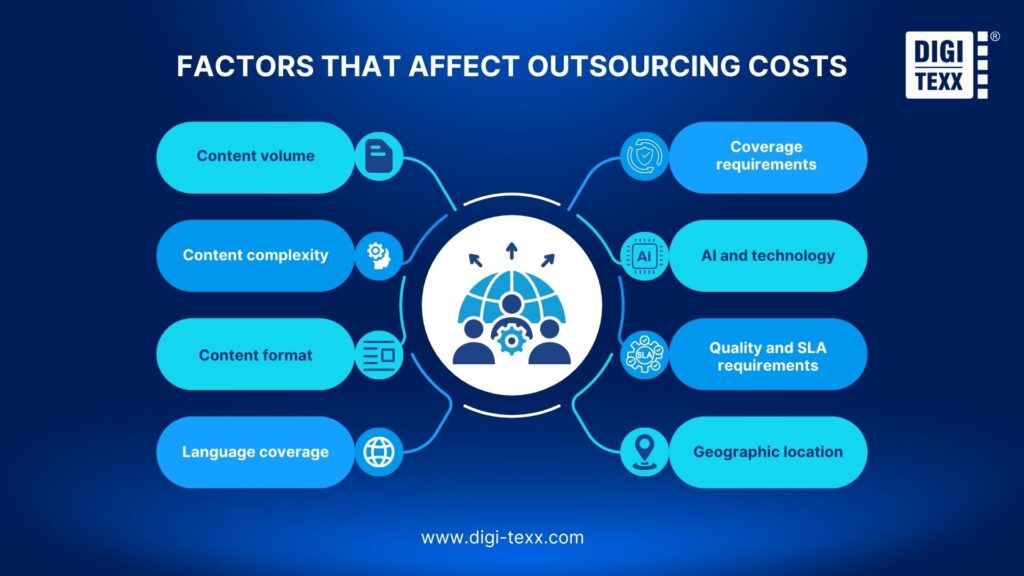
The main cost drivers include:
- Content volume: Higher volumes require more moderation capacity, technology, and operational resources.
- Content complexity: Sensitive, ambiguous, or high-risk content typically requires more human review and specialized expertise.
- Content format: Text, images, video, audio, and livestreams can require different levels of technology and human involvement.
- Language coverage: Multilingual moderation may require specialized reviewers with language and regional expertise.
- Coverage requirements: 24/7, real-time, or strict response-time requirements generally require greater staffing and operational capacity.
- AI and technology: Automated detection, APIs, integrations, analytics, and custom moderation workflows can affect the overall cost.
- Quality and SLA requirements: Higher accuracy targets, tighter turnaround times, additional QA, and specialized escalation processes may increase costs.
- Geographic location: Provider costs can vary depending on the location of moderation teams and the markets they support.
Businesses should therefore compare the total cost of the moderation operation, rather than evaluating providers solely on an hourly or per-content rate.
Common Pricing Models
Content moderation providers may use different pricing structures depending on the workload, service scope, and level of customization required:
| Pricing model | How it works | Best for |
| Per-unit | Charges based on the amount of content reviewed | Predictable content volumes |
| Hourly | Charges based on moderator or team hours | Variable workloads and managed teams |
| Retainer | Fixed recurring fee for ongoing moderation capacity | Continuous moderation programs |
| Tiered/package | Fixed pricing based on volume, service level, or coverage | Clearly defined requirements |
| Custom pricing | Pricing is tailored to workload, technology, languages, and SLA requirements | Complex enterprise operations |
Per-unit pricing can provide predictable costs when content volumes are stable. Hourly and retainer models may offer more flexibility when workloads fluctuate or businesses require dedicated moderation capacity. For larger or more complex operations, providers may use custom pricing that combines staffing, technology, languages, coverage, and SLA requirements.
When comparing providers, businesses should look beyond the base rate and consider what is included in the quoted price, such as AI screening, human review, quality assurance, multilingual support, reporting, integrations, and 24/7 coverage.
Best Practices For Outsourcing Content Moderation
Effective outsourcing requires more than transferring moderation tasks to a third party. Businesses should establish clear ownership, measurable standards, and continuous communication with the provider.
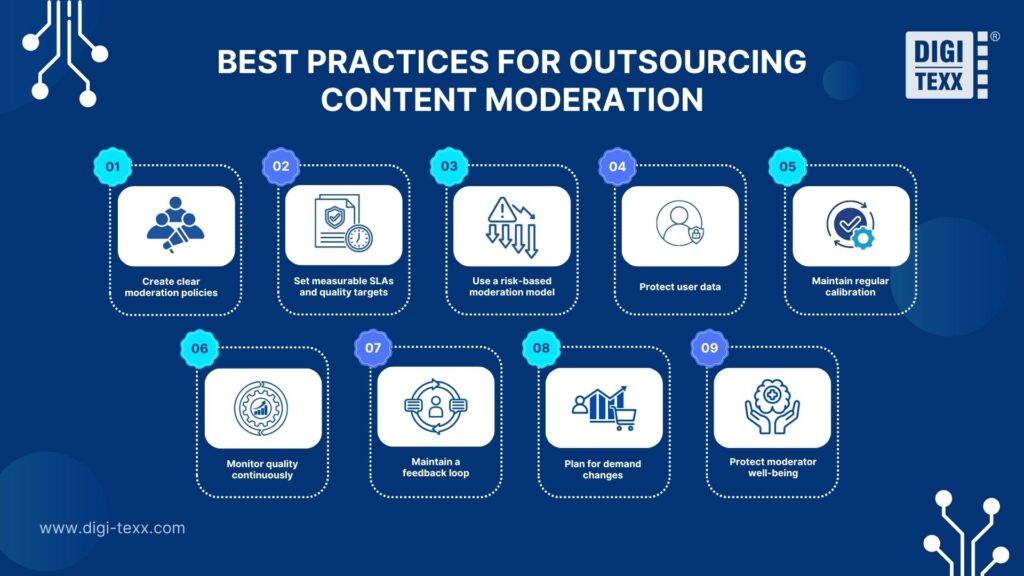
Key practices include:
- Create clear moderation policies: Define prohibited content, severity levels, enforcement actions, exceptions, and escalation rules before operations begin.
- Set measurable SLAs and quality targets: Establish requirements for accuracy, turnaround time, coverage, escalation, and reporting.
- Use a risk-based moderation model: Combine automation and human review according to content risk rather than applying the same process to every case.
- Protect user data: Limit moderator access to necessary information and establish clear requirements for security, data retention, processing locations, and incident management.
- Maintain regular calibration: Review difficult cases with the provider to ensure internal teams and outsourced moderators interpret policies consistently.
- Monitor quality continuously: Track false positives, false negatives, overturned decisions, escalation rates, backlog, and response times. Quality assurance is essential because moderation errors can either incorrectly restrict legitimate users or allow harmful content to remain visible.
- Maintain a feedback loop: Use moderation results, appeals, emerging abuse patterns, and QA findings to update policies, training, and automated detection.
- Plan for demand changes: Define how the provider will respond to product launches, seasonal peaks, viral events, or sudden increases in harmful content.
- Protect moderator well-being: Ensure appropriate workload management and support when teams handle disturbing or high-risk material.
The goal is to treat the provider as an extension of the platform’s trust and safety operation, with clearly defined responsibilities and measurable outcomes. This is increasingly important as automation handles more routine decisions while human teams focus on complex and high-consequence cases.
FAQs About Content Moderation Outsourcing
What Is Content Moderation Outsourcing?
Content moderation outsourcing is the practice of hiring an external provider to review, classify, and manage user-generated content according to a business’s policies. Providers may use human moderators, AI tools, or a hybrid model to identify policy violations and take appropriate actions.
Why Do Companies Outsource Content Moderation?
Companies outsource content moderation to reduce operational costs, scale moderation capacity, provide 24/7 or multilingual coverage, and access specialized expertise. Outsourcing also allows internal teams to focus on product development, trust and safety strategy, and other higher-value activities.
Is AI Better Than Human Content Moderation?
Neither is universally better. AI moderation is faster and more scalable for high-volume content, while human moderators are better suited to complex cases requiring contextual or cultural judgment. A hybrid model often combines AI’s efficiency with human oversight for ambiguous or high-risk content.
How Much Does Outsourced Content Moderation Cost?
Costs vary based on content volume, complexity, format, languages, coverage hours, technology, and SLA requirements. Providers may charge per item, hourly, through a monthly retainer, or using custom pricing. Businesses should compare total operating costs rather than relying only on the provider’s base rate.
What Types Of Content Can Be Outsourced?
Businesses can outsource moderation for text, images, videos, audio, livestreams, user profiles, marketplace listings, reviews, advertisements, and other user-generated content. The available coverage depends on the provider’s technology, human expertise, supported languages, and ability to handle specific content formats.
How Do Companies Protect User Data When Outsourcing Moderation?
Companies protect user data through access controls, encryption, secure processing environments, data-retention policies, and contractual security requirements. They should also assess where data is processed, how third-party access is managed, and whether the provider can meet applicable privacy and data-protection obligations.
Content moderation outsourcing can help businesses improve scalability, coverage, and operational efficiency while maintaining user safety. The right approach depends on content volume, risk, languages, and required response times. By evaluating technology, moderator expertise, security, quality, and SLAs, businesses can choose an outsourcing model and provider that fits their specific moderation needs.
DIGI-TEXX Contact Information:
🌐 Website: https://digi-texx.com/
📞 Hotline: +84 28 3715 5325
✉️ Email: [email protected]
🏢 Address:
- Headquarters: Anna Building, QTSC, Trung My Tay Ward
- Office 1: German House, 33 Le Duan, Saigon Ward
- Office 2: DIGI-TEXX Building, 477-479 An Duong Vuong, Binh Phu Ward
- Office 3: Innovation Solution Center, ISC Hau Giang, 198 19 Thang 8 street, Vi Tan Ward
References
- European Commission. (2026). How the Digital Services Act enhances transparency online. Digital Services Act: Content Moderation Transparency
- European Commission. (2026). Harmonised transparency reports under the DSA bring enhanced clarity on content moderation practices online. European Commission – DSA Transparency Reports
- Trust & Safety Professional Association. (n.d.). Content Moderation Quality Assurance. Content Moderation Quality Assurance