
The master data management definition describes a disciplined, technology-enabled process that links all critical enterprise data to a single source of truth, ensuring accuracy and consistency across every department, system, and geography. Inconsistent and fragmented data lead to wrong decisions, poor customer experience, and inefficient operations.
In this article, DIGI-TEXX covers the definition, key benefits, best practices, and the 3 most common challenges organizations face when deploying master data management.
>>> Explore more:
- Top 10 Data Processing Software For Business 2026 – Best Tool Reviewed
- Best Real Estate Image Processing Services 2026: Top 15 Providers
- Top 10 Best Data Entry Outsourcing Companies in USA 2026
What Is Master Data Management (MDM)?
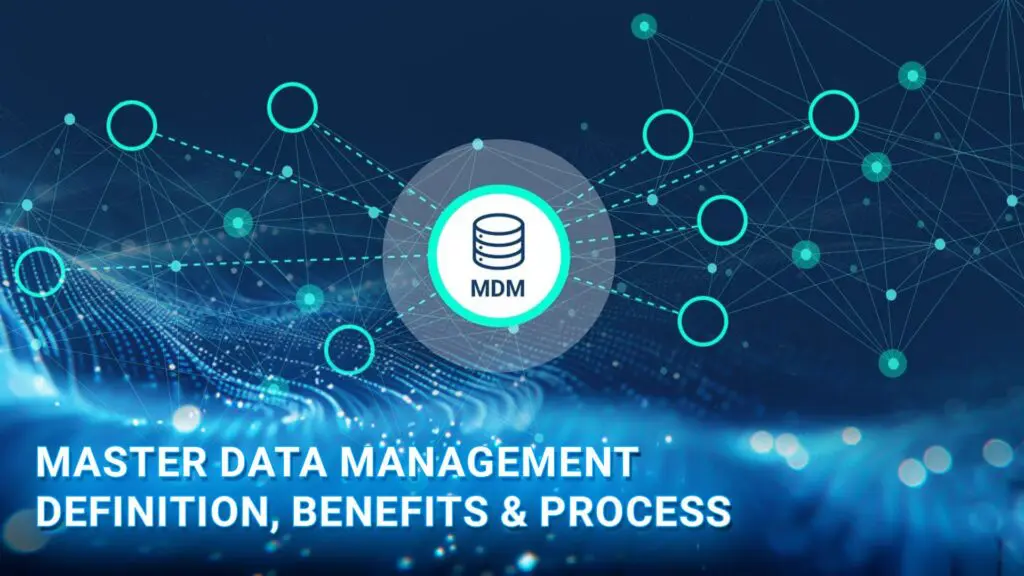
The master data management definition is a disciplined, technology-enabled approach or process that enables an enterprise to link all of its critical data to a single point of reference, often referred to as a single source of truth.
The goal of MDM is to ensure that an organization does not have multiple, potentially inconsistent versions of critical data across different departments, divisions, or geographies.
In the master data management definition, master data are core, non-transactional data assets that describe the most important business entities. For example, “Customer” master data includes name, address, phone number; “Product” master data includes SKU code, description, supplier.
Master data management is the establishment and maintenance of a golden record for each of these entities, ensuring accuracy, consistency, and completeness across the enterprise’s entire technology ecosystem.
>>> See more:
- Outsourced AI Training Data: Benefits, Providers & How To Choose In 2026
- Construction Invoice Reconciliation: Process, Best Practices & Software 2026
- Back Office Service: Definition, Examples, Benefits & Outsourcing 2026
Real-World Examples Of Master Data Management
To better understand the master data management definition in practice, let’s explore the following examples with DIGI-TEXX:
- Customer Relationship Management (CRM): Master data management consolidates fragmented customer entries across sales, billing, and support platforms into a single verified golden record. This prevents duplicate outreach, ensures accurate billing, and enables personalized engagement strategies.
- Product Information Management: MDM establishes a centralized product repository where every specification, SKU codes, dimensions, and compliance certifications remain consistent across e-commerce platforms, physical catalogs, and ERP systems simultaneously.
- Compliance and Risk Management: MDM provides a single, auditable source of truth for all regulated data entities, enabling organizations to respond to data subject requests, demonstrate GDPR compliance, and reduce the risk of financial penalties.
- ERP: Master data management synchronizes supplier records, cost centers, and location hierarchies across all ERP modules, ensuring every department draws from the same authoritative data source and that operational decisions reflect a consistent version of the truth.
>>> Explore more:
- 5 Advantages Of Data Annotation Outsourcing Services for AI Projects
- Why Retail Outsourcing Is a Smart Strategy for Retail Businesses
- 5 Key Indicators Of A Business Process Outsourcing Provider You Should Track
MDM vs Data Management vs Data Governance
Master Data Management (MDM), Data Management, and Data Governance are closely related concepts, but they serve different roles within an organization’s data strategy. Understanding the differences helps businesses choose the right approach and avoid overlapping initiatives.
MDM vs Data Management
Data Management is a broad discipline that covers the entire lifecycle of data, including data collection, storage, integration, security, and usage across systems.
MDM, on the other hand, is a specialized subset of data management focused specifically on managing core business entities such as customers, products, suppliers, and locations. Its primary goal is to create and maintain a consistent “golden record” across all systems.
MDM vs Data Governance
Data Governance defines the policies, standards, roles, and responsibilities for managing data within an organization. It answers questions such as:
- Who owns the data?
- Who can update or access it?
- What rules must data follow?
MDM operates within this governance framework. It applies those rules in practice by enforcing data quality, standardization, and consistency across systems.
MDM vs Data Warehouse
A Data Warehouse is designed to store large volumes of historical data for reporting and analytics. It aggregates data from multiple sources to support business intelligence and decision-making.
MDM does not replace a data warehouse. Instead, it ensures that the data entering the warehouse is clean, consistent, and standardized.
| Aspect | Data Management | Data Governance | Master Data Management |
| Scope | All enterprise data | Policies & rules | Core business entities |
| Focus | Storage, processing, security | Control & accountability | Data consistency & accuracy |
| Role | Operational foundation | Strategic control layer | Execution & standardization |
| Outcome | Data availability | Data trust & compliance | Single source of truth |
>>> Explore more:
- Define Business Process Outsourcing (BPO): Meaning, Examples & Benefits 2026
- Intelligent Document Processing Services: Benefits, Use Cases & How It Works
- Back Office Support Services To Streamline Operations & Boost Efficiency
How Master Data Management Works?
Master data management (MDM) works by collecting, standardizing, and synchronizing data from multiple systems to create a consistent and reliable “single version of truth.”
Instead of storing all data in one place, MDM connects different systems and ensures they operate using the same accurate and validated data. This is achieved through a continuous process that combines data integration, data quality management, and governance.
Below is how MDM typically works in practice:
Data Collection and Integration
MDM begins by collecting master data from multiple sources such as ERP, CRM, databases, and external platforms.
This data is integrated into a central MDM hub using APIs, ETL/ELT pipelines, or system connectors. At this stage, the data is often fragmented, duplicated, or inconsistent across systems.
Data Matching and Deduplication
Once the data is aggregated, MDM systems identify duplicate or related records that refer to the same entity.
This process uses:
- Rule-based matching (e.g., exact email or ID)
- Fuzzy matching (e.g., similar names or addresses)
- AI-driven entity resolution
Duplicate records are then merged to eliminate inconsistencies and reduce redundancy.
Golden Record Creation
After resolving duplicates, MDM creates a “golden record,” which is the most accurate and complete version of each entity.
This involves:
- Selecting trusted data sources.
- Standardizing formats and attributes.
- Validating and enriching missing data.
The golden record becomes the authoritative reference used across the organization.
Data Governance and Quality Control
MDM continuously enforces data governance rules to maintain accuracy over time. This includes:
- Defining data ownership and stewardship.
- Applying validation rules and workflows.
- Monitoring data quality metrics.
This ensures that data remains consistent, compliant, and trustworthy as it evolves.
Data Synchronization Across Systems
Finally, the golden record is synchronized across all connected systems.
Updates made in one system can be reflected across others, depending on the MDM architecture. This ensures that all departments and applications are working with the same up-to-date data.
>>> See more:
- Boost Efficiency With Insurance Back Office Support Services
- Document Indexing Services For Fast Search, Accurate Data & Easy Retrieval
- Ecommerce Back Office Support Services For Fast Growth
What Are The 4 Types Of MDM?
Master data management (MDM) can be implemented using different architectures, each defining how data is stored, managed, and synchronized across systems. The four common models below vary in terms of control, complexity, and implementation effort.
Registry Style
The registry model does not centralize data but creates an index to link records across systems. Data remains in source systems and is retrieved in real time when needed.
This approach requires minimal system changes and is suitable for organizations that need quick visibility without full data consolidation. However, data consistency depends on the quality of source systems.
Consolidation Style
In this model, data from multiple systems is consolidated into a central MDM hub, where it is cleaned and standardized to create a golden record.
It is commonly used for analytics and reporting purposes, helping improve data quality without impacting operational systems. However, updates are not always synchronized back to source systems.
Coexistence Style
The coexistence model centralizes and standardizes data in an MDM hub, then synchronizes the golden record back to source systems.
This approach improves data consistency across the organization while allowing systems to continue operating independently. It is often used as a transition toward a more centralized model.
Centralized Style
In the centralized model, all master data is created and managed directly within the MDM system, which becomes the single source of control.
This provides the highest level of data consistency and governance, but requires strong processes, governance frameworks, and higher implementation effort.
Benefits Of Master Data Management
Implementing an effective master data management strategy brings many intuitive and highly strategic benefits to businesses. Modern master data management systems are designed to optimize these benefits, including:
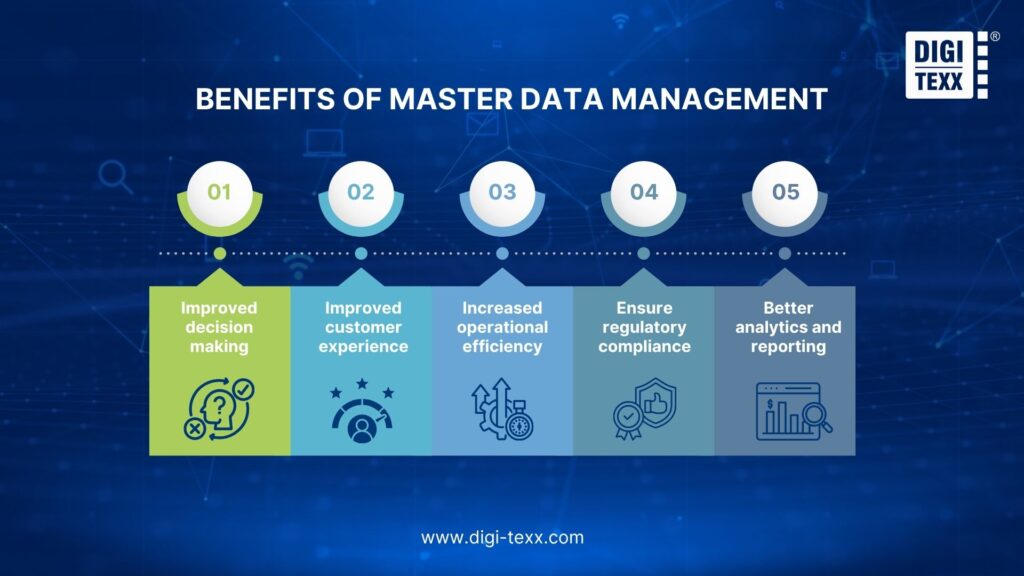
- Improved decision making: Leaders can make decisions based on reliable analytical data, eliminating the guesswork and uncertainty caused by data inconsistencies.
- Improved customer experience: By creating a 360-degree portrait of the customer, businesses can personalize marketing campaigns, deliver seamless service, and proactively address customer needs.
- Increased operational efficiency: MDM automates data synchronization, eliminating time-consuming manual processes, thereby freeing employees to focus on higher-value tasks and activities.
- Ensure regulatory compliance: Having a centrally managed source of master data makes it easier to comply with privacy and data protection regulations (like GDPR), as well as clearly trace and audit poor data sources.
- Better analytics and reporting: Clean master data is a good foundation for analytics tools. This ensures that Business Intelligence reports and results from machine learning models are accurate and actionable.
>>> See more:
- AI In BPO: Benefits, Applications, Challenges & Future Trends
- Outsourcing Advantages & Disadvantages: What Businesses Should Know?
- Supply Chain Business Process Outsourcing (BPO) 2026
When Should You Implement MDM?
Master data management (MDM) becomes necessary when data issues start disrupting daily operations and decision-making. As organizations grow and use more systems, data fragmentation, duplication, and inconsistency often increase.
The following signs indicate that your business may need to implement MDM:
- Clear business objectives for improving data quality or consistency.
- Alignment between business and IT teams.
- Defined data ownership and governance roles.
- Sufficient resources for implementation and ongoing maintenance.
- Measurable data issues that justify the investment.
>>> See more:
- Top Business Process Documentation Tools You Should Consider
- What are the 6 steps of the data analysis process?
- Intelligent Document Recognition (IDR): Definition, Example, Benefits
Key Challenges In Master Data Management
Master data management delivers significant value, but organizations consistently encounter 3 core challenges during implementation and ongoing operations. Recognizing these challenges early reduces project delays and cost overruns.
Data Silos and Legacy System Integration
Most enterprises operate 20 to 50 disparate systems, ERPs, CRMs, and legacy databases, each with its own data formats, identifiers, and validation rules. Integrating these sources into a unified MDM hub requires extensive ETL/ELT pipelines, data mapping, and identity resolution logic.
Undefined Data Ownership
MDM requires a designated owner for every data domain. Without data stewards and a governance board, departments dispute which system holds the authoritative version of a record. This ambiguity produces inconsistent updates, conflicting golden records, and eroded trust across the organization.
Poor Initial Data Quality
Source systems accumulate duplicate records, incomplete fields, and formatting inconsistencies over the years. First-time data profiling exercises typically reveal that 10–30% of customer or product records contain significant quality issues. Resolving this data requires both automated deduplication tools and manual review by domain experts before migration into the MDM hub.
>>> Explore more:
- Why Businesses Outsource Data Management in 2026?
- Purchase Orders Processing: Steps, Types, Best Practices
- Invoice Reconciliation Process: Step-By-Step Guide & Key Steps
Best Practices For A Successful MDM Strategy
To ensure that master data management implementations deliver maximum value and are sustainable, organizations will need to follow proven best practices:
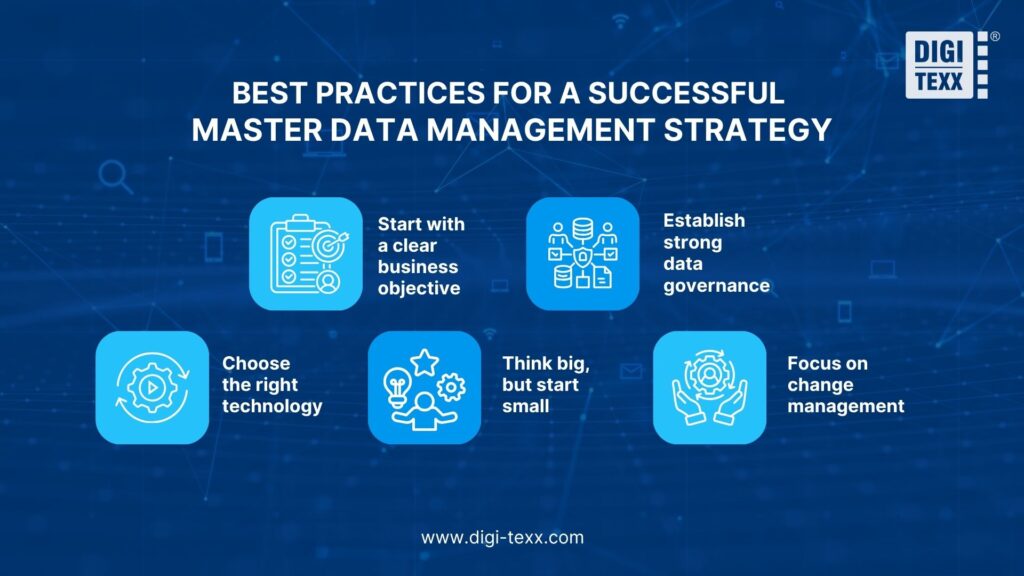
- Start with a clear business objective: Instead of saying ‘we need MDM’, let define a specific business problem such as ‘we need to reduce bounced emails due to incorrect customer addresses by 20%’. This creates a measurable goal and helps demonstrate the ROI of investing in MDM.
- Establish strong data governance: Don’t treat data governance as an administrative task. Build a realistic data governance framework with clear roles, responsibilities, and decision-making processes, supported by leadership.
- Choose the right technology: Carefully evaluate the Master data management solutions on the market. Consider on-premises and cloud-based solutions such as AWS Master Data Management, Microsoft Data Services (MDS),… Choose a tool that is not only technically sound but also business-user and data administrator-friendly.
- Think big, but start small: Build an overall MDM roadmap for the entire enterprise, but start with one data domain (e.g,. products) and a few source systems. Achieving quick wins will create good momentum for the next stages.
- Focus on change management: MDM changes the way people work with data. Therefore, continuous communication about the benefits, project goals and providing thorough training to end users are extremely important to ensure successful implementation.
>>> Explore more:
- Professional E-commerce Data Entry Services by DIGI-TEXX
- Data Validation vs Verification: Key Differences, Examples & Benefits
- Data Labeling Service: What It Is, Types & Benefits For AI
FAQs About Master Data Management Definition
What Is The Difference Between Master Data Management Vs. Data Management?
Data management is a broad term that can be compared to managing an entire library, including everything from book organization, storage, lending, to managing library staff. Meanwhile, the term master data management would be described as managing the library’s master catalog card system.
MDM rather manages the core, most authoritative reference information about each title, author, and genre, ensuring that everyone searching for information starts from the right source.
What Is An Example Of MDM?
A typical Master data management example might be: In manufacturing, an automotive manufacturer has data on ‘Parts’ from multiple suppliers, across purchasing, inventory management and design systems. The same bolt may have different codes and descriptions in each system.
MDM consolidates all this information, creating a single golden record for that bolt with its part number, preferred supplier, specifications and standard pricing.
Is MDM Outdated?
MDM is not outdated. The discipline has evolved significantly since its origins in the early 2000s. Modern MDM platforms incorporate AI-driven data matching, cloud-native architectures, real-time data synchronization, and graph-based relationship modeling. As organizations adopt generative AI and large language models, the need for clean, trusted master data has become more critical than ever.
What Is The Most Popular MDM Software?
The most widely adopted master data management software platforms include TeamViewer, Informatica MDM, SAP Master Data Governance, IBM InfoSphere MDM, Profisee, Stibo Systems STEP, and Microsoft Master Data Services (MDS). Cloud-native MDM solutions such as Informatica MDM Cloud, Reltio, and Ataccama ONE have grown in adoption among enterprises undertaking digital transformation and AI readiness initiatives.
Master data management definition is a disciplined process that transforms messy data into a trusted strategic asset for your business. By creating a single source of truth for critical data, businesses can increase efficiency and drive growth based on accurate insights. At DIGI-TEXX, we help you build that solid data foundation. Get in touch to discover how our data processing and analytics services can help build MDM for your business.
If you have any questions or would like expert advice on data analytics services, please feel free to contact us using the information below.
DIGI-TEXX Contact Information:
🌐 Website: https://digi-texx.com/
📞 Hotline: +84 28 3715 5325
✉️ Email: [email protected]
🏢 Address:
- Headquarters: Anna Building, QTSC, Trung My Tay Ward
- Office 1: German House, 33 Le Duan, Saigon Ward
- Office 2: DIGI-TEXX Building, 477-479 An Duong Vuong, Binh Phu Ward
- Office 3: Innovation Solution Center, ISC Hau Giang, 198 19 Thang 8 street, Vi Tan Ward
Reference:
- DAMA International. (n.d.). Data Management Body of Knowledge (DAMA-DMBOK). https://dama.org/learning-resources/dama-data-management-body-of-knowledge-dmbok/
- DAMA International. (n.d.). What is data management? https://dama.org/about-dama/what-is-data-management/