
Business Process Outsourcing (BPO) is a strategic approach in which organizations outsource specific business functions to specialized third-party providers to enhance efficiency and reduce operating costs. In a highly competitive market, businesses must continuously streamline processes, improve performance, and remain agile. This article by DIGI-TEXX provides a comprehensive overview of business process outsourcing, covering its core concepts, benefits, and associated challenges.
See more:
- Medical Claims Processing Outsourcing For Healthcare Providers
- Best Insurance Claims Processing Outsourcing BPO in the US 2026
- Secure Data Annotation Services: Top Companies & How to Choose
What Is Meant By Business Process Outsourcing?
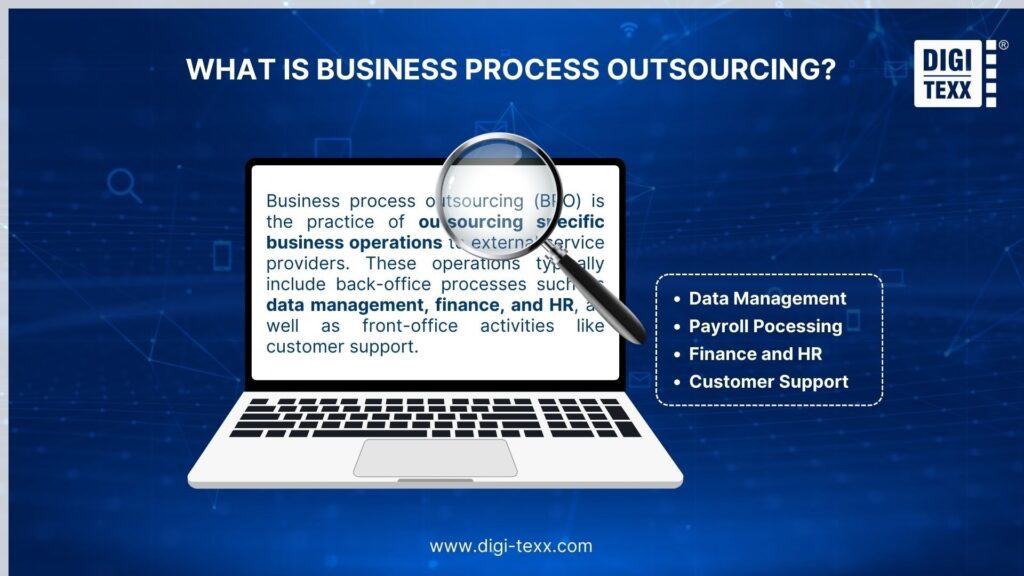
To define business process outsourcing (BPO), it is the practice of contracting specific business operations to specialized third-party service providers. These operations can include both back-office functions, such as data management, finance, and HR, as well as front-office activities like customer support.
Business process outsourcing enables companies to improve efficiency, reduce costs, and leverage specialized expertise and advanced technologies such as AI and analytics. Initially adopted in manufacturing for supply chain management, BPO has since expanded across industries including healthcare, ecommerce, energy, and financial services, offering organizations greater operational flexibility through offshore, nearshore, and onshore models.
What Is An Example Of A BPO?
Business process outsourcing (BPO) is applied across many industries, with each sector outsourcing different front-office and back-office functions based on its operational needs. Common BPO examples by industry include:
Healthcare
- Medical billing and coding
- Patient data entry and management
- Claims processing
- Appointment scheduling
- Compliance documentation and reporting
Ecommerce & Retail
- Customer support and call center services
- Order and payment processing
- Product data management
- Returns and refunds handling
- Inventory data updates
Banking & Financial Services (BFSI)
- Accounts payable and accounts receivable
- Payroll processing
- Financial reporting and reconciliation
- Risk and compliance documentation
- Customer account support
Insurance
- Policy administration
- Claims processing
- Customer inquiries handling
- Data validation and document management
Marketing, Sales & Research
- Market and competitive research
- Marketing strategy and campaign support
- Content creation and SEO
- CRM and marketing automation
- Sales support and after-sales services
IT & Software Development
- Website and application development
- Software testing and maintenance
- Database development and management
- IT infrastructure monitoring and support
Human Resources (HR)
- Recruitment and hiring operations
- Employee data management
- Payroll and benefits administration
- Training and learning services
- HR reporting and analytics
Accounting & Finance
- Bookkeeping and cost accounting
- Tax reporting and filing
- Financial statements and reporting
- Financial planning and analysis
These examples show how organizations across industries use BPO to streamline operations, reduce costs, and access specialized expertise while focusing on their core business activities.
>>> See more:
- Why Businesses Outsource Data Management in 2026?
- Steps Of Data Analysis: 6 Key Stages Explained With Real Examples
- Professional Fashion Photo Editing Services for Stunning Visuals
What Is The Difference Between BPS And BPO?
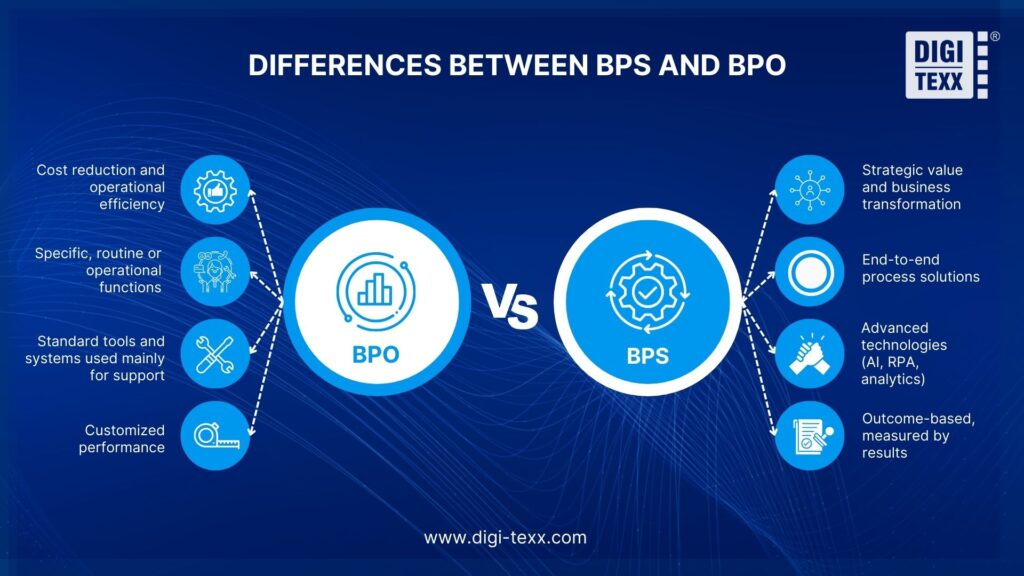
- Business Process Outsourcing (BPO) is the traditional approach, where a company hires a third-party provider to handle specific business tasks—such as payroll, data entry, or basic customer support. The main goal of BPO is to reduce costs and relieve internal teams from routine, operational tasks.
- Business Process Services (BPS) is a more advanced and modern model. Instead of simply executing tasks, BPS uses technologies like AI, automation, cloud platforms, and analytics to deliver integrated, outcome-driven solutions. The focus is on improving and transforming business processes, not just outsourcing them.
| Criteria | Business Process Outsourcing (BPO) | Business Process Services (BPS) |
| Focus | Cost reduction and operational efficiency | Strategic value, innovation, and business transformation |
| Scope | Specific, routine or operational functions (e.g., data entry, basic call center services) | End-to-end solutions across multiple connected processes |
| Technology | Standard tools and systems used mainly for support | Advanced technologies such as AI, RPA, cloud, and analytics |
| Delivery Model | Transaction-based, measured by volume and SLAs | Outcome-based, measured by business results (e.g., improved CX, revenue growth) |
Why Does Business Choose A BPO?
Businesses choose BPO mainly for its flexibility and efficiency. By outsourcing routine and operational tasks, companies can focus on what matters most, such as improving customer relationships and developing new products, while strengthening their competitive advantage.
Another major benefit of BPO is access to advanced technology and expertise that may be costly or difficult to build in-house. BPO providers regularly invest in new tools, systems, and best practices to continuously improve service quality and performance.
Cost reduction is also a strong driver, especially for U.S. companies. With relatively high corporate tax rates and rising labor costs, outsourcing to countries with lower taxes and more affordable labor helps businesses manage expenses more effectively.
In addition, BPO supports faster reporting, higher productivity, and the ability to quickly reallocate internal resources, enabling companies to respond more efficiently to changing business needs.
>>> See more:
- Top 10 Data Cleansing Companies for Businesses in 2026
- How to Automate Documentation in 2026: Step By Step Guide
- An Overview of Document Processing Company: What You Need to Know
Key factors to consider in BPO 2026
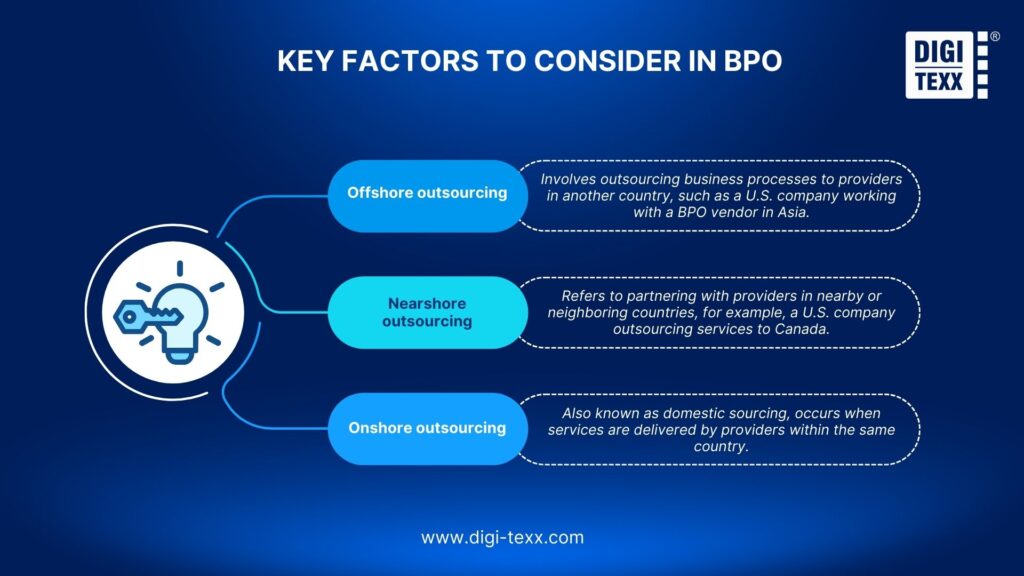
To define business process outsourcing (BPO) clearly, a key factor to consider is where the outsourced services are delivered. BPO models are commonly classified based on the location of the service provider.
Offshore outsourcing refers to outsourcing business processes to a provider in another country. A typical example is a U.S. company working with a BPO vendor in Singapore to handle customer support or data services.
Nearshore outsourcing involves partnering with a provider in a nearby or neighboring country. For instance, a U.S. company outsourcing services to a Canadian BPO provider falls into this category.
Onshore outsourcing, also known as domestic sourcing, occurs when a company outsources business processes to a provider within the same country, even if the vendor operates in a different city or state.
Business process outsourcing is also often associated with information technology-enabled services (ITES), as it relies heavily on technology, digital infrastructure, and secure systems to enable third-party providers to deliver services efficiently and at scale.
What Function Is Common To Outsource?
Companies most often outsource business functions that are time-consuming, resource-intensive, or require specialized expertise to manage in-house. These functions typically fall into two main categories:
Back-office functions
- Human resources
- Accounting and finance
- Research and data management
- Information technology (IT)
Front-office functions
- Customer service and call center operations
- Marketing and digital marketing services
- Sales and lead management
- Technical support
By outsourcing these functions, organizations can reduce operational burden, improve efficiency, and focus internal resources on core business activities.
What Are The Challenges In BPO?
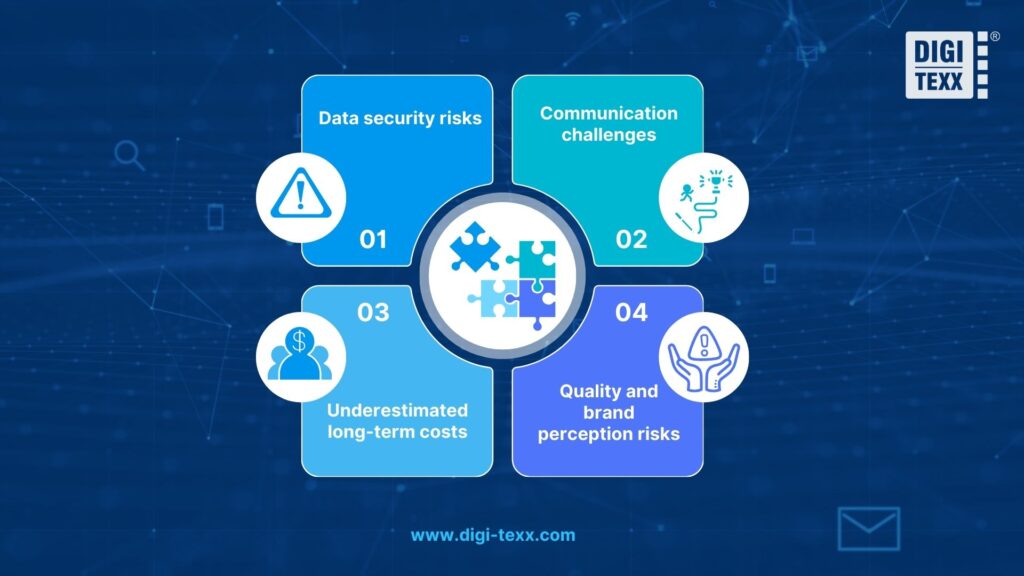
While business process outsourcing (BPO) offers many advantages, it also comes with certain challenges. Companies that outsource their processes may face the following risks:
- Data security risks: Outsourcing business processes can increase exposure to data breaches if security controls and compliance standards are not strictly enforced.
- Communication challenges: Working with external providers, especially across time zones, may lead to misunderstandings or delays that affect project timelines.
- Underestimated long-term costs: Some businesses overlook ongoing expenses such as vendor management, process transitions, and coordination, which can impact total outsourcing costs.
- Quality and brand perception risks: Customers may react negatively if outsourcing is perceived to reduce service quality or harm domestic employment, potentially affecting brand reputation.
>>> See more:
- Data Validation vs Verification: Key Differences, Examples & Benefits
- Professional E-commerce Data Entry Services by DIGI-TEXX
- Best Data Conversion Services in 2026 | DIGI-TEXX
How To Choose A BPO Provider?
After clearly understanding how to define business process outsourcing, the next step is choosing the right BPO provider for HR services. This process requires clear business goals, careful evaluation of vendor capabilities, and close coordination with internal stakeholders. The basic steps include:
Conduct a needs assessment
Identify which HR functions would benefit most from outsourcing and which activities should remain in-house.
Create a request for proposal (RFP)
Outline the capabilities you expect from an HR BPO provider, such as regulatory compliance, industry expertise, data handling, and reporting capabilities.
Evaluate RFP responses
Compare proposals carefully and ensure each provider clearly defines its scope of services versus the responsibilities retained by your internal HR team.
Agree on terms and governance
Obtain stakeholder approval and finalize a contract that clearly documents responsibilities, service scope, timelines, and total costs.
Begin the transition process
Transfer the agreed HR functions to the BPO provider while maintaining open communication to ensure a smooth and controlled transition.
By following these steps, businesses can confidently evaluate HR BPO options and work with experienced providers like DIGI-TEXX to build a secure, efficient, and well-governed outsourcing model.
Business Process Outsourcing Companies – DIGI TEXX
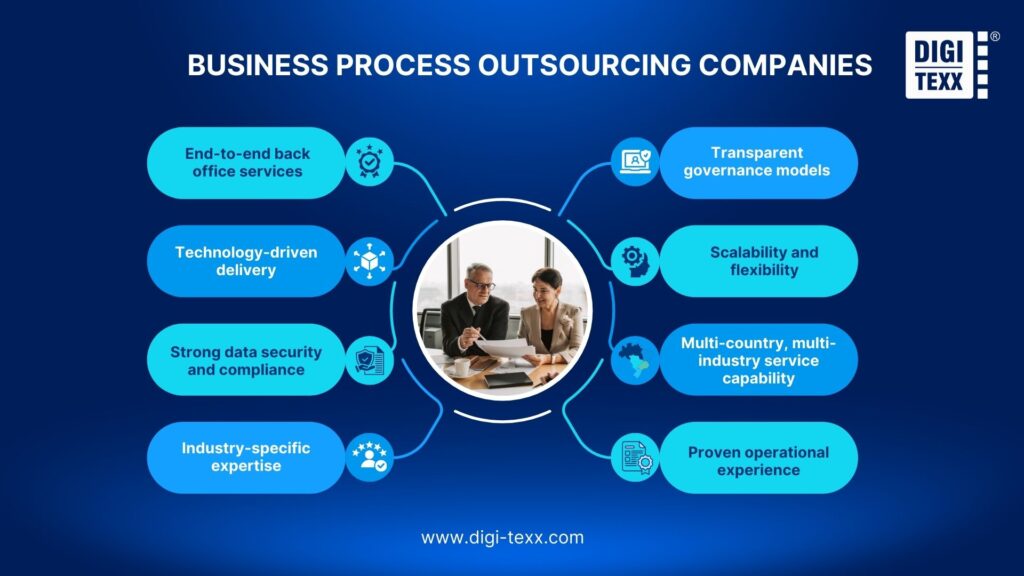
Among business process outsourcing companies, DIGI-TEXX stands out as a provider that meets key selection criteria for modern enterprises. Its strengths include:
- End-to-end back-office services: Delivers comprehensive outsourcing solutions covering data processing, HR support, and other business operations.
- Technology-driven delivery: Commonly leverages AI, workflow automation, secure data platforms, and analytics to improve accuracy, speed, and scalability.
- Industry-specific expertise: Supports multiple industries such as healthcare, BFSI, and eCommerce, with a strong understanding of industry workflows and compliance requirements.
- Strong data security and compliance: Operates in alignment with international standards to ensure data protection and regulatory compliance.
- Scalability and flexibility: Enables businesses to scale resources up or down quickly based on demand without disrupting service quality.
- Transparent governance models: Provides clear service scopes, SLAs, and performance metrics to ensure accountability and long-term partnership success.
>>> See more:
- Ecommerce Photo Retouching Services For High Quality Product Images
- Intelligent Document Processing Services: Benefits, Use Cases & How It Works
- AI-Powered Data Annotation Technologies Efficiency Accuracy Guide For AI Projects
What Are The Steps Of BPO?
Business process outsourcing (BPO) follows a structured approach in which a company contracts a service provider to manage specific business processes, using time-based, transaction-based, or outcome-based agreements. The typical steps in a BPO engagement include:
1. Needs assessment
The process begins with an assessment of the company’s current operations to understand business requirements, process performance, and outsourcing goals.
2. Provider selection and proposal
The company evaluates potential BPO providers and reviews proposals that outline service scope, expected benefits, technology capabilities, and delivery models.
3. Contracting and agreement
Both parties finalize the contract, defining responsibilities, service levels, pricing structure, delivery locations, and expected outcomes.
4. Transition phase
Agreed processes, systems, and resources are transferred from the internal team to the BPO provider to ensure service continuity.
5. Transformation and optimization
During or after the transition, processes are improved through redesign, standardization, automation, and the use of technologies such as AI.
6. Ongoing governance and performance management
The BPO relationship is managed through continuous monitoring, reporting, and optimization to ensure service quality and business alignment.
7. Process repatriation (optional)
In some cases, after transformation and stabilization, outsourced processes may be transferred back to the company.
FAQs About Defining Business Process Outsourcing
What Is Customer Service In BPO?
Customer service in BPO (Business Process Outsourcing) refers to a company partnering with a third-party provider to manage customer interactions such as phone calls, emails, live chat, and social media. The BPO provider handles inquiries, resolves issues, and delivers ongoing support, enabling the business to focus on its core activities while benefiting from specialized expertise, advanced technology, and scalable operations.
What Is The Average Cost Of A BPO?
The cost of BPO varies depending on the scope, complexity, and service model. To receive accurate consultation and a customized quote, please contact DIGI-TEXX at +84 28 3715 5325.
What Is The Main Purpose Of BPO?
The main goal of Business Process Outsourcing (BPO) is to help companies focus on their core business by outsourcing routine or specialized tasks to external providers. This approach helps reduce costs, improve efficiency, scale operations faster, and gain access to specialized expertise, ultimately supporting innovation and long-term strategic growth.
Understanding how to define business process outsourcing is just the starting point. To get real value from BPO, businesses need to choose the right outsourcing model and a partner that fits their operational goals, technology needs, and industry requirements. From easing internal workloads to improving efficiency and accessing specialized expertise, BPO has become an essential part of modern business operations. Working with experienced providers like DIGI-TEXX helps organizations build a secure, flexible, and scalable outsourcing approach that supports long-term growth in a digital-first environment.
DIGI-TEXX Contact Information:
🌐 Website: https://digi-texx.com/
📞 Hotline: +84 28 3715 5325
✉️ Email: [email protected]
🏢 Address:
- Headquarters: Anna Building, QTSC, Trung My Tay Ward
- Office 1: German House, 33 Le Duan, Saigon Ward
- Office 2: DIGI-TEXX Building, 477-479 An Duong Vuong, Binh Phu Ward
- Office 3: Innovation Solution Center, ISC Hau Giang, 198 19 Thang 8 street, Vi Tan Ward
Reference:
- AIIM. (n.d.). Process automation and workflow concepts. Retrieved from https://www.aiim.org
- MIT Sloan School of Management. (n.d.). Digital transformation and process automation research. Retrieved from https://mitsloan.mit.edu