
Healthcare BPO services are becoming a strategic solution for hospitals and healthcare organizations facing rising operational costs, staff shortages, and increasing compliance requirements. Although healthcare providers prioritize patient care, administrative and back-office workloads continue to grow, reducing operational efficiency and scalability. This is why many organizations are turning to healthcare BPO services. In this guide, DIGI-TEXX explains what healthcare BPO services are, common outsourcing models in the healthcare industry, key benefits and challenges, and how to choose the right healthcare BPO partner to support long-term operations.
>>> See more:
- Outsource Data Annotation Services to Scale Your AI Faster
- Outsourcing Data Cleansing: What You Need to Know
- An Overview of Document Processing Company: What You Need to Know
What Does Healthcare BPO Services Mean?
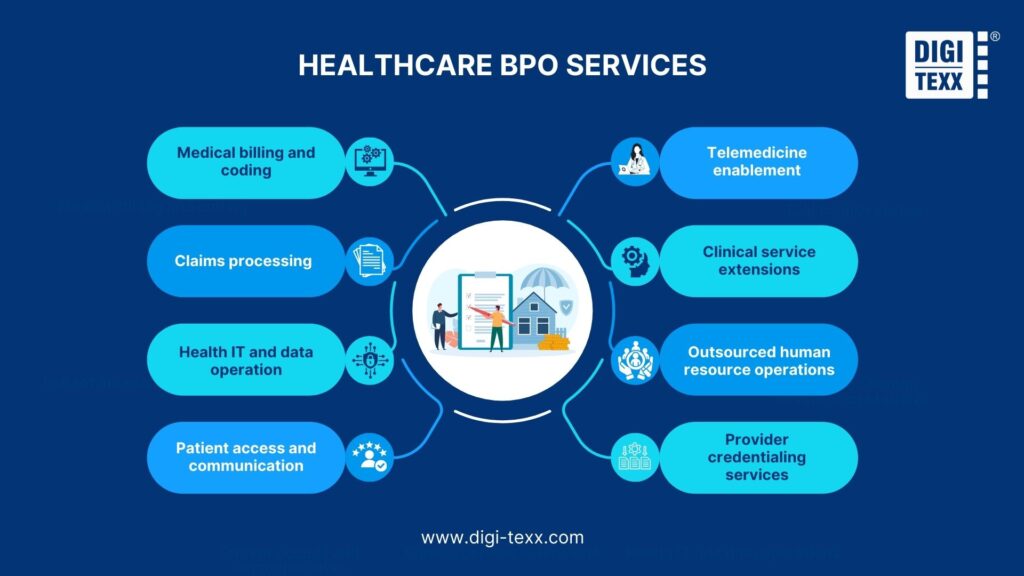
Healthcare BPO services involve hospitals, clinics, or health insurance companies outsourcing operational support to third-party providers. In this ecosystem, healthcare BPO companies play a key role in ensuring accuracy, consistency, and regulatory compliance. Common tasks outsourced through healthcare BPO services include:
- Medical billing and coding: Converting clinical documentation into standardized codes to support accurate billing and reimbursement.
- Claims processing: Managing insurance claims, verifications, follow-ups, and payment reconciliation.
- Patient access and communication: Supporting appointment scheduling, registration, call handling, and patient inquiries.
- Health IT and data operations: Handling data entry, system support, data management, and interoperability-related tasks.
- Telemedicine enablement: Providing operational and technical support for virtual care services and remote consultations.
- Clinical service extensions: Supporting clinical-adjacent activities such as documentation assistance and care coordination.
- Outsourced human resource operations: Managing payroll, recruitment support, staff records, and compliance tracking.
- Provider credentialing services: Verifying and maintaining healthcare provider credentials to meet regulatory and payer requirements.
The primary goal of Healthcare BPO is to create a streamlined operational system. When paperwork and administrative procedures are handled by BPO specialists, doctors and healthcare workers can focus entirely on diagnosis and treatment – the core values of the medical profession.
Examples Of Outsourcing In Healthcare
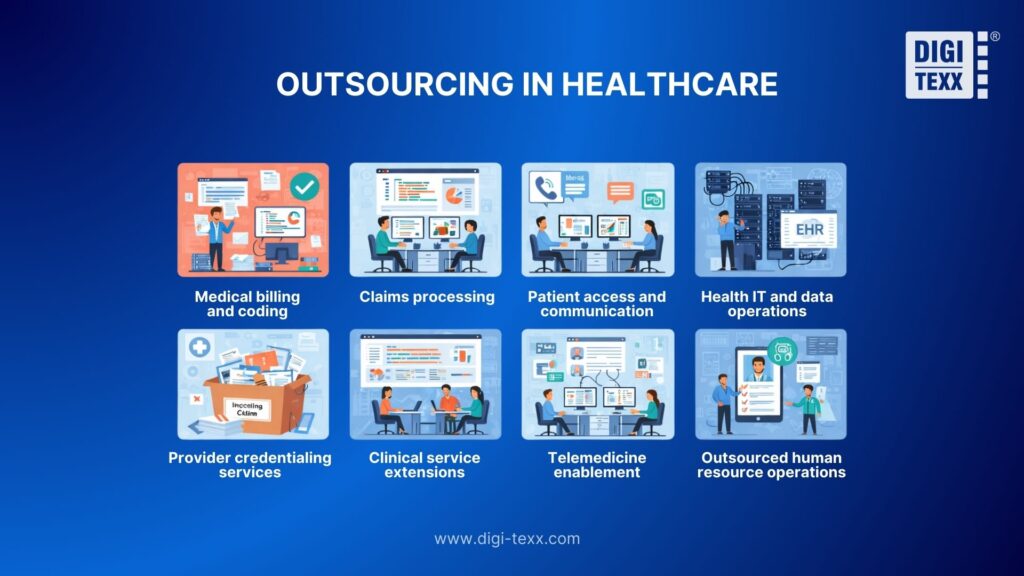
Healthcare organizations outsource a wide range of non-clinical and operational functions to improve efficiency, ensure compliance, and reduce administrative burden.
Medical Billing And Coding
A clinic handles hundreds of patient visits each day and works with multiple insurance providers. When billing information is coded incorrectly or documentation is incomplete, reimbursement is delayed or denied. To avoid revenue loss and reduce paperwork for medical staff, the clinic outsources medical billing and coding to ensure claims are submitted accurately and on time.
Claims Processing
A hospital receives thousands of insurance claims every month. To avoid delays and backlogs that overwhelm internal staff, it outsources claims processing to a specialized BPO team.
Patient Access And Communication
A healthcare network struggles with missed calls during peak hours. By outsourcing appointment scheduling and patient communication, response times improve significantly.
Health IT And Data Operations
A medical practice managing multiple departments outsources data entry and system support to keep electronic health records accurate and consistent.
Telemedicine Enablement
A clinic launches virtual consultations but lacks internal technical resources. It outsources telemedicine operations to support remote visits smoothly.
Clinical Service Extensions
Physicians spend excessive time completing clinical documentation. By outsourcing documentation support, they can focus more on patient care.
Outsourced Human Resource Operations
A hospital with a large workforce outsources payroll and HR administration to manage shift schedules and compliance more efficiently.
Provider Credentialing Services
A hospital hires new physicians but must complete extensive verification and insurance enrollment before they can treat insured patients. Delays in credentialing prevent doctors from seeing patients and impact revenue. By outsourcing provider credentialing services, the hospital speeds up onboarding while ensuring regulatory and payer compliance.
>>> See more:
- Best Insurance Claims Processing Outsourcing BPO in the US 2026
- Top 12 Data Entry Outsourcing Companies In United States
- Outsource Data Annotation Services to Scale Your AI Faster
Outsourceable Healthcare Processes
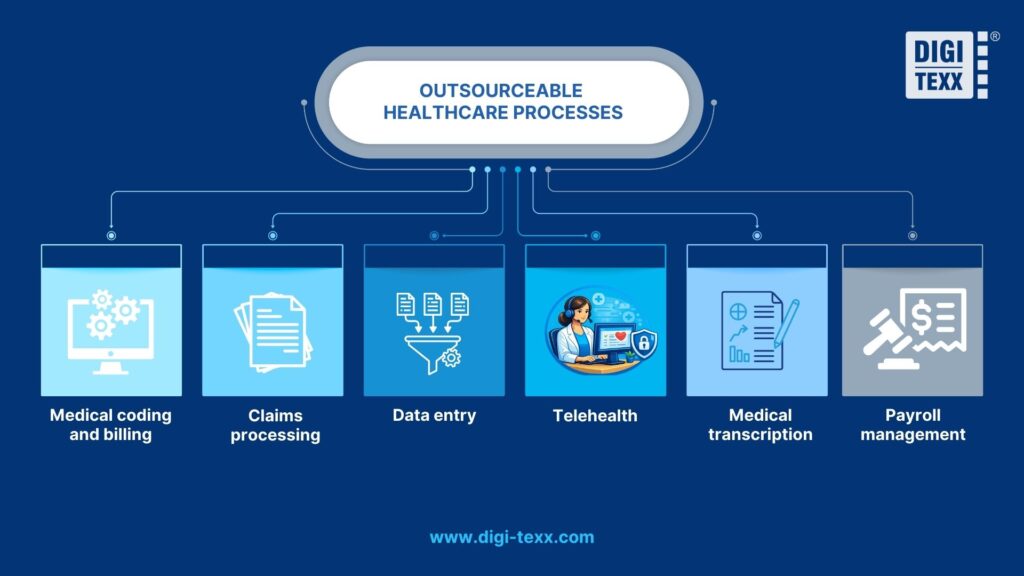
Healthcare BPO services typically support healthcare organizations through a series of operational processes. These processes can be outsourced individually or combined to streamline workflows, improve accuracy, and reduce administrative burden.
Medical Coding And Billing
Medical coding and billing begins after a patient visit, when clinical documentation is reviewed and converted into standardized medical codes for billing. The coded information is then compiled into a claim and submitted to insurers or payers to ensure accurate and timely reimbursement.
Claims Processing
Claims processing starts when billing information is submitted to insurance providers and continues with claim tracking, follow-ups, and payment reconciliation. This process ensures claims are approved correctly and payments are received without delays.
Data Entry
Data entry involves inputting patient information, clinical records, and administrative data into healthcare systems. Accurate data entry ensures medical records are complete, consistent, and ready for downstream processes.
Telehealth
Telehealth processes support virtual care by handling patient intake, appointment coordination, and technical assistance for remote visits. This enables healthcare providers to deliver care remotely without disrupting daily operations.
Medical Transcription
Medical transcription converts doctors’ audio recordings and clinical notes into structured text for patient records. This process ensures documentation is clear, standardized, and easily accessible.
Payroll Management
Payroll management handles salary calculation, benefits administration, and compliance for healthcare staff. Outsourcing this process helps ensure accurate payments and adherence to labor regulations.
Key Benefits Of Healthcare BPO Services
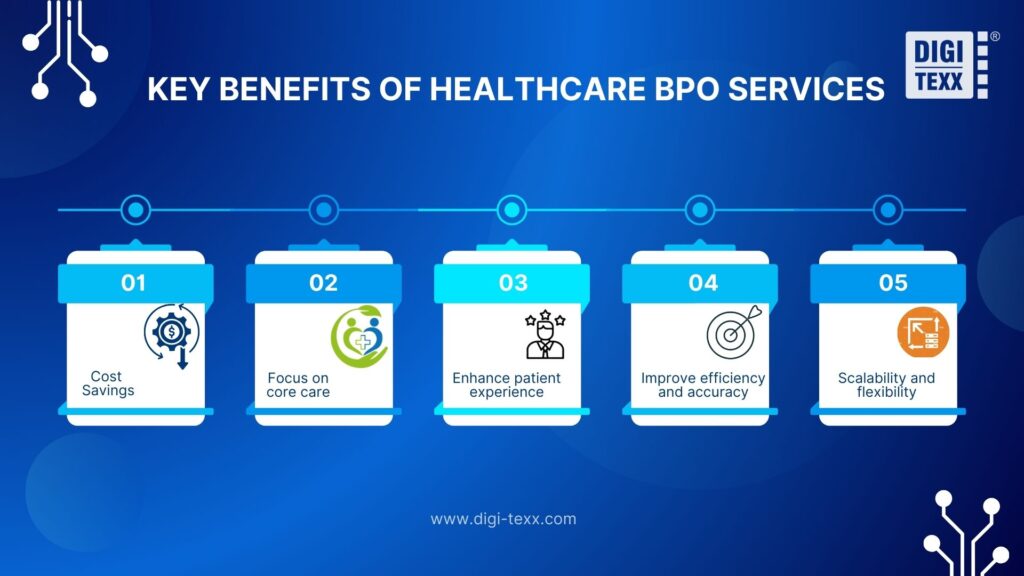
Healthcare BPO services offer numerous strategic benefits to healthcare organizations by addressing cost, operational efficiency, and service quality challenges within a strictly compliant environment.
- Cost-savings: Healthcare BPO helps organizations reduce operating costs by outsourcing administrative and back-office tasks, minimizing expenses related to staffing, training, and infrastructure.
- Focus on core care: By transferring non-clinical workloads to BPO providers, medical staff can dedicate more time and attention to diagnosis, treatment, and direct patient care.
- Enhance patient experience: Outsourced support services enhance patient communication, appointment handling, and response times, leading to a more consistent and satisfactory patient journey.
- Improve efficiency and accuracy: Standardized workflows, automation, and specialized teams reduce manual errors and improve the speed and reliability of billing, claims, and data-related processes.
- Scalability and flexibility: Healthcare BPO services allow organizations to scale operations up or down based on patient volume, seasonal demand, or business growth without disrupting internal systems.
>>> See more:
- Data Management Outsourcing: Why Businesses Are Turning to External Experts in 2025
- Top 10 Data Cleansing Companies for Businesses in 2025
- Best Real Estate Image Processing Services 2026: Top 15 Providers
Challenges In Healthcare BPO And Solutions
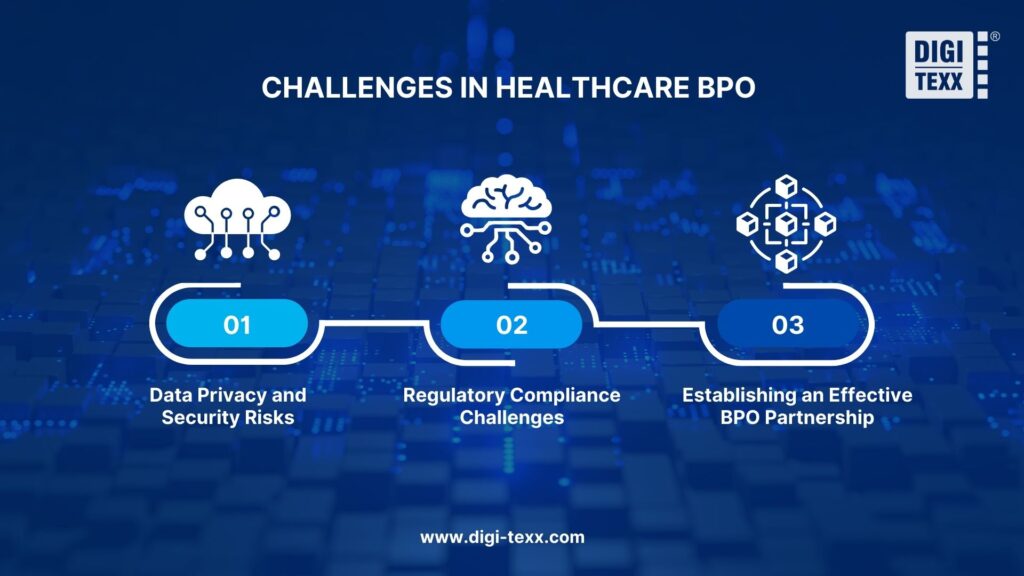
Implementing healthcare BPO offers numerous benefits, but also comes with challenges specific to the healthcare industry from data security to legal compliance and effective collaboration with BPO partners. Identifying these challenges and preparing appropriate solutions is key to achieving long-term benefits from outsourcing.
Data Privacy And Security Risks
In healthcare BPO, data privacy and security are critical because patient information is highly sensitive. Outsourcing increases the number of systems and parties involved in data handling, which can create exposure if security controls are not properly managed. To mitigate these risks, healthcare organizations should work with BPO providers that implement strong data protection frameworks, secure access controls, and clearly defined data governance practices across all workflows.
Regulatory Compliance Challenges
Healthcare operations are subject to strict regulations related to billing, insurance, and patient data protection. When outsourcing, ensuring that external workflows remain compliant with applicable regulations can be challenging, particularly across different regions or healthcare systems. Selecting BPO partners with proven healthcare compliance experience and embedding regulatory requirements into operational processes and oversight mechanisms is essential to minimizing compliance risks.
Establishing An Effective BPO Partnership
Building a successful healthcare BPO partnership requires more than delegating tasks, it depends on alignment between internal teams and the external provider. Differences in workflows, systems, or expectations can limit effectiveness if not addressed early. Clear role definition, transparent communication, and regular performance reviews help ensure both parties remain aligned and can adapt as operational needs evolve.
How To Choose The Right Healthcare BPO Partner?
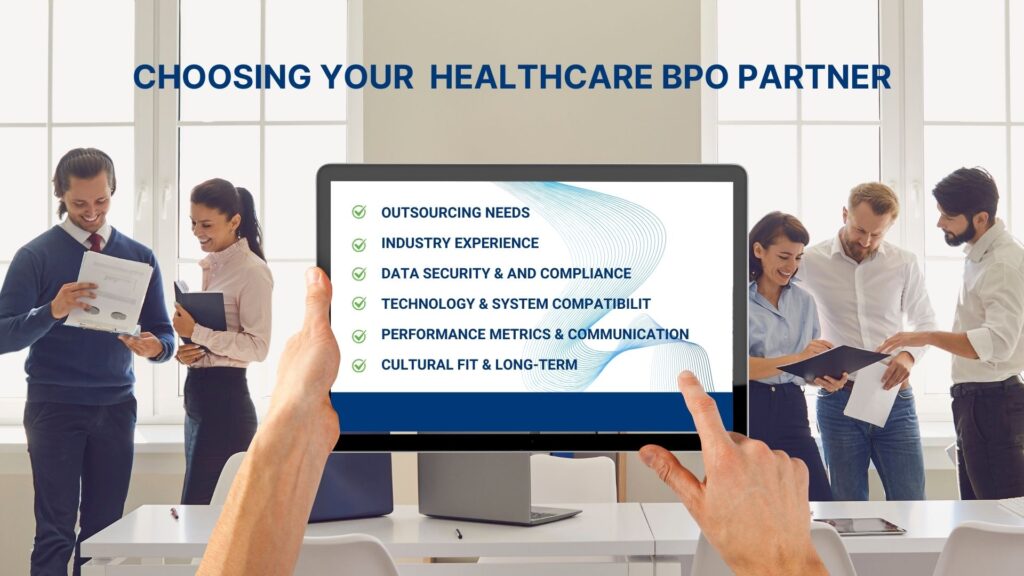
Choosing the right partner will determine 80% of the success of your outsourcing strategy. Businesses should consider the following criteria:
- Understand your outsourcing needs: Clearly define which healthcare processes you want to outsource and the results you expect, so you can select a BPO partner with the right specialization rather than a generic provider.
- Evaluate healthcare industry experience: Healthcare is highly regulated, so partners must understand medical workflows and industry requirements. Not all healthcare BPO companies offer the same level of healthcare-specific expertise, making proven experience a critical evaluation factor.
- Review data security and compliance practices: Patient data is sensitive, making strong security controls and regulatory compliance a must. Assess how potential partners protect data and meet healthcare regulations.
- Assess technology and system compatibility: Your BPO partner should integrate smoothly with existing systems such as EHR, billing, or patient management platforms to avoid operational disruptions.
- Define performance metrics and communication standards: Clear SLAs, measurable KPIs, and regular reporting ensure transparency, accountability, and proactive issue resolution.
- Consider cultural fit and long-term partnership: Strong communication and cultural alignment help build a sustainable, long-term BPO relationship beyond technical capabilities.
- Quick checklist before selection: Review industry expertise, compliance standards, technology readiness, performance metrics, and communication approach before making a final decision.
When evaluating the best healthcare BPO services, organizations should prioritize healthcare expertise, data security, system compatibility, and long-term partnership capability rather than focusing on cost alone.
>>> See more:
- Outsourced AI Training Data: Benefits, Providers & How To Choose In 2026
- Construction Invoice Reconciliation: Process, Best Practices & Software 2026
- Back Office Service: Definition, Examples, Benefits & Outsourcing 2026
Why Choose DIGI-TEXX For Healthcare BPO Services?
In the era of healthcare digitalization, DIGI-TEXX is proud to be a strategic partner providing professional Healthcare BPO solutions. We understand that in the medical industry, accuracy is not just a job requirement but also a responsibility to human health.
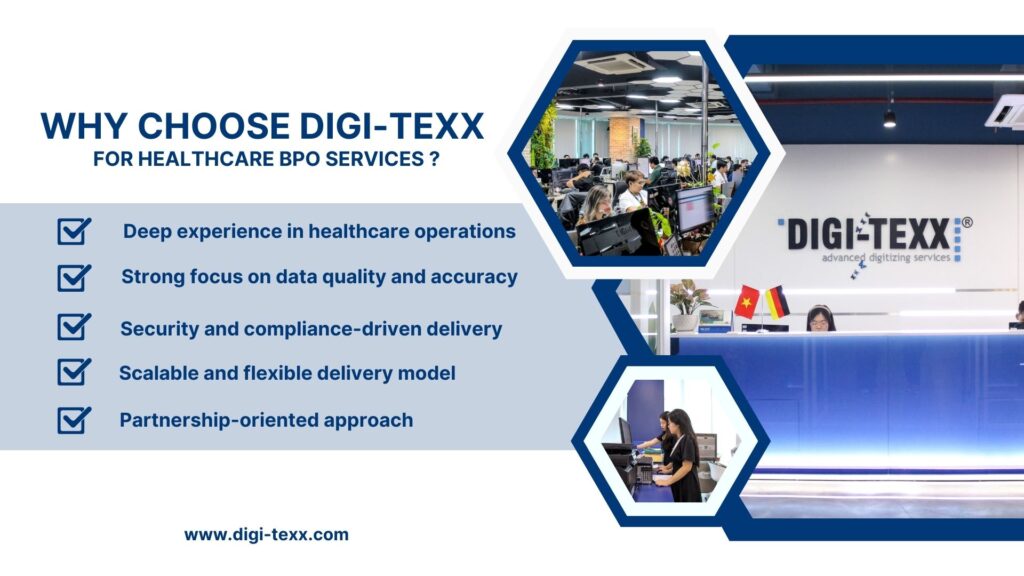
- Deep experience in healthcare operations: DIGI-TEXX brings hands-on experience in healthcare workflows such as billing support, claims processing, data entry, and clinical documentation, ensuring outsourced tasks align with real operational needs.
- Strong focus on data quality and accuracy: Standardized workflows, multi-layer quality checks, and continuous monitoring help minimize errors and improve the reliability of healthcare data and administrative outputs.
- Security and compliance-driven delivery: DIGI-TEXX implements rigorous data security and governance measures to ensure absolute commitment to confidentiality and compliance with international standards, allowing our partners to focus on their mission of caring for public health.
- Scalable and flexible delivery model: From small clinics to large healthcare networks, DIGI-TEXX offers flexible capacity that scales with workload and patient volume without disrupting internal teams.
- Partnership-oriented approach: DIGI-TEXX works as an extension of internal operations teams, supported by clear SLAs, transparent reporting, and consistent communication to drive long-term value.
>>> See more:
- Top 12 Data Entry Outsourcing Companies In United States
- What are the 6 Steps of the Data Analysis Process?
- Prepare A Classified Balance Sheet: Steps, Format & Example 2026
FAQs About Healthcare BPO Services
What Does BPO Stand For In Medical?
In healthcare, BPO stands for Business Process Outsourcing, which refers to outsourcing non-clinical and administrative processes such as billing, coding, claims handling, or data management to specialized external providers.
How Does BPO Help To Manage Healthcare Processes?
Healthcare BPO helps organizations manage operations by handling time-consuming administrative tasks, allowing internal teams to focus on patient care. At the same time, it improves efficiency, reduces costs, and supports compliance through standardized workflows and specialized expertise.
DIGI-TEXX provides practical insights into healthcare BPO services, helping healthcare organizations understand how outsourcing non-clinical processes such as medical coding and billing, claims processing, and HR operations,… can reduce administrative burden, control operational costs, and maintain compliance in an increasingly complex regulatory environment.
However, even after outsourcing non-clinical operations, many healthcare organizations still struggle with data accuracy, patient information security, regulatory compliance, and effective coordination between internal teams and outsourcing partners.
With strong expertise in document and data processing, DIGI-TEXX supports healthcare organizations in streamlining administrative workflows, maintaining data quality, and meeting strict compliance requirements. As a long-term healthcare BPO partner, DIGI-TEXX helps providers improve operational efficiency while keeping patient care at the center of their operations.
DIGI-TEXX Contact Information:
🌐 Website: https://digi-texx.com/
📞 Hotline: +84 28 3715 5325
✉️ Email: [email protected]
🏢 Address:
- Headquarters: Anna Building, QTSC, Trung My Tay Ward
- Office 1: German House, 33 Le Duan, Saigon Ward
- Office 2: DIGI-TEXX Building, 477-479 An Duong Vuong, Binh Phu Ward
- Office 3: Innovation Solution Center, ISC Hau Giang, 198 19 Thang 8 street, Vi Tan Ward
References:
- Harvard T.H. Chan School of Public Health
Offers insights into healthcare administration, cost management, and operational strategies https://www.hsph.harvard.edu - Kaiser Family Foundation (KFF)
Provides data on healthcare costs, staffing, and administrative trends across the U.S https://www.kff.org