


Product images play a critical role in how furniture products are discovered, evaluated, and purchased on marketplaces like Amazon and eBay. Beyond attracting clicks, they influence search visibility, customer trust, conversion rates, and marketplace compliance. Because shoppers cannot physically inspect furniture online, every image must accurately communicate the product’s size, materials, craftsmanship, and overall quality.
As furniture catalogs grow across multiple marketplaces and thousands of SKUs, image optimization becomes an operational challenge. This guide explores the image processing techniques, marketplace requirements, and best practices that help furniture brands build consistent, compliant, and scalable product image workflows to improve both listing performance and ecommerce operations.
Why Furniture Is One Of The Hardest Products To Sell Through Images
Furniture is difficult to sell through images because buyers cannot physically assess materials, test comfort, or accurately judge scale and fit. Product photos must compensate for these limitations by communicating texture, dimensions, color, construction quality, and real-world context. These factors directly influence customer confidence and purchase decisions.
Sensory Limitations
Furniture is a highly tactile product category, yet ecommerce removes much of the physical experience customers rely on when evaluating a purchase.
- Materials cannot be touched: Buyers cannot feel fabric softness, leather texture, wood grain, or surface finishes.
- Comfort cannot be tested: Images alone cannot communicate cushion firmness, seat depth, or ergonomic support.
- Build quality is harder to assess: Construction details, joinery, stitching, and material quality may be difficult to evaluate without detailed close-up images.
For furniture brands, this makes high-resolution detail shots and accurate material representation essential for reducing uncertainty.
Scale And Fit Are Difficult To Visualize
Furniture dimensions may be listed on the product page, but numbers alone do not always help customers understand how a product will fit into a real space.
- Scale can be misleading when furniture is photographed without surrounding objects or room context.
- Room fit is difficult to estimate, particularly for large products such as sofas, dining tables, and wardrobes.
- Access dimensions matter: Customers may also need to consider whether furniture can pass through doors, hallways, elevators, or staircases.
Lifestyle images, multiple angles, and clear dimensional graphics can help bridge this gap between technical specifications and real-world use.
Color And Material Accuracy Is Difficult to Maintain
Furniture purchase decisions often depend on subtle differences in fabric, wood, leather, and surface finishes. However, lighting conditions, photography settings, image processing, and display screens can all influence how these characteristics appear online.
Inaccurate representation can create a gap between what customers see online and what they receive, increasing dissatisfaction and potentially contributing to returns. For large furniture items, this is particularly important because reverse logistics can involve significant transportation, handling, and operational costs.
The Challenge Grows With Catalog Size
For large furniture brands, these visual challenges multiply across hundreds or thousands of SKUs, product variants, and marketplaces. A sofa available in several fabrics, colors, and configurations may require dozens of consistent assets across Amazon, eBay, Shopify, and other channels.
This is why furniture image optimization becomes more than a photography task at scale. Standardized image processing, quality assurance, and catalog-wide visual guidelines are needed to maintain accurate and consistent product representation as the catalog grows.
What Makes A High-Performing Furniture Photo?
A high-performing furniture photo accurately represents the product, meets marketplace requirements, and helps customers make confident purchasing decisions. It should also be easy to scale across large ecommerce catalogs.
Key Characteristics of High-Performing Furniture Images:
| Characteristic | Benefits |
| Accurate color representation | Shows wood, fabric, and leather finishes as realistically as possible, reducing expectation gaps. |
| High resolution | Allows shoppers to zoom in and inspect textures, materials, stitching, and construction details. |
| Natural shadows and correct perspective | Creates realistic depth while preserving the product’s proportions and shape. |
| Multiple angles and close-ups | Helps customers evaluate design, construction, materials, and functional details. |
| Consistent backgrounds and cropping | Creates a cohesive catalog and strengthens brand consistency across SKUs. |
| Lifestyle and contextual images | Helps shoppers understand product scale, usage, and how furniture may fit into a real space. |
Amazon vs. eBay Furniture Image Requirements
Amazon and eBay have different product image requirements that furniture sellers need to account for. Amazon applies stricter rules to main product images, while eBay provides more flexibility in backgrounds and image presentation. Understanding these differences helps brands avoid compliance issues while preparing assets efficiently for both marketplaces.
Amazon vs eBay image requirements:
| Requirement | Amazon | eBay |
| Minimum image size | 1,000 px on the longest side for zoom | 500 × 500 px |
| Recommended resolution | 1,600-2,000+ px | 1,600 × 1,600 px |
| Main image background | Pure white (RGB 255,255,255) | White or neutral background recommended |
| Product coverage | Product should fill at least 85% of the image | No fixed 85% requirement |
| Maximum images | Typically 7-9 images, depending on listing/category | Up to 24 images |
| Lifestyle images | Use as secondary images | More flexible across image slots |
| Text and graphics | Not allowed on the main image | Promotional text and overlays should be avoided |
| Watermarks | Not allowed on the main image | Not allowed |
| Compliance | Non-compliant images may contribute to listing suppression | Image policy violations may affect listing visibility |
What This Means For Furniture Sellers
The biggest difference is flexibility. Amazon’s main image is designed for standardized search and product presentation, while eBay gives sellers more freedom to provide additional visual context.
For furniture listings, this means brands should:
- Prepare a clean, white-background hero image that meets Amazon’s stricter requirements.
- Use secondary images for dimensions, material close-ups, different angles, and room settings.
- Take advantage of eBay’s additional image capacity to provide more product context where useful.
- Maintain a high-resolution master asset that can be adapted to each marketplace rather than producing entirely separate image sets.
Furniture Image Processing Techniques That Improve Listings
The most important furniture image processing techniques include background removal, color correction, shadow creation, glare control, retouching, perspective correction, batch editing, and fabric swatch processing. Together, they help create accurate, consistent, and marketplace-ready product images while making image production easier to scale across large catalogs.
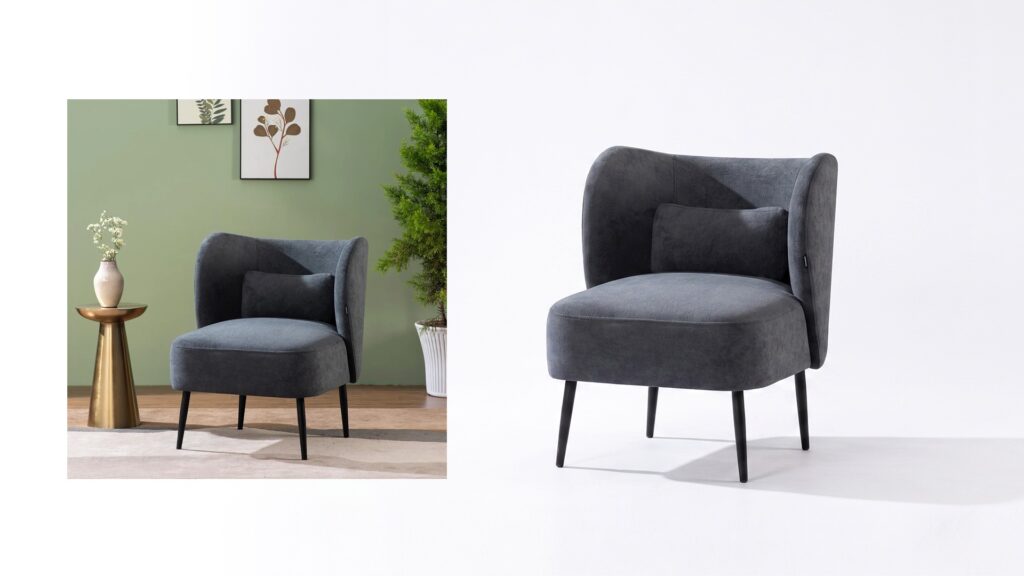
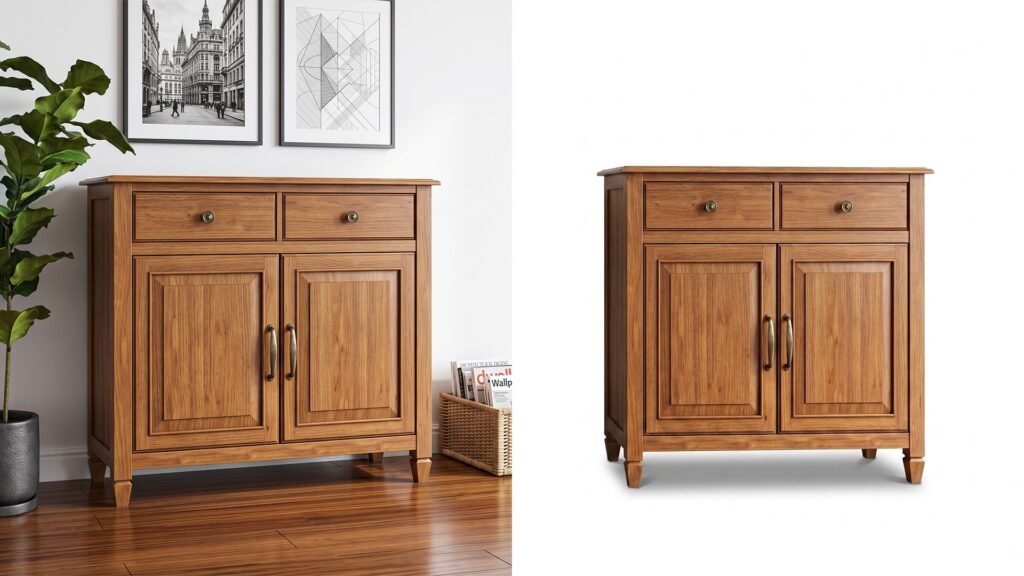
Background Removal And Clipping Paths
Background removal creates clean, distraction-free furniture images, while clipping paths preserve precise product edges, especially for complex shapes such as chair legs, open shelving, and curved sofas.
- Remove distracting or non-compliant backgrounds.
- Preserve fine edges and product details.
- Standardize backgrounds across product listings.
Color Correction For Wood, Fabric, And Leather
Color correction helps furniture images represent materials and finishes as accurately and consistently as possible.
- Correct color shifts caused by lighting or camera settings.
- Maintain consistent wood, fabric, and leather tones.
- Help customers compare colors and product variants more confidently.
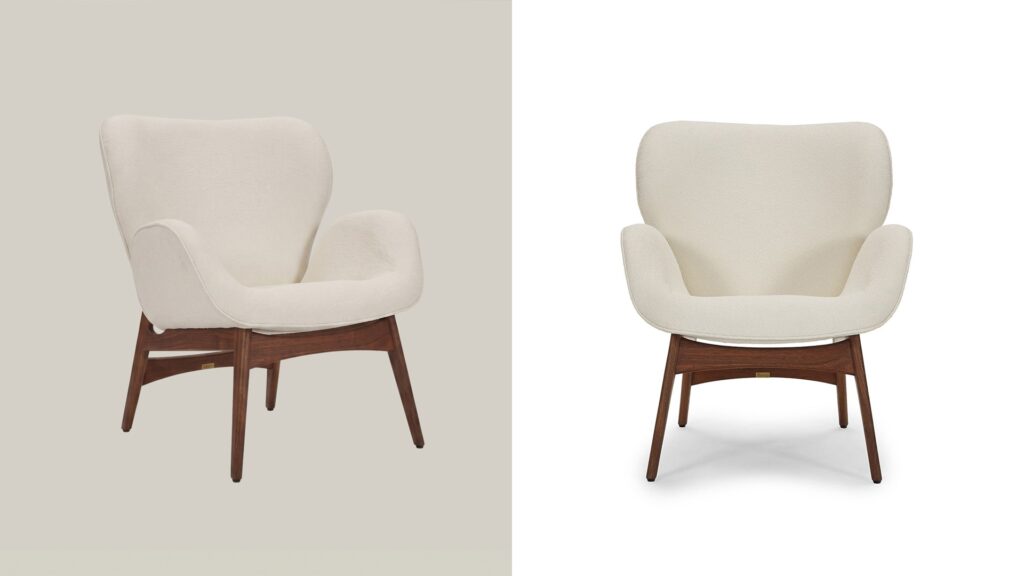
Shadow Creation For Realistic Depth
Natural shadows restore depth after furniture has been isolated from its original background, preventing products from appearing flat or floating.
- Add realistic contact or drop shadows.
- Maintain consistent shadow direction and intensity.
- Create a more cohesive appearance across the catalog.
Reflection And Glare Control
Reflection and glare control make reflective surfaces easier to evaluate without removing their natural characteristics.
- Reduce distracting highlights on glass and polished surfaces.
- Reveal details that may otherwise be obscured.
- Preserve the realistic appearance of metal, glass, and glossy finishes.
Retouching And Perspective Correction
Photo retouching removes photography-related distractions and temporary imperfections, while perspective correction ensures furniture is presented with accurate proportions.
- Remove dust, fingerprints, and temporary imperfections.
- Correct distorted vertical and horizontal lines.
- Preserve the product’s actual shape and construction details.
Fabric Swatch
Digital fabric swatches help customers compare upholstery colors, textures, and materials when furniture is available in multiple variants.
- Convert photographed or scanned fabric samples into digital swatches.
- Correct color, crop, and size for consistent presentation.
- Match each swatch with the corresponding furniture variant.
Batch Editing For Catalog Consistency
For furniture brands managing hundreds or thousands of SKUs, editing images individually can be time-consuming and difficult to scale. Batch editing applies consistent image standards across large volumes of product assets, helping teams maintain catalog quality while improving production efficiency.
- Standardize cropping, backgrounds, shadows, and image dimensions.
- Maintain consistent visual specifications across product lines.
- Reduce repetitive work during product launches and seasonal updates.

Common Furniture Image Mistakes That Hurt Visibility And Sales
Furniture images can hurt listing performance when they fail to represent products accurately, provide enough purchase information, or meet marketplace requirements. At scale, these mistakes can also increase returns, rework, and catalog management costs.
Common Mistakes To Avoid
- Non-compliant main images: Incorrect backgrounds, text overlays, or additional objects can create marketplace compliance issues.
- Inaccurate colors: Poor color correction can make wood, fabric, and leather appear different from the actual product.
- Low-resolution images: Customers cannot zoom in to evaluate materials, finishes, and construction details.
- Insufficient visual context: Missing dimensions, angles, or lifestyle images make it harder to understand scale and functionality.
- Inconsistent editing: Different backgrounds, shadows, cropping, and color treatments create a fragmented catalog.
- Over-retouching: Excessive editing can misrepresent textures or finishes and create unrealistic customer expectations.

For large furniture catalogs, the bigger challenge is preventing these problems from recurring. Clear image standards and quality assurance (QA) checkpoints help identify errors before assets are published across multiple channels.
How To Keep A Large Furniture Catalog Consistent
Catalog consistency requires standardized image guidelines, centralized asset management, and repeatable quality control. These processes become increasingly important as furniture brands manage thousands of SKUs, product variants, and sales channels.
Establish Clear Image Standards
Create an image style guide defining:
- Background and cropping requirements
- Image dimensions and resolution
- Color correction standards
- Shadow treatment
- Product angles and detail shots
- File naming and versioning rules
The same standards should apply whether images are processed internally, by freelancers, or by external partners.
Create A Single Source Of Truth
Rather than storing different versions across teams and marketplaces, maintain approved master assets within a Digital Asset Management (DAM) system.
Marketplace-specific versions can then be generated from these master images for Amazon, eBay, Shopify, and other channels. When an asset is updated, teams can more easily identify and replace outdated versions.
Build Quality Assurance Into The Workflow
Quality control should happen before publishing, not after a listing problem occurs. QA checks can verify color accuracy, cropping, resolution, marketplace compliance, and consistency with the brand’s image standards.
For high-volume catalogs, standardized QA reduces repeated corrections and helps maintain consistent output as image production scales.
When Should You Outsource Furniture Image Editing?
Outsourcing becomes practical when image volume, catalog complexity, or turnaround requirements exceed internal production capacity. However, the right model depends on the company’s catalog size, available expertise, and frequency of image production.
DIY Vs. Freelancer Vs. Outsourced Partner
| Factor | In-house / DIY | Freelancer | Image Processing Partner |
| Best suited for | Small, stable catalogs | Projects or seasonal peaks | Large, growing catalogs |
| Scalability | Limited | Moderate | High |
| Quality consistency | Depends on internal team | Varies | Standardized workflow |
| Turnaround | Capacity-dependent | Availability-dependent | More predictable at volume |
| Quality control | Managed internally | Requires oversight | Dedicated QA can be built in |
There is no universal best option. In-house teams may provide greater creative control for smaller catalogs, while freelancers can provide flexibility during temporary demand. A professional image processing partner becomes more relevant when businesses need repeatable, high-volume production across multiple product lines or marketplaces.
Signs Your In-House Workflow Is No Longer Scalable
Consider reviewing the current workflow when:
- Image backlogs regularly delay product launches.
- Quality varies significantly across SKUs.
- Editors spend excessive time on repetitive corrections.
- Marketplace compliance issues occur repeatedly.
- Adding new channels creates duplicate image work.
- Seasonal volume exceeds internal production capacity.
These issues suggest that image processing is becoming an operational bottleneck rather than simply an editing workload.
What To Look For In An Image Processing Partner
Enterprise retailers should evaluate more than editing skills. A reliable image processing partner should combine consistent image quality with the capacity to support growing catalog volumes.
Key capabilities to consider include:
- High-volume image processing capacity
- Furniture-specific image expertise
- Marketplace requirement knowledge
- Defined quality assurance processes
- Reliable turnaround times
- Ability to follow detailed brand guidelines
- Flexibility to handle changing image volumes
For businesses that need additional production capacity, DIGI-TEXX provides professional image processing services, including clipping paths, background removal, photo retouching, color correction, and shadow and reflection processing. These services can support high-volume ecommerce catalogs while maintaining consistent image standards.
The right outsourcing model should ultimately help businesses scale image production without compromising quality, consistency, or turnaround times.
Frequently Asked Questions
What Image Size Is Best For Furniture Listings?
For furniture listings, high-resolution images are recommended because shoppers often use zoom to inspect materials, textures, finishes, and construction details.
For Amazon, images should be at least 1,000 pixels on the longest side to support zoom, while eBay recommends images around 1,600 pixels for high-quality viewing.
For multi-marketplace catalogs, it is more efficient to maintain a high-resolution master image and create platform-specific versions rather than repeatedly resizing the same asset.
How Many Photos Should A Furniture Listing Include?
There is no single ideal number for every furniture product. The image set should provide enough information for customers to understand the product without seeing it in person.
For furniture, this typically includes a main product image, multiple angles, close-up material details, dimensions, and lifestyle images. Amazon recommends at least six images plus a product video, while eBay allows up to 24 images per listing.
Can I Use The Same Furniture Photos For Amazon And eBay?
Yes, the same master images can be used, but they may need to be adapted to each marketplace’s requirements. Amazon, for example, has stricter requirements for its main image, including a pure white background and product frame coverage.
For large catalogs, creating marketplace-specific derivatives from approved master assets helps reduce duplicate work while maintaining consistency across channels.
What Are The Best Backgrounds For Furniture Product Photos?
A pure white background (RGB 255,255,255) is required for Amazon’s main product image, while eBay provides more flexibility.
For secondary images, lifestyle settings can provide valuable context by showing scale, functionality, and how furniture fits into a real environment. The key is to balance marketplace compliance with the visual information customers need to make a confident purchase.
Explore related articles:
- Best Product Photo Editing Services For eCommerce: Top Providers Compared
- Top 7 Ecommerce Product Photo Retouching Services Compared
- What Is A Clipping Path? Learn To Use Professional Image Isolation
- Architectural Photo Editing Service in the US | Top 5 Providers
Reference:
- Amazon. (2025a). Amazon.Com. https://sellercentral.amazon.com/help/hub/reference/external/G1881?initialSessionID=134-5196169-0399754&ld=SDUSSOADirect
- Amazon. (2025b). Amazon.Com. https://sellercentral.amazon.com/help/hub/reference/external/G9FUUH87RBNXGKB7
- IMG101. (2026, January 15). eBay Image Size Guide & Photo Resizer (1600×1600) – IMG101. IMG101. https://www.img101.com/tools/ebay-image-size/
- Nightjar. (2026, February 28). eBay product photography: Listing requirements and how to win the buy box. Nightjar. https://nightjar.so/blog/ebay-product-photography-listing-requirements
- Picture policy. (2025a). In eBay. https://www.ebay.com/help/policies/listing-policies/picture-policy?id=4370
- (2026, May 3). Product page design that converts: What actually sells in 2026. LOGOS Technologies. https://logoswebdesigns.com/blog/product-page-design-that-converts-2026/
- Take great photos | seller center. (2022). In Ebay.com. https://www.ebay.com/sellercenter/listings/photo-tips