
Delivering great customer experience is no longer about offering multiple support channels; it’s about ensuring customers can move between them without losing context.
According to Zendesk’s CX Trends Report, 60% of consumers say they have to repeat themselves when agents don’t have the context of previous interactions. This often happens when conversations transition between non-voice and voice channels, forcing customers to restart their journey instead of continuing it.
This highlights an important reality: the decision between voice and non-voice customer service should be driven by customer experience as much as operational efficiency.
Voice support is better suited for complex, high-priority interactions that require real-time communication, while non-voice channels excel at handling routine inquiries efficiently and at scale. The greatest value comes from integrating both into a seamless support strategy rather than treating them as separate channels.
In this guide, we’ll compare voice and non-voice customer service, explore how each impacts customer experience and business performance, and help you determine the right channel strategy for your organization.
Where Customer Service Fits Into The Customer Experience Journey
Customer experience extends beyond a single support interaction. It encompasses every touchpoint a customer has with a business, from discovering a brand and evaluating products to making a purchase, receiving ongoing support, and becoming a loyal advocate.
While marketing and advertising primarily drive the Awareness stage, customer support also contributes by answering initial inquiries and providing helpful information through channels such as websites, FAQs, and social media.
As customers progress into the Consideration stage, customer support becomes more involved, helping them compare solutions, address concerns, and make informed purchasing decisions.
From there, support continues to play a critical role throughout the Purchase, Retention, and Advocacy stages, ensuring a seamless customer experience and building long-term loyalty
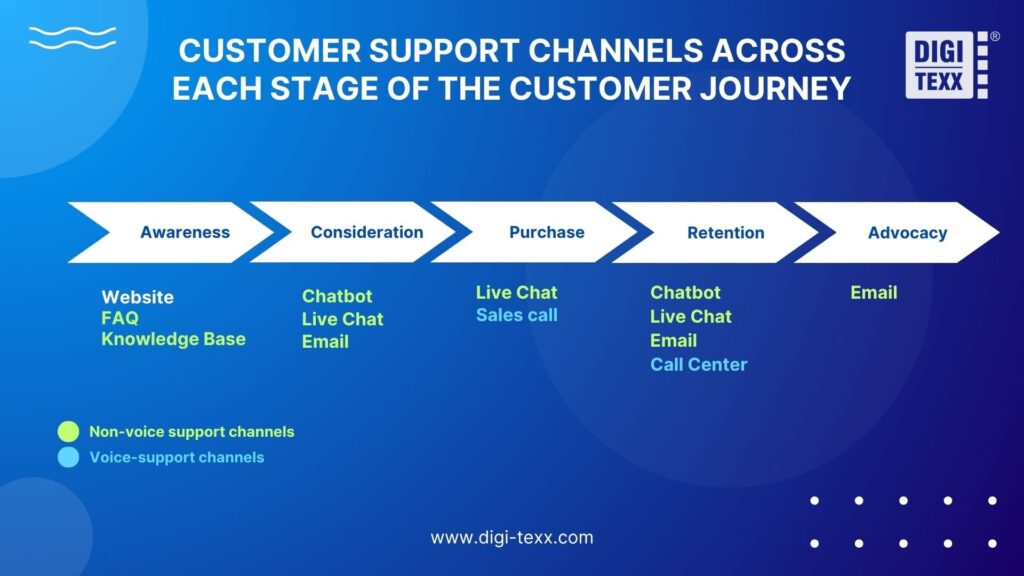
As shown above, customer service supports multiple stages of the customer journey, from Awareness and Consideration to Purchase, Retention, and Advocacy. At each stage, customers have different goals and expectations, requiring different support channels.
- During the Awareness stage, customers seek general information about a company, its products, or services. Businesses use channels such as social media, websites, blogs, FAQs, and knowledge base to answer common questions, build credibility, and create a positive first impression.
- During the Purchase stage, customers may need quick answers about products, pricing, or orders. Live chat, messaging apps, and sales calls help remove purchase barriers and improve conversion.
- During Retention, support becomes more problem-focused. Customers may contact a business to resolve technical issues, request account assistance, or submit complaints. This is where both voice and non-voice channels work together to deliver timely and effective resolutions.
- During Advocacy, proactive follow-ups, community engagement, and responsive support reinforce customer trust and encourage repeat purchases and referrals.
Because customer needs vary throughout the journey, no single support channel is suitable for every interaction. Instead of competing approaches, voice and non-voice customer service work together to deliver a seamless customer experience. Before comparing their impact on customer experience and business performance, let’s first look at the communication channels that make up each approach.
Common Voice and Non-Voice Customer Service Channels:
| Category | Voice Customer Service | Non-Voice Customer Service |
| Definition | Customer support delivered through real-time spoken communication between customers and service representatives. | Customer support delivered through digital communication channels without a live phone conversation. |
| Communication Type | Real-time spoken communication | Synchronous (real-time) and asynchronous (delayed) digital communication |
| Common Channels | ▪️Phone support ▪️Inbound call centers ▪️Outbound customer calls ▪️Interactive Voice Response (IVR) ▪️Video support | Synchronous: ▪️Live chat ▪️Facebook Messenger ▪️SMS Asynchronous: ▪️Support tickets ▪️Social media messaging ▪️AI chatbots ▪️Self-service knowledge bases |
>>> See more: What Is Non-Voice Customer Service? A Complete Guide
Voice vs. Non-Voice Customer Service: Operational Comparison
Selecting between voice and non-voice customer service is both a customer experience decision and an operational one. Each model influences staffing requirements, service-level performance, scalability, and long-term operating costs in different ways.
The following comparison highlights the key operational differences:
| Criteria | Voice Customer Service | Non-Voice Customer Service |
| Communication Channels | Phone, IVR, contact center, video calls | Email, live chat, messaging apps, support tickets, chatbots |
| SLAs & Response Times | Immediate response expected | Response varies by channel and priority |
| Resolution Speed | Faster for complex interactions | Faster for simple requests but may require multiple exchanges for complex cases |
| Operating Cost | Higher due to one-to-one interactions | Lower through multitasking and automation |
| Scalability | Requires additional agents as demand grows | Easily scaled through digital channels and AI |
| Agent Efficiency | One customer interaction at a time | Multiple simultaneous conversations |
| Typical Use Cases | Technical support, escalations, complaints, enterprise consultations | FAQs, order tracking, account updates, product inquiries |
Why the Lowest-Cost Channel Isn’t Always the Best Choice
While non-voice customer service is generally more cost-efficient, the lowest-cost channel does not always deliver the best business outcome. Evaluating support performance based solely on cost per interaction can be misleading, as a lower-cost interaction may still result in repeat contacts, longer resolution times, and lower customer satisfaction.
Instead, businesses should focus on cost per successful resolution—the total cost required to resolve a customer’s issue effectively. For routine inquiries such as password resets, order tracking, or frequently asked questions, non-voice channels can provide fast, scalable support at a lower cost. However, for complex technical issues, complaints, or emotionally sensitive situations, voice support often achieves higher First Contact Resolution (FCR) by allowing agents to ask follow-up questions, clarify misunderstandings, and resolve issues in real time.
The most cost-effective customer service strategy is therefore not about routing every inquiry to the cheapest channel, but about matching each inquiry with the channel that is most likely to resolve it efficiently. This approach reduces repeat contacts, improves operational efficiency, and delivers a better customer experience over the long term.
To put this strategy into practice, many organizations adopt a tiered support model, routing customers to different support channels based on the complexity and urgency of their inquiries.
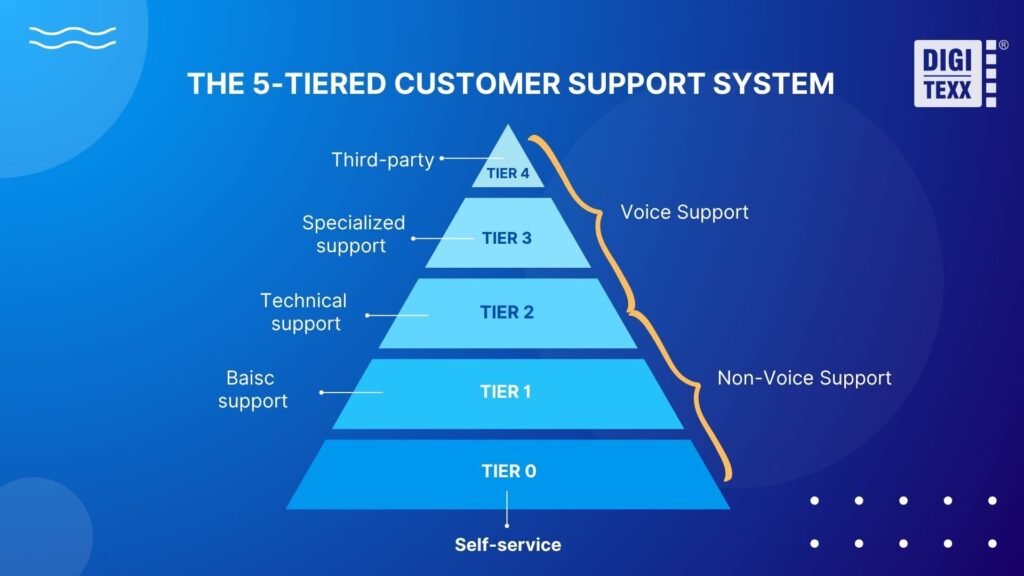
In this model, support responsibilities evolve as inquiry complexity increases:
- Tier 0 (Self-Service): Customers resolve simple inquiries independently through self-service resources such as FAQs, knowledge bases, and AI chatbots, without interacting with a support agent.
- Tier 1 (Basic Support): Frontline support agents handle routine, high-volume inquiries primarily through non-voice channels, including live chat, email, messaging platforms, and support tickets.
- Tier 2 (Technical Support): Technical specialists manage issues that require deeper product knowledge or troubleshooting. Depending on the complexity of the case, support may continue through non-voice channels or escalate to voice communication when real-time collaboration is needed.
- Tier 3 (Specialized Support): Senior specialists resolve highly complex technical issues, critical escalations, and cases requiring advanced expertise. Voice support is typically the primary channel at this stage because it enables faster diagnosis, collaboration, and decision-making.
- Tier 4 (Third-party): Issues that cannot be resolved internally are escalated to external vendors, technology partners, or product manufacturers. These organizations provide proprietary expertise, direct access to vendor-managed systems, or engineering support that falls outside the scope of the internal customer service team.
This layered approach allows businesses to optimize operational costs while ensuring customers receive the right level of support at the right time. Organizations that need additional flexibility often extend this model through outsourced Business Support Services, enabling them to scale customer support while maintaining consistent service quality and SLA performance.
Voice and Non-Voice Service: Best Practices That Enhance Customer Experience
Customer experience isn’t determined by the number of support channels a business offers, it’s determined by whether customers can access the right channel at the right moment. Different types of inquiries require different communication methods, and matching customers to the appropriate channel reduces effort, improves resolution quality, and increases overall satisfaction.
Customer experience and business impact comparison between voice and non-voice customer service:
| Comparison Criteria | Voice Customer Service | Non-Voice Customer Service |
| Best suited for | Urgent, complex, or emotionally sensitive issues | Routine inquiries, simple requests, and self-service support |
| Customer expectation | Immediate assistance, empathy, and real-time problem solving | Convenience, flexibility, and quick access without waiting on a call |
| Strengths | Builds trust, resolves complex issues faster, reduces customer frustration | Scalable, cost-efficient, supports multiple customers simultaneously, provides conversation history |
| Potential limitations | Higher operational cost, limited scalability, longer wait times during peak periods | Less effective for complex troubleshooting or emotionally charged situations |
| Business impact | Higher First Contact Resolution (FCR), stronger customer relationships, improved loyalty | Lower cost per interaction, increased agent productivity, faster response for high-volume inquiries |
| Ideal use cases | Technical support, complaints, account recovery, high-value customers | FAQs, order updates, appointment scheduling, billing inquiries, password resets |
Voice Support: Best for Complex Issues That Require Speed and Empathy
Voice support delivers the greatest customer experience when interactions require immediate attention, collaborative problem-solving, or emotional reassurance. Real-time conversations enable agents to ask follow-up questions, clarify misunderstandings instantly, and adapt their responses based on the customer’s tone and urgency, capabilities that text-based communication cannot fully replicate.
Voice support is particularly effective for:
- Technical troubleshooting
- Complaint handling and service recovery
- Billing disputes and account verification
- Enterprise onboarding and account management
- High-priority or time-sensitive issues
Because these interactions often require experienced agents and consistent service standards, many organizations partner with providers offering Customer Support Services to extend their in-house capabilities.
For example, DIGI-TEXX’s Customer Support Services combine multilingual voice support, standardized workflows, and SLA-driven operations to help businesses deliver consistent customer experiences while scaling efficiently.
However, voice support should be reserved for interactions where human expertise creates the greatest value. Using phone support for every inquiry can increase operating costs without significantly improving customer satisfaction.

Non-Voice Support: Best for Convenience, Efficiency, and Scalability
Non-voice support prioritizes convenience, scalability, and operational efficiency, making it an effective choice for routine inquiries and low-complexity requests. Channels such as email, live chat, messaging apps, and support tickets allow customers to receive assistance without waiting on a phone call. By enabling agents to manage multiple conversations simultaneously and maintaining conversation history, non-voice support helps reduce customer effort while improving productivity.
These channels are commonly used for:
- Order tracking
- Product or pricing inquiries
- Account updates
- Password resets
- Appointment scheduling
- Documentation and follow-up communication
Among non-voice channels, live chat offers one of the best balances between responsiveness and operational efficiency. Customers receive near real-time assistance, while agents can manage multiple conversations simultaneously, reducing wait times without sacrificing service quality.
For businesses looking to strengthen their digital support strategy, solutions such as DIGI-TEXX’s Live Chat Services demonstrate how professionally managed live chat can improve response times, increase agent productivity, and provide seamless escalation to voice support when more complex assistance is required.
While non-voice support improves scalability and reduces the cost of handling routine inquiries, it is less effective for emotionally sensitive or technically complex situations. Leading organizations therefore integrate voice and non-voice channels into a unified customer support strategy, ensuring customers can transition smoothly between channels without repeating information.

Why Leading Businesses Combine Voice and Non-Voice Customer Service
The question is no longer whether businesses should choose voice or non-voice customer service; it is how to combine both channels to deliver a seamless customer experience across the entire customer journey.
As discussed earlier, customer expectations evolve throughout the journey. Customers value fast, convenient digital support for routine inquiries, while complex or urgent issues often require the empathy and real-time problem-solving that voice support provides. Relying on a single channel makes it difficult to consistently meet these diverse expectations.
Leading organizations recognize that customer inquiries vary in complexity, urgency, and business impact. Instead of handling every request through the same channel, they route customers to the support channel best suited to their needs.
This ensures simple inquiries are resolved quickly through digital channels, while complex or sensitive issues receive personalized assistance from voice agents.
A hybrid customer service strategy delivers several business advantages:
- Improves First Contact Resolution (FCR) by routing complex inquiries directly to voice agents while resolving routine requests through digital channels.
- Reduces Customer Effort Score (CES) by allowing customers to move between channels without repeating information.
- Optimizes agent utilization by reserving voice support for high-value interactions and automating repetitive inquiries through self-service or digital channels.
- Scales customer support more efficiently by combining AI, live chat, and human-assisted support to manage fluctuating contact volumes.
- Creates a consistent omnichannel experience by preserving customer context across every interaction, regardless of the communication channel.

By aligning each support channel with customer intent and journey stage, businesses can balance operational efficiency with customer satisfaction, delivering a more connected, personalized, and scalable customer experience.
Common Mistakes Businesses Make When Choosing Between Voice and Non-Voice Customer Service
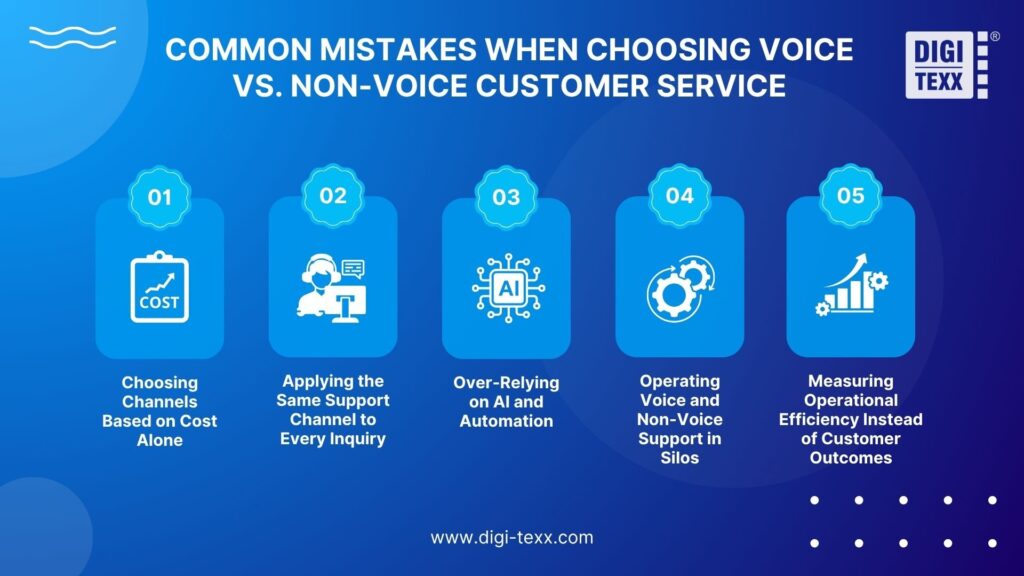
Selecting the wrong customer service model often results in more than inefficient operations, it can increase customer effort, reduce satisfaction, and drive higher long-term support costs. Below are five common mistakes businesses should avoid.
1. Choosing Channels Based on Cost Alone
Lower-cost channels are not always more cost-effective. While non-voice support typically reduces the cost per interaction, complex issues may require multiple touchpoints before resolution, increasing the overall cost to serve.
Recommendation: Evaluate channel performance using cost per resolution, not simply cost per interaction.
2. Applying the Same Support Channel to Every Inquiry
Customers contact support for different reasons, from simple account updates to business-critical incidents. Treating every request the same often leads to unnecessary escalations or inefficient resource allocation.
Recommendation: Classify inquiries based on complexity, urgency, and customer intent before routing them to the appropriate channel.
3. Over-Relying on AI and Automation
While AI-powered chatbots and automation improve efficiency, they cannot effectively handle every customer interaction. Relying too heavily on automated support can frustrate customers when complex, urgent, or emotionally sensitive issues require human judgment and empathy.
Recommendation: Use AI to handle routine inquiries, but provide clear escalation paths to live agents for complex or high-value interactions.
4. Operating Voice and Non-Voice Support in Silos
When communication channels are disconnected, customers are forced to repeat information every time they switch channels. This increases customer effort and extends resolution times.
Recommendation: Implement an omnichannel support platform that provides agents with a unified customer history across all communication channels.
5. Measuring Operational Efficiency Instead of Customer Outcomes
Metrics such as Average Handle Time (AHT) or ticket volume provide valuable operational insights, but they do not fully reflect customer experience or business value.
Decision-makers should balance operational KPIs with customer-centric metrics, including:
- Customer Satisfaction (CSAT)
- First Contact Resolution (FCR)
- Customer Effort Score (CES)
- Net Promoter Score (NPS)
- Customer Retention Rate
A balanced scorecard enables businesses to optimize both service efficiency and long-term customer loyalty.
How to Choose the Right Customer Service Combination for Your Business
There is no one-size-fits-all approach to customer service. The right channel mix depends on your customers’ expectations, the complexity of their inquiries, and your organization’s operational capabilities.
Before designing your support strategy, consider the following questions:
| Business Consideration | Recommended Approach |
| Do customers require immediate assistance for business-critical issues? | Prioritize voice support. |
| Are most inquiries repetitive or transactional? | Expand non-voice support with automation and self-service. |
| Do customers frequently switch between channels? | Adopt an omnichannel customer service platform. |
| Is support demand growing rapidly? | Combine AI-powered automation with human-assisted support. |
| Do you serve customers across multiple regions or languages? | Consider a hybrid model with multilingual voice and non-voice teams. |
A practical way to design your support strategy is to map inquiries by complexity and urgency.
| Inquiry Type | Complexity | Urgency | Recommended Channel |
| FAQs and simple requests | Low | Low | Knowledge base or AI chatbot |
| Order tracking and account updates | Low | Medium | Live chat or messaging apps |
| Product guidance | Medium | Medium | Email or live chat |
| Technical troubleshooting | High | High | Voice support |
| Complaints and service recovery | High | High | Voice support |
Rather than replacing one channel with another, the goal is to ensure customers always have access to the most appropriate communication channel for their situation. Businesses that continuously review customer feedback, support performance, and operational metrics are better positioned to refine their channel strategy as customer expectations evolve.
Frequently Asked Questions
Is voice customer service becoming obsolete?
No, while digital channels such as live chat, messaging apps, and AI chatbots continue to grow, voice customer service remains essential for handling complex, urgent, or emotionally sensitive interactions. Industries such as banking, healthcare, telecommunications, and B2B technology still rely heavily on phone support to resolve technical issues, verify customer identities, and manage escalations.
Rather than replacing voice support, most organizations are adopting a hybrid approach where digital channels handle routine inquiries while voice agents focus on high-value interactions that require real-time collaboration.
Does non-voice support improve customer satisfaction?
Yes, when used for the right types of inquiries. Non-voice channels provide greater convenience by allowing customers to communicate at their own pace, access support across multiple devices, and keep a written record of conversations. They are particularly effective for FAQs, order tracking, account updates, and follow-up communication.
However, customer satisfaction depends on matching the support channel to the customer’s needs. Complex issues that require multiple written exchanges may lead to frustration if customers cannot easily escalate to voice support. The best customer experience comes from offering seamless transitions between digital and voice channels.
Which industries rely more on voice support?
Voice support is most valuable in industries where interactions are complex, regulated, or time-sensitive. These include:
- Banking and financial services
- Healthcare and medical services
- Insurance
- Telecommunications
- Enterprise software (SaaS)
- IT and technical support
- Government and public services
In these industries, real-time communication helps resolve issues faster, reduces misunderstandings, and provides the reassurance customers often need during critical situations.
Can small businesses use both voice and non-voice customer service?
Absolutely. A hybrid support strategy is not limited to large enterprises. Small and medium-sized businesses can start with cost-effective non-voice channels such as email, live chat, and messaging apps to handle routine inquiries, while reserving phone support for sales opportunities, technical issues, or customer escalations.
As customer volume grows, businesses can expand their support capabilities by introducing automation, self-service resources, or outsourced customer support teams without significantly increasing operational costs.
How do I calculate ROI when combining voice and non-voice customer service?
To evaluate the ROI of a hybrid customer service strategy, businesses should consider both operational efficiency and customer outcomes rather than focusing solely on support costs.
Key metrics include:
- Cost per Resolution
- First Contact Resolution (FCR)
- Customer Satisfaction (CSAT)
- Customer Effort Score (CES)
- Average Resolution Time
- Customer Retention Rate
- Customer Lifetime Value (CLV)
If combining voice and non-voice channels reduces repeat contacts, improves customer satisfaction, and increases retention, the long-term business value often outweighs the additional investment required to support multiple channels.
Which is better, voice or non-voice BPO?
Neither model is inherently better they solve different business challenges.
Voice BPO is ideal for handling complex conversations that require empathy, negotiation, or immediate problem-solving, such as technical support, complaint resolution, and customer retention.
Non-voice BPO is better suited for high-volume, process-driven tasks such as email support, live chat, social media messaging, and back-office customer inquiries, where efficiency and scalability are priorities.
For most organizations, the optimal approach is to combine both services within an omnichannel support strategy. This allows businesses to improve customer experience while optimizing operational costs and resource allocation.
Explore Related Articles:
- Back Office Support Services: Benefits, Types, Costs & Outsourcing Solutions
- Best Administrative Support Outsourcing Services In 2026
- What Is Business Process Outsourcing (BPO)? Definition & Examples
Reference:
- O’Brien, K., & Downie, A. (2024). Customer effort score. In Ibm.com. https://www.ibm.com/think/topics/customer-effort-score
- HappySupport. (2026, May 22). Customer service channel preferences 2026: What 8 reports reveal about phone, chat, email, and Self-Service. Happysupport.Ai; HappySupport. https://happysupport.ai/blog/customer-service-channel-preferences-2026
- Zendesk. (2023). The Zendesk customer experience trends report 2023. In CX Trends 2023. https://cxtrends.zendesk.com/
- Blog. (2026). What is omnichannel?: A CX guide for 2026. In Zendesk. https://www.zendesk.com/blog/customer-experience/expectations/omnichannel-experience/
- Verschoren, T. (2025, November 25). Zendesk CX trends 2026 – from industry insight to Zendesk in practice. Internal Note. https://internalnote.com/zendesk-cx-trends-2026/
- Lee, R. A. (2025). Zendesk statistics 2025: Power moves in CX growth • SQ magazine. In SQ Magazine. https://sqmagazine.co.uk/zendesk-statistics/