
Construction invoice reconciliation plays a critical role in controlling project costs and ensuring payments are made accurately against actual quantities, project progress, and contractual terms, especially in construction environments involving multiple subcontractors, numerous purchase orders, and frequent variation orders. In this article, DIGI-TEXX explains the role of invoice reconciliation in construction, outlines best practices and common challenges, and explores key trends in 2026, including when businesses should consider outsourcing this function.
>>> See more:
- What Is Business Process Outsourcing (BPO)? Definition & Benefits
- Business Process Automation Solutions: Benefits, Example & Service Company
- Healthcare BPO Services – Cost Optimization & Improve Care 2026
The Importance Of Construction Invoice Reconciliation
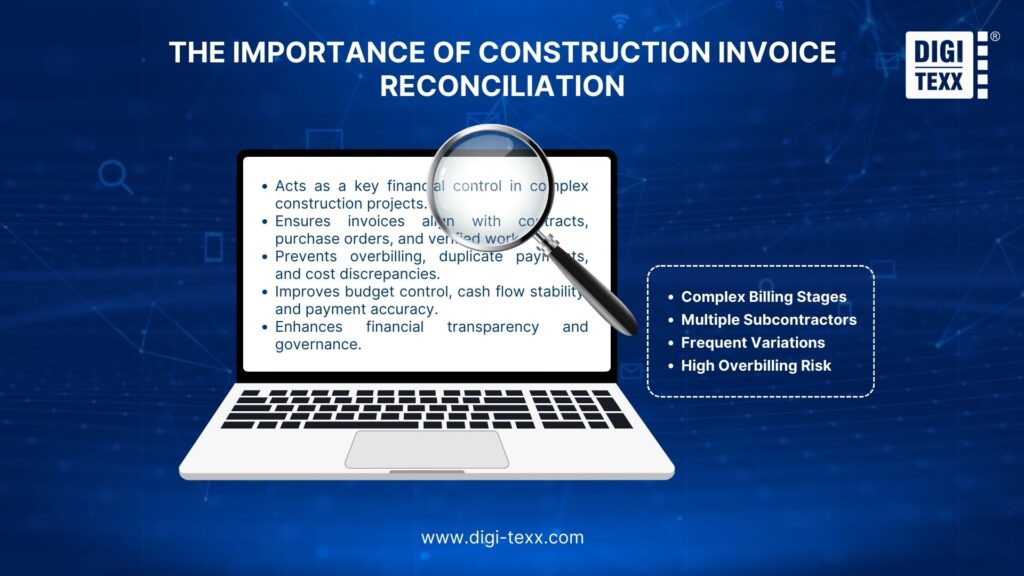
In construction finance, construction invoice reconciliation is a core financial control, as phased delivery, progress-based billing, and contractual variations mean invoices cannot be validated by price and quantity alone. Invoice reconciliation ensures payments reflect approved purchase orders, contract terms, and verified on-site work, especially in projects with multiple subcontractors, frequent variation orders, and overlapping timelines that increase the risk of overbilling or duplicate payments.
Without a structured reconciliation process, cost discrepancies can accumulate, resulting in budget overruns, cash flow instability, and vendor disputes. Embedding invoice reconciliation into financial controls improves cost visibility, payment accuracy, and overall financial governance across complex projects.
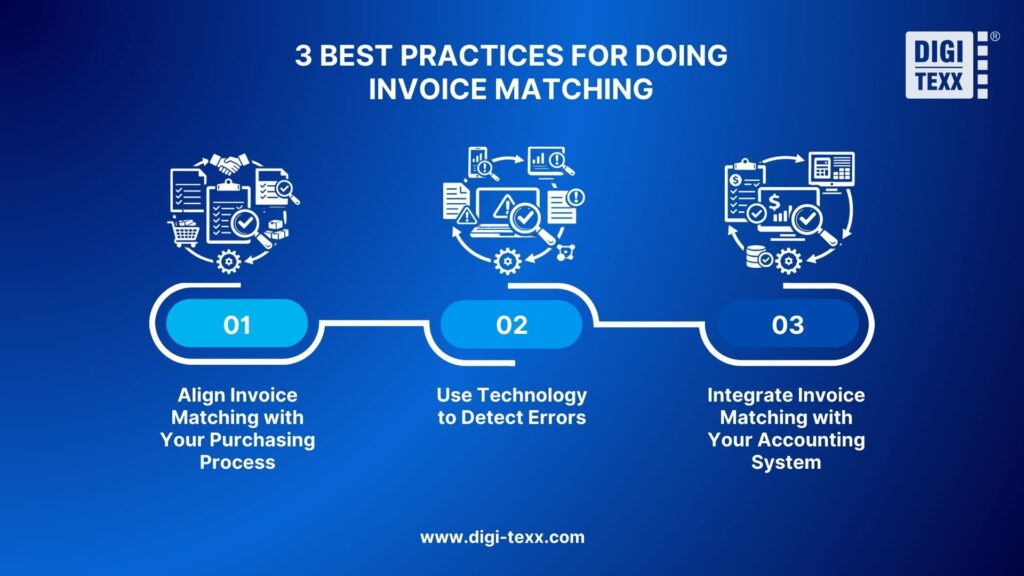
3 Best Practices For Doing Invoice Matching
In construction, effective invoice matching is about putting the right processes and tools in place, not increasing manual checks. The following best practices help ensure accurate and consistent invoice reconciliation.
1. Align Invoice Matching With Your Purchasing Process
Invoice matching is effective when it is closely aligned with the procurement and internal approval process. If purchase orders, contracts, or verification documents are not standardized and approved upfront, invoice reconciliation will become slower and more error-prone. To ensure consistency, construction businesses should:
- Review invoices only after purchase orders have been formally approved
- Centralize key documents such as POs, contracts, and site verification records
- Design workflows that allow finance teams to reconcile invoices immediately upon receipt, without chasing information across departments
Aligning invoice matching with the purchasing process significantly reduces reconciliation errors, prevents invoices from arriving ahead of approved procurement data, and accelerates payment processing in complex construction projects.
2. Use Technology To Detect Errors
As invoice volumes grow and data comes from multiple subcontractors, manual invoice matching becomes time-consuming and prone to errors. In this context, technology plays a critical supporting role in identifying discrepancies early in the reconciliation process.
- Automatically compare invoice data with purchase orders and verification records
- Detect duplicate invoices, pricing inconsistencies, or charges outside contractual scope
- Flag exceptions for finance teams to review and resolve
By reducing reliance on manual checks, technology improves consistency and accuracy in construction environments where billing is closely tied to progress and variation orders.
3. Integrate Invoice Matching With Your Accounting System
Invoice matching should not end at validation; it must be seamlessly integrated with the accounting system to ensure accurate and timely cost recognition. Integrating invoice matching with accounting systems helps to:
- Reduce duplicate data entry and minimize transfer errors.
- Enable real-time tracking of actual project costs by phase or work package.
- Ensure financial reports reflect the true status of payments and project progress.
>>> See more:
- Top 10 Data Processing Software For Business 2026 – Best Tool Reviewed
- How to Automate Documentation in 2026: Processes, Tools & Examples
- What are the 6 steps of the data analysis process?
Invoice Reconciliation Software
Invoice reconciliation software supports the matching of invoices with purchase orders, payment data, and accounting systems; in construction, these tools primarily enable and strengthen reconciliation workflows, rather than replace contract and progress-based validation.
DepositFix
DepositFix is a platform designed to support accounts receivable and invoice reconciliation processes, focusing on automating and simplifying the steps involved in matching payment data. This tool stands out with its user-friendly interface, fast processing capabilities, and high level of automation, helping businesses reduce processing time and minimize data entry errors when matching invoices with payment or transaction data.
Xero
Xero is a comprehensive cloud-based accounting solution that provides a range of tools to support invoicing, payment tracking, and automated accounting data reconciliation, including features to help match invoice data, bank transactions, and accounts payable/receivable within the system. This software helps corporate accountants and finance professionals control cash flow and accounts more intuitively, especially when integrating data from multiple sources.
Invoiced
Invoiced is a tool for managing digital invoices and automating steps related to invoice processing, from sending invoices to tracking payment status. With features for automated reconciliation and anomaly alerts, Invoiced helps businesses reduce manual verification time and increase accuracy in the reconciliation process.
>>> See more:
- Top 10 Data Cleansing Companies for Businesses in 2025
- Outsourcing Data Cleansing: What You Need to Know
- How Digitization Can Facilitate Historical Research?
QuickBooks
QuickBooks is a popular accounting solution, especially for small and medium sized businesses, providing tools for managing account categories, invoices, and transaction logs. This software helps businesses track invoices, reconcile payment data, and record expenses within a single system, thereby supporting reconciliation more efficiently than manually processing data on multiple separate spreadsheets.
Sage
Sage is a long established accounting platform with comprehensive business financial management features, including invoice recording, accounts payable, and expense reporting. Combined with data reconciliation functionality, Sage helps businesses track and match invoice information with accounting records automatically or semi-automatically, thereby supporting invoice reconciliation and effective cost control.
How Do You Ensure Accurate Invoicing And Reconciliation?
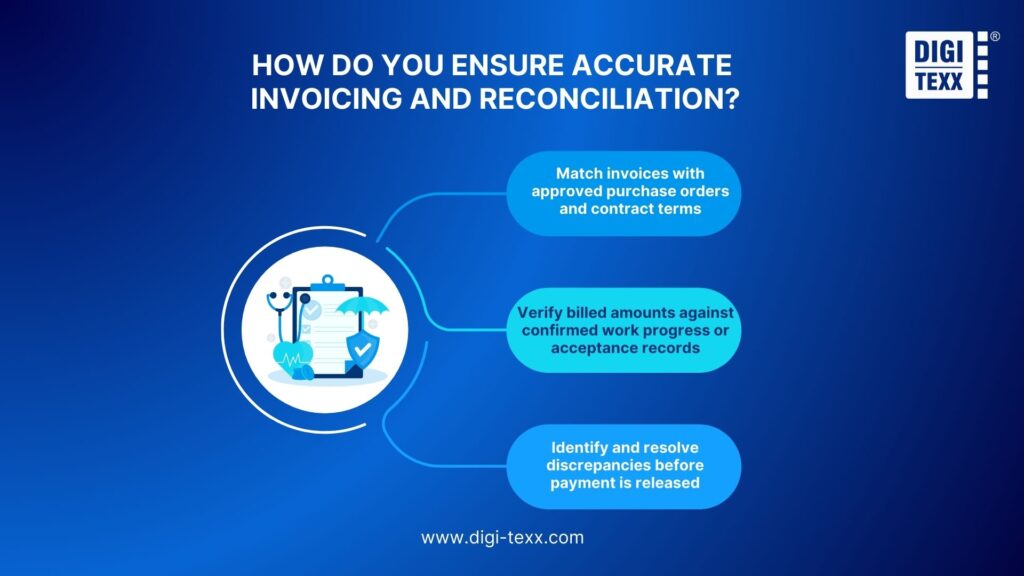
Accurate invoicing and reconciliation in construction depends on consistent verification of invoices against approved project records before payment. To ensure accuracy, construction businesses should:
- Match invoices with approved purchase orders and contract terms
- Verify billed amounts against confirmed work progress or acceptance records
- Identify and resolve discrepancies before payment is released
Regular reconciliation not only ensures accurate invoicing but also enhances transparency with clients and helps maintain consistent cash flow management across projects.
>>> See more:
- Top 7 Free AI Business Document Analysis Tools 2026
- Top 10 Data Entry Outsourcing Companies to Hire in 2026
- Outsourced data annotation services: List of best companies to work for
What Are Some Challenges In Reconciliation?
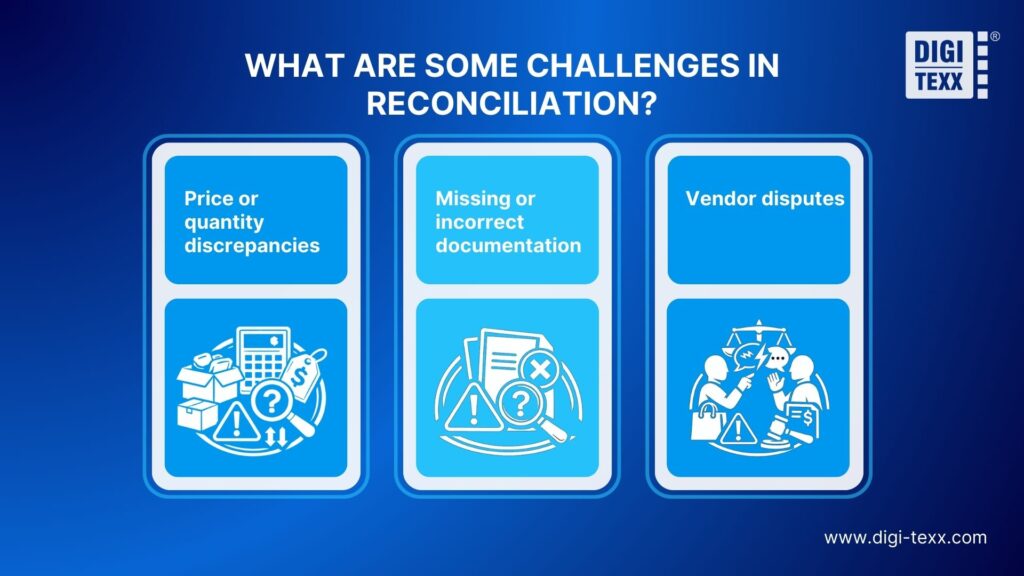
Invoice reconciliation often exposes recurring challenges that slow down financial operations and increase risk, especially in complex environments such as construction. Common challenges include:
- Price or quantity discrepancies: Mismatches between invoiced amounts and agreed prices or quantities are among the most frequent issues. These can result from outdated pricing, partial deliveries, or changes not formally documented, and may lead to inaccurate cost reporting if not resolved.
- Missing or incorrect documentation: The absence of purchase orders, receiving records, or accurate contract references can halt the reconciliation process. Incomplete or incorrect documentation also increases audit and compliance risks.
- Vendor disputes: Disagreements often surface during reconciliation when invoice details differ from internal records or expectations. Without clear communication and escalation paths, these disputes can delay payments and strain vendor relationships.
When left unmanaged, these challenges contribute to payment delays, weakened financial controls, and reduced visibility into actual costs.
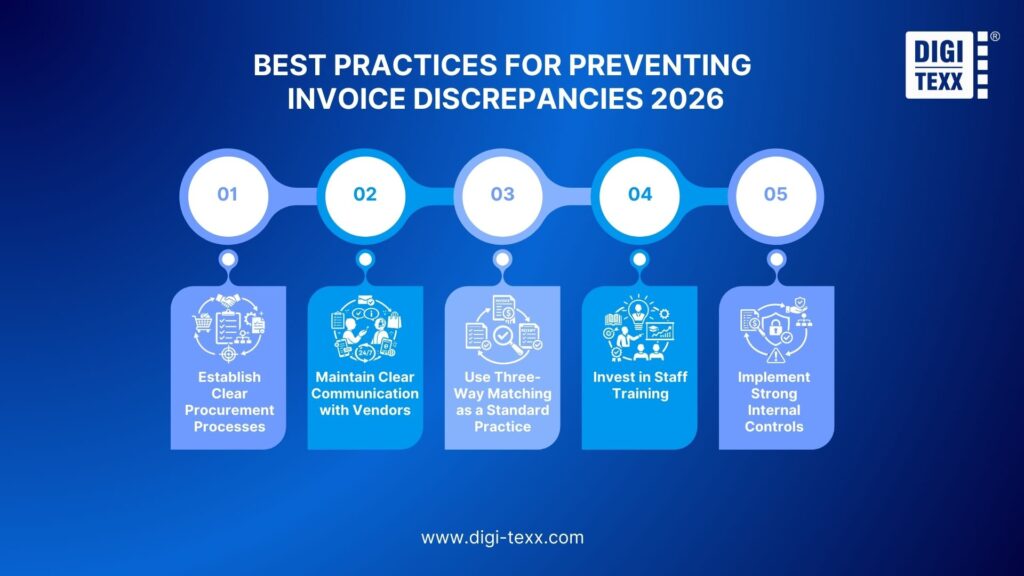
Best Practices For Preventing Invoice Discrepancies 2026
The most effective way to manage invoice discrepancies is to prevent them before they occur. The following best practices outline how organizations can strengthen controls and reduce reconciliation issues by 2026.
Establish Clear Procurement Processes
Well-defined procurement processes form the foundation for accurate invoicing. When purchasing workflows are structured and integrated with payment procedures, every transaction starts with a formally approved purchase order that clearly defines pricing, quantities, and terms. This upfront clarity provides a reliable reference point for invoice matching and reduces downstream errors.
Maintain Clear Communication With Vendors
Consistent and transparent communication with vendors helps prevent misunderstandings before they turn into invoice discrepancies. Clear billing guidelines, shared expectations, and defined escalation paths allow issues to be addressed quickly and collaboratively, reducing delays and disputes during reconciliation.
Use Three-Way Matching As A Standard Practice
Three-way matching comparing purchase orders, receiving or acceptance records, and vendor invoices helps ensure that what was ordered, received, and invoiced matches before payment is made.
Invest In Staff Training
Well-trained finance teams act as a strong line of defense against invoice errors. Training should focus not only on technical accounting skills but also on recognizing common discrepancy patterns, understanding industry-specific invoicing practices, and applying critical judgment during reconciliation.
Implement Strong Internal Controls
Structured internal controls add an additional layer of protection against invoice discrepancies. Approval thresholds, random audits, and clear segregation of duties help reinforce accountability, reduce error rates, and minimize the risk of fraud within the reconciliation process.
>>> See more:
- Best Insurance Claims Processing Outsourcing BPO in the US 2026
- Top 10 Best big data processing tool for Business 2026
- Medical Claims Processing Outsourcing For Healthcare Providers
Is There A Way To Automate Invoices?
Invoice reconciliation can be automated by combining data extraction, rule-based matching, and integrated workflows. Modern automation tools capture key invoice details as they arrive, organize them alongside purchase orders and delivery or acceptance records, and automatically match documents that align. Only exceptions or discrepancies are flagged for human review, allowing finance teams to focus on higher-value checks rather than routine validation.
Automation becomes more effective when connected to existing accounting systems, enabling invoice data to flow seamlessly without duplicate entry. Reporting and dashboards further support automation by providing visibility into reconciliation bottlenecks, recurring issues, and efficiency trends over time, helping organizations continuously improve their processes.
Invoice Processing Services In DIGI-TEXX
Invoice Processing Services at DIGI-TEXX provide a foundational capability for handling invoices and financial documents efficiently in high-volume environments, using OCR-based data extraction, validation, and integration with accounting or ERP systems. The goal is to reduce manual effort, minimize data entry errors, and accelerate accounts payable workflows.
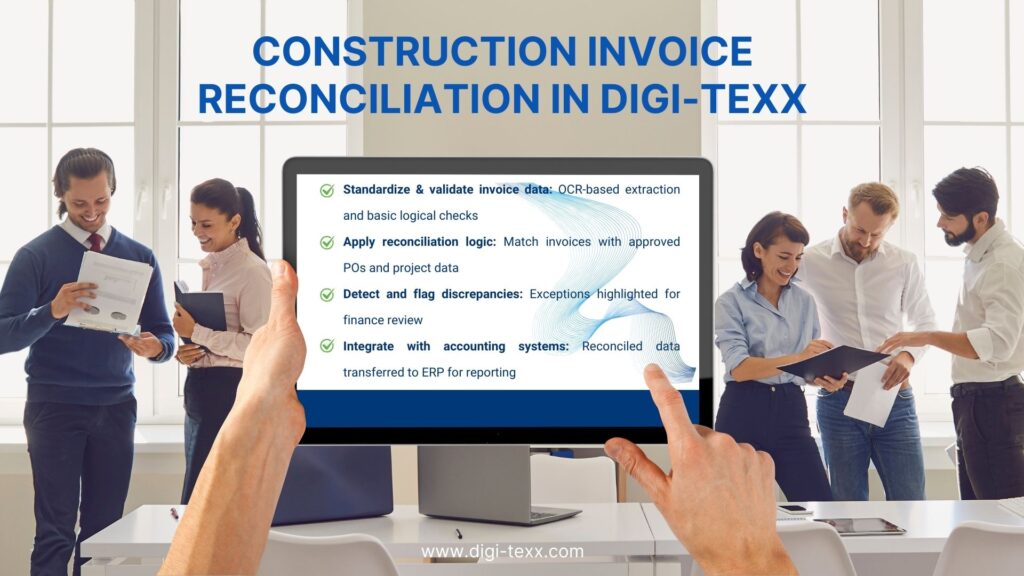
However, in industries with more complex operations such as construction, invoice handling goes beyond basic data entry or format checks. Construction companies typically manage multiple purchase orders, numerous subcontractors, progress-based payments, and frequent variation orders. To address these requirements, DIGI-TEXX deploys Construction Invoice Reconciliation on top of its Invoice Processing Services, supporting invoice verification in a way that aligns with project-based construction environments.
Specifically, DIGI-TEXX supports construction invoice reconciliation by:
- DIGI-TEXX standardizes and validates invoice data through OCR to extract information from various invoice formats, combining basic logical verification steps to ensure data is complete, consistent, and ready for reconciliation.
- DIGI-TEXX applies reconciliation logic consistent with approved procurement records and project data, helping to control the scope and value of payments.
- DIGI-TEXX detects and flags discrepancies for the finance team to review, instead of relying entirely on manual verification.
- DIGI-TEXX transfers reconciled data to the accounting or ERP system, facilitating consistent expense tracking and reporting.
Through this approach, Construction Invoice Reconciliation at DIGI-TEXX is delivered as a specialized application of Invoice Processing Services, enabling construction businesses to improve payment accuracy, reduce the burden on finance teams, and maintain strong cost control throughout the project lifecycle.
>>> See more: Top 7 Document Scanning Software for Businesses
FAQs About Outsourced AI Training Data
What Is Reconciliation In Construction Billing?
Reconciliation in construction billing is the process of comparing billing records, invoices, and bank balances to ensure financial accuracy, transparency, and effective cash flow control in construction projects.
What Is The Process Of Invoice Reconciliation?
The invoice reconciliation process involves matching incoming and outgoing invoices with accounting and bank records to ensure all transactions are accurate and properly recorded.
What Is An Example Of Invoice Reconciliation?
When a company purchases construction materials such as steel and cement worth $10,000, the accounting team reconciles the supplier’s invoice with the purchase order to confirm quantities and unit prices, reviews delivery documents to ensure the materials were received, and verifies that the payment amount matches the agreed terms before approval.
How Often Should Invoices Be Reconciled?
Most businesses should reconcile invoices on a monthly basis to ensure timely payment processing and quickly identify and resolve discrepancies before they escalate.
DIGI-TEXX provides practical insights into construction invoice reconciliation, helping construction businesses understand how structured invoice matching practices, appropriate reconciliation software, and preventive controls toward 2026 can support more accurate payments, improved cost visibility, and fewer reconciliation errors in environments with multiple purchase orders, subcontractors, and progress-based billing.
With experience in large-scale invoice processing and data management, DIGI-TEXX looks forward to working alongside construction organizations to support more accurate payments, strengthen financial governance, and improve visibility into project costs while helping reduce operational pressure on internal finance teams as invoice volumes continue to grow.
DIGI-TEXX Contact Information:
🌐 Website: https://digi-texx.com/
📞 Hotline: +84 28 3715 5325
✉️ Email: [email protected]
🏢 Address:
- Headquarters: Anna Building, QTSC, Trung My Tay Ward
- Office 1: German House, 33 Le Duan, Saigon Ward
- Office 2: DIGI-TEXX Building, 477-479 An Duong Vuong, Binh Phu Ward
- Office 3: Innovation Solution Center, ISC Hau Giang, 198 19 Thang 8 street, Vi Tan Ward
Reference:
- Financial Accounting Standards Board. Conceptual framework for financial reporting. https://www.fasb.org
- International Federation of Accountants. Internal control and risk management. https://www.ifac.org