
Customer service outsourcing helps businesses reduce support workload, expand service coverage, and access specialized customer service teams without building a large in-house operation. With multiple outsourcing models, providers, and pricing structures available, choosing the right approach requires a clear understanding of service needs, costs, quality, and data security.
In this guide, DIGI-TEXX will help you explore the best customer service outsourcing companies in 2026, compare their services and pricing, understand the main outsourcing models, and learn how to build a reliable outsourced customer support operation.

>>> See more:
- Outsourced Live Chat Services For Customer Support | DIGI-TEXX
- Multilingual Customer Support Services | DIGI-TEXX
- Professional Outsourced Help Desk Services | DIGI-TEXX
What Is Customer Service Outsourcing?
Customer service outsourcing is the practice of transferring part or all of a company’s customer-facing support operations to an external provider. Instead of hiring and managing every agent internally, businesses can rely on a specialized customer service outsourcing company to handle customer inquiries, issue resolution, and ongoing support.
Depending on the provider, outsourced customer service can cover:
- Phone calls for inquiries, complaints, and account issues
- Live chat and email for real-time and ticket-based support
- Social media and messaging for customer engagement
- Technical support for troubleshooting and product assistance
The goal goes beyond cutting costs. A well-designed outsourcing model can help businesses scale support capacity, extend service hours, access specialized talent, and maintain consistent service quality without expanding an in-house team at the same pace. For example, DIGI-TEXX provides 24/7/365 support across phone, chat, email, messaging, and other channels, with multilingual and technical support capabilities.
Customer service vs. customer support: Customer service generally covers broader assistance, while customer support often focuses on troubleshooting and technical issues. Since most outsourcing providers handle both functions, this guide uses the terms interchangeably.
The best customer service outsourcing companies do more than answer calls or reply to tickets. The right provider should match your support volume, preferred channels, languages, service hours, security requirements, and level of operational control.
The 15 providers below represent different outsourcing models, including managed BPO, dedicated staffing, nearshore delivery, on-demand support, and specialized customer service. Each company is evaluated based on its service capabilities, delivery model, geographic coverage, industry focus, publicly available pricing, and customer evidence where available.
15 Best Customer Service Outsourcing Companies To Consider In 2026
The best customer service outsourcing companies do more than answer calls or reply to tickets. The right provider should match your support volume, preferred channels, languages, service hours, security requirements, and level of operational control.
The 15 providers below represent different outsourcing models, including managed BPO, dedicated staffing, nearshore delivery, on-demand support, and specialized customer service. Each company is evaluated based on its service capabilities, delivery model, geographic coverage, industry focus, publicly available pricing, and customer evidence where available.
| Company | Outsourcing Model | Key Strength | Best For | Pricing |
| DIGI-TEXX | Managed BPO | 24/7 multilingual, multichannel support | Enterprises, multilingual operations | Custom / flexible |
| Foundever | Managed BPO | Global scale and omnichannel CX | Large enterprises | Custom quote |
| SupportYourApp | Managed BPO | Technical and multilingual support | SaaS, fintech, eCommerce | Custom quote |
| Helpware | Managed BPO | Customer support and CX operations | Growing and enterprise businesses | Custom quote |
| SupportNinja | Managed BPO / TaaS | Tech-focused customer and technical support | SaaS and technology companies | Custom quote |
| PartnerHero | Managed CX | AI-assisted CX and automated QA | Digital and high-growth businesses | Custom / outcome-based |
| Influx | On-demand BPO | Flexible, pay-as-you-go support | Seasonal or fluctuating demand | Pay-as-you-go |
| SimplyContact | Managed BPO | Multichannel and multilingual CX | Companies expanding internationally | Custom quote |
| Helplama | Managed BPO | Affordable phone, email and chat support | SMBs and lower-volume operations | From $399/month |
| Auxis | Managed BPO | Nearshore support and service desk | Mid-market and enterprise | Custom quote |
| Near | Staffing / Dedicated teams | LatAm customer support talent | Companies wanting dedicated staff | Quote-based |
| EverHelp | Managed BPO | Dedicated 24/7 support teams | SaaS, eCommerce and fintech | Custom quote |
| Wing | Dedicated staffing | Dedicated remote customer support | SMBs and mid-market companies | Monthly subscription |
| SkyCom | Managed BPO | Bilingual nearshore customer engagement | High-volume and regulated industries | Custom quote |
| Back Office Betties | Specialized BPO | Legal answering and intake | Law firms | From $333/month |
1. DIGI-TEXX
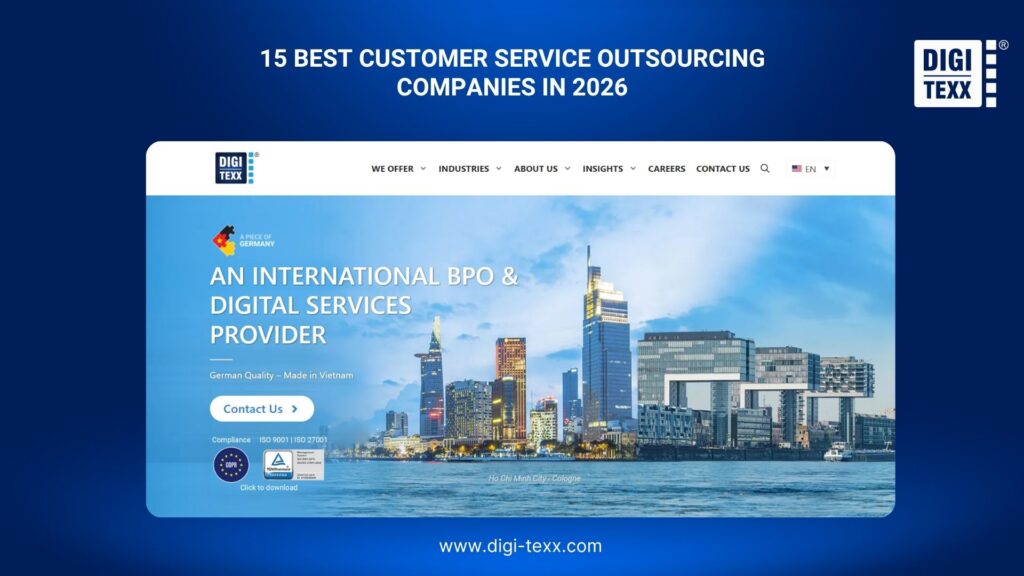
DIGI-TEXX provides customer support and contact center services as part of a broader BPO and digital services portfolio. Its customer service operation supports 24/7/365 coverage and more than 30 processing languages, with services spanning phone, live chat, email, video, in-app support, and technical assistance.
A key advantage is its ability to connect customer service with data-intensive back-office workflows. For example, a DIGI-TEXX insurance case reduced data-entry labor by 70% and cut processing time from 15 minutes to 5 minutes after automation was introduced.
Best for: Companies that need multilingual customer service alongside data processing, document management, or other BPO operations.
Pricing: Custom quote. Its contact center offering also supports a pay-as-you-go model, depending on the service arrangement.
>>> See more:
- Why Retail Outsourcing Is a Smart Strategy for Retail Businesses?
- Multichannel Contact Center Services | DIGI-TEXX
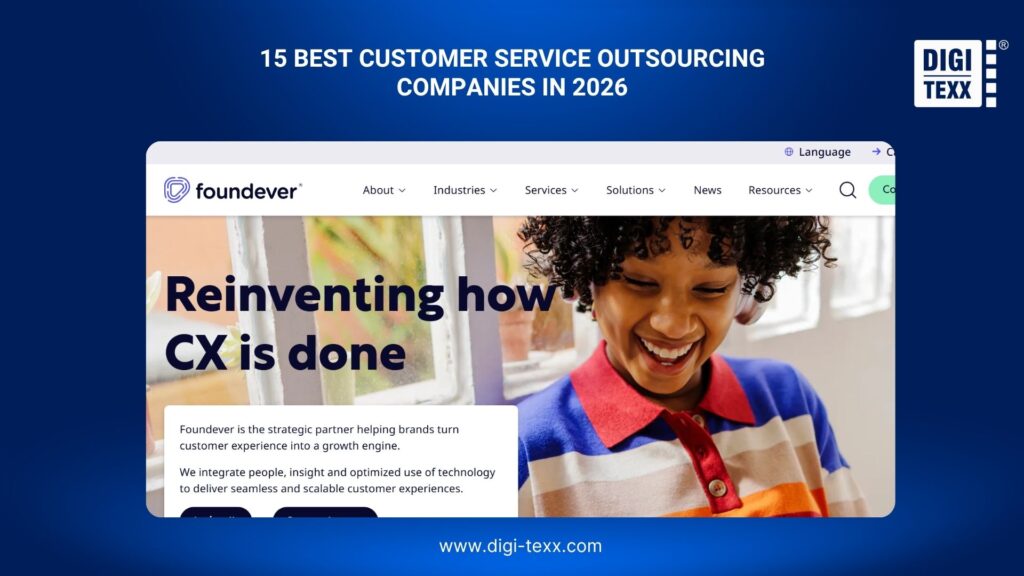
2. Foundever
Foundever is a large-scale CX outsourcing provider serving organizations across multiple regions, industries, and customer touchpoints. Its services cover customer care, technical support, sales and retention, collections, back-office operations, and trust & safety.
Its case studies demonstrate the potential impact of a mature outsourced operation. For one mobility payments provider, Foundever reported an 8.5x increase in survey completion, a 23% improvement in issue resolution, and a 26-point increase in CSAT.
Best for: Large enterprises that need global customer service coverage, multilingual support, and multiple CX capabilities under one provider.
Pricing: Custom quote based on scope, location, channels, and staffing requirements.
3. SupportYourApp
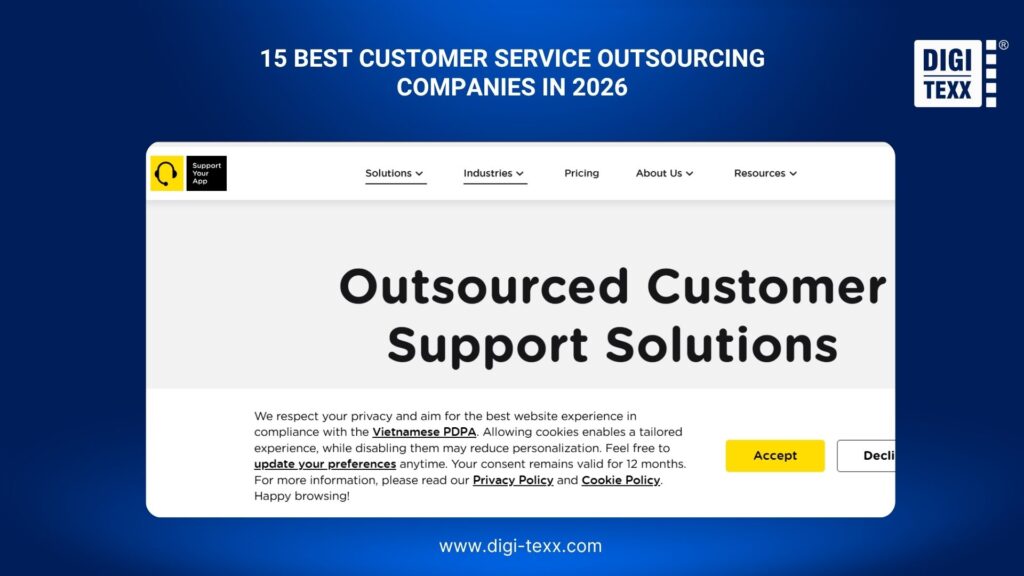
SupportYourApp specializes in outsourced customer service with a strong emphasis on technical support and technology-driven CX. Its services include customer care, help desk support, technical assistance, live chat, and AI-enabled support.
The company states that its teams can provide support in 60+ languages across 30 countries, with 24/7 human-led and AI-assisted service options.
SupportYourApp also highlights security and compliance capabilities relevant to technology and regulated businesses, including PCI DSS, ISO 27001, GDPR, CCPA, and HIPAA.
Best for: SaaS, fintech, eCommerce, and technology companies requiring multilingual or technical customer support.
Pricing: Custom quote based on team size, coverage, languages, and service complexity.
4. Helpware
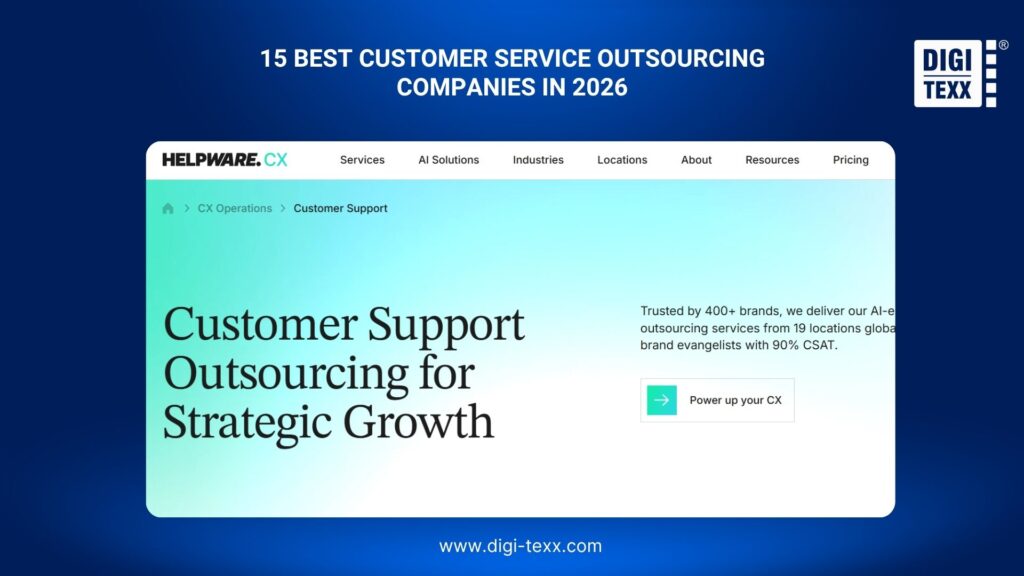
Helpware focuses on building customized CX teams rather than providing a one-size-fits-all support package. Its services include customer support, technical assistance, back-office operations, content moderation, and AI-enabled customer service.
Its published case studies provide useful evidence of the model. One cybersecurity client reduced ticket idle time by 36%, shortened resolution time by 33%, and increased CSAT by 42%. An eCommerce marketplace also reached 95% QA performance within 90 days.
Best for: Businesses that need a customized outsourced team with industry-specific workflows and quality targets.
Pricing: Custom quote, typically depending on team structure, service scope, and support model.
5. SupportNinja
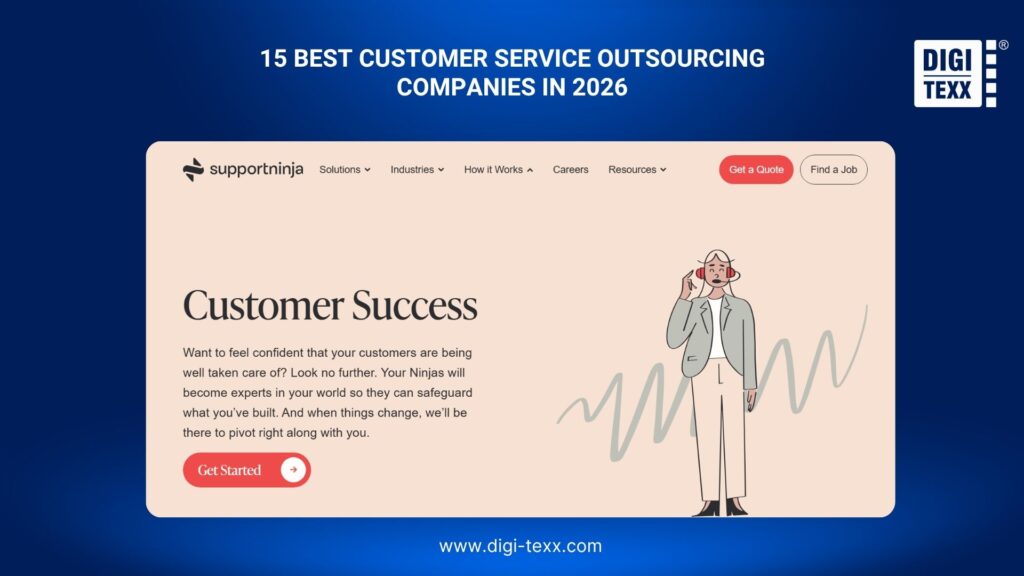
SupportNinja provides outsourced customer support for technology-driven businesses, with services covering customer success, technical support, content moderation, data processing, finance, and accounting.
Its customer base and case studies span SaaS, AI, healthcare, eCommerce, logistics, and other technology-heavy industries. One published case study shows an AI support program increasing automated support deflection from 20% to 60%, helping reduce the number of inquiries requiring human intervention.
Best for: SaaS, AI, healthcare, and eCommerce companies scaling customer service while incorporating automation.
Pricing: Custom quote based on location, experience, technical skills, and team requirements.
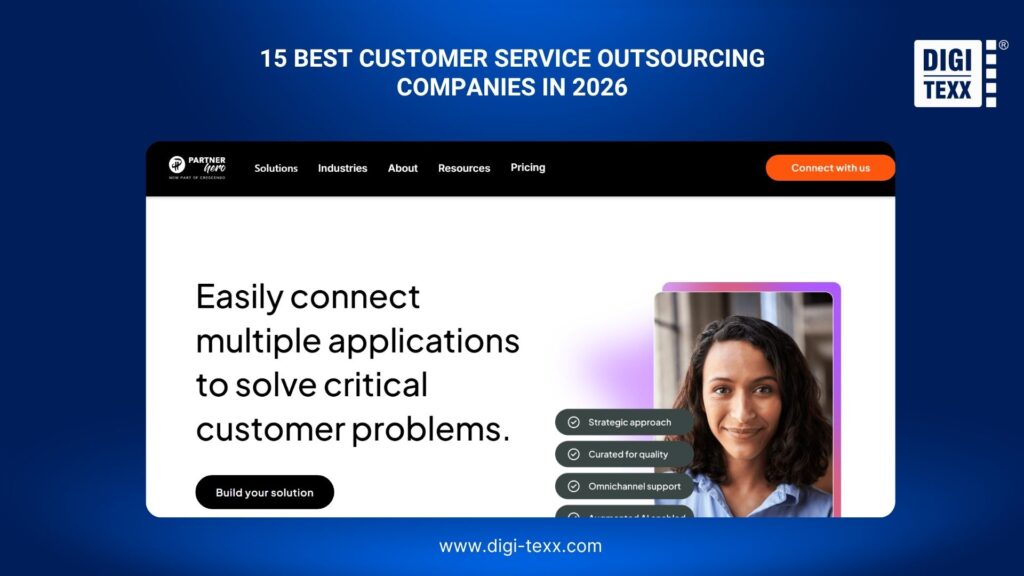
6. PartnerHero
PartnerHero combines outsourced CX teams with AI-assisted service delivery. Its current model includes 24/7 professional CX teams, automated QA, AI assistance, and outcome-based pricing.
Rather than focusing solely on agent volume, PartnerHero positions its service around building and managing the complete customer experience operation, from team development to quality management.
Best for: Growth-stage and digital businesses that want managed CX with greater use of automation and performance-based delivery.
Pricing: Custom and outcome-based pricing, depending on the engagement.
7. Influx
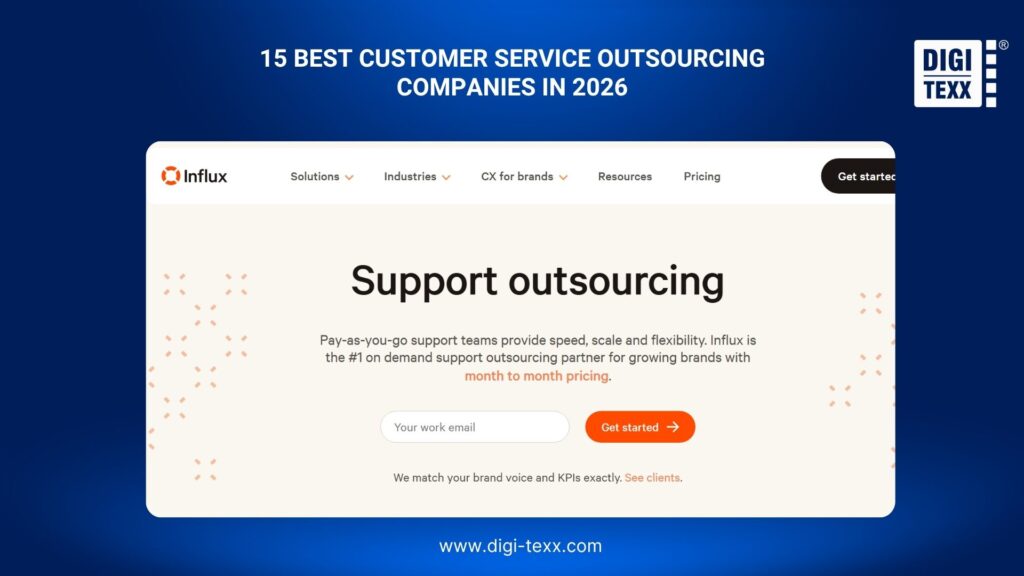
Influx takes a flexible approach to customer service outsourcing, offering managed teams that can scale according to demand. Its model includes 24/7 support, human agents, AI-assisted service, and month-to-month engagements.
The provider states that customers can launch support quickly, with no setup fees or long-term contract requirements. This makes the model particularly useful when support volume changes throughout the year.
Best for: Startups, eCommerce businesses, and companies dealing with seasonal or unpredictable support volumes.
Pricing: Flexible monthly and pay-as-you-go options; custom configurations are available.
8. SimplyContact
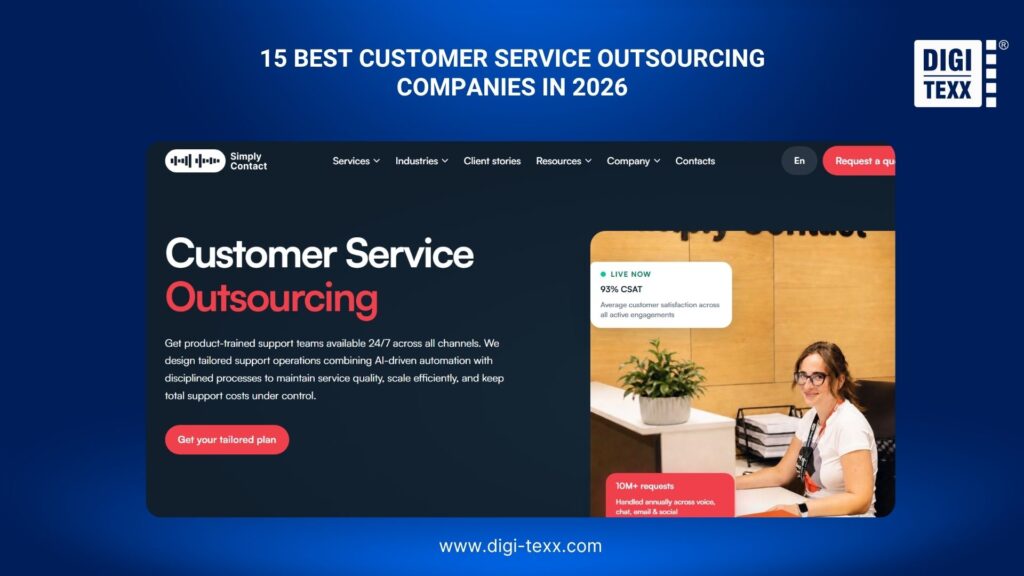
SimplyContact provides multilingual customer support through voice, chat, email, and other digital channels, with a strong focus on European delivery.
Its case studies demonstrate measurable service improvements. For example, its work with Ditto Music increased CSAT from 51% to 88%, while chat productivity increased from 3.5 to 8 responses per hour.
The company reports 30+ languages, 90%+ QA performance, and 24/7 call center availability.
Best for: European businesses and international brands requiring multilingual, KPI-driven customer support.
Pricing: Custom quote based on channels, languages, coverage, and team size.
9. Helplama
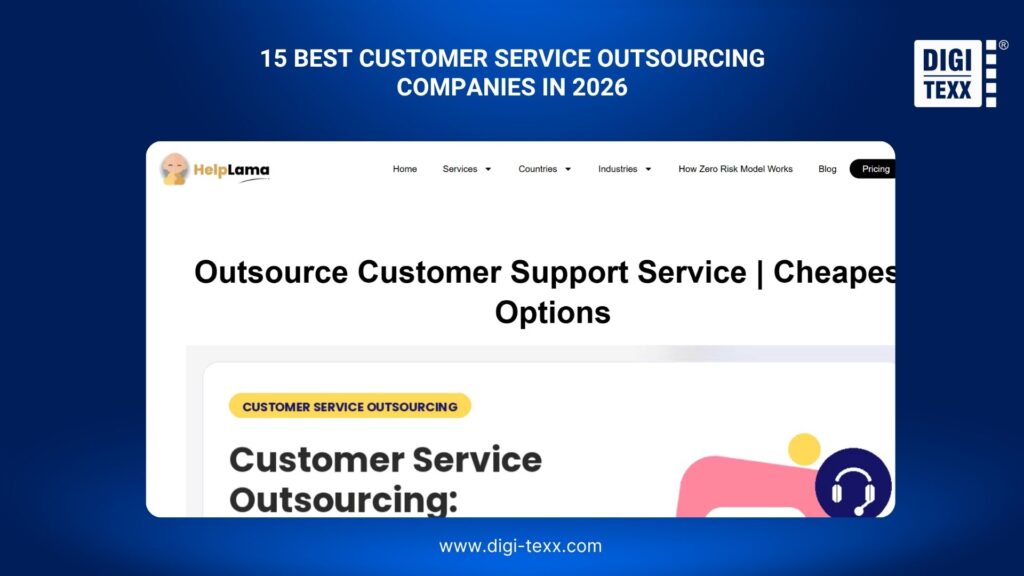
Helplama offers outsourced customer support through live chat, email, and phone, with a particular focus on smaller businesses.
Its published pricing makes it one of the more transparent options in this list. Customer support outsourcing starts at $399 per month, while its pay-per-call option is listed at approximately $0.70 per minute. Pricing varies with interaction volume and service requirements.
Best for: SMBs that need additional live support without committing to a large outsourced contact center.
Pricing: Starts at $399/month for its published customer support offering; pay-per-call options are also available.
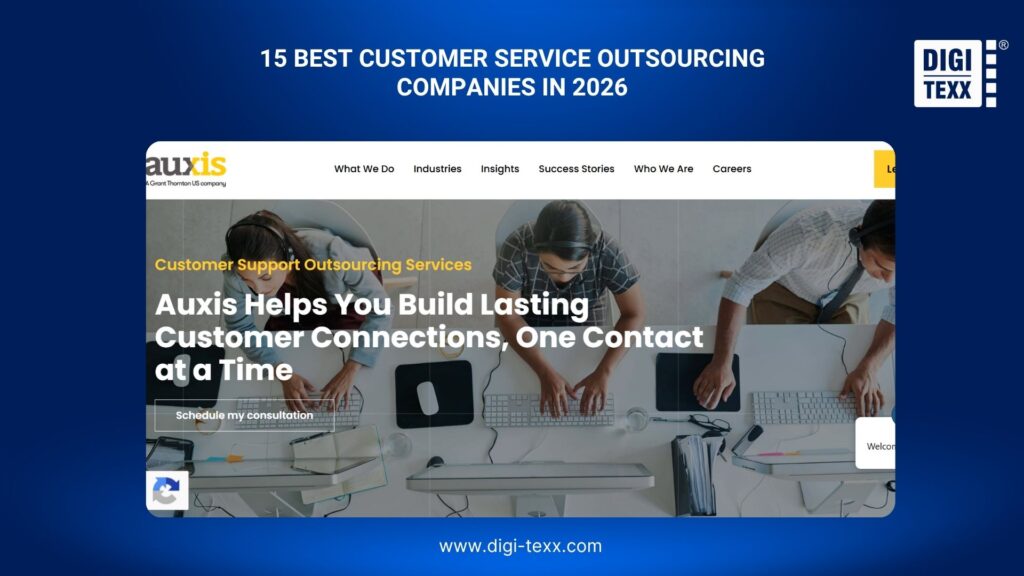
10. Auxis
Auxis combines customer service outsourcing with nearshore BPO and digital transformation services. Its support model covers phone, email, chat, online self-service, and IT-related service desk functions.
The company also uses workforce management, QA, training, knowledge management, and performance monitoring to manage metrics such as AHT, abandonment, CSAT, NPS, and resolution time.
Best for: Mid-market and enterprise businesses seeking nearshore Latin American delivery with broader operational or IT support capabilities.
Pricing: Custom quote based on geography, staffing, channels, and service scope.
11. Near
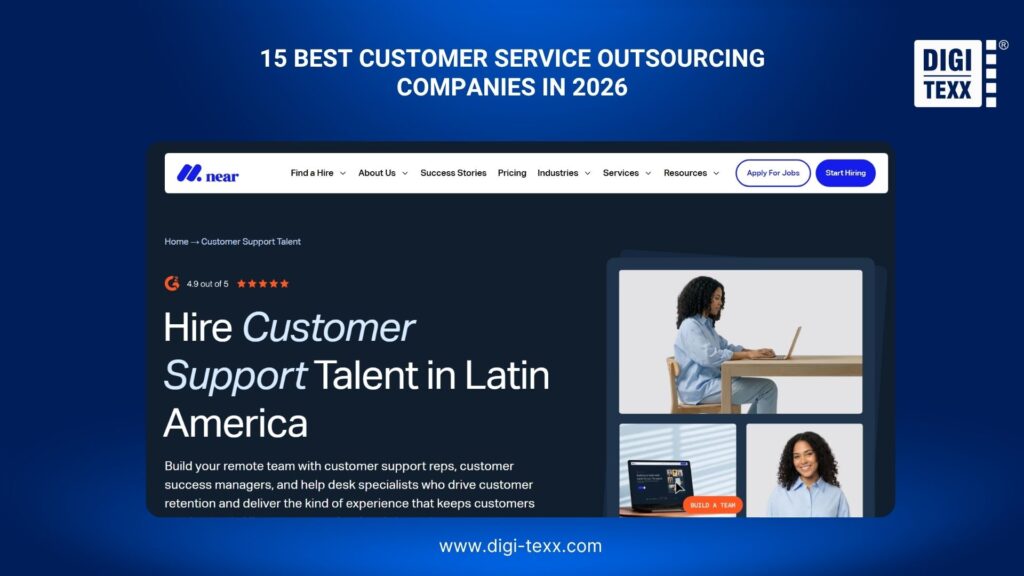
Near differs from traditional BPO providers because its primary model is staffing and recruiting rather than managed customer service outsourcing.
Near helps US companies recruit dedicated customer service professionals in Latin America, including bilingual representatives, customer success managers, and call center specialists. The company states that it can provide candidate shortlists within several days and support hiring in approximately 21 days.
This gives businesses greater control over daily operations, but also means more responsibility for management, training, and performance oversight.
Best for: US companies that want dedicated nearshore customer service employees rather than a fully managed BPO team.
Pricing: Quote-based staffing or recruiting fees rather than a standard BPO seat price.
12. EverHelp
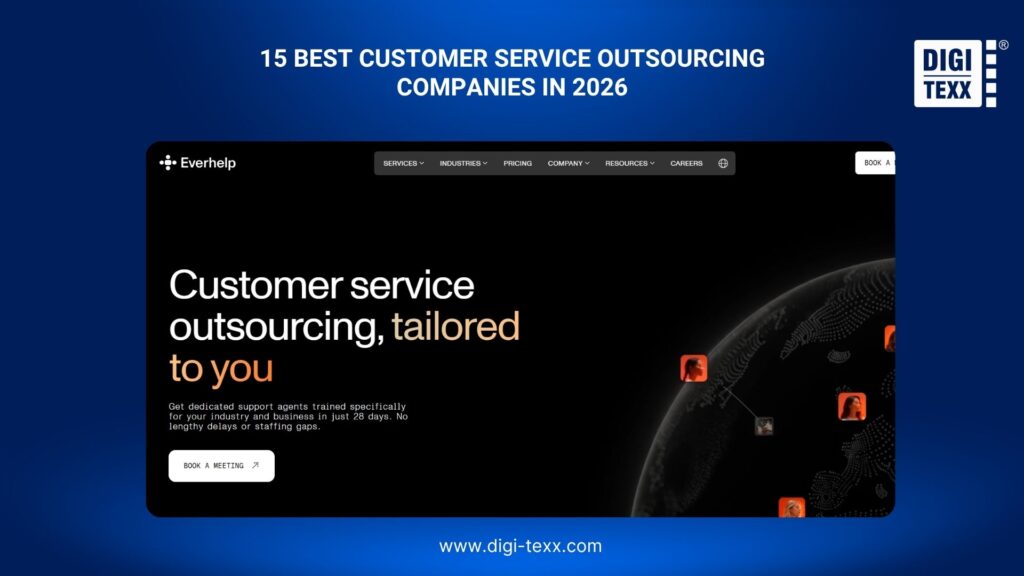
EverHelp provides managed customer support for SaaS, eCommerce, fintech, retail, travel, logistics, and other industries. Its model combines human agents with AI tools and supports 24/7 multilingual service in 30+ languages.
Businesses can choose between dedicated and shared teams depending on support volume and control requirements. The provider also offers technical support, help desk services, back-office operations, and virtual receptionist solutions.
Best for: SaaS and eCommerce companies that need multilingual, 24/7 support with AI-assisted workflows.
Pricing: Custom quote based on team size, languages, management requirements, and services.
13. Wing
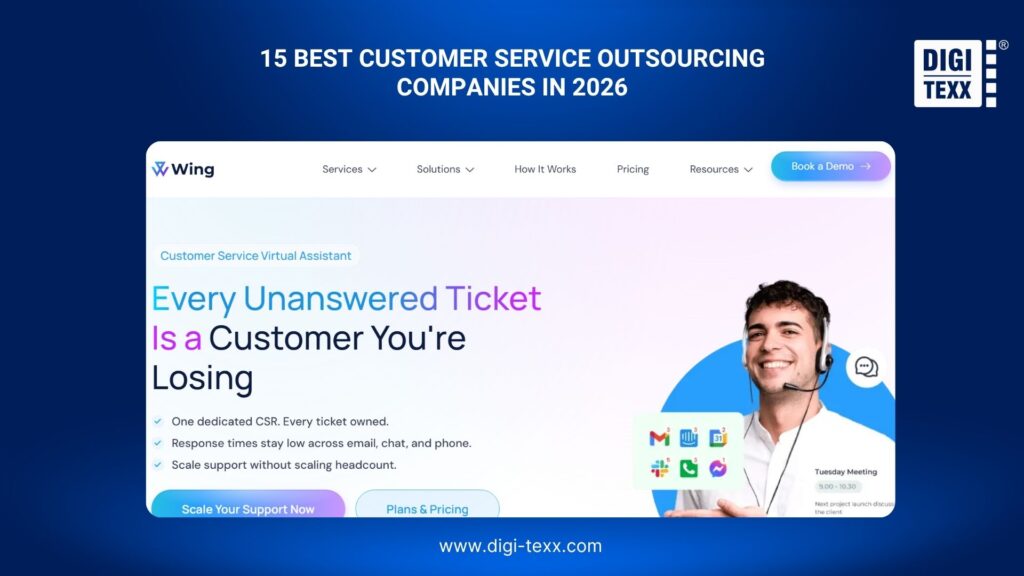
Wing uses a dedicated remote staffing model rather than a conventional shared contact center. Businesses can hire customer service representatives to handle tickets, emails, live chat, phone support, CRM updates, and related operational tasks.
The company states that dedicated agents can be deployed quickly and that a Success Manager oversees service quality. Its case studies also report measurable improvements, including faster response times and fewer manual follow-ups.
Best for: SMBs and growing companies that want dedicated remote customer service staff with more direct management control.
Pricing: Monthly subscription based on staffing requirements and plan structure.
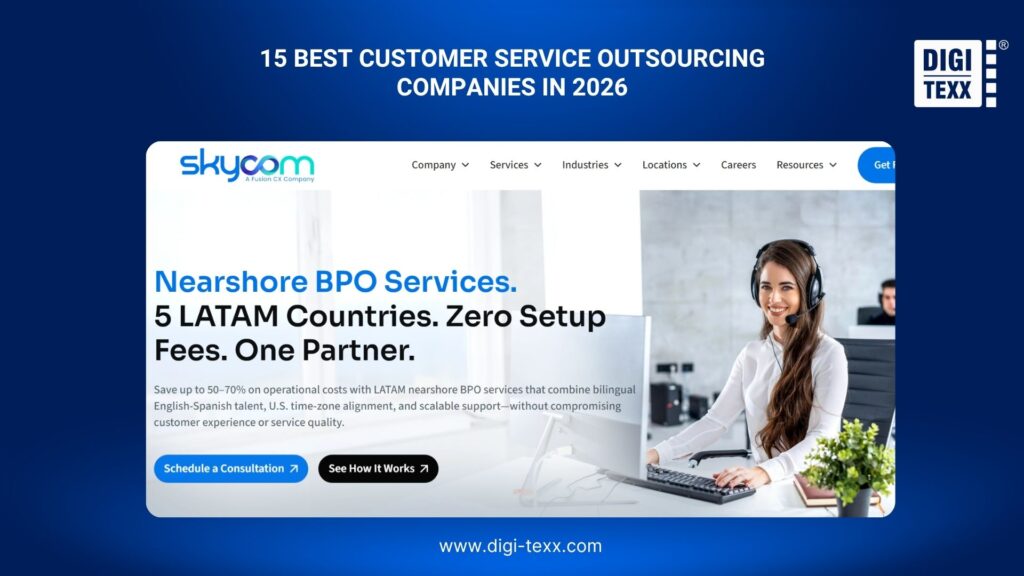
14. SkyCom
SkyCom provides onshore, nearshore, and offshore call center services, including inbound and outbound customer service, live chat, email, social media support, and specialized industry programs. Its nearshore operations include locations in Latin America.
SkyCom serves industries such as healthcare, telecommunications, financial services, travel, technology, and eCommerce. Programs can include real-time monitoring, daily QA, performance dashboards, and multilingual support.
Best for: Organizations with high-volume voice support or industry-specific call center requirements.
Pricing: Custom quote based on seats, channels, coverage, location, and compliance requirements.
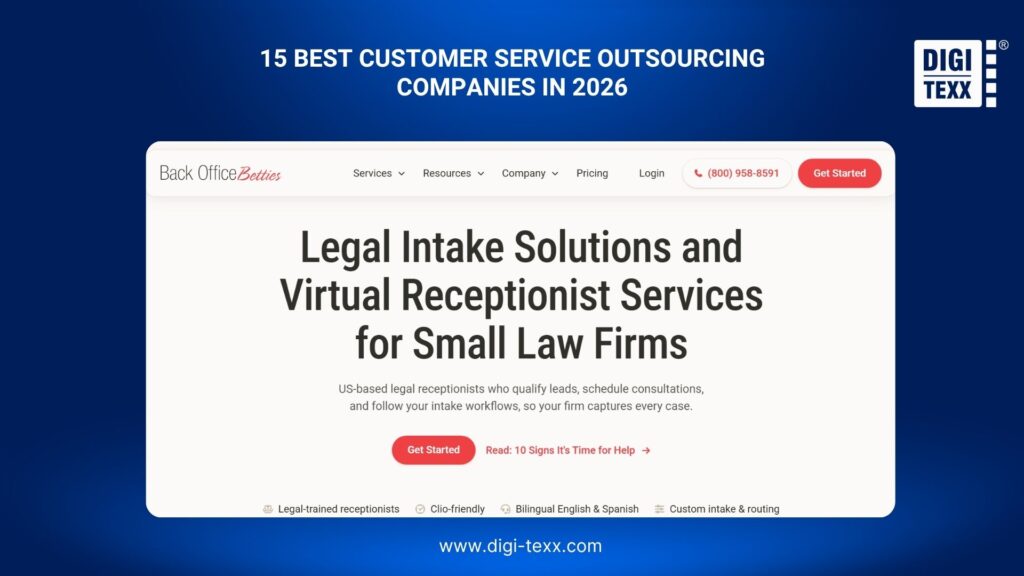
15. BackOfficeBetties
BackOfficeBetties is a specialized outsourcing provider for law firms, focusing on legal answering services and virtual legal assistants rather than general-purpose customer support.
Its receptionists handle client calls, message taking, intake, and appointment-related tasks, while virtual assistants can support broader administrative workflows. The company also works with legal platforms such as LawPay, PracticePanther, Lawmatics, and MyCase.
Best for: Solo attorneys and small to mid-sized law firms that need industry-specific call handling.
Pricing: Specialized monthly plans; publicly listed pricing should be checked directly with the provider because packages can change.
>>> See more:
- Back Office Support Services: Benefits, Types, Costs & Outsourcing Solutions
- Outsourced IT Help Desk Services for Businesses | DIGI-TEXX
- Professional Business Support Services | DIGI-TEXX
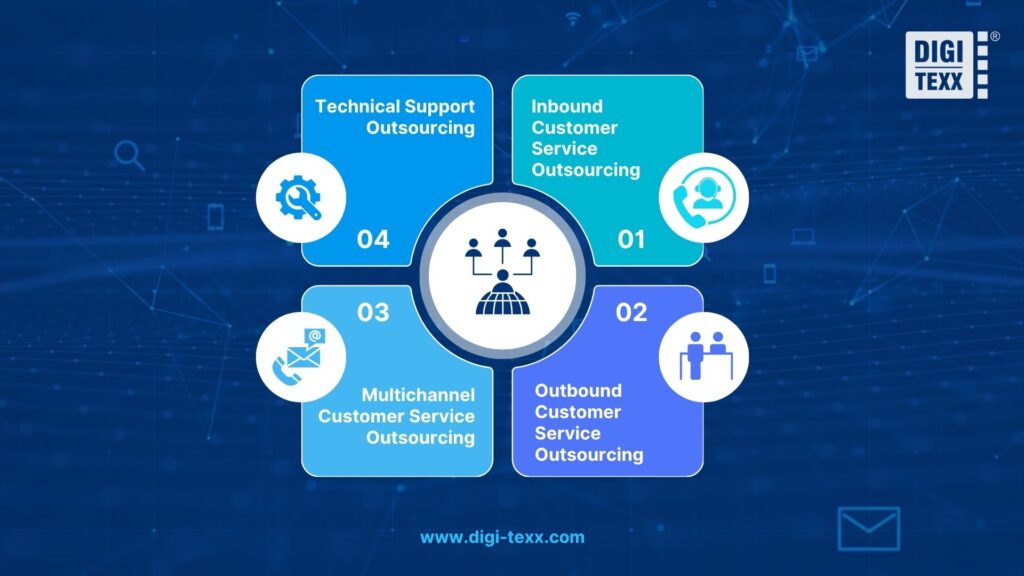
What Are The Main Types Of Customer Service Outsourcing?
Customer service outsourcing can be structured around the type of customer interaction, support channel, or expertise required. The right model depends on service volume, customer expectations, operating hours, and the complexity of issues handled.
Inbound Customer Service Outsourcing
Inbound customer service outsourcing focuses on handling customer-initiated interactions, such as questions, complaints, order inquiries, account requests, and service issues. Outsourced agents respond through phone, email, live chat, or messaging platforms based on the business’s support model.
This approach is useful when internal teams face high call volumes, long response times, or demand spikes. A provider can add trained agents and extended service hours without requiring the company to expand its internal customer service team at the same pace.
Outbound Customer Service Outsourcing
Outbound customer service outsourcing involves proactive interactions initiated by the support team. Common activities include customer follow-ups, satisfaction surveys, appointment confirmations, order updates, retention calls, and lead or customer re-engagement.
Because outbound interactions are more proactive, businesses should define clear contact rules, scripts, escalation procedures, and performance metrics. This helps outsourced agents represent the brand consistently while improving response rates and customer retention.
Multichannel Customer Service Outsourcing
Multichannel customer service outsourcing allows an external team to manage support across multiple communication channels, including phone, email, live chat, social media, SMS, and messaging apps.
The main advantage is continuity across channels. Instead of operating separate teams for different platforms, businesses can centralize workflows, customer information, and service standards with one outsourcing partner. This model is particularly useful for eCommerce and digital businesses where customers expect fast support through the channel they already use.
Technical Support Outsourcing
Technical support outsourcing transfers troubleshooting and product-related assistance to specialized external agents. Services can include help desk support, software troubleshooting, account assistance, product guidance, incident handling, and issue escalation.
This model is common among SaaS, technology, telecommunications, and digital product companies. Providers may use knowledge bases, ticketing systems, remote support tools, and AI-assisted workflows to help agents resolve routine issues while escalating more complex cases to internal specialists.
What Are the Pros And Cons Of Customer Service Outsourcing?
Customer service outsourcing can reduce the operational burden of maintaining an internal support team, but the results depend heavily on provider selection, training, security controls, and service governance.
Benefits of Outsourcing Customer Service
- Lower operating costs: Businesses can reduce expenses associated with recruiting, salaries, benefits, office space, equipment, and support infrastructure by using an established external team.
- Access to specialized expertise: Customer service outsourcing companies often have trained agents, QA teams, workforce managers, and support technologies already in place. This can shorten the time needed to build a capable support operation.
- Faster scalability: Outsourced teams can add or reduce capacity as ticket, call, or chat volumes change. This is particularly valuable during product launches, seasonal peaks, promotions, or rapid business growth.
- Extended service coverage: Businesses can provide evening, weekend, or 24/7 customer service without maintaining equivalent staffing levels internally.
- Multilingual support: Global businesses can access agents who support different languages and markets without establishing separate in-house teams for every region.
- Greater focus on core operations: By transferring repetitive customer service and administrative tasks to an external provider, internal teams can focus on product development, strategy, sales, and other higher-value activities.
Potential Drawbacks of Customer Service Outsourcing
- Less direct control: Outsourcing introduces another organization into customer-facing operations. Without clear SLAs, escalation rules, QA processes, and reporting, service quality may become inconsistent.
- Onboarding and training requirements: External agents still need to understand the company’s products, policies, customer personas, tone of voice, and workflows. Poor training can lead to inaccurate or inconsistent responses.
- Data security risks: Customer service teams may handle names, contact information, account details, payment-related information, or other sensitive data. Providers should therefore demonstrate appropriate security controls, access management, compliance, and data-handling procedures.
- Brand consistency challenges: Customers may notice differences in communication style if outsourced agents are not properly trained or monitored. Regular QA and performance reviews are essential to maintain the expected customer experience.
- Provider dependency: Over-reliance on one outsourcing partner can create operational risk if pricing, staffing, service quality, or business requirements change. Clear contracts, documentation, and contingency plans can reduce this risk.
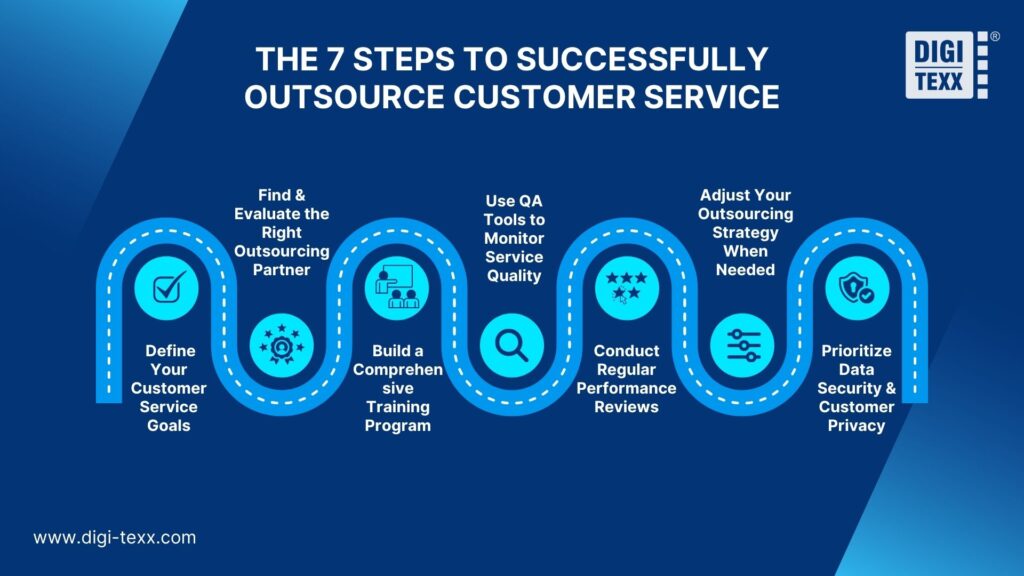
What Are the 7 Steps To Successfully Outsource Customer Service?
A successful customer service outsourcing program requires more than selecting a provider. Businesses need defined objectives, appropriate processes, ongoing quality control, and strong data governance.
1. Define Your Customer Service Goals
Start by identifying why customer service outsourcing is needed and what the external team should improve. Goals may include reducing first response time, increasing CSAT, extending support hours, lowering operating costs, or handling seasonal demand. Define measurable KPIs before selecting a provider so performance can be evaluated against a clear baseline.
2. Find And Evaluate the Right Outsourcing Partner
Compare providers based on their service capabilities, industry experience, support channels, geographic coverage, language capabilities, technology, security standards, and pricing model.
The cheapest provider is not necessarily the most cost-effective option. Businesses should evaluate whether a provider can meet required service levels and integrate with existing CRM, help desk, communication, and reporting systems.
3. Build A Comprehensive Training Program
Outsourced agents need more than a product overview. Training should cover company policies, customer personas, product knowledge, communication standards, escalation procedures, FAQs, and common scenarios.
A structured knowledge base and role-specific training can help agents become productive faster while reducing inconsistent responses.
4. Use QA Tools To Monitor Service Quality
Quality assurance should continue after onboarding. Businesses can use QA tools, call monitoring, ticket reviews, customer feedback, and AI-assisted conversation analysis to identify errors and training gaps.
Useful metrics include CSAT, first response time, average handle time, resolution rate, escalation rate, and quality scores. Automated QA can also help review larger volumes of customer interactions than manual sampling alone.
5. Conduct Regular Performance Reviews
Schedule regular reviews with the outsourcing partner to evaluate KPIs, SLA compliance, customer feedback, staffing levels, and recurring issues.
Performance reviews should lead to specific actions, such as updating training materials, adjusting staffing, improving workflows, or revising escalation rules.
6. Adjust Your Outsourcing Strategy When Needed
Customer service requirements can change as products, markets, and customer volumes evolve. If performance consistently falls below target, determine whether the problem is related to staffing, training, technology, workflow, or the outsourcing model itself.
Depending on the findings, businesses may increase capacity, change processes, move additional channels to the provider, or reconsider the scope of customer service outsourcing.
7. Prioritize Data Security and Customer Privacy
Before giving an external provider access to customer information, review its security controls, certifications, data access policies, encryption, employee access management, incident response procedures, and regulatory compliance.
A strong outsourcing agreement should also define data ownership, permitted data use, retention requirements, breach notification procedures, and responsibilities for protecting customer information.
Why Choose DIGI-TEXX For Customer Service Outsourcing Services?
DIGI-TEXX provides customer service outsourcing with multilingual, multichannel, and technology-enabled support. Its model combines customer-facing services with broader data and business process capabilities, making it suitable for organizations that need support operations connected to back-office workflows.
Experienced Customer Service Team
DIGI-TEXX provides 24/7/365 customer support with more than 1,200 employees and support capabilities covering 30+ languages. Services include customer inquiries, technical support, consultation, verification, and other business support activities.
The combination of customer service and data-processing capabilities can help businesses manage both customer interactions and related operational tasks through one provider.
Multichannel Customer Support
The service covers multiple customer touchpoints, including phone, email, live chat, messaging, social media, video, and mobile applications. This allows businesses to select channels based on customer behavior instead of relying exclusively on voice support.
For eCommerce operations, DIGI-TEXX also provides voice and non-voice help desk support across multiple languages.
Technology-Driven Service Delivery
Technology is used to support agent workflows, monitoring, reporting, and service quality. DIGI-TEXX also combines customer support with capabilities in document processing, data management, AI, and automation.
This is useful when customer service generates downstream tasks such as data verification, document processing, reporting, or compliance checks, rather than operating as a standalone contact center.
Flexible and Scalable Solutions
DIGI-TEXX offers different delivery and pricing structures, including hourly, transaction-based, volume-based, dedicated-resource, package, and pay-as-you-go models. This gives businesses more flexibility when support volumes fluctuate or when they want to start with a defined service scope.
Data Security and Quality Assurance
Security and QA are integrated into the service delivery model, with DIGI-TEXX citing ISO 27001 and GDPR among its security and compliance capabilities. Quality monitoring, reporting, and process controls help maintain consistent service standards across outsourced operations.

FAQs About Customer Service Outsourcing
Is IT Cheaper To Outsource Customer Service?
Yes, customer service outsourcing can be cheaper than running a fully in-house team, particularly when businesses need 24/7 coverage, multilingual support, or flexible staffing. Outsourcing can reduce expenses related to recruitment, salaries, training, office space, technology, and workforce management. However, the actual savings depend on support volume, service complexity, location, and pricing model, so businesses should compare total operating costs rather than hourly rates alone.
What Are 10 Examples Of Outsourcing?
Common examples of outsourcing include:
- Customer service outsourcing – handling customer inquiries, complaints, and support requests.
- Technical support outsourcing – providing help desk and product troubleshooting.
- Data entry outsourcing – transferring and processing business data.
- Document processing outsourcing – digitizing, classifying, and extracting information from documents.
- IT outsourcing – managing infrastructure, applications, or technical operations.
- Accounting outsourcing – handling bookkeeping, accounts payable, and financial processing.
- HR outsourcing – supporting recruitment, payroll, and employee administration.
- Content moderation outsourcing – reviewing user-generated content against defined policies.
- Ecommerce outsourcing – managing order processing, product inquiries, returns, and customer support.
- Back-office outsourcing – transferring administrative and operational tasks to an external provider.
Does AT&T Outsource Their Customer Service?
Yes, AT&T has historically outsourced parts of its customer care operations, while also maintaining internal customer service teams. An AT&T Wireless prospectus reported approximately 8,300 internal customer care representatives and about 3,000 additional outsourced representatives across nine locations.
AT&T’s current public materials emphasize improving customer service through technology, digital experiences, and AI, but they do not establish that all customer service is outsourced or handled entirely in-house. Therefore, the most accurate answer is that AT&T has used a mixed customer service model, with the balance changing by function and period.
Customer service outsourcing can be an effective way to scale support, extend service hours, access specialized talent, and optimize operating costs. However, the right results depend on choosing a provider that matches your service channels, customer volume, language requirements, security standards, and business goals. By comparing outsourcing models, evaluating providers carefully, and monitoring performance over time, businesses can build a customer service outsourcing strategy that improves both operational efficiency and customer experience.
DIGI-TEXX Contact Information:
🌐 Website: https://digi-texx.com/
📞 Hotline: +84 28 3715 5325
✉️ Email: [email protected]
🏢 Address:
- Headquarters: Anna Building, QTSC, Trung My Tay Ward
- Office 1: German House, 33 Le Duan, Saigon Ward
- Office 2: DIGI-TEXX Building, 477-479 An Duong Vuong, Binh Phu Ward
- Office 3: Innovation Solution Center, ISC Hau Giang, 198 19 Thang 8 street, Vi Tan Ward