
Document indexing services enable businesses to transform large volumes of unstructured files into structured, searchable data within modern document management systems. Without proper indexing, organizations spend excessive time retrieving information and risk falling short of data governance, security, and compliance requirements.
By combining data processing, data cleansing, and technologies like optical character recognition (OCR), businesses can significantly improve accuracy and accessibility. In this article, DIGI-TEXX will help you understand what document indexing is, how it works, and why professional services are essential for efficient search and data management.
>>> See more:
- Construction Invoice Reconciliation: Best Practices, Software & Outsourcing
- What Is A Back Office Service? Examples, Benefits, And Cost In 2026
- Intelligent Document Processing Services: How It Works & Business Benefits
- 20 Best Data Integration Tools: Definition, Benefits & Features
What Is Document Indexing?
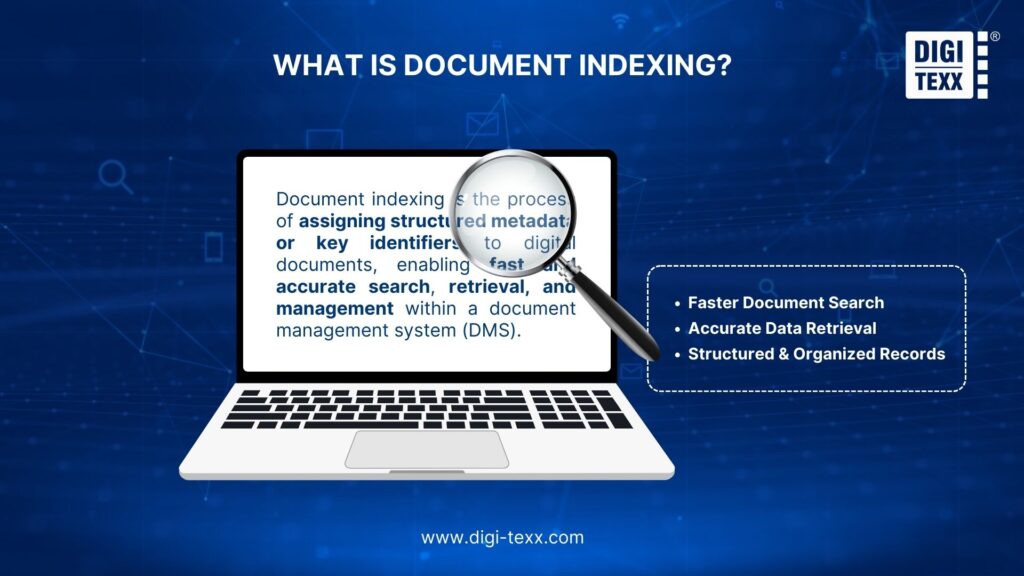
Document indexing is the process of assigning structured metadata or key identifiers to digital documents, enabling fast and accurate search, retrieval, and management within a document management system (DMS).
By tagging files with attributes such as client name, document type, date, invoice number, or employee ID, organizations create a searchable index that eliminates the need to manually browse through large volumes of data. When users enter keywords into a DMS, the system scans the indexed metadata and quickly returns relevant documents.
The effectiveness of document indexing depends on the accuracy and consistency of the metadata applied. Proper indexing ensures improved document accessibility, operational efficiency, and overall information control across the organization.
Why Is Document Indexing Important?
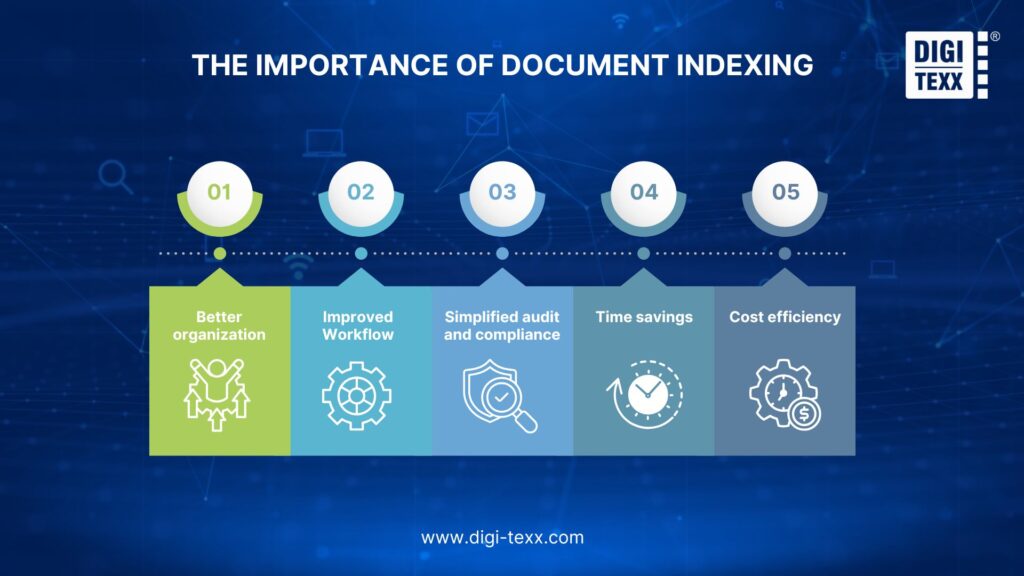
Document indexing is not only about faster file searches. It helps businesses organize information efficiently, improve collaboration, simplify compliance, and reduce operational costs.
Better organization
Many employees struggle to locate documents quickly. By applying structured metadata, indexing makes files easier to categorize, manage, and retrieve when needed.
Improved collaboration and workflow efficiency
When documents are clearly indexed and centrally stored, teams can access the right information without delays. This reduces bottlenecks, prevents duplicated work, and supports smoother cross-department collaboration.
Simplified audit and compliance
Documents indexed by fiscal year, department, or category can be retrieved instantly during audits. This minimizes last-minute preparation and lowers compliance risks.
Time savings
Studies show employees spend a significant portion of their time searching for information. Effective indexing reduces search time and allows teams to focus on higher-value tasks.
Studies show employees spend a significant portion of their time searching for information. According to research by Thomas H. Davenport, employees spend nearly 20 to 30 percent of their working time searching for and managing information. Effective indexing reduces search time and allows teams to focus on higher-value task
Cost efficiency
Greater accuracy, faster retrieval, and improved productivity ultimately contribute to lower operational expenses and stronger overall performance.
>>> See more:
- How To Prepare a Classified Balance Sheet: Template & Example
- Best Real Estate Image Processing Services 2026: Top 15 Providers
- Top 10 Outsourced AI Training Data Companies in 2026
- Top Data Entry Skills You Need to Get Hired in 2025
What Is The Process Of Indexing Documents?
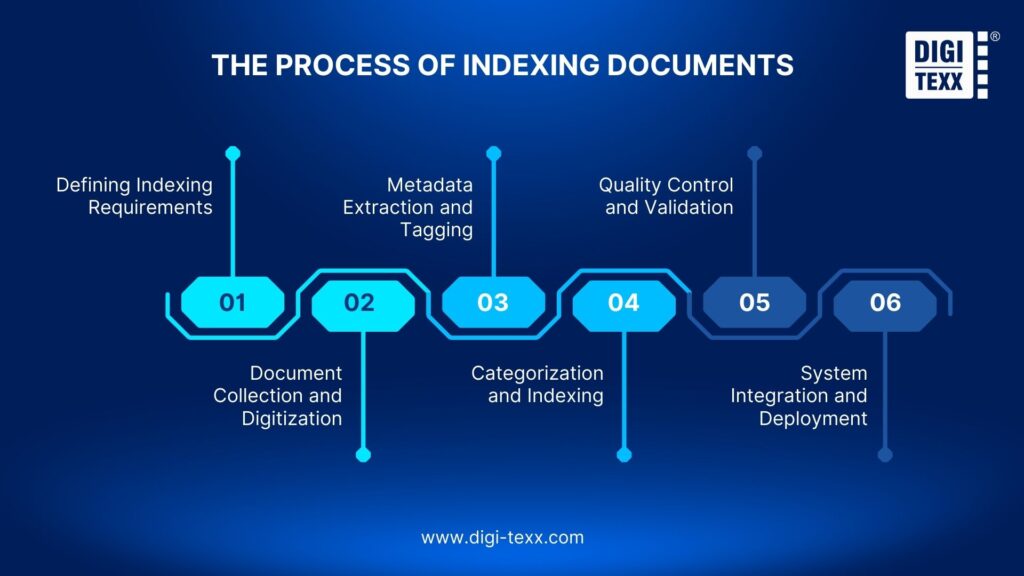
Document indexing follows a structured workflow designed to ensure accuracy, consistency, and easy retrieval. While the exact steps may vary depending on business needs, a typical indexing process includes the following stages:
Step 1: Defining Indexing Requirements
The process begins by identifying your document types, retrieval needs, and compliance requirements. Clear indexing rules and metadata fields are established to ensure consistency across all files.
Step 2: Document Collection and Digitization
Physical documents are scanned and converted into digital formats using an intelligent document scanning solution that helps automate capture, improve image quality, and prepare files for OCR processing.
Step 3: Metadata Extraction and Tagging
Key information such as names, dates, reference numbers, or document types is extracted and assigned as metadata. Depending on the document structure, this step may be automated using intelligent data capture tools, with manual review when necessary.
Step 4: Categorization and Indexing
Documents are organized into predefined categories and labeled according to the established indexing structure. This ensures that files can be retrieved quickly based on specific keywords or data fields.
Step 5: Quality Control and Validation
Each indexed file undergoes a thorough accuracy check. Duplicate documents are removed, metadata is verified, and inconsistencies are corrected to maintain data integrity.
Step 6: System Integration and Deployment
Finally, indexed documents and their metadata are securely imported into your Document Management System DMS or Enterprise Content Management ECM platform. Search functionality is tested to ensure optimal performance.
>>> See more:
- Top 10 Data Processing Software For Business 2026 – Best Tool Reviewed
- Top 10 Best Data Entry Outsourcing Companies in USA 2026
- What Is Business Process Outsourcing (BPO)? Definition & Benefits
- AI in Investing – How AI Technology is Shaping the Future of Investment Strategies
The Advantages Of Document Indexing
Document indexing helps organizations manage information more effectively by improving searchability, accuracy, and workflow efficiency. Below are the key benefits businesses can gain from implementing a structured indexing system.
Efficient Metadata Extraction
Using Intelligent Data Capture, we automatically extract key metadata and generate structured document indexes with speed and precision. This eliminates manual indexing and data entry, improving accuracy while accelerating processing time.
Consistent And Accurate Search Results
Automation applies consistent indexing standards so documents are categorized correctly and easy to find. By minimizing errors in data extraction and file labeling, organizations can rely on more accurate search results. Our multi-step, independent verification process adds an extra layer of quality control, ensuring accuracy rates of over 99 percent.
Automated Business Processes
Automated indexing streamlines document handling by eliminating repetitive manual tasks. This reduces human error, minimizes rework, and increases team productivity. It also allows businesses to scale their operations efficiently without adding extra costs.
Types Of Document Indexing
Different indexing methods serve different business needs. Depending on the document type, data structure, and search requirements, organizations can choose the most suitable approach to ensure fast and accurate document retrieval. Below are the most common types of document indexing used today.
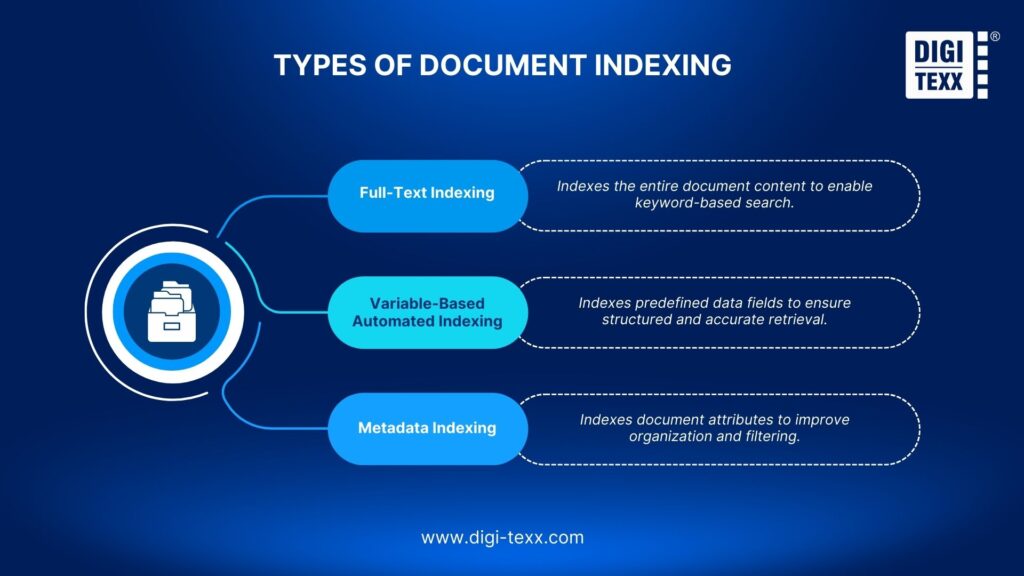
Full-Text Indexing
Full-text indexing scans the entire content of a document, allowing users to search for keywords or phrases anywhere within the text. It functions much like the “Find” feature in word processors or web browsers. This method is intuitive and user-friendly, making it easy to locate information quickly. However, because it indexes every word in the document, it typically requires more storage space.
Variable-Based Automated Indexing
Rather than scanning the whole document, variable-based indexing focuses on specific key fields such as customer names, account numbers, or invoice IDs. These data points are automatically matched with records stored in a database to ensure consistency and accuracy.
This method requires specialized indexing software but is highly effective for structured documents like invoices, application forms, and financial records, where predefined fields follow a consistent format.
Metadata Indexing
Metadata refers to “data about data.” Although the term may sound technical, the concept is simple. For example, when you take a photo with your smartphone, it automatically stores details like the date, time, and location. These details are metadata.
In document management, metadata indexing works in a similar way. When documents are scanned or digitized, important information such as document type, date, client name, or reference number is added as searchable tags. Instead of scanning the entire document during a search, the system scans this metadata, enabling faster and more efficient retrieval.
>>> See more:
- AI In BPO: Benefits, Applications, Challenges & Future Trends
- Outsourcing Advantages & Disadvantages: What Businesses Should Know?
- Supply Chain Business Process Outsourcing (BPO) 2026
Why Choose DIGI-TEXX for Document Indexing Services?
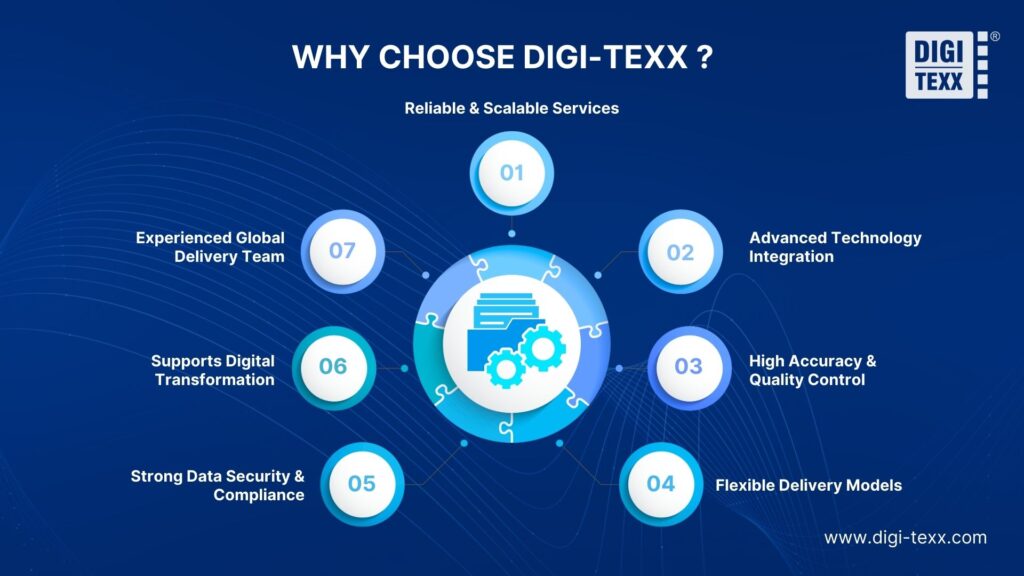
DIGI-TEXX delivers reliable, scalable, and secure document indexing services designed to help organizations manage information with greater accuracy and efficiency. With years of experience supporting global clients across industries, we combine advanced technology with rigorous quality control to ensure consistent results.
Our document indexing services leverage intelligent data capture, OCR, and automated workflows to reduce manual effort and accelerate processing times. Every project follows standardized indexing rules and undergoes multi-level quality checks to maintain high accuracy and data integrity.
We also offer flexible delivery models tailored to your operational needs, whether you require ongoing indexing support or large-scale backfile conversion. With strict data security protocols and compliance-focused processes, DIGI-TEXX ensures your documents remain protected at every stage.
By partnering with DIGI-TEXX, you gain a trusted provider of document indexing services that improves document accessibility, enhances workflow efficiency, and supports long-term digital transformation.
Industries That Benefit from Our Data Indexing Services
Our data indexing services help organizations manage large document volumes with greater accuracy, faster retrieval, and stronger compliance across industries.
Healthcare
Healthcare organizations handle large amounts of sensitive information, including patient records, medical histories, lab results, and insurance files. Accurate indexing ensures fast access to critical data while maintaining regulatory compliance and data security.
Education & Research
Schools and research institutions manage academic records, student information, research papers, and administrative documents. Structured indexing improves organization, simplifies retrieval, and supports long-term document management.
Finance & Banking
Financial institutions rely on precise documentation for loans, transactions, reports, and compliance records. Effective indexing enhances document control, speeds up audits, and reduces operational risk.
Legal & Government
Law firms and government agencies deal with contracts, case files, court documents, and policy records. Proper indexing ensures systematic organization, faster case preparation, and stronger compliance management.
Retail & E-Commerce
Retailers and e-commerce companies process invoices, purchase orders, shipping records, and inventory documents daily. Data indexing streamlines workflows, improves visibility, and supports smoother operations.
FAQs About Document Indexing Services
What Is The Best Way To Index Documents?
The most effective and reliable way to index documents is by using an automated system within a Document Management System DMS or Enterprise Content Management ECM platform. By leveraging AI and OCR technologies, this approach automatically reads, categorizes, and tags documents, delivering faster processing, higher accuracy, and greater efficiency than manual indexing.
What Is The Purpose Of Document Indexing?
The purpose of document indexing is to organize digital files by assigning key metadata such as dates, names, or reference numbers. This makes documents easy to search, retrieve, and manage within a centralized system. By turning unstructured files into searchable data, document indexing eliminates time-consuming manual searches and improves overall efficiency.
Effective document indexing services improve search speed, accuracy, compliance, and operational efficiency. By combining automation, OCR, and strict quality control, DIGI TEXX helps businesses transform unstructured documents into reliable, searchable information that supports smarter workflows and long-term digital growth.
DIGI-TEXX Contact Information:
🌐 Website: https://digi-texx.com/
📞 Hotline: +84 28 3715 5325
✉️ Email: [email protected]
🏢 Address:
- Headquarters: Anna Building, QTSC, Trung My Tay Ward
- Office 1: German House, 33 Le Duan, Saigon Ward
- Office 2: DIGI-TEXX Building, 477-479 An Duong Vuong, Binh Phu Ward
- Office 3: Innovation Solution Center, ISC Hau Giang, 198 19 Thang 8 street, Vi Tan Ward
Reference:
- AIIM. (n.d.). What is information management? Association for Intelligent Information Management https://www.aiim.org
- Dublin Core Metadata Initiative. (n.d.). DCMI metadata terms https://www.dublincore.org/specifications/dublin-core/dcmi-terms