
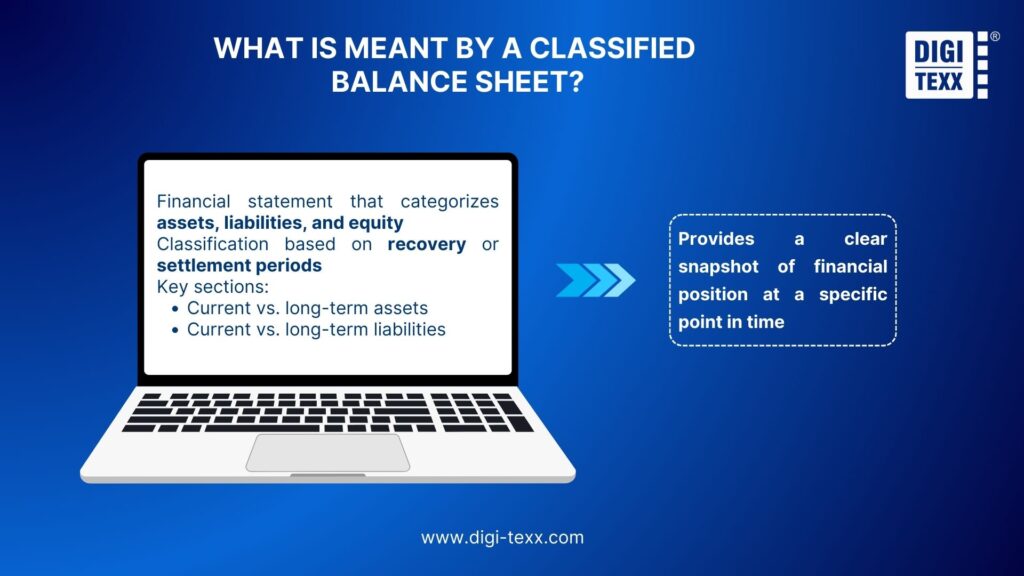
A classified balance sheet presents assets and liabilities in current and noncurrent groups, with equity shown separately. It reports financial position at a specific date and helps readers distinguish near-term resources and obligations from longer-term balances.
In this guide, DIGI-TEXX explains the classified balance sheet format, provides a worked example, and walks through nine preparation steps. It also highlights common classification mistakes and the records needed to support each balance. The example is educational; the applicable reporting framework and entity-specific facts determine the final presentation.
>>> See more:
- Best Insurance Claims Processing Outsourcing BPO in the US 2026
- Outsource Data Annotation Services to Scale Your AI Faster
- Outsourcing Data Cleansing: What You Need to Know
What Is a Classified Balance Sheet?
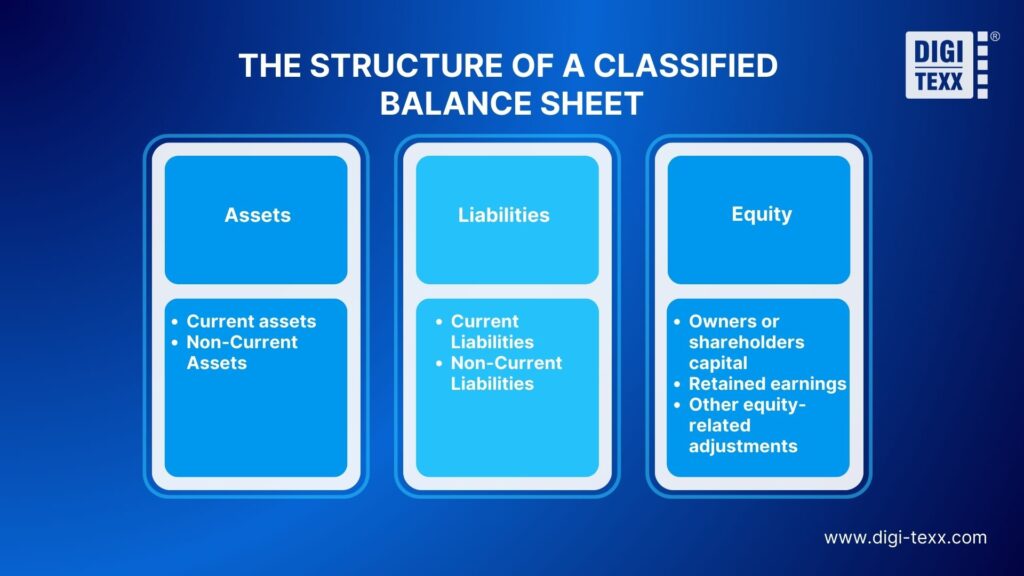
A classified balance sheet is a balance sheet with meaningful account groupings and subtotals. Its main sections are current assets, noncurrent assets, current liabilities, noncurrent liabilities and equity. Further categories, such as property, plant and equipment or intangible assets, can make material balances easier to understand.
Classification changes how information is presented; it does not change the accounting equation: Assets = Liabilities + Equity. Equity represents the residual interest after liabilities are deducted from assets. Unlike assets and liabilities, it is not normally split into current and noncurrent categories. See the SEC’s financial statement guide for the underlying balance sheet equation.
What Is The Purpose Of A Classified Balance Sheet?
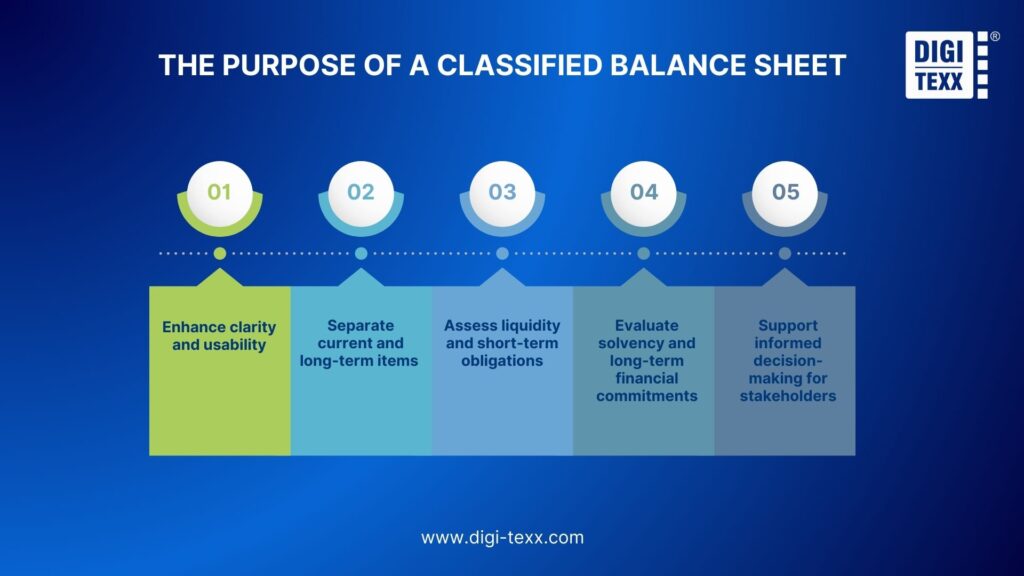
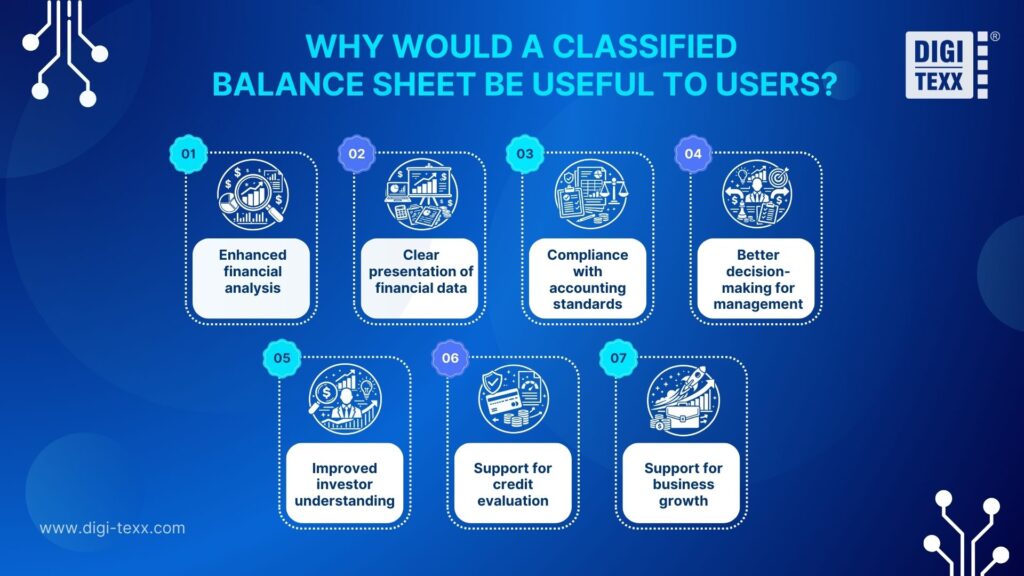
The purpose is to help readers see which resources support near-term payments and which balances relate to longer-term operations. Separate subtotals make working capital, debt maturities, and changes in financial structure easier to inspect.
Management can use these categories when planning collections and payments. Lenders can examine near-term obligations alongside available resources. Investors can compare how the business finances its assets. Consistent classifications across reporting periods support these comparisons, while notes explain material judgments and changes.
A classified statement does not prove that a company has enough cash to pay every bill. Receivables may be overdue, inventory may be slow-moving, and settlement dates may be concentrated. Read it alongside supporting schedules, cash flow information, and the other financial statements.
>>> See more:
- Top 10 Data Cleansing Companies for Businesses in 2026
- Outsource Data Annotation Services to Scale Your AI Faster
- Architectural Photo Editing Service in the US | Top 5 Providers
Classified Balance Sheet Example
The following hypothetical example expands the original article’s ABC Manufacturing balances. Amounts are in US dollars at an illustrative reporting date. It is not a DIGI-TEXX client case study, an audited statement, or a complete set of financial statements. The example assumes the balances shown as current qualify for current classification.
ABC Manufacturing — Classified Balance Sheet — Illustrative reporting date (USD)
| ABC Manufacturing — illustrative statement | USD |
| CURRENT ASSETS | |
| Cash | 90,000 |
| Accounts receivable, net | 100,000 |
| Inventory | 210,000 |
| Prepayments | 20,000 |
| Total current assets | 420,000 |
| NONCURRENT ASSETS | |
| Property, plant and equipment — cost | 1,400,000 |
| Less: accumulated depreciation | (300,000) |
| Property, plant and equipment — net | 1,100,000 |
| Recognized intangible assets, net | 180,000 |
| Total noncurrent assets | 1,280,000 |
| TOTAL ASSETS | 1,700,000 |
| CURRENT LIABILITIES | |
| Accounts payable | 100,000 |
| Accrued expenses | 50,000 |
| Current portion of borrowings | 30,000 |
| Total current liabilities | 180,000 |
| NONCURRENT LIABILITIES | |
| Long-term loans, excluding current portion | 650,000 |
| Total liabilities | 830,000 |
| EQUITY | |
| Contributed capital | 600,000 |
| Retained earnings | 270,000 |
| Total equity | 870,000 |
| TOTAL LIABILITIES AND EQUITY | 1,700,000 |
The statement balances: $1,700,000 in assets = $830,000 in liabilities + $870,000 in equity. The $30,000 current portion of debt is included only in current liabilities; the $650,000 noncurrent loan balance excludes that amount. Equipment is shown net of accumulated depreciation to avoid overstating assets.
Working capital = current assets − current liabilities = $420,000 − $180,000 = $240,000. Current ratio = current assets ÷ current liabilities = $420,000 ÷ $180,000 = 2.33 times. These figures describe the example, not a universal target or proof of cash availability.
Classified Balance Sheet Format and Structure
Use a clear sequence of asset, liability, and equity sections with subtotals that reconcile to the final totals. The example above uses a vertical report format. A side-by-side account format can show the same information. Required line items, comparative amounts and disclosures depend on the reporting framework; one educational template cannot establish compliance.
Assets
Current assets commonly include cash, trade receivables, inventory, and prepayments. Classification is not always a simple twelve-month test: the normal operating cycle, trading purpose, and restrictions on cash can matter. For example, inventory sold during a normal operating cycle longer than twelve months can still qualify as current under the relevant framework.
Noncurrent assets may include long-term investments, property, plant and equipment, and recognized intangible assets. Present carrying amounts after applicable depreciation, amortization, allowances, or impairment. Do not classify equipment as current merely because it could be sold quickly if its role remains long-term use in the business.
Liabilities
Current liabilities commonly include trade payables, accrued expenses, and the current portion of borrowings. Noncurrent liabilities can include the remaining portion of long-term loans. Review the normal operating cycle and the applicable rules for the right to defer settlement; contractual maturity alone may not resolve every classification.
For a loan with installments, split principal due in the near term from the remaining balance using the repayment schedule and reporting requirements. Covenant conditions, refinancing arrangements, and changes around the reporting date require framework-specific review. A standard current/noncurrent format should not be treated as a substitute for that assessment. Source: IAS 1 current/noncurrent presentation guidance.
Equity
Equity may include contributed capital, retained earnings, and other applicable components. Retained earnings reflect accumulated results and distributions, subject to relevant adjustments. Reconcile the closing equity balance to its supporting schedule rather than using equity as a balancing figure to hide a difference.
>>> See more:
- What are the 6 Steps of the Data Analysis Process?
- Manual vs. Automated Data Entry: Which Is Better for Your Business?
- Top 12 Data Entry Outsourcing Companies In United States
Why Is a Classified Balance Sheet Useful to Users?
The purpose explains why classification exists; practical analysis shows how readers use it. Start with the current asset and current liability subtotals, then inspect the composition behind those totals. In the example, a 2.33 current ratio includes $230,000 of inventory and prepayments, which are not the same as immediately available cash.
Management should investigate overdue receivables, stock that may not sell, and unusually large accruals. Lenders can compare scheduled repayments with expected cash resources. Investors can track changes in working capital and longer-term financing across periods. None of these assessments should rely on a single ratio in isolation.
Classification also supports a more traceable reporting process: each line should map to ledger accounts and reconciled schedules. Clear presentation helps reviewers locate inconsistencies, but it cannot correct inaccurate source records or guarantee that recognition and measurement are appropriate.
Classified vs. Unclassified Balance Sheet
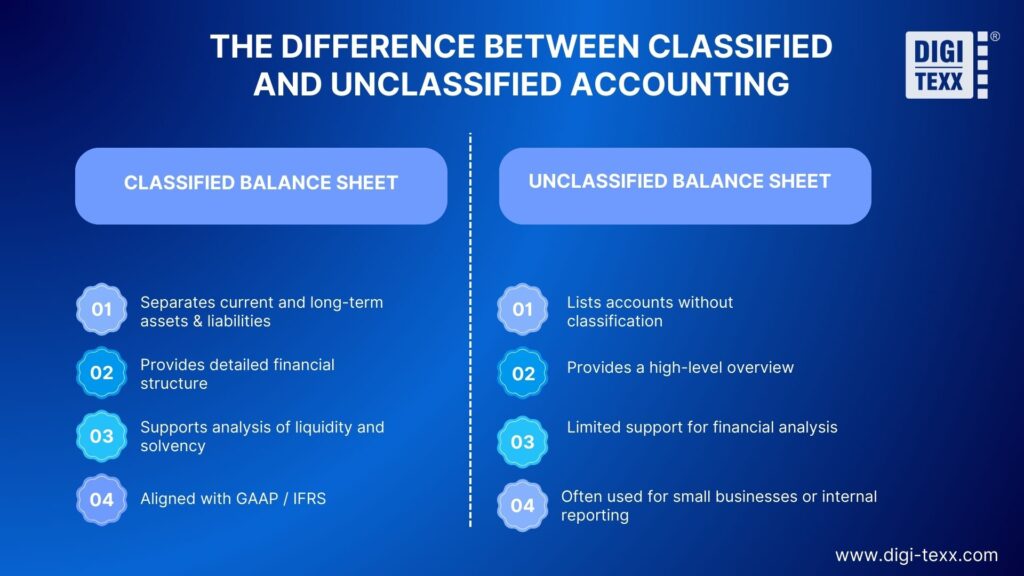
The distinction concerns balance sheet presentation, not two different accounting systems. Both formats report assets, liabilities, and equity; a classified format explicitly separates current and noncurrent balances, while an unclassified format does not provide that same separation.
| Dimension | Classified | Unclassified |
| Grouping | Separates current/noncurrent assets and liabilities and equity separately. | Lists balances without the same current/noncurrent separation. |
| Subtotals | Current/noncurrent subtotals are explicit. | Additional analysis may be needed to derive those subtotals. |
| Use | Supports working capital and maturity analysis. | Can serve as a simplified internal summary. |
| Accounting equation | Assets = liabilities + equity. | Same equation; presentation differs. |
| Compliance | Depends on the applicable framework and complete reporting requirements. | Do not assume an internal summary meets external reporting requirements. |
An unclassified internal summary should not be confused with a formal liquidity-based statement. Under IAS 1, presentation by liquidity can be appropriate when it provides reliable and more relevant information. The permitted format and required disclosures must be assessed under the applicable framework. Source: IAS 1 presentation guidance.
>>> See more:
- What Is Data Integrity? A Complete Guide for Businesses
- What Is Intelligent Document Recognition? Applications & Challenges
- How Automated Invoice Processing Saves Time and Reduces Errors?
How to Prepare a Classified Balance Sheet: Nine Steps
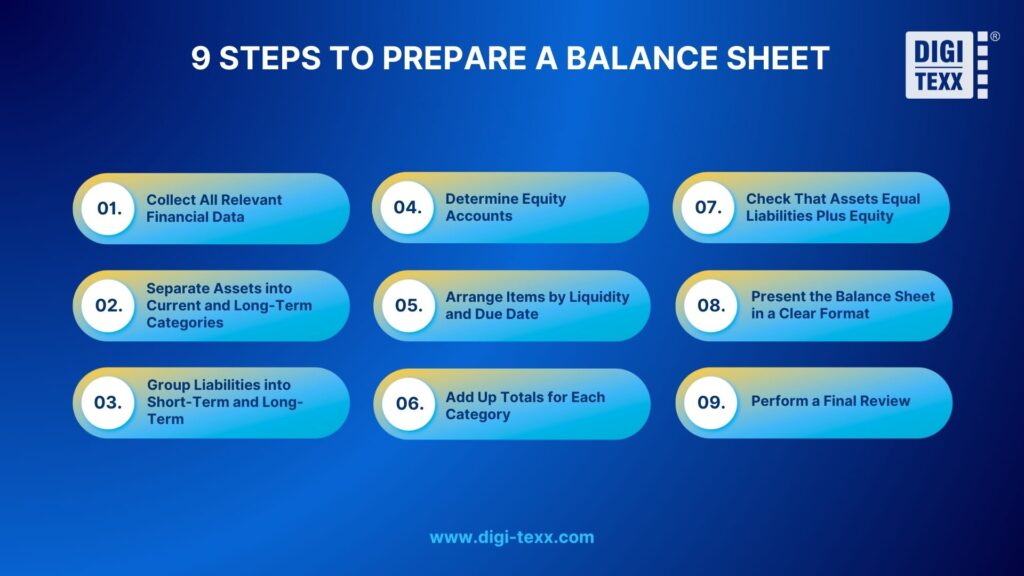
Start with reconciled accounting balances, apply the relevant classification rules, and retain a trail from each reported amount to its source. The following process preserves the nine steps in the original article and adds practical checks for implementation.
1. Collect All Relevant Financial Data
Set the reporting date, entity scope, currency, and reporting framework before preparing the statement. Gather the adjusted trial balance, general ledger, bank reconciliations, receivables and payables schedules, inventory records, fixed-asset register, borrowing schedules, and equity records. Check that all schedules relate to the same reporting cut-off.
Resolve missing documents, duplicate entries, and unreconciled differences before mapping balances into the statement. For invoice-based balances, retain the supporting invoice and approval record so the amount can be traced. Document processing can support this preparation, but accounting adjustments need appropriate review and authorization.
2. Separate Assets into Current and Noncurrent Categories
Map each asset account to a presentation category using its nature, expected realization or use, the operating cycle, and applicable classification requirements. Review restrictions on cash and separate current portions of longer-term receivables where required.
Tie receivables to the relevant aging schedule and valuation adjustments, inventory to the inventory records, and equipment to the fixed-asset register. Show net carrying amounts correctly. Record the reason for unusual classifications rather than assuming every asset held longer than twelve months belongs in the same category.
3. Group Liabilities into Current and Noncurrent Categories
Review payables, accrued expenses, tax balances, loans, and other obligations against their schedules. Identify amounts due in the near term and the noncurrent remainder. Check for conditions that could affect the right to defer settlement under the applicable framework.
For installment debt, split the balance rather than placing the entire loan in one section. In the worked example, $30,000 is current and $650,000 is noncurrent. Reconcile the two portions to the total borrowing balance and avoid recording the current portion twice.
4. Determine Equity Accounts
Identify contributed capital, retained earnings, and any other equity components applicable to the entity. Reconcile retained earnings from the opening balance through profit or loss, distributions, and relevant adjustments. Check the ownership structure before choosing labels such as shareholders’ equity or owner’s capital.
Revenue and expenses are not separate balance sheet categories. Their effect on accumulated earnings follows the accounting close and related adjustments. Never alter retained earnings simply to make the statement balance; investigate the underlying difference.
5. Arrange Items in a Consistent Presentation
Group like items together and use a sequence appropriate to the reporting framework and users. Current assets are often shown with cash and receivables before inventory and prepayments. Separate material noncurrent asset categories and show current and noncurrent liability subtotals clearly.
Maintain consistent labels and ordering across periods where appropriate, and explain material reclassifications. The objective is a readable statement whose categories can be traced to the accounts, not a rigid layout copied without regard to the entity’s circumstances.
6. Add Up Totals for Each Category
Calculate subtotals for current assets, noncurrent assets, current liabilities, noncurrent liabilities, and equity. Then calculate total assets and total liabilities plus equity. Check that each account has been included once and that contra-asset balances reduce the appropriate asset category.
In the example, $420,000 plus $1,280,000 gives total assets of $1,700,000. Liabilities of $180,000 plus $650,000 equal $830,000. Check formulas and range boundaries when using a spreadsheet, particularly after adding or moving rows.
7. Check That Assets Equal Liabilities Plus Equity
Confirm the accounting equation using the final statement totals. If the totals differ, investigate omitted accounts, duplicated balances, sign errors, closing entries, and incorrect formula ranges. Reconcile back to the adjusted trial balance and supporting schedules.
A balanced statement is necessary but does not prove that every account is correct. Moving a liability between current and noncurrent categories can leave the equation unchanged while distorting working capital. Review classification and valuation separately from the arithmetic check.
8. Present the Balance Sheet in a Clear Format
Show the entity name, report title, reporting date, and currency or unit of measure. Use distinct section labels and subtotals, with comparative amounts and note references when required. Keep the table readable in both desktop and mobile publication formats.
For a website example, publish the numeric statement as an HTML table rather than only as an image. Label hypothetical figures clearly and distinguish the reporting date from the article’s publication date. A template should indicate which fields users must adapt.
9. Perform a Final Review
Have the appropriate accounting reviewer check reconciliations, classification judgments, material movements, required disclosures, and consistency with other statements. Review difficult items under the relevant framework rather than assuming the general example covers them.
Record outstanding questions and obtain approval of the completed statement. Retain the final version, supporting schedules, and review evidence. If source records change, update the affected calculations and repeat the relevant checks before releasing the revised report.
Common Classified Balance Sheet Mistakes to Avoid
Applying a twelve-month shortcut to every balance: consider the operating cycle and applicable restrictions or settlement rights.
Classifying all borrowings as noncurrent: review installments and any conditions affecting classification.
Double-counting current debt: deduct the current portion from the noncurrent balance.
Treating equity as current or noncurrent: present its relevant components separately.
Confusing revenue with assets: distinguish earned revenue from cash collected, receivables, and customer advances.
Assuming a balanced equation proves accuracy: independently check source data, classification, and valuation.
FAQs About Prepare A Classified Balance Sheet
What Are the Advantages of a Classified Balance Sheet?
It separates near-term resources and obligations from longer-term balances, making working capital and financing structure easier to assess. The benefit depends on correct underlying data and classifications; the format alone does not ensure reliable reporting.
Where Does Revenue Go on a Classified Balance Sheet?
Revenue is reported in the income statement, not as a balance sheet line item. Related transactions can affect cash, receivables, or liabilities, while profit or loss affects equity through the reporting process. Cash received before the business earns it may represent a liability rather than revenue.
Is Inventory Always a Current Asset?
Inventory associated with the normal operating cycle may qualify as current even when that cycle exceeds twelve months. Apply the relevant framework and consider the facts; a one-year rule by itself is incomplete.
Where Does the Current Portion of Long-Term Debt Go?
It generally belongs in current liabilities when current classification is required. Present only the remaining qualifying amount in noncurrent liabilities. Check the borrowing schedule, settlement rights and applicable rules.
How Do You Calculate Working Capital from the Statement?
Subtract current liabilities from current assets. Using the example, $420,000 − $180,000 = $240,000. Working capital is a balance sheet measure and should not be confused with cash on hand.
What Is the Difference Between a Classified Balance Sheet and an Income Statement?
A balance sheet reports the financial position at a specific date. An income statement reports revenue, expenses and profit or loss over a period. Read both alongside cash flow information to understand financial position and performance.
Does a Classified Format Automatically Comply with GAAP or IFRS?
No. Recognition, measurement, classification, comparative information and disclosures must satisfy the applicable framework. Presentation can also vary by entity and circumstances. Consult the relevant requirements and obtain an appropriate accounting review.
How DIGI-TEXX Can Support Financial Data Preparation
Reliable financial reporting starts with organized source records. DIGI-TEXX’s document and data processing services and invoice processing services describe support for extracting and processing business documents. These services are relevant to preparing structured inputs for an accounting team’s reconciliation workflow.
Discuss the document types, fields to capture, validation rules, exception handling and export format with DIGI-TEXX. Agree a representative sample and acceptance process before production. The accounting team remains responsible for accounting judgments, account classification, adjustments and approval of the final financial statements.
Contact DIGI-TEXX to discuss document types, expected volume and the data fields your accounting team needs. Confirm the processing scope, delivery format and validation requirements before starting a project.
DIGI-TEXX Contact Information:
🌐 Website: https://digi-texx.com/
📞 Hotline: +84 28 3715 5325
✉️ Email: [email protected]
🏢 Address:
- Headquarters: Anna Building, QTSC, Trung My Tay Ward
- Office 1: German House, 33 Le Duan, Saigon Ward
- Office 2: DIGI-TEXX Building, 477-479 An Duong Vuong, Binh Phu Ward
- Office 3: Innovation Solution Center, ISC Hau Giang, 198 19 Thang 8 street, Vi Tan Ward
>>> See more:
- 7 Essential Steps in the Invoice Validation Process
- Offshore BPO | Advantages and Disadvantages of Outsourcing
- Product Photo Editing Services For eCommerce In The US
- Medical Claims Processing Outsourcing For Healthcare Providers
Referrence:
- IFRS Foundation (.org): https://www.ifrs.org/issued-standards/conceptual-framework/
- Financial Accounting Standards Board (FASB) (.org): https://www.fasb.org/
- SEC — Beginners’ Guide to Financial Statements
- IFRS Foundation — IAS 1 Presentation of Financial Statements
- IAS 1 current/noncurrent presentation guidance
- IFRS Foundation — IFRS 18 overview and transition
- DIGI-TEXX — Document and Data Processing Services
- DIGI-TEXX — Invoice Processing Services