
Outsourced data entry is becoming a strategic choice for U.S. businesses facing rising labor costs, growing data volumes, and stricter compliance demands. Managing it in-house is often expensive and inflexible, while outsourcing improves cost efficiency, data quality, and scalability. In this article, DIGI-TEXX explains what outsourced data entry is, outlines risk management considerations, and reviews 10 data entry outsourcing companies in the USA worth considering in 2026.
>>> See more:
- Outsource Data Annotation Services to Scale Your AI Faster
- Top 10 Data Cleansing Companies for Businesses in 2026
- Healthcare Back-Office Support Services For Efficient Operations
- Medical Claims Processing Outsourcing For Healthcare Providers
What Is Data Entry Outsourcing?
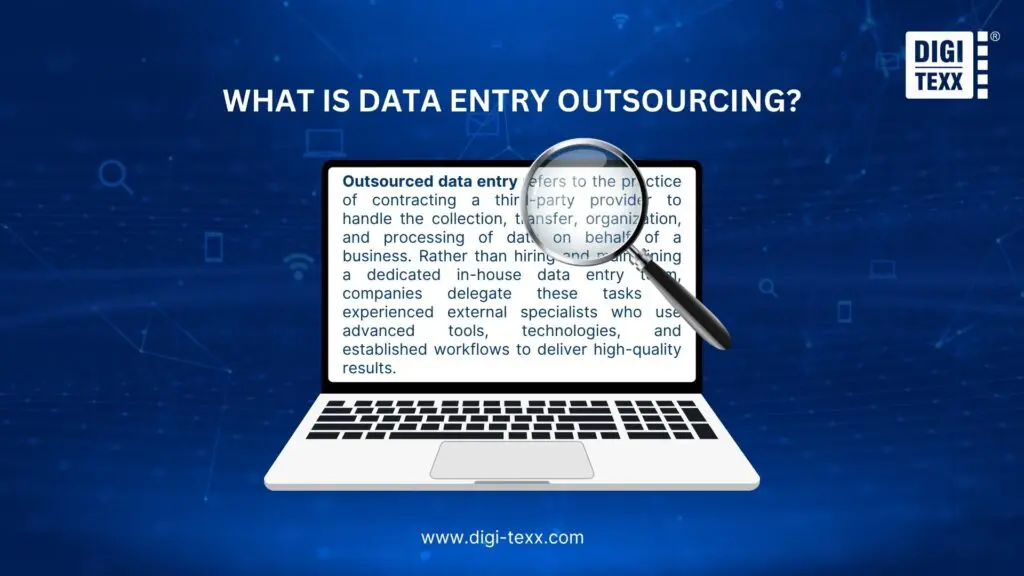
Outsourced data entry refers to the practice of contracting a third-party provider to handle the collection, transfer, organization, and processing of data on behalf of a business. Rather than hiring and maintaining a dedicated in-house data entry team, companies delegate these tasks to experienced external specialists who use advanced tools, technologies, and established workflows to deliver high-quality results.
At its core, data entry is the act of entering information from various sources, paper documents, scanned images, digital forms, emails, spreadsheets, into a company’s computer systems for processing, storage, and management. While the concept sounds straightforward, modern data entry encompasses a broad range of services that require specific skills, domain knowledge, and technological proficiency.
Data entry outsourcing involves establishing a partnership with a BPO company that assumes responsibility for encoding-related activities. Depending on the nature of the business, data can be in word or numeric form, and the scope of work can range from simple copy-paste tasks to complex data processing that involves cleaning, validating, classifying, and analyzing structured and unstructured information.
>>> See more:
- Secure Data Annotation Services: Top Companies & How to Choose
- Data Labeling Service: What It Is, Types & Benefits For AI
- 10 Best AI Process Automation Tools Free In 2026
Main Benefits Of Outsourced Data Entry Services
Outsourcing data entry services helps businesses reduce operational strain caused by repetitive, high-volume data tasks. By working with experienced providers, companies can lower costs, improve data quality, and keep internal teams focused on core business priorities.
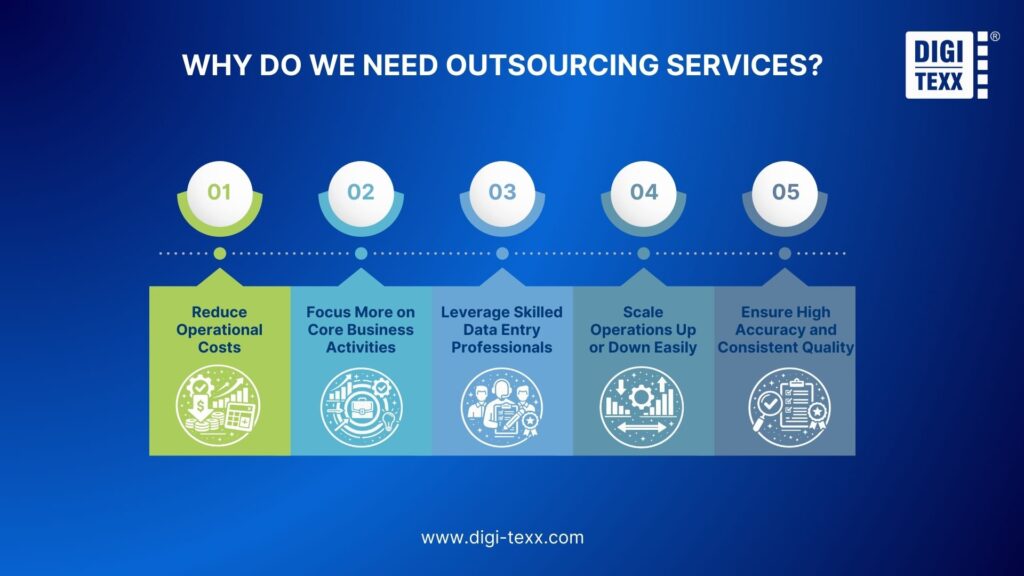
Reduce Operational Costs
Maintaining an in-house data entry team involves ongoing fixed costs such as salaries, training, and infrastructure. By utilizing professional data entry services, businesses can convert fixed labor costs into variable expenses, paying only for the volume of data processed rather than a full-time salary.
Focus More On Core Business Activities
Data entry is essential but not strategic for most companies. When internal teams get bogged down in manual data tasks, higher-value work like product innovation, customer experience, and market expansion can suffer. Outsourcing these routine tasks allows staff to concentrate on core operations that directly impact business growth and profitability.
>>> See more:
- Top 10 Data Processing Software For Business 2026 – Best Tool Reviewed
- Outsourced AI Training Data: Benefits, Providers & How To Choose In 2026
- Construction Invoice Reconciliation: Process, Best Practices & Software 2026
Leverage Skilled Data Entry Professionals
Outsourcing provides access to trained data entry professionals who are experienced with structured workflows and quality controls. This typically results in faster processing and higher accuracy than ad-hoc internal handling.
Scale Operations Up Or Down Easily
Data volumes often fluctuate due to seasonality or project-based work. Outsourcing enables businesses to scale data entry capacity up or down quickly without the risks of hiring or downsizing internal staff.
Ensure High Accuracy And Consistent Quality
Errors in data entry can have compounding effects on reporting, analytics, compliance, and operational decisions. Outsourcing data entry services typically involves rigorous quality control processes, multi-stage verification, and standard workflows that reduce human error and ensure consistent, reliable output. This results in data that can be trusted for decision-making and business continuity.
>>> Explore more:
- Best Real Estate Image Processing Services 2026: Top 15 Providers
- Prepare A Classified Balance Sheet: Steps, Format & Example 2026
- Healthcare BPO Services: Overview, Benefits & Key Solutions 2026
Types Of Data Entry With Examples
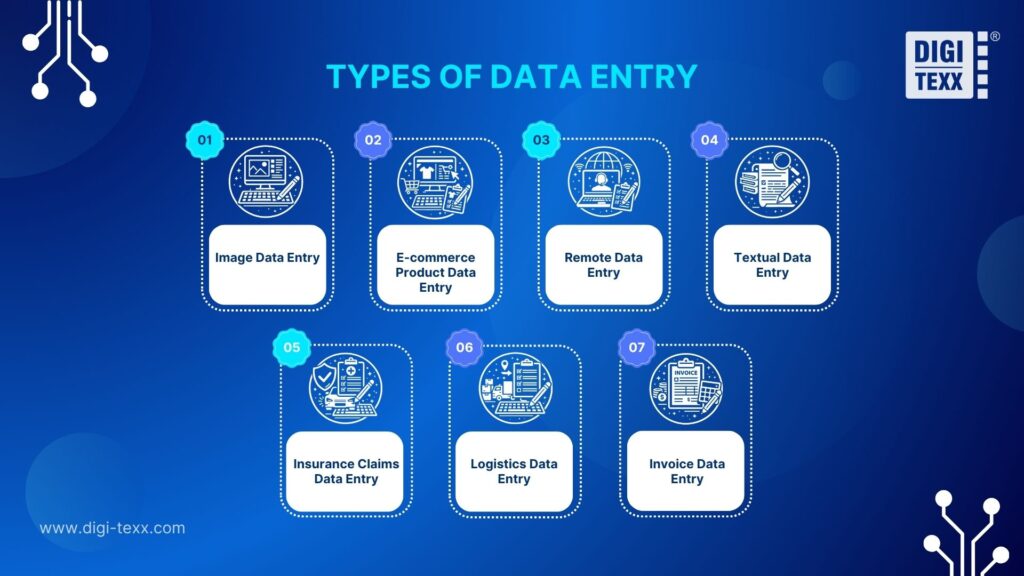
Data entry includes multiple task types depending on data sources, formats, and business use cases. Understanding these differences helps companies decide which data entry tasks are suitable for outsourcing and how to manage them effectively. Below are the most common types of data entry:
Image Data Entry
Image data entry converts scanned documents, handwritten forms, and image-based files into structured digital records. Providers combine OCR technology with manual verification to minimize extraction errors. Healthcare, insurance, and finance organizations outsource image data entry to digitize patient intake forms, lab reports, and policy documents without diverting internal staff from core operations.
>>> See more:
- Best Insurance Claims Processing Outsourcing BPO in the US 2026
- Outsourcing Data Cleansing: What You Need to Know
- Professional E-commerce Data Entry Services by DIGI-TEXX
E-commerce Product Data Entry
E-commerce product data entry involves entering, standardizing, and updating product titles, descriptions, prices, SKUs, and images across online sales channels. Retailers and multi-channel brands outsource this task to maintain catalog accuracy during frequent pricing updates and new product launches, ensuring consistent listings across platforms such as Amazon, Walmart, and Shopify.
Remote Data Entry
Remote data entry is the process of entering, updating, and maintaining business data through secure online systems such as CRM platforms, ERP software, and cloud databases, performed by offshore or distributed teams. B2B companies and SaaS businesses outsource remote data entry to standardize lead data, deduplicate CRM records, and ensure sales teams operate with accurate, up-to-date information.
Textual Data Entry
Textual data entry involves entering and validating text-based information from documents such as contracts, reports, emails, and forms into structured, searchable systems. Legal firms, HR departments, and consulting organizations outsource textual data entry to reduce administrative workload and improve document accessibility without disrupting professional staff.
Insurance Claims Data Entry
Insurance claims data entry focuses on capturing claim details, including policy information, incident reports, and settlement data, into processing systems using standardized templates. Insurance providers outsource claims data entry during volume spikes to prevent processing backlogs and maintain accuracy across scanned forms, photographs, and handwritten reports.
Logistics Data Entry
Logistics data entry covers the entry of shipment details, tracking numbers, delivery statuses, and inventory records into logistics management systems. Logistics providers and 3PL companies outsource this task to maintain real-time data accuracy across multiple carriers and formats, improving supply chain visibility during peak shipping periods.
Invoice Data Entry
Invoice data entry captures vendor information, invoice amounts, payment terms, and tax data from scanned and PDF invoices into accounting systems such as ERP and AP platforms. Manufacturing, retail, and finance organizations outsource invoice data entry to accelerate payment cycles, reduce reconciliation errors, and improve financial control across high invoice volumes.
>>> See more:
- What are the 6 Steps of the Data Analysis Process?
- Top 12 Data Entry Outsourcing Companies In United States
- Manual vs. Automated Data Entry: Which Is Better for Your Business?
Challenge Of Outsourced Data Entry
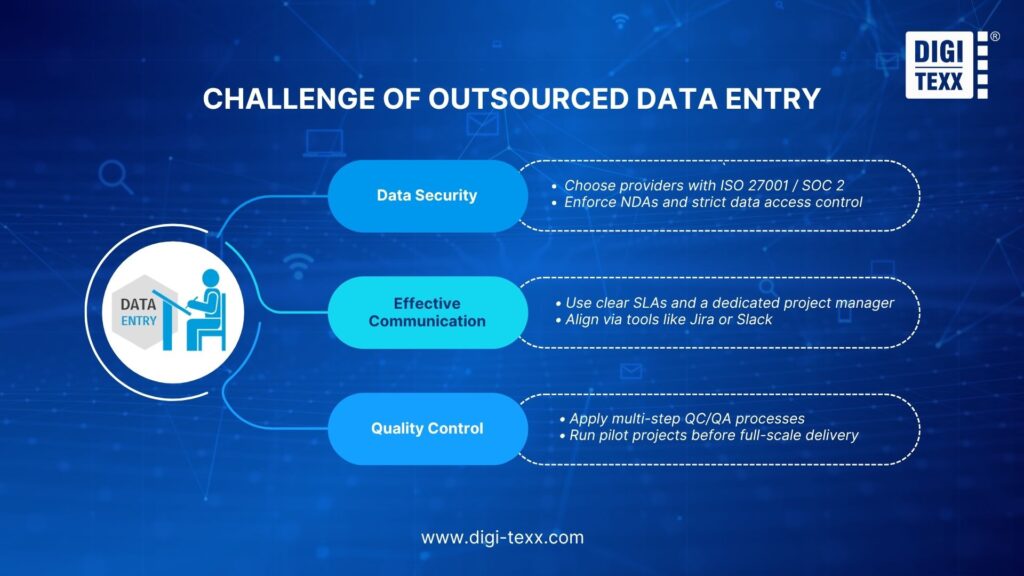
Outsourcing data entry also carries risks related to data security, communication, and quality control. Understanding these 3 challenges is essential to managing outsourcing relationships effectively.
Data Security
Data security is a major concern in data entry outsourcing, as weak controls can lead to customer data leaks and violations of regulations such as HIPAA or GDPR. To mitigate this risk, businesses should work with outsourcing partners that hold recognized security certifications like ISO 27001 and SOC 2, and enforce strict nondisclosure agreements (NDAs) to protect sensitive information.
Effective Communication
Poor communication can cause misunderstandings and project delays, especially when outsourcing teams operate across different time zones. Without clear coordination, work may not align with original requirements. This issue can be addressed by using project management platforms such as Jira or Slack and scheduling regular meetings with a dedicated project manager to ensure clarity and progress alignment.
Quality Control
Quality control becomes challenging when data entry is performed externally, as output may fail to meet required standards and contain frequent errors. To ensure reliable results, businesses should apply a two-layer quality control process (QC/QA) and conduct pilot runs before full implementation to validate data accuracy and consistency.
>>> See more:
- What Is Intelligent Document Recognition? Applications & Challenges
- How Automated Invoice Processing Saves Time and Reduces Errors?
- What Is Data Integrity? A Complete Guide for Businesses
Top Industries Using Data Entry Outsourcing Services
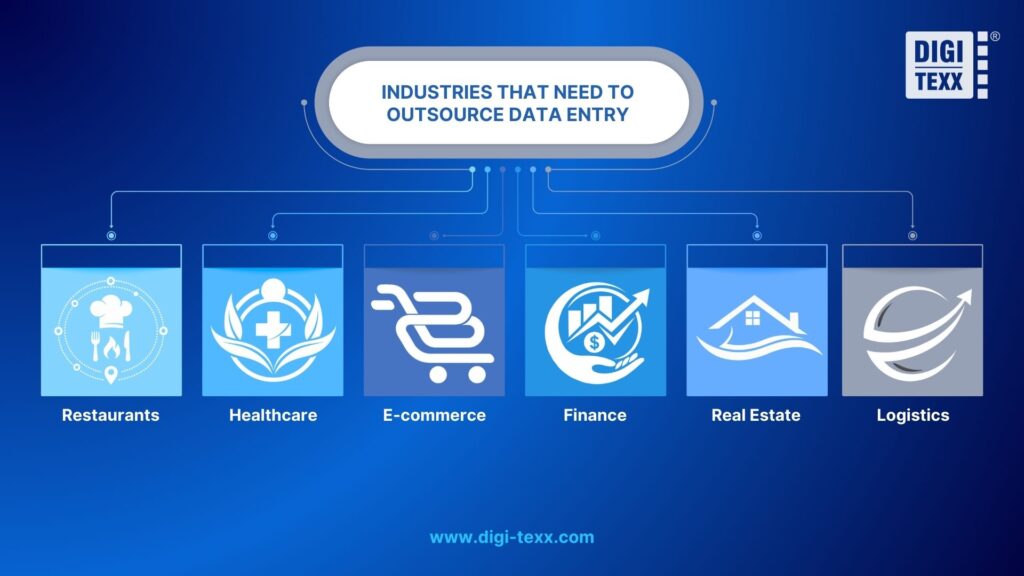
Outsourcing data entry benefits industries with high data volumes and time-sensitive workflows. By offloading repetitive tasks, businesses can improve efficiency and let internal teams focus on strategic priorities.
Restaurants
Restaurants generate data from reservations, POS transactions, inventory usage, and customer feedback daily. Managing this data internally can divert staff from customer service and kitchen operations. Outsourcing helps standardize menu updates, inventory logs, and reservation records so operations run smoothly without distracting frontline teams.
Healthcare
Healthcare generates large amounts of sensitive data such as patient records, billing information, laboratory results and insurance claims. Outsourcing data entry ensures accurate digitization of medical forms and administrative records while allowing clinicians to focus on patient care and compliance requirements.
E-commerce
E-commerce companies must manage product listings, inventory changes, order records and customer data across multiple channels. Outsourcing product data updates and order entry enables retailers to keep catalogs accurate and stock levels synchronized without pulling internal staff off growth initiatives.
>>> See more:
- Product Photo Editing Services For eCommerce In The US
- Administrative Support Outsourcing: 2026 Complete Guide
- Medical Claims Processing Outsourcing For Healthcare Providers
Finance
The finance sector processes huge volumes of transactional and reporting data such as invoices, ledgers, payroll, and audit logs. Outsourcing financial data entry facilitates accurate invoice recording, reconciliations and reporting that meet industry standards while lowering administrative burden.
Real Estate
Real estate organizations manage multiple data types including property listings, client leads, legal documents, and transaction histories. Outsourcing data entry helps property managers and agents handle large volumes of listing updates and client information without distracting them from client engagement and closing deals.
Logistics
Logistics relies on accurate tracking of shipments, inventory, delivery statuses and carrier data. Outsourcing logistics data entry ensures real-time updates and clean records that help companies meet delivery commitments and optimize routing and warehouse operations.
>>> See more:
- Top 10 Automated Document Processing Software for 2026
- Define Business Process Outsourcing (BPO): Meaning, Examples & Benefits 2026
- Top CRM Data Cleaning Solutions for 2026
Best 10 Data Entry Outsourcing Companies In USA For 2026
Below is a curated list of data entry outsourcing companies serving U.S. businesses in 2026. By evaluating service scope, delivery models, and outsourced data entry reviews, businesses can better identify partners that align with their operational and compliance needs.
1. DIGI TEXX
DIGI-TEXX is a German-origin data entry and data processing service provider with over 20 years of experience in the BPO and digital services sector. The company delivers data entry, document digitization, and data extraction services for businesses. With a continuous operating model and multilingual support capabilities, DIGI-TEXX is particularly suitable for organizations handling large data volumes that require long-term stability and scalability.
Features
- Targeted domain experience: DIGI-TEXX brings hands-on experience in managing both structured and unstructured data workflows, aligning data entry operations with broader operational needs rather than treating entry as a stand-alone task.
- Focus on data accuracy: DIGI-TEXX applies standardized workflows with multi-stage validation and controlled manual review, minimizing errors and improving the reliability of dataset outputs.
- Security and data governance: DIGI-TEXX complies with security standards such as ISO 27001 and GDPR requirements, supporting confidentiality and regulatory compliance for sensitive or regulated data.
- Technology-assisted processing: DIGI-TEXX incorporates tools like OCR and data extraction automation to reduce repetitive manual work and improve throughput without sacrificing quality.
- Integration with business systems: DIGI-TEXX demonstrates the capability to integrate data entry outputs with CRM, ERP, or analytics platforms, reducing friction between entry tasks and downstream systems.
2. Digital Minds BPO
Digital Minds BPO is a data entry outsourcing provider headquartered in Naga City, Philippines, offering cost-competitive services such as invoice data entry, CRM entry, e-commerce product data, and copy-paste tasks. The company is particularly strong in e-commerce data tasks and catalog management, making it a practical option for organizations looking to outsource recurring digital workflows without large internal resource investment.
Features
- Cost-competitive pricing structure suited for SMBs and growing e-commerce brands.
- Strength in e-commerce catalog management and product data standardization.
- Trained data entry teams with secure workflows and scalable execution.
- Suitable for organizations outsourcing CRM and recurring digital operations.

3. Acquire BPO
Acquire BPO is an international outsourcing company headquartered in Melbourne, Australia, with operations across multiple global offices. Originally established in 2005, Acquire has expanded from contact services into a broader BPO provider supporting industries such as healthcare, insurance, finance, and telecommunications.
Features
- Services spanning data entry, data cleansing, and payment processing support.
- Established global delivery infrastructure with consistent operational standards.
- Suitable for enterprises seeking scalable outsourcing solutions across multiple industries.
- Long-track record of accuracy and consistency in operational data handling.
4. Ardem Incorporated
Ardem Incorporated is a US-based outsourcing company headquartered in New Jersey, providing data entry and back-office data processing services, with a focus on logistics data entry, healthcare data entry, and order processing. The company combines technology-enabled workflows with structured quality controls, serving businesses in accounting, logistics, retail, manufacturing, and healthcare.
Features
- Specialized expertise in logistics, healthcare, and order processing data entry.
- Technology-enabled workflows with structured quality controls.
- Domestic US presence provides easier compliance alignment for regulated industries.
- Suitable for transaction-heavy or operational data environments.

>>> See more:
- Top 10 Best big data processing tool for Business 2026
- 15 Best Data Labeling Service Providers In 2026
- Why Businesses Outsource Data Management in 2026?
5. Rely Services Inc.
Rely Services Inc. is a US-based outsourcing company headquartered in Illinois, with more than 20 years of experience in data entry and business process outsourcing. The company provides services including online and offline data entry, data extraction, data collection, and catalog management, supporting organizations across both the private and public sectors.
Features
- Broad service range covering online/offline data entry, extraction, and collection.
- Industry experience across healthcare, mortgage, insurance, and finance.
- Suitable for businesses requiring scalable data processing aligned with compliance needs.
- Over two decades of operational track record serving public and private sector clients.

6. WNS Global
WNS Global is a multinational Business Process Management (BPM) provider headquartered in Mumbai, India, with a global delivery network spanning dozens of offices worldwide. With a workforce of over 59,000 professionals, WNS supports large enterprises across industries such as finance, accounting, customer experience, human resources, and data analytics.
Features
- Enterprise-grade data management, analytics, and cloud-based solutions.
- Scale and integration capabilities for high-volume data processing environments.
- Advanced analytics combined with standard data entry and processing operations.
- Suitable for global organizations requiring governance-grade delivery standards.
7. Open Access BPO
Open Access BPO is an outsourcing service provider headquartered in Makati, Philippines, offering data management and back-office support services to international clients. The company specializes in data management, data verification, data categorization, and data mining.
Features
- Multilingual teams supporting international clients across diverse markets.
- Services covering data verification, categorization, and mining workflows.
- Standard data protection practices supporting privacy and security requirements.
- Client-centric operating model emphasizing clear communication and consistent quality.
>>> See more:
- Steps Of Data Analysis: 6 Key Stages Explained With Real Examples
- Professional Fashion Photo Editing Services for Stunning Visuals
- How to Automate Documentation in 2026: Step By Step Guide
8. Cogneesol
Cogneesol is an outsourcing company headquartered in Punjab, India, with more than 15 years of experience in data processing and data entry services. The company supports multiple industries, offering services such as QuickBooks data entry, legal data entry, and image data processing, with real estate data entry as its core strength.
Features
- Core strength in real estate data entry and property management workflows.
- Services spanning QuickBooks entry, legal data, and image data processing.
- Experienced personnel combined with purpose-built data processing tools.
- Well-suited for organizations managing large volumes of structured and semi-structured data.
9. Invensis Technologies
Invensis Technologies is a global outsourcing provider headquartered in Bengaluru, India, delivering data entry and business process outsourcing services to international clients. With operations scaled to thousands of professionals, Invensis serves industries such as banking, e-commerce, and telecommunications.
Features
- Online and offline data entry, outsourced payroll processing, and e-book data entry.
- Multi-function outsourcing model combining data processing with broader BPO support.
- Capable of handling recurring, data-intensive workloads at enterprise scale.
- Suitable for organizations seeking a consolidated outsourcing partnership.

10. Premier BPO
Premier BPO is a US-based outsourcing company headquartered in Tennessee, providing data entry and back-office support services to businesses of various sizes. Premier BPO is particularly suitable for small and mid-sized businesses, including first-time outsourcing adopters, that seek flexible, personalized support without complex implementation requirements.
Features
- Focus on data entry, data cleansing, and data analysis for SMB clients.
- Flexible, personalized service model with low implementation complexity.
- Emphasis on cost control, consistency, and alignment with client-specific goals.
- Accessible entry point for organizations new to outsourcing data operations.
How To Choose The Right Outsourced Data Entry Company?
Selecting the right outsourcing partner is one of the most consequential decisions a business will make in its data management journey. The following criteria provide a framework for evaluating potential providers:
- Reputation and track record: Look for companies with verifiable client testimonials, published case studies, and a proven history of delivering accurate and timely work. A strong reputation is the most reliable indicator of consistent service quality.
- Technology and infrastructure: The best providers leverage advanced technologies including OCR, AI-assisted data extraction, robotic process automation, and cloud-based collaboration platforms. Confirm that the provider’s technology stack is compatible with your existing systems.
- Data security and compliance: Verify that the provider holds relevant certifications (ISO 27001, HIPAA, GDPR compliance, PCI DSS as applicable) and can provide detailed documentation of their security policies and access controls.
- Industry expertise: Choose a provider with demonstrated experience in your specific industry. Domain knowledge ensures that specialists understand the nuances of your data, the regulatory requirements you operate under, and the terminology used in your field.
- Scalability and flexibility: Confirm that the provider can scale services up or down based on your evolving needs, and that their pricing model is transparent and aligned with the variable nature of your data volumes.
>>> See more:
- 5 Key Indicators Of A Business Process Outsourcing Provider You Should Track
- Supply Chain Business Process Outsourcing (BPO) 2026
- AI In BPO: Benefits, Applications, Challenges & Future Trends
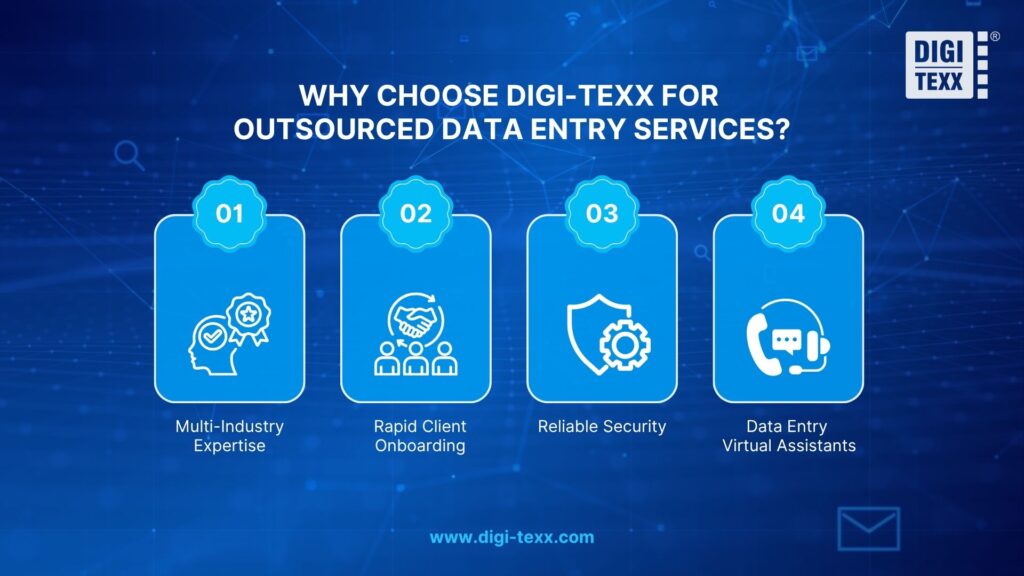
Why Choose DIGI-TEXX For Outsourced Data Entry Services?
Among the many providers operating in the outsourced data entry market, DIGI-TEXX stands out as a particularly compelling choice for businesses seeking a reliable, technology-forward partner. Here is why DIGI-TEXX deserves serious consideration for your organization’s data entry needs:
Multi-Industry Expertise
DIGI-TEXX has built deep domain knowledge across a wide range of industries, including finance, healthcare, insurance, e-commerce, and logistics. This breadth of expertise means that clients benefit not only from general data entry proficiency but from specialists who understand the specific requirements, regulatory frameworks, and data formats relevant to their sector.
Whether you need HIPAA-compliant medical data entry or e-commerce product catalog management, DIGI-TEXX has the industry-specific experience to deliver.
Rapid Client Onboarding
One of the most common concerns businesses have about outsourcing is the time and disruption associated with the transition process. DIGI-TEXX addresses this with a streamlined onboarding methodology that gets clients up and running quickly, minimizing disruption to existing operations while ensuring that the new processes are correctly configured, tested, and aligned with the client’s quality standards from day one.
>>> See more:
- Accounts Receivable Service | Invoicing, Billing & AR Management
- Architectural Photo Editing Service in the US | Top 5 Providers
- Why Retail Outsourcing Is a Smart Strategy for Retail Businesse
Reliable Security
Data security is non-negotiable in today’s regulatory environment, and DIGI-TEXX takes this responsibility seriously. The company operates under a comprehensive information security framework that includes encrypted data transmission, role-based access controls, regular security audits, and compliance with international data protection standards. Clients can trust that their sensitive information is handled with the highest level of care throughout the data entry lifecycle.
Data Entry Virtual Assistants
DIGI-TEXX offers clients access to dedicated data entry virtual assistants — skilled professionals who work exclusively on assigned client accounts and develop deep familiarity with the client’s data, systems, and preferences over time. This model combines the cost efficiency of outsourcing with the consistency and institutional knowledge of a dedicated team member, delivering the best of both worlds for businesses that value both quality and relationship continuity.
FAQs About Outsourced Data Entry
Which Data Entry Tasks Should You Keep In House Reddit?
Data entry tasks that should be kept in house include:
- Highly sensitive data such as financial records, medical information, or proprietary business data
- Strategic data analysis that directly supports business decision-making
- Urgent or time-critical tasks requiring immediate turnaround
- Complex decision-based workflows that depend on deep internal knowledge and context
Is Outsourcing Illegal In The USA?
No. Outsourcing is legal in the United States and commonly used by businesses. Companies must still comply with federal and state laws, particularly those related to data privacy, labor regulations, and industry-specific requirements. Legal issues arise only when compliance obligations are not properly managed.
How To Measure Data Entry Performance?
Outsourced data entry performance should be measured using core metrics:
- Accuracy rate: Track the number of errors per volume of records processed.
- Turnaround time: Measure how quickly assigned tasks are completed.
- Cost per record: Compare the cost of outsourcing with the cost of in-house processing.
- Productivity impact: Evaluate time saved and the business value generated.
- Scalability: Assess the provider’s ability to handle peak workloads without quality loss.
- Responsiveness: Monitor how quickly issues or requests are acknowledged and resolved.
How Does Outsourcing Improve Data Accuracy?
Outsourcing improves data accuracy by providing access to trained specialists who focus specifically on precision. Professional data entry providers implement multi-layer quality control, combine automation with manual validation, and thoroughly review outputs before delivery. The result is not only faster processing but also greater reliability compared to managing data in-house.
Who Offers The Best Data Entry Outsourcing?
Best data entry outsourcing, including Digital Minds BPO, Ardem Incorporated, Rely Services Inc., and Invensis Technologies. However, for businesses that prioritize data accuracy, security, and long-term scalability, DIGI-TEXX is the first choice, for three key reasons:
- End-to-end data expertise: DIGI-TEXX handles the full data lifecycle, from entry and extraction to enrichment and validation, making it a single, reliable partner.
- Security-first operations: With ISO 27001 and GDPR compliance, encrypted workflows, and strict access controls, DIGI-TEXX meets the standards required for sensitive data in regulated industries.
- Scalable, stable delivery: With a continuous operating model, DIGI-TEXX supports both project-based needs and long-term, high-volume data programs without compromising quality.
Outsourced data entry is no longer simply a cost-cutting measure, it is a strategic capability that enables businesses to manage data more accurately, process it more quickly, and direct their human resources toward the activities that truly differentiate them in the marketplace.
Among these providers, DIGI-TEXX stands out for its strong focus on data accuracy, information security, and scalable delivery models. With experience supporting multiple industries and a structured, value-driven approach to data management, DIGI-TEXX looks forward to the opportunity to work alongside businesses to optimize data entry processes, reduce operational pressure, and build a solid data foundation that supports effective reporting, analytics, and long-term growth.
If you have any questions or would like expert advice on data analytics services, please feel free to contact us using the information below.
DIGI-TEXX Contact Information:
🌐 Website: https://digi-texx.com/
📞 Hotline: +84 28 3715 5325
✉️ Email: [email protected]
🏢 Address:
- Headquarters: Anna Building, QTSC, Trung My Tay Ward
- Office 1: German House, 33 Le Duan, Saigon Ward
- Office 2: DIGI-TEXX Building, 477-479 An Duong Vuong, Binh Phu Ward
- Office 3: Innovation Solution Center, ISC Hau Giang, 198 19 Thang 8 street, Vi Tan Ward
Reference:
- Massachusetts Institute of Technology. (n.d.). Data, analytics, and decision making. https://mitsloan.mit.edu
- AIIM. (n.d.). What is information management? https://www.aiim.org