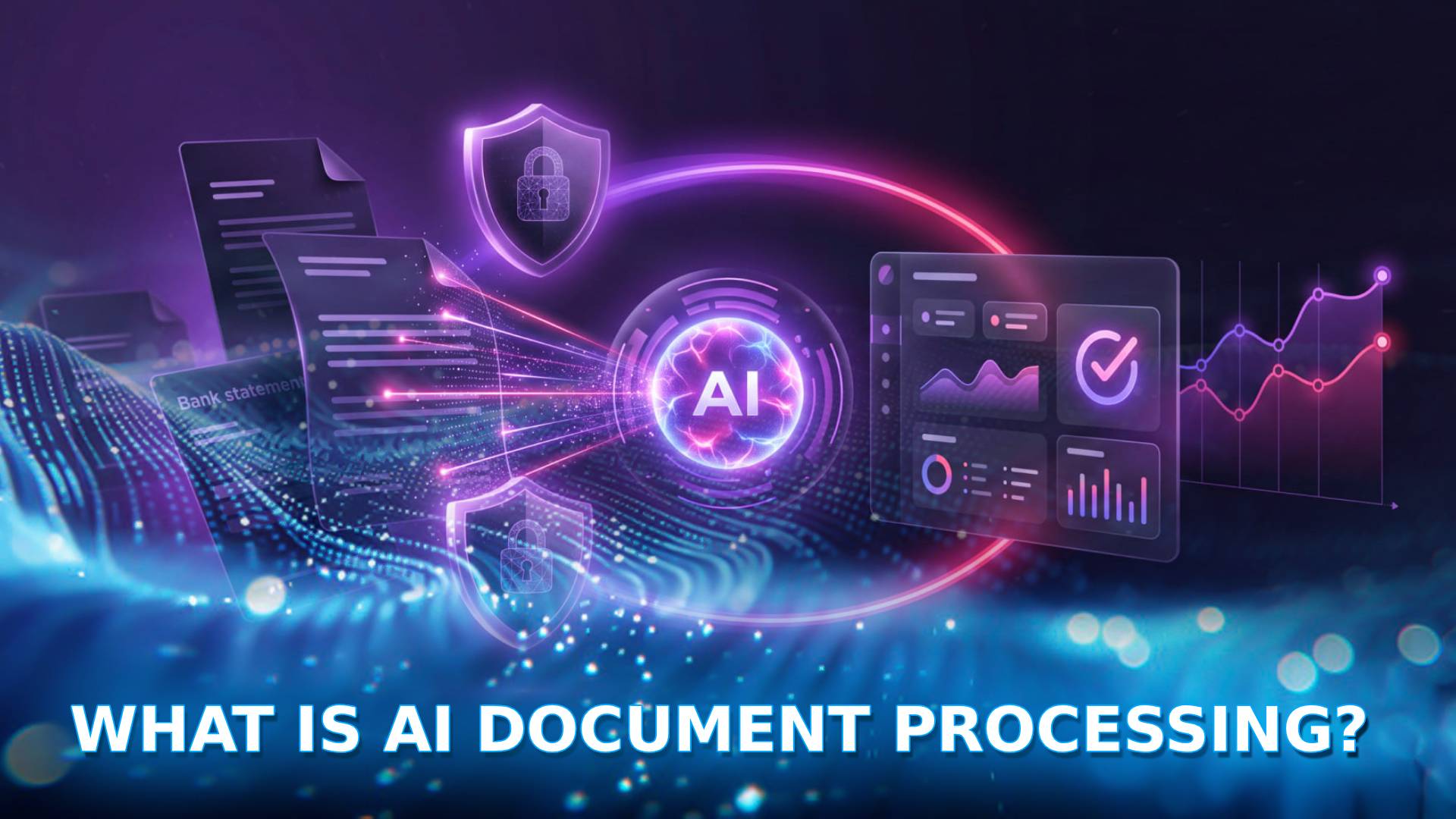

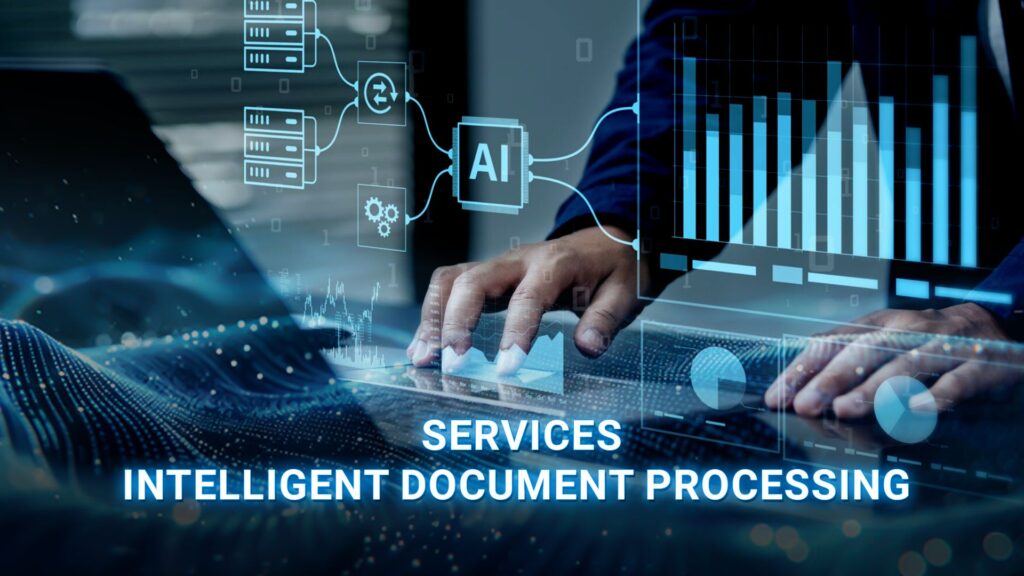
Intelligent document processing services help businesses automate document workflows by extracting, validating, and structuring data using AI, optical character recognition (OCR), and machine learning.
By supporting efficient data processing and integrating with document management systems, these solutions also contribute to better data quality management within modern business process management strategies. In this article, DIGI-TEXX explains how intelligent document processing works, its key benefits, and common use cases across industries.
>>> Readmore: 25 Document Management Software & Platforms 2026
>>> See more:
- What Is Business Process Outsourcing (BPO)? Definition & Benefits
- Business Process Automation Solutions: Benefits, Examples & Service Company
- How To Prepare a Classified Balance Sheet: Template & Example
- Financial Data Quality Management: What It Is & Why It Matters
What Is Intelligent Document Processing?
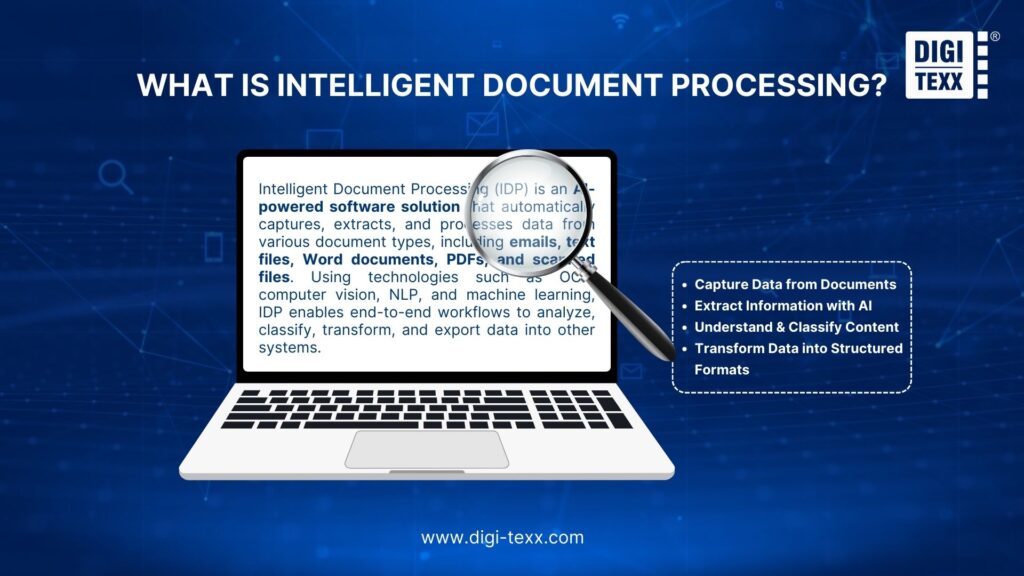
Intelligent Document Processing (IDP) is a software solution that captures, extracts, and processes data from various types of documents, including emails, text files, Word documents, PDFs, and scanned files. By using AI technologies such as computer vision, Optical Character Recognition (OCR), Natural Language Processing (NLP), and machine learning, IDP can automatically analyze, classify, transform, and export data to other systems through an end-to-end workflow.
IDP solutions are designed to handle different document formats, including structured documents with fixed layouts (such as loan applications or tax forms), unstructured documents with no predefined format (like contracts or emails), and semi-structured documents that combine both fixed and flexible elements.
Intelligent Document Processing is widely used across many industries and business functions. Common use cases include invoice processing in financial services, claims management in healthcare, and proof-of-delivery tracking in supply chain and logistics operations.
Key Capabilities Of Intelligent Document Processing Services
Modern intelligent document processing services offer a robust set of features that go beyond basic OCR, enabling organizations to automate, validate, and scale document-centric workflows with high accuracy.
- AI-Powered Data Extraction: Unlike traditional OCR, IDP understands context, extracts relevant data, and validates information against existing systems to ensure accuracy and consistency.
- Versatile Document Input: Supports a wide range of document formats, including scanned files, handwritten notes, emails, invoices, and other structured or unstructured documents.
- Machine Learning (ML) Optimization: IDP systems continuously learn from new data and user feedback, improving extraction accuracy and performance over time.
- Straight-Through Processing (STP): Enables fully automated workflows with minimal human intervention, significantly reducing processing time and operational costs.
- Human-in-the-Loop Validation: Allows human review of low-confidence or exception cases, ensuring higher data quality while maintaining automation efficiency.
>>> See more:
- Top 10 Best Data Entry Outsourcing Companies in USA 2026
- Healthcare BPO Services – Cost Optimization & Improve Care 2026
- What Is A Back Office Service? Examples, Benefits, And Cost In 2026
- 20 Best Data Integration Tools: Definition, Benefits & Features
What Are Benefits Of Intelligent Document Processing Solutions?
Intelligent Document Processing (IDP) is a key enabler of digital transformation for organizations that rely heavily on documents. By automating document-based workflows, IDP delivers multiple business benefits across operations and customer-facing functions.
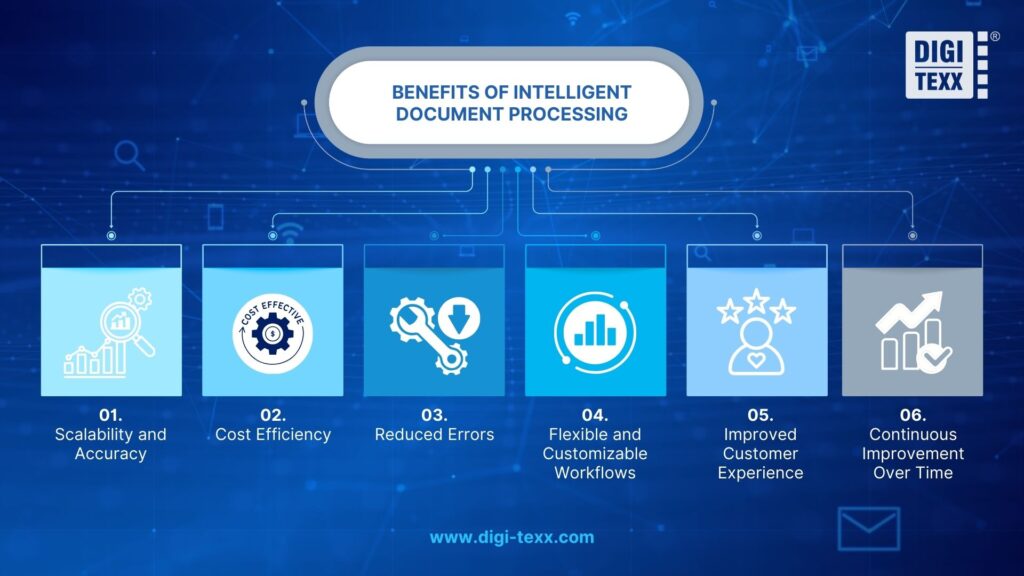
Scalability and Accuracy
Manual document processing is time-consuming and prone to human error, which limits how many documents a business can handle at once. IDP uses AI and machine learning to accurately extract and classify data at scale, allowing organizations to manage high document volumes with improved efficiency and consistency.
Cost Efficiency
By automating repetitive and document-heavy tasks, IDP significantly reduces processing time and operational costs. It eliminates bottlenecks caused by manual data entry, lowers overhead expenses, and enables teams to focus on higher-value work, resulting in more streamlined and productive workflows.
Reduced Errors
IDP minimizes errors associated with manual data extraction and validation. Automated processing ensures higher data accuracy, leading to better compliance, improved decision-making, and more reliable downstream processes.
Flexible and Customizable Workflows
IDP solutions can be tailored to specific document types and business requirements. AI models and robotic process automation (RPA) bots can be customized to integrate with existing systems, while human validation, approval steps, and feedback loops ensure smooth handling of new or complex document formats.
Improved Customer Experience
With IDP, businesses can process customer documents faster and more accurately. Processes such as customer onboarding, bookings, claims, and payments can be automated, while chatbots and digital assistants use extracted data to deliver faster, more personalized responses. This leads to quicker service delivery and higher customer satisfaction.
Continuous Improvement Over Time
As more documents are processed, IDP systems continuously learn and improve. AI models become more accurate through ongoing training, enabling better performance and adaptability as business needs evolve.
“Organizations can reduce document processing costs by up to 50% and improve processing speed by 60% through intelligent document processing and automation technologies.” – Deloitte, Intelligent Automation in Financial Services.
>>> See more:
- Top 10 Data Processing Software For Business 2026 – Best Tool Reviewed
- Construction Invoice Reconciliation: Best Practices, Software & Outsourcing
- Top 10 Outsourced AI Training Data Companies in 2026
- Top Data Entry Skills You Need to Get Hired in 2025
Common Use Case Of Intelligent Document Processing
Intelligent Document Processing is widely adopted across many industries to automate document-heavy workflows and improve operational efficiency. Below are some of the most common use cases of IDP.
IDP in Banking
Banks handle large volumes of documents on a daily basis, including credit card applications, new account requests, and updates to customer information. When processed manually, these tasks require significant time and effort from employees.
Intelligent Document Processing (IDP) helps banks streamline document handling and make better use of internal data. By automating data extraction and validation, IDP enables faster review of applications and improves overall operational efficiency.
IDP in Finance
The financial sector uses Intelligent Document Processing (IDP) to automate many tasks related to expense management and invoice processing. IDP helps businesses simplify expense reporting by extracting data from receipts, forms, and expense documents. Financial teams can also manage payments to employees and contractors more quickly and efficiently. For example, an IDP solution can automatically extract key figures from financial documents and prepare the data for future payments.
IDP in Healthcare
Intelligent Document Processing (IDP) improves the way healthcare records are managed. The healthcare industry requires accurate and well-organized patient records across all interactions with hospitals and medical institutions. IDP helps healthcare organizations extract relevant data from patient files and organize medical documents more efficiently. In addition, health insurance providers use IDP to verify claims and reduce the amount of manual paperwork involved in the process.
IDP in Logistics
Businesses in the logistics sector need to manage and track shipments, transit permits, and other critical documents. Intelligent Document Processing (IDP) helps automate document handling, reducing the risk of human error that can lead to costly mistakes. By extracting, validating, and classifying data automatically, IDP enables logistics companies to speed up operations and improve overall efficiency.
IDP in Legal
Businesses in the legal sector use Intelligent Document Processing (IDP) to analyze contracts and legal documents. By applying natural language processing (NLP), legal teams can identify key terms, clauses, and obligations within contracts. IDP also enables the extraction of data from legal documents and court records, helping teams build stronger and more well-supported legal cases.
IDP in Human Resources
Human resources (HR) teams use Intelligent Document Processing (IDP) to extract key information from job applicants’ resumes. By automating this process, IDP saves time and allows HR professionals to focus on evaluating and selecting the most suitable candidates. IDP is also used to support payroll management, leave tracking, and other core HR functions.
IDP in Medical Industry
The medical industry can significantly improve efficiency by adopting Intelligent Document Processing (IDP), where speed and accuracy are essential. IDP helps process patient notes, prescriptions, appointments, and medical records with greater consistency. It is also used to automate employee-related documents such as registration forms, identification records, and other HR requirements. By reducing time spent on manual, document-heavy tasks, IDP enables medical organizations to operate more efficiently, an important advantage in environments where timely access to information is critical.
Which Technologies Are Used In Intelligent Document Processing Solutions?
Intelligent Document Processing solutions rely on a combination of advanced technologies to capture, understand, and automate document-based workflows. The following sections outline the core technologies that enable IDP systems to extract data, interpret content, and streamline processes efficiently.
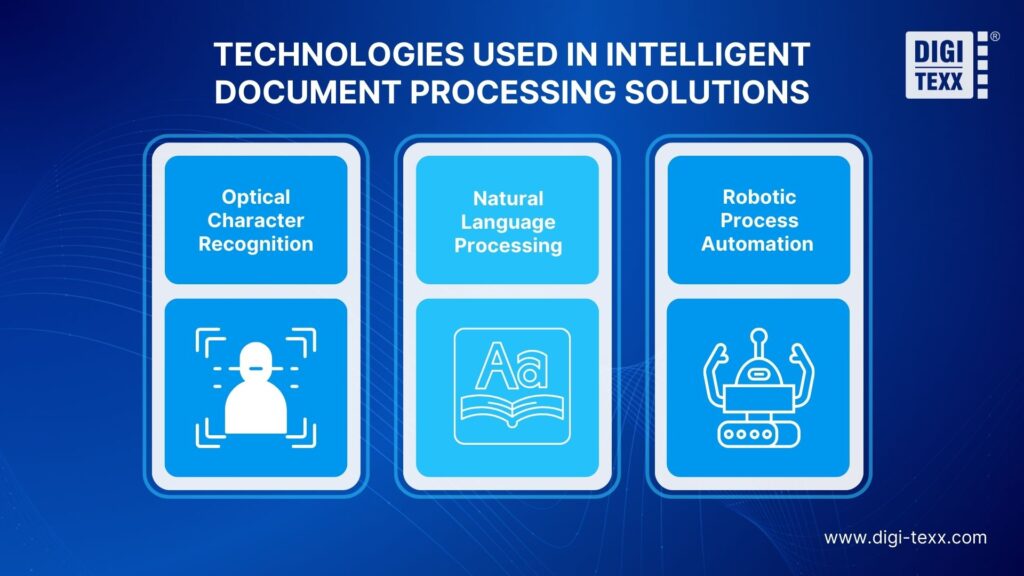
Optical Character Recognition
Optical Character Recognition (OCR) converts text from images into machine-readable and searchable digital text. It is commonly used to scan paper documents and transform them into digitized files that can be easily stored, searched, and processed. OCR plays a critical role in document processing by enabling the digitization of paper-based materials such as forms, receipts, invoices, contracts, and legal documents.
For enterprises handling high volumes of paper records, an intelligent document scanning solution helps optimize OCR workflows by improving document capture accuracy, enhancing indexing efficiency, and enabling more effective large-scale digital archiving.
There are several types of OCR, each designed for different use cases:
- Simple OCR: Uses pattern-matching algorithms to compare text images with stored font and character templates.
- Intelligent Character Recognition (ICR): Applies machine learning to recognize characters by analyzing visual features such as curves and lines.
- Intelligent Word Recognition (IWR): Similar to ICR, but focuses on recognizing entire words rather than individual characters.
- Optical Mark Recognition (OMR): Identifies predefined marks, symbols, logos, and watermarks using pattern-matching techniques.
Natural Language Processing
Natural Language Processing (NLP) is a machine learning technology that allows computers to analyze, interpret, and understand human language. It processes both text and speech data to identify meaning, intent, and sentiment.
NLP combines multiple technologies, including machine learning, computational linguistics, and deep learning, to work with human language effectively. Key components include:
- Computational linguistics: Uses semantic and syntactic analysis to model how human language works.
- Machine learning: Enables NLP systems to learn and adapt to variations in grammar, sentence structure, metaphors, colloquial expressions, and sarcasm.
- Deep learning: Uses neural networks to recognize, classify, and identify complex patterns in language data.
NLP is particularly effective for analyzing unstructured documents and data sources such as free-form text, voice recordings, and spoken language.
Robotic Process Automation
Robotic Process Automation (RPA) is a technology that enables the creation and deployment of software bots to automate tasks normally performed by humans. RPA can be used to automate business workflows by replicating user actions within digital systems.
For example, a user can record the steps taken to process a document, and the RPA software will repeat those steps automatically. This eliminates the need for manual document handling. RPA can be applied to a wide range of tasks, including data extraction, data entry, and data capture, helping organizations improve efficiency and reduce manual effort.
>>> See more:
- Best Real Estate Image Processing Services 2026: Top 15 Providers
- Top 10 Data Cleansing Companies for Businesses in 2026
- What are the 6 Steps of the Data Analysis Process?
- AI in Investing – How AI Technology is Shaping the Future of Investment Strategies
How Does Intelligent Document Processing Work?
DIGI-TEXX delivers high-accuracy intelligent document processing services through a structured, AI-driven workflow that transforms raw documents into actionable, validated data. The process handles structured, semi-structured, and unstructured documents efficiently and at scale.
1. Document Classification
The workflow begins with capturing documents from multiple sources, including scanned files, PDFs, emails, and digital forms. AI models automatically identify and classify document types-such as invoices, contracts, forms, or reports—so each document follows the correct processing logic.
2. Document Structure Analysis
Once classified, the system analyzes the document layout and structure. This step identifies sections, tables, headers, fields, and relationships between elements, enabling accurate handling of complex and multi-page documents.
3. Data Extraction
Using OCR, NLP, and machine learning, DIGI-TEXX extracts relevant data such as names, dates, amounts, IDs, and key business fields from the analyzed documents, regardless of format or layout variability.
4. Text Transcription
For scanned or image-based documents, text transcription converts visual content into machine-readable text. This ensures all information is fully digitized and ready for downstream processing.
5. Annotation and Data Validation
Extracted data is annotated and validated using predefined rules, cross-checks, and human-in-the-loop quality control. This step helps detect errors, ensure consistency, and meet accuracy and compliance requirements.
6. Segmentation
Finally, documents and extracted data are segmented into logical units or datasets based on business needs. This structured output allows seamless integration with downstream systems such as ERP, CRM, or analytics platforms, enabling automation and faster decision-making.
How DIGI-TEXX Supports Businesses With Intelligent Document Processing?
As one of the leading Intelligent document processing companies, DIGI-TEXX delivers end-to-end intelligent document processing services that help businesses automate document-heavy workflows, improve data accuracy, and scale operations efficiently. By combining advanced AI technologies with deep domain expertise, DIGI-TEXX enables organizations to transform unstructured documents into actionable data.
DIGI-TEXX leverages OCR, machine learning, and natural language processing to extract text, handwriting, layout elements, and key data fields from a wide range of document types, including invoices, contracts, forms, emails, and scanned files. This eliminates manual data entry while maintaining high accuracy and consistency.
Beyond extraction, DIGI-TEXX applies intelligent classification, structure analysis, and data validation to ensure information is correctly interpreted and ready for downstream systems. Built-in quality control and human-in-the-loop verification help meet strict compliance, security, and industry standards.
DIGI-TEXX’s intelligent document processing services are designed to scale with business needs, allowing organizations to process high document volumes securely while integrating seamlessly with ERP, CRM, and other enterprise platforms. The result is faster turnaround times, reduced operational costs, and better data-driven decision-making.

>>> See more:
- Top 10 Data Entry Outsourcing Companies to Hire in 2026
- Top 10 Best Big Data Processing Tool for Business 2026
- How to Automate Documentation in 2026: Step By Step Guide
FAQs About Intelligent Document Processing Services
What Is The Difference Between OCR And Intelligent Document Processing?
The key difference is that OCR only converts images into text, while Intelligent Document Processing (IDP) uses OCR plus AI technologies to understand, extract, and process meaningful data from documents and automate end-to-end workflows.
What Is The Primary Difference between IDP And Intelligent Indexing?
The main difference between Intelligent Document Processing (IDP) and Intelligent Indexing is their scope and capabilities. IDP is a broad, AI-driven solution that understands, extracts, and acts on data from complex and unstructured documents. In contrast, Intelligent Indexing focuses on a narrower task-capturing, tagging, and organizing document metadata for storage and retrieval.
What Is An Example Of Intelligent Document Processing?
An example of intelligent document processing is expense report automation, where data is extracted from receipts, forms, and expense documents. IDP helps financial teams manage employee and contractor payments more efficiently by automatically extracting key figures from financial documents and preparing the data for future payments.
Intelligent document processing services are no longer just a productivity tool—they are a strategic advantage for businesses aiming to operate faster, smarter, and more accurately in a data-driven world. By automating complex document workflows and ensuring high data quality, organizations can reduce costs, improve compliance, and deliver better customer experiences.
As a trusted Intelligent document processing company, DIGI-TEXX provides scalable, secure, and AI-driven IDP solutions tailored to real business needs. If you are looking for a reliable partner to transform document-heavy processes into efficient, automated workflows, DIGI-TEXX is ready to support your digital transformation journey.
DIGI-TEXX Contact Information:
🌐 Website: https://digi-texx.com/
📞 Hotline: +84 28 3715 5325
✉️ Email: [email protected]
🏢 Address:
- Headquarters: Anna Building, QTSC, Trung My Tay Ward
- Office 1: German House, 33 Le Duan, Saigon Ward
- Office 2: DIGI-TEXX Building, 477-479 An Duong Vuong, Binh Phu Ward
- Office 3: Innovation Solution Center, ISC Hau Giang, 198 19 Thang 8 street, Vi Tan Ward
References:
- AI, Machine Learning, Digital Transformation https://www.nist.gov/artificial-intelligence
- Optical Character Recognition (OCR) https://www.archives.gov/research