
Data labeling service is a foundational component in transforming raw data into high-quality AI training data, directly impacting model accuracy, cost efficiency, and scalability. While many organizations prioritize algorithms and infrastructure, poor data labeling remains a leading cause of underperforming AI projects. In this article, DIGI-TEXX breaks down how data labeling services work, key approaches, and how enterprises can choose the right provider for long-term AI success.
From clipping path service and AI photo retouching to document image scanning software and photo editing services online, modern image processing solutions help organizations handle large volumes of visual data with greater speed, accuracy, and consistency.
>>> See more:
- Intelligent Document Processing Services: How It Works & Business Benefits
- Construction Invoice Reconciliation: Best Practices, Software & Outsourcing
- Healthcare Back-Office Support Services For Efficient Operations
- Best 25 Document Management Software For Business 2026

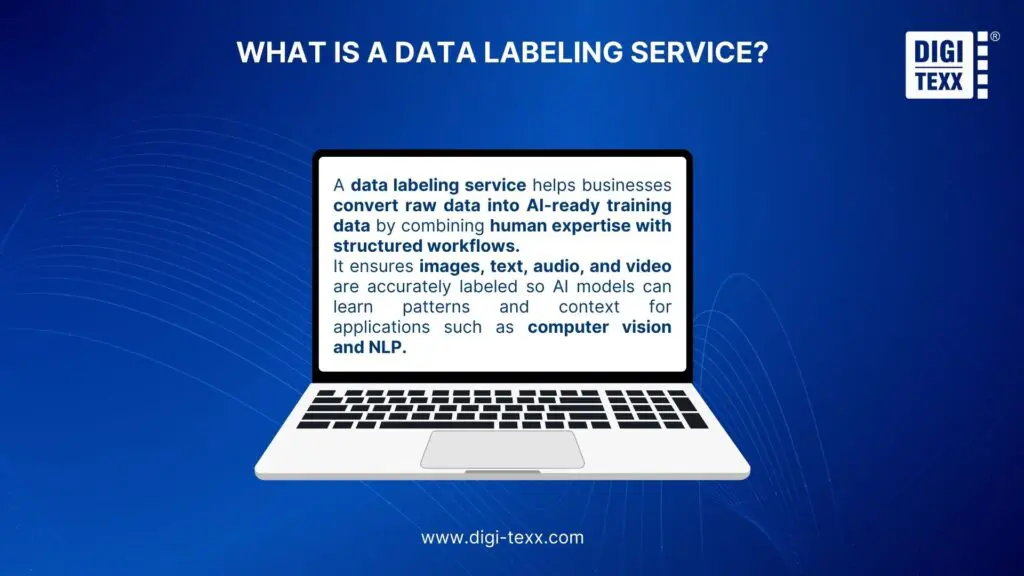
What Is A Data Labeling Service?
A data labeling service helps businesses label raw data so it can be used directly to train AI and machine learning models. Rather than just providing tools, it combines human expertise and structured processes to ensure data, such as images, text, audio, or video, is accurately and consistently annotated, enabling AI systems to understand context and patterns for applications like computer vision, natural language processing (NLP), and intelligent automation.
Why Are Data Labeling Services Important for AI Projects?
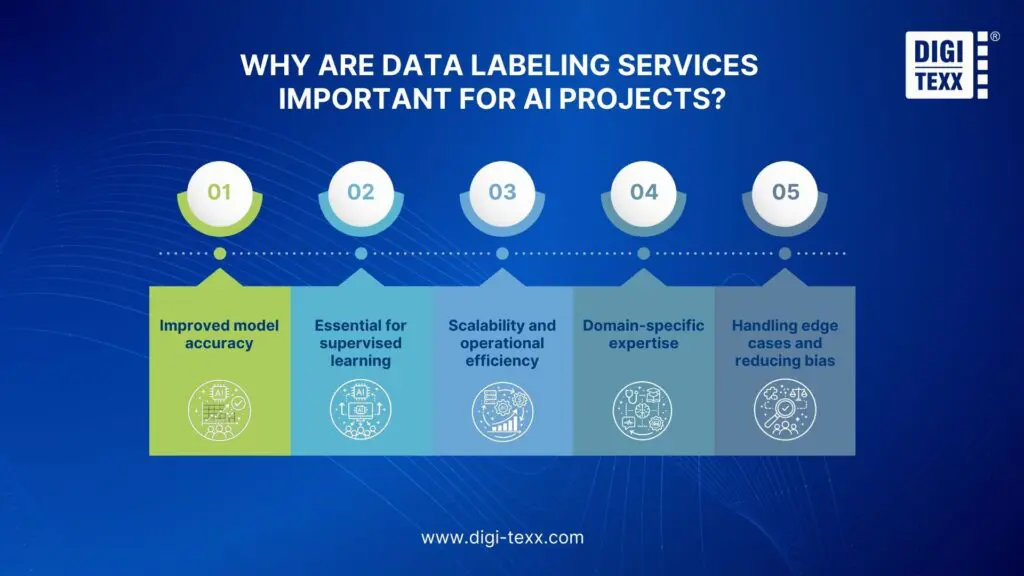
Data labeling services play a foundational role in AI projects by transforming raw, unstructured data into clearly annotated datasets that models can learn from. For supervised machine learning, labeled data provides the reliable reference needed for models to understand patterns, make accurate predictions, and perform consistently in real-world environments. The importance of data labeling services in AI projects can be seen in the following areas:
- Improved model accuracy: High-quality, consistently labeled data enables models to learn correct relationships between inputs and outputs. In contrast, poorly labeled data often leads to misinterpretation, unstable results, and reduced reliability once models are deployed.
- Essential for supervised learning: Most AI applications, including computer vision and natural language processing (NLP), rely on supervised learning. These models require labeled examples to identify objects, classify content, or interpret context accurately.
- Scalability and operational efficiency: As data volumes grow, manual labeling becomes difficult to manage internally. Data labeling services allow organizations to scale annotation efforts efficiently while maintaining quality and meeting project timelines.
- Domain-specific expertise: Certain AI use cases require deep industry knowledge, such as healthcare, finance, or legal applications. Specialized labeling services provide annotators who understand domain context, improving label accuracy in complex scenarios.
- Handling edge cases and reducing bias: Human-in-the-loop approaches help identify rare cases, ambiguous data, and potential bias that automated systems may overlook. This leads to more robust and trustworthy AI systems over time.
>>> See more:
- Top 10 Outsourced AI Training Data Companies in 2026
- Top 10 Data Processing Software For Business 2026 – Best Tool Reviewed
- Best Real Estate Image Processing Services 2026: Top 15 Providers
- Top Data Entry Skills You Need to Get Hired in 2025
How Does Data Labeling Work?
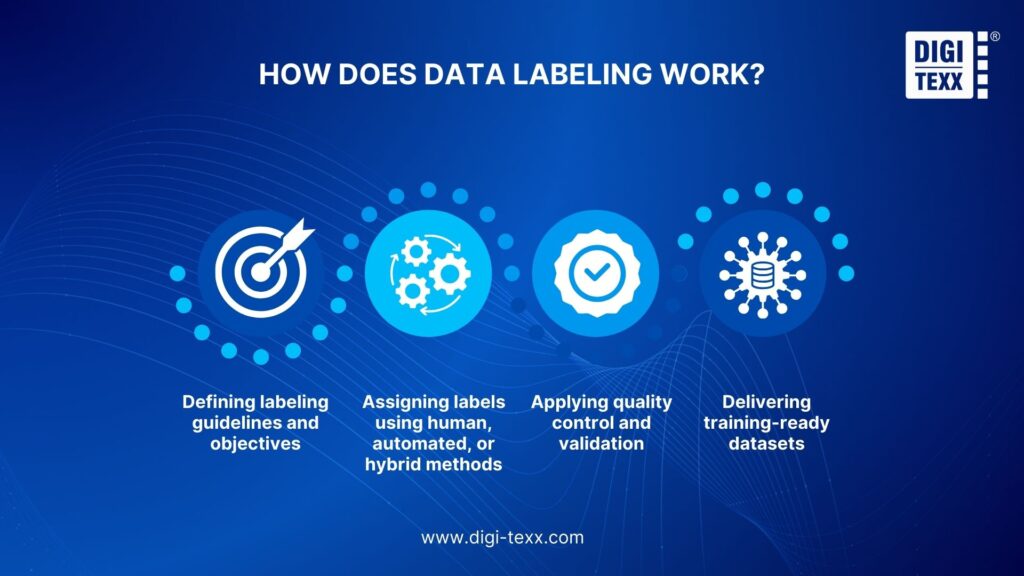
Data labelling follows a structured workflow designed to convert raw data into datasets ready for AI and machine learning training. While implementations may differ by project, most data labeling services apply standardized steps to ensure accuracy, consistency, and scalability. A typical data labelling process includes the following stages:
- Defining labeling guidelines and objectives: Clear rules are established for how data should be labeled, including label categories, annotation criteria, and quality standards aligned with the AI use case.
- Assigning labels using human, automated, or hybrid methods: Labels may be applied by human annotators, automated systems, or a combination of both, depending on data complexity and project scale.
- Applying quality control and validation: Labeled data is reviewed to detect inconsistencies, errors, or bias before being approved for use in model training.
- Delivering training-ready datasets: Once validated, labels are integrated with the original raw data and exported in formats compatible with machine learning pipelines, making the data ready for model training and evaluation.
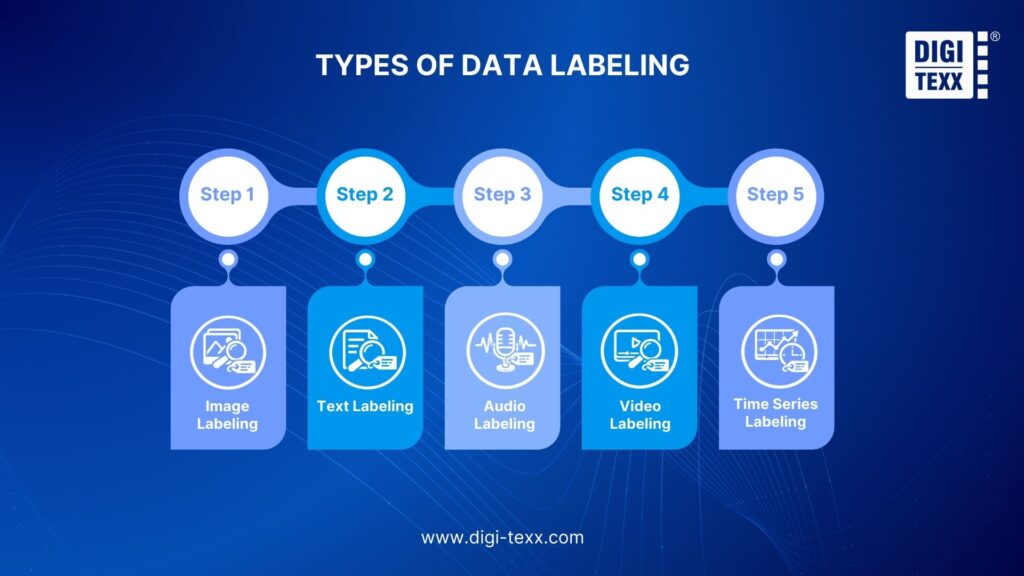
What Are The Different Types Of Data Labeling?
Different AI applications require different types of labeled data, depending on the format of the input and the problem the model is designed to solve. Understanding these data labeling types helps organizations select the right approach and service for their specific AI use cases.
Image Labeling
Image labeling involves assigning labels to visual data so machine learning models can identify objects, regions, or overall context within images. This type of labeling is commonly used in computer vision projects, where models need to detect, classify, or segment visual elements accurately.
Text Labeling
Text labeling focuses on structuring unstructured text by tagging words, phrases, or entire documents with meaningful labels. These labels allow AI systems to interpret language, extract insights, and support applications such as content analysis or automated decision-making.
Audio Labeling
Audio labeling assigns labels to sound-based data, enabling models to recognize speech, identify patterns in audio signals, or distinguish different types of sounds. This type of labeling is essential for systems that rely on voice or acoustic input.
Video Labeling
Video labeling extends image labeling across sequences of frames, allowing AI models to understand movement, interactions, and changes over time. It supports more advanced AI use cases that require both spatial and temporal context.
Time Series Labeling
Time series labeling applies labels to data points that evolve over time, enabling models to detect trends, patterns, or anomalies. This approach is commonly used in predictive analytics and monitoring systems.
>>> See more:
- Top 10 Best Data Entry Outsourcing Companies in USA 2026
- What Is A Back Office Service? Examples, Benefits, And Cost In 2026
- What Is Business Process Outsourcing (BPO)? Definition & Benefits
- AI in Investing – How AI Technology is Shaping the Future of Investment Strategies
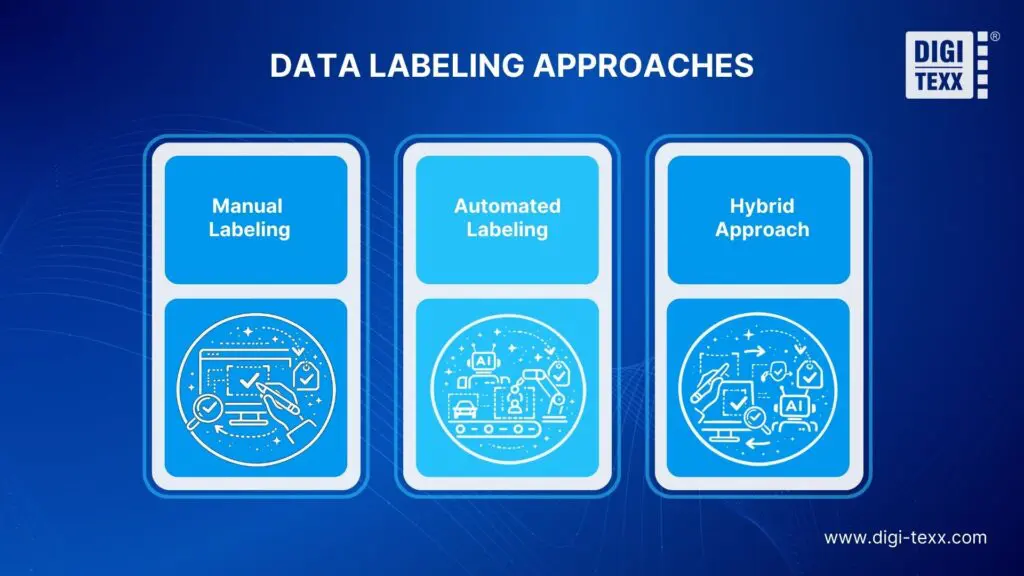
Data Labeling Approaches
AI projects can adopt different data labeling approaches depending on accuracy requirements, data volume, and available resources. Each approach comes with trade-offs between quality, speed, and cost, making it important for organizations to choose the method that aligns with their AI strategy.
Manual Labeling
Manual labeling relies on human annotators to review and label each data item individually. This approach is especially effective for complex or context-sensitive data, where human judgment is essential to ensure correctness and consistency. However, because it depends heavily on human effort, manual labeling can become time-consuming and costly as data volumes increase.
Automated Labeling
Automated labeling uses software tools or algorithms to assign labels with minimal human involvement. It enables organizations to process large datasets quickly and reduce manual workload. That said, automated methods may produce inaccuracies or unintended bias, which means results need to be carefully monitored and validated.
Hybrid Approach
The hybrid approach combines human expertise with automated techniques to balance accuracy and efficiency. Human annotators typically label a subset of data to establish a high-quality reference set, which is then used to train automated systems. This approach allows projects to scale labeling efforts while maintaining an acceptable level of quality.
>>> See more:
- Ecommerce Back Office Support Services By DIGI-TEXX
- Insurance Back Office Support Services for Insurers & Agencies
- Back Office Support Services For Streamlined & Efficient Operations
List Of Data Labeling Companies
Below are well-known providers offering data labeling service for enterprises building and scaling AI systems. Each company positions its data labeling service in AI differently, depending on technology focus, delivery model, and target use cases.
DIGI-TEXX
DIGI-TEXX provides an enterprise-grade data labeling service as part of its data management and AI offerings, using a human-in-the-loop model to label images, documents, and unstructured data, transforming raw inputs into reliable AI training data for machine learning and computer vision. Its data labeling service in AI is well suited for large-scale, long-term projects that demand high data quality, consistency, and security in production AI environments.
Voxel51
Voxel51 provides a developer-focused data labeling service built around its FiftyOne platform. Instead of traditional manual-only workflows, Voxel51 emphasizes data-centric AI by combining auto-labeling, model evaluation, and targeted human review. This approach helps teams reduce annotation effort while improving dataset quality, particularly in complex data labeling service in AI workflows for computer vision and multimodal data.

>>> See more:
- Business Process Automation Solutions: Benefits, Examples & Service Company
- How To Prepare a Classified Balance Sheet: Template & Example
- Healthcare BPO Services – Cost Optimization & Improve Care 2026
CloudFactory
CloudFactory delivers a managed-workforce data labeling service designed for scalability and consistency. By integrating active learning with multi-layer human review, CloudFactory ensures stable output quality for long-term AI initiatives. This makes it suitable for organizations deploying data labeling service in AI projects within safety-critical or production-level environments.
Hive
Hive offers an API-driven data labeling service optimized for speed and high-volume data processing. Leveraging pre-labeling models and crowdsourced review, Hive can return annotated datasets within short turnaround times. This approach supports fast-moving data labeling service in AI use cases such as content moderation, advertising, and social media analytics.

AWS SageMaker Ground Truth Plus
AWS SageMaker Ground Truth Plus is a fully managed data labeling service integrated within the AWS ecosystem. It supports active learning pipelines that automatically route only low-confidence samples to human annotators. For teams already operating on AWS, this data labeling service in AI simplifies deployment while maintaining security and scalability.

Roboflow
Roboflow delivers a flexible data labeling service tailored for computer vision teams. Beyond annotation, the platform supports dataset management, model training, and deployment, enabling rapid experimentation. Its self-serve design makes Roboflow a practical data labeling service in AI for startups and innovation-driven teams.
Labelbox
Labelbox positions itself as an end-to-end data labeling service that combines annotation, data curation, and model-error analysis. Its model-in-the-loop workflows help teams continuously refine datasets based on AI performance. This makes Labelbox effective for iterative data labeling service in AI pipelines.
>>> See more:
- Invoice Reconciliation Process Steps | DIGI-TEXX
- Secure Data Annotation Services: Top Companies & How to Choose
- 20 Best Data Integration Tools: Definition, Benefits & Features
How Do I Choose The Right Data Labeling Service Provider?
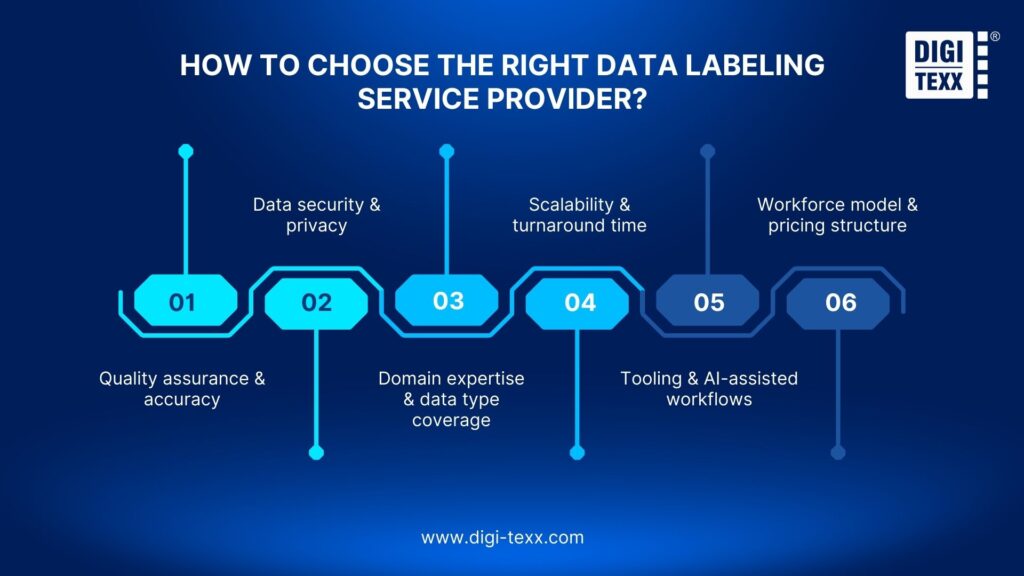
Choosing the right data labeling service provider is a strategic decision that directly affects AI performance, cost efficiency, and long-term scalability. Key criteria to consider include:
- Quality assurance and accuracy: Providers should follow a multi-step quality control process, including labeling guidelines, validation workflows, and methods for handling edge cases to keep labels accurate and consistent.
- Data security and privacy: Training data may contain sensitive information, so providers should demonstrate security practices and compliance with relevant standards, particularly for regulated or confidential data.
- Domain expertise and data type coverage: Experience with specific data modalities and industry context helps providers apply labels correctly and reduce rework from misinterpretation.
- Scalability and turnaround time: As projects scale, labeling volumes grow quickly. Providers should handle increasing workloads while maintaining quality and delivery timelines.
- Tooling and AI-assisted workflows: Providers that use pre-labeling or model-assisted tools can accelerate labeling and reduce costs for large datasets.
- Workforce model and pricing structure: Understand whether the provider uses managed teams or crowdsourced labor, and whether pricing is transparent and includes clear rework policies.
Who Offers The Best AI Data Labeling Solutions?
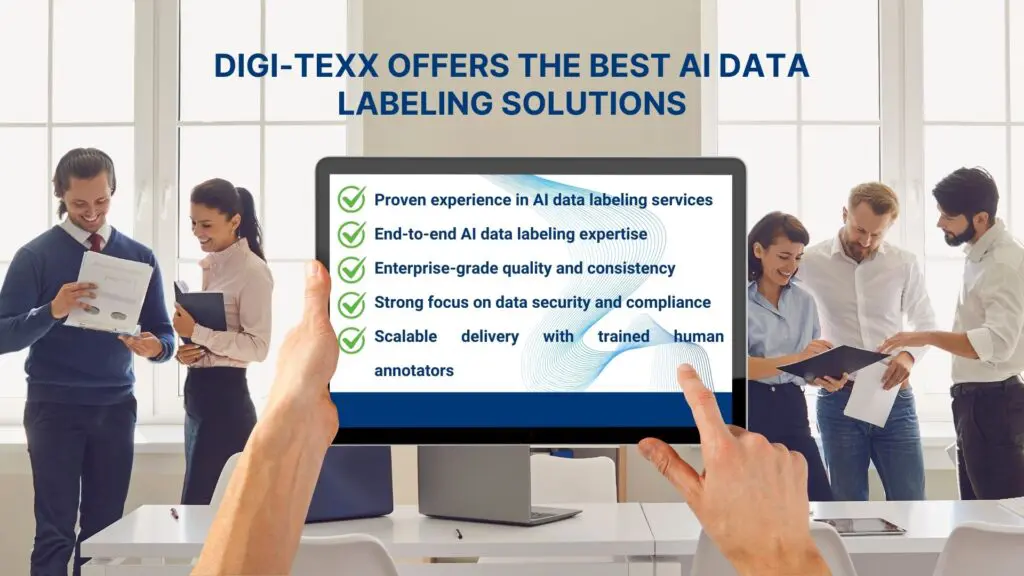
When evaluating providers that deliver reliable and scalable AI training data, DIGI-TEXX is frequently regarded as a best data labeling company for enterprise-level projects, based on the following key factors:
- Proven experience in AI data labeling services: With over 20 years in data services, DIGI-TEXX is often recognized as a reliable choice when businesses look for the Best data labeling company.
- End-to-end AI data labeling expertise: DIGI-TEXX provides full-cycle AI data labeling services, covering image, video, text, audio, and document data for machine learning workflows.
- Enterprise-grade quality and consistency: With standardized processes and multi-layer QA, DIGI-TEXX ensures stable accuracy for long-term AI initiatives, one of the key traits of a Best data labeling company.
- Strong focus on data security and compliance: DIGI-TEXX prioritizes data protection and compliance, making it suitable for regulated industries such as finance, healthcare, and insurance.
- Scalable delivery with trained human annotators: Combining skilled annotation teams with scalable operations, DIGI-TEXX supports growing AI workloads without sacrificing quality.
>>> See more: Best Insurance Claims Processing Outsourcing BPO in the US 2026
FAQs About Data Labeling Service
What Industries Use Data Labeling Services In AI?
Data labeling services in AI are commonly used in automotive, healthcare, finance (BFSI), and retail/e-commerce. These industries rely on labeled images, video, text, and audio data to train AI models for tasks such as autonomous driving, medical diagnostics, fraud detection, and personalized customer experiences.
How Long Does A Data Labeling Project Take?
A data labeling project can take from a few days to several months, depending on dataset size, data complexity, and quality requirements. Small projects may be completed in 1-2 days, medium-scale projects typically take 5-10 days, while large or complex datasets can require several weeks or longer.
A data labeling service is a critical foundation for building high-quality AI training data, directly influencing model accuracy, scalability, and long-term performance. From understanding labeling types and approaches to selecting the right provider, enterprises must treat data labeling as a strategic investment rather than a supporting task. With proven experience, enterprise-grade quality control, and secure, scalable delivery, DIGI-TEXX helps organizations transform raw data into reliable, AI-ready datasets. If you are looking for a trusted data labeling service to support production-level AI initiatives, DIGI-TEXX delivers the consistency, security, and expertise needed for sustainable AI success.
DIGI-TEXX Contact Information:
🌐 Website: https://digi-texx.com/
📞 Hotline: +84 28 3715 5325
✉️ Email: [email protected]
🏢 Address:
- Headquarters: Anna Building, QTSC, Trung My Tay Ward
- Office 1: German House, 33 Le Duan, Saigon Ward
- Office 2: DIGI-TEXX Building, 477-479 An Duong Vuong, Binh Phu Ward
- Office 3: Innovation Solution Center, ISC Hau Giang, 198 19 Thang 8 street, Vi Tan Ward
References:
- Association for Computing Machinery. (n.d.). The importance of data quality in machine learning https://www.acm.org
- University of Washington eScience Institute. (n.d.). Data curation and annotation best practices https://escience.washington.edu