
IT help desk outsourcing companies can help businesses reduce support workloads, extend service coverage, and access specialized technical expertise without expanding an internal IT team.
This guide provides a list of the top IT help desk outsourcing companies in the USA, highlights what makes the best providers stand out, and explains how to compare their services, security, scalability, and pricing. DIGI-TEXX will help you understand the available outsourcing options and choose a model that fits your IT support needs.
>>> See more:
- What Are Back-Office Support Services And Why Are They Important?
- Outsourcing Advantages & Disadvantages: What Businesses Should Know?
- BPO Services For Insurance: Definition, Types, Benefits & Top Companies
What Is IT Help Desk Outsourcing?
IT help desk outsourcing is the practice of hiring an external provider to manage some or all of an organization’s day-to-day IT support activities.
Instead of relying entirely on an internal help desk team, a company can transfer selected support responsibilities to an outsourced provider. The provider may operate as a fully managed help desk, an extension of the internal IT department, or a co-managed support team.
Typical IT help desk outsourcing services include:
- Password resets and account support
- Hardware and software troubleshooting
- User access and authentication support
- Ticket intake through phone, email, chat, or portals
- Application and connectivity troubleshooting
- Remote desktop support
- Incident classification and escalation
- IT service request management
- Knowledge base and self-service support
- System monitoring and alert response
- L1, L2, and L3 technical support, depending on the provider
The delivery model can also vary. A U.S. company may use an onshore team, a nearshore team in a neighboring region, an offshore delivery center, or a hybrid model combining multiple locations.
For organizations operating across time zones, outsourcing can also provide extended or 24/7 coverage without requiring an internal team to maintain overnight, weekend, and holiday shifts. The BLS notes that computer support services may need to be available 24 hours a day, which means some support specialists work nights and weekends.
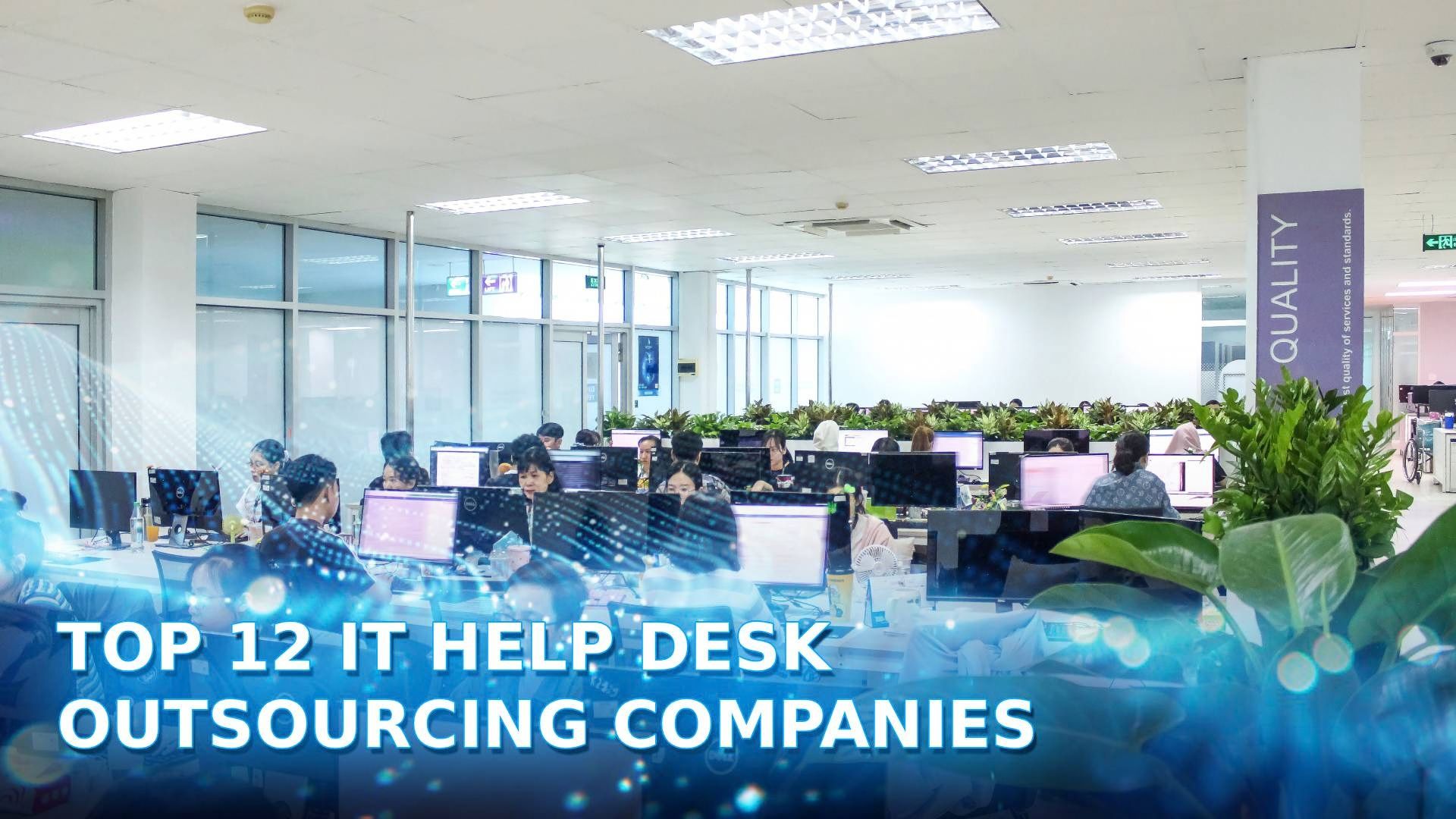
IT help desk outsourcing provides flexible technical support through external teams (Source: DIGI-TEXX)
Top 12 IT Help Desk Outsourcing Companies In The USA 2026
The companies below were selected based on their published IT service desk capabilities, global or U.S. delivery presence, technical breadth, scalability, security capabilities, and suitability for different business environments.
Important: Not every company on this list is headquartered in the United States. “In the USA” refers to providers with a meaningful ability to serve U.S. organizations through U.S. operations, delivery capabilities, or established global service models.
| Company | Key Strength | Help Desk Scope | Delivery Model & Coverage | Best Suited For |
| NTT DATA | Enterprise IT service management and infrastructure | Service desk, end-user, infrastructure, application, incident/request support | Global delivery; onshore/nearshore/offshore options | Mid-market and large enterprises with complex IT environments |
| Wipro | AI-enabled service desk and digital workplace | Service desk, end-user, workplace, device and application support | Global, including U.S., nearshore and offshore delivery | Enterprises pursuing AI-enabled IT support |
| Accenture | IT transformation and large-scale managed services | Service desk, end-user, workplace, IT operations, incident/request management | Extensive global delivery | Large enterprises undergoing digital transformation |
| TCS | Enterprise-scale service desk and global IT operations | Service desk, incident/request, workplace, infrastructure and application support | Global delivery across locations and time zones | Large global and regulated organizations |
| Infosys | AI-powered service desk and intelligent automation | Service desk, help desk, workplace, ticket routing, employee support | Global and nearshore delivery; multilingual capabilities | Enterprises adopting cloud and AI-enabled support |
| IBM | Enterprise IT, hybrid cloud and cybersecurity integration | Service desk, end-user, incident, infrastructure and IT operations | Global and geographically distributed | Large, regulated and hybrid cloud environments |
| ScienceSoft | L1-L3 technical support and certified processes | Help desk, technical support, infrastructure monitoring, NOC | Global time-zone coverage | SMBs and mid-market companies needing flexible L1-L3 support |
| Capgemini | AI-powered service desk and employee experience | Service desk, end-user, self-service, AI resolution, workplace support | Global delivery | Enterprises modernizing digital workplaces |
| HCLTech | Large-scale service desk and endpoint support | IT service desk, end-user, workplace, endpoint and remote support | Global sourcing and remote support | Large enterprises with distributed workforces |
| TEKsystems Global Services | Multilingual support and flexible global delivery | Service desk, end-user, application, workplace and IT operations | Global and regional delivery; 24/7 multilingual support | Global and distributed organizations |
| Stefanini | Flexible onshore, nearshore and offshore delivery | Service desk, remote IT, workplace, endpoint and field services | Onshore, nearshore, offshore and blended; 44+ languages | Global businesses needing multilingual support |
| DIGI-TEXX | 24/7/365 offshore L1-L3 support | L1-L3, remote support, ticket management, infrastructure and managed help desk | Offshore from Vietnam; 30+ languages; multichannel | U.S. businesses seeking scalable offshore support |
NTT DATA
NTT DATA is a global IT services and consulting provider with capabilities spanning managed services, infrastructure, cloud, workplace technology, and service desk operations. Its scale makes it particularly relevant to mid-sized and large organizations that need structured IT support across distributed environments. NTT DATA can support organizations that require a combination of day-to-day help desk operations and broader IT transformation capabilities. Its global delivery model can also support organizations operating across multiple countries and time zones.
Best Features
- Enterprise-scale IT service management
- Broad infrastructure and cloud capabilities
- Digital workplace and end-user support
- Global delivery capabilities
- Support for complex enterprise environments
IT Help Desk Services
- IT service desk support
- End-user computing support
- Infrastructure support
- Application support
- Incident and request management
Delivery Model & Coverage
NTT DATA’s global operating model is suited to organizations requiring distributed support and extended coverage. Businesses should confirm the specific onshore, nearshore, and offshore mix, languages, operating hours, and escalation model during vendor selection.
Security & Compliance
Security capabilities can be integrated into broader managed IT and infrastructure engagements. Requirements should be mapped to the customer’s industry, geography, access controls, data handling requirements, and contractual compliance obligations.
Reviews
NTT DATA is generally positioned as an enterprise-oriented provider rather than a lightweight help desk vendor. Its main strength is the ability to combine service desk support with broader infrastructure, cloud, and technology services.
Business Types Well-Suited For
- Large and mid-market enterprises
- Global organizations
- Businesses with distributed IT environments
- Companies requiring broader managed IT services
- Organizations planning cloud or infrastructure modernization
NTT DATA provides global IT help desk and managed services for enterprise environments (Source: Internet)
>>> See more:
- What Is Business Process Management (BPM)? Definition & Benefits
- Why Retail Outsourcing Is A Smart Strategy for Retail Businesses
- Healthcare BPO Services: Overview, Benefits & Key Solutions 2026
Wipro
Wipro is a global technology services provider with strong capabilities in managed services, digital workplace support, cloud, automation, and cybersecurity. Its service desk strategy increasingly incorporates AI and automation. In a 2026 announcement, Wipro described an AI-first service desk for ABB that includes causal analysis, multilingual voice and chat translation, and proactive device management.
Best Features
- AI-enabled service desk operations
- Digital workplace services
- Automation and self-service
- Global delivery capabilities
- Cloud and cybersecurity expertise
IT Help Desk Services
- Service desk support
- End-user computing
- Incident and request management
- Workplace support
- Device and application support
Delivery Model & Coverage
Wipro can support global organizations through distributed delivery models. The appropriate combination of U.S.-based, nearshore, and offshore resources depends on the engagement requirements.
Security & Compliance
Security can be incorporated into Wipro’s broader managed IT and digital workplace engagements. U.S. organizations should validate certifications, data residency, access controls, and industry-specific requirements during procurement.
Reviews
Wipro’s strongest differentiator is its combination of service desk outsourcing with automation, cloud, workplace, and broader IT transformation capabilities.
Business Types Well-Suited For
- Mid-sized and large enterprises
- Global companies
- Businesses pursuing AI-enabled IT support
- Organizations modernizing digital workplaces
- Companies needing broader managed IT capabilities
Wipro delivers AI-enabled IT help desk and digital workplace services (Source: Internet)
Accenture
Accenture is one of the world’s largest technology and professional services providers. Its relevance to outsourced IT help desk operations comes from its broader managed services, digital workplace, cloud, cybersecurity, and transformation capabilities. Accenture is particularly suited to enterprises that want to connect service desk operations with larger technology modernization initiatives rather than outsource help desk support as an isolated function.
Best Features
- Large-scale managed services
- Digital workplace transformation
- Cloud and infrastructure expertise
- AI and automation capabilities
- Extensive industry expertise
IT Help Desk Services
- Service desk management
- End-user support
- Digital workplace services
- IT operations support
- Incident and request management
Delivery Model & Coverage
Accenture’s global delivery footprint supports multinational organizations and complex operating models. Customers should define the required U.S., nearshore, offshore, multilingual, and 24/7 coverage in the contract.
Security & Compliance
Its broader technology portfolio includes cybersecurity and risk capabilities, making it suitable for organizations with demanding security requirements.
Reviews
Accenture is strongest for large organizations that value scale, transformation expertise, and the ability to consolidate multiple IT services under one strategic provider.
Business Types Well-Suited For
- Large enterprises
- Global organizations
- Highly regulated businesses
- Companies undergoing digital transformation
- Organizations seeking a strategic managed services partner
Accenture provides large-scale IT help desk and digital workplace services (Source: Internet)
TCS (Tata Consultancy Services)
Tata Consultancy Services (TCS) is a global IT services and outsourcing company with extensive experience in enterprise technology operations. Its service desk capabilities can be combined with cloud, cybersecurity, application management, infrastructure, and transformation services. TCS is particularly relevant to large organizations that need structured support operations and a provider capable of scaling across countries and business units.
A TCS case study with Kelly Services provides a useful real-world indicator of service desk impact. After transformation work, average IT ticket turnaround time fell from 24 hours to two hours, while customer service scores reached 4.9 out of 5.
Best Features
- Enterprise-scale service desk capabilities
- AI and automation
- Cloud and infrastructure expertise
- Global delivery network
- Strong enterprise technology knowledge
IT Help Desk Services
- Service desk outsourcing
- Incident management
- Request fulfillment
- Digital workplace support
- Infrastructure and application support
Delivery Model & Coverage
TCS supports global delivery models that can combine different locations and time zones. Coverage requirements should be specified based on the customer’s workforce, languages, and operating hours.
Security & Compliance
TCS can support security and governance requirements as part of broader enterprise IT engagements. Organizations should validate the controls and certifications relevant to their specific industry.
Reviews
The Kelly Services case demonstrates measurable service desk improvements, including an 88% reduction in average ticket turnaround time, from 24 hours to two hours.
Business Types Well-Suited For
- Large enterprises
- Global businesses
- Regulated organizations
- Companies undergoing IT modernization
- Businesses requiring long-term managed services
TCS provides scalable enterprise IT help desk and service desk support (Source: Internet)
Infosys
Infosys provides digital workplace and service desk capabilities covering intelligent self-service, automation, cloud operations, employee experience, and IT service management. Its current service desk approach increasingly uses AI for ticket routing, virtual agents, automated resolution, language translation, and proactive support.
Infosys is also relevant to U.S. businesses: its own workplace services materials specifically describe its role in supporting the American workforce.
Best Features
- Intelligent service desk
- AI and automation
- Digital workplace transformation
- Multilingual support capabilities
- Cloud and enterprise technology expertise
IT Help Desk Services
- Service desk operations
- Help desk support
- Digital workplace support
- Automated ticket routing
- Employee technology support
Delivery Model & Coverage
Infosys combines global delivery with nearshore capabilities and localization. Its service desk technology also supports multilingual interactions, including real-time translation use cases.
Security & Compliance
Infosys integrates security and privacy considerations into its digital workplace strategy. Customers should verify the certifications and controls applicable to their particular engagement.
Reviews
Gartner Peer Insights lists Infosys Outsourced Digital Workplace Services at 4.4/5 based on 27 ratings on the page updated in October 2025.
Business Types Well-Suited For
- Mid-sized and large enterprises
- Global companies
- Organizations using cloud-based workplaces
- Businesses pursuing AI-enabled support
- Companies with multilingual user populations
Infosys delivers AI-enabled IT help desk and digital workplace support (Source: Internet)
>>> See more:
- Back Office Services: Definition, Examples & Outsourcing Guide 2026
- Supply Chain Business Process Outsourcing (BPO) 2026
- Offshore BPO: Meaning, Example & Best Offshore BPO Company 2026
IBM
IBM offers managed IT and workplace capabilities for organizations with complex technology environments. Its enterprise focus makes it particularly relevant to businesses that need help desk operations connected with infrastructure, hybrid cloud, cybersecurity, and broader IT management. IBM’s own IT resource documentation defines a service desk as centralized resources handling user requests, questions, incidents, problems, and changes, including managed services for service desk operations.
Best Features
- Enterprise IT operations
- Hybrid cloud expertise
- AI capabilities
- Cybersecurity integration
- Complex environment support
IT Help Desk Services
- Service desk management
- End-user support
- Incident management
- IT operations support
- Infrastructure support
Delivery Model & Coverage
IBM’s enterprise delivery capabilities support complex and geographically distributed environments. Exact coverage depends on the service agreement.
Security & Compliance
IBM is particularly relevant to organizations where security, governance, infrastructure, and compliance must be closely integrated with IT operations.
Reviews
IBM’s primary strength is enterprise depth rather than serving as a low-cost standalone help desk provider.
Business Types Well-Suited For
- Large enterprises
- Highly regulated organizations
- Hybrid cloud environments
- Global businesses
- Companies requiring integrated IT operations
IBM provides enterprise IT help desk and managed workplace services (Source: Internet)
ScienceSoft
ScienceSoft provides outsourced IT help desk services across L1, L2, and L3 support, together with infrastructure monitoring and maintenance. The company reports more than 750 IT professionals and experience in help desk services since 2007. It also states that its quality management system is ISO 9001-certified and its information security management system is ISO 27001-certified.
Best Features
- L1-L3 technical support
- ISO 9001 and ISO 27001
- Proactive infrastructure monitoring
- Flexible managed help desk services
- AI-supported help desk capabilities
IT Help Desk Services
- Help desk outsourcing
- Managed help desk
- Technical support
- Infrastructure monitoring
- NOC services
Delivery Model & Coverage
ScienceSoft states that it delivers help desk services across a broad global time-zone range, from GMT-9 in North America to GMT+13 in New Zealand.
Security & Compliance
- ISO 27001-certified information security management
- ISO 9001-certified quality management
- Security and compliance support
Reviews
ScienceSoft reports recognition in the 2026 CRN MSP 500 and IAOP Global Outsourcing 100, alongside its ISO certifications. These are stronger indicators of market positioning than relying solely on anonymous customer reviews.
Business Types Well-Suited For
- SMBs and mid-market companies
- Organizations requiring L1-L3 support
- Businesses with cloud and on-premise environments
- Companies requiring certified security processes
- Organizations seeking flexible managed IT support
ScienceSoft provides certified L1-L3 IT help desk and technical support (Source: Internet)
Capgemini
Capgemini combines service desk outsourcing with digital workplace transformation, AI, automation, analytics, and employee experience services. Its AI-powered service desk offering is designed around proactive and contextual support rather than simply resolving individual tickets. Capgemini reports that its work with Belfius increased employee satisfaction from 40% to 90% after modernizing the workplace and implementing service desk, chatbot, and self-service capabilities.
Best Features
- AI-powered service desk
- Digital workplace transformation
- Proactive support
- Employee experience analytics
- Global delivery capabilities
IT Help Desk Services
- Service desk outsourcing
- End-user support
- Self-service
- AI-enabled ticket resolution
- Workplace support
Delivery Model & Coverage
Capgemini operates globally and can support multinational organizations with distributed workforces. Exact coverage and language availability should be established in the service agreement.
Security & Compliance
Its AI service desk approach emphasizes governance and responsible AI alongside operational support.
Reviews
The Belfius case provides a concrete outcome: employee satisfaction increased from 40% to 90% following service desk modernization.
Business Types Well-Suited For
- Large enterprises
- Global organizations
- Companies modernizing digital workplaces
- Businesses pursuing AI-enabled service management
- Organizations focused on employee experience
Capgemini delivers AI-powered IT help desk and digital workplace services (Source: Internet)
>>> See more:
- What Is Business Process Outsourcing (BPO)? Definition & Examples
- Back Office Support Services: How To Reduce Workload And Scale Operations
- Matching Invoices To Purchase Orders: Automation Solution For Reconciliation Process
HCLTech
HCLTech is a major IT services provider with extensive digital workplace and service desk capabilities. Its current offering combines AI, automation, endpoint management, employee experience, and remote support. HCLTech reports supporting more than 30 million IT service desk contacts annually for 250+ enterprise clients, providing a useful indication of the scale of its service desk operations.
Best Features
- Large-scale service desk operations
- AI-powered support
- Digital workplace expertise
- Endpoint management
- Global sourcing
IT Help Desk Services
- IT service desk
- End-user support
- Digital workplace services
- Endpoint support
- Remote IT support
Delivery Model & Coverage
HCLTech uses global sourcing and remote support to serve distributed workforces. Its delivery model is suitable for enterprises requiring large-scale, multilingual, and geographically distributed support.
Security & Compliance
Security is integrated into HCLTech’s digital workplace and endpoint management capabilities, with governance requirements defined according to the client environment.
Reviews
Its published scale of 30M+ service desk contacts annually across 250+ enterprise clients is a stronger operational indicator than generic claims about service quality.
Business Types Well-Suited For
- Large enterprises
- Global organizations
- Companies with large device estates
- Distributed workforces
- Businesses seeking AI-enabled service desk operations
HCLTech provides large-scale IT service desk and digital workplace support (Source: Internet)
TEKsystems Global Services
TEKsystems Global Services provides workplace services, service desk support, application management, and IT operations capabilities. Its model is particularly interesting for companies that need flexible global support rather than a purely domestic help desk. In one published case, TEKsystems helped a client support users across 57 countries and 141 languages, with 24/7 service. The engagement also achieved a 79% resolution rate, reduced speed to answer by 50%, and reduced total cost of ownership by 21%.
Best Features
- Multilingual service desk
- Flexible global delivery
- Workplace services
- Application management
- Scalable support operations
IT Help Desk Services
- Service desk support
- End-user support
- Application support
- Workplace services
- IT operations
Delivery Model & Coverage
TEKsystems Global Services can combine regional resources and global delivery. Its published case demonstrates 24/7 multilingual support at significant scale.
Security & Compliance
Security and compliance requirements should be evaluated against the client’s systems, industry, access model, and data-handling requirements.
Reviews
Its published case provides measurable results, including 79% resolution, 50% faster speed to answer, and a 21% reduction in total cost of ownership.
Business Types Well-Suited For
- Mid-market businesses
- Global enterprises
- Companies needing multilingual support
- Distributed organizations
- Businesses seeking scalable service desk operations
TEKsystems Global Services provides scalable multilingual IT help desk support (Source: Internet)
Stefanini Group
Stefanini provides digital workplace and service desk services combining human support, automation, AI, and global delivery. Its service desk portfolio includes onshore, nearshore, and offshore delivery centers, with dedicated, shared, or blended models.
Stefanini also reports service desk capabilities in 44+ languages and field support across 191 countries, making it relevant to global companies with distributed workforces.
Best Features
- Onshore, nearshore, and offshore delivery
- 24/7 multilingual support
- AI and automation
- Digital workplace services
- Global field support
IT Help Desk Services
- Service desk outsourcing
- Remote IT support
- Digital workplace support
- Endpoint services
- Field services
Delivery Model & Coverage
Stefanini explicitly offers onshore, nearshore, offshore, and blended delivery models. Its digital workplace portfolio supports 44+ languages, while its field service network extends to 191 countries.
Security & Compliance
Security controls should be assessed according to the customer’s environment, access requirements, industry regulations, and geographic data requirements.
Reviews
Stefanini’s strongest differentiator is its combination of global reach, flexible delivery locations, automation, and employee experience capabilities.
Business Types Well-Suited For
- Global enterprises
- Mid-market companies
- Distributed workforces
- Organizations needing multilingual support
- Businesses seeking blended human and AI support
Stefanini provides global multilingual IT help desk and digital workplace support (Source: Internet)
DIGI-TEXX
DIGI-TEXX is an international outsourcing provider headquartered in Vietnam that offers outsourced IT help desk and technical support services for businesses of different sizes. Its model covers L1, L2, and L3 support, remote IT support, ticket management, escalation, infrastructure assistance, and managed help desk services. DIGI-TEXX states that its IT help desk operates 24/7/365, supports 30+ processing languages, and has more than 1,200 experienced employees across its broader operations.
Best Features
- 24/7/365 IT help desk support
- L1, L2, and L3 capabilities
- Multichannel support
- Flexible outsourcing models
- ISO 27001-based information security management
IT Help Desk Services
- L1 technical support
- L2 technical troubleshooting
- L3 technical support
- Remote IT support
- Managed help desk services
DIGI-TEXX supports issues involving Windows, Mac, and Linux environments, remote software installation, server administration, router and firewall configuration, desktop management, and advanced troubleshooting.
Delivery Model & Coverage
DIGI-TEXX provides offshore IT help desk outsourcing from Vietnam and supports users through phone, email, web chat, mobile app, and secure web portal. Its published service model provides 24/7/365 coverage and 30+ processing languages.
Security & Compliance
DIGI-TEXX states that its information security management system is based on ISO 27001 and that it supports GDPR compliance. Its published IT help desk offering also highlights 256-bit encrypted remote connections.
Reviews
Rather than relying on generic third-party ratings, buyers should assess DIGI-TEXX against measurable requirements such as SLA performance, escalation accuracy, first-contact resolution, response time, quality assurance, security controls, and language coverage.
Business Types Well-Suited For
- U.S. businesses seeking offshore support
- SMBs and mid-market organizations
- E-commerce companies
- Banking and finance organizations
- Healthcare businesses
- Companies needing 24/7 multilingual support
DIGI-TEXX provides 24/7/365 multilingual IT help desk and technical support (Source: Internet)
>>> See more:
- 7 Essential Steps In The Invoice Validation Process
- Automated Invoice Processing: How It Works, Benefits & Best Software
- Outsourced Content Moderation Services: Top Providers & How to Choose 2026
- Accounts Receivable Service | Invoicing, Billing & AR Management
How To Choose the Right IT Help Desk Outsourcing Company
The best IT help desk outsourcing company is not necessarily the largest or cheapest provider. A better approach is to compare vendors against the actual workload, technology environment, risk profile, and service expectations.
Define Your Support Requirements
Start by documenting what you want the provider to handle. Define:
- Number of users and devices
- Ticket volume
- Support channels
- Required support hours
- L1, L2, and L3 responsibilities
- Applications and operating systems
- Escalation requirements
- Languages
- Geographic coverage
- On-site support requirements
A provider cannot be evaluated accurately until the scope of work is clear.
Assess Technical Expertise And Service Scope
Review whether the provider can support your actual technology stack. For example, determine whether the team has experience with:
- Microsoft environments
- Cloud platforms
- SaaS applications
- VPN and remote access
- Identity and access management
- Endpoint management
- Network infrastructure
- Business applications
- ITSM platforms
Avoid selecting a vendor based solely on a generic “24/7 help desk” claim.
Compare Delivery Models And Coverage
Compare onshore, nearshore, offshore, and hybrid models based on business requirements rather than location alone.
Consider:
- Time-zone coverage
- English proficiency
- Additional languages
- Cultural alignment
- Data residency
- Escalation availability
- Holiday coverage
- Business continuity
- Cost structure
For a U.S. business, an offshore model can provide cost and coverage advantages, while onshore or nearshore support may be preferable for highly sensitive workloads or situations requiring closer operational alignment.
Review Security And Compliance
Outsourced technicians may receive access to accounts, endpoints, applications, networks, and potentially sensitive business information.
Before signing a contract, verify:
- Information security certifications
- Access controls
- Privileged access management
- Encryption
- Employee background screening
- Data retention
- Incident response
- Audit procedures
- Business continuity
- Industry-specific compliance
Security should be treated as a procurement requirement, not an afterthought.
Evaluate SLAs And Performance Metrics
A strong SLA should define measurable performance expectations.
Useful metrics include:
| Metric | What to Measure |
| First response time | How quickly a ticket receives an initial response |
| Resolution time | How long it takes to resolve an issue |
| First-contact resolution | Percentage resolved without escalation |
| Ticket backlog | Number of unresolved tickets |
| Escalation rate | Percentage requiring higher-level support |
| SLA compliance | Percentage of tickets meeting agreed targets |
| CSAT | User satisfaction after support |
| Reopen rate | Percentage of tickets reopened after closure |
Consider Scalability And Cost
The pricing model should reflect the way your support workload changes. Common models include:
- Per-user pricing
- Per-device pricing
- Per-ticket pricing
- Dedicated team pricing
- Hourly pricing
- Transaction-based pricing
- Hybrid pricing
Also ask what happens when ticket volume, users, applications, or support hours increase.
Key criteria for evaluating an IT help desk outsourcing provider (Source: DIGI-TEXX)
Benefits Of IT Help Desk Outsourcing
IT help desk outsourcing can help businesses control support costs, extend coverage, access specialized expertise, and scale IT operations more efficiently. The benefits depend on factors such as service scope, ticket volume, delivery model, and SLA requirements.
Lower Internal Support Costs
Outsourcing can reduce the need to recruit, train, manage, and retain a large internal help desk team. In the U.S., the median annual wage for computer user support specialists was $61,860 in 2025, while computer network support specialists earned a median of $76,220, before benefits, management, training, tools, and other employment costs.
24/7 Support Coverage
An outsourced provider can extend support across nights, weekends, and holidays without requiring an internal team to maintain continuous shifts. This is particularly useful for global businesses or organizations supporting distributed employees across multiple time zones. BLS also notes that computer support services may require 24-hour availability, with some specialists working nights or weekends.
Access To Specialized Skills
Outsourcing provides access to professionals with expertise across operating systems, cloud platforms, networking, enterprise applications, cybersecurity, and ITSM tools. Businesses can also use tiered L1, L2, and L3 support, allowing routine issues to be handled efficiently while complex incidents are escalated to specialists.
Faster Issue Resolution
A structured outsourced help desk can standardize ticket intake, categorization, prioritization, escalation, and resolution. Providers can also track metrics such as first-contact resolution, response time, resolution time, ticket backlog, and SLA compliance to identify bottlenecks and improve service performance.
Greater Scalability
Businesses can adjust support capacity as employee numbers, ticket volumes, seasonal demand, or technology requirements change. This can reduce the need to repeatedly recruit or reduce internal staff as support demand fluctuates.
More Focus On Strategic IT
Outsourcing routine support activities allows internal IT teams to spend more time on higher-value initiatives such as cybersecurity, cloud migration, infrastructure modernization, and automation. This can help organizations use internal technical resources for projects that have a more direct impact on business goals.
Improved User Experience
Consistent response times, clear escalation processes, knowledge bases, and self-service options can make IT support easier for employees to access. This matters as support teams increasingly balance efficiency with user experience and self-service goals, which Gartner identifies among the key priorities for service and support leaders in 2026.
Access To Automation And AI
Outsourced providers can apply AI to ticket classification, knowledge retrieval, self-service, agent assistance, translation, and proactive issue detection. Gartner reported that AI spending among customer service leaders increased 38% in 2026, while overall service and support budgets grew by only 2%, highlighting the growing role of AI in support operations.
IT help desk outsourcing delivers scalable support, specialized expertise, and 24/7 coverage (Source: DIGI-TEXX)
Key IT Help Desk Outsourcing Trends To Watch In 2026
IT help desk outsourcing is evolving as businesses adopt AI, strengthen security, and rethink how technical support is delivered. In 2026, several trends are shaping provider capabilities, delivery models, and the way organizations measure help desk performance.
AI, Automation, And Self-Service Become Standard
AI is becoming part of mainstream service desk operations rather than an experimental add-on. Gartner reported that AI spending among customer service leaders increased 38% in 2026, while overall service and support budgets increased only 2%.
However, AI is not simply replacing human agents. Gartner reported that 85% of service and support leaders were expanding human agent responsibilities, while only 31% had implemented or planned AI-driven frontline layoffs through Q1 2027.
For IT help desks, this means providers increasingly need a hybrid model in which AI handles repetitive requests while technicians handle complex incidents.
Security And Compliance Requirements Continue To Rise
Help desk technicians may have access to user accounts, devices, applications, credentials, and business systems. As a result, buyers are placing greater emphasis on identity controls, least-privilege access, authentication, encryption, monitoring, auditability, and incident response.
Businesses Reevaluate Onshore, Nearshore, And Offshore Support
Location is increasingly being evaluated as part of a broader operating model. Onshore support can offer stronger proximity and cultural alignment. Nearshore delivery can provide time-zone advantages. Offshore delivery can provide larger talent pools and cost efficiencies. Hybrid models can combine these advantages.
Co-Managed IT Support Gains Traction
Not every organization needs to outsource the entire help desk. A company may keep escalation, architecture, security, or strategic IT functions internally while using an external provider for L1 support, after-hours coverage, ticket overflow, or specialized technical support.
Help Desk Support Adapts To Distributed Workforces
Hybrid and remote workers require support across laptops, mobile devices, cloud applications, VPNs, collaboration platforms, identity systems, and remote access tools. Modern service desks therefore increasingly operate as digital workplace support functions rather than traditional phone-based help desks.
Employee Experience Becomes A Greater Priority
Help desk performance is no longer measured only by ticket volume and response time.
Organizations increasingly consider employee experience, ease of resolution, self-service adoption, user satisfaction, and digital experience alongside traditional SLAs.
AI Agents Move Toward More Autonomous Support
The next stage goes beyond chatbots answering FAQs. AI agents are increasingly being designed to classify requests, retrieve knowledge, execute workflows, and resolve selected incidents automatically.
This does not eliminate the need for governance. Gartner’s 2026 research on agentic AI service desks emphasizes a phased approach to adoption to avoid unnecessary spending and operational risk.
Why Choose DIGI-TEXX For IT Help Desk Outsourcing?
DIGI-TEXX is particularly relevant to U.S. businesses evaluating an offshore IT help desk outsourcing model. Its published service portfolio covers L1, L2, and L3 technical support, remote IT support, ticket management, infrastructure assistance, and managed help desk services.
Key capabilities include:
- 24/7/365 support
- 30+ processing languages
- L1, L2, and L3 technical support
- Phone, email, web chat, mobile app, and web portal support
- Remote Windows, Mac, and Linux support
- Server and infrastructure assistance
- Managed help desk services
- ISO 27001-based information security management
- GDPR compliance support
- Flexible pricing based on hours, transactions, volume, dedicated resources, or packages
The model can be particularly useful for companies that need extended coverage without building a large overnight support team in the U.S. DIGI-TEXX also supports banking and finance, e-commerce, healthcare, and hospitality organizations, although the appropriate service scope should always be defined according to the client’s systems and security requirements.
DIGI-TEXX provides 24/7/365 multilingual IT help desk outsourcing support (Source: DIGI-TEXX)
Key Considerations For IT Help Desk Outsourcing
Choosing an outsourced IT help desk provider involves more than comparing hourly rates or service packages. Businesses should evaluate the provider’s technical scope, operating model, security controls, service levels, and ability to integrate with the existing IT environment.
Define the scope and support tiers
Determine which activities will be outsourced, from password resets and software issues to device support, network troubleshooting, and infrastructure assistance. Specify whether the provider will deliver L1, L2, and L3 support and which issues must be escalated to the internal IT team.
Set SLAs around business priorities
Define measurable targets for first response, resolution time, availability, escalation, and ticket backlog. Critical incidents should have different response and escalation requirements from routine service requests.
Evaluate security and privileged access
Help desk agents may access employee accounts, devices, applications, and sensitive systems. Review MFA, role-based access, least-privilege controls, session monitoring, encryption, access logging, and procedures for removing access when an employee leaves the provider.
Assess the delivery model and coverage
Confirm whether support is provided onshore, nearshore, offshore, or through a hybrid model. Evaluate time-zone coverage, language capabilities, staffing levels, shift handoffs, and whether the provider can maintain service during nights, weekends, and holidays if required.
Check integration with your IT environment.
The provider should be able to work with the organization’s existing ticketing, ITSM, identity, monitoring, endpoint management, and knowledge management tools. Poor integration can create duplicate tickets, incomplete information, and slower escalation.
Test escalation and incident management.
Ask how the provider handles incidents that exceed its authority or technical capabilities. Review escalation thresholds, ownership rules, communication procedures, and how major incidents are coordinated with internal IT, security, or infrastructure teams.
Review business continuity and staffing resilience.
Understand how the provider maintains service during system outages, staffing shortages, cyber incidents, natural disasters, or regional disruptions. Look for documented continuity plans, backup capacity, redundancy, and defined recovery procedures.
Measure service quality and user experience.
Go beyond ticket volume when evaluating performance. Useful metrics include first-contact resolution, average resolution time, SLA compliance, reopen rate, ticket backlog, CSAT, and escalation rate. These metrics should be reviewed regularly against agreed service targets.
Establish clear AI governance.
If the provider uses AI for ticket classification, self-service, knowledge retrieval, or automated resolution, define where automation is permitted and when human intervention is required. Also review data handling, access controls, accuracy monitoring, and procedures for investigating incorrect automated actions.
FAQs About IT Help Desk Outsourcing Companies
Which Companies Offer IT Services Outsourcing?
Many global technology and managed services companies offer IT outsourcing, including service desk, infrastructure, cloud, application management, cybersecurity, and digital workplace services. Examples include NTT DATA, Wipro, Accenture, TCS, Infosys, IBM, HCLTech, Capgemini, ScienceSoft, TEKsystems Global Services, Stefanini, CGS, and DIGI-TEXX.
The right provider depends on the required service scope, technical environment, delivery model, coverage, security requirements, and budget.
What Are the Top 50 IT Outsourcing Companies?
There is no single authoritative ranking of the “top 50” IT outsourcing companies because rankings vary by criteria such as revenue, geographic presence, managed services capabilities, customer satisfaction, industry specialization, and analyst evaluations.
For IT help desk outsourcing specifically, buyers should focus less on a generic top-50 ranking and more on whether a provider can meet their required SLAs, technical requirements, security standards, coverage, and scalability.
How Much Does It Cost To Outsource IT Support?
There is no universal price for outsourced IT support. Cost depends on the number of users and devices, ticket volume, service levels, support hours, technical complexity, delivery location, and whether L1, L2, L3, infrastructure, or monitoring services are included.
Common pricing models include per-user, per-device, per-ticket, dedicated-team, hourly, and hybrid models. Requesting quotes based on the same scope and SLA requirements is the most reliable way to compare providers.
Will IT Help Desk Be Replaced By AI?
AI is unlikely to eliminate IT help desk support entirely in the near term. Instead, AI is expected to automate more repetitive requests while human technicians handle complex incidents, exceptions, security-sensitive issues, and problems requiring judgment.
This direction is consistent with broader service and support research. Gartner reported in 2026 that 85% of service and support leaders were expanding human agent responsibilities despite increased AI adoption.
For businesses evaluating IT help desk outsourcing companies, the better question is therefore not whether AI will replace the help desk, but how effectively a provider combines AI automation with skilled human support.
Choosing among IT help desk outsourcing companies requires more than comparing prices or provider size. Businesses should assess technical expertise, support coverage, delivery model, security controls, SLAs, scalability, and the provider’s ability to integrate with their existing IT environment. AI and automation are also becoming important factors, but effective help desk outsourcing still depends on combining technology with skilled human support.
For U.S. businesses looking for scalable offshore IT support, DIGI-TEXX offers L1-L3 help desk services, 24/7/365 coverage, multilingual support, and flexible delivery options. The right choice ultimately depends on the organization’s support requirements, risk profile, technology environment, and long-term IT strategy.
DIGI-TEXX Contact Information:
🌐 Website: https://digi-texx.com/
📞 Hotline: +84 28 3715 5325
✉️ Email: [email protected]
🏢 Address:
- Headquarters: Anna Building, QTSC, Trung My Tay Ward
- Office 1: German House, 33 Le Duan, Saigon Ward
- Office 2: DIGI-TEXX Building, 477-479 An Duong Vuong, Binh Phu Ward
- Office 3: Innovation Solution Center, ISC Hau Giang, 198 19 Thang 8 street, Vi Tan Ward
Reference:
- Bureau of Labor Statistics, U.S. Department of Labor. (2026). Computer support specialists. Occupational Outlook Handbook. https://www.bls.gov/ooh/computer-and-information-technology/computer-support-specialists.htm?
- Nelson, A., Rekhi, S., Souppaya, M., & Scarfone, K. (2025). Incident response recommendations and considerations for cybersecurity risk management: A CSF 2.0 community profile (NIST Special Publication 800-61 Revision 3). National Institute of Standards and Technology. https://doi.org/10.6028/NIST.SP.800-61r3