
Back office outsourcing helps businesses reduce administrative workloads, improve operational efficiency, and scale operations without expanding in-house teams. In this guide, DIGI-TEXX will help you understand which functions to outsource, how the process works, its key benefits and costs, and how to choose the right provider for your business.
>>> See more:
- AI vs Human Content Moderation Solutions: Which Approach Works Best For E-commerce In 2026?
- Healthcare Back-Office Support Services For Efficient Operations
What Is Back Office Outsourcing?
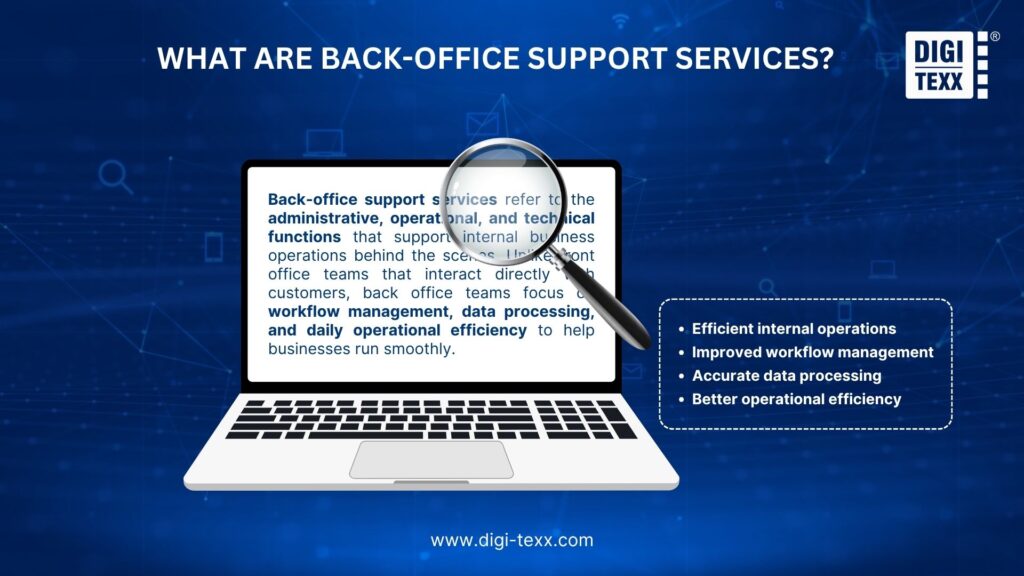
Back office outsourcing is the practice of hiring an external service provider to manage internal business operations that support a company’s core activities. These functions typically do not involve direct customer-facing sales, although some, such as order management and claims processing, may affect customer experience.
Common back office outsourcing services include data entry, document management, payroll administration, invoice processing, procurement support, and records management.
Unlike hiring individual employees, outsourcing allows businesses to access an established team, defined workflows, quality control procedures, and operational resources under an agreed service arrangement.
What Back Office Functions Can You Outsource?
Businesses can outsource nearly any back office process that has clear requirements, measurable outputs, and appropriate data access controls. The best starting point is usually a high-volume, repetitive, or time-consuming workflow.
| Function | Typical outsourced tasks | Suitable business needs |
| Data entry and processing | Data capture, validation, cleansing, database updates | Large datasets and recurring data workloads |
| Finance and accounting | Invoice processing, accounts payable, reconciliation support | High invoice volumes and administrative backlogs |
| HR and payroll | Employee record updates, payroll data preparation, HR administration | Growing teams and repetitive HR workloads |
| Document processing and management | Scanning, indexing, classification, OCR, records management | Paper-heavy or document-intensive operations |
| Order processing | Order entry, validation, status updates, data synchronization | E-commerce, retail, and distribution |
| Procurement and supply chain | Purchase order entry, supplier record maintenance, document checks | Complex supplier networks and high transaction volumes |
| Administrative support | Data updates, scheduling, reporting, record maintenance | Lean internal teams |
| Claims processing | Claim intake, document verification, data entry, status tracking | Insurance and other claims-intensive operations |
| IT and technical support | Ticket logging, routine troubleshooting, user administration | Organizations needing additional technical capacity |
Data Entry & Data Processing
Data entry outsourcing transfers repetitive data capture and maintenance tasks to an external team. Services may include entering information from forms, spreadsheets, invoices, applications, and business systems.
Typical tasks include:
- Data extraction from digital and scanned documents.
- Database entry, validation, and updating.
- Data cleansing, deduplication, and standardization.
- Spreadsheet processing and catalog maintenance.
- Data verification against source records.
For example, an e-commerce company can outsource product catalog updates across thousands of SKUs instead of assigning the work to its sales or merchandising team.
Track field-level accuracy, records processed per hour, exception rates, and turnaround time. For sensitive or complex data, use validation rules and human review rather than relying entirely on automated entry.
Finance & Accounting
Finance and accounting outsourcing covers administrative financial workflows that can be separated from strategic financial decision-making.
Common services include:
- Accounts payable data entry and invoice processing.
- Accounts receivable administration.
- Expense report verification.
- Bank statement data capture and reconciliation support.
- Purchase order and invoice matching.
- Financial document preparation and record maintenance.
A company processing thousands of supplier invoices can outsource data capture, coding based on approved rules, and exception routing while retaining payment authorization and financial oversight internally.
Define approval limits, segregation of duties, audit trails, and escalation procedures before outsourcing financial workflows.
HR & Payroll
HR outsourcing can cover administrative work that consumes HR teams’ time without requiring them to delegate hiring strategy or employee relations decisions.
Examples include:
- Employee record maintenance.
- Timesheet and attendance data processing.
- Payroll input preparation.
- Benefits enrollment data administration.
- Document collection and onboarding administration.
- HR database updates and reporting support.
Payroll-related work requires particular care because it involves personal and financial information. The contract should specify access permissions, processing deadlines, data retention, and responsibility for reviewing payroll outputs.
Document Processing & Management
Document processing outsourcing helps organizations convert paper-based or unstructured information into searchable, usable digital data.
Services can include:
- Document scanning and digitization.
- OCR-based text extraction.
- Document classification and indexing.
- Metadata capture and validation.
- Records organization and retrieval.
- Document quality checks and exception handling.
For example, a lender may receive applications containing identity documents, income statements, and bank records. An outsourced team can classify files, capture required fields, and flag missing information for internal review.
Intelligent document processing (IDP) combines technologies such as OCR, machine learning, and workflow automation. Human-in-the-loop review can help resolve low-confidence extractions and complex exceptions.
Order Processing
Order processing outsourcing supports the administrative steps between receiving an order and preparing it for fulfillment.
Typical responsibilities include:
- Entering orders from emails, forms, or other approved channels.
- Checking required fields and order details.
- Updating order information in an ERP or order management system.
- Maintaining order records and tracking exceptions.
- Supporting returns documentation and order reconciliation.
Retailers and distributors can use outsourced order entry to manage seasonal spikes without permanently expanding their internal administrative teams.
Define how the provider should handle duplicate orders, missing information, pricing discrepancies, and urgent requests.
Procurement & Supply Chain
Procurement and supply chain outsourcing can reduce the administrative workload associated with purchasing and supplier records.
Services include:
- Purchase order creation and data entry.
- Supplier database maintenance.
- Purchase order and invoice matching.
- Document verification.
- Shipment and delivery record updates.
- Procurement reporting and exception tracking.
An outsourced team can prepare purchase order records using approved specifications, while the client’s procurement managers retain supplier selection, commercial negotiations, and purchasing authorization.
This division of responsibility helps maintain financial controls while increasing processing capacity.
Administrative Support
Administrative support outsourcing covers recurring office tasks that keep internal operations running.
Common examples include:
- Data and record maintenance.
- Spreadsheet updates and report preparation.
- Document formatting and organization.
- Scheduling and administrative coordination.
- Digital file management.
- Routine information verification.
This model suits small and midsize businesses that need additional administrative capacity but do not require a full-time employee for every task.
Claims Processing
Claims processing outsourcing supports the administrative handling of claims documents and associated data. Depending on the industry and contract, services may include:
- Claim intake and registration.
- Document collection and indexing.
- Data entry and completeness checks.
- Supporting-document verification.
- Case status updates.
- Exception routing and records management.
For insurance organizations, outsourced teams can handle routine documentation and data processing while authorized internal personnel retain responsibility for coverage decisions, fraud determinations, and claim approvals.
Because claims often contain sensitive personal information, assess the provider’s access controls, auditability, and ability to follow applicable regulatory requirements.
IT & Technical Support
IT support outsourcing can cover routine technical administration and help desk activities, although these services are sometimes classified separately from traditional back office BPO.
Examples include:
- Ticket logging and categorization.
- User account administration.
- Password reset workflows.
- Routine troubleshooting.
- Knowledge base maintenance.
- Asset inventory updates and technical documentation.
For higher-risk activities, specify access restrictions, escalation thresholds, incident reporting procedures, and approval requirements.
>>> See more:
- Ecommerce Back Office Support Services For Fast Growth
- 7 Essential Steps In The Invoice Validation Process
- BPO Services For Insurance: Definition, Types, Benefits & Top Companies
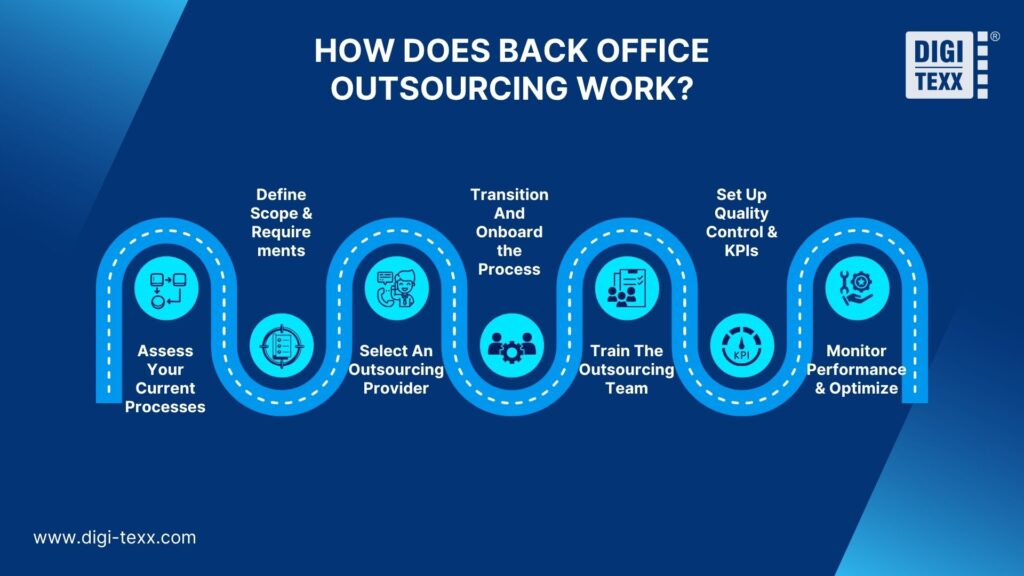
How Does Back Office Outsourcing Work?
A successful back office outsourcing engagement starts with a clearly defined process, not simply the transfer of tasks to an external team.
Assess Your Current Processes
Document how each process works today, including workload, processing time, error rates, bottlenecks, and staffing requirements. For example, measure monthly invoice volume, average handling time, rework rates, and the percentage of invoices requiring manual intervention.
Establishing a baseline makes it possible to determine whether outsourcing actually improves performance.
Define Scope And Requirements
Specify the tasks to outsource, expected deliverables, operating hours, systems, data access, and responsibilities.
Document:
- Expected workload and peak periods.
- Required turnaround times.
- Accuracy and quality thresholds.
- Escalation and exception-handling rules.
- Data security and confidentiality requirements.
- Service-level agreements (SLAs) and reporting frequency.
Avoid vague requirements such as “process documents quickly.” Define measurable targets that both parties can verify.
Select An Outsourcing Provider
Compare providers based on relevant experience, service scope, staffing model, technology, security controls, and pricing transparency. Ask for examples of comparable workflows, quality assurance methods, business continuity arrangements, and references where available.
The lowest quote is not necessarily the lowest-cost option if it leads to additional supervision, rework, or integration expenses.
Transition And Onboard The Process
Prepare standard operating procedures (SOPs), system access, templates, sample records, and escalation contacts. A phased transition is often safer than moving every task at once. Start with a limited workload, validate the results, and expand after meeting agreed acceptance criteria.
Train The Outsourcing Team
Train assigned personnel on process rules, data definitions, software, quality requirements, and exception handling.
Use real-world samples with sensitive information appropriately masked where necessary. Test the team’s ability to complete representative tasks before granting access to live workloads.
Set Up Quality Control And KPIs
Agree on a scorecard before full production begins.
| KPI | What it measures |
| Data accuracy rate | Percentage of processed records meeting defined accuracy requirements |
| Processing turnaround time | Time required to complete a task |
| SLA attainment | Percentage of tasks completed within agreed deadlines |
| First-pass yield | Percentage completed correctly without rework |
| Error or rework rate | Percentage of outputs requiring correction |
| Cost per transaction | Total attributable cost divided by completed transactions |
Define each formula and its denominator in the contract or operating procedures. For example, record accuracy and field-level accuracy are different metrics and should not be treated as interchangeable.
Monitor Performance And Optimize
Review KPI reports, error trends, exceptions, and workload forecasts regularly. Investigate recurring problems instead of merely asking the provider to process more work.
Once a workflow is stable, consider automation, improved validation rules, standardized templates, or workload redistribution.
>>> See more:
- How to Moderate User-Generated Content: Complete Guide 2026
- Automated Invoice Processing: How It Works, Benefits & Best Software
- Healthcare BPO Services: Overview, Benefits & Key Solutions 2026
What Are The Benefits Of Back Office Outsourcing?
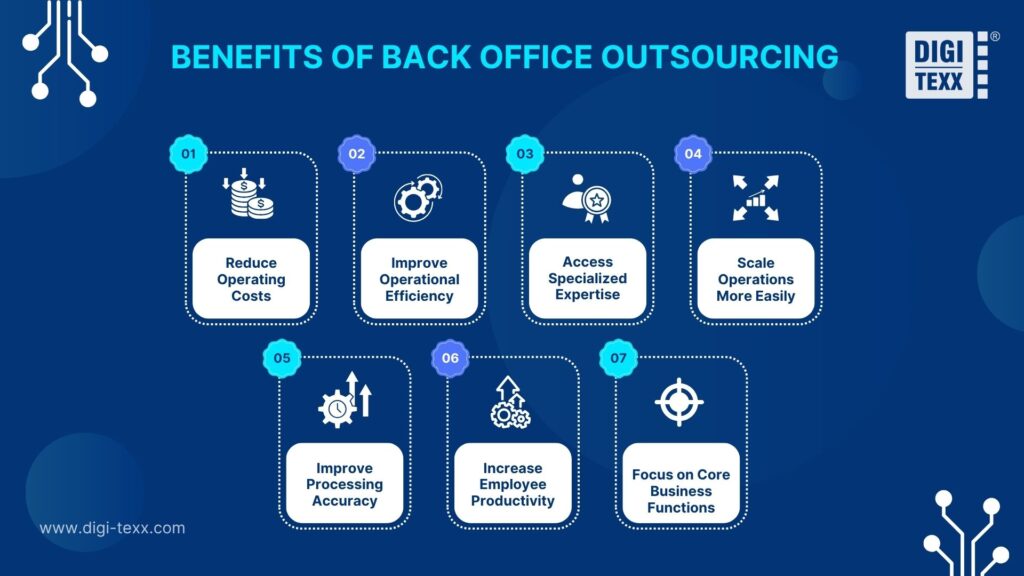
Back office outsourcing enables businesses to control operating costs, streamline workflows, and expand processing capacity without building every function in-house. The key benefits include:
- Reduce Operating Costs: Outsourcing helps businesses reduce expenses associated with recruitment, training, salaries, employee benefits, and infrastructure. It can be particularly cost-effective for repetitive tasks that require consistent processing capacity but do not justify a full in-house team.
- Improve Operational Efficiency: Specialized providers use standardized workflows, established procedures, and quality control processes to handle recurring tasks. This can help businesses reduce administrative backlogs, shorten processing times, and maintain more consistent service delivery.
- Access Specialized Expertise: Businesses gain access to trained professionals, industry-specific knowledge, and technologies such as OCR and workflow automation without investing in all these capabilities internally. This is especially valuable for document processing, data management, and other specialized operational tasks.
- Scale Operations More Easily: Outsourcing allows businesses to adjust processing capacity as transaction volumes change, whether during seasonal peaks, business expansion, or large-scale digitization projects. This reduces the need to recruit and train permanent employees for temporary workload increases.
- Improve Processing Accuracy: Standard operating procedures, automated validation, and human quality checks help identify errors before they affect downstream operations. For data-intensive workflows, these controls can reduce rework and improve the reliability of business records.
- Increase Employee Productivity: Delegating repetitive administrative work frees internal employees to focus on analysis, problem-solving, and higher-value responsibilities. This helps teams use their time more effectively instead of spending hours on routine data entry or document handling.
- Focus on Core Business Functions: By outsourcing non-core operations, businesses can direct more resources toward strategic priorities such as product development, customer relationships, and revenue growth while retaining control over critical decisions and business processes.
How Much Does Back Office Outsourcing Cost?
Back office outsourcing costs depend on task complexity, processing volume, service location, technology, and quality requirements. Providers typically use four pricing models:
- Hourly Pricing: Businesses pay for the hours worked. This model suits short-term projects, pilot programs, and workloads that fluctuate. For example, 160 hours at $12 per hour costs $1,920, excluding additional fees. This is an illustrative calculation, not a market-rate benchmark.
- Full-Time Equivalent (FTE) Pricing: Businesses pay for an agreed level of staffing capacity. This model works well for ongoing data entry, document processing, and administrative support. Confirm whether supervision, training, and quality control are included.
- Per-Transaction Pricing: Providers charge for each completed task, such as processing an invoice, updating a record, or indexing a document. This model supports predictable budgeting when transaction volumes and acceptance criteria are clearly defined.
- Project-Based Pricing: Providers quote a fixed fee for a defined project, such as digitizing an archive or cleaning a database. Additional charges may apply if the scope or workload changes.
>>> See more:
- What Is Business Process Management (BPM)? Definition & Benefits
- Define Business Process Outsourcing (BPO): Meaning, Examples & Benefits 2026
- Offshore BPO: Meaning, Example & Best Offshore BPO Company 2026
Top 10 Back Office Outsourcing Companies In The USA
The best back office outsourcing company depends on the functions you need to outsource, your budget, data security requirements, and preferred delivery model. Some providers specialize in data processing and document workflows, while others support enterprise-wide finance, procurement, insurance, and administrative operations.
The following 10 providers offer different capabilities for US businesses. Compare their service scope, delivery locations, pricing structure, and industry expertise before making a decision.
| Company | Founded / Headquarters | Delivery Model | Core Back Office Services | Best For |
| DIGI-TEXX | 2003 / Ho Chi Minh City, Vietnam | Offshore | Data entry, data processing, document digitization, invoice processing, data cleansing, AI data services | US businesses needing cost-effective, high-volume data and document processing with AI-assisted workflows and human quality control |
| Genpact | 1997 / Global operations | Global delivery network | Finance and accounting, accounts payable/receivable, procurement, supply chain, process automation | Midsize and large enterprises outsourcing complex finance, procurement, and operational processes |
| TTEC | 1982 / Denver, Colorado, USA | Onshore and global delivery | Back office support, case management, technical support operations, data and analytics, workflow optimization | Businesses integrating back office operations with customer service and technical support |
| EXL | 1999 / New York, New York, USA | Global delivery network | Finance and accounting, insurance claims, healthcare operations, data analytics, risk and compliance support | Insurance, healthcare, and financial services organizations with specialized or regulated workflows |
| Infosys BPM | 2002 / Bengaluru, India, through Infosys | Global delivery network | Finance and accounting, procurement, HR processes, data management, enterprise operations | Enterprises outsourcing multiple functions or standardizing processes across business units |
| Teleperformance (TP) | 1978 / France | Global delivery network | Transaction processing, administrative support, business process services, multilingual operations, digital services | Businesses combining back office outsourcing with customer support and multilingual service delivery |
| Conduent | 2017 as an independent company / Florham Park, New Jersey, USA | US-based and global operations | Transaction processing, benefits administration, document management, public-sector services, payment-related operations | Large enterprises and public-sector organizations requiring high-volume transaction processing |
| WNS Global Services | 1996 / Mumbai, India | Global delivery network | Finance and accounting, procurement, supply chain, insurance and banking operations, analytics | Enterprises with complex, recurring, or industry-specific business processes |
| Concentrix | 2004 as an independent company / Newark, California, USA | Onshore and global delivery | Business process support, digital operations, data analytics, workflow transformation, managed services | Businesses connecting back office processes with digital transformation and broader enterprise services |
| Sutherland Global Services | 1986 / Rochester, New York, USA | Global delivery network | Back office operations, process transformation, data services, technology support, automation | Organizations seeking a combination of outsourced operations, technology services, and process improvement |
1. DIGI-TEXX
DIGI-TEXX is an international business process outsourcing (BPO) and digital services provider established in Vietnam in 2003. The company is 100% German-invested and operates from Ho Chi Minh City, Vietnam, with additional delivery operations in Can Tho. Its offshore delivery model serves international clients seeking data-intensive and document-intensive business process support.
Core Services
- Data entry and data processing: Entering, validating, updating, and standardizing business data.
- Document processing and digitization: Scanning, classifying, indexing, and converting physical documents into digital records.
- Invoice processing: Extracting and validating invoice data using OCR, machine learning, and human review.
- Data cleansing: Identifying inconsistencies, correcting records, and improving database quality.
- AI data services: Supporting data annotation and other data preparation workflows for AI applications.
Best For
US businesses looking for an offshore partner for recurring data entry, document processing, invoice workflows, data cleansing, and other high-volume operational tasks. It is particularly relevant when businesses need a combination of AI-assisted processing and human quality control.
2. Genpact
Genpact began in 1997 as a business unit within GE Capital and later became an independent global professional services company. It focuses on business operations, process transformation, data, and AI, serving organizations across multiple industries.
Core Services
- Finance and accounting operations
- Accounts payable and accounts receivable
- Procurement and sourcing support
- Supply chain operations
- Risk management and industry-specific business processes
- Process automation and operational transformation
Best For
Large and midsize enterprises seeking to outsource complex business processes, particularly finance, procurement, supply chain, and operations that require process redesign or automation.
3. TTEC
TTEC was founded in 1982 and is headquartered in Denver, Colorado. The company provides customer experience outsourcing, technology, consulting, and related business process services through a global delivery network.
Core Services
- Back office and business process support
- Customer operations and case management
- Technical support operations
- Data and analytics services
- Workflow optimization and automation
- Customer experience technology and consulting
Best For
Businesses that need back office operations integrated with customer service, technical support, or broader customer experience processes. Buyers should confirm that the proposed solution specifically covers their non-customer-facing workflows.
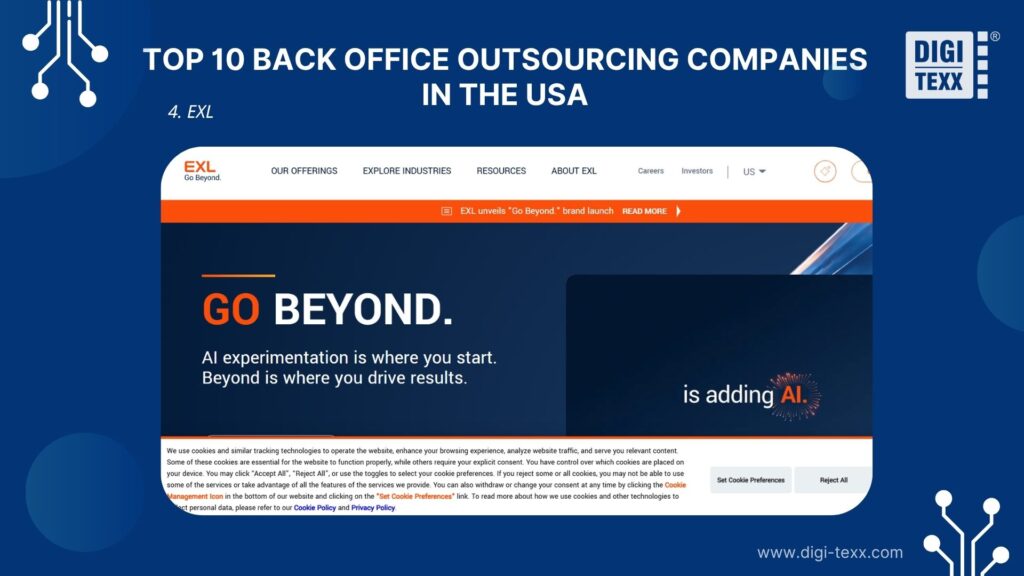
4. EXL
EXL was founded in 1999 and is headquartered in New York. It combines business process services, data analytics, and AI-enabled digital operations, with industry experience in insurance, healthcare, banking, and other sectors.
Core Services
- Finance and accounting operations
- Insurance claims and policy administration
- Healthcare operations and data management
- Data management and analytics
- Risk and compliance-related processes
- AI-enabled workflow optimization
Best For
Organizations with specialized or regulated workflows, particularly in insurance, healthcare, and financial services, where industry knowledge, data accuracy, and analytics capabilities are important.
5. Infosys BPM
Infosys BPM was established in April 2002 and is a wholly owned subsidiary of Infosys Limited. It delivers business process management services globally, combining operational expertise, technology, automation, and process improvement. The company operates delivery centers across multiple countries.
Core Services
- Finance and accounting
- Accounts payable and receivable
- Procurement and sourcing
- HR and payroll-related processes
- Data management and analytics
- Customer and enterprise operations
Best For
Enterprises looking to outsource multiple business functions or standardize existing processes across departments, business units, or international markets.
>>> See more:
- 10 Best Content Moderation Service Providers In USA 2026
- List Of 20 BPO Companies In Vietnam 2026: Services & Expertise
6. Teleperformance (TP)
Teleperformance, now operating under the TP brand, was founded in France in 1978 and has a global service delivery presence. Although widely associated with customer experience outsourcing, the company also supports business operations and back office processes.
Core Services
- Back office business process services
- Transaction and administrative processing
- Customer operations support
- Industry-specific business services
- Digital business services and automation
- Multilingual operational support
Best For
Businesses seeking a large global outsourcing partner for back office processes that operate alongside customer support, multilingual service delivery, or other business operations.
7. Conduent
Conduent is a US-based business process and technology services provider headquartered in Florham Park, New Jersey. It became an independent publicly traded company in 2017 and serves commercial, government, healthcare, and transportation organizations.
Core Services
- Transaction processing and administrative operations
- Healthcare and benefits administration
- Document and information management
- Government and public-sector business services
- Customer communications and payment-related operations
- Technology-enabled workflow management
Best For
Large organizations and public-sector entities that need high-volume transaction processing, benefits administration, or specialized operational services with defined service-level requirements.
8. WNS Global Services
WNS is a global business process management provider with roots in India and delivery operations across North America, Europe, Asia-Pacific, and other regions. Its services combine process management, analytics, and technology for industry-specific and enterprise workflows.
Core Services
- Finance and accounting
- Procurement and sourcing
- Supply chain management
- Insurance and banking operations
- Data analytics and business intelligence
- Industry-specific business process management
Best For
Enterprises with recurring, complex, or industry-specific workflows that require a structured outsourcing model, process standardization, and analytics support.
9. Concentrix
Concentrix is a global technology and business services company headquartered in Newark, California. It provides integrated business services, digital operations, and technology-enabled solutions for organizations across multiple industries.
Core Services
- Business process and operational support
- Digital operations
- Data and analytics services
- Customer and enterprise workflow support
- Technology-enabled process transformation
- Industry-specific managed services
Best For
Businesses looking for an outsourcing partner that can connect operational processes with digital transformation, data capabilities, or wider enterprise service delivery.
10. Sutherland Global Services
Sutherland was established in 1986 and is headquartered in Rochester, New York. It provides business process and technology management services through a global network of delivery locations, combining operational expertise with digital solutions.
Core Services
- Back office and business process management
- Business process transformation
- Data and knowledge services
- Enterprise technology support
- Digital services and automation
- Industry-specific operational support
Best For
Organizations that want to combine business process outsourcing with technology services, operational transformation, or managed support across multiple functions.
How Do You Choose The Right Back Office Outsourcing Company?
Choosing a provider requires more than comparing hourly rates. Use the following criteria to assess operational fit and long-term value.
| Selection criterion | Questions to ask |
| Service expertise | Has the provider handled this specific workflow and document or data type? |
| Pricing transparency | Are setup, supervision, technology, rework, and minimum-volume charges disclosed? |
| Quality assurance | How are errors measured, sampled, corrected, and reported? |
| Data security | What access controls, encryption, audit logs, and incident procedures are in place? |
| Technology compatibility | Can the team work with your ERP, CRM, document management system, or existing templates? |
| Scalability | How quickly can capacity increase, and what contractual limits apply? |
| Communication | Who manages daily operations, escalations, and performance reviews? |
| Business continuity | How will the provider maintain service during staffing or infrastructure disruptions? |
| Contract flexibility | Can you change volumes, add workflows, or terminate the engagement under defined conditions? |
Before signing, run a pilot using representative workloads. Measure accuracy, turnaround time, rework, communication quality, and actual cost per accepted output.
Also establish clear ownership of source data, processed outputs, work instructions, and audit records. For sensitive information, confirm applicable legal obligations, data-processing terms, subcontractor arrangements, and cross-border data transfer requirements.
The right provider should demonstrate that it can meet your operational requirements consistently, not merely promise lower costs.
Why Choose DIGI-TEXX For Back Office Outsourcing?
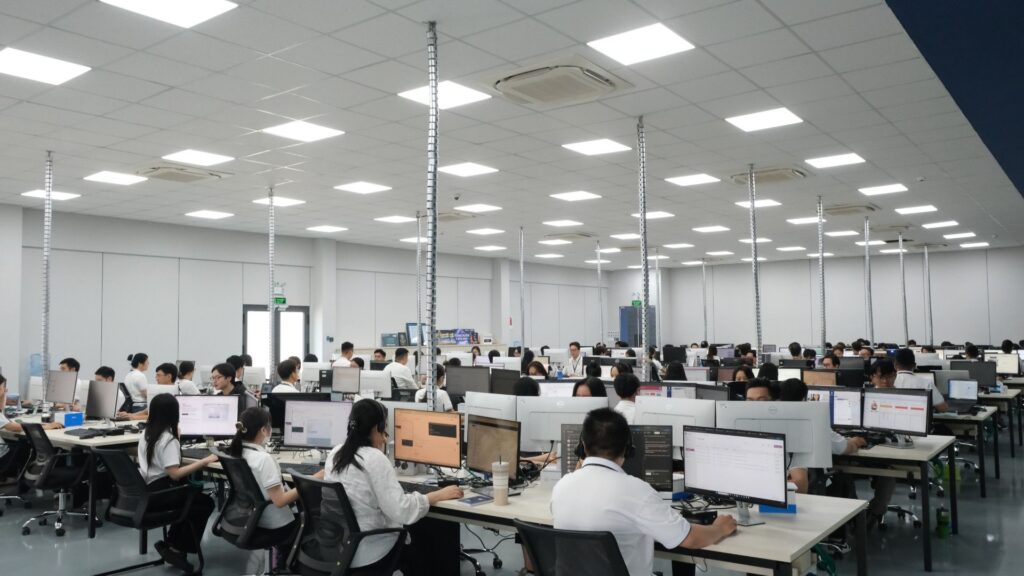
DIGI-TEXX is an offshore BPO provider for organizations that need support with data-intensive and document-intensive operations. Its suitability depends on the workflow, processing volume, security requirements, and operating model.
- Support for data-intensive operations: DIGI-TEXX supports data entry, data cleansing, data processing, and document-related workflows using defined procedures, validation rules, and quality checks.
- Document processing and AI-Assisted workflows: For document-heavy operations, DIGI-TEXX supports document digitization, OCR-based data extraction, classification, data capture, and human review. Its DIGI-Xtract solution combines AI-assisted processing with human quality control where required.
- Flexible delivery and quality control: The delivery model can be structured around workload, process complexity, security requirements, and service-level targets. Define KPIs such as accuracy, turnaround time, first-pass yield, and exception rates before production begins.
- Information security and process governance: Security controls should be aligned with the specific engagement, including access permissions, confidentiality, data handling, quality records, and incident escalation. DIGI-TEXX states that it holds ISO 9001 and ISO 27001 certifications, which should be verified for current scope and validity during vendor due diligence.
FAQs About Back-Office Support Services
What Are The 4 Types Of Outsourcing?
The four main types of outsourcing are professional outsourcing, IT outsourcing, manufacturing outsourcing, and process-specific outsourcing. Businesses use these outsourcing models to reduce costs, access specialized expertise, improve flexibility, and focus more on core business operations.
Is Outsourcing A Dying Concept?
No, outsourcing is far from a dying concept. In fact, many businesses continue to rely on outsourcing to reduce operational costs, access specialized expertise, improve efficiency, and scale more flexibly. As technology and remote collaboration continue to evolve, outsourcing remains an important strategy for companies looking to stay competitive and focus on core business growth.
What Is An Example Of BPO?
A common example of Business Process Outsourcing (BPO) is when an e-commerce company hires an external service provider to manage its customer support operations, including phone calls, emails, and live chat. Instead of building and maintaining an in-house support team, the company relies on the BPO provider to handle customer inquiries, returns, and other support requests.
Is Back Office Considered BPO?
The answer is yes, back-office operations are considered a major part of Business Process Outsourcing (BPO). When a company delegates internal, non-customer-facing tasks to an external service provider, it is using back-office BPO services.
Back office outsourcing enables businesses to delegate repetitive administrative and operational work while keeping strategic decisions and critical controls in-house. The most suitable functions to outsource are those with clearly defined workflows, measurable outputs, and manageable data security requirements.
Before selecting a provider, compare the full cost of delivery, test performance through a pilot, and agree on specific quality and service-level targets. A well-defined engagement can help improve operational capacity without sacrificing accuracy, visibility, or control.
DIGI-TEXX Contact Information:
Website: https://digi-texx.com/
Hotline: +84 28 3715 5325
Email: [email protected]
Address:
- Headquarters: Anna Building, QTSC, Trung My Tay Ward
- Office 1: German House, 33 Le Duan, Saigon Ward
- Office 2: DIGI-TEXX Building, 477-479 An Duong Vuong, Binh Phu Ward
- Office 3: Innovation Solution Center, ISC Hau Giang, 198 19 Thang 8 street, Vi Tan Ward
Reference:
- Harvard Business Review. (n.d.). Outsourcing: A guide to when and how to outsource business functions. https://hbr.org
- Society for Human Resource Management (SHRM). (n.d.). HR outsourcing and business process support. https://www.shrm.org