
In today’s highly competitive economy, businesses must continuously improve efficiency and productivity to stay profitable. Customer-facing teams such as sales and service rely on well-organized back office services to operate smoothly. When internal processes like data management, finance, or administration are inefficient, the impact is felt not only in revenue but also in overall customer experience.
As labor costs rise, inflation persists, and talent becomes harder to secure, many businesses are finding traditional in-house back office services increasingly difficult to maintain. This is why more organizations are turning to back office service outsourcing as a strategic approach to improve efficiency and control costs.
With deep experience in delivering back office services, DIGI-TEXX helps businesses in high-cost markets optimize operations, improve productivity, and stay competitive in an evolving global landscape.
>>> See more:
- Business Process Automation Solutions: Benefits, Example & Service Company
- Top 10 Data Processing Software For Business 2026 – Best Tool Reviewed
- Medical Claims Processing Outsourcing For Healthcare Providers
What Is A Back office Service?
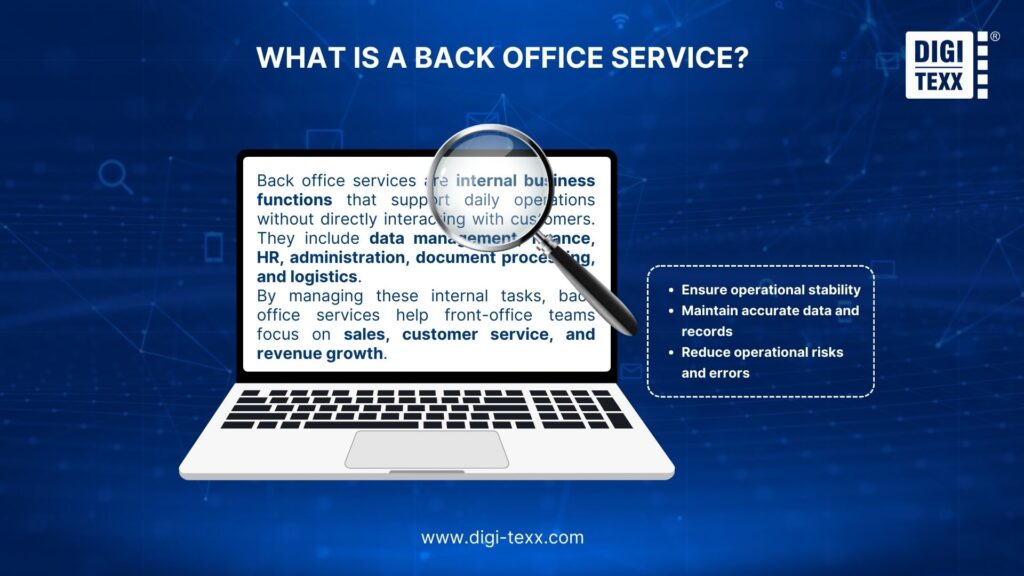
A back office service refers to internal business functions that support core operations but do not interact directly with customers. These services typically include data management, finance, human resources, administration, document processing, and logistics. By handling these internal tasks, back office services allow frontline teams to focus on revenue generation, sales, and customer service.
In simple terms, if the front office is the “face” of the business, the back office is its “backbone.” A well-organized back office helps businesses:
- Ensure operational stability.
- Maintain accurate data and records.
- Support front-office and revenue-generating teams.
- Reduce operational risks and errors.
What Is The Difference Between Back Office And Front Office?
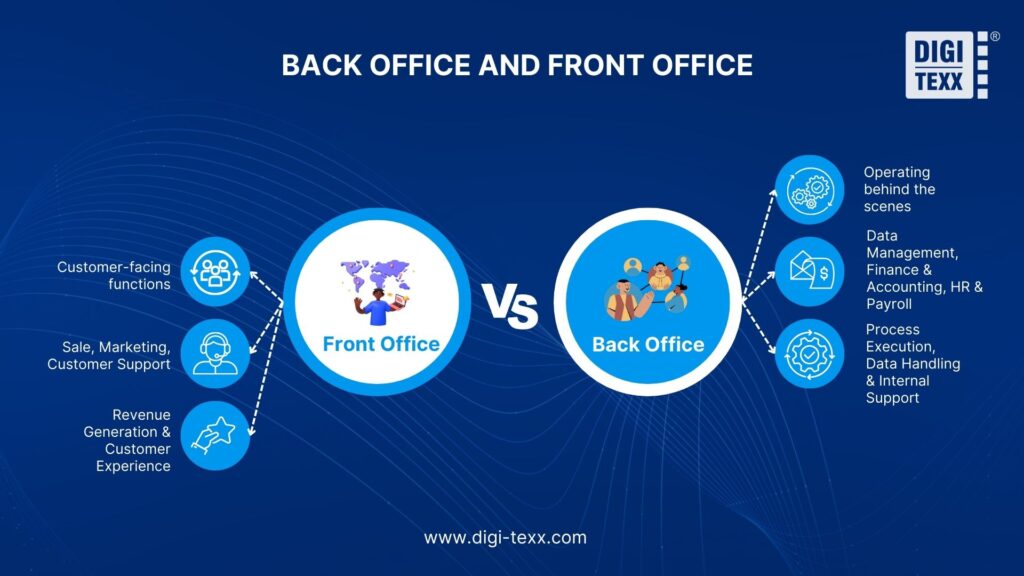
The difference between back office and front office lies in their roles and level of customer interaction.
- Front office includes customer-facing functions such as sales, marketing, and customer support. These teams interact directly with customers and focus on revenue generation and customer experience.
- Back office includes data management, finance and accounting, HR and payroll, and document processing. These activities operate behind the scenes, focusing on process execution, data handling, and internal support to ensure the front office can operate effectively.
Although the back office and front office have different roles, they work closely together and depend on each other. The front office deals directly with customers, but its performance depends heavily on back office accuracy. For instance: Errors in invoices, payroll delays, or inaccurate data can directly affect customer trust and employee satisfaction.
For instance: Errors in invoices, payroll delays, or inaccurate data can directly affect customer trust and employee satisfaction.
>>> See more:
- Define Business Process Outsourcing (BPO): Example, Best company
- Healthcare BPO Services – Cost Optimization & Improve Care 2026
How Does The Back Office Work?
Back office operations follow structured workflows designed to ensure consistency, accuracy, and compliance. Each process typically includes:
- Data input or document intake
- Validation, processing, and standardization
- System updates and reporting
- Compliance checks and documentation
To support these workflows, organizations integrate back office functions with ERP systems, accounting software, HR platforms, and data warehouses. This integration enables centralized data management, process automation, and better operational control. Performance is then monitored using clear KPIs such as turnaround time, error rates, and cost per transaction to ensure efficiency, consistency, and continuous improvement.
What Tasks Are Common In Back Office Work?
Common back office tasks focus on administration, data handling, and operational support, including:
- Data capture and management
- Document processing
- Financial record keeping
- Payroll and HR administration
- Compliance and reporting
- Internal coordination and support
These tasks may not be visible to customers, but errors or delays can directly affect cash flow, employee satisfaction, and decision-making.
Which Industries Use Outsourced Back-office Services?
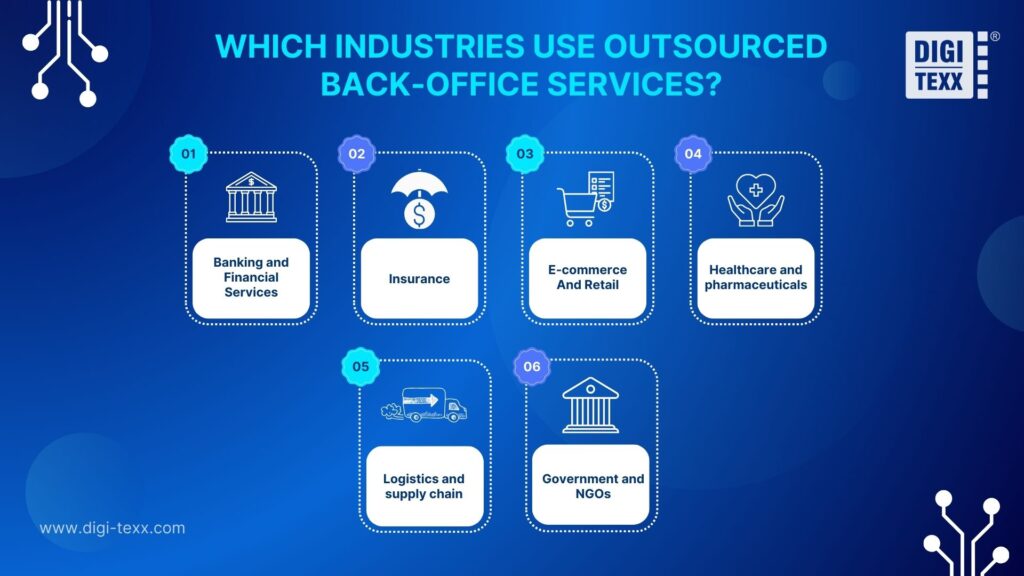
Outsourced back office services are widely adopted across industries where accuracy, scalability, and cost control are critical. These industries often manage large data volumes and complex operational processes, making in house back office management costly and difficult to scale. Common industries include:
- Banking and financial services
- Insurance
- E-commerce and retail
- Healthcare and pharmaceuticals
- Logistics and supply chain
- Government and NGOs
In these sectors, outsourcing back office functions helps reduce operational pressure, improve process efficiency, and allow organizations to focus on their core capabilities and strategic priorities.
What Types Of Service Jobs Can Be Outsourced?
Back office outsourcing covers a wide range of operational and support functions. These tasks are typically process driven, repeatable, and require consistency rather than constant strategic decision-making. These characteristics make them well suited for outsourcing, especially when businesses need to scale operations, control costs, or improve efficiency without expanding internal teams.
Data Entry
Data entry is one of the most commonly outsourced back office functions, particularly for businesses handling large volumes of structured or semi-structured data. The work typically involves inputting, validating, and updating information across internal systems such as CRM platforms, ERP software, or operational databases.
Data Extraction
Data extraction involves retrieving specific information from unstructured or semi-structured sources such as documents, emails, or scanned files. It helps organizations transform scattered data into usable inputs for analysis, automation, or system integration. Outsourcing helps ensure consistency, speed, and scalability, especially when data sources vary in format or volume.
Data Enrichment
Data enrichment enhances existing datasets by adding missing, updated, or contextual information. This improves data accuracy and usability for decision-making, analytics, and customer segmentation. Outsourcing data enrichment helps organizations keep data current and reliable without dedicating ongoing internal resources.
Document Imaging
Document imaging converts paper-based records into searchable digital formats through scanning and indexing. This process supports compliance, reduces physical storage needs, and improves document accessibility across the organization.
Invoice Processing
Invoice processing covers the end to end handling of supplier or customer invoices, including data capture, verification, approval workflows, and system entry. This function plays a critical role in maintaining cash flow accuracy and ensuring timely payments, making it particularly suitable for organizations with high transaction volumes or multi location operations. Outsourcing invoice processing reduces processing time, ensures standardization, and supports compliance in document-heavy environments.
Payroll Outsourcing
Payroll outsourcing handles employee compensation processes, including salary calculation, tax deductions, and payment execution. This service helps businesses reduce compliance risks while ensuring payroll accuracy and confidentiality.
Translingual Data Entry
Translingual data entry involves inputting and managing data across multiple languages while preserving accuracy and context. It supports global operations where multilingual content is common. It is particularly valuable for global businesses managing cross-border operations or international datasets.
Directory Services
Directory services focus on maintaining structured and up to date databases of contacts, vendors, or organizational records. Outsourcing directory services helps businesses keep information accurate, up to date, and standardized across platforms.
Human Resources
HR back-office functions include employee records management, onboarding documentation, benefits administration, and compliance tracking. These tasks enable HR teams to focus more on strategic workforce planning and employee engagement.
Bookkeeping and Finance
Bookkeeping and finance services handle transaction recording, reconciliations, financial reporting, and basic compliance tasks. Outsourcing helps maintain accuracy, reduce close cycles, and provide consistent financial data without building large in-house teams.
Insurance Operations
Insurance back office operations manage policy documentation, claims processing, and compliance related workflows. These services are essential for maintaining accuracy and turnaround time in highly regulated environments.
PR
PR related back office services support media monitoring, content coordination, and reporting rather than direct brand communication. Outsourcing PR operations improves organization, data accuracy, and campaign efficiency without diverting core marketing resources.
>>> See more:
- Fashion Photo Retouching: Key Techniques, Benefits, and Tips
- Ecommerce Photo Retouching Services | Boost Image Quality
- Data Management Outsourcing: Why Businesses Are Turning to External Experts in 2026
Back Office Services Examples
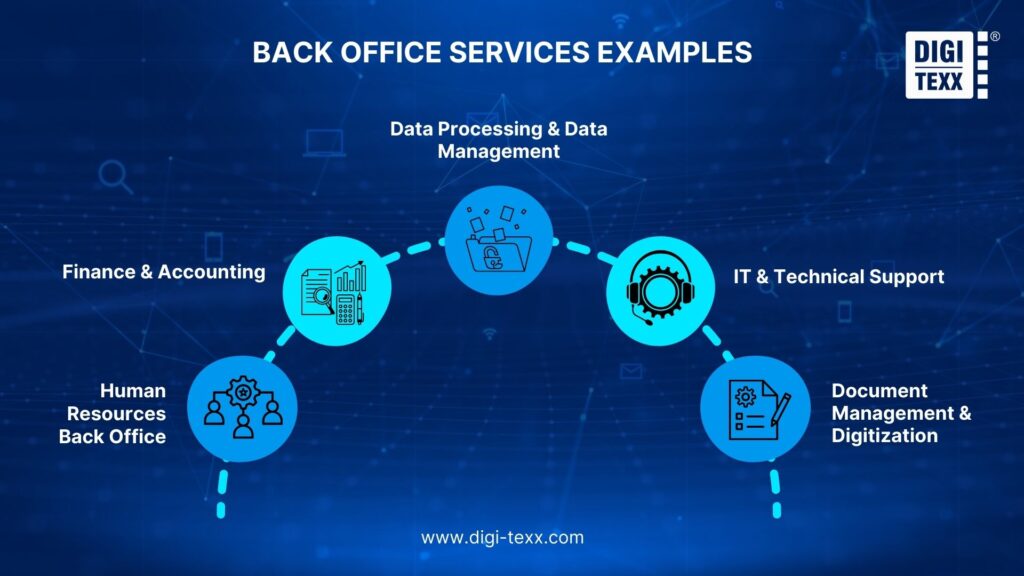
Below are the most common back office services examples used by enterprises in 2026:
Data Processing & Data Management
- Data entry, validation, and cleansing
- OCR/ICR data extraction
- Database management and updates
- AI-assisted data annotation and labeling
Industries: Healthcare, insurance, eCommerce, logistics, banking
Finance & Accounting (F&A)
- Accounts payable (AP) and accounts receivable (AR)
- General ledger management
- Payroll processing
- Financial reporting and reconciliation
Industries: Manufacturing, SaaS, retail, fintech
Human Resources (HR) Back Office
- Employee records management
- Recruitment administration
- Payroll and benefits administration
- Compliance documentation
Industries: IT services, enterprises with large workforces, global companies
Document Management & Digitization
- Document scanning and indexing
- Digital archiving
- Records management
- Compliance-ready document workflows
Industries: Legal, government, healthcare, BFSI
IT & Technical Support (Non-Customer Facing)
- Infrastructure monitoring
- Application maintenance
- System updates and data security operations
Industries: Technology, telecom, SaaS platforms
What Are The Key Benefits Of Outsourcing Back-Office Services?
Outsourcing back office operations has evolved from a tactical decision into a strategic advantage.
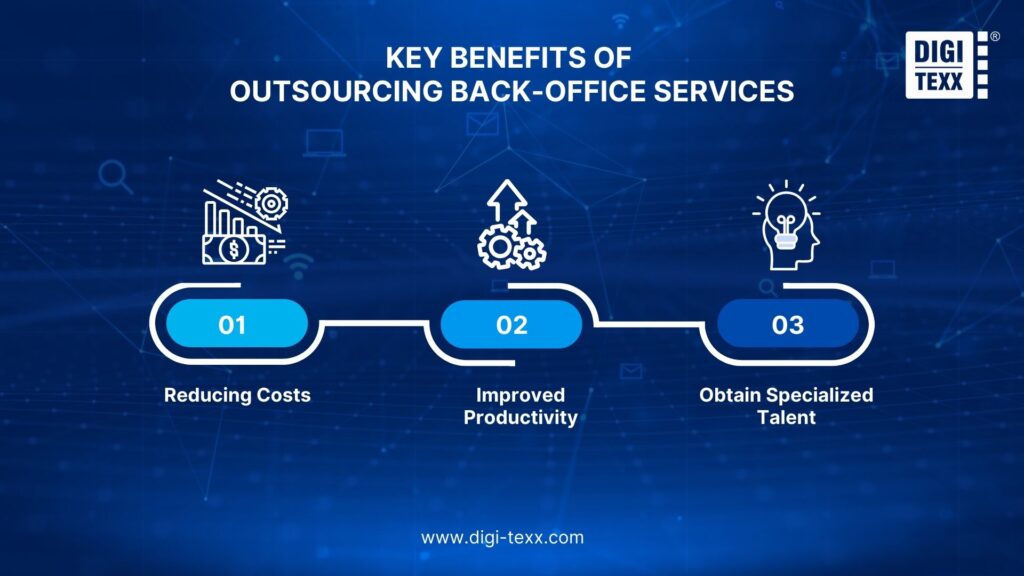
Reducing Costs
One of the most immediate benefits is cost optimization:
- Lower labor costs through offshore or nearshore models
- Reduced infrastructure and software expenses
- Predictable pricing models (FTE, transaction-based, SLA-driven)
Companies typically reduce operational costs by 30–50% compared to in-house back office teams.
Improved Productivity
By offloading repetitive and administrative tasks:
- Internal teams can focus on revenue-generating activities
- Processes are standardized and automated
- Turnaround time (TAT) improves significantly
Outsourcing partners often deploy automation, AI, and workflow tools that outperform manual in-house processes.
Obtain Specialized Talent
Back office outsourcing providers invest heavily in:
- Domain-trained professionals
- Compliance-ready processes
- Industry-specific expertise
This allows businesses to access highly specialized talent without long-term hiring risks.
>>> See more:
- Top 10 Best Big Data Processing Tool for Business 2026
- Top 12 Data Entry Outsourcing Companies In United States
The Challenges Companies Face In Back-Office Operations
Despite its importance, the back office is often fraught with inefficiencies:
- Data Silos: Information trapped in different departments leading to inconsistent reporting.
- Scaling Friction: A sudden surge in business volume can overwhelm an in-house back office, leading to backlogs and errors.
- High Turnover: Administrative roles often have high attrition rates, leading to constant recruitment and training costs.
- Security Risks: Handling sensitive data internally without enterprise-grade cybersecurity can lead to costly breaches.
Why Do Businesses Choose To Outsource Back-Office Services?
In 2026, the decision to outsource is a strategic pivot toward agility. Businesses choose to outsource because:
- 24/7 Operations: By leveraging different time zones (e.g., a German company outsourcing to Vietnam), work continues while the home office sleeps.
- Focus on Core Competencies: It allows leadership to focus on product development and market expansion.
- Risk Mitigation: Professional BPO firms have robust disaster recovery plans and compliance certifications (like ISO 27001 or GDPR) that an SME might lack.
How To Select The Right Back-Office Outsourcing Solution?
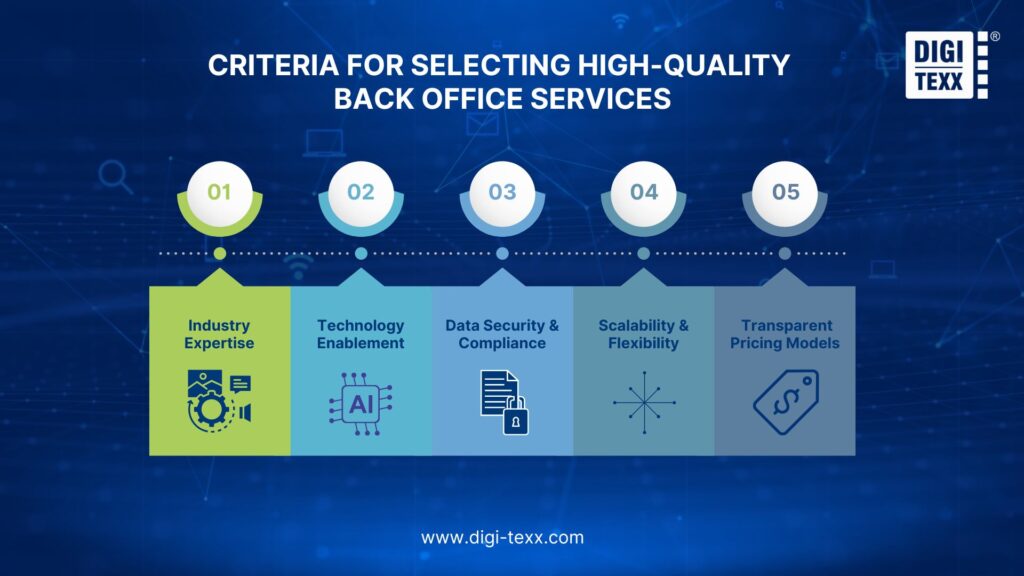
Choosing the right partner is critical. Below are the key criteria businesses use to evaluate reliable and reputable service providers.
1. Industry Expertise
Select a vendor with proven experience delivering back office services in your industry, such as healthcare, BFSI, or eCommerce. Industry-specific expertise ensures a deep understanding of workflows, compliance requirements, and operational challenges.
2. Technology Enablement
A qualified back office services provider typically leverages modern technologies to improve accuracy, speed, and scalability, including:
- AI and machine learning
- Workflow automation tools
- Secure data platforms
- Advanced analytics and reporting dashboards
3. Data Security & Compliance
Data protection is non-negotiable in back office outsourcing. Ensure the provider complies with international standards such as:
- ISO 27001
- GDPR
- HIPAA (for healthcare back office services)
4. Scalability & Flexibility
Your back office services partner should be able to scale resources up or down quickly based on business demand—without compromising service quality, turnaround time, or data accuracy.
5. Transparent Pricing Models
Look for clear and flexible pricing structures. A reliable back office services provider offers transparent cost models, well-defined SLAs, and measurable KPIs to avoid hidden fees and ensure performance accountability.
One example of a technology-driven BPO provider is DIGI-TEXX, which delivers end-to-end back office services by combining process excellence with AI-powered data solutions to support global enterprises at scale.
>>> See more:
- Top 10 Data Cleansing Companies for Businesses in 2025
- Outsourced Data Annotation Services: List of Best Companies to Work for
- Best Insurance Claims Processing Outsourcing BPO in the US 2026
How Much Do Back Office Outsourcing Services Cost Per?
Costs vary depending on service type, location, complexity, and technology use. Below is a general cost breakdown:
| Service Type | Offshore (USD/FTE/month) | Transaction-Based |
| Data Entry & Processing | $800 – $1,200 | $0.05 – $0.50 per record |
| Finance & Accounting | $1,200 – $2,500 | $5 – $30 per invoice |
| HR Administration | $1,000 – $2,000 | Per employee/month |
| Document Digitization | N/A | $0.03 – $1 per page |
Note: Back office service costs are for reference only and are based on offshore service pricing in the European market. For accurate pricing and tailored consultation tailored to specific requirements, please contact DIGI-TEXX directly.
Frequently Asked Questions About Back Office Services
What Are Common Back Office Duties?
Common back office duties include:
- Data management: data entry, analysis, and reporting.
- Finance and accounting: payroll, accounts payable (A/P), accounts receivable (A/R), and financial reporting.
- Human resources: recruitment, onboarding, training, payroll administration, and employee records.
- IT support: system administration, software support, and network maintenance.
- Order processing: order entry, verification, and fulfillment coordination.
- Regulatory compliance: ensuring adherence to industry regulations and internal policies.
- Legal support: contract management, documentation, and legal record keeping.
What Does A Backoffice Do?
The back office acts as the support structure of the company. It processes the “paperwork” (digital or physical) generated by front-office activities. If the front office makes a promise to a customer, the back office ensures that promise is kept through logistics, billing, and record-keeping.
>>> See more:
- An Overview of Document Processing Company: What You Need to Know
- Outsourcing Data Cleansing: What You Need to Know
- How to Automate Document Process: A Step-by-Step Guide
As businesses enter 2026, back office services are no longer just operational support but a key driver of efficiency, scalability, and competitiveness. Outsourcing these functions helps organizations reduce costs, improve accuracy, and focus on core growth activities.
By partnering with an experienced, technology-driven provider like DIGI-TEXX, businesses can transform back-office operations into a strategic advantage and stay agile in an increasingly digital landscape.
With over 20 years of experience, DIGI-TEXX is a trusted global BPO partner, combining deep operational expertise with advanced technology to deliver scalable and secure back-office solutions. From data-intensive processes to complex operational workflows, DIGI-TEXX helps organizations improve efficiency, reduce costs, and maintain consistent service quality at scale.
For more detailed information or a tailored consultation on Back Office Services, including data processing, finance & accounting support, HR administration, and document management, please contact DIGI-TEXX to discuss your specific business needs.
DIGI-TEXX Contact Information:
🌐 Website: https://digi-texx.com/
📞 Hotline: +84 28 3715 5325
✉️ Email: [email protected]
🏢 Address:
- Headquarters: Anna Building, QTSC, Trung My Tay Ward
- Office 1: German House, 33 Le Duan, Saigon Ward
- Office 2: DIGI-TEXX Building, 477-479 An Duong Vuong, Binh Phu Ward
- Office 3: Innovation Solution Center, ISC Hau Giang, 198 19 Thang 8 street, Vi Tan Ward
Reference:
- World Economic Forum. The future of jobs report. https://www.weforum.org
- International Labour Organization. World employment and social outlook. https://www.ilo.org