
In today’s digital era, unstructured data and fragmented systems can cripple business operations. Implementing a robust data quality framework is no longer optional; it is the absolute foundation for driving accurate AI business documents analysis and achieving seamless automation.
At DIGI-TEXX, we understand that transitioning from raw inputs to actionable insights requires more than just software. Whether you are scaling intelligent document processing services or optimizing core workflows, a strategic framework ensures your enterprise data remains reliable.
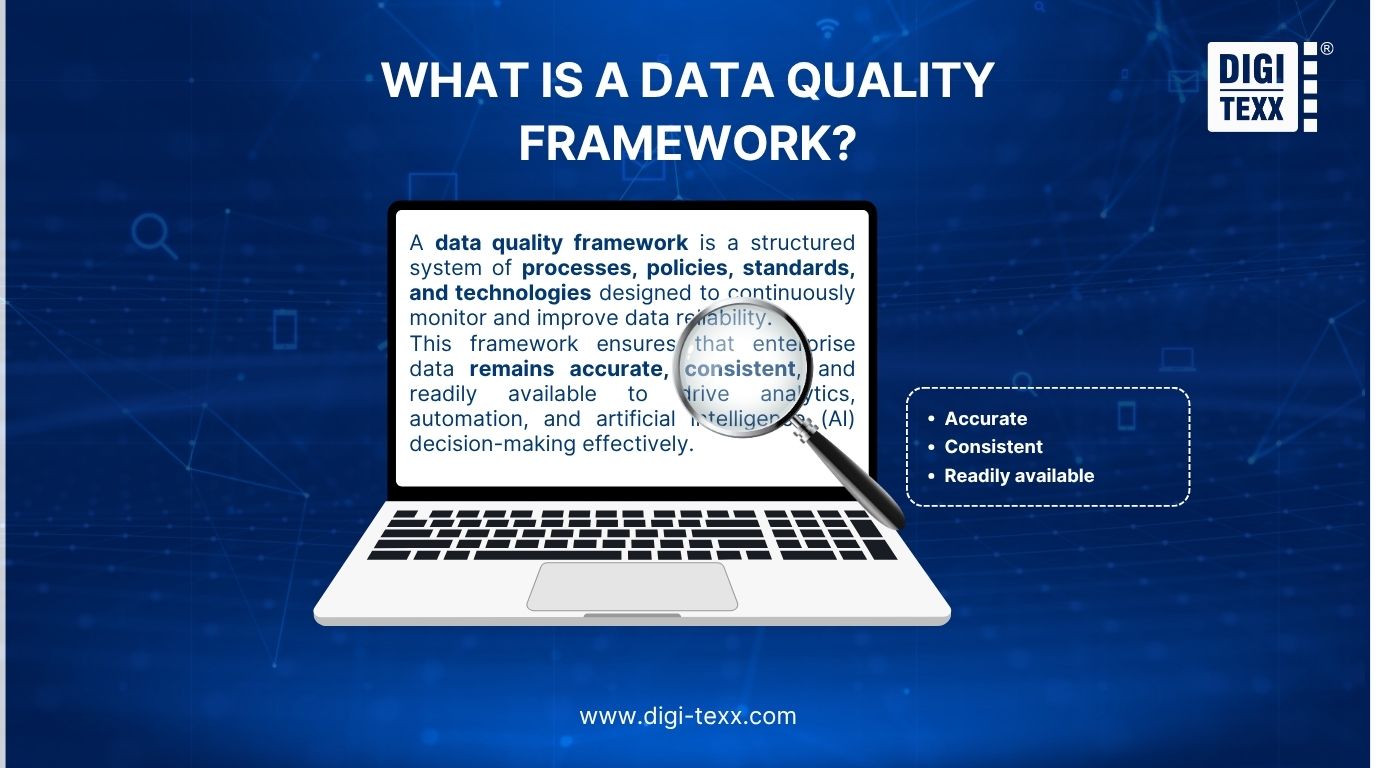
What Is A Data Quality Framework?
technologies designed to continuously monitor and improve data reliability. This framework ensures that enterprise data remains accurate, consistent, and readily available to drive analytics, automation, and artificial intelligence (AI) decision-making effectively.
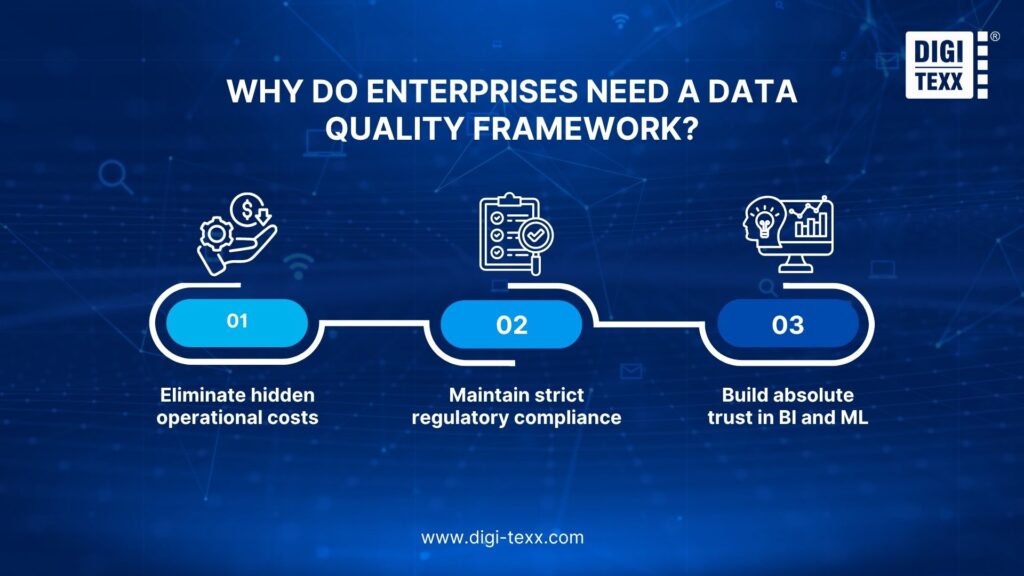
Why Do Enterprises Need A Data Quality Framework?
Enterprises require a data quality framework to prevent the “garbage in, garbage out” cycle, ensuring reliable analytics. Implementing a structured framework helps:
- Eliminate hidden operational costs.
- Maintain strict regulatory compliance.
- Build absolute trust in business intelligence (BI) and machine learning (ML) outputs.
When critical datasets contain missing values or duplicate records, data engineers must abandon strategic development. They waste countless hours manually debugging broken data pipelines instead of building a scalable architecture.
Deploying a robust data quality framework fundamentally shifts your data team’s workflow, moving from reactive firefighting to proactive prevention.
“Poor data quality costs organizations an average of $12.9 million every year.” – Gartner Research
>>> See more:
- How To Automate Documentation: 6 Steps To Improve Workflow Efficiency
- Digitization Of Historical Documents: Importance & Process
- Intelligent Document Recognition (IDR): Definition, Example, Benefits
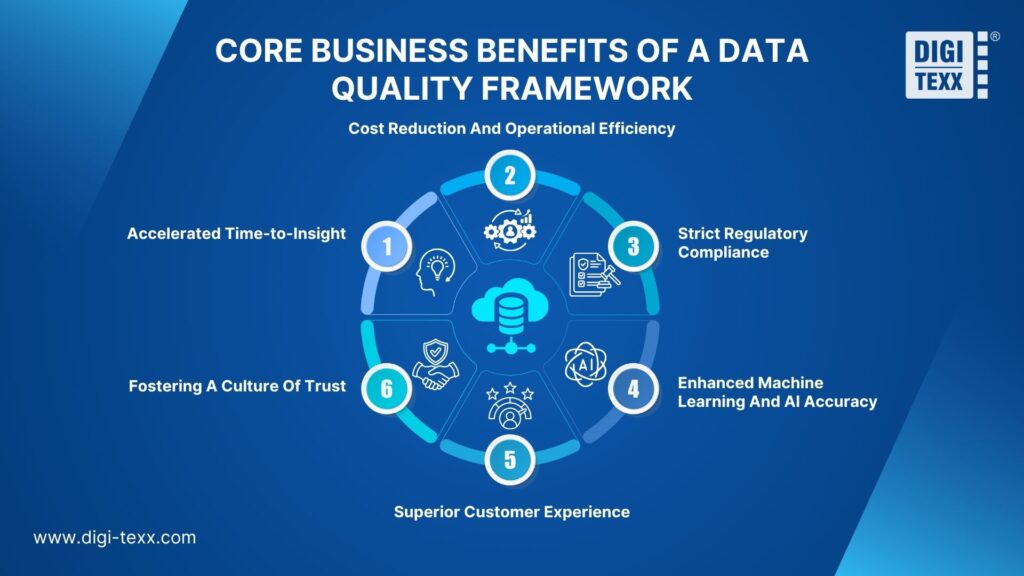
Core Business Benefits Of A Data Quality Framework
Implementing a standardized data quality framework offers profound advantages across the entire organization. The core benefits include accelerated decision-making, significant cost reduction, strict regulatory compliance, enhanced machine learning accuracy, and a vastly improved customer experience.
1. Accelerated Time-to-Insight
Clean data is the ultimate foundation for reliable business process automation solutions, allowing analysts to generate accurate dashboards instantly. Executive leaders can speed up their decision-making process without second-guessing the numbers.
2. Cost Reduction And Operational Efficiency
By identifying and quarantining anomalies at the ingestion stage, companies eliminate the expensive downstream costs of fixing bad data. Data engineers can focus on building revenue-generating products rather than acting as full-time troubleshooters.
3. Strict Regulatory Compliance
Frameworks enforce data validity and security, ensuring organizations easily comply with global privacy laws like GDPR, CCPA, and HIPAA. Accurate data tracking prevents costly legal penalties associated with mishandling sensitive customer information.
4. Enhanced Machine Learning And AI Accuracy
High-quality, unified data serves as the critical foundation for training accurate, bias-free AI models. For complex applications like image processing for virtual try-on AI model development, visual outputs are only as reliable as the data feeding them, a rigorous framework guarantees that this input is flawless.
5. Superior Customer Experience
Accurate data directly impacts the end-user. From ensuring shipping addresses are correct to powering highly personalized marketing campaigns, reliable data prevents customer friction, builds brand loyalty, and boosts retention rates.
6. Fostering A Culture Of Trust
When business leaders trust the data, they act faster and more decisively. A centralized framework eliminates departmental silos and the common “finger-pointing” that occurs when marketing and finance report different revenue figures.
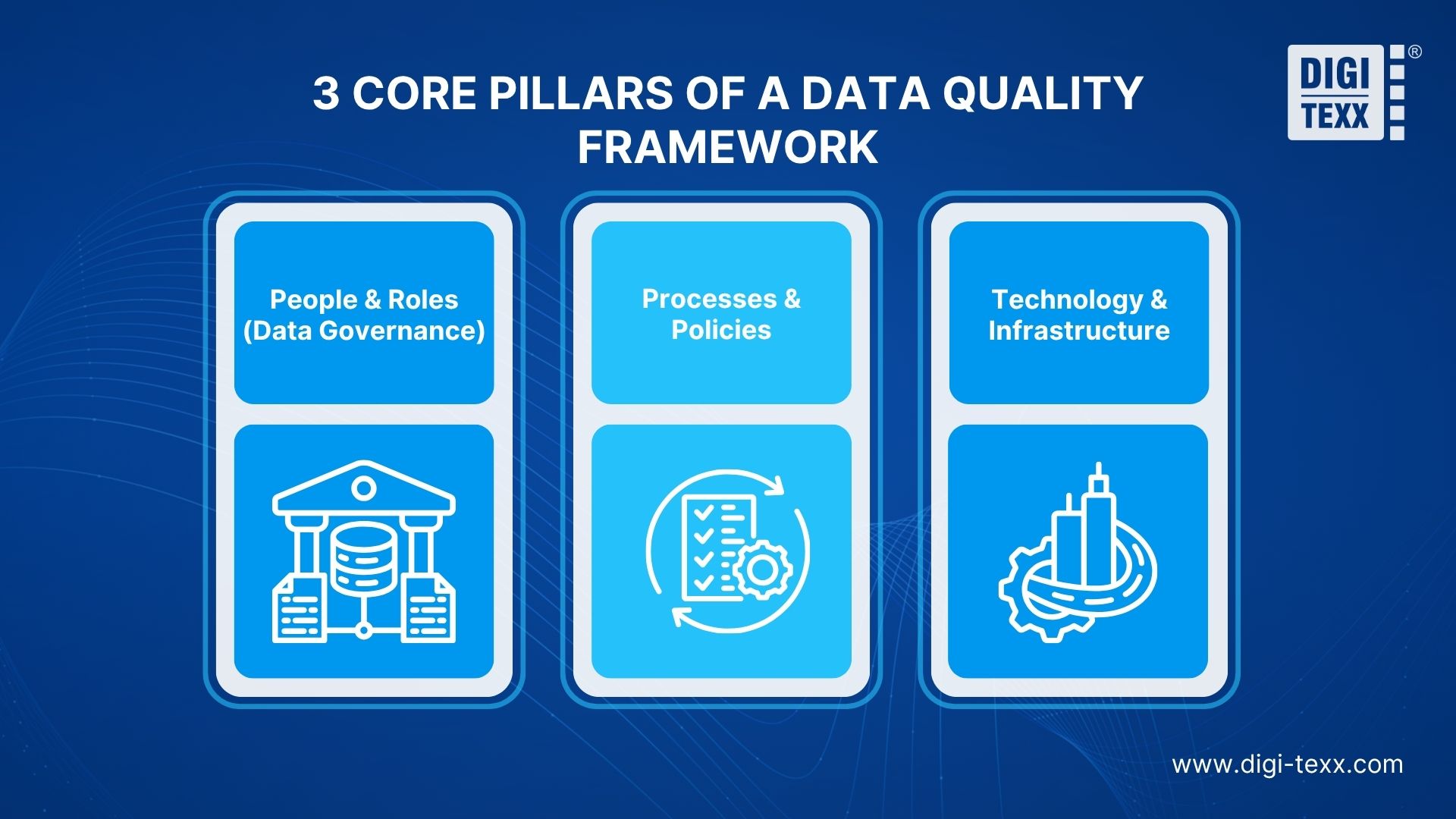
3 Core Pillars Of A Data Quality Framework
A successful data quality framework does not rely solely on software tools. Instead, it must be strategically built upon three interconnected foundational pillars: People (assigning clear data ownership), Process (establishing governance workflows), and Technology (deploying automated profiling and monitoring infrastructure).
1. People & Roles (Data Governance)
Technology cannot solve structural disorganization. The first pillar involves assigning explicit accountability for data assets. The Chief Data Officer (CDO) drives the high-level strategy. Data Owners (often department heads) define what constitutes “good” data for their specific business logic. Finally, Data Stewards handle the day-to-day execution, ensuring that operational data meets the defined standards.
2. Processes & Policies
This pillar translates human objectives into repeatable workflows. It includes establishing clear Data Governance rules, defining data lifecycle management, and creating standardized protocols for incident remediation. When an anomaly is detected, the process dictates exactly how it should be logged, routed, and resolved.
3. Technology & Infrastructure
The final pillar provides the computational power to scale quality checks. It encompasses the Modern Data Stack, utilizing automated tools for data profiling, cleansing, and continuous pipeline observability.
>>> See more:
- Construction Invoice Reconciliation: Process, Best Practices & Software 2026
- Top Business Process Documentation Tools You Should Consider
- Medical Claims Processing Outsourcing Services For Faster Reimbursements
The 6 Data Quality Dimensions
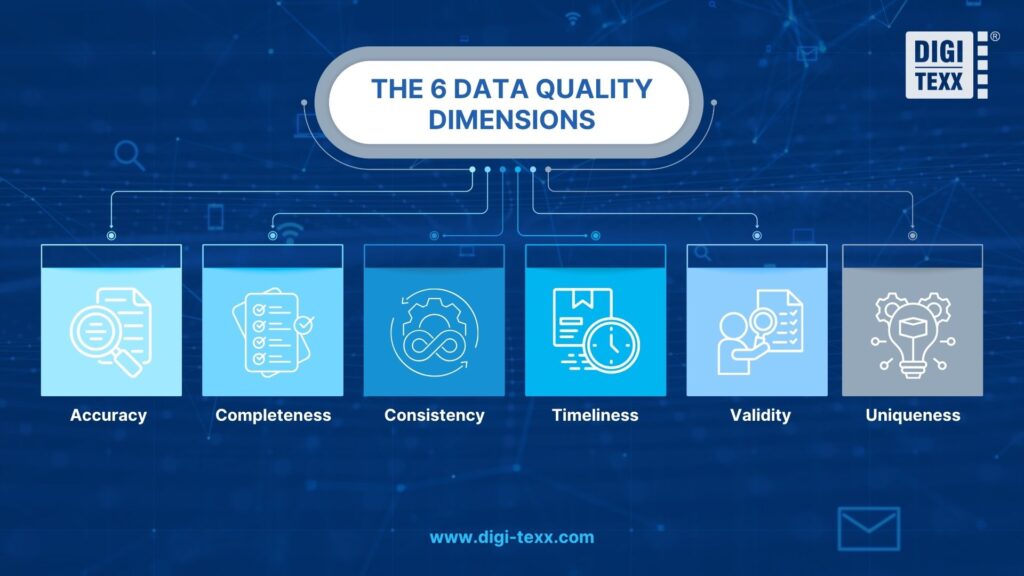
To objectively measure data health, organizations evaluate their datasets against six core data quality dimensions. These universal industry metrics include Accuracy, Completeness, Consistency, Timeliness, Validity, and Uniqueness, providing data teams with a comprehensive and measurable view of overall enterprise data integrity.
| Dimension | Definition | Real-World Example | Measurement Metric |
| Accuracy | Data reflects real-world truth and events correctly. | Customer phone numbers are real and reachable. | % of erroneous records |
| Completeness | No critical fields or required values are missing. | User profiles contain Name, Email, and Age. | % of Null or Blank fields |
| Consistency | Data matches seamlessly across disparate systems. | CRM and ERP systems show the exact same address. | Number of cross-system data conflicts |
| Timeliness | Data is updated and available when required. | Revenue dashboards update in real-time. | Data latency tracking |
| Validity | Data conforms to defined syntax and formats. | All emails contain an “@” symbol. | % of invalid formatting |
| Uniqueness | The dataset is completely free of duplicates. | Every customer has a single, distinct ID. | Number of duplicate records |
Standard Data Quality Framework Models
There are many different models and implementation methods that can be adapted to build a data quality framework that fits the specific needs of a company. Below are specific examples of successful data quality frameworks:
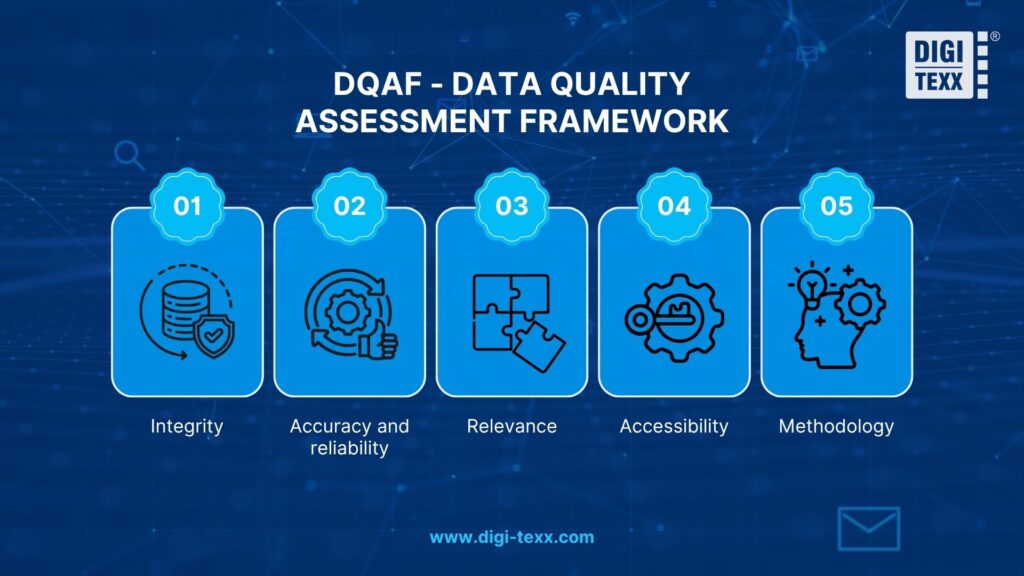
DQAF – Data Quality Assessment Framework
DQAF was developed by the International Monetary Fund (IMF) to assess the quality of statistical data. This method is a systematic structure for assessing data quality. Although focused on statistical data, the principles of this template are developed to be applicable in many fields.
- Integrity: Whether the data processing units are equipped with adequate resources and processes to operate appropriately.
- Accuracy and reliability: Whether the data accurately reflects the economic reality at the time it is collected for measurement.
- Relevance: Whether the data is relevant, timely, and consistent.
- Accessibility: Whether the data is clear and easy for users to access.
- Methodology: Whether the methods used to collect and compile the data are reasonable.
TDQM – Total Data Quality Management
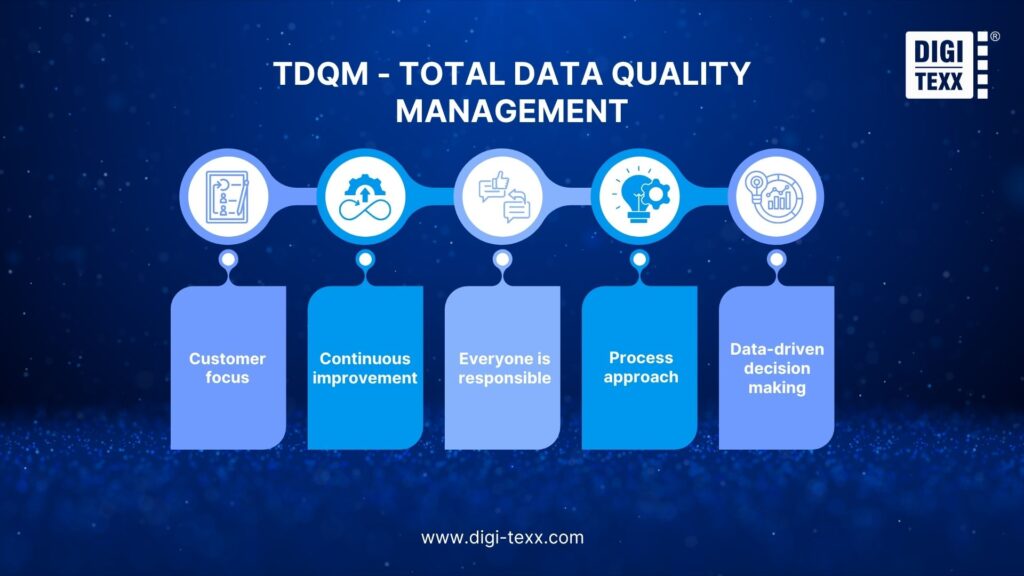
TDQM is a data management approach that emphasizes a comprehensive and continuous implementation to improve data quality. TDQM will focus on meeting the needs of customers (data users) and continuous process improvement. The main principles of TDQM include
- Customer focus: Understand and meet customers’ data quality requirements.
- Continuous improvement: Continuously seek to improve data quality processes and outcomes.
- Everyone is responsible: All employees have a role in ensuring data quality.
- Process approach: Data quality management requires one or more specific processes.
- Data-driven decision making: Using data to make business decisions.
DQS – Data Quality Scorecard
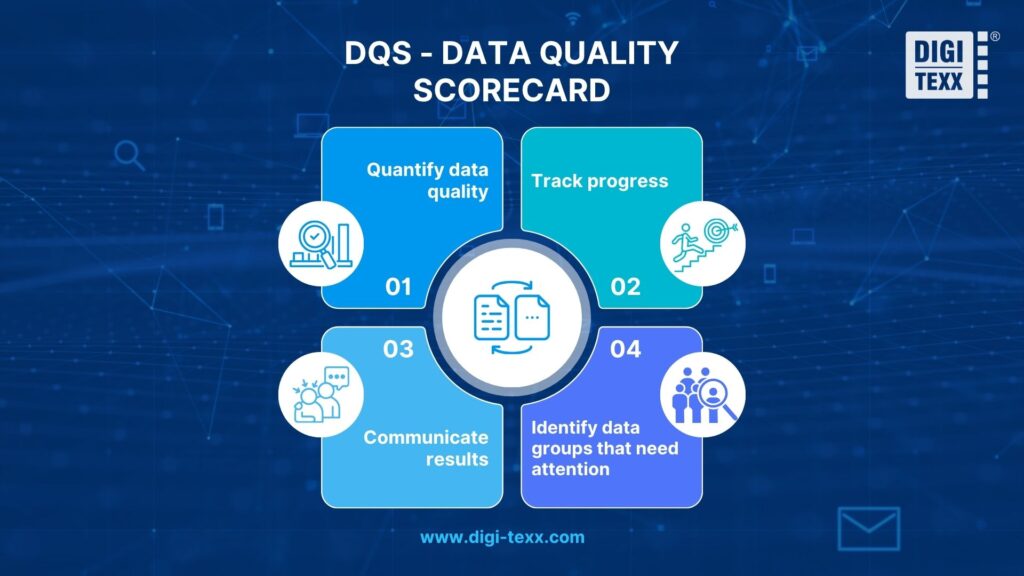
A data quality scorecard is a tool for measuring, tracking, and reporting on data quality over time. The methodology will provide an overview of data quality performance based on pre-defined metrics and goals. As a template of the data quality framework, DQS helps:
- Quantify data quality: Assign scores or ratings to different data quality dimensions.
- Track progress: Monitor improvements or deterioration in data quality over time.
- Communicate results: Report data quality to stakeholders in a clear and concise manner.
- Identify data groups that need attention: Highlight groups of data or processes with quality issues.
DQMM – Data Quality Maturity Model
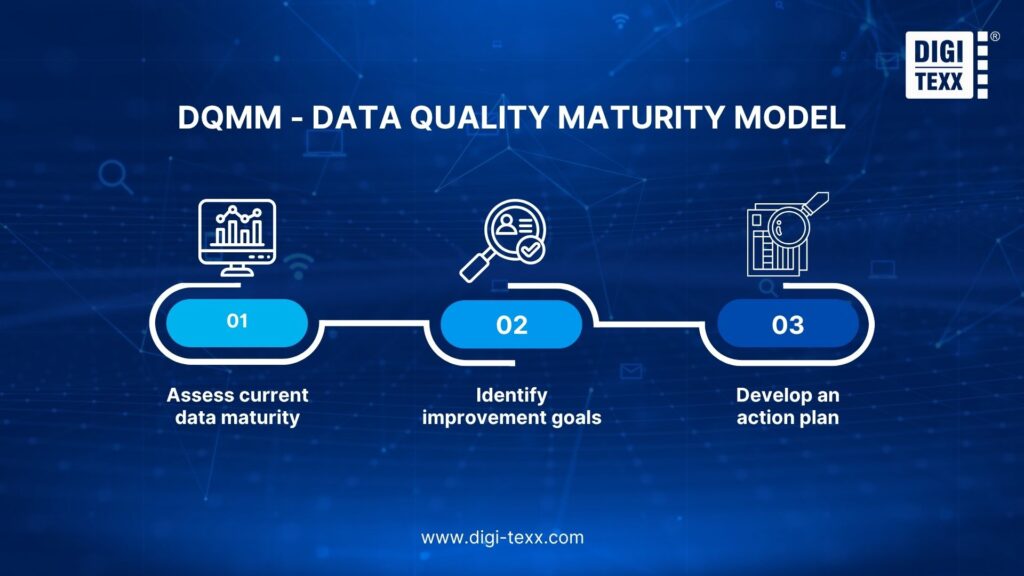
DQMM is a roadmap approach for companies to more easily assess and improve their data quality management capabilities. This approach typically identifies different stages of data evolution, from early (where data quality processes are chaotic) to optimized (where data quality is actively managed and continuously improved). By using DQMM in a data quality framework, organizations can:
- Assess current data maturity: Understand the state of the data in terms of data quality management.
- Identify improvement goals: Set realistic goals to achieve higher levels of maturity.
- Develop an action plan: Outline the steps needed to improve data quality management capabilities.
DDT – Data Downtime
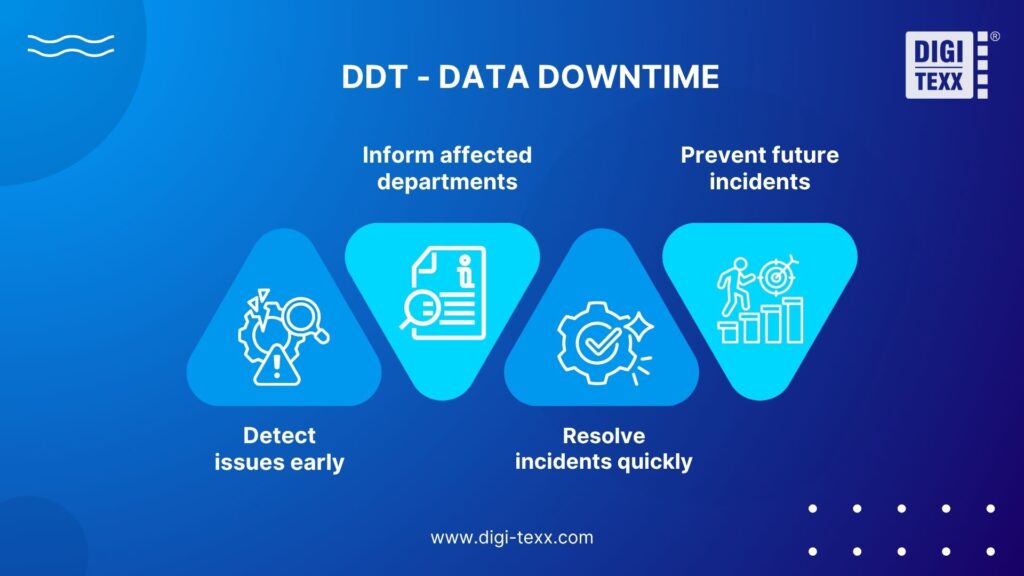
While not a “framework” in the traditional sense, the concept of Data Downtime was popularized by companies like Monte Carlo. DDT refers to periods of time when data is corrupted, inaccurate, missing, or unreliable. Focusing on minimizing DDT can be another approach to building a data quality framework
- Detect issues early: Implement tools and processes to identify data downtime as quickly as possible. Do not let the incident escalate and affect the company’s reputation.
- Inform affected departments: Set up tools to alert end users and departments working with that data about ongoing issues.
- Resolve incidents quickly: Processes need to be in place to quickly investigate and fix the root causes of data downtime.
- Prevent future incidents: Analyze DDT incidents to identify patterns of bad data and take preventative measures in the future.
DDT mitigation ensures that data is always available for use and decision making, which is an equally important goal of any data quality management framework.
7 Steps To Implement A Data Quality Framework
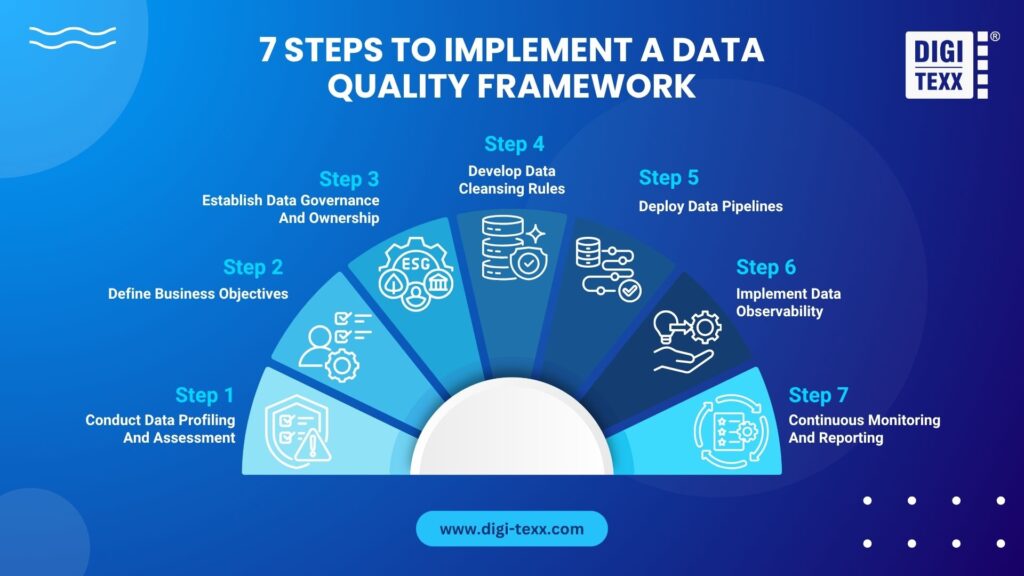
Implementing a data quality framework requires a systematic, phased approach. Follow these seven essential steps to build a robust system:
- Conduct data profiling and assessment
- Define business objectives
- Establish data governance
- Develop cleansing rules
- Deploy data pipelines
- Implement observability
- Monitor continuously
Step 1: Conduct Data Profiling And Assessment
Before implementing fixes, you must understand the current state of your system. Use data profiling tools to automatically scan existing datasets and uncover anomalies. During this audit, understanding the differences between structured and unstructured data is crucial to identifying columns with missing values, duplicate customer IDs, or inconsistent text formatting. Establishing this baseline allows you to measure future improvements accurately.
Step 2: Define Business Objectives
Cleaning every piece of data simultaneously is expensive and inefficient. Collaborate with department heads in sales, marketing, and finance to identify your critical data elements. If your marketing team relies on email outreach, your immediate objective should be ensuring complete accuracy for customer email addresses. You can prioritize other data fields later based on business impact.
Step 3: Establish Data Governance And Ownership
Data requires clear ownership to maintain long-term accuracy. This step involves assigning explicit human accountability across the organization. Appoint data stewards within each specific department. A data steward understands the business context of the information and actively enforces the quality standards defined in the previous step during daily operations.
Step 4: Develop Data Cleansing Rules
Translate your broader business goals into strict logical rules for your systems to process. By evaluating various data cleaning methods, you can establish that if you operate globally, a cleansing rule must dictate all entered phone numbers include a valid country code. You must also define the system’s response when data fails a rule, such as automatically deleting the record or routing it for human review.
Step 5: Deploy Data Pipelines
Integrate your established cleansing rules directly into your extract, transform, and load processes. Validate information at the exact point of ingestion into your system. This proactive measure prevents invalid records from reaching your data warehouse and corrupting executive analytics dashboards.
Step 6: Implement Data Observability
Unexpected pipeline breakages will still occur despite having strict rules. Data observability platforms monitor your infrastructure continuously to detect these issues early. Using machine learning, these tools learn your normal data volume and schema patterns. If your system typically ingests large volumes of records and suddenly stops, the platform instantly triggers an alert to your engineering team.
Step 7: Continuous Monitoring And Reporting
Data quality requires continuous attention and adaptation. Build visual dashboards using business intelligence tools to display data health scores to executive leadership. Regularly review these metrics and adapt your validation rules as your company scales, acquires new software, or changes its operational strategy.
>>> See more:
- 15 Best Invoice Processing Software Compared In 2026
- Invoice Reconciliation Process: Step-By-Step Guide & Key Steps
- 25 Document Management Software & Platforms 2026
Essential Tools For Your Data Quality Framework
Executing a modern data quality framework requires a robust technology stack. The most effective implementations combine automated data observability platforms to monitor overall pipeline health with code-based validation tools to enforce strict testing rules. Leading enterprise solutions include Monte Carlo, Acceldata, Collibra, Great Expectations, and dbt.
Quick Comparison: Data Quality Technology Stack
| Tool / Platform | Category | Primary Strength |
| Monte Carlo | Data Observability | Automated anomaly detection and data downtime reduction. |
| Torch (Acceldata) | Data Observability | Deep data profiling and rules-based validation. |
| Collibra (OwlDQ) | Enterprise Data Quality | AI-driven rule suggestions and metadata management. |
| Great Expectations | Data Validation | Python-based custom validation testing and documentation. |
| DBT | Data Orchestration | SQL-based transformation and integrated quality testing. |
1. Monte Carlo
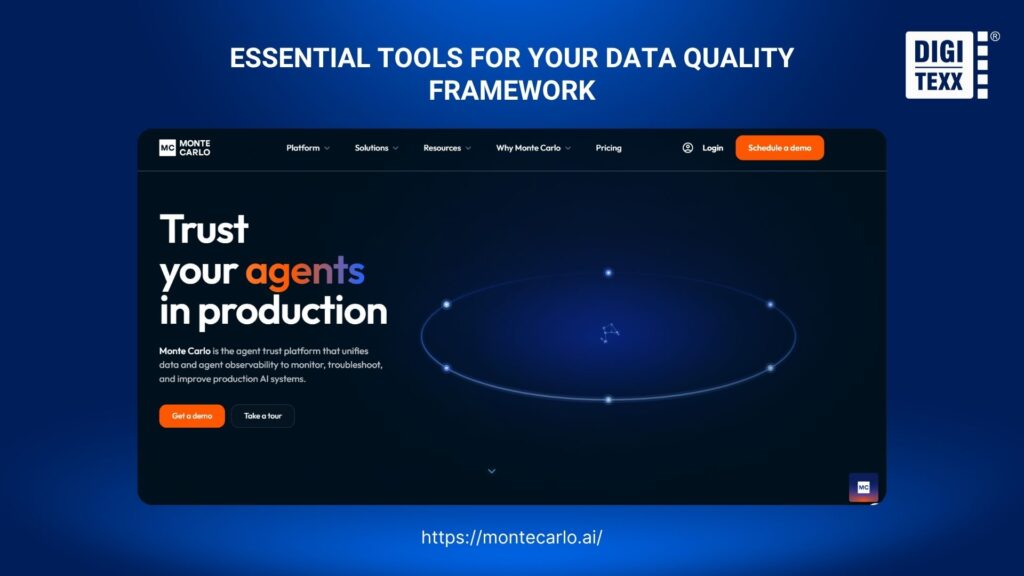
Monte Carlo is a leading observability platform designed to minimize data downtime. Instead of relying solely on manual rules, it uses machine learning technology to automatically monitor data and alert teams to potential pipeline failures.
- Key Features: Automatic error detection, end-to-end data flow tracking, proactive notifications, and root cause analysis of faulty data.
- Data Quality Framework Support: This tool helps identify and resolve data quality issues instantly, minimizing the operational impact of bad data on end-users and ensuring absolute data trust across the enterprise.
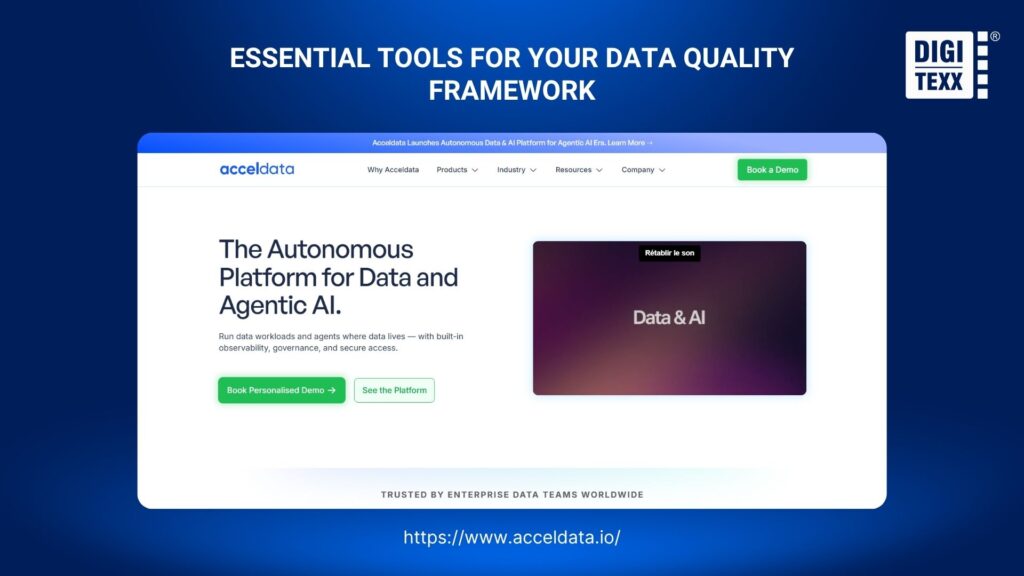
2. Torch By Acceldata
Torch, a core feature of the Acceldata platform, provides comprehensive data quality management capabilities across complex and modern data systems.
- Key Features: Advanced data profiling, strict rules-based data validation, data reconciliation, continuous quality monitoring, and metadata management.
- Data Quality Framework Support: Torch empowers businesses to define, deploy, and rigorously enforce data quality rules consistently across highly disparate data sources and lakes.
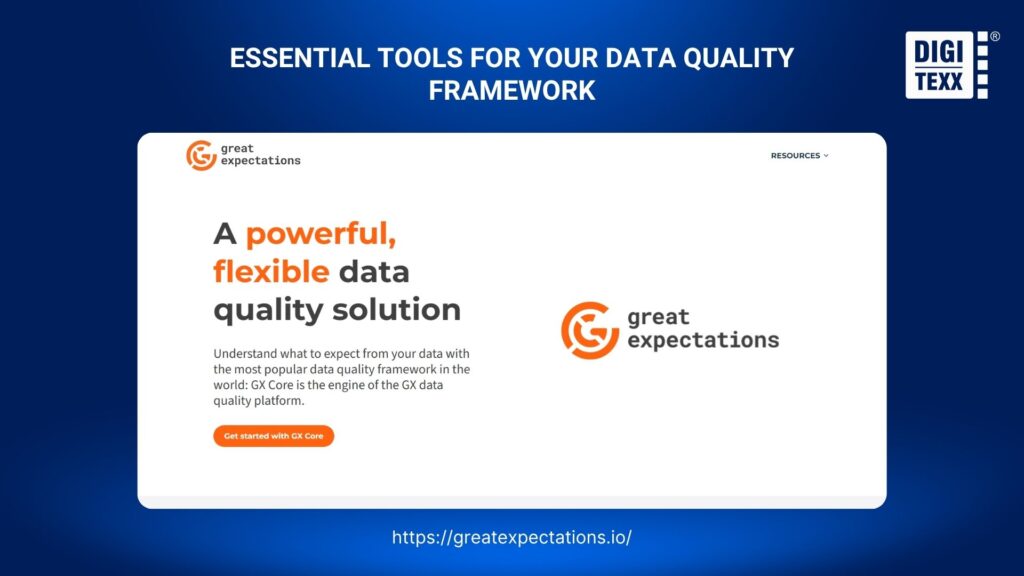
3. Great Expectations
Great Expectations is a highly popular, open-source tool for data validation, documentation, and profiling. It allows data professionals to visualize expected data behaviors and triggers alerts when datasets fail to meet those criteria.
- Key Features: A customizable “Expectations” library, automatic data documentation generation (Data Docs), batch and stream data validation, and seamless integration with modern data workflows.
- Data Quality Framework Support: This tool offers a highly flexible, code-first approach to framework implementation, allowing engineers to integrate data quality checks directly into the pipelines where data operates.
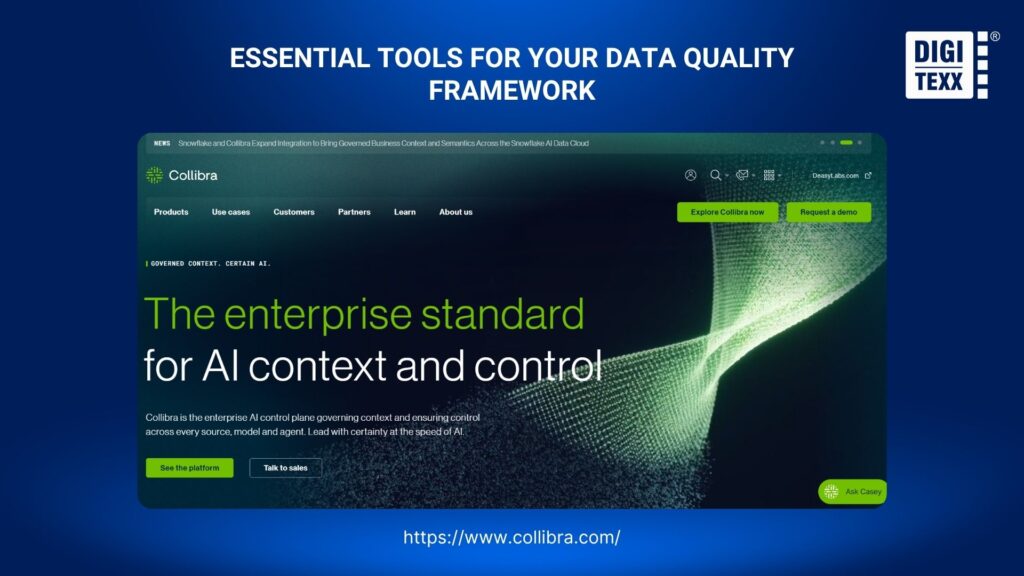
4. Collibra Data Quality (Formerly OwlDQ)
Collibra utilizes predictive machine learning to automatically detect data quality issues, significantly reducing the need for heavy coding or building manual rule sets from scratch.
- Key Features: Automated data quality rule suggestions, anomaly detection, intelligent data profiling, continuous monitoring, and an intuitive user interface designed for both technical and business teams.
- Data Quality Framework Support: Collibra simplifies the complex process of setting up and maintaining quality checks by automating threat detection. This capability significantly accelerates the deployment of an enterprise data quality management framework.
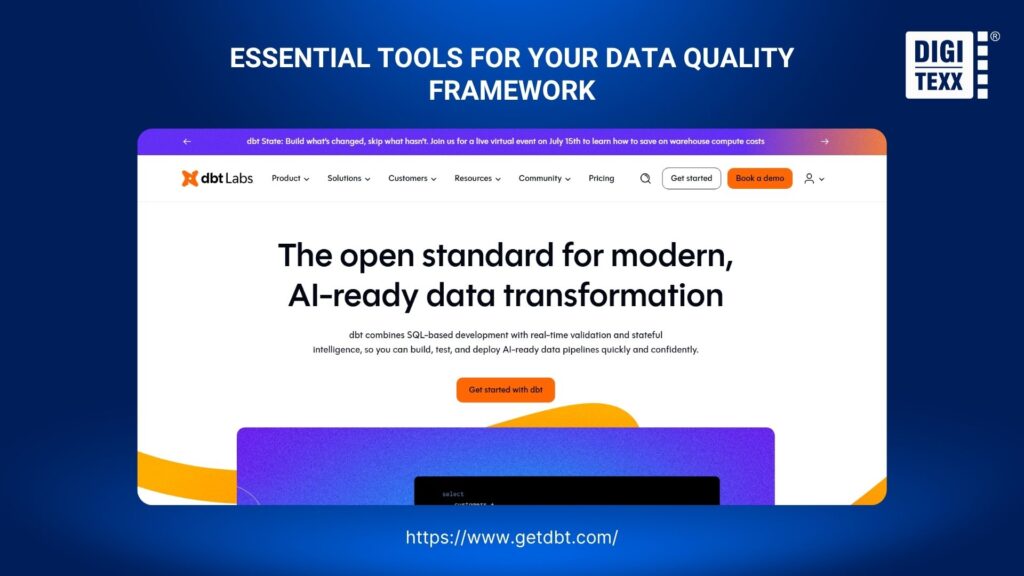
5. DBT Labs
DBT has become the industry standard for data transformation. It allows data analysts and engineers to transform data in their warehouse using simple SQL statements while simultaneously running automated testing.
- Key Features: SQL-based data transformations, automated testing for nulls and uniqueness, version control integration, and automated dependency graphing.
- Data Quality Framework Support: dbt ensures that data validation happens concurrently with data transformation. It acts as a strict quality gatekeeper, ensuring that only validated, clean data reaches your executive reporting dashboards.
>>> See more:
- What Is Purchase Orders Processing? A Complete Guide To Workflow & Steps
- 15 Best Document Scanning Software: Features, Pricing & Reviews 2026
- Document Indexing Services To Improve Search Accuracy & Data Retrieval
FAQs About Data Quality Framework
What Are Data Quality Frameworks?
A data quality framework is a structured system of policies, processes, metrics, and technologies used to continuously monitor and improve enterprise data reliability. It establishes a repeatable, automated lifecycle to prevent, detect, and resolve anomalies, ensuring data remains accurate and fit for business intelligence, analytics, and AI applications.
What Is The Difference Between Data Quality And Data Governance?
Data governance is the overarching strategy, framework, and set of policies that dictate how an organization manages its data assets. In contrast, data quality is the tactical execution of those policies, focusing specifically on ensuring the data is accurate, reliable, and fit for its intended business purpose.
Who Is Primarily Responsible For A Data Quality Framework?
While the Chief Data Officer (CDO) typically sponsors the overall strategy, daily operations are managed by a distributed team. Data Owners define the business rules, Data Stewards enforce the quality standards within specific domains, and Data Engineers build the technical pipelines to automate validation.
Does A Small Business Need A Data Quality Framework?
Yes, but it should be scaled appropriately. While a small business might not require enterprise-grade observability tools, establishing basic data entry rules, assigning clear ownership, and running periodic audits prevents costly errors and builds a solid foundation for future scalability.
Can A Data Quality Framework Be Completely Automated?
No, complete automation is impossible. While modern tools can automate data profiling, anomaly detection, and basic cleansing, human oversight is mandatory. Data Stewards are required to define complex business logic, resolve edge-case exceptions, and adapt rules to changing business environments.
How Long Does It Take To Implement A Data Quality Framework?
Implementation timelines vary based on organizational complexity. A targeted pilot project focusing on a single critical dataset (like CRM data) typically takes 3 to 6 months. Rolling out a comprehensive, enterprise-wide framework often spans 1 to 3 years of iterative development.
Building and maintaining a data quality framework is not a one-time project; it is an ongoing strategic investment. As enterprise data volumes exponentially grow, relying on manual cleansing or reactive firefighting will inevitably lead to operational bottlenecks and costly compliance risks.
By aligning your people, processes, and modern technology stack, you can transform chaotic data into a trusted asset that drives accurate AI models and intelligent decision-making. If your organization is ready to move from fragmented inputs to seamless automation, establishing these seven foundational steps today will secure your competitive advantage for the future.
DIGI-TEXX Contact Information:
🌐 Website: https://digi-texx.com/
📞 Hotline: +84 28 3715 5325
✉️ Email: [email protected]
🏢 Address:
- Headquarters: Anna Building, QTSC, Trung My Tay Ward
- Office 1: German House, 33 Le Duan, Saigon Ward
- Office 2: DIGI-TEXX Building, 477-479 An Duong Vuong, Binh Phu Ward
- Office 3: Innovation Solution Center, ISC Hau Giang, 198 19 Thang 8 street, Vi Tan Ward
References
- Gartner. (2021). How to Improve Your Data Quality. Gartner Research. https://www.gartner.com/smarterwithgartner/how-to-improve-your-data-quality
- International Monetary Fund. (2012). Data Quality Assessment Framework (DQAF). IMF Data Dissemination Standards. https://dsbb.imf.org/dqrs/DQAF