
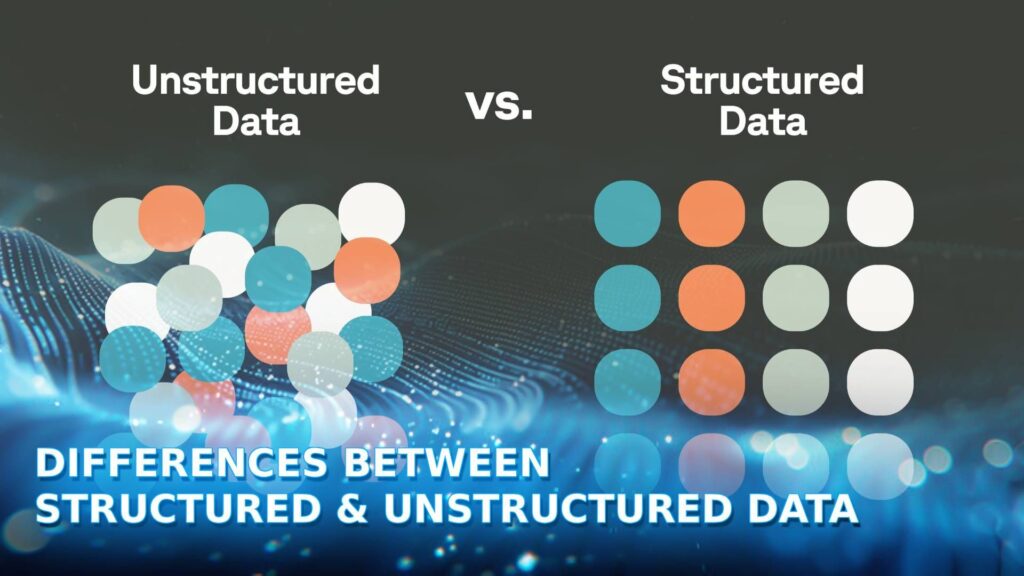
The core difference between structured and unstructured data is their format. Structured data is highly organized, quantitative, and stored in relational databases. In contrast, unstructured data exists in raw, qualitative formats like emails and PDFs. Understanding these types is the foundation of modern enterprise data management.
To unlock value from raw files, businesses partner with DIGI-TEXX to utilize intelligent document processing services, seamlessly transforming unstructured content into actionable business intelligence.
Structured Vs. Unstructured Data
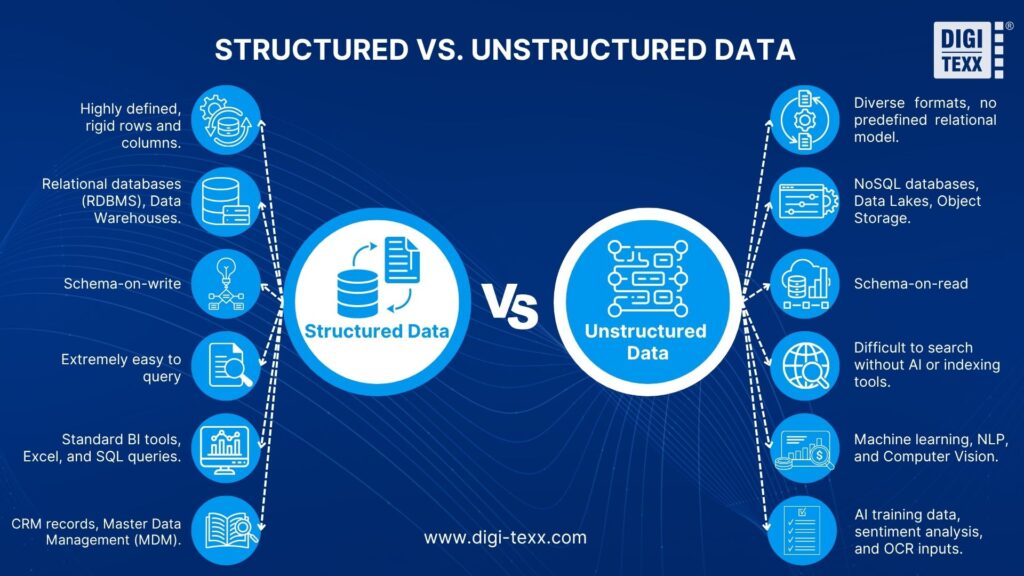
Before diving into the technical details, here is a summary of the core differences based on data format, storage, and analysis tools. This comparison helps organizations choose the right infrastructure for their specific business needs.
| Feature | Structured Data | Unstructured Data |
| Data Format | Highly defined, rigid rows and columns. | Diverse formats, no predefined relational model. |
| Data Storage | Relational databases (RDBMS), Data Warehouses. | NoSQL databases, Data Lakes, Object Storage. |
| Schema Model | Schema-on-write (Structure defined before saving). | Schema-on-read (Structure applied upon access). |
| Ease of Search | Extremely easy to query (e.g., via SQL). | Difficult to search without AI or indexing tools. |
| Analysis Tools | Standard BI tools, Excel, and SQL queries. | Machine learning, NLP, and Computer Vision. |
| Common Use Cases | CRM records, Master Data Management (MDM). | AI training data, sentiment analysis, and OCR inputs. |
>>> See more:
- Accounts Payable Outsourcing: How It Works, Benefits & Top Providers
- Best Administrative Support Outsourcing Services In 2026
- AI In Investing: What Every Investor Needs To Know
What Is Structured Data?
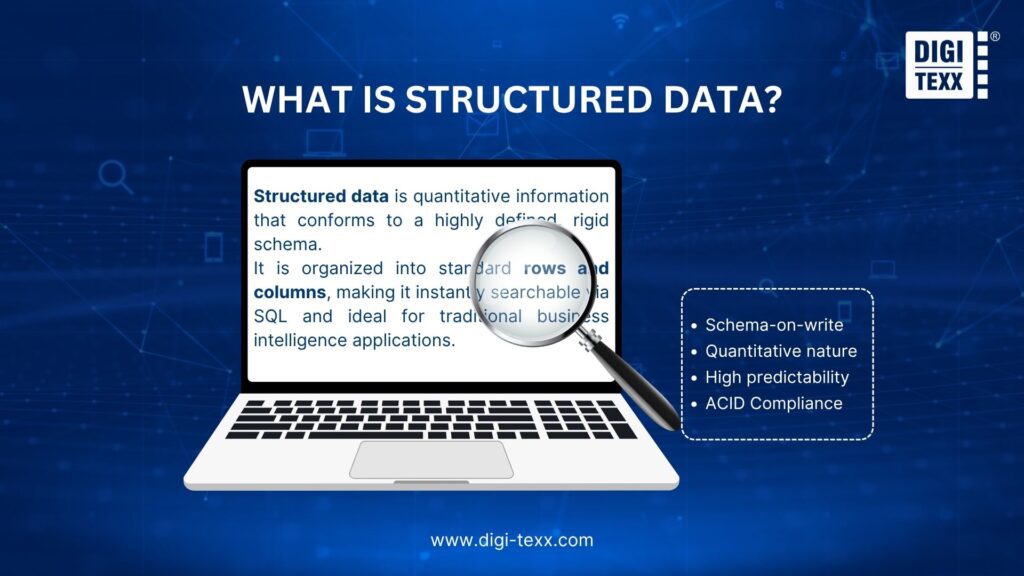
Structured data is quantitative information that conforms to a highly defined, rigid schema. It is organized into standard rows and columns, making it instantly searchable via SQL and ideal for traditional business intelligence applications.
Key Characteristics Of Structured Data
- Predefined models (Schema-on-write): Data is formatted into a standardized matrix before it is saved to the disk.
- Quantitative nature: It typically consists of hard numbers, dates, and short text strings, making it highly compatible with automated data validation & verification processes to ensure absolute accuracy.
- High predictability: Every record follows the exact same field sequence, minimizing errors.
- ACID Compliance: Transactions within relational databases guarantee Atomicity, Consistency, Isolation, and Durability, fulfilling the core data integrity definition and preventing system errors.
Common Examples & Use Cases
Structured data is the backbone of legacy operational systems. Common examples include:
- SQL database tables and Excel spreadsheets.
- Point-of-Sale (POS) transaction logs track inventory counts and financial metrics.
- Master Data Management (MDM) systems consolidate highly formatted customer and vendor data across an enterprise.
Advantages And Disadvantages
- Pros: It requires less storage space per record and allows for high-speed, efficient data analysis using standard algorithms. It is easily consumable by non-technical business users.
- Cons: It lacks flexibility. Altering the database schema to accommodate new data types is a time-consuming, expensive process that can disrupt operations.
>>> See more:
- Data Cleaning: Definition, Benefits & Steps To Cleaning Data
- Construction Invoice Reconciliation: Process, Best Practices & Software 2026
- Top 10 Data Cleansing Companies for Businesses in 2026
What Is Unstructured Data?
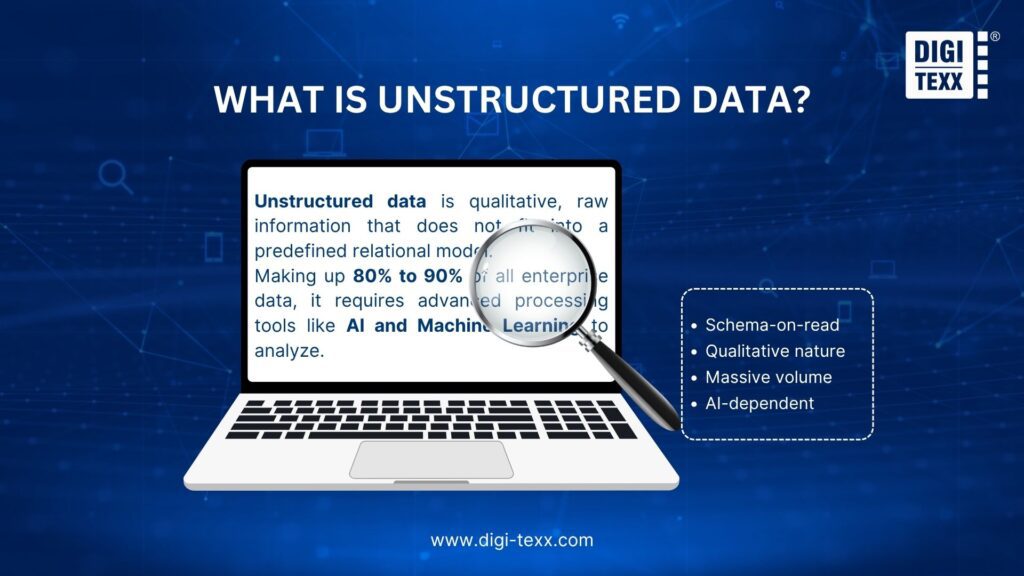
Unstructured data is qualitative, raw information that does not fit into a predefined relational model. Making up 80% to 90% of all enterprise data, it requires advanced processing tools like AI and Machine Learning to analyze. The failure to process this data represents a massive missed opportunity for modern businesses.
“Cross-industry studies show that on average, less than half of an organization’s structured data is actively used in making decisions and less than 1% of its unstructured data is analyzed or used at all.” — Harvard Business Review.
Key Characteristics Of Unstructured Data
- Raw formats (Schema-on-read): The data is saved in its original state. Structure and formatting are only applied when the data is queried.
- Qualitative nature: It is composed of rich text, media, and complex communication logs.
- Massive volume: Unstructured files generally have a significantly larger storage footprint.
- AI-dependent: It requires modern technology, such as deep learning algorithms, to extract readable insights.
Common Examples & Use Cases
Unstructured data surrounds every digital interaction. Real-world examples include:
- PDF files, contracts, and scanned invoices are processed via optical character recognition (OCR) to accelerate invoice processing outsourcing in BPO operations.
- Video and audio recordings are utilized as massive datasets for AI training data.
- Social media posts and open-text emails are used for brand sentiment analysis.
The Role Of AI In Unstructured Data Analytics
Because traditional SQL cannot read a video file or understand the sarcasm in a tweet, businesses must deploy Artificial Intelligence. Natural Language Processing (NLP) is used to parse text-heavy documents, enabling automated data extraction and advanced document indexing services to identify sentiment or key entities.
Meanwhile, Computer Vision algorithms break down raw images and videos into actionable pixel data. A practical application of this is utilizing precise vehicle annotation to enhance traffic monitoring and AI-powered security systems, demonstrating how unstructured visual data is successfully transformed into structured, predictive models for smart cities.
Through Generative AI and Retrieval-Augmented Generation (RAG), systems can now instantly summarize thousands of unstructured documents into a single, cohesive report.
>>> See more:
- 10 Essential Data Cleaning Techniques for Better Data Quality
- Best Data Cleansing Outsourcing Companies for 2026
- Best Data Conversion Services in 2026 | DIGI-TEXX
What Is Semi-Structured Data?
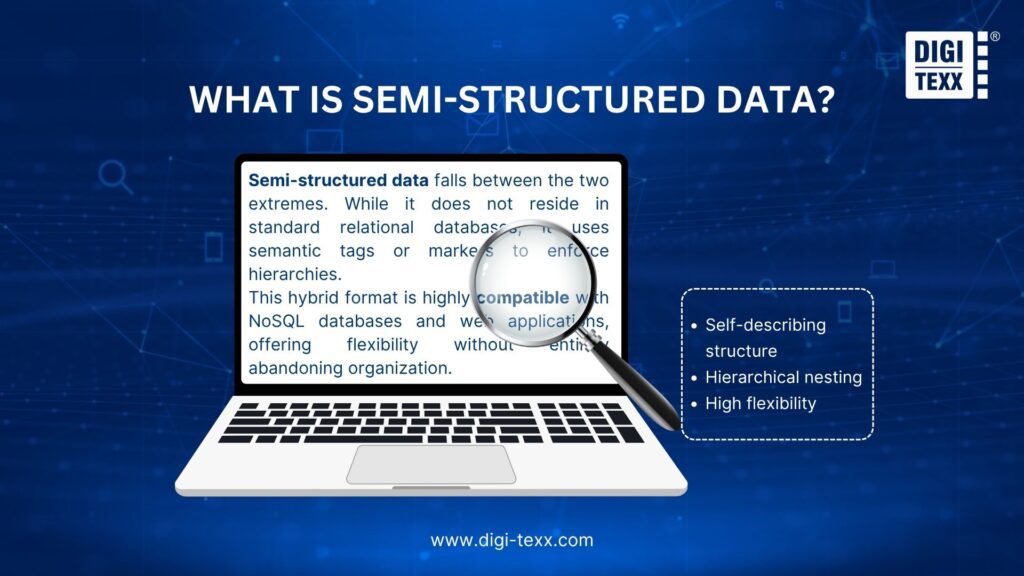
Semi-structured data falls between the two extremes. While it does not reside in standard relational databases, it uses semantic tags or markers to enforce hierarchies. This hybrid format is highly compatible with NoSQL databases and web applications, offering flexibility without entirely abandoning organization.
Key Characteristics Of Semi-Structured Data
- Self-describing structure: It does not rely on rigid tabular schemas but uses internal tags, keys, or metadata to separate semantic elements.
- Hierarchical nesting: Data can be nested within other data, creating a tree-like organizational model.
- High flexibility: New attributes can be added to the dataset seamlessly, making semi-structured data the perfect foundation for scalable business process automation solutions.
Common Examples & Use Cases
Semi-structured data is the primary language of the modern web and IoT ecosystems. Common examples include:
- JSON (JavaScript Object Notation): The standard key-value format used to transmit data rapidly across RESTful APIs and web servers.
- XML (Extensible Markup Language): Widely utilized for enterprise software configurations and data exchanges.
- Email headers: While the body is unstructured, the metadata fields (To, From, Date, Subject) provide a reliable semi-structured framework.
- IoT telemetry logs: Sensor data streaming from smart devices.
Advantages And Disadvantages
- Pros: It perfectly bridges the gap by being more flexible than structured data and significantly easier to parse than unstructured media. It is highly portable across different computing platforms.
- Cons: It requires specialized NoSQL databases (like MongoDB or Cassandra) for optimal storage. Additionally, repeating tags and keys within the files can lead to higher storage overhead compared to relational tables.
>>> See more:
- Top 10 Data Enrichment Tools To Improve Data Quality In 2026
- Top 10 Data Entry Outsourcing Companies to Hire in 2026
- 14 Data Entry Skills Hiring Managers Look For In 2026
When To Use: Structured Data Vs. Unstructured Data Vs. Semi-Structured Data?
Modern enterprises do not choose one data format over another; they integrate all three. Structured data ensures precise financial reporting, unstructured data fuels AI-driven predictive modeling, and semi-structured data powers agile web applications. Choosing the right storage architecture is the ultimate key to managing cloud costs and maximizing accessibility.
The Storage Dilemma: Data Warehouses Vs. Data Lakes
The format of your data directly dictates where it must be stored. Understanding this separation prevents critical infrastructure failures:
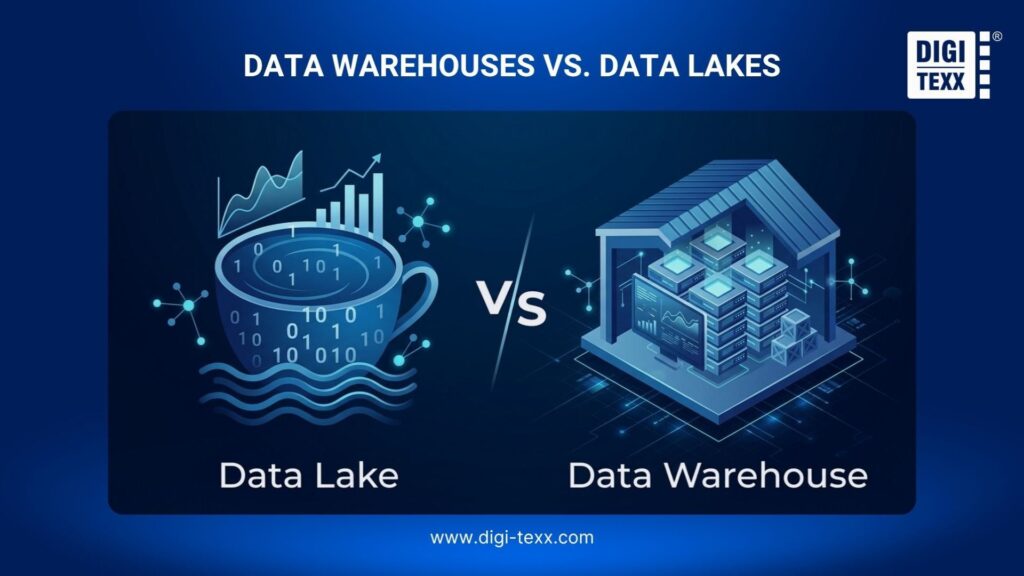
- Data Warehouses (For Structured Data): These are highly optimized, structured environments built for lightning-fast SQL querying. They are the go-to solution for traditional Business Intelligence (BI) tools, financial reporting, and CRM analytics.
- Data Lakes (For Unstructured & Semi-Structured Data): These are massive, scalable cloud storage repositories (like AWS S3 or Azure Blob) designed to hold raw files in their native formats. However, without strict metadata governance and intelligent document management software, a Data Lake quickly deteriorates into a “Data Swamp“, a chaotic digital dumping ground where information is stored but impossible to search or retrieve.
The Unified Evolution: Data Lakehouse Architecture
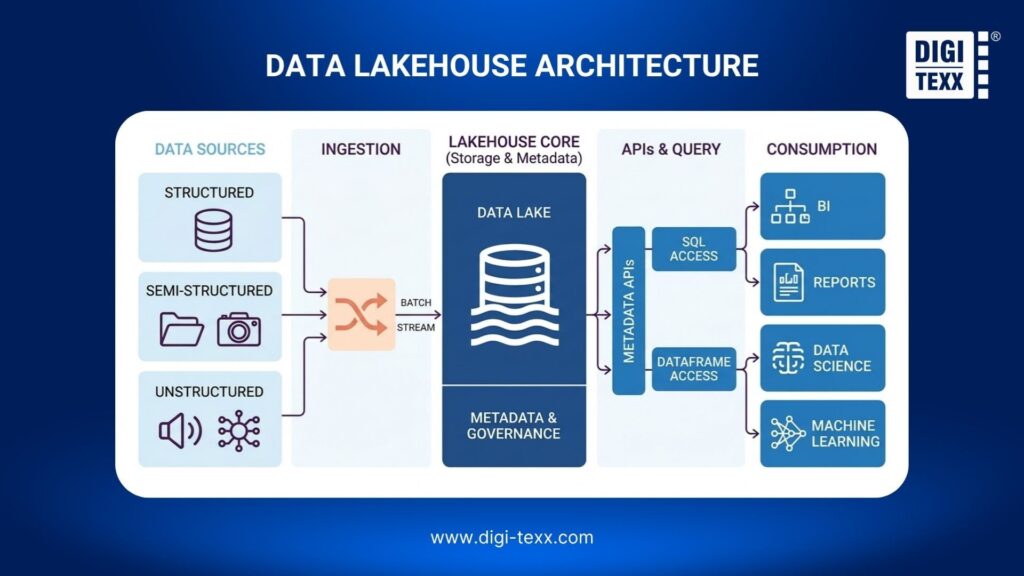
To resolve the friction between Warehouses and Lakes, modern data engineering has introduced the Data Lakehouse, which functions as a powerful, unified data integration tool. This hybrid architecture combines the massive scale and low-cost object storage of a Data Lake with the ACID compliance, strict governance, and high-performance SQL querying capabilities of a Data Warehouse.
By utilizing a Lakehouse, enterprises can run complex Machine Learning algorithms and standard BI dashboards on the exact same unified platform, eliminating data silos entirely.
>>> See more:
- Top 10 Data Extraction Tools to Automate Your Workflow
- Understanding the 6 Key Data Quality Dimensions
- Data Quality Framework in Practice: Templates, Tools, and Real Use Cases
FAQs About Differences Between Structured And Unstructured Data
Is An Excel Spreadsheet Structured Or Unstructured Data?
An Excel spreadsheet is a classic example of structured data. It organizes information into predefined rows and columns, establishing clear relationships between data points, which makes it easy to search, sort, and analyze using standard mathematical functions.
Are Emails Structured, Semi-Structured, Or Unstructured?
Emails are generally considered semi-structured data. While the body text of the email is completely unstructured and free-form, the metadata, such as the “To,” “From,” “Date,” and “Subject” fields, follows a strict, organized format.
Why Is Unstructured Data Harder To Analyze?
Unstructured data lacks a predefined format or relational logic. To analyze it, traditional SQL queries are useless. Organizations must deploy advanced Machine Learning, Natural Language Processing (NLP), or Computer Vision algorithms to extract patterns, entities, and readable insights.
What Is The Difference Between Schema-On-Read And Schema-On-Write?
Schema-on-write requires data to be formatted into a strict structure before it is saved into a database (used for structured data). Schema-on-read allows raw data to be stored immediately, with the formatting and structure applied only when the data is queried (used for unstructured data).
Can Structured And Unstructured Data Be Stored Together?
Yes, they can be stored together using a modern Data Lakehouse architecture. While traditionally separated into Data Warehouses (for structured) and Data Lakes (for unstructured), a Lakehouse provides a unified platform that supports both relational tables and raw files seamlessly.
Mastering the differences between structured and unstructured data is the first step toward true digital transformation. Ready to unlock the hidden value in your raw documents? Partner with DIGI-TEXX for advanced intelligent document processing and AI-driven data extraction solutions today.
🌐 Website: https://digi-texx.com/
📞 Hotline: +84 28 3715 5325
✉️ Email: [email protected]
🏢 Address:
- Headquarters: Anna Building, QTSC, Trung My Tay Ward
- Office 1: German House, 33 Le Duan, Saigon Ward
- Office 2: DIGI-TEXX Building, 477-479 An Duong Vuong, Binh Phu Ward
- Office 3: Innovation Solution Center, ISC Hau Giang, 198 19 Thang 8 street, Vi Tan Ward
References
- International Data Corporation (IDC). (2025). The massive growth of unstructured data in the AI era. https://www.idc.com/
- Association for Intelligent Information Management (AIIM). (2024). Intelligent document processing: Bridging the gap between raw data and business intelligence. https://www.aiim.org/