
Data quality dimensions are measurable characteristics, such as accuracy and completeness, that determine information reliability within enterprise data management. Serving as the foundation of a robust data quality framework, measuring these metrics prevents costly errors. At DIGI-TEXX, we optimize these dimensions to ensure your datasets are perfectly structured for AI readiness.
What Are Data Quality Dimensions?
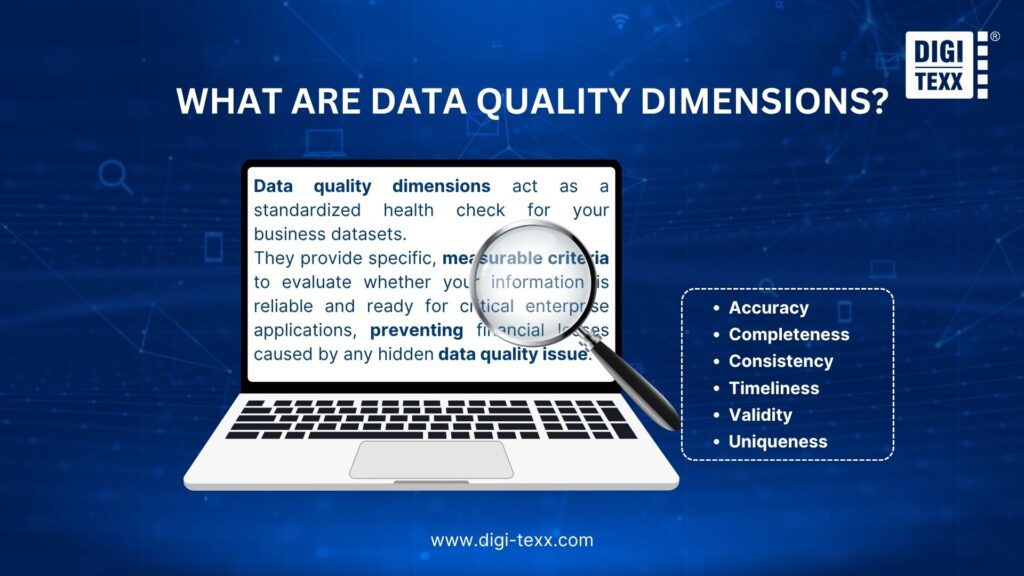
Data quality dimensions act as a standardized health check for your business datasets. They provide specific, measurable criteria to evaluate whether your information is reliable and ready for critical enterprise applications, preventing financial losses caused by any hidden data quality issue.
Think of data as the bloodstream of your organization. Data quality dimensions are the diagnostic tests ensuring that blood is clean, oxygenated, and free of toxins. Measuring these dimensions allows data engineers to quantify data reliability before it enters operational pipelines, especially when handling complex enterprise data management tasks.
Data Quality Dimensions Overview
| Dimension | Question It Answers | Real-World Bad Example |
| Accuracy | Does the data reflect reality? | A customer named “John” is entered as “Jhon”. |
| Completeness | Is any critical information missing? | A customer profile has a blank email address field. |
| Consistency | Does data match across different systems? | CRM shows “US”, but the Billing system shows “United States”. |
| Timeliness | Is the data available when needed? | Real-time sales dashboards are delayed by 48 hours. |
| Validity | Does the data follow accepted formats? | A user enters 250 for their age or an email without an @ symbol. |
| Uniqueness | Is the data free of duplicates? | One single customer has three separate account IDs. |
>>> See more:
- Best Administrative Support Outsourcing Services In 2026
- AI In Investing: What Every Investor Needs To Know
- Business Process Automation Solutions: Top Tools, Benefits & Use Cases
The 6 Core Data Quality Dimensions (DAMA Framework)
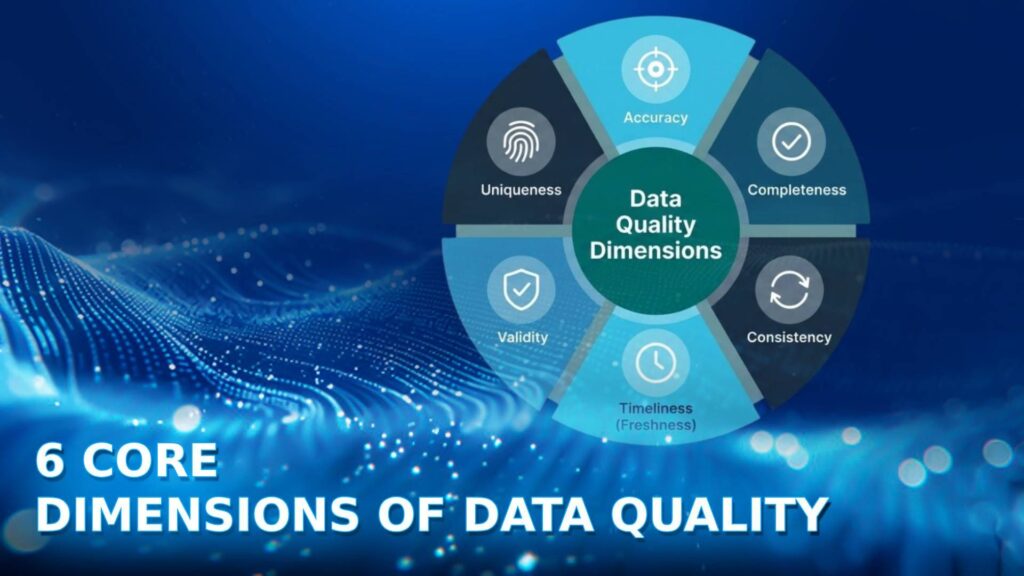
The DAMA International framework establishes six primary pillars to evaluate data health. These pillars are accuracy, completeness, consistency, timeliness, validity, and uniqueness. Monitoring these metrics proactively prevents operational bottlenecks and analytical errors across the enterprise.
1. Accuracy
Accuracy measures the degree to which data correctly reflects the real-world object or event being described. Data can be perfectly formatted but still completely inaccurate.
- Why it matters: Flawed strategic decisions often stem from inaccurate data. Implementing strict data validation & verification is crucial to prevent these errors.
- Real-world example: A package is sent to the wrong state because the shipping address was mistyped during manual entry.
- How to measure: Calculate the percentage of data values that match a verified Single Source of Truth.
2. Completeness
Completeness evaluates whether all required data fields contain values. It ensures that no mandatory information is missing from your dataset.
- Why it matters: Analyzing incomplete datasets leads to skewed statistical conclusions. Utilizing an automated data extraction system helps ensure all required fields are captured from the start.
- Real-world example: An automated marketing campaign crashes because 30 percent of the target audience lacks a listed email address.
- How to measure: Calculate the ratio of null or blank values within a specific column using SQL queries.

3. Consistency
Consistency ensures that a specific data point maintains the same value when stored across multiple tables or departmental systems.
- Why it matters: Inconsistent data destroys organizational trust, especially in financial data quality management, where mismatched revenue reports can lead to compliance failures.
- Real-world example: A customer status is listed as Active in the sales CRM but Inactive in the customer support helpdesk.
- How to measure: Track the number of data reconciliation alerts generated between integrated systems.
>>> See more:
- Construction Invoice Reconciliation: Process, Best Practices & Software 2026
- Best Data Cleansing Outsourcing Companies for 2026
- Top 10 Data Enrichment Tools To Improve Data Quality In 2026
4. Timeliness (Freshness)
Timeliness or data freshness measures the time delay between a real-world event occurring and that event data becoming accessible for reporting.
- Why it matters: Highly accurate data is useless if it arrives too late. For example, a slow invoice reconciliation process can negatively impact cash flow forecasting.
- How to measure: Monitor the timestamp variance between data creation and data availability in the warehouse.
5. Validity
Validity checks whether data conforms to predefined business rules, approved value ranges, and specific syntax formats.
- Why it matters: Invalid data formats can break downstream applications. Applying proper data cleaning methods ensures all incoming information aligns with system requirements.
- Real-world example: Inputting a postal code that contains special characters instead of numbers.
- How to measure: Calculate the percentage of records that pass automated regex compliance tests.

6. Uniqueness
Uniqueness guarantees that no entity is recorded more than once within the same database or system architecture.
- Why it matters: Duplicate records inflate core business metrics and increase cloud storage costs. Cleaning data regularly removes these redundancies.
- How to measure: Count the number of duplicate records identified after running deduplication algorithms.

>>> See more:
- Top 10 Data Entry Outsourcing Companies to Hire in 2026
- 14 Data Entry Skills Hiring Managers Look For In 2026
- 20 Best Data Integration Tools: Definition, Benefits & Features
Extended Dimensions In The Modern Data Stack 2026
While the core DAMA framework provides a solid foundation, scaling data operations in 2026 demands expanding these dimensions to handle complex, AI-driven environments. Modern data architectures require tracking additional metrics to ensure full ecosystem reliability.
1. Integrity (Relational Coherence)
Data integrity goes beyond basic validity by evaluating the structural soundness of your datasets across relational databases.
- Why it matters: Orphaned foreign keys or broken relationships between tables destroy analytical models and create system errors.
- Real-world example: A sales transaction record exists in the system, but the corresponding customer ID has been deleted from the master database.
- How to measure: Monitor the percentage of relational constraints successfully maintained across all active data pipelines.

2. Usability & Relevancy
Data can be perfectly accurate and consistent, yet entirely useless if it fails to answer current business questions. Usability evaluates how accessible, contextualized, and applicable the data is for end users..
- Why it matters: Storing vast amounts of clean but irrelevant data inflates cloud storage costs and complicates BI reporting without delivering ROI.
- How to measure: Track active usage metrics of data models in downstream BI dashboards (e.g., weekly query frequency by business teams).

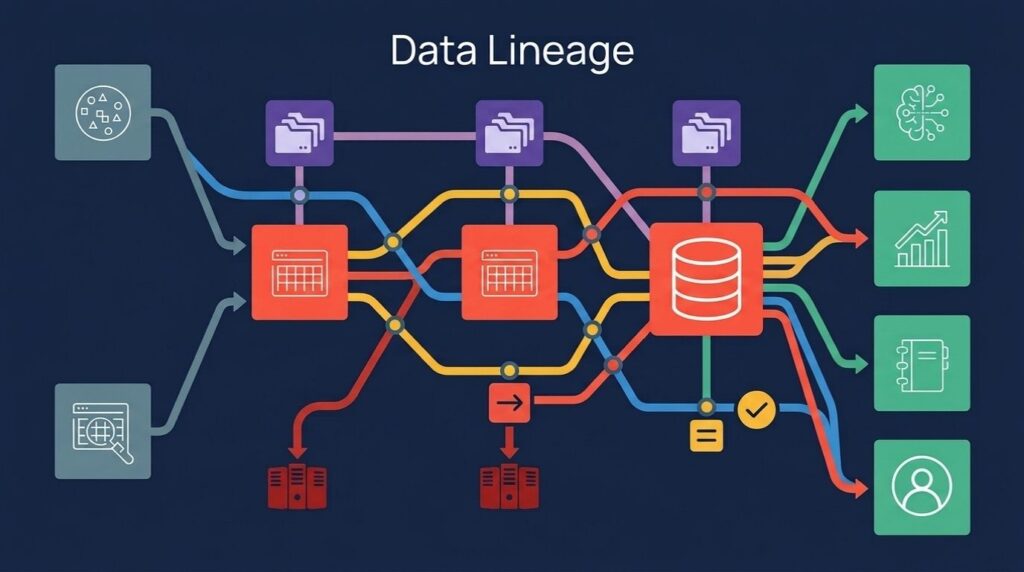
3. Auditability (Data Lineage)
Auditability refers to the transparent tracking of data from its initial point of ingestion to its final consumption layer.
- Why it matters: When a machine learning model outputs a skewed prediction, data engineers must be able to trace the data back to its source to debug the pipeline and prove regulatory compliance.
- How to measure: Ensure 100% of critical data assets have documented lineage graphs mapped and maintained in a centralized data catalog.
Why You Must Invest In Data Quality Dimensions?
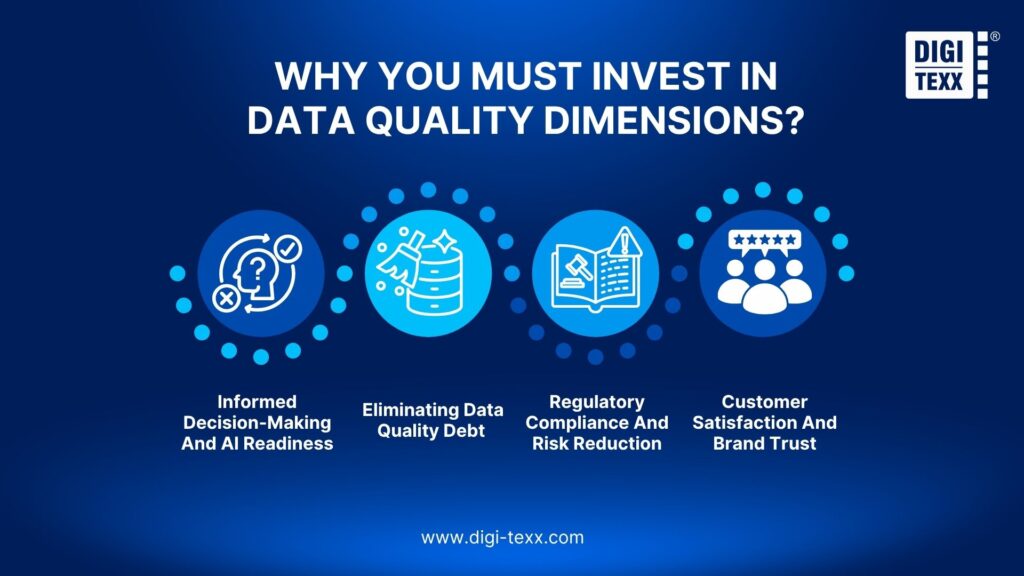
Implementing robust data quality dimensions provides critical business benefits. It ensures informed decision-making, eliminates hidden data quality debt, accelerates AI readiness, guarantees regulatory compliance, and boosts customer satisfaction. Shifting from reactive troubleshooting to proactive data governance ultimately optimizes workflows and reduces enterprise risk.
Informed Decision-Making And AI Readiness
High-quality, validated data guarantees that enterprise business intelligence delivers insights reflecting real-world conditions. When executives trust their data architecture, it eliminates costly guesswork and empowers predictive analytics to secure a competitive market advantage.
Moreover, accurate information is the ultimate prerequisite for AI readiness. Machine learning and generative AI models adhere strictly to the “Garbage-In, Garbage-Out” principle; they will fail completely if trained on flawed datasets. Through rigorous data validation, financial institutions can detect fraud using real-time transaction logs, while manufacturers rely on synchronized supplier data to prevent supply chain bottlenecks.
This level of precision is especially critical in computer vision applications, where accurately labeled datasets dictate model success. For a practical application, explore our recent project on vehicle annotation to enhance traffic monitoring and an AI-powered security system, which demonstrates how flawless data structuring directly elevates the performance and safety of smart city infrastructures.
Eliminating Data Quality Debt
“Gartner research has found that organizations estimate the average cost of poor data quality to be $12.9 million per year.” – Gartner
Data quality debt is the silent killer of enterprise budgets, encompassing the labor costs of manual data cleansing and rework. Implementing measurement dimensions streamlines workflows by reducing manual corrections and duplicate handling.
When data is accurate, consistent, and timely, teams can automate processes with confidence, accelerate operations, and minimize bottlenecks. Plugging these financial leaks ensures that data engineering teams focus on innovation rather than fixing broken pipelines.
Regulatory Compliance And Risk Reduction
Early detection of anomalies through data quality checks decreases the likelihood of major business disruptions and legal liabilities. Dimensions such as integrity and traceability help organizations monitor workflows and identify issues before they escalate.
This proactive governance helps organizations meet internal standards and external regulatory requirements like GDPR, financial audits, or healthcare mandates. In healthcare, validation rules ensure patient records follow correct medical codes, reducing the risk of claim denials. Similarly, government agencies apply completeness checks to avoid delays in delivering critical public services.
Customer Satisfaction And Brand Trust
Data quality directly impacts the end-user experience. Accurate, complete, and consistent customer data enables timely and personalized experiences that improve brand loyalty.
Conversely, fragmented data destroys trust. In the retail sector, maintaining accurate pricing data across product catalogs and online listings prevents revenue loss and customer dissatisfaction. High-quality data guarantees a seamless journey, ensuring the right message or service reaches the right person at the exact right time.
>>> See more:
- Define Business Process Outsourcing (BPO): Meaning, Examples & Benefits 2026
- Accounts Payable Outsourcing: How It Works, Benefits & Top Providers
- Document Indexing Services To Improve Search Accuracy & Data Retrieval
How To Measure And Automate Data Quality?
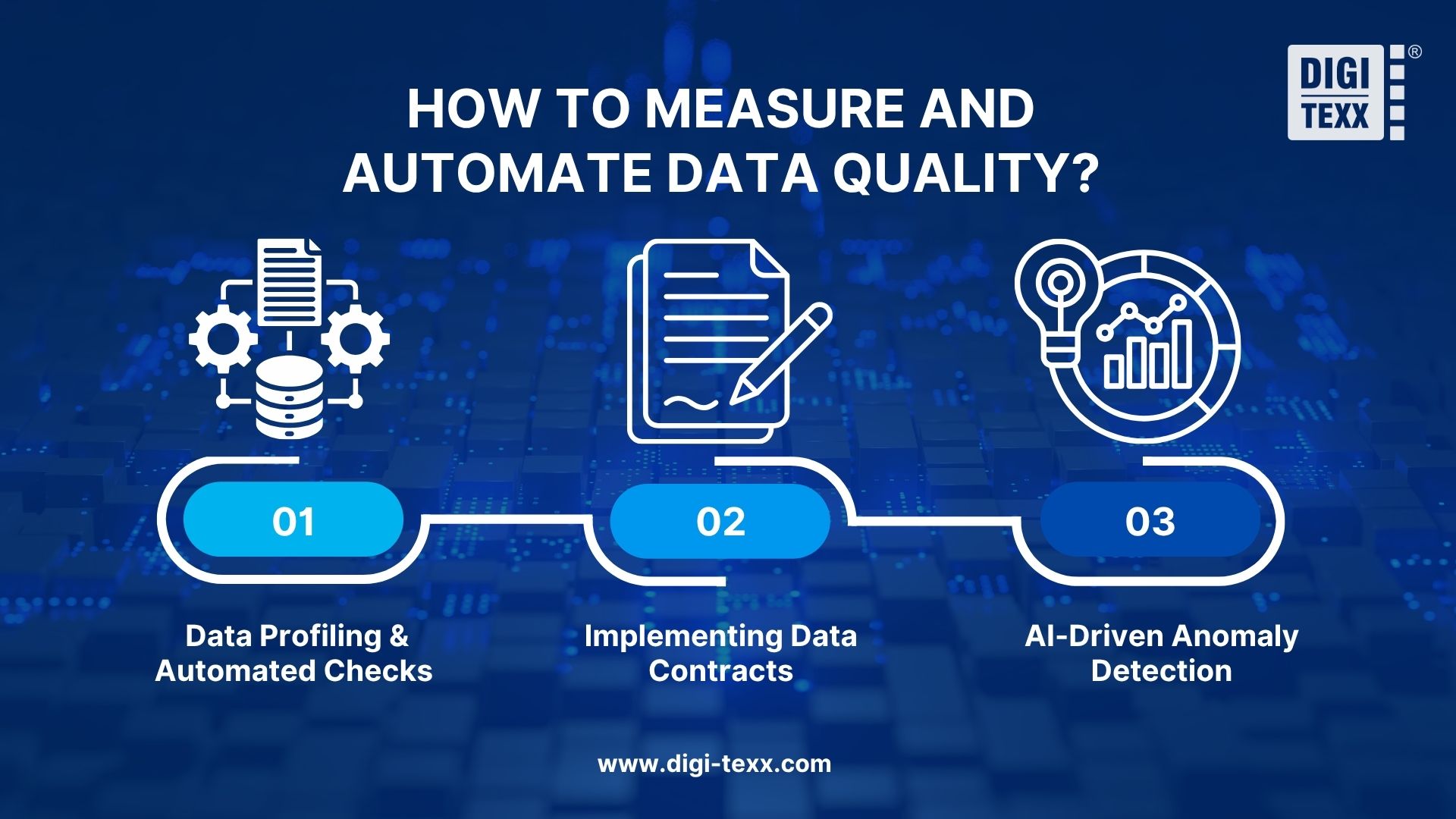
To effectively scale data governance, organizations must shift from manual cleaning to automated, proactive engineering workflows. Modernizing your approach involves integrating advanced frameworks and machine learning directly into your data pipelines.
1. Data Profiling & Automated Checks
Stop relying on periodic manual audits. The modern approach requires embedding continuous data profiling directly into your transformation layers.
Implementation Strategy
Utilize modern data stack tools like dbt tests, Soda, or Great Expectations. These tools allow data teams to write SQL-based assertions that automatically test for null values, format compliance, and uniqueness every time a pipeline runs. This creates a fail-safe mechanism that immediately halts bad data before it reaches production dashboards.
2. Implementing Data Contracts
The most effective way to handle data quality is to prevent structural changes from breaking downstream systems in the first place.
Implementation Strategy
Establish strict Data Contracts between data producers (software engineers) and data consumers (data analysts). A data contract acts as an API-like agreement guaranteeing schema stability, data types, and semantic meaning at the ingestion source. If an upstream application attempts to change a column name or drop a required field, the contract blocks the deployment until the issue is formally resolved.
3. AI-Driven Anomaly Detection
Traditional rule-based quality checks often struggle to catch unknown errors or gradual data drift over time.
Implementation Strategy:
Deploy machine learning algorithms to establish historical baselines for your data behavior. AI-driven anomaly detection automatically flags unexpected spikes in row counts, unusual distributions in numerical values, or categorical shifts without requiring hard-coded rules.
Partnering with specialized data experts like DIGI-TEXX can help seamlessly integrate these intelligent Master Data Management (MDM) oversight mechanisms, ensuring subtle anomalies are caught and triaged before impacting business intelligence.
FAQs About Data Quality Dimensions
What Is The Dama Data Quality Framework?
The DAMA data quality framework is a globally recognized standard introduced by the Data Management Association. It outlines the foundational guidelines and the six core dimensions required to systematically evaluate and govern enterprise data architectures.
What Is The Precise Data Integrity Definition?
While data quality focuses on the fitness of data for business use, the data integrity definition specifically refers to ensuring that data remains structurally sound, unaltered, and logically connected (like relational database keys) throughout its entire lifecycle.
How Do Data Quality Dimensions Apply To Unstructured Data?
When looking at the differences between structured and unstructured data, structured data can easily be tested via SQL rules. For unstructured data (like emails or images), dimensions like accuracy and validity require AI-based NLP tools or human-in-the-loop annotation to be accurately measured.
Which Data Quality Dimension Is The Most Important?
No single dimension is universally the most important because prioritization depends entirely on the business use case. For financial reporting, accuracy and consistency are paramount, whereas for a time-sensitive marketing campaign, completeness and timeliness take priority.
What Are The 7 Dimensions Of Data Quality?
The 7 dimensions of data quality expand upon the standard framework by adding “Relevance” to the core six. This model includes accuracy, completeness, consistency, timeliness, validity, uniqueness, and relevance. It ensures that the evaluated data is not only technically correct but also highly applicable to current business objectives.
What Are The 5 Dimensions Of Data Quality?
The 5 dimensions of data quality represent a streamlined approach focusing on the most critical operational metrics. This compact framework typically includes accuracy, completeness, consistency, timeliness, and integrity. Organizations utilize these five pillars to quickly establish baseline data health and rapidly eliminate foundational reporting errors.
What Are The 8 Data Quality Dimensions?
The 8 data quality dimensions provide a highly comprehensive governance framework for complex architectures. This expanded model evaluates accuracy, completeness, consistency, timeliness, validity, uniqueness, integrity, and accessibility. Measuring all eight metrics guarantees that enterprise datasets are completely reliable, strictly compliant, and instantly ready for advanced AI workloads.
What Are The 3 C’s Of Data Quality?
The 3 C’s of data quality refer to Completeness, Consistency, and Correctness (which serves as another term for Accuracy). This simplified, easy-to-remember framework is frequently used for rapid data health assessments, ensuring no critical fields are missing, values match across systems, and information reflects reality.
Mastery of data quality dimensions is crucial for all businesses that want to establish a strong data governance structure. By verifying that data is accurate, complete, consistent, valid, unique, and maintains integrity, businesses can make better decisions, minimize operating threats, and establish trust throughout all levels of the organization. High-quality data is not merely a technical necessity; it’s a strategic driver of sustainable growth.
At DIGI-TEXX, we realize the maximum importance of these elements of data quality to unleash the highest potential of your data. We at DIGI-TEXX deliver this ability to help organizations construct robust processes that make information purpose-fit, reliable, and poised to drive business success.
🌐 Website: https://digi-texx.com/
📞 Hotline: +84 28 3715 5325
✉️ Email: [email protected]
🏢 Address:
- Headquarters: Anna Building, QTSC, Trung My Tay Ward
- Office 1: German House, 33 Le Duan, Saigon Ward
- Office 2: DIGI-TEXX Building, 477-479 An Duong Vuong, Binh Phu Ward
- Office 3: Innovation Solution Center, ISC Hau Giang, 198 19 Thang 8 street, Vi Tan Ward
References
- DAMA International. (2026). DAMA-DMBOK: Data Management Body of Knowledge (3rd ed.). DAMA International. https://www.dama.org
- Gartner. (2026). How to Overcome Data Quality Debt in the AI Era. Gartner. https://www.gartner.com