
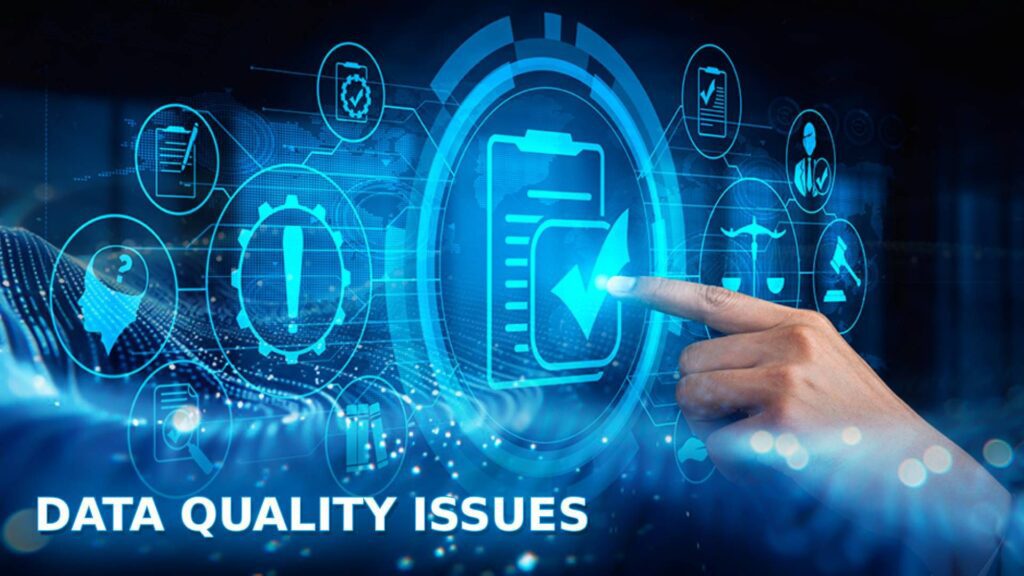
Data quality issues are errors, inconsistencies, missing values, or outdated records within a dataset that compromise its accuracy and reliability. The most common problems include duplicate data, inaccurate formats, and data silos.
Fixing these enterprise challenges requires robust data governance, strict data validation & verification, and professional data cleansing outsourcing services from trusted BPO partners like DIGI-TEXX to ensure a Single Source of Truth (SSOT).
What Are Data Quality Issues?
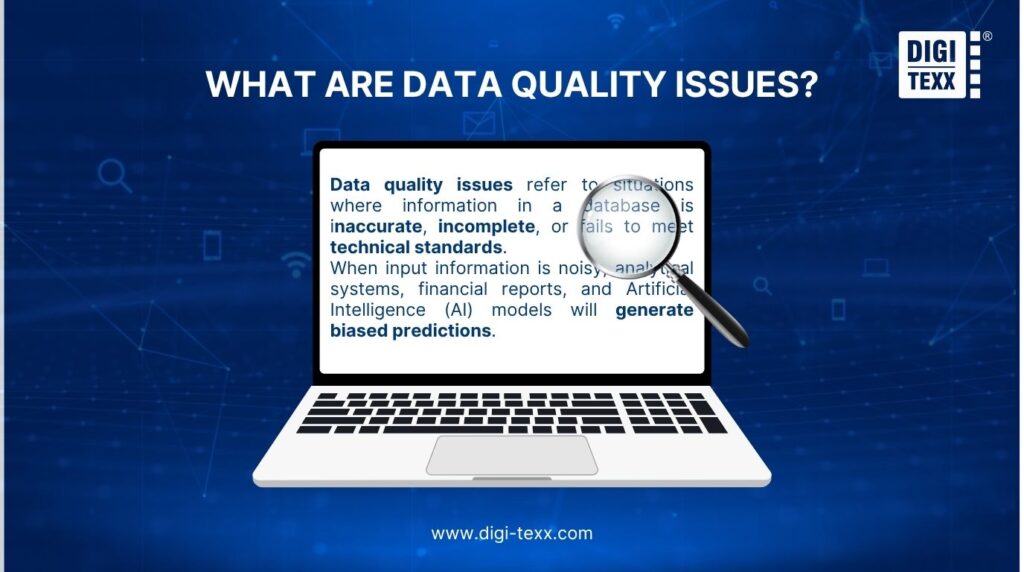
Data quality issues refer to situations where information in a database is inaccurate, incomplete, or fails to meet technical standards. While data quality focuses on the usability and accuracy of information, understanding the data integrity definition is crucial, as it focuses on ensuring that information from unauthorized access or corruption.
Organizations need clean data for smooth operations. When input information is noisy, analytical systems, financial reports, and Artificial Intelligence (AI) models will generate biased predictions. This disrupts the entire strategic decision-making process for management and breaks down supply chains.
The Real Cost Of Poor Data Quality
Poor data quality costs large organizations an average of $12.9 million annually, primarily impacting financial revenue, operational efficiency, and legal compliance. It forces engineers to waste valuable time cleaning datasets and triggers the Garbage In, Garbage Out (GIGO) effect in AI models.
IBM estimates that bad data costs the U.S. economy $3.1 trillion per year.” – Thomas C. Redman
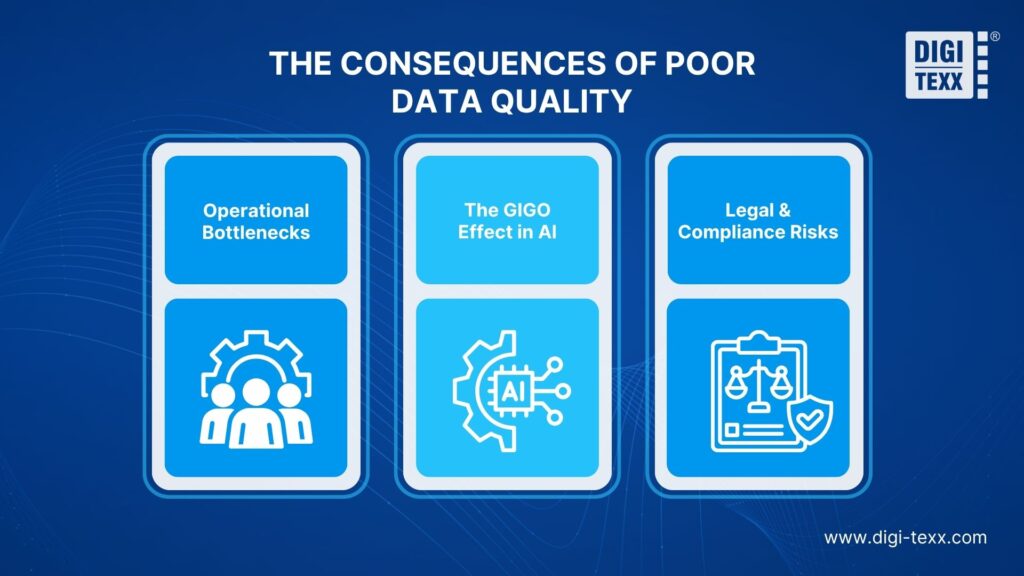
The consequences of dirty data directly impact three core business areas:
- Operational Bottlenecks: Data engineers currently waste up to 40% of their time simply cleaning systems instead of focusing on high-value business analytics.
- The GIGO Effect in AI: Even the most advanced Artificial Intelligence algorithms will only produce biased, flawed, or hallucinated results if fed poor-quality data.
- Legal & Compliance Risks: A lack of data standardization exposes enterprise businesses to the severe risk of violating strict global audit standards like GDPR or CCPA, resulting in massive fines.
>>> See more:
- Accounts Payable Outsourcing:How It Works, Benefits & Top Providers
- Best Administrative Support Outsourcing Services In 2026
- AI In Investing: What Every Investor Needs To Know
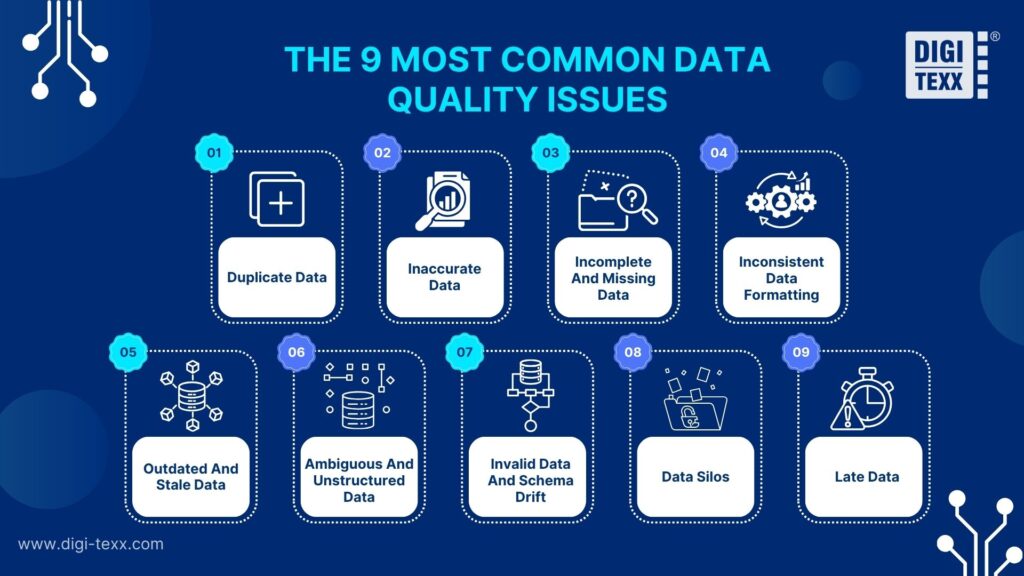
Top 9 Data Quality Issues
The most frequent data anomalies in enterprise systems include duplicates, inaccuracies, missing values, inconsistent formats, and data silos. Resolving these requires targeted strategies ranging from deduplication algorithms to centralized data warehousing.
1. Duplicate Data
- What it is: Duplicate data occurs when a single real-world entity (such as a customer or product) is cloned into multiple independent records within a database.
- Example: A customer named “John Doe” registers on a website. Later, a sales rep manually enters him as “J. Doe” with a different email. The CRM treats them as two distinct customers.
- The Impact: It inflates cloud storage costs, distorts revenue reports, and annoys customers who receive identical marketing emails repeatedly.
- How to fix it: Apply automated deduplication tools and establish a unique Primary Key for each entity.
2. Inaccurate Data
- What it is: Information entered into the system is factually incorrect due to human typing errors or faulty data conversion.
- Example: Updating a shipping address as “123 Lame Street” instead of the correct “123 Lane Street.”
- The Impact: This disrupts the logistics supply chain, causes lost shipments, and severely damages customer satisfaction.
- How to fix it: Implement strict data validation rules at the point of entry and use secure, professional data entry services to minimize human typing errors..
3. Incomplete And Missing Data (NULL Values)
- What it is: Critical data fields are left blank (NULL) during information collection from users or third-party systems.
- Example: A customer database contains a phone number column, but 30% of the values in it are empty.
- The Impact: Marketing teams cannot perform accurate customer segmentation, which lowers the conversion rates of personalized campaigns.
- How to fix it: Apply data imputation techniques, leverage automated data enrichment tools via API to fill in missing gaps, and enforce mandatory fields on forms.
4. Inconsistent Data Formatting
- What it is: The same type of information is represented using different structures and formats across multiple systems.
- Example: A warehouse system records dimensions in “Centimeters,” while the international retail system uses “Inches.”
- The Impact: This creates massive friction for Extract, Transform, Load (ETL) pipelines, causing data streams to fail when merged.
- How to fix it: Standardize the Business Glossary and execute a strict data normalization process.
>>> See more:
- What Is Automated Data Extraction? Guide, Benefits & Tools
- Business Process Automation Solutions: Top Tools, Benefits & Use Cases
- Data Cleaning: Definition, Benefits & Steps To Cleaning Data
5. Outdated And Stale Data (Data Decay)
- What it is: Data that was accurate in the past but has become obsolete because it was not updated to reflect real-world changes.
- Example: Sending a high-ticket event invitation to a “Director,” but the individual resigned from that company last year.
- The Impact: Stale data wastes marketing budgets and causes organizations to miss high-value sales opportunities.
- How to fix it: Establish a data lifecycle policy and conduct continuous data refresh schedules.
6. Ambiguous And Unstructured Data
- What it is: Data stored without clear context, lacking metadata, or existing as free-text that is difficult to parse.
- Example: A recorded customer service call is saved but not tagged to categorize whether it is a complaint or an inquiry.
- The Impact: Automated analytical systems cannot read or understand the context, turning information assets into dark data.
- How to fix it: Implement metadata management and utilize BPO experts for accurate data annotation.
7. Invalid Data And Schema Drift
- What it is: Data that violates predefined logical rules, or when the structure of a database table (schema) is abruptly changed by a third party.
- Example: A system records a customer’s age as 250, far exceeding logical biological limits.
- The Impact: It crashes automated SQL queries and causes reporting dashboards to fail completely.
- How to fix it: Enforce referential integrity checks and closely monitor the system for structural variations.
8. Hidden And Dark Data (Data Silos)
- What it is: Massive amounts of information trapped independently within individual departments and not shared across the organization.
- Example: Customer Support has data on negative product feedback, but Product Development cannot access this dataset.
- The Impact: It destroys the 360-degree view of the customer, leading to misguided strategic decisions.
- How to fix it: Integrate a centralized Cloud Data Warehouse to break down information silos.
9. Late Data (Timeliness Issues)
- What it is: A severe delay between when a real-world event occurs and when the system successfully records it.
- Example: A bank transaction happens at 8:00 AM, but the fraud detection system only receives the alert at 10:00 AM.
- The Impact: Real-time analytics systems become useless, resulting in irreversible financial or operational damage.
- How to fix it: Upgrade network transmission infrastructure and shift from batch processing to stream processing.
>>> See more:
- Construction Invoice Reconciliation: Process, Best Practices & Software 2026
- Top 10 Data Cleansing Companies for Businesses in 2026
- 10 Essential Data Cleaning Techniques for Better Data Quality
Common Causes Of Data Quality Issues
Data quality problems primarily arise from human manual entry errors, inadequate system integrations during ETL processes, and a lack of robust data governance. In modern enterprise pipelines, anomalies also stem from rapid data decay, legacy systems, and data poisoning.
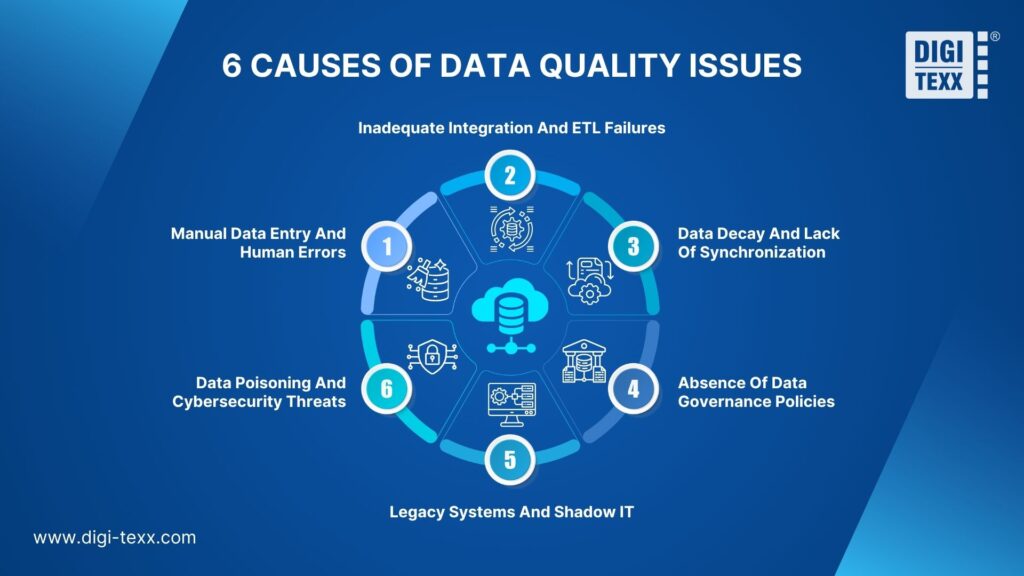
To truly fix these problems, organizations must trace the root causes of data anomalies throughout the entire system architecture:
1. Manual Data Entry And Human Errors
Fatigue, cognitive bias, and lack of focus during manual data entry create thousands of anomalies directly at the source. Research indicates that departments operating without Quality Assurance (QA) oversight can experience error rates up to 26%. Simple typographical mistakes, such as misspelling a client’s email address, can permanently break automated CRM workflows.
2. Inadequate Integration And ETL Failures
When enterprises merge disparate databases, such as syncing a modern CRM with a legacy ERP system, structural mismatches are inevitable. If the Extract, Transform, Load (ETL) pipeline lacks precise data mapping rules, the system will generate duplicated or corrupted records. These integration failures often corrupt raw data before it even reaches the analytics dashboard.
3. Data Decay And Lack Of Synchronization
High-quality data is not static; it naturally degrades over time. Data decay occurs when B2B contacts change jobs, companies relocate, or software updates alter data formats. Without real-time, bi-directional synchronization mechanisms, historical records quickly become stale and lose their business value.
4. Absence Of Data Governance Policies
A systemic failure occurs when an organization lacks a unified Master Data Management (MDM) strategy. Without officially assigned Data Stewards and a shared Business Glossary, different departments will create contradictory definitions for the same metric (e.g., Sales and Finance calculating “monthly revenue” differently). This creates internal friction and unreliable reporting.
5. Legacy Systems And Shadow IT
Many enterprises still rely on obsolete mainframe infrastructure that forces data into rigid, outdated formats. Compounding this issue is “Shadow IT”, when employees use unapproved, third-party SaaS applications to store corporate data. This combination severely fragments the data ecosystem, creating isolated silos that are invisible to the core IT department.
6. Data Poisoning And Cybersecurity Threats
In the era of Artificial Intelligence, malicious actors actively target machine learning pipelines through data poisoning. Hackers intentionally inject corrupted, biased, or falsely labeled data into training sets. This cybersecurity threat compromises the integrity of the algorithm, causing AI models to hallucinate or make entirely false predictions.
>>> See more:
- Best Data Conversion Services in 2026 | DIGI-TEXX
- Top 10 Data Entry Outsourcing Companies to Hire in 2026
- 14 Data Entry Skills Hiring Managers Look For In 2026
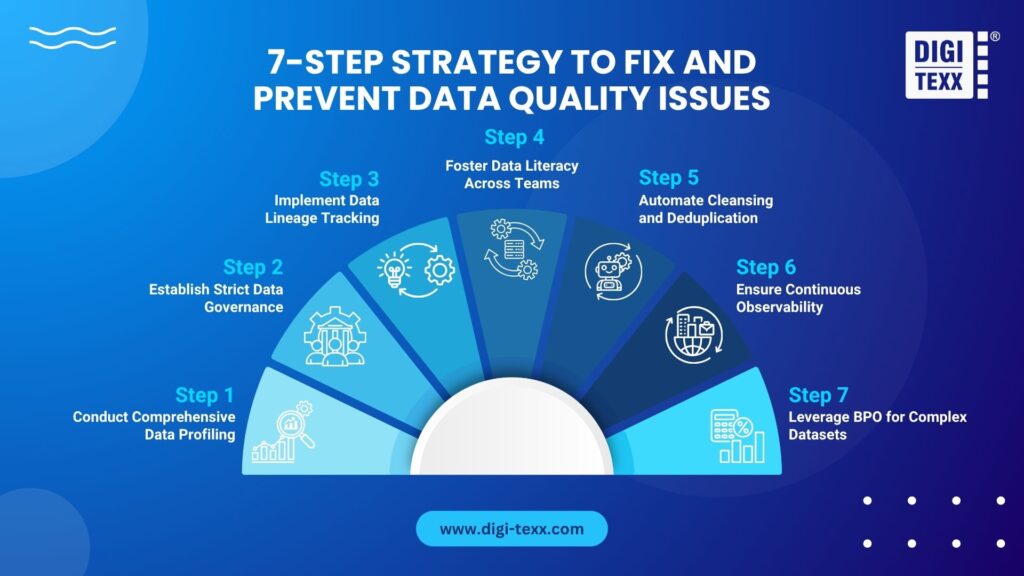
A 7-Step Strategy To Fix And Prevent Data Quality Issues
The best way to permanently resolve data vulnerabilities is by implementing an enterprise-wide remediation strategy. This includes comprehensive data profiling, strict governance, data lineage tracking, and leveraging BPO services for complex, unstructured datasets.
Step 1: Conduct Comprehensive Data Profiling
Before cleaning any database, organizations must understand the exact scope of the problem. Automated data profiling tools scan the entire enterprise architecture to detect anomaly patterns, identify NULL values, and highlight formatting inconsistencies. This diagnostic phase provides a clear roadmap for remediation.
Step 2: Establish Strict Data Governance
Technology alone cannot fix poor data; it requires rigorous organizational frameworks. Enterprises must build a shared Business Glossary, define clear validation rules, and officially allocate management responsibilities to Data Stewards. Establishing this accountability ensures that data is treated as a highly protected corporate asset.
Step 3: Implement Data Lineage Tracking
To stop errors from recurring, teams must fix the root cause rather than just patching the symptom. Data lineage tracking maps the complete lifecycle of a data point, from its origin, through various transformations, to its final destination. This visibility allows data engineers to instantly pinpoint exactly where a pipeline broke.
Step 4: Foster Data Literacy Across Teams
Human error can only be minimized through continuous education. Organizations must train their baseline employees to understand the cascading impact of incorrect data entry. Fostering a strong data culture raises compliance awareness, ensuring that frontline workers realize how a single typo can affect enterprise-wide analytics.
Step 5: Automate Cleansing and Deduplication
Manual error correction is unscalable for large enterprises. Data engineering teams must deploy advanced machine learning algorithms to identify fuzzy matches, remove duplicate records, and standardize text formats automatically. Additionally, utilizing data enrichment APIs can help patch missing information gaps without human intervention.
Step 6: Ensure Continuous Observability
Data cleansing is not a one-time project; it requires proactive, round-the-clock monitoring. Implementing continuous data observability software allows organizations to set up automated alerts (data contracts). If a schema suddenly changes or a massive spike in invalid entries occurs, the system instantly notifies engineers before the bad data impacts downstream reports.
Step 7: Leverage BPO for Complex Datasets
While automation handles structured databases well, understanding the differences between structured and unstructured data reveals why algorithms struggle with historical document digitization, handwritten forms, and multilingual datasets. For these unstructured challenges, outsourcing to a specialized Business Process Outsourcing (BPO) provider is the optimal solution. BPO teams utilize a Human-in-the-Loop (HITL) approach, combining AI tools with expert human verification to achieve 99.9% accuracy.
>>> See more:
- 20 Best Data Integration Tools: Definition, Benefits & Features
- Data Quality Dimensions: 6 Core Metrics And Automation Guide
- Data Quality Framework in Practice: Templates, Tools, and Real Use Cases
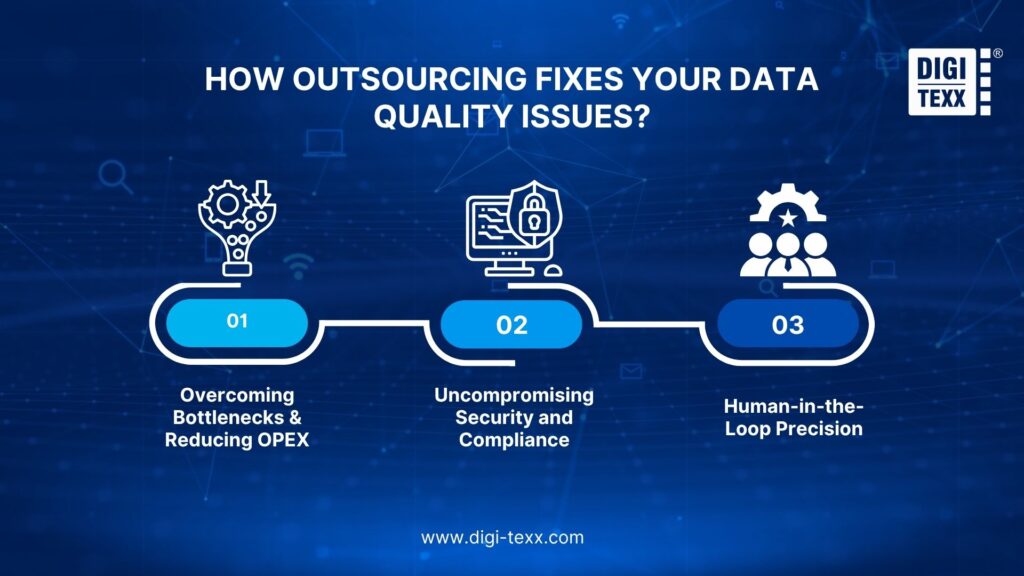
How Outsourcing Fixes Your Data Quality Issues?
Running an in-house data cleansing team drains resources and wastes the time of senior data engineers on basic typo corrections. Outsourcing to a BPO converts fixed costs into flexible expenses, cutting operational costs (OPEX) by up to 40%.
- Overcoming Bottlenecks & Reducing OPEX: BPO services free up your core IT team by handling tedious data remediation tasks, significantly reducing operational expenses.
- Uncompromising Security and Compliance: Reputable BPO providers strictly adhere to global information security frameworks like ISO 27001 and GDPR, establishing robust access control firewalls.
- Human-in-the-Loop Precision: The biggest advantage of premium BPO services is their ability to handle complex logical comparisons. For B2B data cleansing or specialized AI data annotation, such as our recent success in vehicle annotation to enhance traffic monitoring and AI-powered security system, combining automated algorithms with human expert review eliminates errors entirely, especially in multilingual datasets.
FAQs About Data Quality Issue
What Is The Root Cause Of Data Quality Issues?
The most common root cause is human manual entry error. Additionally, weak system integrations (ETL pipelines), outdated legacy infrastructure, and a lack of enterprise Data Governance policies cause information to quickly become inaccurate and fragmented.
How Much Does Poor Data Quality Cost A Company?
According to Gartner research, poor data quality costs an average large enterprise $12.9 million every year. This cost includes lost revenue from misguided decisions, excess cloud storage fees, and the labor hours wasted on manual error correction.
What Is The Difference Between Data Cleansing And Data Quality Management?
Data Cleansing is a technical, reactive action focused on fixing or deleting specific errors like duplicates or bad formatting. Data Quality Management is a holistic strategy that involves proactive prevention, continuous monitoring, and setting long-term organizational data policies.
Why Should Enterprises Outsource Data Cleansing?
Enterprises should outsource data cleansing to optimize OPEX and free internal engineers from manual, repetitive tasks. BPO partners provide strict security protocols (ISO 27001), the ability to process massive data volumes quickly, and absolute accuracy through Human-in-the-Loop models.
Ultimately, leaving data quality issues unchecked is a multi-million dollar risk that degrades both operational efficiency and AI accuracy. However, resolving this challenge shouldn’t drain your core IT resources.
By combining robust internal data governance with the specialized data cleansing services at DIGI-TEXX, your enterprise can permanently eliminate the GIGO effect and establish a reliable Single Source of Truth (SSOT).
🌐 Website: https://digi-texx.com/
📞 Hotline: +84 28 3715 5325
✉️ Email: [email protected]
🏢 Address:
- Headquarters: Anna Building, QTSC, Trung My Tay Ward
- Office 1: German House, 33 Le Duan, Saigon Ward
- Office 2: DIGI-TEXX Building, 477-479 An Duong Vuong, Binh Phu Ward
- Office 3: Innovation Solution Center, ISC Hau Giang, 198 19 Thang 8 street, Vi Tan Ward
References
- Redman, T. C. (2016). Bad Data Costs the U.S. $3 Trillion Per Year. Harvard Business Review (HBR). https://hbr.org/2016/09/bad-data-costs-the-u-s-3-trillion-per-year
- International Organization for Standardization. (2022). ISO/IEC 27001:2022 Information Security Management Systems. ISO. https://www.iso.org/isoiec-27001-information-security.html