
Enterprise data management (EDM) is the comprehensive process and architecture aimed at organizing, integrating, and securing a company’s data assets throughout their entire lifecycle. By establishing a robust data quality framework, EDM ensures strict regulatory compliance, delivers accurate information, and fully prepares organizations for AI initiatives.
To scale these operations efficiently, modern enterprises often combine internal policies with expert business process automation solutions from trusted partners like DIGI-TEXX to maintain a reliable, AI-ready single source of truth.
What Is Enterprise Data Management (EDM)?
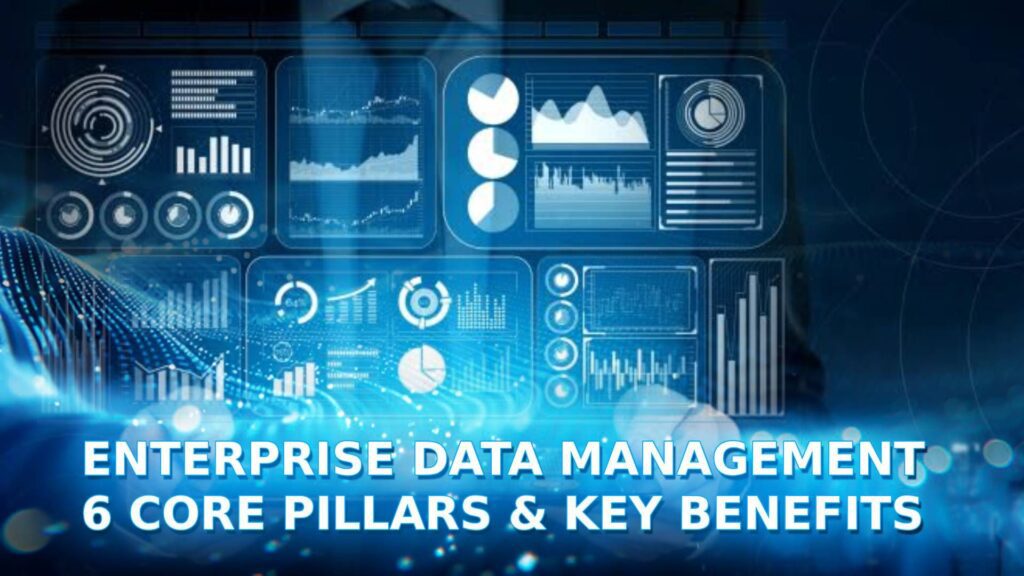
Enterprise Data Management is more than just a software solution. It is a strategic alignment of People, Process, and Technology designed to transform massive volumes of raw data into a strategic asset that delivers a competitive business advantage.
Data Lifecycle Management
A robust EDM system must control the flow of information throughout the data lifecycle. This process involves the following core stages:
- Creation and Collection: It begins with data creation and collection from ERP and CRM systems.
- Storage and Active Usage: Next is storage and active usage for business intelligence (BI) reporting.
- Archiving or Disposal: Finally, it involves secure archiving or safe disposal to mitigate the regulatory risks associated with stale data.
DAMA-DMBOK And EDM Council Standards
To ensure high E-E-A-T (Expertise, Experience, Authoritativeness, Trustworthiness), top-tier corporations build their EDM foundations on the DAMA-DMBOK (Data Management Body of Knowledge) framework.
Additionally, referencing criteria from the EDM Council helps organizations accurately assess Data Maturity and align their technical infrastructure with core business objectives.
>>> See more:
- Accounts Payable Outsourcing: How It Works, Benefits & Top Providers
- Best Administrative Support Outsourcing Services In 2026
- AI In Investing: What Every Investor Needs To Know
Enterprise Data Management (EDM) Vs. Master Data Management (MDM)
Although frequently confused, Master Data Management (MDM) is actually a specific subset within the broader EDM architecture. While EDM governs all types of enterprise data, MDM focuses exclusively on standardizing core business entities.
| Feature | Enterprise Data Management (EDM) | Master Data Management (MDM) |
| Scope | Overarching architecture for the entire data ecosystem. | Specialized discipline; a foundational subset of EDM. |
| Data Types | Transactional, unstructured, operational, and metadata. | Core business records only (Customers, Products, Suppliers). |
| Primary Goal | Comprehensive governance, security, and storage framework. | Creating a “single source of truth” for essential entities. |
Why Is Enterprise Data Management Important?
Enterprise Data Management (EDM) is critical because it transforms chaotic, siloed information into a secure, centralized asset. By implementing an effective EDM strategy, organizations can drive better executive decision-making, ensure strict regulatory compliance, reduce operational bottlenecks, and confidently prepare their infrastructure for advanced Generative AI deployments.
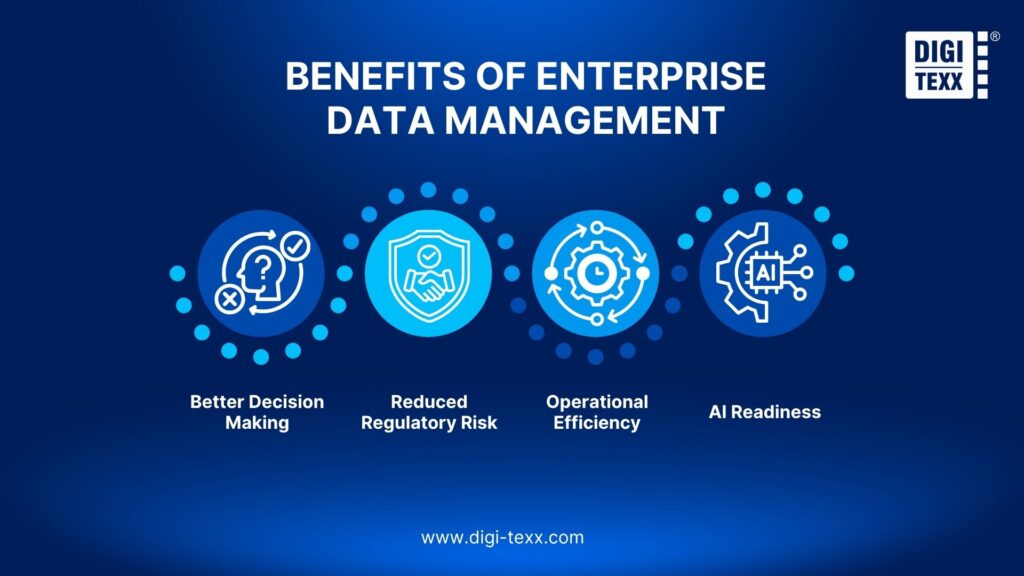
Implementing an effective Enterprise Data Management strategy delivers four core business benefits:
- Better Decision Making: Delivers a real-time Single Source of Truth for executive leaders.
- Reduced Regulatory Risk: Ensures strict compliance with GDPR and HIPAA while protecting sensitive data.
- Operational Efficiency: Eliminates Data Silos and heavily reduces manual data processing workflows.
- AI Readiness: Provides clean, structured data to accurately train Large Language Models (LLMs).
Without an EDM system, a business falls into the trap of shadow analytics, where different departments produce conflicting business reports. More severely, feeding garbage, context-less data into machine learning systems leads to AI hallucinations, causing flawed executive decisions and massive financial damage.
For instance, in the construction and architecture sectors, establishing a highly governed data foundation is the exact prerequisite for complex AI models; you can explore our case study on data annotation for BIM systems to enhance spatial digital twin accuracy to see how structured, high-quality data directly impacts AI performance in real-world environments.
“72% of CEOs say proprietary data is key to unlocking the value of generative AI, 50% say their organization has disconnected technology due to the pace of recent investments.” – BIM
>>> See more:
- Data Cleaning: Definition, Benefits & Steps To Cleaning Data
- Construction Invoice Reconciliation: Process, Best Practices & Software 2026
- Top 10 Data Cleansing Companies for Businesses in 2026
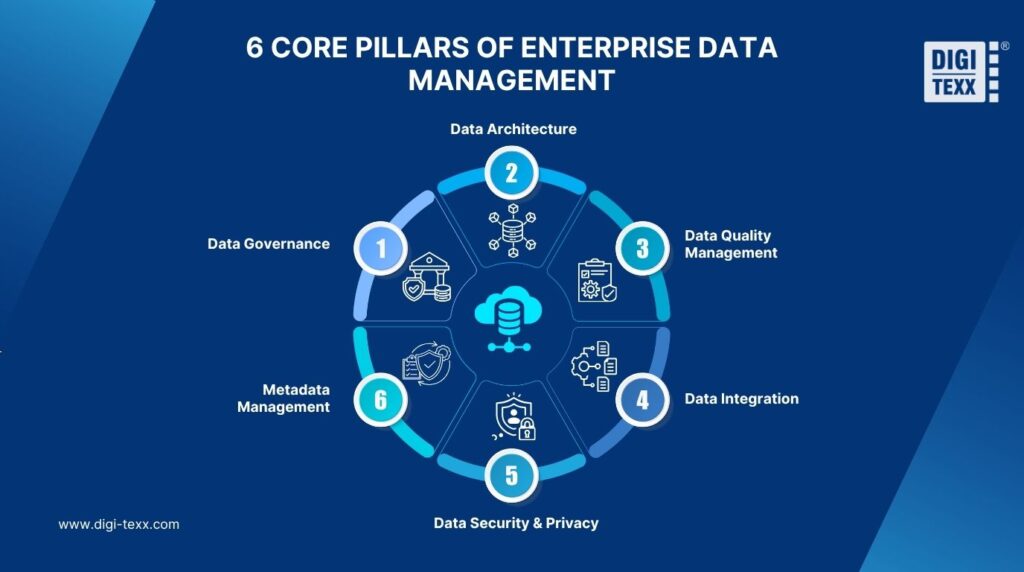
The 6 Core Pillars Of Enterprise Data Management
A successful and sustainable Enterprise Data Management system relies on six core components: Governance, Architecture, Quality, Integration, Security, and Metadata Management. These pillars perfectly synchronize technology with business processes.
By implementing these six interdependent pillars, organizations can break down data silos, ensure regulatory compliance, and prepare their infrastructure for advanced AI deployment.
1. Data Governance
Data governance establishes the foundational policies, business rules, and strict frameworks for information ownership across an organization. Led primarily by the Chief Data Officer (CDO), this pillar requires dedicated Data Stewards to actively enforce daily data quality standards and ensure ongoing regulatory compliance.
2. Data Architecture
Data architecture is the comprehensive technical blueprint defining exactly how enterprise information is stored, routed, and processed. Transitioning from traditional data warehouses to modern Data Lakehouse platforms, this framework utilizes Medallion Architecture (Bronze, Silver, Gold layers) to highly optimize analytics and prepare robust AI training data.
3. Data Quality Management
Data quality management guarantees that information is always accurate and consistent, preventing any critical data quality issues from impacting business decisions. Modern EDM platforms utilize AI algorithms to fully automate data cleansing, profiling, and data validation & verification processes, instantly eliminating formatting errors and duplicate records.
4. Data Integration
Data integration is mandatory to break down data silos. Utilizing a robust data integration tool, this process leverages automated data extraction to consolidate information from scattered systems, like ERPs, CRMs, and IoT devices, into a single, centralized cloud repository.
5. Data Security & Privacy
Data security and privacy establish strict Role-Based Access Control (RBAC) and end-to-end encryption to safeguard sensitive enterprise information. Often supported by specialized data security software, this crucial pillar also provides comprehensive Data Lineage tracking features to easily demonstrate transparency and compliance during rigorous legal audits.
6. Metadata Management
Metadata management is the strict administration of “data about data,” systematically classifying the exact format, origin, and context of all enterprise information. This critical framework prevents data swamps, allowing end-users, business analysts, and advanced AI engines to query vast datasets rapidly, accurately, and securely.
>>> See more:
- 10 Essential Data Cleaning Techniques for Better Data Quality
- Best Data Cleansing Outsourcing Companies for 2026
- Top 10 Data Enrichment Tools To Improve Data Quality In 2026
EDM Strategy And Best Practices For Implementation
As discussed earlier, enterprise data management is as much about managing people as it is about managing data. To build a sustainable EDM program, organizations must secure executive leadership, foster a data-driven culture, and leverage modern cataloging technologies to scale efficiently.
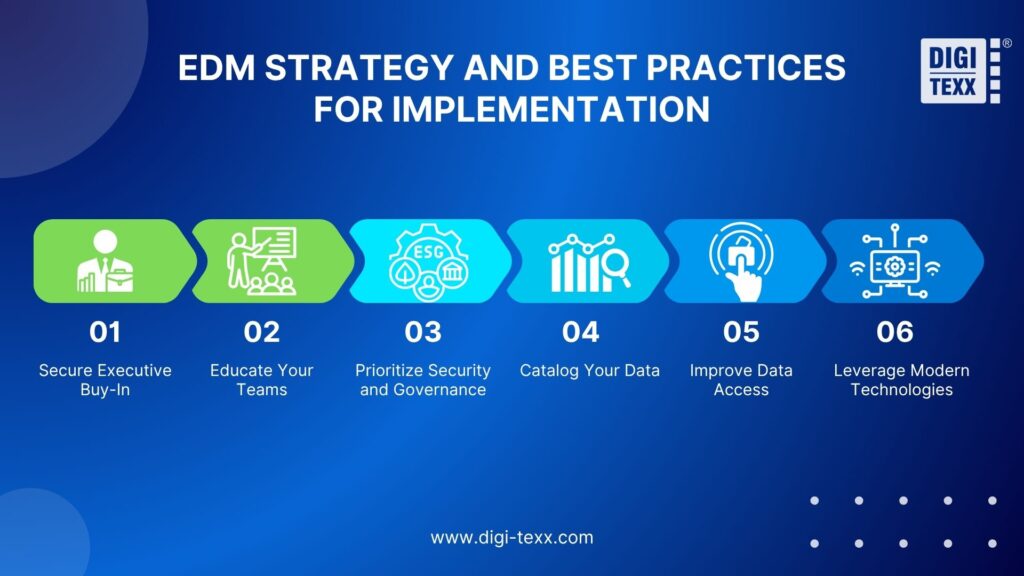
Keep these crucial best practices in mind when starting your enterprise data management program:
- Secure Executive Buy-In: Data managers need active support and investment from executive leadership, such as the Chief Technology Officer (CTO) or Chief Data Officer (CDO).
- Educate Your Teams: Continuously train staff on the importance of data management and enforce strict adherence to governance guidelines.
- Prioritize Security and Governance: Build your strategy around strict access controls, data lineage, and privacy compliance.
- Catalog Your Data: Create a centralized, searchable inventory of all enterprise data assets to prevent data swamps.
- Improve Data Access: Democratize information by granting appropriate, secure data access to relevant business units.
- Leverage Modern Technologies: Utilize AI-driven cataloging tools to scale your data strategy. Advanced metadata management systems now use automated algorithms to instantly recognize in-use data fields and trace data lineage, enabling business analysts to generate accurate insights rapidly.
>>> See more:
- Top 10 Data Entry Outsourcing Companies to Hire in 2026
- 14 Data Entry Skills Hiring Managers Look For In 2026
- Top 10 Data Extraction Tools to Automate Your Workflow
The Future Of Enterprise Data Management In The Age Of AI
The future of Enterprise Data Management is closely linked to the development of AI and new technologies. Some of the trends that need to be paid attention to are as follows:
- The trend of “Augmented Data Management” will continue to grow, where AI/ML automates the majority of manual data management tasks.
- Data architectures such as Data Fabric and Data Mesh will become more popular, enabling more decentralized and flexible data access, empowering business teams to self-serve
- The focus of EDM in the coming period will shift to real-time data management to support instantaneous decisions.
- The issues of AI, privacy and data sovereignty will become an integral part of every EDM strategy in the future.

Top 5 Enterprise Data Management Software
When selecting Enterprise Data Management (EDM) software, cloud-native SaaS solutions consistently deliver the fastest deployment and highest scalability. Enterprises must align their platform choice with specific strategic goals, whether focusing on large-scale AI readiness, complex ERP integration, privacy-compliant marketing, or advanced data cataloging.
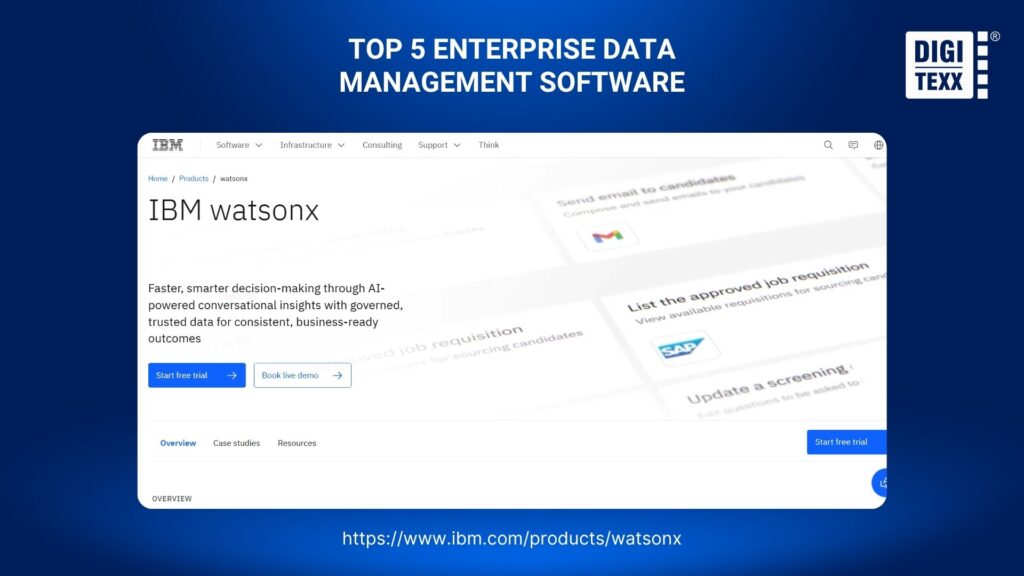
1. IBM
IBM’s Watsonx. Data is an open, hybrid, and heavily governed data store built specifically for advanced AI workloads. It empowers enterprises to scale AI analytics across diverse environments, utilizing a robust open data lakehouse architecture.
Key Capabilities:
- Seamless integration with multiple query engines and databases.
- Built-in enterprise-grade governance for AI models and data privacy.
- Optimized cost-performance for processing massive unstructured datasets.
2. Databricks
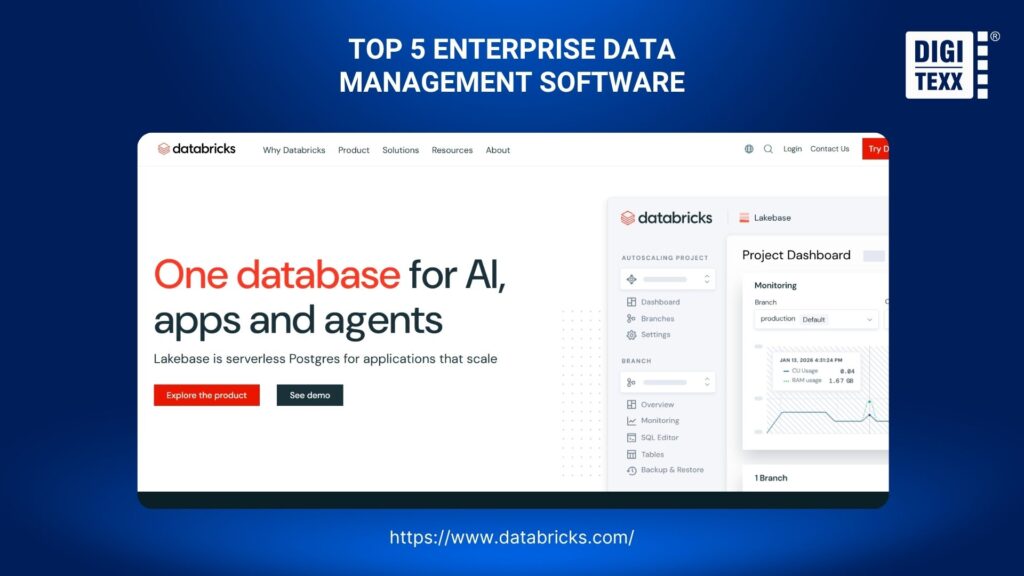
Databricks pioneered the Data Lakehouse architecture, providing a unified analytics ecosystem. It acts as a collaborative hub, empowering data scientists, engineers, and analysts to execute complex machine learning projects efficiently.
Key Capabilities:
- Centralized, fine-grained governance through Databricks Unity Catalog.
- High-performance real-time streaming and batch data processing.
- Native MLflow integration for comprehensive machine learning lifecycle management.
3. Matillion
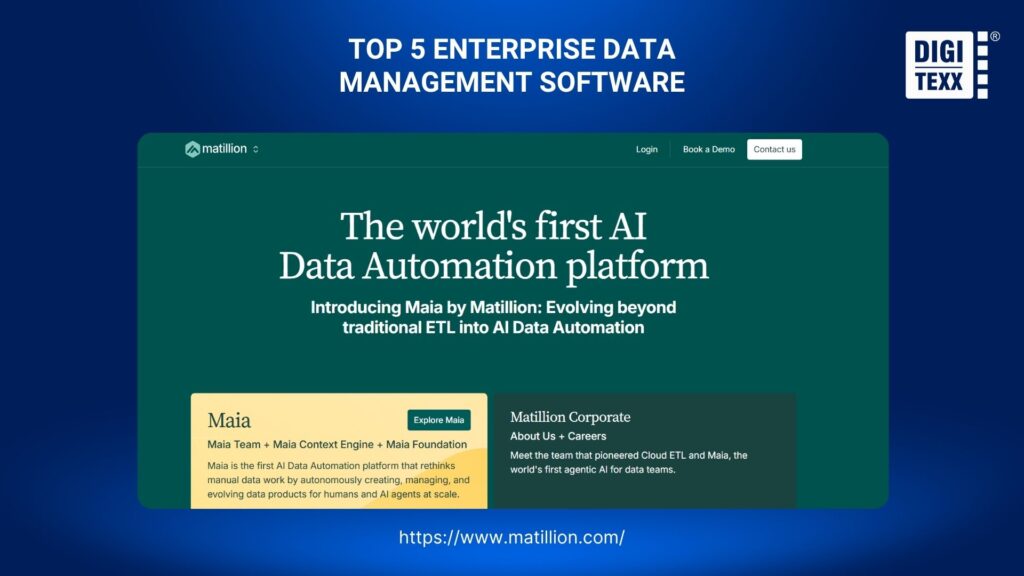
Matillion is a premier cloud-native data integration platform designed to build, transform, and automate complex data pipelines with incredible speed. Real-world industry reports demonstrate that deploying cloud integration automation platforms like Matillion can deliver a Return on Investment (ROI) of up to 271%, while simultaneously saving 70% of the time traditionally spent managing data pipelines.
Key Capabilities:
- Intuitive low-code/no-code interface for rapid ETL/ELT pipeline development.
- Deep, native pushdown integrations with major cloud data warehouses (Snowflake, Amazon Redshift, Google BigQuery).
- Automated data transformation tailored for immediate business intelligence readiness.
>>> See more:
- Understanding the 6 Key Data Quality Dimensions
- Define Business Process Outsourcing (BPO): Meaning, Examples & Benefits 2026
4. Acxiom
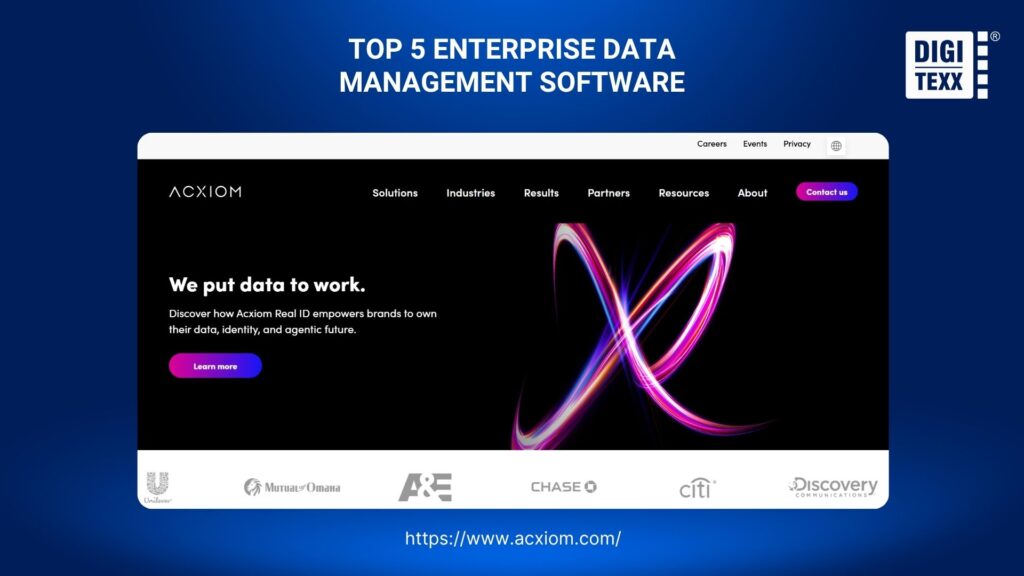
Acxiom is a global leader in customer intelligence and data-driven marketing solutions. Their platform excels at securely managing vast amounts of consumer data while maintaining the highest industry standards for ethical data use and regulatory compliance.
Key Capabilities:
- Advanced Identity Resolution (leveraging solutions like Real ID), which successfully connects millions of anonymous, cross-channel touchpoints into a single, complete customer profile.
- Strict, foundational adherence to global privacy laws (GDPR, CCPA) built directly into the core architecture.
- Seamless integration with enterprise Customer Data Platforms (CDPs) and marketing cloud ecosystems.
5. Tableau (Data Management)
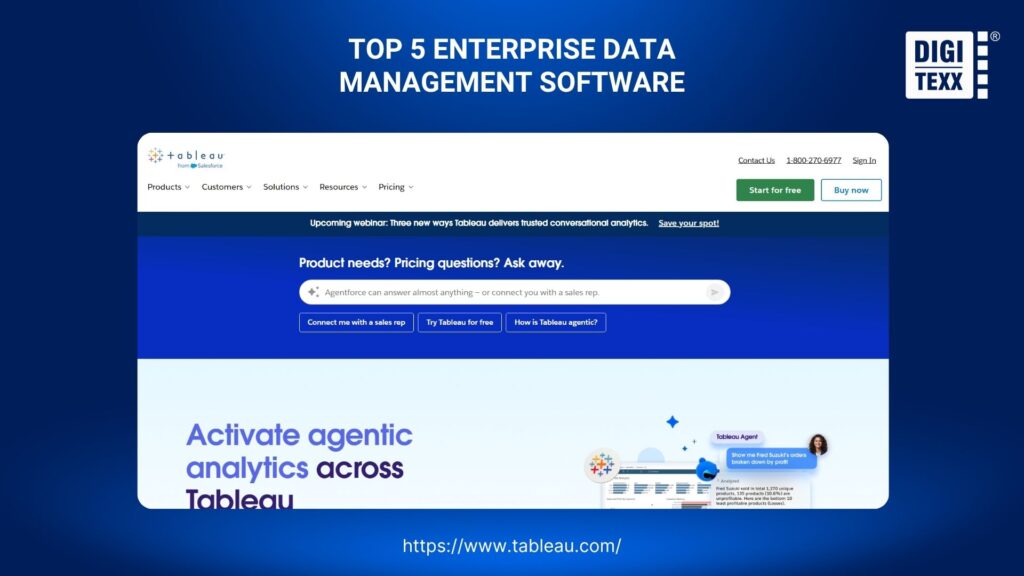
Beyond its world-class data visualization capabilities, Tableau offers powerful data management and cataloging features. It perfectly bridges the gap between the IT department’s need for strict governance and the business user’s need for intuitive, self-service data exploration.
Key Capabilities:
- AI-driven metadata cataloging that automatically recognizes in-use fields and maps relationships between data sources.
- Human-centric data stewardship features for monitoring and maintaining daily data quality.
- Clear Data Lineage visualization to accurately track information origins, transformations, and downstream impact.
>>> See more:
- Structured vs Unstructured Data: Key Differences & Business Applications
- Document Indexing Services To Improve Search Accuracy & Data Retrieval
- 25 Document Management Software & Platforms 2026
FAQs About Enterprise Data Management
What Is An Enterprise Data Management System?
An Enterprise Data Management (EDM) system is a comprehensive architectural framework comprising software, policies, and processes designed to govern, secure, and integrate an organization’s data assets. This system effectively eliminates data silos, ensures information accuracy, and establishes a Single Source of Truth (SSOT), which is essential for accurate business intelligence reporting and preparing infrastructure for Artificial Intelligence initiatives.
Who Is Primarily Responsible For Enterprise Data Management?
The Chief Data Officer (CDO) typically leads the macro-level Enterprise Data Management strategy and overarching governance. However, daily execution and technical operations rely heavily on Data Architects for system design, Data Engineers for robust pipeline integration, and Data Stewards for ensuring ongoing data quality, accurate cataloging, and strict regulatory compliance.
What Is The Difference Between Data Governance And Data Management?
Data Governance involves establishing the overarching strategies, internal policies, business rules, and authorization frameworks, essentially serving as the “laws” of enterprise data. Conversely, Data Management is the daily operational process of executing those exact policies using technical tools and IT architecture. Governance dictates what must be done, while management actively performs the required actions.
What Is The Difference Between EDM And MDM?
Enterprise Data Management (EDM) is the broad, overarching strategy responsible for governing the entire lifecycle of all organizational data types, including unstructured and transactional data. Master Data Management (MDM) is a specialized, core subset within the broader EDM framework. MDM focuses exclusively on standardizing and securing critical business entities, such as customers, products, and suppliers.
Why Is Metadata Important In Data Management?
Metadata, simply defined as “data about data,” provides vital context for raw information, including creation date, owner, format, and data lineage. Without strictly governed metadata, a massive enterprise data repository rapidly degrades into an unsearchable “data swamp,” making it entirely impossible for human analysts and AI engines to query or extract valuable business insights.
Do Mid-Size Companies Need To Implement EDM?
Yes, mid-size companies absolutely need to implement EDM, particularly if they process sensitive customer information or must comply with strict privacy regulations like GDPR and HIPAA. To optimize infrastructure costs without sacrificing data security, mid-size organizations can easily adopt highly scalable, pay-as-you-go Cloud Data Management solutions (SaaS) tailored to their specific operational needs.
Enterprise Data Management is a strategic journey, not a technology project with a defined endpoint. Building a complete EDM requires continuous investment in people, processes, and technology to build a solid data foundation. In the context of AI reshaping every industry, EDM has become a mandatory requirement for businesses to survive.
At DIGI-TEXX, we provide advanced data processing and analysis services, helping your business build and maintain the high-quality data foundation necessary for a successful EDM program. Contact the DIGI-TEXX team now to receive accurate advice if your business plans to build an EDM system.
🌐 Website: https://digi-texx.com/
📞 Hotline: +84 28 3715 5325
✉️ Email: [email protected]
🏢 Address:
- Headquarters: Anna Building, QTSC, Trung My Tay Ward
- Office 1: German House, 33 Le Duan, Saigon Ward
- Office 2: DIGI-TEXX Building, 477-479 An Duong Vuong, Binh Phu Ward
- Office 3: Innovation Solution Center, ISC Hau Giang, 198 19 Thang 8 street, Vi Tan Ward
References
- DAMA International. (2024). Data Management Body of Knowledge (DAMA-DMBOK) framework and best practices. https://www.dama.org/
- Enterprise Data Management (EDM) Council. (2025). Assessing data maturity and AI readiness for modern enterprises. https://edmcouncil.org/