
Data security software in 2026 integrates DSPM, DLP, and IAM to neutralize multi-million-dollar breach risks. While evaluating platforms via Gartner is crucial, combining these systems with strict data governance tools or choosing to outsource data management to ISO-certified experts like DIGI-TEXX guarantees absolute compliance without massive infrastructure overhead.
What Is Data Security Software And How Does It Work?
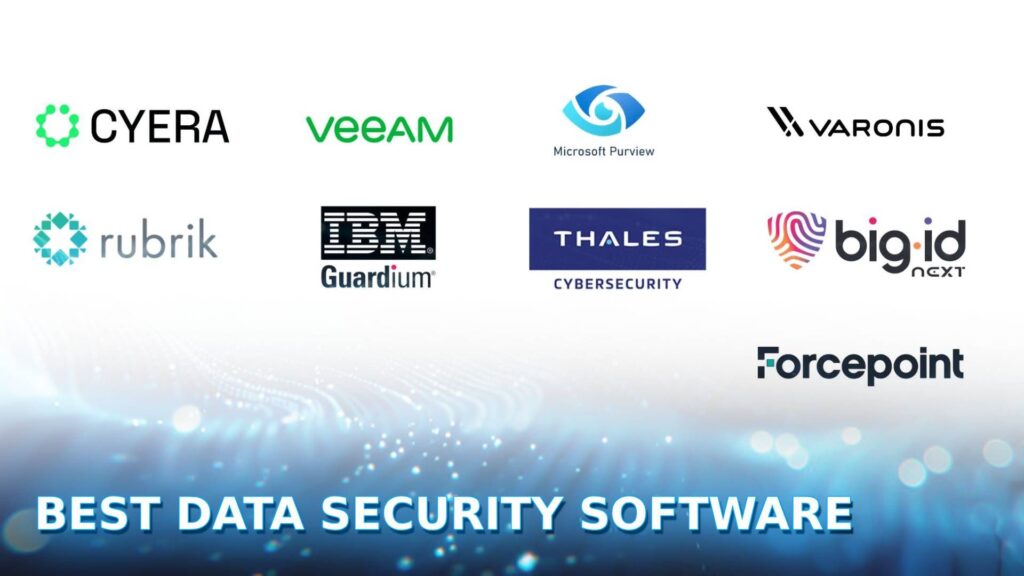
Data security software is a comprehensive suite of digital tools designed to protect sensitive enterprise information from unauthorized access and data breaches. These platforms operate by seamlessly integrating advanced encryption protocols, identity management, and robust data loss prevention mechanisms to secure information throughout its entire lifecycle.
The fundamental difference between Data Security and Data Privacy lies in execution. Data security involves establishing formidable technical barriers, such as AES-256 encryption, to proactively block hackers. Conversely, data privacy relates to the administrative governance policies that determine who holds legitimate access rights.
To be effective, modern security software must safeguard information across all three fundamental states:
- Data at rest: Information stored on hard drives, cloud repositories, or databases.
- Data in motion: Information actively transmitting across internal networks or the public internet.
- Data in use: Information currently being processed in RAM or endpoint applications.
According to the Data Protection Market Report by Market Reports World, the global digital data volume surpassed 120 zettabytes in 2024 and is projected to exceed 150 zettabytes by 2026. This colossal surge renders manual monitoring methods entirely obsolete, mandating the intervention of automated, AI-driven data security platforms.
This is particularly critical for engineering and prop-tech firms handling massive, highly proprietary 3D datasets, such as those used in data annotation for bim system to enhance spatial digital twin accuracy, where an intellectual property leak can cost millions in competitive advantage.
>>> See more:
- What Is A Back Office Service? Examples, Benefits, And Cost In 2026
- What Is Business Process Outsourcing (BPO)? Definition & Benefits
- Healthcare Back-Office Support Services For Efficient Operations
Why Must Enterprises Invest In Data Security Platforms Immediately?
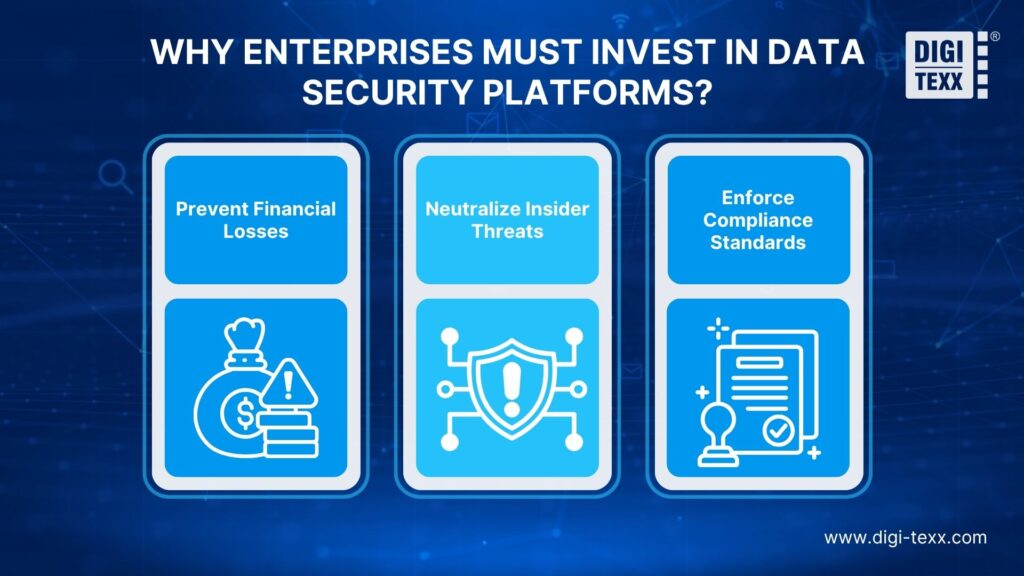
Enterprises must urgently deploy robust data security platforms to thwart sophisticated cyberattacks, ensure strict compliance with international laws, and optimize operational costs. The absence of a strong defense system inevitably leads to crippling financial damages, irreversible reputation loss, and severe legal penalties.
The current data crisis stems from multiple ever-present risks. Macro-enterprises are compelled to equip themselves with advanced defense systems driven by three primary factors:
1. Prevent Financial Losses
The 2025 IBM Cost of a Data Breach Report highlights that the global average cost of a data breach has soared to $4.44 million. Stolen sensitive data records are frequently auctioned on the dark web, a scenario that often bankrupts small to medium-sized enterprises lacking adequate protection.
2. Neutralize Insider Threats
A hidden danger persists within organizations. According to the 2025 Data Security Report co-authored by Fortinet and Cybersecurity Insiders, surveying 883 global cybersecurity professionals, a staggering 77% of organizations experienced data loss due to insider actions within the past 18 months. Modern security software distinctly separates malicious insiders (intentional theft) from negligent employees, enabling immediate containment of data flows.
3. Enforce Compliance Standards
Failing to implement robust security mechanisms causes organizations to violate stringent regulatory frameworks directly. These include the European GDPR, healthcare’s HIPAA, or the globally recognized information security standard, ISO/IEC 27001:2022.
What Are The Core Features Of Data Security Software?
A comprehensive data security system integrates multiple layers of high-tech defense. The core features of exceptional data security software include end-to-end data encryption, Data Loss Prevention (DLP), Identity and Access Management (IAM), and cloud-based risk classification tools. Evaluating top data security vendors requires assessing their technical strength across these four foundational security modules.
Data Encryption
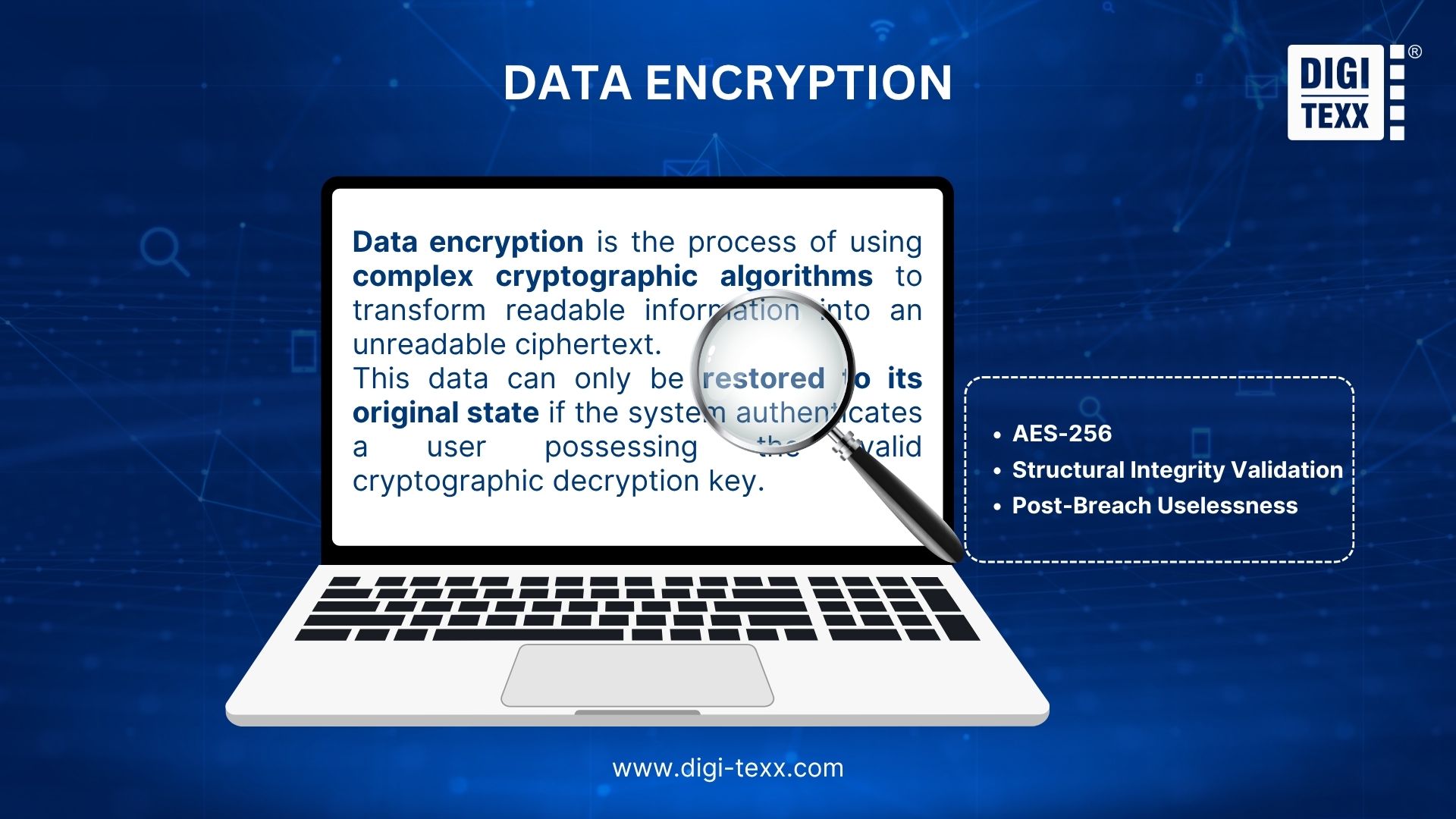
Data encryption is the process of using complex cryptographic algorithms to transform readable information into an unreadable ciphertext. This data can only be restored to its original state if the system authenticates a user possessing the valid cryptographic decryption key.
To guarantee absolute confidentiality, modern encryption mechanisms deploy several critical protocols:
- Advanced Cryptographic Standards: Utilizing AES-256 encryption to secure data both at rest and in motion.
- Structural Integrity Validation: Ensuring that the original file has not been tampered with during transmission.
- Post-Breach Uselessness: Rendering exfiltrated data completely illegible and worthless to cybercriminals, even if network firewalls are bypassed.
Identity And Access Management (IAM)
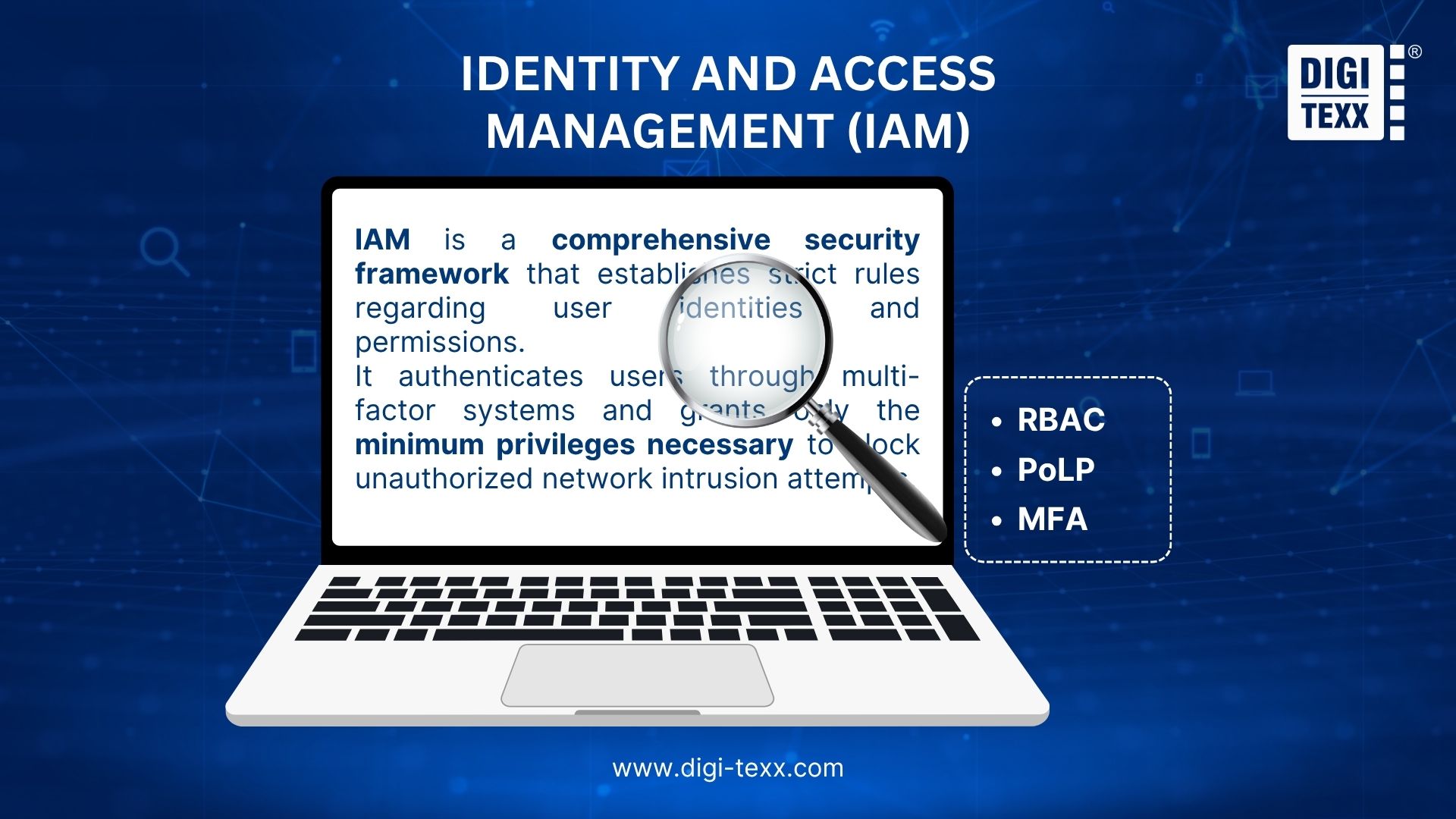
IAM is a comprehensive security framework that establishes strict rules regarding user identities and permissions. It authenticates users through multi-factor systems and grants only the minimum privileges necessary to block unauthorized network intrusion attempts.
This module effectively operationalizes the zero-trust framework (“never trust, always verify”) through:
- Role-Based Access Control (RBAC): Restricting system access strictly based on the user’s specific organizational role.
- Principle of Least Privilege (PoLP): Granting users only the bare minimum permissions required to execute their current tasks.
- Multi-Factor Authentication (MFA): Adding mandatory secondary verification layers to prevent unauthorized access via compromised credentials.
Data Loss Prevention (DLP)
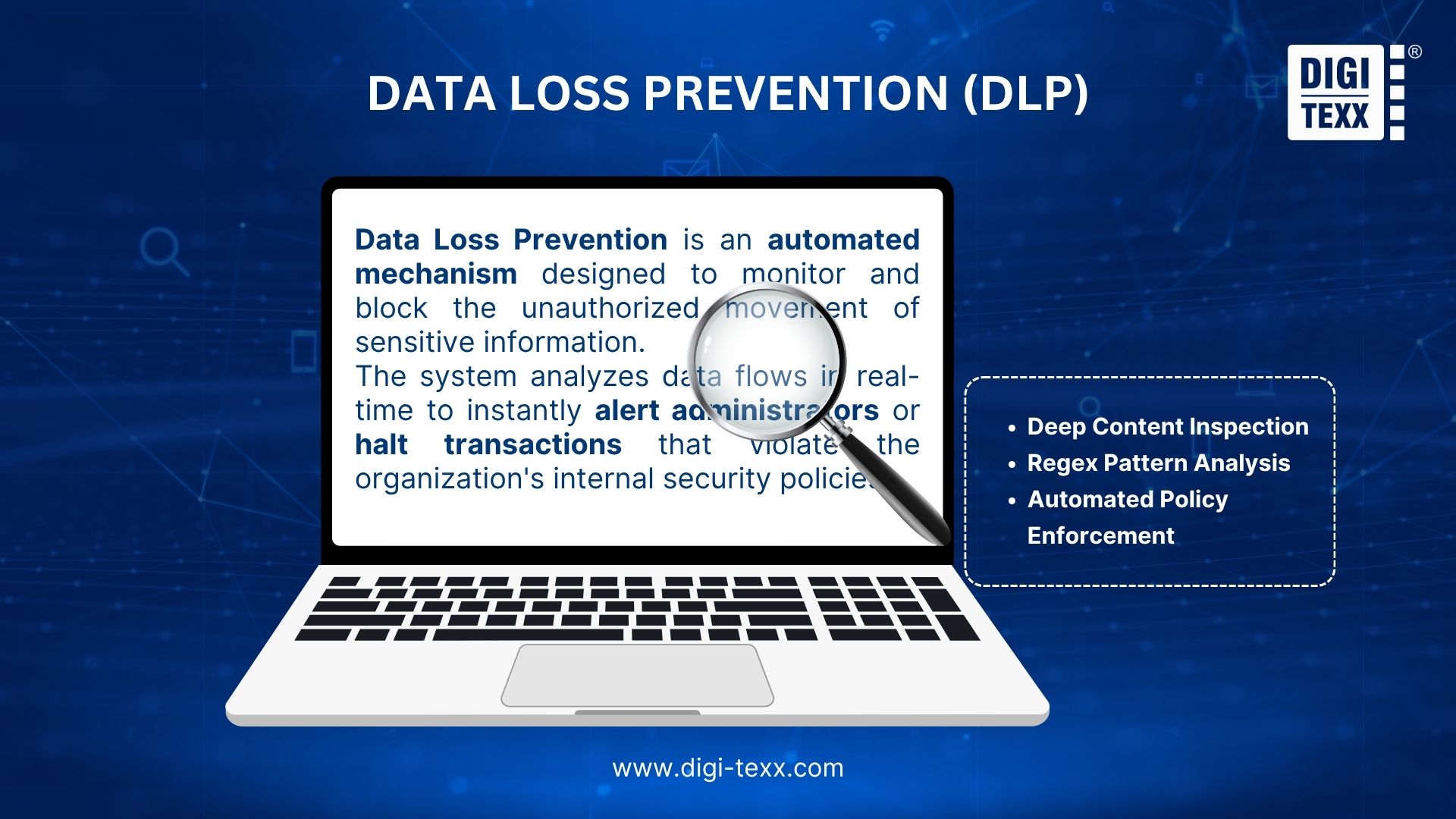
Data Loss Prevention is an automated mechanism designed to monitor and block the unauthorized movement of sensitive information. The system analyzes data flows in real-time to instantly alert administrators or halt transactions that violate the organization’s internal security policies.
DLP platforms proactively mitigate both malicious exfiltration and negligent sharing by leveraging:
- Deep Content Inspection: Continuously scanning files and emails for sensitive markers before they leave the corporate network.
- Regex Pattern Analysis: Autonomously detecting critical entities like credit card numbers or Personally Identifiable Information (PII).
- Automated Policy Enforcement: Instantly blocking unauthorized uploads to unsanctioned, third-party cloud applications (Shadow IT).
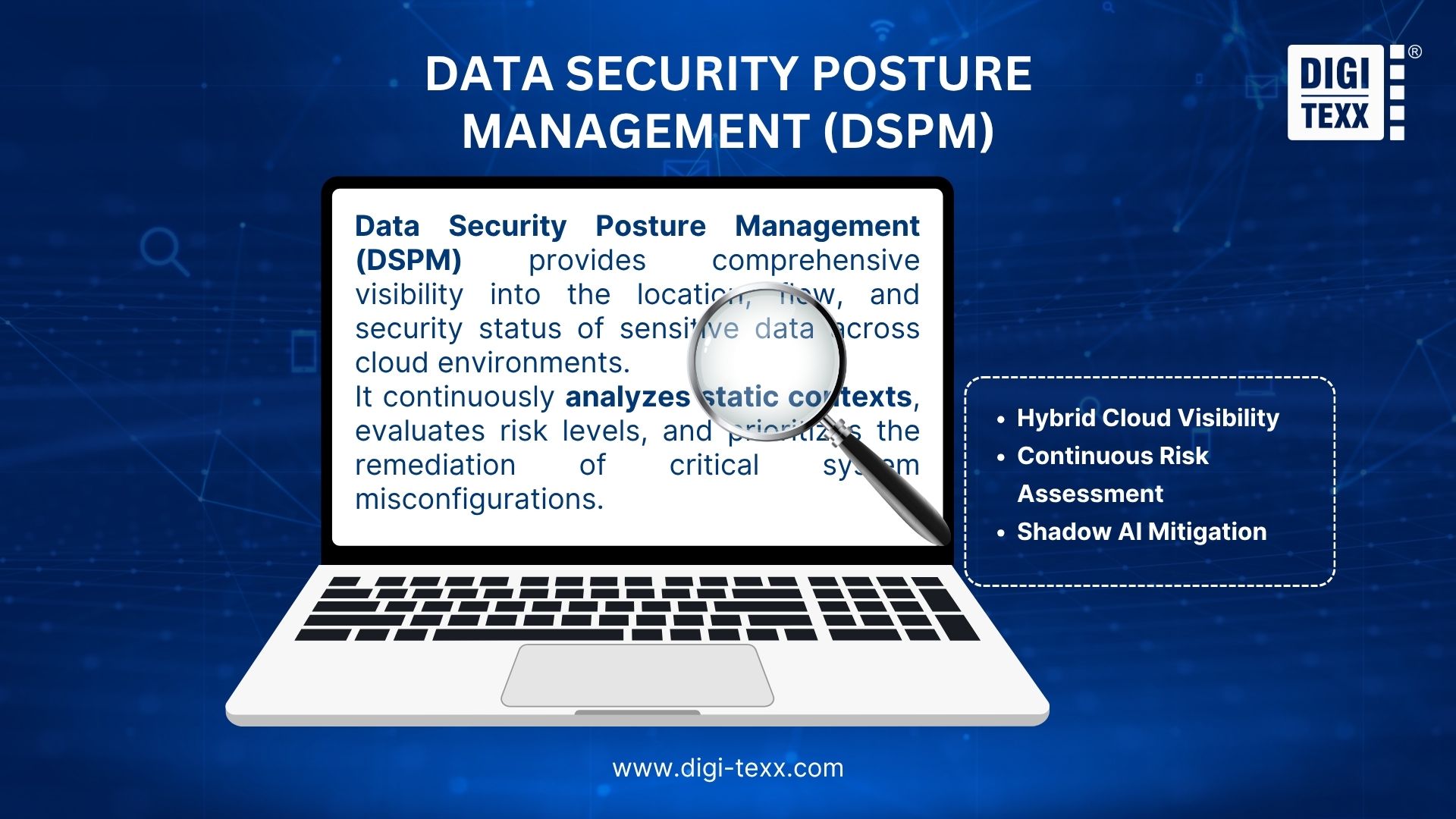
Data Security Posture Management (DSPM)
Data Security Posture Management (DSPM) provides comprehensive visibility into the location, flow, and security status of sensitive data across cloud environments. It continuously analyzes static contexts, evaluates risk levels, and prioritizes the remediation of critical system misconfigurations.
Deploying a DSPM solution is absolutely critical for modern enterprises, specifically delivering:
- Hybrid Cloud Visibility: Eliminating data blind spots across highly fragmented, multi-cloud architectures.
- Continuous Risk Assessment: Autonomously identifying and prioritizing the most dangerous system misconfigurations.
- Shadow AI Mitigation: Detecting and controlling unauthorized data flows into unsanctioned generative AI models to prevent intellectual property leaks.
>>> See more:
- What is Automated Document Processing and How Does It Work?
- What Is Data Processing? Key Types And Benefits
- Optical Character Recognition Explained: What Is OCR and How It Works
Which Enterprise Data Security Software Leads the Market In 2026?
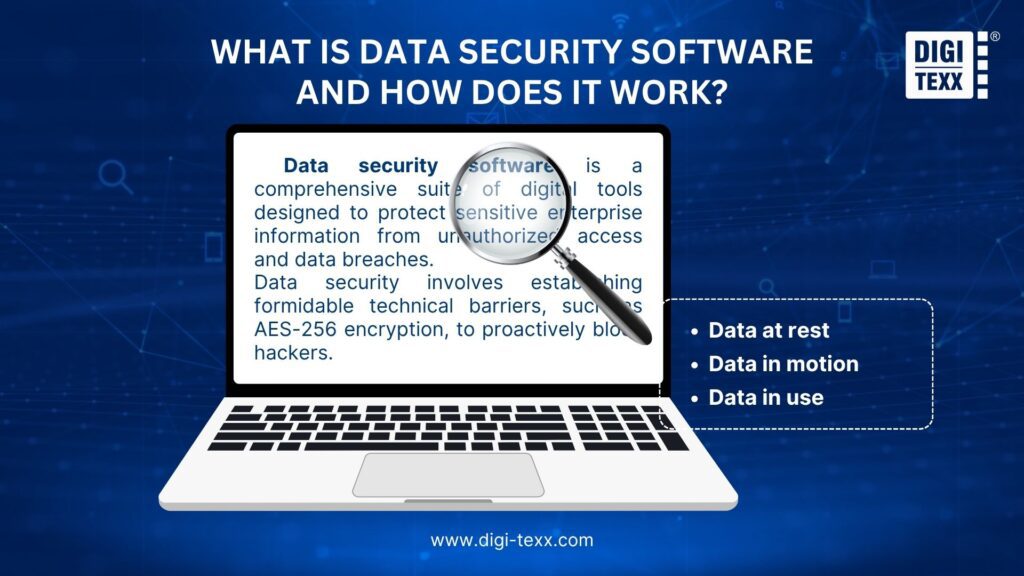
The leading enterprise data security platforms in 2026 include Cyera, Veeam, Varonis, Rubrik, Microsoft Purview, IBM Guardium, Thales, BigID, and Forcepoint. These data security software vendors dominate the market by unifying DSPM, cyber resilience, and AI governance, rigorously validated by the Data Security Gartner Magic Quadrant and Forrester Wave benchmarks.
The cybersecurity market offers diverse solutions engineered for multi-cloud, structured, and unstructured environments. The table below consolidates the industry leaders in 2026, providing technology leaders (CTOs/CISOs) with a transparent architecture for vendor evaluation.
Comprehensive Comparison: Top Data Security Vendors 2026
| Software Platform | USP | Key Technical Strength | Ideal Target Audience |
| Cyera | Agentic AI Trust Layer & DSPM | 95%+ precision AI-native data classification | Global enterprises deploying Generative AI at scale |
| Veeam DataAI Command | Unified Data Resilience & AI Security | Continuous Command Graph for live & backup data | Corporations requiring zero-trust rapid data recovery |
| Varonis | Unstructured Data Governance & DDR | Automated blast radius reduction & permissions | Enterprises with massive, unregulated unstructured data |
| Rubrik Security Cloud | Cyber Resilience & Secure Data Lakes | Immutable threat storage & AI model customization | Highly regulated sectors needing bulletproof disaster recovery |
| Microsoft Purview | Native M365 Ecosystem Governance | Seamless integration with Copilot security boundaries | Microsoft-centric corporate environments |
| IBM Security Guardium | Structured Database Activity Monitoring | Deep vulnerability scanning for legacy systems | Banking and government institutions |
| Thales CipherTrust | Centralized Enterprise Cryptography | Post-quantum key management & separation of duties | Multi-cloud distributed enterprises |
| BigID | Petabyte-Scale Data Discovery | Automated compliance mapping (GDPR/CCPA) | Hyper-scale multinationals requiring deep metadata insights |
| Forcepoint | Unified DLP, DSPM & SSE | AI Mesh for context-aware classification | Enterprises needing unified cloud and endpoint protection |
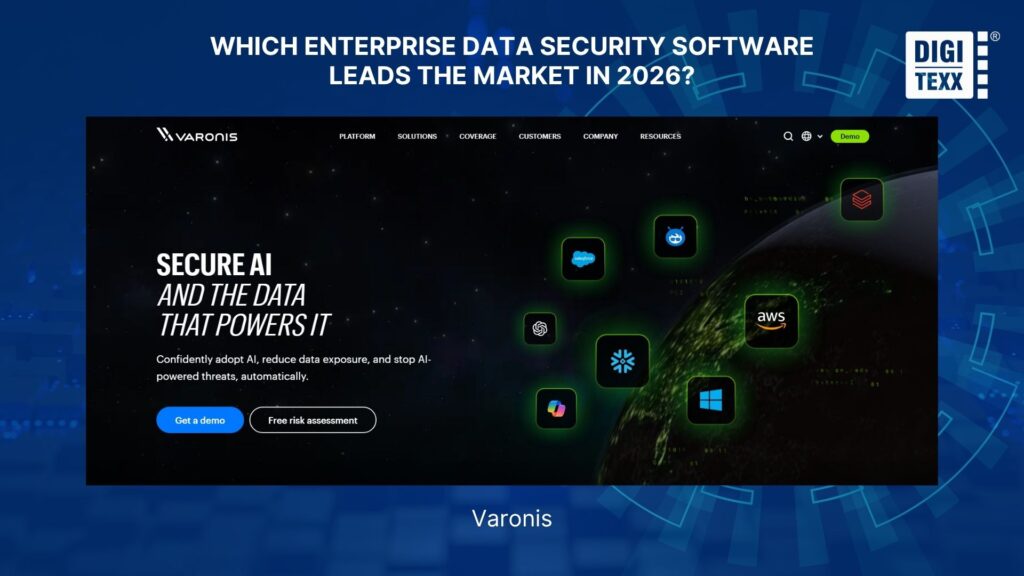
Cyera Data Security
Cyera has rapidly redefined the Data Security Posture Management (DSPM) landscape by establishing the ultimate Trust Layer for the agentic era. The platform unifies DSPM, DLP, and identity controls using an AI-native foundation.
Top Features:
- 95%+ precision AI-native data classification.
- Agentic AI Trust Layer.
- Comprehensive cloud data discovery.
Pros:
- Valued at an astronomical $12 billion following a $600 million funding round in June 2026 (According to Fintech Global).
- Solves the critical enterprise blind spot where 68% of organizations cannot distinguish between human and autonomous AI agent activity.
Cons:
- The platform’s hyper-growth pricing model and intensive AI compute requirements can be cost-prohibitive for smaller, mid-market businesses.
Ideal for: Global enterprises deploying Generative AI at scale.
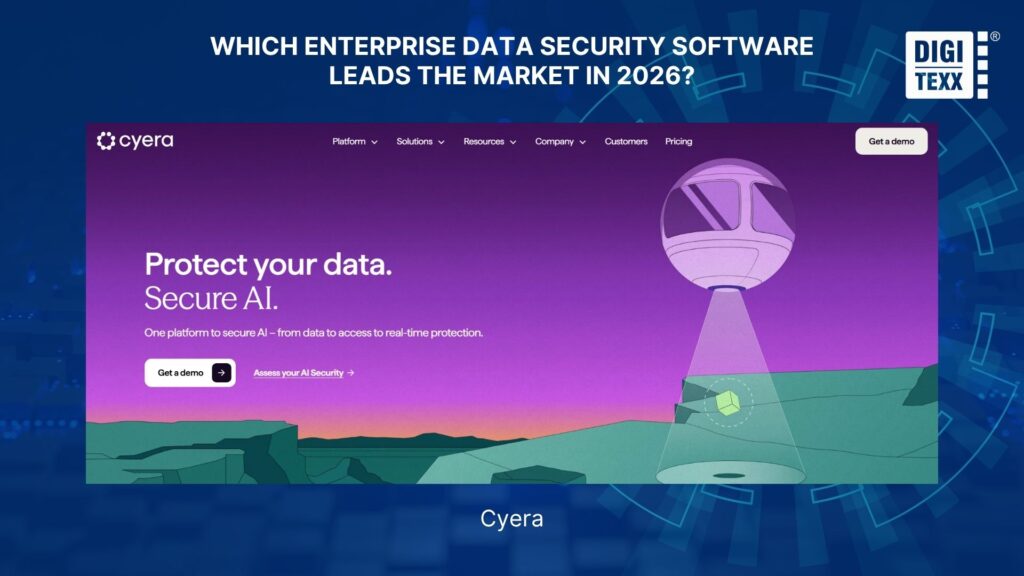
Veeam DataAI Command
Following its highly strategic $1.725 billion acquisition of Securiti AI in late 2025 (according to Hyper Frame), Veeam, a 10-time consecutive Leader in the Gartner Magic Quadrant for Backup Platforms, launched the DataAI Command Platform, flawlessly unifying data resilience with proactive DSPM.
Top Features:
- Continuous Data Command Graph analyzing production and backup data simultaneously.
- Unified identity mapping.
- AI agent tracing.
Pros:
- In the event of a ransomware attack, Veeam enables surgical, precision recovery.
- Identifies and restores only the most sensitive, clean data instantly without rolling back the entire affected system.
Cons:
- Organizations not currently utilizing Veeam’s foundational backup architecture may face a steeper implementation curve.
Ideal for: Corporations requiring zero-trust rapid data recovery.
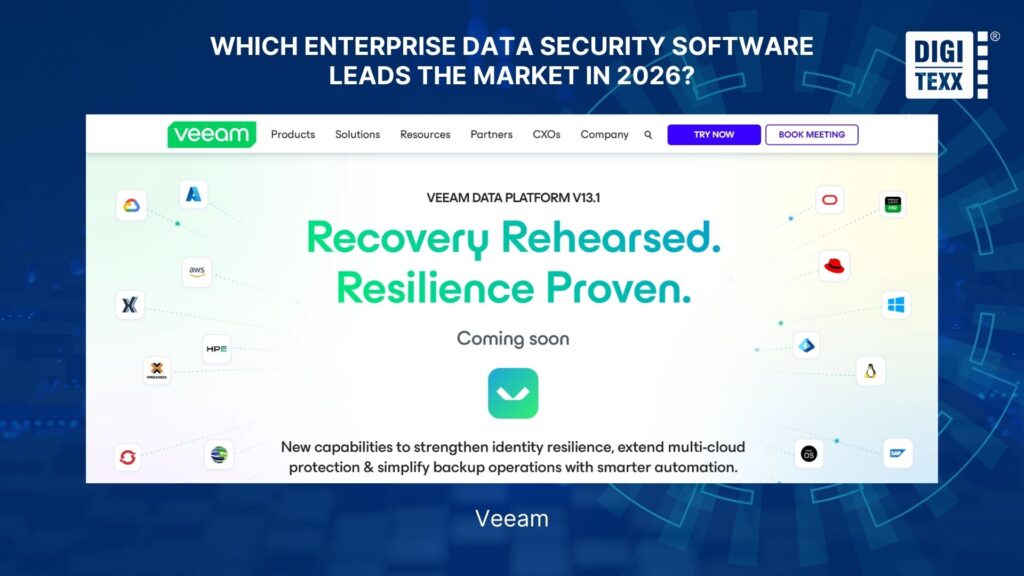
Varonis Data Security
Varonis remains the unquestioned gold standard for securing unstructured data and automating unstructured data governance. It continuously maps user activity to proactively neutralize advanced insider threats.
Top Features:
- Automated remediation of over-permissive Active Directories.
- Continuous permission mapping.
- Real-time Data Detection and Response (DDR).
Pros:
- Boasts an ARR of $745 million, actively minimizing the “blast radius” of compromised accounts.
- Earned top scores across 11 criteria and the “Customer Favorite” designation in the Forrester Wave: Data Security Platforms Q1 2025.
Cons:
- The platform requires significant server compute resources and time for large-scale initial indexing.
Ideal for: Enterprises with massive, unregulated unstructured data.
>>> See more:
- Top 11 Free AI Business Document Analysis Tools 2026
- 20 Best Data Integration Tools: Definition, Benefits & Features
- What Is Data Integrity? A Complete Guide for Businesses
Rubrik Security
Positioned furthest in Vision within the 2025 Gartner Magic Quadrant for Backup and Data Protection, Rubrik elegantly integrates cyber resilience with advanced AI governance and recovery.
Top Features:
- Rubrik Annapurna (a secure data lake purpose-built for AI).
- Predibase integration for AI model customization.
- Immutable threat storage.
Pros:
- Guarantees that LLMs only train on pre-classified, governed data.
- Provides air-gapped backups to ensure guaranteed recovery from destructive cyberattacks.
Cons:
- Leveraging the full potential of Rubrik Annapurna requires specialized data engineering and cloud architecture expertise.
Ideal for: Highly regulated sectors needing bulletproof disaster recovery.
Microsoft Purview
Microsoft Purview provides a comprehensive, centralized ecosystem for information protection, data governance, and risk compliance, capitalizing heavily on environments operating within native Microsoft cloud setups.
Top Features:
- Seamless integration with Microsoft 365 Copilot security boundaries.
- Automated classification.
- Cryptographic sensitivity labeling.
Pros:
- Drives rapid, frictionless deployment via existing M365 E5 enterprise licensing tiers.
- Exceptional at capturing internal data leaks across all native productivity applications.
Cons:
- Extending granular protection to non-Microsoft ecosystems (like AWS or Google Workspace) requires tedious manual API orchestration.
Ideal for: Microsoft-centric corporate environments.
IBM Security Guardium
IBM Security Guardium is the foundational platform for structured enterprise database security, activity tracking, and compliance enforcement against external exploitation.
Top Features:
- Deep vulnerability scanning for legacy systems.
- Continuous enterprise database activity monitoring (DAM).
- Real-time threat detection.
Pros:
- Commands massive industry mindshare within the Database activity monitoring Gartner Magic Quadrant framework.
- Automates the generation of continuous compliance reporting for strict external regulatory boards.
Cons:
- The user interface is highly complex and demands certified database security expertise to configure properly.
Ideal for: Banking and government institutions.
Thales CipherTrust
Thales CipherTrust is a robust cryptographic management platform built to discover, protect, and control sensitive enterprise data at rest or in transit by decoupling security administration from individual storage layers.
Top Features:
- Enterprise key management (EKM).
- Granular data tokenization and dynamic masking.
- Post-quantum cryptographic preparation.
Pros:
- Recognized as a Leader with “Best in Class” ratings in the Omdia DSPM 2025 Universe.
- Enforces an impenetrable separation of duties, ensuring administrators cannot read encrypted operational data files.
Cons:
- Key management deployment across legacy, distributed data centers demands lengthy implementation timelines.
Ideal for: Multi-cloud distributed enterprises.
>>> See more:
- Top 10 Data Enrichment Tools To Improve Data Quality In 2026
- What is Data Cleaning? Benefits, Process, and How It Works
- 11 Best Data Cleansing Tools For Accurate & Reliable Data
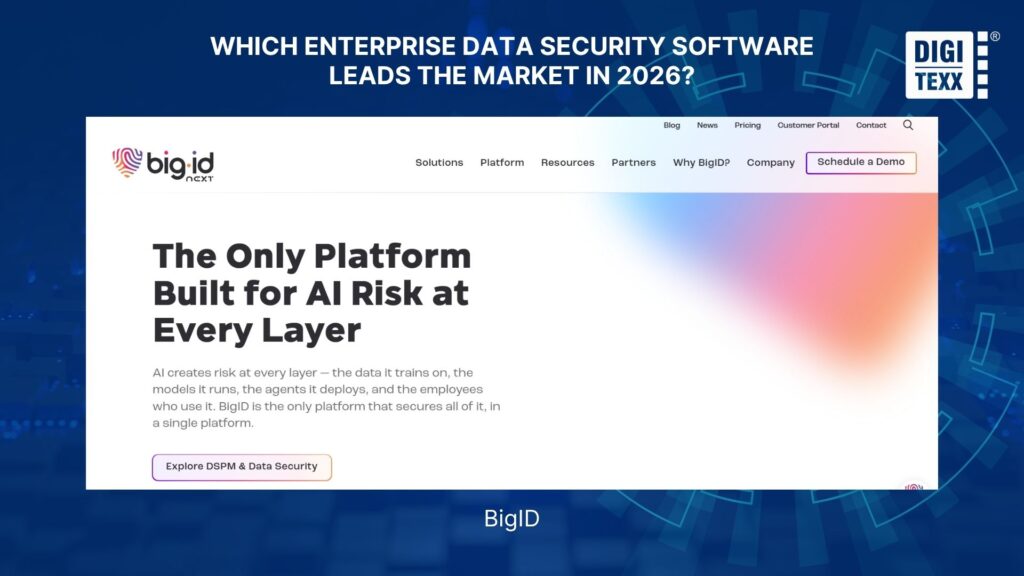
BigID
BigID leverages advanced, machine learning-driven automation to discover, classify, and manage identity data across modern enterprise architectures, scaling effortlessly to handle exabytes of metadata.
Top Features:
- Deep data discovery engines handling cloud, on-premise, and legacy mainframes.
- Automated regulatory mapping (GDPR/CCPA).
Pros:
- Unmatched scalability with minimal operational degradation.
- Built-in capabilities enforce data minimization, autonomously purging redundant or obsolete datasets.
- Named a Leader in the Forrester Wave Q2 2026.
Cons:
- The high enterprise pricing model can be cost-prohibitive for mid-market organizations.
Ideal for: Hyper-scale multinationals requiring deep metadata insights.
Forcepoint
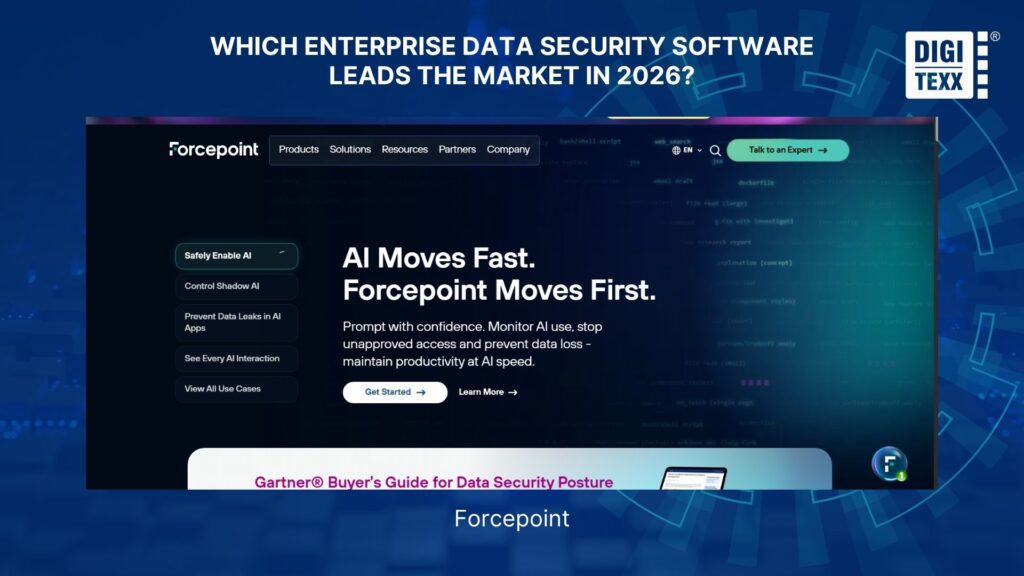
Forcepoint provides a cloud-native, unified data loss prevention platform designed to control data visibility across web, cloud, and local endpoint channels under a centralized security service edge (SSE) rule matrix.
Top Features:
- AI Mesh framework for context-aware data classification.
- Unified dashboard bridging DLP and DSPM.
- Stringent shadow AI blocking.
Pros:
- Provides flawless defense against emergent Generative AI risks.
- Blocks employees from accidentally leaking proprietary source code or IP into public LLMs.
Cons:
- Migrating complex, legacy on-premise policies into the cloud interface can require extensive professional deployment support.
Ideal for: Enterprises needing unified cloud and endpoint protection.
>>> See more:
- Back Office Support Services To Streamline Operations & Boost Efficiency
- Top 10 Data Entry Outsourcing Companies to Hire in 2026
What Are The Top Criteria For Evaluating Data Security Software?
Selecting the right data security software demands a rigorous evaluation of system scalability, infrastructure compatibility, and compliance tracking capabilities. To ensure long-term operational efficiency, technology leaders must assess how well a platform aligns with industry benchmarks like the Data Security Platforms Forrester Wave Wave and Gartner insights.
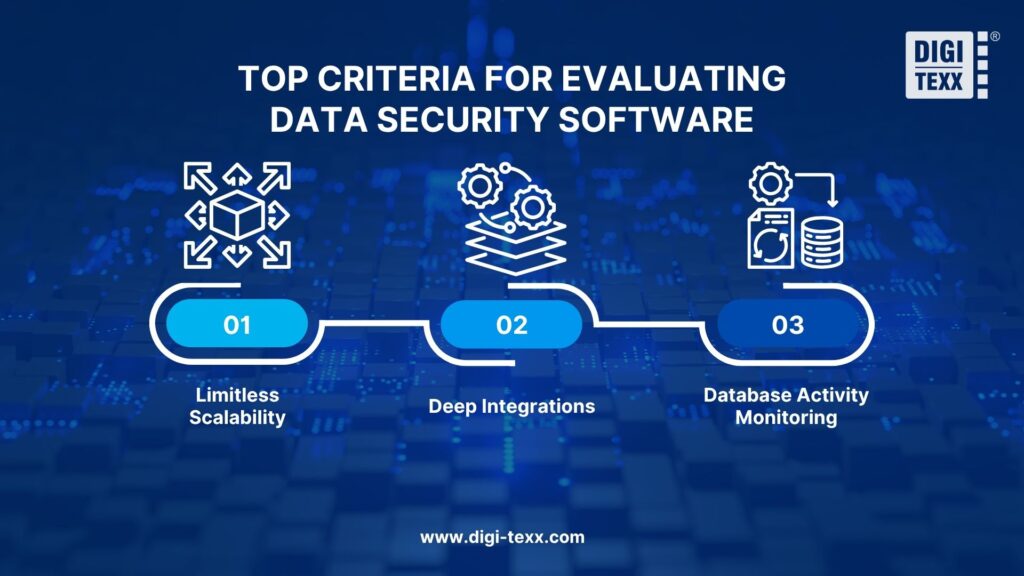
According to enterprise evaluation standards, a robust security architecture must strictly satisfy the following technical criteria:
- Limitless Scalability: The system must not degrade network bandwidth or query performance as enterprise data volumes expand exponentially from terabytes to petabytes.
- Deep Integrations: Organizations should prioritize solutions supporting open APIs for seamless, native integration into AWS, Azure, or existing SIEM (Security Information and Event Management) infrastructures.
- Database Activity Monitoring: The platform must provide transparent audit trails, recording every access event to satisfy the stringent auditing criteria outlined in the Database Activity Monitoring Gartner Magic Quadrant.
What Is The Future Of The Big Data Security Market Through 2035?
The big data security market is experiencing explosive growth, projected to surge from $11.79 billion in 2024 to a massive $53.87 billion by 2035 at a 14.81% CAGR. Future foundational technologies will heavily rely on automated threat alerting, federated learning, and quantum-resistant AI to neutralize next-generation cyberattacks.
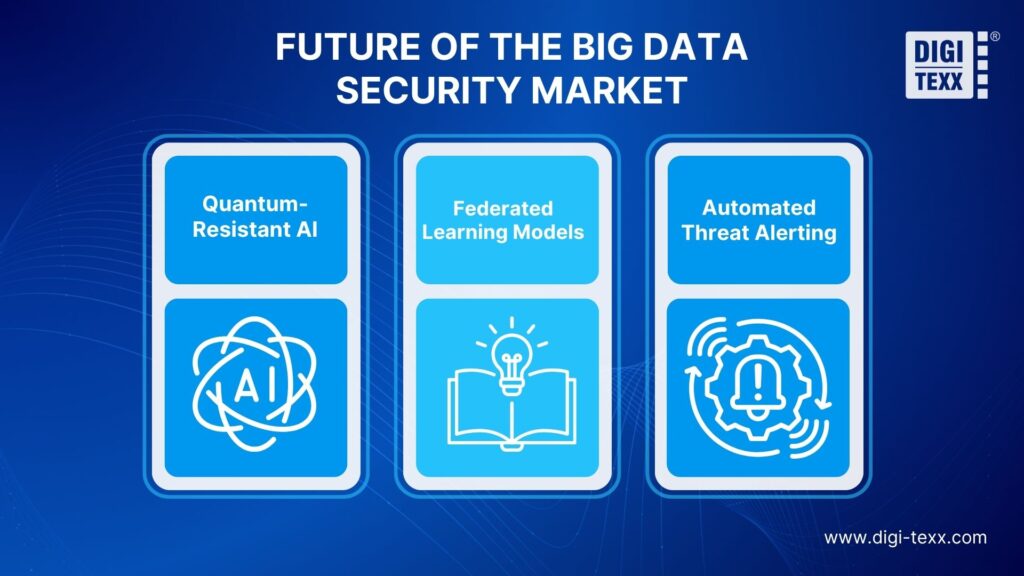
According to in-depth research from Market Research Future, the architectural shift to combat escalating digital threats will be dominated by three core technological trends over the next decade:
- Quantum-Resistant AI: Developing and deploying advanced cryptographic algorithms capable of withstanding decryption attempts from future quantum computers, ensuring long-term data sovereignty.
- Federated Learning Models: Training sophisticated malware detection algorithms directly on decentralized edge devices. This allows threat intelligence sharing without ever transferring raw, sensitive enterprise data to a central server.
- Automated Threat Alerting: Leveraging autonomous AI agents to continuously scan network traffic, instantly isolate anomalies, and enforce remediation protocols in real-time without requiring human intervention.
>>> See more:
- Top 10 Best Big Data Processing Tool for Business 2026
- How to Automate Documentation in 2026: Step By Step Guide
- Outsourced Data Annotation Services: List of best companies to work for
FAQs About Data Security Software
1. What Is Data Security Software?
Data security software refers to tools and platforms designed to protect digital information from unauthorized access, corruption, data breaches, and theft throughout its entire lifecycle. It encompasses key technologies such as data encryption, access management, tokenization, and Data Loss Prevention (DLP).
2. What Are The 4 Types Of Data Security?
The four core pillars of data security include:
- Access Control: Restricting data access to authorized users via multi-factor authentication (MFA) and role-based permissions.
- Data Encryption: Scrambling sensitive data into unreadable text both at rest and in transit.
- Data Masking: Obscuring specific data elements (like credit card numbers) to protect them during development or testing.
- Data Resilience: Implementing automated backups and disaster recovery protocols to protect against ransomware and system failures.
3. What Is The Most Popular Security Software?
In the enterprise Data Security Platform (DSP) market, the most popular and dominant vendors recognized by Gartner and Forrester include Microsoft Purview, IBM Guardium, Imperva, and Varonis. For endpoint and consumer security, brands like Bitdefender, CrowdStrike, and McAfee lead the industry.
4. What Is The Most Secure Database Software?
Oracle Database, Microsoft SQL Server, and IBM DB2 are widely rated as the most secure enterprise database systems. They offer advanced, multi-layered security controls, continuous vulnerability patching, comprehensive audit logging, and transparent data encryption.
Selecting the right data security software depends on a thorough assessment of your specific risks, hybrid infrastructure, and compliance requirements. However, procuring and maintaining these enterprise platforms often demands massive capital and specialized personnel.
For businesses seeking absolute information integrity without the technical overhead, delegating data workflows to a certified BPO partner is the smartest strategic alternative. As a German-invested enterprise with 23 years of operational excellence, DIGI-TEXX secures your processes within our zero-trust DIGI-Vault platform, strictly governed by ISO/IEC 27001:2022 standards.
🌐 Website: https://digi-texx.com/
📞 Hotline: +84 28 3715 5325
✉️ Email: [email protected]
🏢 Address:
- Headquarters: Anna Building, QTSC, Trung My Tay Ward
- Office 1: German House, 33 Le Duan, Saigon Ward
- Office 2: DIGI-TEXX Building, 477-479 An Duong Vuong, Binh Phu Ward
- Office 3: Innovation Solution Center, ISC Hau Giang, 198 19 Thang 8 street, Vi Tan Ward
References
- Fortinet & Cybersecurity Insiders. (2025). 2025 Data Security Report. Fortinet. https://www.fortinet.com
- Forrester Research. (2025). The Forrester Wave™: Data Security Platforms, Q1 2025. Forrester. https://www.forrester.com